Articles by Victor Gluck, Editor-in-Chief
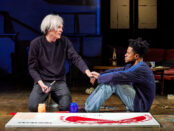
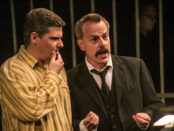
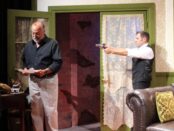
While Bettany and Pope are each very convincing as Warhol and Basquiat since they are made up to look exactly like they did in life, they seem to be in two different plays, using different acting styles. The other problem with "The Collaboration" is that it feels very superficial, like a laundry list of items for them to discuss, while at least several of the dramatic devices are taken out of context or are relocated in chronology. It is certainly a fascinating premise: an older famous and fabulously successful artist whose star is fading and a younger rising star who has taken the art world by storm and seems to be unstoppable, brought together by their shared dealer. [more]
H.M.S. Pinafore (NYGASP)
While Albert Bergeret’s old-fashioned production does not sparkle, it is a solid, steady ship that satisfies with all its jokes intact plus a few new ones like the hilarious drunken scene between the captain and the First Lord of the Admiralty. Associate conductor Joseph Rubin kept the orchestra in close harmony and gave an excellent account of Sullivan’s lilting score. Albère’s attractively realistic scenery looked brand new and created interesting stage pictures. The lovely late Victorian costumes by Gail Wofford helped complete the stage picture. Benjamin Weill’s lighting design bathed the stage in sunlight for the daytime scenes in the first act, and used blues and purples for the evening scenes of the second act. [more]
Truth’s a Dog Must to Kennel
Under the direction of Karl Janes and Andy Smith, Tim Crouch is a very commanding performer, using his resonant baritone to paint pictures with words, holding our attention at all times. Narrating alone he makes us see all he describes from the theater, to the audience, to the landscape on stage and the other unseen actors. However, the play is not for all theatergoers simply because the format is complex and hard to follow and knowledge of the plot of "King Lear" is mandatory. On the other hand, for those who are into experimental theater, this is an exemplary model of the genre boldly pushing the envelope to what is possible. [more]
Ohio State Murders
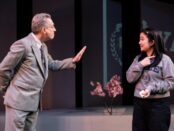
McDonald is mesmerizing as she speaks Kennedy’s strong, clear, poetic and evocative prose. We never forget that McDonald’s Suzanne Alexander is giving a lecture but she changes ages in an instant as she becomes the wide-eyed and innocent college student in love with learning and new ideas, and then return to being the mature author with a shocking story to tell. McDonald shifts beautifully between idyllic scenes of college life, the ugly face of racism in the dorm and on campus, and the off-stage violence that defines the murders. While the play is not told in strict chronological order there is no problem in following the story of these few years in the early 1950’s that shape Suzanne Alexander’s life. [more]
Des Moines
Michael Shannon, Hari Nef, Heather Alicia Simms, Arliss Howard and Johanna Day in a scene from [more]
Becky Nurse of Salem
In any event, Ruhl has not written a play set in 1692 or a sequel to "The Crucible" but a comedy about free-spirited Becky Nurse, a descendant of the accused witch Rebecca Nurse, a pious 71-year-old woman who had nine children and was hard of hearing, who wishes to set the record straight. Although a fascinating premise, the problem with play is that it throws in everything except the kitchen sink – but, in fact, it makes use of metal freestanding toilet. The play attempts to cover multiple themes and topics: revisionist history, the opioid crisis, the generation gap, teenage suicide, the Salem Witch Trial, unemployment, medical care, the supernatural, adultery, and office harassment. Conceived and written between 2016 - 2019, the play also tries to connect Trump Rallies in which the crowds shouted “Lock her up” and Trump’s repeated use of the words “witch hunt” and his attempt to appear the victim to the hysteria of the Salem Witch Trial in 1692. All of this is too much weight for any one play. Director Rebecca Taichman’s uneven production does not help, though much of that is the fault of the shift in tone in the writing. [more]
The Weak and the Strong
Erik Ehn’s title "The Weak and the Strong" taken from St. Paul may refer to the bad choices that some people make that others avoid, but it seems to only reinforce the clichés of most western films. The storytelling and production are mostly so obscure that the play becomes tedious as it is so difficult to follow. With a 70-minute first act, the play seems extremely long and overwritten. It is to be hoped that the play finds an audience that can follow its circuitous path to its conclusion and in its poetic speech and metaphors. [more]
Ain’t No Mo’
Jordan E. Cooper’s scathing new racial comedy, "Ain’t No Mo’" has made the successful transition to Broadway with five of the six original actors from the previous Public Theater staging in 2019 and a more elaborate physical production from an almost entirely different design team. Delving into Black life and attitudes now, the play is hilarious, but not laugh-out-loud funny, rather it's impressive because of its cleverness, but its satire does not trigger laughter. However, its outrageous form of satire may not appeal to all theatergoers. [more]
Underneath the Skin
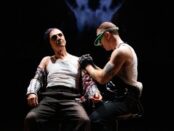
Famed performance artist John Kelly has brought his latest show, "Underneath the Skin" to La MaMa, subtitled “A Penetrative Portrayal of a Queer Giant Based on the life and work of Samuel Steward 1909-1993.” Steward had a remarkable life in the first three-quarters of the 20th century as a college professor, a tattoo artist, a pornographer, an unofficial collaborator at the Kinsey Institute and a sexual renegade. He was also a friend of Gertrude Stein and Alice B. Toklas, Thomas Mann, André Gide, had trysts with Rudolph Valentino and Lord Alfred Douglas, and became the lover of Thornton Wilder. Underneath the Skin is a fascinating and engrossing blend of theater, dance, video, erotic art and a gay history of the 20th century. [more]
& Juliet
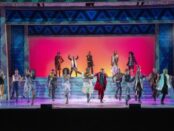
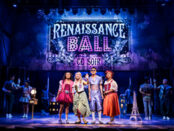
The cast is a combination of New York stage favorites (Stark Sands, "Kinky Boots," and Betsy Wolfe, "Waitress," "Falsettos" and "The Mystery of Edwin Drood"), new faces (Lorna Courtney, Ben Jackson Walker, Justin David Sullivan) and older veterans (opera baritone Paolo Szot and London stage star Melanie La Barrie making her Broadway debut.) The clever book is by writer David West Read previously seen in New York with "The Performers" and "The Dream of the Burning Boy" as well as the long running television series Schitt’s Creek. The show seems to have been influenced by "Something Rotten"(parody of Elizabethan times), "Six "(its updated 16th century costumes by Paloma Young), "Head Over Heels" (reboot of a classic tale wedded to a pop-rock score) and "Moulin Rouge" (the over-the-top staging by director Luke Sheppard and choreographer Jennifer Weber) – but is actually more fun than all of those shows. At times it resembles "Saturday Night Live" skits but knows enough to keep them short and not let any of them go on too long before introducing the next complication. [more]
A Christmas Carol (Jefferson Mays)
Visually the show pulls out all of the stops continually making stage magic. Every scene offers new scenic effects and things that appear impossible but are right there on stage before you, and disappear in a twinkling of an eye to be replaced by new wonders. Beginning with Marley’s hearse in a flashback to seven years ago, Laffrey’s designs include Scrooge’s gloomy office, Scrooge’s staircase which somehow deposits him in his even darker bedroom on the second floor, the depressing all-boys school that Scrooge attended as a youth, Fezziwig’s warehouse (Scrooge’s first real job,) a colorful Christmas panorama filled with food and presents, the poor kitchen of the Cratchit family, the lavish dining room of his nephew Fred, and a brightly lit snow-filled cemetery. Using streaming video projection, a revolving stage and seemingly magic acts, as well as fog and snow effects, the production attempts all things that are possible on a stage. [more]
Sandra
Cale’s story uses many film noir devices from the 1940’s: exotic locale, strange encounters, searching down unknown streets, disappearing characters, a sexy stranger, danger signals avoided, clues that don’t add up, information that turns out to be fallacious, a damsel in distress, stolen objects, moments of high passion, etc. Yet all seem to be used as if for the first time. The elements are time tested, but the story is new. Cale is an excellent storyteller pulling us in with enough hints and clues to keep us interested until the very end. There are moments that sag but he always pulls out us into something new and unexpected. [more]
Evanston Salt Costs Climbing
Will Arbery’s Evanston "Salt Costs Climbing" (set in the city in which the author received his Master of Fine Arts Degree in 2015) is a perplexing experience as it shifts from realism to absurdism to surrealism. Its worthy topics of ecology and climate change notwithstanding, the play’s repetitiousness and unprepared-for events are frustrating as well as the missing backstories. While it begins interestingly enough , it very quickly turns tedious and inexplicable. A noble experiment, "Evanston Salt Costs Climbing" is either for the select few or needs a rewrite or second draft. [more]
Camp Siegfried
"Camp Siegfried" is a new departure for the author of "Small Mouth Sounds," "Continuity," "Make Believe" and "Grand Horizons." Depicting an important piece of history in an age when hate speech is on the rise, the play seems to be attempting something it doesn’t quite achieve. However, it is certainly a worthy effort and an engrossing piece in the theater though it leaves us hungry for more. [more]
The Rat Trap
Noel Coward’s "The Rat Trap" is not only entertaining but seems to have been ahead of its time. Discounted by critics and the author alike when it had its only production until now in 1926, the play turns out to be a cogent exploration of a creative woman’s search for her place in society, one which has no niche for her talents once she is a married woman. The Mint Theater Company does the play justice, restoring its reputation as an Edwardian period piece on the topic of the New Woman who is also a gifted artist. In Sarin Monae West and Elisabeth Gray we see the work of talented performers who we want to see more of in the future. [more]
Where We Belong
Writer/ director/actress Madeline Sayet is an engaging performer. Directed by Mei Ann Teo, her one-woman show “Where We Belong” is an autobiographical tale of her Mohegan roots and her seeking her place in the world as she travels to London to pursue a PhD in Shakespeare. While much of the play contains information and stories that will come as a revelation to most New Yorkers, the play often feels like a lecture with an agenda. The most interesting parts are her own discoveries about her roots and her encounters with other people in which she plays both characters. [more]
Almost Famous
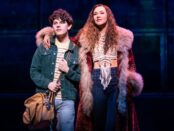
What Crowe has done in writing his own book for the new show is recreate almost exactly every scene in the movie starting from the time when 15-year-old hero William Miller meets rock critic Lester Bangs, including the bus and plane sequences. The best lines in the stage version are recognizable from the film and nothing of equal stature has been added to the version now on stage at the Bernard J. Jacobs Theatre. The new songs credited to composer Tom Kitt with lyrics by Crowe and Kitt add little to the work as they do not forward the story. A good many of the iconic songs from the film make their appearance but as staged by director Jeremy Herrin and choreographer Sarah O’Gleby they are the least effective numbers in the show. [more]
My Broken Language
Hudes has directed her own play in a delightful vaudeville/musical comedy style with dancing between the scenes to choreography by Ebony Williams to live music played by pianist Ariacne Trujillo-Durand, supervised by Alex Lacamoire. Of the five actresses who perform each in their own inimitable style, three of them have appeared in Hudes’ plays before: Daphne Rubin-Vega and Zabryna Guevara (who play the Author twice each) have appeared in two New York productions and Marilyn Torres has appeared regionally in the Pulitzer Prize-winning, "Water by the Spoonful" at The Old Globe, San Diego. By the end of the evening we feel we have met all of the Perez women as well as know what makes the Author tick. [more]
A Delicate Balance
The first Off Broadway revival of Edward Albee’s " A elicate Balance," his first Pulitzer Prize-winning play (of three), is also the first to feature an all Asian American cast as well as being the first New York production of an Albee play to be performed by a non-white cast. A coproduction of Transport Group and the National Asian American Theatre Company (NAATCO), it is has been directed by Jack Cummings III, Transport Group’s artistic director. The production is elegant and polished, if a bit leisurely. However, at two hours and 45 minutes the running time is the same length as the 2014 Broadway revival. The six character cast is led by Mia Katigbak, actor-manager and co-founder of NAATCO. [more]
Topdog/Underdog
The 20th anniversary revival of Suzan-Lori Parks’ Pulitzer Prize-winning play, "Topdog/Underdog," is just as powerful and absorbing as before with its story of two African American brothers Booth and Lincoln who are searching for the American Dream in opposite ways. Under the astute but leisurely direction of Kenny Leon (Tony Award Best Revivals of "A Soldier’s Play," "A Raisin in the Sun" and "Fences"), rising stars Corey Hawkins (Tony nominated for "Six Degrees of Separation," and appearances in the film versions of "In the Heights" and "The Tragedy of Macbeth") and Yahya Abdul-Mateen II (Emmy Award winner for HBO’s "Watchmen" as well as ensemble awards for the cast of "The Trial of the Chicago 7") give riveted performances in this two-hander. [more]
Straight Line Crazy
Ralph Fiennes’ towering performance as a megalomaniac who changes the face of New York as we know it is worth the price of admission. With his puffed out chest and nose in the air remaking himself physically, he creates a biographical portrait which will go down in the theater annals. Co-directors Nicholas Hytner and Jamie Armitage keep all the data and speechifying fascinating despite what could be the dryness of the material. And let’s not forget David Hare’s achievement to place the 30 year career of builder Robert Moses front and center on stage without overwhelming us with facts and figures but creating drama out of real life confrontations. "Straight Line Crazy" may just prove to be the dramatic high point of this theater season. [more]
What Passes for Comedy
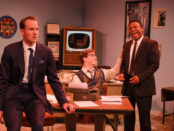
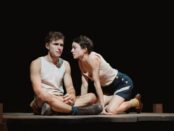
G.D. Kimble’s "What Passes for Comedy" depicts the fascinating era of early live television talk shows and the racism and anti-Semitism which was acceptable in those days. However, it also hints at hilarious comic interludes which it does not deliver. A much better play is hiding in this material and a rewrite could make it a much more successful evening. Its lack of focus camouflages its real intentions which are quite admirable. The play is also hampered by its conventional structure which requires a good many unnecessary exchanges. Nevertheless, this is an admirable attempt at something a little different from the usual run of historical plays on the stage, an absorbing evening even when it is not clear exactly where it is going. [more]

A Raisin in the Sun
Mandi Masden, Tonya Pinkins and Toussaint Battiste in a scene from Robert O’Hara’s production [more]

Montag
While director Dustin Wills has given 'Montag" a superb production, the meaning and message of Kate Tarker’s play remains obscure. Demonstrating female empowerment alone is not enough if the details remain murky and confusing. If the play has any geopolitical message about American-German-Turkish relations, it is entirely lost in the proceedings. The fact that both women are now single parents is not given much significance in the play. One gets the feeling that much of the play has a private meaning for the author who grew up in Germany on the outskirts of a U.S. military community. For those who do not know German, “Montag” is the word for Monday, the day when Clifford Andrews went missing and the women barricaded themselves in the apartment. [more]
The Winter’s Tale (Bedlam)
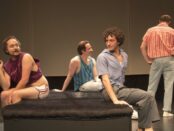
Many of Bedlam’s productions have used small casts with most of the actors playing more than one role. In the case of "The Winter’s Tale," not one of Shakespeare’s more often produced plays, the casting uses so few actors that the play becomes confusing and difficult to follow, and a great many characters and much dialogue has necessarily been cut. In one head-scratching scene, Elan Zafir is required to play King Polixenes and his son Prince Florizel at the same time. While the sets and costumes are modern, with the Shakespeare poetry sacrificed to sound like contemporary speech, the characters are still referred to as “King Leontes” and his wife “Queen Hermione.” As the setting by John McDermott looks like three rooms in a frat house, one wonders why the Royal Family of Sicilia would be living in such shabby quarters and continually guzzling beer in the palace. [more]

Leopoldstadt
Tom Stoppard’s "Leopoldstadt" is a powerful achievement, a history of our time as well as a cautionary tale. In depicting Jewish life in Vienna from 1899 - 1955, It also reveals a way of life and a culture rarely seen on our stage. Patrick Marber’s superb production keeps the story progressing at just the right tempo both to follow the plot as well as reflect family life as it is really lived. There is not a weak link among the 36 actors in which all of the children’s roles are double cast. The excellent design team puts four generations of Vienna on stage of Broadway’s Longacre Theatre. [more]

Everything’s Fine
Actor/writer/director Douglas McGrath is a charming storyteller and his one-man show "Everything’s Fine" is a total delight. He tells the entertaining and poignant story of his eventful 14th year when he was in ninth grade but also describes life in his family of five growing up in Midland, Texas. His tale of darkest adolescence is also nostalgic and reminiscent of the problems of life as a teen. The title turns out to be ironic as it was an expression his father used before announcing there was a new problem. [more]
Baldwin & Buckley At Cambridge
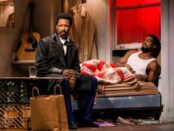
"Baldwin & Buckley at Cambridge" should stir up controversy as their 1965 topic is still relevant. Such a debate today would have a great deal more ammunition than either of these men had at the time. However, one can still hear both points of view today given by liberals and conservatives, respectively. The fact that the Baldwin/Buckley debate is still relevant can be witnessed from the rise of the Black Lives Matter Movement in 2013 as well as the 2019 publication of "The Fire Is Upon Us: James Baldwin, William F. Buckley, Jr., and the Debate over Race in America" by Nicholas Buccola. This is a question which has not been resolved in the intervening 57 years. [more]
The Sea Lady
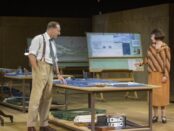
Neith Boyce’s "The Sea Lady," a Broadway-bound play in 1935, only now having its world premiere at Metropolitan Playhouse is an attempt at a Shavian play of ideas. Based on a 1901 novel by socialist H.G. Wells, this very Edwardian story resembles Shaw’s "Misalliance" but without the wit or the scope of ideas. Extremely tentative in how far it dares to go, "The Sea Lady" seems like a relic of an earlier age. It has charm but it lacks depth; its message may have been new in 1901 when the novel came out or 1935 when the play was finished, but today it seems extremely old hat. [more]
Washington Square
On what is either a shoestring budget or a conscious effort to strip Henry James’ novel down to its essentials, Randy Sharp’s new adaptation of "Washington Square" is both exciting theater and entirely true to its source material. The quartet of fine actors make this story of 1840’s New York entirely credible and engrossing at all times. While it avoids the beautiful trappings usually associated with the period, it is so gripping that they are not missed for a moment. [more]
I’m Revolting
There are two truisms in life in addition to the one about death and taxes: it takes all kinds of people to make a world and something will get everyone in the end. The world premiere of Gracie Gardner’s "I’m Revolting" beautifully proves both points. A sensitive and perceptive play set in the waiting room of a private New York City skin cancer clinic, the play introduces us to all walks of people and many reactions to medical reports. The ensemble cast includes several veteran actors (Laura Esterman, Glenn Fitzgerald, Peter Gerety and Patrice Johnson Chevannes) and several not so well known faces. Knud Adams’ direction is subtle and unobtrusive allowing life to pass on the Linda Gross stage of the Atlantic Theater Company. [more]
Weightless
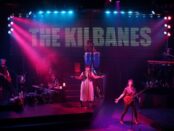
"Weightless" is an engaging little indie rock musical, little in the sense that it has only three characters plus a narrator and runs only 75 minutes of playing time. The show features the Bay Area rock band The Kilbanes (married songwriting and performing duo bassist Kate Kilbane and keyboard player Dan Moses) who also wrote the show, and the cast that also filmed the show in 2021 during the pandemic. Like "Hadestown," "Weightless" is based on a story in Greek mythology and includes the gods on Mount Olympus; in this case the source material is from Ovid’s "Metamorphoses," a work written in Latin. "Weightless" is performed as if it were a concept album staged as a concert with the characters all played by the six member band who sit or stand on the stage placed on various platforms. Peiyi Wong’s set design does not allow for much stage movement and Tamilla Woodard’s direction does not give the actors much to do in the way of stage business. However, the storytelling is clear and the characters well defined. [more]
This Beautiful Future
If you like your W.W. II history unadulterated, you may object to a love story between a French teenage girl and a Nazi soldier even if they are inexperienced and innocent and unaware of what is to come. The fact that they are both hopeful of life in the future in the middle of war and devastation notwithstanding, were people ever this naïve and unworldly? While "This Beautiful Future" is tastefully presented, it does not deal with the moral issues that the play hints at but refuses to recognize. [more]
Fauna
Is it possible to be completely truthful in attempting to tell the life of a famous author in a biofilm? That is the premise of Argentinian novelist and playwright Romina Paula’s "Fauna" now having its English language premiere at New York’s Torn Page Theater. As the play is philosophical, poetic, cerebral, and literary with quotes from many authors including Argentinian writers unfamiliar to Americans, it may be too erudite and esoteric for most theatergoers. However, April Sweeney’s production at the vest pocket Torn Page Theater is so intense that it carries its audience with it. With the actors only feet from the viewers so that you feel you are in the room with them, the play is a powerful experience that few productions ever achieve. [more]
Burn
Although Alan Cumming is a charismatic performer, the distracting video design, the often overpowering music, and the often flashing lighting by Tim Lutkin, gets in the way of viewing the show. Much of the effect is created by the atmospheric lighting which periodically changes color (blue, green, red) yet at times it turns the evening into a multimedia event. Since none of the poems are clear enough to be understood, we learn little of Burns’ output as a poet though we do hear about his triumphs that lead to being lionized in Edinburgh. The contemporary music only rarely suggests the period. The dance elements also seem an eccentric way to portray this 18th century man who attempted to live life to the fullest. Cumming charmingly depicts this Scottish icon though he does come off as a lovable rogue. It is all an example of too much being too much. The rather coy ending has Cumming sitting on the edge of the stage declaiming Burns’ now famous poem, “Auld Lang Syne,” after the final curtain has already descended. [more]
Sacco and Vanzetti: A New American Opera
The finished score by Lehrman is 50% music he created based on themes by Blitzstein: pieces of his unproduced 1932 opera "The Condemned" (an earlier work about Sacco and Vanzetti), a march, a cabaret song, a song cycle, a piano piece for mezzo-soprano Brenda Lewis who had starred in Blitzstein’s 1949 opera "Regina" (based on Lillian Hellman’s "The Little Foxes"), and portions of 13 songs from "Reuben, Reuben," his 1955 folk opera set in Little Italy which failed in Boston and which he had been recycling in later works. Blitzstein’s libretto for the three-act "Sacco and Vanzetti"(performed at Lehman College in two parts) was based on transcripts, letters, and interviews with the principals involved in the case. One addition approved by the estate was the inclusion of Governor Michael Dukakis’ exoneration of Sacco and Vanzetti in 1977, the 50th anniversary of their execution, as a fitting new ending to the opera. [more]
Our Man in Santiago
Mark Wilding’s "Our Man in Santiago" is billed as a “raucous political farce” but it is neither loud and noisy nor hilariously funny. Inspired by Gabriel Garcia Marquez’s 1974 article in Harper’s Magazine concerning the CIA involvement in the death of democratically elected President Salvador Allende, the play supposes that the CIA had operatives in Santiago ready to kill Allende when General Pinochet launched his coup that took out Allende’s government and democracy in Chile for the next 16 years. While Charlie Mount, who also directed LA’s Theater West production in 2021, keeps the play bubbling along, the one-dimensional characters and the lack of real farcical stage business diminish the play to an overlong attempt at satire. [more]
Remember This: The Lesson of Jan Karski
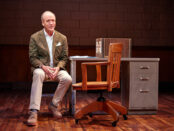
Aside from his ability to create multiple characters with his voice and body language, Strathairn’s physicality is remarkable in aging from a young man to a senior citizen before our eyes as well as using the table for enacting various events such as jumping off of a train or Karski’s torture by the Nazis. (The movement director is Emma Jaster,) In the brief 90 minutes of playing time, Strathairn is able to establish a quietly heroic man’s entire life and career with modesty, sincerity and simplicity. It is not only a remarkable performance, it is also an impressive reconstruction of another man’s character and deeds. [more]
My Onliness
"My Onliness," Robert Lyons’ latest stage work, is a musical homage to Polish avant-garde playwright Stanislaw Ignacy Witkiewicz (active 1918-1934) but who resurfaced during the 1960’s when his works began to be published and translated. Directed by Daniel Irizarry who also plays the leading role as the Mad King, "My Onliness" with lyrics by Lyons and original music by Kamala Sankaram, resembles the anarchic East Village plays and happenings of the 1960’s. It is part of a through line from Alfred Jarry’s "Ubu Roi" (1896) to Eugene Ionesco’s "Exit the King" (1962). A political fable for adults, "My Onliness" is performed as a cabaret and circus entertainment with exaggerated costumes, outrageous stage business, and audience participation. While the often obscure text is for the adventurous, it does touch on many hot current issues. [more]
Los Otros
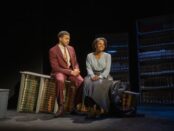
A fresh antidote to the usual brassy, loud rock musicals of today, "Los Otros" slows down the tempo and the sound level with a story of the experiences of two people who learn to love, cope and risk over the course of many decades. Luba Mason and Caesar Samayoa are quite endearing as the two California residents whose lives overlap. They give remarkable performances mainly appearing alone on stage telling and singing their stories. Cudos to librettist Ellen Fitzhugh and composer Michael John LaChiusa for bucking the trend and giving us a deep but small-scale musical revealing two lives through variously well-chosen experiences which add up to lives well lived. Long after you see it, it you will recall incidents that Lillian and Carlos recount. This may be the result of the fact that Los Otros is based on real people and true life experiences. [more]
As You Like It (Public Works)
Public Works’ musical adaptation of "As You Like It" is an enchanting evening of summer fun under the stars. Trimmed to a long one act, the story is accessible for both those who know the Shakespearean original and those who don’t. The score is always easy on the ears and has many crowd pleasers. The huge cast led by Rebecca Naomi Jones as Rosalind and including non-professional community partners is totally comfortable with the Elizabethan language and the contemporary score by Shaina Taub. With this show, Shakespeare in the Park has a real winner. [more]
HYPROV: Improv Under Hypnosis
'Hyprov" is a delightful and surprising evening as there is no telling how it will turn out. Will the Hyprovisers be good at their improvs? Will they stay in character? How will they deal with the somewhat preposterous suggestions by the audience or Colin’s instructions? Will the improvs make complete skits? Will the volunteers all remain on the same wavelength? One could see this show several times as both the improvs and the volunteers will vary from night to night. A clever evening is had by all with the charming Asad Mecci running the first half and Colin Mochrie organizing the second half. [more]
Titanique
"Titantique" is the most hilarious musical parody to play New York in many a year. Since international superstar Céline Dion only got to sing one song at the end of James Cameron’s blockbuster "Titanic," the now iconic “My Heart Will Go On” which went on to win the Academy Award for Best Song, why not turn the film into a cabaret musical with a score made up entirely from the Céline Dion catalog? That is just what Marla Mindelle, Constantine Rousouli and Tye Blue’s book has uproariously done, casting Mindelle in the leading role as a perfect mimic of Céline Dion, Rousouli as hero Jack Dawson, and Blue directing the show. Whether you recall the film from 25 years ago or not, the satire is pungent and the jokes skewer many pop culture icons. [more]
macbitches
It is not until the last 15 minutes of Sophie McIntosh’s new play, "macbitches," that a dramatic event takes place. Up until then the play is mostly the chit chat of acting majors talking about productions they have been in, eccentric directors they have worked with at the college, rehearsal horrors, and theater experiences elsewhere. While this has some interest for theater buffs, it goes on too long and tends to be more and more of the same. If you know such shows as "The Drowsy Chaperone," "The Crucible," "Hedda Gabler," "Antigone," "Guys and Dolls" and "Macbeth" very well you may be able to follow the gossip. If not, you may grow very bored by all the anecdotes. There is some talk of the toxic environment of male-run academic departments but very little of it makes much of an impression. We never hear what the male acting students think of the department or its practices, only their bad behavior in rehearsal. [more]
The Inconvenient Miracle: A Mysterious Birth Musical
Samantha Streich and Deijah Faulkner in a scene from “The Inconvenient Miracle: A Mysterious [more]
Oresteia (Almeida Theatre)
If you have ever seen a play by Aeschylus, you know how static and slow they are, made up entirely of monologues and choral odes with hardly any action. It was Sophocles and Euripides who added what we consider drama to ancient Greek plays. Director Robert Icke’s new version of Aeschylus’ "Oresteia," the only complete Greek trilogy that remains extant, has been adapted into a updated tetralogy that is accessible, easy to identify with, and dramatically exciting. The Almeida Theatre production now at the Park Avenue Armory features magnificent performances by Anastasia Hille (Baptiste's wife Celia in the television series of the same name) and Angus Wright (Claudius, in Icke’s current also modern dress production of "Hamlet" running in repertory with Oresteia) as Klytemnestra and Agamemnon. Presented as a long evening of four plays, this is a commitment for the audience as the running time is three hours and 35 minutes with three intermissions. [more]
Hit the Wall
Jake Shore’s "Hit the Wall," though limited in its range, is very successful in its goals. It gives Adam Files and Alexandra Guerrero juicy roles as the aging mentor and the younger student who may have surpassed the master. It also depicts a world unfamiliar to most of us. Whether this world is entirely accurate is another question which only those in the know can tell us. However, the play as it now stands is an impressive but small piece of work. [more]
Cat on a Hot Tin Roof
While the play is rooted in its original 1955 period (its language, social mores, references, three-act form), this revival directed by Joe Rosario has attempted to place it in the present from the contemporary set and clothing and such props as cell phones and a great many uses of the f-word. However, without updating the dialogue, the play does not make sense reset in 2022, particularly in its archaic handling of homosexuality as it was referenced pre-Stonewall. Its themes of deception, greed and “mendacity” (a word made famous by this play) would seem to make the play contemporary but everything else about it including its hothouse atmosphere marks it as dated. [more]
The Kite Runner
The second problem is the performance of Amir Arison, star of nine seasons on NBC’s "The Blacklist," and eight Off Broadway dramas, playing both "The Kite Runner"’s narrator and its protagonist Amir. As the narrator, Arison is totally impassive giving little weight to the tumultuous events he describes. He also plays Amir as both a child and as an adult. While he is unconvincing as the child Amir from ages 10 to 12, his mostly unemotional portrayal of the adult Amir undercuts the events he describes. Still more damaging to the story, the violence has been toned down greatly, changing the villainous Assef from a psychopath to just a bully, and leaving out the shocking events in the soccer stadium demonstrating Taliban justice. The story still creates its own spell but is greatly diminished from the strengths of the novel. Luckily most of the supporting cast is quite excellent which saves the play. [more]
Into the Woods
Patina Miller as The Witch in a scene from the New York City Center Encores! Production of “Into [more]
Sex, Grift and Death: An Evening of Plays by Steven Berkoff and Caryl Churchill
For its 35th anniversary, PTP/NYC (Potomac Theater Project) continues is exploration of little known British plays by major playwrights with the New York premieres of one acts by Steven Berkoff and Caryl Churchill. The triple bill entitled "Sex, Grift and Death" includes the first local productions of Berkoff’s "Lunch" and Churchill’s "Here We Go," as well as the first NYC revival of Churchill’s "Hot Fudge," last seen here at The Public Theater in 1990. While the productions directed by Richard Romagnoli (Berkoff) and Cheryl Faraone (Churchill) are fine as far as they go, they all seem a little too underheated to be truly theatrical for these in-yer-face, confrontational authors. The evening’s title sums up the themes of this triple bill. [more]
Between the Lines
"Into the Woods" is not the only fairy tale for adults in New York right now. "Between the Lines," based on the best-selling novel by Jodi Picoult and Samantha van Leer, has been turned into a charming and delightful new musical which is actually an improvement over the overlong original. Featuring a talented and attractive cast headed by Arielle Jacobs, Julia Murney and Vicki Lewis as well as several unfamiliar faces, the show offers a melodic and bouncy score to witty and clever lyrics by Elyssa Samsel and Kate Anderson in their New York theater debuts. Jeff Calhoun’s direction is sharp and smart making this an extremely entertaining show. [more]
Richard III (Free Shakespeare in the Park)
And of his behavior Richard continues to explain, “And therefore, since I cannot prove a lover, I am determined to prove a villain.” In this production we see none of this though this speech comes near the beginning of the play. What we are offered is a one-dimensional action production which dilutes the play and entirely throws out historical authenticity. While Dede Ayite’s costumes are mostly period there are entirely modern touches like the two young princes, sons of the previous king, wearing gold sneakers. Instead, Richard is surrounded with people who have disabilities or physical challenges which somehow turns the play on its head: Lady Anne in a wheelchair, two deaf actors use sign language, Richmond (later King Henry VII) has cerebral palsy, and one of the courtiers who plays several roles is a dwarf. Nice to give all of these actors work but in this play it reverses the focus of the story and theme. [more]
Hamlet (Almeida Theatre)
Modern dress "Hamlet" productions can be problematic when the directors don’t plan out all the details. Robert Icke’s staging for London’s Almeida Theatre now at New York’s Park Avenue Armory is that rare production which has updated the play so well that it appears to be intended to be set in our time all along. Original, surprising and ingenious, the production amazes to the point we wonder why no one has though of these ideas before. The sleek, cool settings and costumes by Hildegard Bechtler brilliantly convey the corridors of power while the video design by Tal Yarden, a sort of closed circuit CNN, make William Shakespeare's tragedy feel up to the minute. This "Hamlet" is also accessible and easy to follow, even at a running time of three hours and 30 minutes. [more]
Chains
The Mint Theater Company continues its three play mini-festival of the forgotten plays of Elizabeth Baker with "Chains." Given a polished – maybe too polished – production like the earlier "The Price of Thomas Scott," this play is also problematic, but in another way. Unlike her contemporaries John Galsworthy, George Bernard Shaw and Harley Granville-Barker, Baker’s "Chains" has a very narrow focus: the discontents of the lower middle-class white collar folk. All of the characters in the play’s first half (the script’s Act I and II) do nothing but either complain about the grind of their daily six-days-a-week jobs (half-holiday on Saturday) or laugh at those who would give up a steady employment. You would think that back in 1909 when the play was written there wasn’t anything else to talk about. Jenn Thompson’s direction is conventional and sedate where something more animated might have been more to the point. [more]
The Orchard
Such an event is the high-tech adaptation at the Baryshnikov Arts Center calling itself "The Orchard," conceived and directed by Igor Golyak, described as based on "The Cherry Orchard" by Anton Chekhov as translated by Carol Rocamora. If you don’t know the play, you will be entirely at sea. If you know the play, you will marvel at all the totally unnecessary tricks used by the director that do nothing to help with understanding the play or ferreting out its meaning. Although the production has a fine cast headed by Mikhail Baryshnikov and Jessica Hecht, the actors are swamped by all the unnecessary trappings around them. [more]
The Bedwetter
Comedian Sarah Silverman has turned her bestselling memoir, "The Bedwetter: Stories of Courage, Redemption and Pee," into a musical with the help of co-book writer Joshua Harmon, author of this year’s award-winning "Prayer for the French Republic," and composer Adam Schlesinger ("Cry-Baby"), who passed away in 2020 just as the show was about to go into rehearsal prior to the pandemic. The new musical, simply called "The Bedwetter," like the book is by turns amusing, first hilarious and later serious. Anne Kauffman’s production has a top-notch cast headed by Bebe Neuwirth, Caissie Levy, Darren Goldstein and Rick Crom. [more]
Mr. Parker
"Mr. Parker," the latest play by Michael McKeever whose "Daniel’s Husband" has been produced twice Off Broadway, has been given a stylish production by director Joe Brancato who also directed the earlier play. David Goldstein’s one-room studio set situated in the East Village is elegant and cozy. The costumes by Myra Oney are chic. The acting by its trio of actors is polished and urbane. Even its premise of a gay man dealing with the sudden death of a long-time partner and husband is up-to-date and timely However, as written the play seems superficial and slight. Dramatically it avoids all the big scenes that might have been included. It remains entertaining but without the payoff one wants in such a drama. [more]
Sky of Darkness
Following the lead of Francis Ford Coppola’s "Apocalypse Now," Siting Yang has updated Conrad’s "Heart of Darkness" to the present but left the story mainly set in Africa. In "Sky of Darkness" as the narrator Ma Luo (Yang’s new Marlow) is Chinese, the tale is now an exposé of Chinese interference in African affairs both financial and military. However, Yang complicates the story by having it periodically interrupted by The Ghost of Nigerian novelist Chinua Achebe who famously gave a lecture criticizing Conrad’s novella in 1975 from an African point of view as racist and stereotyped. But this Achebe doesn’t object to the story as a xenophobic work of post-colonialism but criticizes Conrad for what he says he did not see. He doesn’t take into consideration that Conrad’s story is told by a series of narrators and that Captain Marlow is horrified by the repression he does see by the European rulers (in his time the brutal Belgian occupation). [more]
Romeo & Bernadette: A Musical Tale of Verona & Brooklyn
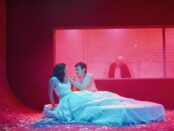
"Romeo & Bernadette" is a musical comedy worthy of the name that delivers on all counts. Mark Saltzman’s spoofing of the old story is great fun and his lines are very clever. The score with its famous melodies transformed in new ways is a lush feast for the each particularly as sung by this excellent cast. Under Justin Ross Cohen’s direction the cast brings this far-fetched story to brilliant life. One only hopes that the threat of the real story of Hamlet comes as a follow-up. [more]