
Articles by Victor Gluck, Editor-in-Chief
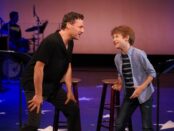
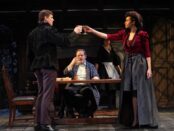
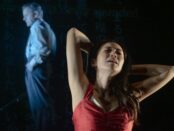
Philip Roth’s 1995 Rabelaisian novel "Sabbath’s Theater" would seem a strange choice for stage adaptation both as it is considered Roth’s raunchiest – if not filthiest – book and it moves around a great deal to places in New England, New York, New Jersey and Venice, Italy. The stage adaptation by journalist Ariel Levy and actor-director John Turturro who also stars in The New Group’s production at the Pershing Square Signature Center is not really a play but a staged reading. Performed by Turturro and two actors, Elizabeth Marvel and Jason Kravits, taking all the other parts, this very doubling reinforces the feeling that this is not a fully realized play. [more]
The Frogs
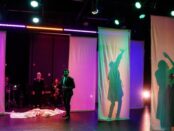
MasterVoices acquitted itself well in this deliciously comic concert staging of "The Frogs." Why this Stephen Sondheim score is not better known or revived more often remains a mystery after seeing the fine production that fit the Fredrick P. Rose Hall of the Rose Theater. Hopefully, this concert will lead to more fully staged productions now that MasterVoices demonstrated how many star turns are available in this comic masterpiece by Shevelove, Lane and Sondheim. [more]
Partnership
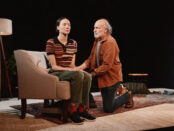
The three plays in the “Meet Miss Baker” Project, "The Price of Thomas Scott" in 2019, "Chains" in 2022 and now "Partnership" in 2023 are quite different. While Partnership is the only one you could call a conventional comedy, and a romantic one at that, it offers the least social commentary of the three. At first seeming to be a study of the Shavian “New Woman,” it ultimately makes little or no statement about women’s roles or rights at the time. Women theatergoers may appreciate a period play which puts the female roles front and center, but this play is ultimately too bland and inoffensive. [more]
All the Devils Are Here: How Shakespeare Invented the Villain
The subtitle of Patrick Page’s absorbing and informative one-man show "All the Devils Are Here: How Shakespeare Invented the Villain” is an actuate description of the content of his presentation. In a kind of lecture-performance it is Page’s credible contention that Shakespeare took the Vice character (the villain from the Middle Ages' Morality plays through Christopher Marlowe) and added psychological realism. Eventually in his last play, "The Tempest," Shakespeare was dealing with a character with a very worthy justification for revenge who finds compassion and empathy instead. [more]
Salesman 之死
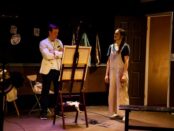
Not only is Jeremy Tiang’s "Salesman 之死I" an important document of a classic American play, it is also an illustrative reminder of the cultural differences between China and the United States. Under the direction of Michael Leibenluft, the cast of six is always engaging and always convincing playing both men and women alternately. The design puts the audience directly into the rehearsal room from March to May 1983. The play also allows us to watch major American playwright Arthur Miller as he explores and rethinks a play he had written over three decades before. The fact that the Chinese actors eventually did so well with this typically American text demonstrates the universality of Miller’s greatest play. [more]
Jaja’s African Hair Braiding
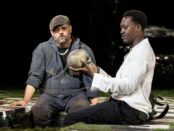
"Jaja" is quite different from Bioh's other plays in that it is also very revealing about life in NYC for African immigrants. Directed by Whitney White who has piloted several major new Black plays in recent years, the play is funny, poignant and illustrative. The excellent and compelling cast of 11 includes six fine actors making their Broadway debuts. David Zinn’s detailed hair salon puts every inch of Jada’s Harlem African Hair Braiding parlor on stage down to the last braid and bobby pin. [more]
Bloodshot
Elinor T Vanderburg’s "Bloodspot" is a fascinating attempt to create a film noir play for the stage. The visuals do not live up to the script’s promise, but it remains entertaining and engrossing. The schizophrenic characterizations, half realistic and half outrageous, are distracting in their inconsistency; however, it does not take away from the final effect. While the production by SheNYC Arts, “a femme-led nonprofit organization fighting for gender equality in the arts and entertainment industry across the United States,” is deficient in several ways, the play augurs an impressive future career for talented playwright Elinor T Vanderburg. [more]
Golden Rainbow
The 1968 musical 'Golden Rainbow" (the show that gave us the song sensation “I’ve Gotta Be Me”) was so identified with its stars Steve Lawrence and Edie Gormé that it has not been seen in 55 years. When it was suggested to composer Walter Marks that he revisit the show, he found it had so much material created specifically for the Lawrences that it was no longer revivable. Instead he has written a new version of the original book by the late Ernest Kinoy (his collaborator on the Broadway musical "Bajour") as well as five new songs. The results are a small but appealing musical comedy with a terrific jazzy score as directed and choreographed by Stuart Ross. [more]
Dracula, A Comedy of Terrors
Each generation gets its own version of Bram Stoker’s Dracula, the classic vampire horror story, that possibly reflects its needs of it own time. The latest version now called "Dracula: A Comedy of Terrors" by Gordon Greenberg and Steve Rosen is a hoot, both a parody and a comedy, a cross-dressing hilarity in the style of both Charles Ludlam’s Ridiculous Theatrical Company and Monty Python. A fabulously talented cast of five led by buff, sexy young James Daly in the title role get a workout with the other four playing many roles in quick costume changes. Greenberg’s production with its witty script and design makes this a must-see entertainment. After the pandemic and other recent horrors, this is just what the doctor ordered. [more]
Mary Gets Hers
From the playing style, as directed by Josiah Davis, the play seems to be a spoof. Unfortunately, it is not funny though the actors cheerfully mug their way through Horwitz’s text as though they find it hilarious. Its Middle Ages protagonist Mary played by Haley Wong is so naïve and unsophisticated that it is difficult to believe her portrayal. Much of the dialogue is very repetitious and becomes tedious while the plot is so emaciated that it is a wonder that it takes 80 minutes of playing time. [more]
Infinite Life
Ever since Pulitzer Prize-winning playwright Annie Baker adapted 'Uncle Vanya" for a 2012 production at the Soho Rep, her plays like "The Flick," "John" and "The Antipodes" have becomes more Chekhovian: not a great deal happens but characters live out their daily lives. In her new play "Infinite Life," she has gone even further with the silences and the pauses that she has become famous for. Under James Macdonald’s superb direction, we watch five women and one man read, sleep, talk and sip water or juice on the patio of a wellness clinic in Northern California trying to deal with their chronic pain. Not much happens but, on the other hand, these people reveal their whole lives before they complete their treatments and go back to their previous existences. [more]
Job
Max Wolf Friedlich’s "Job" is as tense as a thriller, as compelling as a psychological drama and as up-to-date as tomorrow’s headlines. As directed by Michael Herwitz, Peter Friedman and Sydney Lemmon are living their roles, rather than just acting them. While the play will grab you by the throat while you are in the theater, it will give you a great deal to think about after you leave. In that it resembles other two-character plays by such authors as David Mamet and Harold Pinter. It is to be hoped that the play will be extended or better yet moved to a larger theater so that more people will be able to see it. [more]
The Creeps
Catherine Waller’s one person show, "The Creeps", has all the elements of a successful horror show: a macabre setting, dark lighting, off-beat characters, and strange unexplained going-ons. Unfortunately, several things get in the way of its registering. Created and starring Waller dressed entirely in form fitting black, the production has eschewed a director who is very much needed as there is too much dead time in this slightly less than one hour show. At this length it still seems long with too many undramatic pauses. Presented in the renovated four-sided Playhouse 46 at St. Luke’s, the audience is also aware of each other throughout which makes the evening a great deal less scary than it ought to be. Scott Monnin’s lighting is never dark enough to make us feel that we are in some place other than the theater with other people. [more]
The Tempest (Public Works)
Visually, the show is not as effective as it might have been considering the play usually includes a great deal of magic. Here there is very little in the way of scenic illusions or legerdemain. Alexis Distler’s setting which makes use of some elements of the design for Hamlet, the previous staging on the Delacorte stage, a falling down mansion seemingly off its foundation, adds little to the production’s visuals. Except for the stunning harpy costume for Ariel by Wilberth Gonzalez, the rest of the designs are more than bland. The all-black leather creations for the Europeans give the production a contemporary look that feels out of place. The dozens of community partners dressed in matching blue and yellow outfits have been given little to do besides stand around as witnesses or hum to the large-scale musical numbers. [more]
How to Steal an Election: A Dirty Politics Musical
While the misnamed "How to Steal an Election: A Dirty Politics Musical" is no lost masterpiece and at times seems long, it is a diverting political revue which offers an interesting take on the politics of the last 180 years. With the charming Jason Graae at the helm, the rest of the talented cast keeps the show rolling merrily along. New faces Emma Degerstedt, Alex Joseph Grayson, Courtney Arango, Kelly Berman and Drew Tanabe demonstrate that they should have very successful and acclaimed careers before them from their work here. [more]
Pay the Writer
Directed by Karen Carpenter, "Pay the Writer" by best-selling novelist Tawni O’Dell is slick and superficial but entertaining and engrossing. The play about the 45 year friendship between an ultimately successful gay literary agent and an unknown African American novelist who becomes celebrated and wealthy plays like a novel or mini-series with its 13 scenes and many two-character encounters but is ultimately satisfying by the time it reaches its denouement. The high powered cast plays it to the hilt, belying the fact that the characters are superficial and stereotyped, which, of course, doesn’t make it untrue. Some of the play is extremely funny with one-liners worth repeating. [more]
What Else Is True?
Another problem with the play is that although the subject is “Improv” we never actually witness any, just theater games to prepare for group improvs. Games like Mind Meld, Mating Call, 99 Problems, Zip Zap Zop and the Pattern Game are practiced but as the rules are not made clear, many in the audience be confused by what is happening. Throughout the play we are told that Miles is the most brilliant of them all, based on his auditions and performances, but except for a brief moment in the next to last scene in which he performs two characters in an improv alone, we are never shown any evidence of this. [more]
Back to the Future: The Musical
"Back to the Future: The Musical," the time travel adventure, joins a long line of problematic screen to stage musicalizations which do not improve on the originals in any way. Joining the list that includes in recent memory "Pretty Woman," "King Kong," "Tootsie," "Mrs. Doubtfire" and "Almost Famous," Back to the Future, using one of the original movie’s co-writers (Bob Gale without Robert Zemeckis), attempts to transplant the film in toto to the stage of the Winter Garden Theatre without adding anything new to the mix other than having the characters sing and dance. If theater is meant to surprise us, then like the stage version of "Almost Famous," "Back to the Future" slavishly follows its source material so that we feel like we have seen it all before – and better. [more]
Cat Kid Comic Club
The family-oriented TheaterWorksUSA’s latest musical adaptation of the best-selling children’s novels of Dev Pilkey is "Cat Kid Comic Club: The Musical," an exuberant colorful one hour irreverent entertainment for children of all ages. Written by Kevin Del Aguila (book and lyrics) and Brad Alexander (music) who previously wrote the highly successful "Dog Man: The Musical" from the earlier Pilkey series, "Cat Kid Comic Club" is surprisingly faithful to the book of the same name and will not disappoint its many fans. With clever and imaginative direction by Marlo Hunter and her design team which uses puppets as well as live actors, the hard-working cast of six (almost all of whom appeared in TheaterWorks’ "Dog Man" musical) play multiple roles to tell this hilarious and surprising story. [more]
Wheel of Fortune
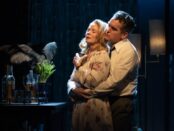
What appears to be filmmaker Jing Ma’s first stage play, "Wheel of Fortune" is a touching story of a depressed man about to turn 30 and without a job or a girlfriend. His bad luck changes when his mother visiting from Delaware becomes a Tarot card reader and predicts a change of life with the “Wheel of Fortune” card. Directed by the author, the play has a few too many scenes and set changes (like a film script) for the tiny stage of UNDER St. Marks Theater but it remains both engrossing and poignant. [more]

Flex
Whether you follow basketball or not, Candrice Jones’ "Flex" is exciting theater. Actually, the play is not only about women’s high school basketball but also passions, future plans, romance, sex, ethics, friendships, rivalries, betrayals, and possible dreams deferred for all of the play’s five teammates as we follow them from their home town games in Plainnole to the 1997-98 Arkansas High School State Championship. Using a cast of relatively unfamiliar performers all of whom are making their Lincoln Center Theater debuts, director Lileana Blain-Cruz best known for her work on new plays has kept the performance as taut as a real game throughout its two hours and 20 minutes length. [more]
The Cottage
Although Sandy Rustin’s "The Cottage," now arrived at Broadway’s Helen Hayes Theater, bills itself as “A Romantic and (Not Quite) Murderous Comedy of Manners,” it is devoid of the two requirements of drawing room comedy: wit and quotable one-liners. Although its hard-working stable of stars including Eric McCormack, Laura Bell Bundy, Lilli Cooper and Alex Moffat, have been directed by television star Jason Alexander to behave as though the play is comic, there are hardly any laughs. [more]

Vermont
Another head scratcher is that advance publicity on the play calls it “an uproarious comedy”; however, as there are no more than two laughs in the whole play as currently produced on the stage of the wild project this is a false appellation. While the play involves a story of a married urban couple who travel to Vermont to join a self-sustaining commune run by his former college roommate, there are no surprises and the events are very predictable, with all of the revelations left for the final scene. [more]

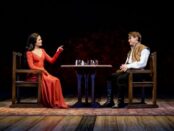
Orpheus Descending
Among the problems with the production is the fact that there is no chemistry between Siff and Alexander. We are supposed to believe that their encounter not only brings Lady Torrance back to life but that Val falls in love for the first time. However, this is not demonstrated by their performances. Williams’ requirement that his heroine use a Southern yet Italian accent is a difficult assignment and Siff seems uncomfortable at this while her Italian accent comes and goes. More damaging still is that while we are told that Val Xavier has a positive effect on all the women who encounter him, Lady Torrance, Carol Cutrere, Vee Talbott (the Sheriff’s wife), and causing the men to be jealous, Alexander fails to exude the kind of charisma needed for this role. Not only is he too bland, he often fades into the woodwork when we should be conscious of his presence at all times. [more]

How to Find a Husband in 37 Years or Longer
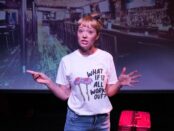
Pyle is an engaging performer. However, not only does her story wander around but the interruptions by her father or rather her day dreams about past lovers become hard to follow due to all the disconnects. Her father follows an ex-wife to Texas from Indiana while Pyle ends up in Los Angeles from New York. The message is not clear until she explicitly states that she is “in the exact right spot.” When she removes her parka, she wears a t-shirt that states: “What if it all works out?” which appears to be the take away from the evening. [more]

The Doctor
Juliet Stevenson as Dr. Ruth Wolff in a scene from Robert Icke’s “The Doctor” at the Park [more]

Once Upon a One More Time
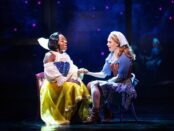
The only problem with Hartmere’s plot is that it remains undeveloped. None of the princesses get to read Friedan's book (there is initially only one copy) and they take it on faith that it offers them alternatives. The plot goes off on a series of tangents (Prince Charming’s assistant Prince Erudite the Celibate reveals that he is gay when he meets Snow White’s assistant Clumsy, the Cinderella’s Stepmother attempts to get the Narrator to choose one of her daughters for Prince Charming after Cinderella’s defection) but these narratives turn out as you would expect with no surprises. As staged by director/choreographer team Keene & Mari Madrid, whose credits up until now are mainly in film and music video, (creative consultant: British director: David Leveaux), the many production numbers look like aerobics for a rock video which may please Spears fans but look incongruous in a Broadway musical based on 18th and 19th century stories. Spears’ fans will be pleased that the show includes eight of her top ten hits: “Oops!... I Did It Again,” “Baby One More Time,” “Gimme More,” “Toxic,” “Circus,” “Lucky,” “Work Bitch,” and “Stronger,” almost all with lyrics tweaked by Hartmere to fit a story of princes and princesses. [more]

Hamlet (Free Shakespeare in the Park)
For this year’s Free Shakespeare in the Park, director Kenny Leon has set his modern dress "Hamlet" in what looks like the same Georgia estate as his acclaimed 2019 production of "Much Ado About Nothing." However, Beowulf Boritt’s set this time around looks as though the Georgia suburban mansion has been destroyed by a hurricane with the main house off its foundation and the main room missing three of its walls. The set also features two American flags, a partly buried “Stacey Abrams 2020” poster (used in the "Much Ado") and a jeep nosed into a huge puddle with an Elsinore license plate. While the production is chock full of ideas (too many of them), it creates the new problem that Shakespeare’s "Hamlet" doesn’t make much sense set in America. After all, when is the last time we had a king and queen? Obviously, the parallel is that something is rotten in America but where is this Never Neverland? [more]
Eisenhower: This Piece of Ground
Based on a range of Eisenhower’s memoirs, speeches and letters, the play demonstrates without a doubt his belief in moderation and his liberal bent of which many people today are unaware. Set at his Gettysburg farm in 1962, two years after the end of his presidency at age 71, the premise is that while recording his memories for a book on his White House years, he is incensed by a New York Times poll of 75 historians which places him 22 out of 31 presidents, “a great American, not great president.” He then attempts to defend his life and work in the two acts that follow, with the first half taking us through W.W. II and the second half delineating his presidency. [more]
A Simulacrum
While the show approximates a magic show, it also is a lecture demonstration. However, if you are hoping to hear how the tricks are accomplished you will be disappointed. Cuiffo who has a charming demeanor is both low-key and casual, dispassionate and nonchalant. "A Simulacrum" is a diverting evening but it may leave you hungry for more – or at least the explanations of what you have just seen before your eyes. The rapport between Hnath and Cuiffo is that of friends and by the end of the evening you may feel like you have been admitted to their inner circle. [more]
Lizard Boy
Scheduled to run only until July 1, "Lizard Boy" deserves a longer life as one of the most satisfying musical theater offerings to be seen currently in New York. While the message of tolerance and diversity is not heavy, the theme is dramatized so that no one can mistake its intent. The three-person cast is superb in the acting, singing and musical departments. Brandon Ivie’s staging is clever and imaginative, while the book, music and lyrics by Justin Huertas make audience goers look forward to his next project with eager anticipation. [more]
Days of Wine and Roses
Lucas’ script remains faithful to Miller’s teleplay (with the excision of Joe’s delirium tremens in the psycho ward or his second hospitalization) and much of the dialogue is actually Miller’s. However, the problem is the score. Guettel’s 18 songs (including four reprises) are often atonal, unmelodic, unrhymed and don’t scan. While this is true of the Tony Award-winning "The Light in the Piazza" that score had such a lush sound that it was automatically romantic and appropriate for its story. Here it is almost as though Guettel is striving for opera but without the orchestral underpinnings to make it so. The lyrics are mostly recitative, abstract and metaphorical. Aside from three songs in which Joe or Kirsten are joined by their seven-year-old daughter Lila (played by Ella Dane Morgan), only the couple sing, with O’Hara given seven solos. The real problem is as Stephen Sondheim said about his musical Do I Hear a Waltz?: these are characters that wouldn’t sing so the only way to solve this is to have made "Days of Wine and Roses" an opera with a great deal of orchestral music. Here the songs do not add anything to the story. Like Marvin Hamlisch’s score for the stage version of "Sweet Smell of Success," Guettel’s music is devoid of atmosphere, period or otherwise, unless this is the fault of the orchestrations by Guettel with additional orchestrations by Jamie Lawrence. [more]
The Comeuppance
Branden Jacobs-Jenkins’ "The Comeuppance," the culmination of his decade as a Premiere Resident playwright at Signature Theatre, does for the millennials what "The Big Chill" did for the Baby Boomers. Astutely directed by Eric Ting, this fascinating but uneven play also reviews the stresses and traumas of the last 20 years for that generation. This five-character reunion of people who knew each other at St. Anthony, class of 2002, in Prince George’s County, Maryland, is densely plotted and packed with dramatic moments. And then there is a new wrinkle, an uninvited guest. [more]
Fallen Angels
The problem with the play is that it has a one joke plot, simply what will happen when Maurice appears – if he does. The play runs out of steam very early on. However, if the drunken scene is played as over the top it will generate the comedy that the play doesn’t offer. Unfortunately, accomplished actresses Elizabeth Hayden as Julia and Jenny Tucker as Jane have been directed to remain two upper-class matrons throughout. Neither of them seem drunk enough to cause the chaos that ensues. Otherwise, the acting is of a high caliber though the play peaks much too soon. [more]
American One Acts, a double bill
The little OPERA theatre of ny has become known for its adventurous programing of rarely seen and heard operas in English including the New York premieres of Benjamin Britten’s opera for television, "Owen Wingrave," and Carlisle Floyd’s final work for the stage, "Prince of Players," as well as new translations of works by Gluck, Mozart and, Rossini. Now in association with Harlem Opera Theater and National Black Theatre, they have presented an unusual double bill of contrasting "American One Acts," both set in the American South. Act I was a performance of "Highway 1, U.S.A." (1962) by William Grant Still, called the Dean of African American Composers, and the first Black composer to have an opera performed by a major company, his "Troubled Island" premiered by the New York City Opera in 1949. The second half of the bill was Kurt Weill’s "Down in the Valley," a folk-opera intended for schools and community groups, written for the radio in 1945 and then revised for stage production in 1948 at Indiana University by the Bloomington Opera Workshop. After its premiere it had 85 amateur productions in the following ten months. However, it has not remained in the repertory. [more]
King James
Whether you are a basketball fan or not, Rajiv Joseph’s "King James" is an intriguing depiction of an unlikely friendship over 12 years. Under Kenny Leon’s polished direction, Glenn Davis and Chris Perfetti hold the stage with their complicated relationship and representation of male friendship. Although the play doesn’t tackle new ground, it remains absorbing as time passes and the men’s careers take different paths. [more]
Bernarda’s Daughters
The six-member cast creates a believable ensemble though their roles are not all clearly defined. While the play reveals much about the Haitian community living in Brooklyn, as 'Bernarda’s Daughters" feels almost plotless it seems to drift from one conversation to another with little or no structure. The idea of an updated Americanized version of Lorca’s very Spanish tragedy "The House of Bernarda Alba" is a good one. However, this is not as compelling or successful as Marcus Gardley’s "The House That Will Not Stand" which reset the play in 1813 New Orleans. [more]
The Fears
The world premiere of Emma Sheanshang’s "The Fears" is a hilarious and poignant satire on self-help groups and the sort of people who take their emotional temperature all day long – literally. It is the latest in a new genre of plays in which the humor comes from something that may be painful but it is still possible to laugh at. Smoothly and astutely directed by Dan Algrant who has mainly worked in film, the ensemble of seven actors are entirely convincing as a group of damaged people who meet once a week at a Buddhist center in New York City to deal with early traumas that are keeping them from moving on in their lives. While the play fails to make a bigger statement, it remains entertaining and engrossing throughout. [more]
Sorry for Your Loss
As directed by the astute Josh Sharp, Kayne begins his show as a stand-up act, but warns us “This is a comedy show. BUT it is also sad. There will be long stretches where you will not be laughing. I don’t want to feel like I tricked you, so I’m telling you in advance.” However, Kayne is able to find the absurdity in things that are inherently sad so that there is much humor in his one-man show. After his stand-up comedy routine, he gives a short math lesson using a white board and a black board (set design by Brett Banakis) to demonstrate that things are often not what they seem. [more]
Samuel Clemens: Tales of Mark Twain
All of this is told by Baer in Twain’s humorous and inimitable style filled with anecdotes both true and untrue. As we are told from the author himself, “I have never been a man to allow the truth to stand in the way of a good lie.” The presentation also includes sections from travel letters in Twain’s own words besides a large section of Huckleberry Finn’s adventures down the Mississippi. The presentation also sets Twain’s life in the context of the growing America of those days, events like the Gold Rush, the transcontinental railroad, the election of Abraham Lincoln, the burgeoning of literacy and the press, etc. Even if you know a good deal about the life of Samuel Clemens a.k.a. Mark Twain, Joe Baer’s one-man show fills in a great many gaps with fascinating adventures of a world traveler who had a keen eye for the ridiculous and the satiric. In "Samuel Clemens: Tales of Mark Twain," he remains good company throughout the evening. [more]
New York, New York
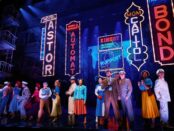
"New York, New York" is a big, jazzy show in the style of golden age musicals we have not seen for a while. While it removes the abusive relationship between Jimmy and Francine from the film, in doing so it waters down the story to a rather old-fashioned “newcomers make good in the big city” tale we have seen before. The theme of racism is handled rather simplistically, borrowing parts of the Lena Horne and Dorothy Dandridge stories. Characters seem to come and go and are often gone for too long a time. The new collaborations by Kander and Miranda are fun to hear but they do not come up to the standard of the Kander and Ebb songs that we know. The show becomes a showcase for the much loved songs “But the World Goes ‘Round” and “New York, New York” which are given pride of place. [more]
Muses
However, both every scene as written by Maldonado and directed by Theatre East’s artistic director Judson Jones is staged as though it were the climax. It is one thing to enact a play up to the hilt. Here there is no arc or build up. Every scene begins at the top and leaves the actors with nowhere to go. Although performed by a tight quartet of actors, as written the characters are two dimensional, telling us no back story and little about them. [more]
Iolanthe (MasterVoices)
MasterVoices concluded its 2022-23 season with a lovely concert staging performance of Gilbert and Sullivan’s rarely seen comic opera "Iolanthe (or The Peer and the Peri)" staged and conducted by artistic director Ted Sperling. The cast was mainly made up of Tony Award winners (Christine Ebersole and Santino Fontana) and Broadway regulars (David Garrison, Jason Danieley and Phillip Boykin) with some fast rising young opera singers (Ashley Fabian and Schyler Vargas) and a principal ballerina from the New York City Ballet (Tiler Peck). All seemed to be thoroughly enjoying their Carnegie Hall outing. The 120-member Master Voices chorus and orchestra gave a glorious rendition of the 141 year old score. [more]
Good Night, Oscar
Sean Hayes, up till now best known for his Emmy Award-winning performance as Jack McFarland on "Will and Grace," gives a titanic performance as humorist, raconteur and pianist Oscar Levant once called the wittiest man in America, in Doug Wright’s new play "Good Night, Oscar." Although Levant is not much remembered today, you can enjoy this character study and depiction of early late night television even if you have never heard of him before. While "Will and Grace" has made evident Hayes’ way with one-liners, "Good Night, Oscar" demonstrates that Hayes is able to dig deep in a character portrayal as well. Credit must go to director Lisa Peterson for inspiring this memorable performance. [more]
The Knight of the Burning Pestle
Directors Noah Brody and Emily Young, both of the Fiasco Theater, have neatly trimmed the dialogue and some of the minor characters so that the play comes in at two hours and 15 minutes. However, they have made some choices that work much less well. Except for a rolling doorway to designate Merrythought’s home, Christopher Swader & Justin Swader’s scenic design does not differentiate one scene from another due to its lack of design elements. Other than the musical interludes, the productions lacks atmosphere in all its scenes. They have also used doubling and tripling to the point where it is difficult to keep straight who most of the actors are when they appear on stage in this play that has probably never been seen by most members of the audience. Most distracting is actress Royer Bockus playing three male roles – Merrythough’s son Michael, Little George, and a Servant as well as a horse named George. The role of Venturewell has had a change of gender but as Tina Chilip is still called “Merchant” but does not suggest one in her 17th century matron costume, this remains a little disconcerting. Characters who play major roles in one scene return to play minor roles in others which is more than a little confusing. [more]
The Thanksgiving Play
Larissa Fasthorse’s "The Thanksgiving Play" gives a good tweaking to those who are so hung up on political correctness that they dare not make a decision. On the other hand, the play reminds us how difficult it is to be fair to all sides of the historical spectrum. The erasure of the Native American point of view is made clear by their very absence from the play, while the problem of educators knowing how to walk the fine line between inclusion and suitability is given a rare airing in this delightful parody. The use of in jokes, theatrical, historical and educational notwithstanding, "The Thanksgiving Play" is a satire that entertains while it makes some very real and needed points about political correctness when dealing with unpleasant American history. [more]
Plays for the Plague Year
While the playlets seem too slight to have much dramatic weight as they are mainly about one minute long, they do have a cumulative effect summing up a year that was like no other in recent memory. Often the scenes feel like they want to go and continue, but Parks keeps them short. Periodically, we have a one sentence scene telling us how many people have died from Covid as of that date. Beginning on March 13, 2020, the first full day of the shutdown, the playlets continue until April 13, 2021, a year and a month from when Parks started. An electronic sign above the stage states the date of each scene and its name which include such titles as “Home,” “Broadway Is Closed,” “The City at 7 PM,” “Who’s Gonna Pay For This?,” and “Hiatus 4 Months: Holding It Together Together.” [more]
On the Right Track
The latest collaboration by composer lyricist Albert M. Tapper and bookwriter Tony Sportiello, "On the Right Track," proves to be a charming chamber musical for three performers playing seven roles. The show combines realism with magic and the supernatural as it tells three stories which take place on a New Jersey Transit train. The Conductor, the narrator, also is a mystical figure who is able to give the characters second chances in life and lea them to a better place than when they came on board. Owing some inspiration to such classics as Sir James M. Barrie’s "Dear Brutus", Sutton Vane’s "Outward Bound" and Frank Capra’s "It’s a Wonderful Life," "On the Right Track" avoids being preachy at the same time that it offers suggestions about how to live one’s life. [more]
Camelot
Unfortunately, though Sorkin may have made this "Camelot" more politically correct, scientifically accurate and less supernatural, it is much less entertaining and magical than earlier productions and certainly much darker as well as less funny. Whereas the original 1960 Broadway production billed itself as “the most beautiful show in the world,” Bartlett Sher’s revival has an almost empty grey stage most of the time (designed by Michael Yeargan) and drab costumes from Jennifer Moeller. Although the cast has 25 performers, the court scenes always look underpopulated as though not enough courtiers have shown up and there is almost no pageantry which one expects for a royal court of the Dark Ages or the Middle Ages. [more]
Emilie: La Marquise du Châtelet Defends Her Life Tonight
Gunderson uses two actors to play Emilie and writer Voltaire who was her mentor, companion and lover, and then three actors to play everyone else, from Emilie’s mother, husband and daughter, to servants and mathematician Sir Isaac Newton and poet Jean-Francois de Saint-Lambert. As they do not change their costumes, we are never entirely certain who they are when they reappear. Throughout the play Emilie is working on the physics formula F=mv2 (known as force vive) which she attributes to German mathematician and thinker Gottfried Wilhelm Leibniz. Unfortunately, this math will be foreign to most theatergoers who have not studied physics. Emilie narrates and addresses the audience, then turns back and interacts with the other characters on stage. She also keeps score in chalk on the walls as whether Love or Philosophy is in the ascendance. The play, cast as a flashback, has very short scenes so that a great deal passes in a short time. While the first act seems to be bits and pieces, the second act settles down into a more dramatic confrontation between Emilie and Voltaire and becomes more involving. MacGowan never finds the right tone to accomplish all of this. [more]
Smart
Mary Elizabeth Hamilton’s Smart has an interesting premise but does not carry out its goal turning quickly into a domestic drama and later a bittersweet love story. The two acts seem to be two different plays while the sketchy characters do not give the fine three actresses much to work from. Even the production values get in the way of understanding the play. Hamilton has a good ear for dialogue but needs to work on plotting and characterization in order to make this a satisfying theatrical experience. [more]
Life of Pi
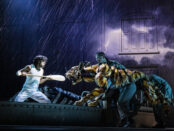
"Life of Pi" is a unique theatrical experience with its animal puppetry, depiction of days on the ocean, and bringing to life an Indian city, circa 1977. It tells a fantastical story with brio and flair making use of all of the theatrical arts. With a cast led by Olivier Award winner Hiran Abeysekera, you could not imagine anyone else in these roles. However, the playwriting and the production do have their flaws which are eventually overcome by its theatricality and storytelling. Kudos to director Max Webster for orchestrating the production so well. [more]
Vanities – The Musical
Although the women grow up and change over the 26 years we see them, Heifner’s book tends to stay away from politics and the women’s movement other than mentioning markers like Kennedy, Nixon and Bob Dylan. However, the dialogue is bright and lively. The show is definitely a period piece ending as it does in 1990 but there are probably women who still live these lives. While in no way taking a feminist point of view, the characters do evolve and change over the years. [more]
The Harder They Come
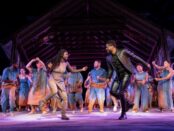
Celebrating the 50th anniversary of its original film release, Pulitzer Prize-winning playwright Suzan-Lori Parks has turned "The Harder They Come," the cult Jamaican film that starred later reggae legend Jimmy Cliff, into an exuberant stage musical now at The Public Theater. Led by British stage star Natey Jones and American Caribbean actress Meecah, the large cast does full justice to the new score which includes the ten songs used in the movie plus 26 other Jamaican and traditional songs, additionally interpolated ones by Cliff and others, and some with additional lyrics by Parks. There are also three original songs by Parks herself who when she is not involved with one of her plays fronts her own rock band. [more]
Bad Cinderella
The book of "Bad Cinderella" plays like a series of unfunny "Saturday Night Live" sketches. Laurence Connor (who also directed the earlier London production) has given the show no particular style and each scene seems to be in another genre. The show can’t decide if it is taking place now - with its references to rock band Guns N’ Roses (parodied in the song “Buns ‘n’ Roses”),its use of both diversity and inclusion, a female Vicar, its erotic baker, reference to a “spare” prince, and its shirtless muscle hunks seen in the palace gym – or the Middle Ages. [more]
The Good John Proctor
Unfortunately, Monohon’s play which takes its cues from Miller’s drama, assumes a thorough knowledge of "The Crucible" and leaves out a great deal of information that would make it easier to follow. For example, John Proctor’s name is never uttered by the girls even after Abigail goes to work for him and his wife in the play. Caitlin Sullivan’s direction is too tame by far so that the play is not very dramatic. The most exciting event, the trial itself, is left as an afterthought and narrated years later by one of the girls after her death. [more]
Arden of Faversham
The problem with this production is that although the characters’ behavior is utterly outrageous on the verge of satire, Berger has directed in so flat and bland a style, that shocking lines that should get embarrassed laughter fail to make any impression. Has Berger directed the play absolutely straight knowing that his audience is unlikely to be familiar with it? It would be more fun and rewarding if was as over-the-top as the murderers’ plotting. [more]
The Hunting Gun
Not for everyone, this minimalistic theatrical event is performed entirely in Japanese with English language supertitles above the stage so that for non-Japanese speakers it requires reading of the text throughout. More’s the pity as Nakatani is a very expressive actress (having won six Japanese Academy Awards) and one doesn’t want to miss a moment of her performance. [more]
A Doll’s House
Like Ivo van Hove’s pared-down revival of Arthur Miller’s "A View from the Bridge," Jamie Lloyd’s new Broadway production of Henrik Ibsen’s 1879 "A Doll’s House" uses no sets or props and all black costumes for the entire cast. Going even further than van Hove, he has the heroine Nora Helmer played by film star Jessica Chastain seated almost for the entire length of this intermission-less three-act play. Using a new version by Amy Herzog recast in spare modern vernacular, this Doll’s House proves to be riveting and intense, even if you know the play very well, focusing our attention on the dialogue, the acting and emotion, rather than the décor and the historical trappings of 19th century Norway as we usually do. [more]
The Rewards of Being Frank
While playwright Scovell has a facility for language, she does not have the wit to mimic Wilde’s classic one-liners. Instead, she borrows expressions from the play and attempts to imitate the format of his humor. Lines like “It is imperative to be an attentive hostess, but never forgot that you are your most important guest” and “I’m glad to hear that your fervor for the truth is tempered by your humanity” pass for witticisms. Much time is spent on whether a wedding was “elegantly extravagant” or “extravagantly elegant.” The opening scene of the first act (and the end of the second act) is devoted to a discussion of cucumber sandwiches, which Wilde did justice to in his play and as such this comes as no surprise to an audience versed in the earlier work. [more]