JOEL BENJAMIN was a child performer on Broadway and danced with leading modern dance and ballet companies. Joel has been attending theater, ballet and opera performances ever since childhood, becoming quite opinionated over the years. He was the founder and artistic director of the American Chamber Ballet and subsequently was massage therapist to the stars before becoming a reviewer and memoirist. He is a member of the Outer Critics Circle.
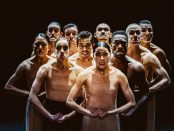
In her selection of the movements and structure of "Four Quartets," Tamowitz chose to ignore the depth and imagery of the poems, producing a cool Merce Cunningham-like ballet that glided along beautifully on the surface of Eliot’s heavy, sometimes distasteful, imagery. Movements were balletic, full of arabesques, skittery connecting steps, soft leaps and jumps. She built the work upon a series of steps and phrases that are repeated in various ways: jumped, turned, performed alone, performed in unison and performed in reverse. One salient image was that of a dancer jumping into the arms of another. Other than that there was very little touching. The barefoot dancers often mimicked each other or performed side by side. Only two duets occurred, one quite long near the end, watched by the other cast members gathered at the corners of the set. [more]
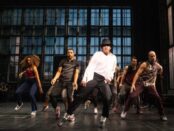
Wheeldon and Pulitzer Award-winning playwright Lynn Nottage make every effort to hide the fact that MJ is a jukebox musical, despite the fact that the first notes of every song elicited loud shouts and applause (part of the reason the show runs two and a half hours). Nottage has invented a plodding framework for the show. It is 1992 in Los Angeles. TV reporter, Rachel (a down-to-earth Whitney Bashor who acts as the play’s Greek chorus) and her hyperactive assistant, Alejandro (a charming Gabriel Ruiz) corral a reluctant Jackson to have his rehearsals for his huge upcoming 'Dangerous" tour documented. [more]
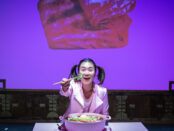
Who knew that SPAM has figured so importantly in Korean and Korean-American cuisines? Jaime Sunwoo’s "Specially Processed American Me" tells that story and much more. "Specially Processed American Me"—check out those first letters!—uses SPAM as a metaphor to explore the huge subject of the Korean War, SPAM and her own intimate, moving autobiography as a Korean-American. [more]
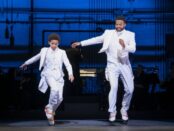
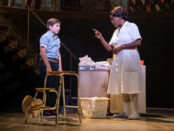
Let’s start with the best: The great Joshua Henry’s 11 o’clock number, “William’s Song,” a gut-wrenching revelatory song sung by the title character’s emotionally distant father. Henry endows the number with the emotional punch of “And I Am Telling You” from "Dreamgirls." Since Henry Krieger wrote the music to both songs the striking similarity is understandable. Of course, Tom Eyen wrote the "Dreamgirls"’ vivid lyrics and librettro; Robert Lorick wrote the words for the pleasant, plot-moving score of "The Tap Dance Kid." "The Tap Dance Kid"—book by Charles Blackwell, based on the novel "Nobody’s Family Is Going to Change" by Louise Fitzhugh—is a simple domestic tale now reset in the 1950’s, gussied up with the brilliant tap choreography of Jared Grimes and the keen, vivifying direction of Kenny Leon. But, even under Leon’s artful hand and Grimes’ beautifully performed numbers, "The Tap Dance Kid" remains a defiantly unimaginative story. [more]
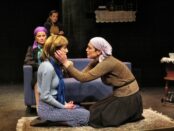
The New Yiddish Rep’s (David Mandelbaum, artistic director) production of the Yiddish language "Di Froyen (The Women)" is a bittersweet, anger-inducing portrait of modern day Chasid women caught between orthodox Jewish ideology and the rush of modern society’s laws and attitudes into their lives. Adapted by Malky Goldman and Melissa Weisz from Naomi Regan’s "Women’s Minyan," "Di Froyen," in one compact, tense hour, opens up a previously secret world to the public. Here are six women, all wearing sheitels (wigs that orthodox Jewish women must wear because showing their own hair is proscribed by religious law) and all under immense pressure from within and without their enclave. [more]
Turning the plight of New York City’s homeless into a game is an iffy proposition to say the least. At best, the audience for the theatrical effort, "Addressless: A Walk in Our Shoes," learns about the daily terrors facing this disenfranchised population; at worst, the interactive game overshadows the very same awful truths turning homelessness into a superficial search for more and more points. The Zoom audience, giving advice to the actors who portray the unfortunate avatars of three luckless souls, takes the focus off of their tragic, often inescapable circumstances. [more]
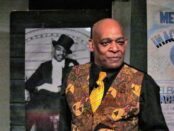
He used the gimmick of preparing to perform the very show he was performing for his audience in the Cabaret Theater of the Theater for the New City; but by the end of his fascinating and grueling life story he was on fire with his tale of his life in the theater and film. He grew up in the Sixties when the U.S. was in turmoil and it seemed that everyone was getting high. Smokey’s career began with a first prize in his Washington, D.C., high school talent show and some performances at the Arena Stage. He quit school to try his luck in California but failed and returned to D.C. where he joined an all-Black repertory theater and appeared in his first commercial which he showed on a large screen. Much later he appeared in Francis Ford Coppola’s "The Cotton Club" as a featured musical performer. His number in the film was shown proving he was an impressive dancer and singer partnered by Jackée Harry. [more]
Parsons’ first work on the program was the tour de force solo “Balance of Power” performed by the phenomenal Zoey Anderson. Clad in Barbara Erin Delo’s brilliantly colored tight costume—the bright red left sleeve particularly inventive—Anderson first appeared upside down in a golden spotlight. (Lighting by Chambers.) As she turned right side up, she began undulating to Giancarlo De Trizio’s sparkling score, her body reacting to every nuance of the quite rhythmic music. Parsons unloaded hundreds of difficult tiny movements on her which she performed with skill and allure, stopping the show with her quickness and sensuality. [more]
If you are a Princess Diana completist, "Diana: The Musical" will satisfy your needs along with the deeper Spencer and The Queen and all the innumerable documentaries about this ill-fated fairy princess. Those interested in delving deeper into the Princess Diana mystique will be disappointed with this superficial, but somehow entertaining, musical. [more]
When Sonny Marie Lee stepped onto the stage of the Actors Temple Theatre as the eponymous "The Bronx Babe" I thought she was putting the audience on, acting the stereotypical, Noo Yawk accented girl telling her memories of a stressful period in her life that tested her mettle. But, no, the woman who stood before us, the woman who both wrote and directed "The Bronx Babe," was obviously unaware of her theatrical shortcomings as she blithely told tales of her early teen years in the racially charged Bronx of the 1970’s. [more]
Unfolding from a stand-up comedy routine—“A prisoner walks into a bar…!”—and set in a comedy venue designed with ingenuity and style by Walt Spangler, Turtle veers from hokey to horrible helped by the spiffy routines staged by choreographer Kenny Ingram in over-the-top, sometimes kitschy, routines. Where else can you see dancing prison guards waving their batons as they tap dance in a circle or the flexible actor Josh Marin portraying an ATM and a basketball hoop? [more]
"Caroline, or Change" is an important musical, more now than in 2004. It should be seen. The Roundabout production, though somewhat flawed, still communicates the complicated relationship between Blacks and Jews, clearly an issue in today’s New York City. It is an excellently constructed show, its message surviving mostly intact. [more]
Now there’s "Swan Lake Rock Opera" created by Mirit Shem-Ur (book and lyrics), Tsedi Sarfati (director and dramaturge) and Sharona Pick (music production and additional music). The show uses orchestral themes from the original Tchaikovsky score and clever pop variations to create witty songs and underscoring. The libretto of "Rock Opera" follows the original Swan Lake plot points which tell of Young Prince Siegfried, ordered by his mother the Queen to choose a fiancée from a list of foreign princesses she has assembled. He goes off to hunt to avoid making a decision and meets the Swan/Woman Odette and falls in love only to be deceived by her doppelganger Odile, an agent of the evil Von Rothbart who has cast a spell that turned women into swans. This deception leads to tragedy. [more]
Before the dancers appeared live, "Dance" commenced with a burst of Glass’ iconic, pulsating music—here pre-recorded, originally performed live—and a still from LeWitt’s original video projected onto a scrim which covered the entire stage opening. LeWitt’s videos, intimate contributions to the work, also served to honor the performances of the original cast: Childs, Graham Conley, Cynthia Hedstrom, Erin Matthiessen, Daniel McCusker, Susan Osberg, Judy Padow, Ande Peck and Megan Walker. [more]
The final work on Program 1 was its finest. A.I.M. By Kyle Abraham presented its director’s “Our Indigo: If We Were a Love Song,” a deeply moving paean to the darker meanings of love. It was choreographed to Nina Simone’s glorious renditions of six songs in which she wrapped her moving contralto around the lyrics of “Don’t Explain,” “Black is the Color of My True Love’s Hair,” and “Little Girl Blue.” The opening moments found the seven-member cast gathered in a dramatically lit upstage corner—moody lighting designed by Dan Scully—bending and reaching, dispersing only to return to their sculptural starting image. [more]
DiMurro writes with an acute sense of the rhythm of New York speech and its old-school jargon, helped by director William Roudebush’s complementary sense of timing, not to mention four expert actors who know how to embody these characters. Herrick Goldman’s atmospheric lighting and Andy Evan Cohen’s brilliant urban soundscape immeasurably added to the overall impact of "1-2-3 Manhunt." [more]
The dances on this program are perfect examples of the Denishawn aesthetic which combined what was then exoticism with impeccable theatricality. The Denishawn troupe was very much of its time, the early twentieth century. The modern dance giants that came out of this artistic sensibility—Martha Graham, Doris Humphrey and Charles Weidman in particular—revolted against the exoticism to find a modern way of expressing themselves through movement, the way that artists who were their contemporaries put distance between them and the Impressionists. These modern dance pioneers learned the ins and outs of dramatic presentation as they forged new dance forms. [more]
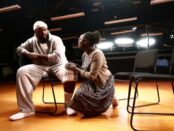
Benjamin Viertel directs "Between the Bars" brilliantly finding the balance between theatricality and reality. Each character emerges as distinct and multidimensional, even the guards who sit passively until they show their savage sides. This is a cast of fine actors who communicate both the indignities of confinement and its ultimate tragic toll just feet away from the audience. [more]
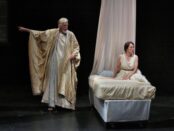
It is to the credit of the entire cast—dressed in Anthony Paul-Cavaretta’s period tunics and flowing robes—that Lackey’s sometimes over-the-top dialogue lands credibly. Two other elements elevate the play: Michael Sirotta’s lovely, mood-enhancing score and Jon DeGaetano’s imaginative scenery which includes large, stage-spanning curtains that cleverly serve as entranceways, sails and even ancient columns. Michael Redman’s moody projections enhance Sirotta’s contributions. [more]
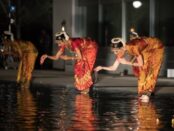
As the opaquely complicated plot played out on the stage, the three lead dancers (Ranee, Aparna and Ashwini Ramaswamy) took turns displaying impeccable Bharatanatyam technique: feet adorned with ghungroos (ankle bells), softly pounding out clear rhythms in varied positions, arms, exquisitely expressive, moving in striking patterns topped by constantly changing hand positions (mudras) which communicated character, mood and, to some extent, the story as it unfolded. [more]
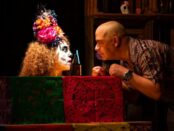
Sadly, these promises aren’t kept in this mishmash of plots and characters that never quite meshes into a viable whole; it remains an unsteady comedy/fantasy never morphing into a smooth-running play. Cissel awkwardly interrupts the play, alternating reality—such as it is—with colorful dance/mime sequences. The characters—including the Mother/aka Severed Head—yell at each other, most often about that poor, ubiquitous head, garishly made up for the Mexican celebration of El Día de los Muertos. Every time the head speaks her mind the play comes to impudent life. [more]
"Roles and Rules of Comedy," six short comedic bits of fluff written and directed by Harold Dean James is a character-driven view of contemporary New York City. Presented at the elegant Players Club on Gramercy Park by We Three Productions, James deals mostly with down-to-earth people like Donna (Donna Kennedy) and Jaymie (Sharon Fogarty) who meet at a bus stop awaiting a ride that never seems to arrive in “At the Bus Stop Part 5.” [more]
It’s unlikely that New York City will ever see these five troupes sharing a stage again. This was a festive occasion despite being uneven in tone and not particularly representative of at least two of the large dance companies. Pretentious program notes were fortunately only available online so that they couldn’t mar the visceral enjoyment of several of these works in Program One. ... Each evening of the BAAND Together Dance Festival will feature a different program with contributions from each of these five wonderful dance companies. [more]
It is definitely worth a gander for both its subject matter and its performer, the disarming and immensely talented Jon Peterson who also adapted the one-man play from Chip Deffaa’s original stage production which Deffaa previously staged. Peterson directed this filmed adaptation and choreographed the scintillating tap routines matched with joyous precision to Cohan’s repertoire of gung-ho Americana. (Think “Over There,” “You’re a Grand Old Flag,” “Give My Regards to Broadway” and “Forty-five Minutes from Broadway.”) The choreographic high point was Peterson’s hip-swinging dance to “The Hinkey Dee.” [more]
Hamilton Clancy, the artistic director of The Drilling Company, joins forces with his assistant director Karla Hendrick to stage The Two Noble Kinsmen in a modern-dress version that makes the plot of the play more accessible to the al fresco audience but tends to devalue the Elizabethan language. They have even added a few very modern turns of phrases and pop tunes to elicit laughs during the few lighter moments of the plot. [more]
She gets to sing everything from the Patsy Kline classic “Crazy,” “Respect” (made famous by Aretha Franklin), and “Summertime” from Porgy and Bess to generous, beautifully acted scenes from Bizet’s Carmen, her favorite role and the highlight of the show. The setting, a comfortable, slightly formal room (by Jaime Terrazzino) also includes a convenient grand piano played by John DiPinto (who alternates with Allison Brewster Franzetti), clearly delighting in collaborating with this warm-hearted diva. [more]
In what might just be the best stage role of her career, Jackie Hoffman plays the multi-faceted Ariana in E. Dale Smith’s "Fruma-Sarah (Waiting in the Wings)" at Nancy Manocherian’s the cell theatre in Chelsea. Sitting in place, attached to a hefty rope, she takes the audience and her co-star, Kelly Kinsella as Margo Peterson, “substitute fly captain,” on a journey of a life not well, but interestingly, lived. [more]
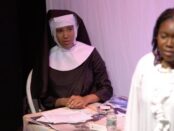
The Icarus of Icarus and Amina is a poster of Henri Matisse’s brilliantly colorful abstraction of that Greek mythological character who soared too close to the sun, and Amina (Sidney Caruth who skillfully balances sweetness and strength) is a Bangladeshi who has just this day graduated from a Catholic high school. Because Amina hasn’t made any real friends even after four years of school, she gravitates to Sister Tre’s classroom ostensibly to say good-bye, a farewell that morphs into a bit of soul searching. Rachel McCain (a walking illustration of “still waters run deep”) plays Sister Tre, a Filipina nun and Amina’s favorite teacher and mentor who cautiously welcomes Amina into her classroom as she does some end-of-term tidying up. [more]
Havel’s Audience represents CAMT’s first foray into modern Czech literature having previously staged imaginative productions of folk material. This visit to contemporary theater, unfortunately, wasn’t as successful as most of CAMT’s fairytale presentations. The combination of whimsical marionettes and psychologically sophisticated drama didn’t gel. The autobiographical Audience pits Havel’s alter-ego, Ferdinand Vanĕk (played by Vít Hořejš who also translated and directed the play), against The Brewmaster (Theresa Linnihan) in what initially seemed to be casual, directionless banter during a workday at a beer brewing company. Preceding the actual play were a series of historic newsreels—prepared by Suzanna Halsey—showing how Czechoslovakia (when it was still called Czechoslovakia) descended from the high hopes of 1968—euphemistically called the Prague Spring—to the depths of despair following the Soviet Union’s crushing invasion to put down what they perceived as a pro-West revolution. The newsreel images were far more frightening than Havel’s two hander which is clearly meant to reveal in everyday terms just how nefariously the communist, totalistic credo infiltrated daily life in Prague. [more]
Written by Krista Knight and Brinegar, Sloppy Bonnie follows its title character (played with irresistible zest by Amanda Disney) as she lays waste to everything and everyone in her path, leaving car wrecks and bodies spread across the South. Two exuberant actors, Curtis Reed and James Rudolph II, portray all the other characters—male and female—beginning with zippy “cosmic” FM radio hosts, Chauncey and Dr. Rob, who deliver homey philosophy and songs. They introduce Bonnie, clad in a slightly slutty outfit—revealing blouse, ridiculously short skirt and white patent leather boots (by Alex Sargent Capps, Megan Haase and Gabrielle Saliba)—straight out of Li’l Abner which is an apt reference as the entire physical production is presented as a brightly colored cartoon with elaborate framings, abstract designs and hilarious manipulations of the actual performers’ appearances. [more]
“Sea,” according to Magloire’s program notes is “loosely inspired by the movement of waves.” Five dancers—Anabel Alpert, Megan Foley, Amber Neff, Rachele Perla and Alison Tatsuoka-dressed in Sarah Thea’s beautifully flowing blue costumes, certainly moved in ways that were wavelike, but they also seemed to be performing a constantly shifting ritual that eased from quietly intense to agitated and back—from languor to vigor. [more]
Sutton Foster, one of the shining lights of New York City’s currently dimmed theater scene, glowed in Sutton Foster/Bring Me to Light. Her voice and interpretations were the richest they have ever been. Add to this her choice of repertoire and her talented guests and Bring Me to Light is a beacon of light in a dark year. As we see New York City Center’s backstage staff prepare for the performance, Foster performed the Rodgers and Hammerstein classic “Cockeyed Optimist” segueing to Stephen Sondheim’s “Everybody Says Don’t” and Kander and Ebb’s “Yes,” all upbeat, optimistic songs that should resonate with today’s pandemic-strained audiences. [more]
Ephrat “Bounce” Asherie, the artistic director of the effervescent Ephrat Asherie Dance (EAD) has absorbed the disciplines of a number of dance forms: hip-hop, breaking, Latin-American and Vogue. She skillfully and wittily scanned all of these into Odeon, a 105-minute long work that showed off her six member troupe. They—including Asherie—danced with a verve, if not native authenticity, that matched the Brazilian-tinged score by Ernesto Nazareth, here interpreted by an on stage four-member band under the musical direction of Ehud Asherie. [more]
Aguirre manages to have written a play that doesn’t feel like a play thanks to his interpretation of the main character. He doesn’t overdo the emotions, letting the songs carry that weight for him. Sarah Norris’ direction—aided by Hallie Griffin’s skillful film and sound editing—is unobtrusive except for allowing the two women characters to veer towards stereotype, particularly when Aguirre’s Allen is so natural. [more]
"Jericho" has a great deal going for it. It is directed by Marsha Mason and features Jill Eikenberry. These two formidable theater artists’ participation promises quality which is evident from the first scene on to the quietly scathing denouement. Jericho also has proven itself in a run in 2013 at the 59E59 Theaters. Its intimate, six character scale lends itself to the close-ups of streaming which Mason deftly juggles with a combination of in-your-face emotion and wit. [more]
Now directed by the energetic and warm Enrique Cruz DeJesus, Alpha Omega provided welcome relief from months of quarantine and angst with “Solo Suites,” a breezy—in every sense of the word—outdoor, healthily spaced program created by three choreographers who have had the privilege of working in this inviting space, a beautifully appointed home base in the East Village.
Now directed by the energetic and warm Enrique Cruz DeJesus, Alpha Omega provided welcome relief from months of quarantine and angst with “Solo Suites,” a breezy—in every sense of the word—outdoor, healthily spaced program created by three choreographers who have had the privilege of working in this inviting space, a beautifully appointed home base in the East Village. These three choreographers presented four solos as the carefully spaced, masked and wine imbibing audience watched as breezes swept up the costumes. After calmly (and professionally) enduring a minor audio snafu, Ari Mayzick opened the program with his “Orphée,” a tense study of grief, an intense take on the Orpheus and Eurydice legend. [more]
“Rooms2020” was to have been presented in a live season which was aborted by the current Covid crisis. Instead, the troupe has presented the work artfully streamed in a version that is more realistic, each section filmed by the dancers themselves and edited with artistic precision and a feeling for its dramatic arc by associate artistic director Lauren Naslund to make a cogent whole. (The other directors are the founder Jim May, Samantha Geracht and Eleanor Bunker.) [more]
Van Hove's energetic cast is too often lost among the video images which is sad because they are a wonderfully scrappy group of actor/dancer/singers who give their all. (I’m told that this is less of an issue in the higher reaches of the theatre due to the difference in perspective.) To be sure, there are wonderful moments where the groups move about in cityscapes that constantly change around them, but these are countered by long scenes during which the actors appear to be lilliputian figures whose singing and emoting get lost in the confusion of giant faces. [more]
If one were to come to conclusions about the Netherlands after seeing the three ballets presented by the Nederlands Dans Theater at the New York City Center, the Netherlands would clearly come off as a place of doom and gloom where relationships are expressed by tossing each other around or totally avoiding contact. This world-class dance troupe is always welcome, but one has to wonder who programmed this mini-season. Of course, the company’s artistic director Paul Lightfoot who co-choreographed one of these works has to have been the driving force in putting this show together. [more]
This illustrates the biggest problem with "Suicide Forest": it takes on too many issues, jumping from social to sexual to mythological to intimate family subjects. Making the play even more difficult to understand is that it is performed in both Japanese and English. In addition there is some confusing cross-ressing. "Suicide Forest" is alternately funny, disgusting and moving, making it too often a tiring show to sit through despite its wealth of social commentary. The director Aya Ogawa kept the show rolling along but couldn’t make all the parts gel. [more]
Music director Andy Einhorn who conceived the show was a genial, informed host. Having worked as the music supervisor and music director for the most recent revival of "Hello, Dolly!," he was at times overcome with emotion as the show, directed by Cady Huffman, revealed all of Herman’s richness and, yes, sophistication. Listening to and quoting Herman really got to Einhorn whose beautiful arrangements buoyed all the songs. [more]
Could there be five more self-involved, selfish, self-deceptive characters than those who populate Lily Akerman’s "The Commons" at the 59E59 Theaters? No, these five roommates aren’t evil, just depressingly of the here and now, young people who have lost the ability to communicate honestly with each other. There’s a problem with a 90-minute play about people who do not connect: it is an unrewarding slog for an audience to sit through. [more]
"Goy Friendly" is clearly meant as a light entertainment with lecture-demonstration components and succeeds as such. It’s delightful spending time with this superb raconteur, even if he cleverly sidesteps the deeper implications of his subject matter. [more]
Hosted by the Graham Company’s elegant director Janet Eilber, the program began with some historical comments after which two groups of dancers, one representing the Graham technique from Graham 2 and the other the Cunningham technique from the Merce Cunningham Trust entered the large studio/theater. They performed parallel exercise routines, the Graham side guided by Virginie Mécène, Graham 2’s director and former Graham star and the Cunningham contingent guided by two former Cunningham members Jennifer Goggans and the aforementioned filmmaker Madoff. [more]
“The legend returns” claimed the fliers and posters for "Matthew Bourne’s Swan Lake"’s short season at the New York City Center. That proclamation wasn’t far from the truth. "Swan Lake" is definitely Bourne’s most famous and prolifically performed work from a repertory that includes "Edward Scissorhands," "Sleeping Beauty" and "The Red Shoes," all having made touchdowns in New York City with varying success. Only his "Swan Lake" has caught the imagination of audiences throughout the world despite its daring take on a beloved classic. [more]
The 92nd St. Y’s Lyrics & Lyricists, one of New York’s leading propagators of the Great American Songbook, featured the witty and sardonic songs of E.Y. “Yip” Harburg in its most recent edition: "E.Y. 'Yip' Harburg: Follow the Fellow Who Follows a Dream." Harburg, famous for writing the lyrics for "The Wizard of Oz" and "Finian’s Rainbow," wrote over 600 songs with many collaborators. The show gracefully explored his oeuvre and his life using the extraordinary talents of five fine singers and a superb band led by Paul Masse who supplied the often surprising orchestrations. They were helped by vivid projections by Dan Scully that showed New York City street scenes, theater marquees, historic programs and posters as well as photos of a genial looking Harburg who tried all his life to defy all the prejudices and inequities of his time and replace them with his complex and colorful lyrics that featured witty rhymes and references. [more]
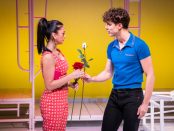
"Romeo & Bernadette," a fresh take on Shakespeare’s oft-adapted tale of love, is an unabashed valentine to inter-era romance. Shakespeare’s Romeo (cutie-pie Nikita Burshteyn, perfectly cast) is magically time-travelled to 1960’s Brooklyn to seek Bernadette (beautiful Anna Kostakis who plays both the foul-mouthed Bernadette and the demure Juliet), a striking doppelganger of his beloved sixteenth century Juliet. There he meets members of two rival Italian mobs who substitute, 1960-style, for the Capulets and Montagues. [more]
By stripping the story of local color—even the projections show little but an anonymous seascape—the creative team does ill by "Sing Street. " Take away the Irish accents, the 1980’s songs and a quick reference to The Famine, and this story of alienated teens could have taken place in Boise, Idaho, or Buenos Aires, Argentina. Let’s face it, the let’s-put-together-a-band-to-solve-our-problems was even a common theme in MGM films of the forties! (The original "Sing Street" movie, of course, was filmed in Dublin and was filled to the brim with local color and the grimness of economic distress.) [more]
Israeli-born choreographer Zvi Gotheiner created "Maim ('Water' in Hebrew)," a somber meditation on water, drought, misery, community and survival for seven members of ZviDance, all brilliant dancers with clearly defined personalities. Somehow, in under an hour, Gotheiner managed to dredge up memories and images of his early life on a kibbutz and how valuable water was in the life of his community. That, added to the current climate crisis’ causing drastic drought concerns, stimulated him to produce "MAIM ('Water' in Hebrew)." [more]
After marveling at Ken Jennings’ power of memorization, one has to admire his ability to deliver the entire text of "The Gospel of John" with unwavering clarity and devotion to its meaning both as literature and as a Christian lodestone. An agile actor (and singer), Jennings (the original Tobias in "Sweeney Todd"), deftly tells the story of Jesus as seen through the eyes of John the Baptist. The actor roams about a simple raised platform in front of a rough-hewn back curtain made of wrinkled tan cloth. What looks like a handmade bench—a subtle reference to Jesus’ vocation?—completes the set. [more]
Goldfaden’s escapist musical fantasy combines bits and pieces from many sources: the Cinderella fairy tale; Gilbert-and-Sullivan-esque rapid-fire, tongue twister songs; old-fashioned (even in 1878!) melodrama; Mozart’s The Abduction from the Seraglio; and—believe it or not—the Seventies’ TV sitcom, “Laverne and Shirley”! (The L & S reference, to be absolutely honest, might be an interjection improvised by the actor—yes actor—playing the title role.) [more]
His more abstract ballets for The Chase Brock Experience, such as its current presentation at Theatre Row, "The Four Seasons" to the Vivaldi score (a revival from 2006), did not fare quite as well. Despite the fact that "The Four Seasons" had some spoken text (by David Zellnick) and an environmental subtext, the majority of the work was a pretty, but slightly anemic balletic expression of the famous (over-used?) score. [more]
Do we really need another Jukebox Musical on Broadway—another hum-along, sing-along, déjà vu, vaguely autobiographical songfest? When the subject is as charged up as Tina Turner, the answer is yes—a conditional yes, but….yes, especially when the title character is embodied by the sensational Adrienne Warren who gained accolades for her rendition of Tina in the original London production and is one of the main reasons Tina gained the momentum to make the jump to Broadway. [more]
Artistic director Enrique Cruz DeJesus presented a performance of Alpha Omega in preparation for the troupe’s fiftieth anniversary season next year. This concert featured two works by the brilliant modern dance choreography Eleo Pomare whose works have, for some reason, been neglected for years. Mr. Cruz DeJesus also presented two of his works, “Bittersweet” and “Tormenta.” [more]
Tiffany Mills’ "Not then, not yet," a world premiere dance/theater work at The Flea proposed a dark, slightly chaotic view of relationships and alienation choreographed on her own troupe, the Tiffany Mills Company. Only 45 minutes long, Not then, not yet was dense with activity and glum interactions among the six dancers (including Mills) and singer Muriel Louveau who composed the erratically performed score, co-written with Angélica Negrón. [more]
In 1957 Truman Capote disingenuously misled the legendary actor Marlon Brando into opening up to him under the guise of helping to publicize the soppy melodrama, Sayonara which Brando was then making in Kyoto. This now infamous interview caused quite a stir for its snarky tone and caustic observations about Asian women. In their "BrandoCapote," Sara & Reid Farrington have sliced and diced this article, added music, fanciful Japanese costumes and rather severely stylized choreography and come up with a fascinating theater piece. [more]
In a counterintuitive casting coup, handsome Jonathan Groff stars as the nebbish Seymour Krelborn who works at Mushnik’s (a funny, kvetchy Tom Alan Robbins) failing flower shop on Skid Row. Seymour discovers an odd potted plant in Chinatown after an eclipse, a plant that leads to great success for both Mushnik and Seymour. Although it is difficult to forget Groff’s physical attributes (well-hidden under Tom Broecker’s costumes), he delivers a brilliantly realized sad sack Seymour. Poor Seymour is in love with the much put upon Audrey played with ditzy perfection by Tammy Blanchard. Two-time Tony Award winner Christian Borle chews the scenery as Audrey’s sadistic dentist boyfriend, Orin Scrivello plus several other characters such as a William Morris agent and an NBC TV executive. [more]