
News Ticker
- December 12, 2025 in Musicals // The Faggots and Their Friends Between Revolutions
- December 12, 2025 in Cabaret // Mary Foster Conklin — Mirrors Revisited (50th Anniversary)
- December 11, 2025 in Cabaret // Kathy Kaefer — Kiss Me Once: Stories from the Homefront
- December 11, 2025 in Off-Broadway // The American Soldier
- December 9, 2025 in Off-Broadway // This World of Tomorrow
- December 9, 2025 in Cabaret // A Noel Coward Celebration — Steve Ross & Friends
- December 7, 2025 in Off-Broadway // Diversion
- December 5, 2025 in Off-Broadway // Meet the Cartozians
- December 5, 2025 in Features // Tom Stoppard: An Appreciation
- December 4, 2025 in Off-Broadway // Practice
- December 4, 2025 in Cabaret // Eddie Bruce — The Magic & Music of Tony Bennett
- December 3, 2025 in Interviews // Interview with Ty Jones, Classical Theater of Harlem
- December 2, 2025 in Features // Gingold Theatrical Group’s 20th Anniversary Gala at The Players
- December 2, 2025 in Interviews // The American Soldier – An Interview with Douglas Taurel
- December 2, 2025 in Off-Broadway // A Bodega Princess Remembers La Fiesta de los Reyes Magos, 1998
Archive
Jennifer Kidwell’s "we come to collect: a flirtation, with capitalism" is not so much a theatrical production as it is a revelation—an offering, a conjuring, a glittering séance of self-examination draped in velvet and lit by the shimmer of a slightly crooked chandelier. Co-conspirators Kidwell and Brandon Kazen-Maddox are not here to collect, as the title slyly suggests. No, far from it. They have arrived bearing gifts: extravagant, irreverent, and comforting…gifts of laughter, of vulnerability, of truth. Gifts that ask nothing in return but your full, unguarded presence. Premiering at The Flea Theater in TriBeCa, this audacious production gleefully dismantles the social and economic scaffolding that props up our daily lives, only to replace it with something far more anarchic, more tender, and ultimately more human.
[more]
Ted Lange’s "Lady Patriot" reunites the author/director with his cast mates from The Love Boat series, Jill Whelan and Fred Grandy. Leaving that aside as it has little to do with his new historical play, the third in Lange’s American history trilogy, "Lady Patriot" is based on true events that took place in the Jefferson Davis White House and the neighboring house, the Elizabeth Van Lew Mansion, in Richmond, Virginia, during the Civil War, 1861 – 1865. While the play purports to tell the story of the leak in the Davis cabinet and the successful Union spying ring in the Confederacy in Richmond, it lacks urgency and tension even at the end when the Confederacy is about to come to an end. Told in 18 short scenes, the play could use a good deal of pruning of its two and a half hour running time.
[more]
And by the time we arrive at "Fantasmas"—his 2024 HBO series that feels less like television and more like a guided tour through the psyche of a queer mystic armed with a glitter pen and a penchant for unresolved metaphor—it becomes abundantly clear that Torres is not dabbling in a style so much as building a universe. "Color Theories," then, is not an outlier but an extension—another window into that universe, pastel-hued and ever-so-slightly haunted. But don’t call it a play—at least not in the Off Broadway sense. Call it a chromatic séance, a theatrical mood board, or perhaps a dispatch from the dreamworld of a lonely child with a glitter pen and a grudge against Helvetica.
[more]
The background on the story indicates that "The Adventures of Huckleberry Finn" by Mark Twain was an inspiration for the story, but the only connections to that book seem to be the idea of traveling on a river and speaking a dialect of English typically associated with poorly educated people. Two examples of the form are in the first two scenes. Hucka (Brooke Elizabeth) in the opening monologue says, “I don haf ta pay hardly pay no attention to ‘em." And in the next scene, Cain (Carson Merrick) says, "Ya tol me ya war gointa finish this ‘fore sunup.”
[more]
Crafted with sensitivity and spectacle by playwright Darrah Cloud and brought to life with unflinching precision by director Sam Helfrich, "House of McQueen" dares to unravel the mythos of the late, great Alexander McQueen (1969–2010), the enfant terrible of British fashion. Here, the theater becomes both confessional and catwalk, memory palace and mausoleum, as the production careens through the designer's short but incandescent life. McQueen's nephew, Gary James McQueen, serving as Creative Director, lends the production an air of intimacy and authenticity rarely achieved in biographical theater. This is no sanitized tribute, no saccharine memorial. It is raw. It is fractured. It is McQueen.
[more]
Still, for a piece that purports to tackle the complexity of addiction, "Sober Songs" often fails to excavate its deepest layers. Relapses, romantic entanglements, suicidal ideation, and earnest confessions flit across the stage, but many are handled with a frustrating brevity, giving the sense that we are skimming the surface of lives meant to be far more turbulent than the book or score allows them to be.
[more]
This self-aware parody depicts a show within a show, where the cast breaks the fourth wall, comes out and greets the audience, and tells us they’re about to put this thing on. With tongues so firmly planted in cheeks, they’d probably bite right through them, they regale us with reservations and caveats galore. There’s a possessed young girl, Megan (Emma Hunton), her movie-star mom, Kate (Leigh Wulff), a coupla priests (Ethan Crystal and Jesse Merlin), a glittery demonic “Rowdy” (Steven Cutts), and a woeful stage manager (Jaime Lyn Beatty). Playwright/composer/lyricist Michael Shaw Fisher exercises his acting chops in a couple of roles. You’d think enough mayhem would be in store for the cast as it embarks on this ramshackle enterprise, but all (ahem) hell breaks loose when an actor actually becomes possessed.
[more]
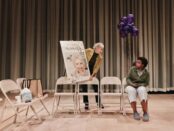
"Oil & Whiskey" is a new musical that won the "Sold Out Award" at the 2025 NYC Fringe Festival. The music by Kit Nolan, principal keyboardist and musical director for award-winning violinist Lindsey Stirling, is uniformly excellent, filled with great melodies and foot-stomping country delights. It compares well to the sadly closed "Dead Outlaw." The book and lyrics by Dax Wiley are not quite on the same level but sometimes reach the highs of the music.
[more]
An element of the story is the behavior of the English noblemen. They switch allegiances depending on the behavior of either King John or King Philip II. It is not easy to follow these shifting loyalties in the context of the internecine conflict being played out, and this is made more difficult by the fact that many of the characters are portrayed by the same actors. Since some in the ensemble are tasked with playing two or three characters, this introduces an element of confusion in the production. Given the constraints imposed by the need to play multiple characters, the cast makes a solid effort to achieve a reasonable level of transparency.
[more]
When the play begins those who know the original will recognize that Ali has edited the text: the first two scenes have been flipped which makes perfect sense letting us know that Viola, the heroine, has been shipwrecked off the coast of Illyria, and that she has lost her twin brother Sebastian. (She decides to dress in male clothing in order to see the lay of the land as a single woman in a foreign country.) Unfortunately some of the other edits, including the most famous scene in the play in which the unloved puritan Malvolio reads out loud the forged letter he has received with the famous lines “Some are born great, some achieve greatness, and some have greatness thrust upon ‘em,” are mistakes. Much of the edited material makes the play dark so the intent may have been to soften the play’s somber side, though it does eliminate much of the characters’ best material.
[more]
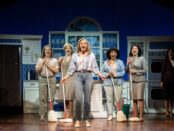
British illusionist Jamie Allan has brought his aptly named magic show "Amaze" to New World Stages and it is truly awesome. His act is so low key that one doesn’t at first realize how remarkable his tricks are taking many familiar and famous magic acts one step further – like the card trick with a deck of blank cards. He also uses his show to build the theory that children are more susceptible to magic and illusion and that we all need to return to our childhood memories and imaginations.
[more]
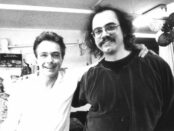
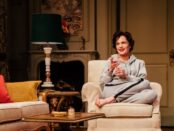
American actress Elizabeth McGovern is best known today for her role as Lady Cora, Countess of Grantham, in the long-running "Downton Abbey" series. However, she is also an Academy-Award winning nominee for her performance in the film of "Ragtime" as chorus girl and actress Evelyn Nesbitt. Since the early 1990s when she moved to London, she has often appeared on the West End stage. Now she has come to our shores as Hollywood icon Ava Gardner in a play of her own devising: "Ava: The Secret Conversations," adapted from the 2013 book of the same name by celebrity journalist Peter Evans and Gardner herself.
Although not the first name that comes to mind when one thinks of actresses to impersonate sex symbol Gardner, McGovern is charming and surprising, profane and coy, an independent woman who knows her own mind and has a great deal to say. She gives off flashes of fireworks along with the witty dialogue taken from Gardner’s own words. She is not only convincing but sympathetic as she recounts the mistakes and tragedies in her life. On stage throughout is Aaron Costa Ganis as British journalist Evans who we don’t learn as much about but makes an interesting foil for the flamboyant Gardner, even in these later years after her screen fame.
[more]
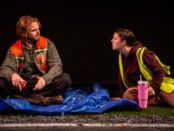
The two characters at the center of the story are Owen (D.B. Milliken) and Jaki (Mia Sinclair Jenness). Owen is a man in his late 20s who works as the roadkill collector in a rural county in Wisconsin. Jaki is a 20-year-old woman who is doing a six-week sentence for a drunk driving violation. What unfolds over the course of the play is how these two very different people discover an emotional connection neither had ever considered which is at the core of empathy: the understanding and sharing of someone’s feelings.
[more]
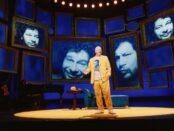
At the beginning of his eponymous Broadway foray, "Jeff Ross: Take a Banana for the Ride," the self-styled insult comic promises a catharsis, which seems like an obvious setup to soon mock the forlorn theater geeks sprinkled among an audience predominantly there to see Ross unleash the "Roastmaster General" persona he's cultivated over more than a quarter century of televised potshots at dais-trapped celebrities. But, it turns out the joke is on all of us. While Ross doesn't completely abandon his sophomoric shtick, it's also not the heart of his show, which has an unexpectedly big one.
[more]
Part of the problem with the play is that it attempts to cover too many topics in the form of a domestic tragedy: pollution, industrial waste, climate change, toxic chemicals, poverty, red-lining, foreclosures, destruction of animals, etc. It also cannot make up its mind whether its style is realism, surrealism, expressionism, symbolism or even magic realism. Many of the elements seem extraneous, tangential or not fully unified to the plot such as the talking animals. There is an interesting play hiding in this material but the playwright does not seem to know how to shape his ideas and wants to cover everything in this one play.
[more]
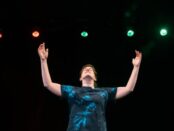
While the ensemble is solid in their portrayals of the characters, the play lacks a clear dramatic line regarding the main point of the story. Bossert's portrayal of Disney and his emotional struggles appears to provide the scaffolding for a story that, in reality, is about Lillian Disney and her influence on the decisions that will ultimately be attributed to Walt. Her careful guidance of Walt's presentation style ultimately enabled him to speak in public with greater confidence and engage more effectively with his audience. Her conversations and skillful guidance of Mary Blair's view of herself as an artist, independent of her husband, led to Mary's increased confidence in herself and ultimately to Walt's recognition of her talent.
[more]
There’s a lot going on in this new musical about Alan Turing—and perhaps too much. In attempting to encompass the breadth of Turing’s extraordinary life, the production ends up overwhelmed by its own ambition. It is too long to sustain its narrative with somewhat underdeveloped characters, and too short to provide the necessary depth to the relationships that are meant to drive its emotional core.
[more]
Do we need another jukebox musical? In the case of "Rolling Thunder: A Rock Journey," the answer is a wavering yes. Written with more insight than usual by Bryce Hallett, with musical direction by Sonny Paladino, "Rolling Thunder" manages to find a fresh way to bring that era to life, opening with a brash burst of music (“Magic Carpet Ride” by Steppenwolf) and a period newscast of Nixon explaining why the war was expanding—contrary to growing public anti-war sentiment. The title refers to the sudden savage saturation bombing campaign against North Vietnam 60 years ago.
[more]
"well, i’ll let you go," Bubba Weiler’s exquisitely devastating new work, staged with unpretentious yet profound grace by director Jack Serio leading a magnificent cast at the Space at Irondale in Brooklyn is, in a word, haunting. The play unfolds as a poignant, slow-burning elegy to ordinary lives and the extraordinary grief that can shatter them. It is a tender meditation on loss, memory, and the fragile architecture of community—one that both embraces and exposes the complex, often contradictory, human heart.
[more]
"Lili/Darwin" is a captivating one-woman show from writer/performer Darwin Del Fabro ("They/Them," "A Midsummer Night’s Dream") that explores her own transition as well as that of Danish painter Lili Elbe, with Del Fabro playing both in alternating segments. Elbe was a trans woman in the 1920s/30s and one of the first people to ever get sex reassignment surgery. Del Fabro reads from the painter’s posthumously published journals as a way to reimagine Elbe’s innermost moments contrasted with those of her own. At the same time, she maintains the dramatic distinction between herself and the Danish painter.
[more]
The show deals with the emotional impact of their not being able to have children after a series of miscarriages, and finally leading to the diagnosis of ovarian cancer. Gitter adds emotional depth to the story with an understanding and sensitivity to the affection Gene and Gilda had for each other in these moments of stress, culminating in an ending that underscores their love.
[more]
Kevin Zak’s 'Ginger Twinsies" now at the Orpheum Theatre is an outrageous, campy gay stage parody of the 1998 Lindsay Lohan (a true redhead) remake of "The Parent Trap" in which she played fraternal twins, directed by rom-com specialist Nancy Meyers. Much of the humor is based on name dropping of pop culture, film, stage and television lore with “appearances” by Vanessa Redgrave, Demi Moore, Shirley MacLaine, Julianne Moore and Jessica Lee Curtis as well as Ms. Meyers herself. A great many gags come from the Harry Potter movies as well as Curtis in "Freaky Friday" and a plug for her new "Freakier Friday" opening on August 1. You don’t have to know "The Parent Trap" to enjoy the jokes as much of the humor is visual but it helps set up the premise. The laughs come once a minute but not all of them land as successfully as they are meant to.
[more]
Under Lorin Latarro’s direction, there is little or no character development in Davenport’s book, with all of the characters remaining the same throughout, and the only thing that propels the show are the surprising events that happen. Joy’s family remains negative and dismissive about her inventing career (while eventually helping out in the marketing) until almost the very end. Davenport fudges the last scene by not telling us how the biased Texas judge ends up ruling in Joy’s favor so that the ending leaves us hanging. When the judge demeans Joy as a one-time inventor, we know that she has one of her clever inventions in her pocket (a reflective dog flea collar) but she never takes it out in her own defense. The songs are more like window dressing than adding much to the show and Milazzo’s generic lyrics tend to be very repetitious and give away their message in their titles. The show might have been more powerful as a straight play without the musical score.
[more]
Some 30 years have passed since I ghost-wrote David Cassidy’s autobiography, “C’Mon Get Happy.” The book continues to sell, and I continue to get questions from David’s fans. If I so much as mention him on Facebook—perhaps offering a toast to his memory on his birthday—people will message me with inquiries. I tried to answer some of the questions I got with a lengthy article that I wrote for this publication five years ago, “David Cassidy: Behind the Scenes.” But I still continue to get all sorts of questions.
[more]
As directed by Avra-Fox Lerner and written by Curtis Fox, the production has many problems, the first being its leisurely slow pace which makes the play seem longer and less dramatic than it is. Written in 19 scenes and taking place on the same Soho loft set throughout, the play is more of a teleplay than a stage play, minus the camera angles and the set changes. Each scene only reveals one new piece of information, a dramaturgically dull way to tell a stage story. In spite of all this, the play might have worked if the acting was passionate and intense but the cool, unemotional style undercuts much of the tension.
[more]
Andy Fickman’s polished production with its highly effective choreography by Gary Lloyd (additional choreography by Stephanie Klemons) is a Broadway-style production in a smaller house. If "Heathers the Musical" seemed too cynical in 2014 when it also played at New World Stages, time or events have caught up with it and it now seems a reflection of the life we live. With Broadway stars Lorna Courtney and Casey Likes leading the high-powered cast, "Heathers the Musical" should be a hit of the summer and beyond – and not just for teens and twenty-somethings who were in full evidence at the performance under review.
[more]
How far would you go to be famous on social media? Julia Randall’s "Dilaria" is a stunning exposé of Gen Z 20-year olds, brought up on and addicted to TikTok and Instagram, who spend all their free time on their smart phones trolling the Internet. Making their Off Broadway debuts, rising stars Ella Stiller, Chiara Aurelia and Christopher Briney play very superficial college grads relocated to New York, but Randall gets a tremendous amount of satire from their interactions. The language is raw and sexy, not for senior citizens, but there is much humor in the way these twenty-somethings use words, particularly the latest urban slang.
[more]
"Open" is an award-winning love story by Crystal Skillman that uses magic as the emotional hook, taking an audience on a journey through the trials, tribulations, and triumphs of the challenges some people face in the pursuit of love in a socially and politically complicated world. In this case, two young women are drawn to each other by their love of the magical and mysterious.
[more]
The idea presented in this prologue is that Holder, after 20 years in his theatrical life, has reached a dead end in his interest in playwriting. He is looking for something to re-energize himself, or he will give it all up and move on to something else. The prologue reader pulls a string, releasing a cascade of 36 folded cards from a box on the ceiling. The claim is that everything that is to transpire is real, and if Holder doesn't complete all of the tasks listed on the cards, he will quit the theater forever.
[more]
John Krasinski, best known for his role as the charming and amiable Jim Halpert on NBC’s sitcom The Office, is inspired casting for Penelope Skinner’s Angry Alan, a perfect showcase for his talents now the opening show at Studio Seaview, the renovated Tony Kiser Theater. In Skinner’s monologue co-created with actor Donald Sage Mackay who first played the part at the 2018 Edinburgh Fringe Festival, Krasinski is Roger, a three-years divorced man, who also lost his executive position job at AT&T and now works as the dairy manager at his local Kroger, a job he hates. Surfing the net, he finds a website called “Angry Alan” which seems to explain his midlife crisis: it is all the result of the “Gynocracy: a female dominated political regime which took over decades ago.” Roger who addresses us directly is still smarting from the fact that his live-in girlfriend Courtney has recently discovered feminism from a community college life class she is attending.
[more]
Austin Phillips’s puppet design deserves special mention. His owlet creation is imbued with uncanny charm—Wesley is clearly an owl, yes, but one whose subtle articulation suggests personality rather than anthropomorphism. The puppet becomes a living character, thanks in large part to the finely tuned performance of Daniel Sanchez, making an impressive Off-Broadway debut. As Wesley, Sanchez navigates a delicate balance: he gives the owl presence, agency, even affection, without sacrificing the essential strangeness of the animal. His portrayal renders the owl’s devotion to Casey moving and believable, even as we are always aware that this is a bird, not a human in disguise. As he dances with Casey during the “Winter is Coming” sequence we are painfully aware of how little time they can expect to share together.
[more]
"Machinal" makes use of all of these Expressionistic techniques. However, the current production has added tap dancing, practical foley and heightened movement created by choreographer Hilligoss in all of the scenes which both drowns out much of the dialogue and becomes very distracting. Obviously it is meant to emphasize the mechanical aspects of modern life but it also works as a sledge hammer repeatedly hitting the audience over the head with what is perfectly clear in the text itself. It is as though the director and choreographer do not trust the audience to get the message of the play.
[more]
"Lowcountry" by Abby Rosebrock, author of 'Blue Ridge" seen at Atlantic Theater Company in 2019, has a great deal going for it: a fine cast, a play told in real time, scenic design in keeping with the milieu and the plot, and characters quirky enough to keep us interested. However, this talky play doesn’t get where it is going until the last ten minutes and has a great many unanswered questions that perplex as one watches the play. While Jo Bonney’s production is strong on the characterizations, it is weak on pace so the plot seems to go on longer than it needs to and lacks tension until the very end. Ultimately, except for those last surprising minutes, the play eventually becomes tedious and in need of a few cuts – or new devices.
[more]
«
1
2
3
4
5
6
…
114
»
Copyright Jack Quinn, 2001-2023