News Ticker
- April 7, 2026 in Musicals // No Singing in the Navy
- April 7, 2026 in Off-Broadway // Uncle Vanya, scenes from country life
- April 7, 2026 in Off-Broadway // The Last Audition
- April 2, 2026 in Columns // THE EXPLOSIVE GROWTH OF FILM AND TV PRODUCTION FACILITIES IN THE NEW YORK / NEW JERSEY AREA
- April 1, 2026 in Musicals // Gotta Dance!
- March 31, 2026 in Off-Broadway // Jesa
- March 30, 2026 in Musicals // Monte Cristo
- March 30, 2026 in Off-Broadway // The Unknown
- March 30, 2026 in Off-Broadway // Antigone (This Play I Read in High School)
- March 30, 2026 in Off-Broadway // Antigone in Analysis
- March 29, 2026 in Off-Broadway // Bughouse
- March 28, 2026 in Musicals // The Paparazzi
- March 27, 2026 in Broadway // Giant
- March 26, 2026 in Off-Broadway // Ivanov
- March 25, 2026 in Musicals // Blood/Love
- March 24, 2026 in Off-Broadway // Touch
- March 24, 2026 in Music // The Silent Serenade
- March 23, 2026 in Musicals // The Wild Party (New York City Center Encores!)
- March 22, 2026 in Broadway // Every Brilliant Thing
- March 22, 2026 in Multimedia // Burnout Paradise
- March 20, 2026 in Musicals // Chasing Grace
- March 20, 2026 in Off-Broadway // Entangled: 12 Scenes in a Circle K off the I-40 in New Mexico
- March 19, 2026 in Off-Broadway // Trash
- March 17, 2026 in Concerts // The New York Pops: “United in Sound: America at 250”
- March 17, 2026 in Musicals // Bigfoot! A New Musical
- March 14, 2026 in Off-Broadway // Spare Parts
- March 14, 2026 in Off-Broadway // Zack
- March 13, 2026 in Off-Broadway // Dear John
- March 10, 2026 in Off-Broadway // Our House
- March 10, 2026 in Off-Broadway // Body Count
- March 8, 2026 in Off-Broadway // Chinese Republicans
- March 7, 2026 in Off-Broadway // The Mall The Mall The Mall
- March 7, 2026 in Off-Broadway // The Reservoir
- March 1, 2026 in Off-Broadway // Marcel on the Train
Archive
The perennial tale of a noble servant exploited by a self-absorbed upper class family is given a bewildering and tedious treatment by playwright Amina Henry in "The Great Novel." It’s an enervating 95 minute mashup of lesser Ionesco with helpings of Wes Anderson and the visual style of John Singer Sargent.
[more]
Ukrainian director Rimas Tuminas has led the Vakhtangov State Academic Theatre of Russia in a massacre of Mikhail Lermontov’s 1845 play "Masquerade." Presented by the Cherry Orchard Festival, the spectacle on stage at the New York City Center made a mockery of an intelligent verse play that beautifully reveals the passions underneath the elegant façade of early 19th century Russian high society.
[more]
Living up to its title, a racially and physically diverse game company of ten male performers really are nude throughout "Camp Morning Wood: A Very Naked Musical." It succeeds as a joyous flesh parade but disappoints as an actual theater piece. What might have been an engaging encounter group-style exploration depicting facets of the gay male experience is instead labored with a flatly comical cornball plot that’s dragged out to two hours with an intermission.
[more]
Kate Hamill who has had success with "Sense and Sensibility" (Bedlam), "Pride and Prejudice" (Primary Stages), and "Vanity Fair "(The Pearl Theatre) has now turned her sights to Louisa May Alcott’s beloved novel of growing up, "Little Women." With this stage adaptation she seems to want to have it both ways: although still set during the Civil War with the women in long dresses and singing “The Battle Hymn of the Republic,” Jo wears men’s clothing and she and Laurie often speak of feeling like they do not fit their gender role. A note in the script states that the play “MUST be cast in an inclusive fashion. It is an American play, and should reflect America today.” As a result, the Primary Stages production makes the March family sisters Hispanic, African American, and Caucasian. This new "Little Women" has a modern sensibility at war with the material.
[more]
Twenty-five-year-old African-American Michigan native and New York University graduate Usher is an usher at a Disney Broadway musical who is writing an autobiographical musical about his troubled life. His religious Christian parents are scornful of his sexuality and dubious of his career goals as he doesn’t emulate the commercial simplisticness of Tyler Perry who gets skewered in a production number. This exploration is light on plot and so we get a series a of overheated vignettes often laden with wan shock value. The often didactic dialogue relies on scatology peppered with the N-word. Dark comedy crossed with poignancy abounds.
[more]
Skillman unfolds an achingly beautiful story, dropping bits and pieces of Kristen’s thoughts and memories as she balances her tightrope of love, commitment, sacrifice and transformation. Hill’s performance as Kristen is funny, honest, compelling and heartbreaking; one cannot take their eyes off her, and it’s not because she is the sole occupant of the stage.
[more]
Megan Monaghan Rivas’ gender-bending take on the popular, much-adapted Alexandre Dumas 1844 novel, "The Three Musketeers," moves the action from the 17th century to Paris during World War II. A very dedicated group of brave women take part in the Underground fighting behind enemy lines to sabotage the Nazis who were occupying most of France.Written for the Women in Theatre Festival (WIT) and staged at the beautiful A.R.T./New York Theatres on the far West Side, an area which is filling up with fresh new theatrical venues, "Three Musketeers: 1941" is a brave expression of the power of women.
[more]
Scottish playwrights Kieran Hurley and Gary McNair explore the murky pre-adult domain with candor and humor in "Square Go," an appealing two-hander directed by Finn Den Hertog and featuring two fully adult actors, Daniel Portman and Gavin Jon Wright, portraying—respectively—Max and Stevie, a pair of 13-year-old besties who seem to transform, regularly, into each other’s biggest enemy. There are hilarious moments in the play, but Hurley and McNair don’t treat the characters in a condescending way.
[more]
Given references to "Prizzi’s Honor," "Looking for Mr. Goodbar, " Haagen-Dazs Vanilla Swiss Almond, and VCRs, the otherwise effective revival of "Frankie and Johnny"--now on Broadway at the Broadhurst Theatre--can feel rather dated. The play debuted, after all, in 1987, and McNally’s ambition for realism makes such references natural, if not exactly necessary. But it’s still a substantial look at a one-night stand between Frankie, a waitress, and Johnny, a short-order cook at the same off-stage restaurant.
[more]
Regrettably these achievements are marred by hollow tangents, diluting the play’s potential power. Having come up with a such a novel premise, Rocco is carried away by a concern with form rather than straightforwardness. Much of it plays out like subpar Robert Altman with empty cross talk, heavy- handed overlapping dialogue and strained comedy. The whimsical device of a hotdog vendor caught up in the action is overused and becomes a drag despite Brandt Adams’ gruff charm and masterful comic timing.
[more]
By placing his ballet in the realm of the high-strung ballroom world, Eifman supplied himself plenty of excuses to make dances that bounced about the stage to his score of a parade of waltzes, polkas, marches and bits and pieces of the output of some of the many “Waltz King” Strausses (Johann the Son, Josef and Eduard) with one interlude of Mozart tossed in at the end.
[more]
Under Shinn’s direction, Winstead making her stage debut is very low-key, almost as an observer in her own story. True she works as a therapist, one who tries not to reveal her personal feelings to her patients, but in her private life she ought to show more emotion given the provocations. In the original production directed by James Macdonald, Pablo Schreiber as both Peter and Craig was devastating, leaving the audience almost quaking in their shoes. Here Woodell is almost indistinguishable as the twin brothers, thorough dressed in an olive green t-shirt as Peter and a button-down striped flannel shirt as Craig so that we have no trouble keeping them apart. The revelations come periodically but the play and the production seem under heated. It also seems to be too dependent on emails and phone calls, rather than dramatizing the story.
[more]

Such lukewarm response may be attributable, at least in part, to the changing times. Lone Star focuses on a not-so-old Good Ol’ Boy from rural Texas named Roy (de Rogatis). He’s a Vietnam veteran who drunkenly bullies his younger brother, Ray (Chris Loupos), outside the back of a local bar called Angel’s. Roy also bedevils a former high school classmate named Cletis, aka “Skeeter” (Michael Villastrigo), a nerdy nincompoop who has long envied Roy for his swagger and alleged popularity with women. At one point in the show, Roy enumerates for Ray the ugly atrocities against Vietnamese citizens that he saw during the war, in essence bragging about his capacity to endure it all. In a culture that has become increasingly sensitive about the horrors of Post-Traumatic Stress Disorder, there’s little room now for humor surrounding such content. Perhaps, too, audiences are simply less amused than they used to be by depictions of rural Texans as dung-kicking buffoons, which is probably a good thing.
[more]
The play offers no catharsis as the actors are so low-key throughout, all much too calm even when the stakes are rising. As a result, there is little or no tension even when we realize the pattern that each scene will offer a worse revelation than the one before. Tergesen’s black sheep Billy gives us no clue as to the reason for his malignant behavior. Both AuCoin as his brother David and Parisse as David’s wife Molly are cool and sophisticated when they should be losing their temper. Wolff’s Brown University freshman is too inarticulate, but unfortunately he is straitjacketed by the dialogue he has been given.
[more]
Cohen is clearly an intelligent, well-read man, familiar with the twists and turns of different periods and styles. "Midnight Street" is chock full of ideas, poetic meanderings and some worthwhile melodies but just doesn’t add up. His direction can’t overcome the pretentious language and heavy-handed symbolism. Only a Lotte Lenya or, perhaps, a Patti LuPone might have given Mr. Cohen’s songs the right gravity, not to mention finding sense where none exists.
[more]
Bekah Brunstetter’s new play, "Public Servant," has its heart in the right place. It shares with The Cake, seen earlier this year at Manhattan Theatre Club, the first part of a trilogy with the new play, a similar theme: private issues of public figures, with both plays set in North Carolina where the author hails from. Like Della in "The Cake," Ed in "Public Servant" is a well-meaning man whose personal beliefs do not always agree with all members of the community - including his own college-age daughter. Unfortunately, "Public Servant" has many of the same problems and drawbacks that marred "The Cake."
[more]
G. Austin Allen’s set is a larger-than-life closet draped in purple cloth and which also includes a kitchen. To this room comes the older man in his mid-60’s who has discovered that as his husband Steven is dying of cancer, nursing homes are ambivalent about taking in gay men. Next is a middle-aged man in his mid-40’s who has had an emotional meltdown having realized he is soon to turn 50 and has no partner to fill his lonely life at which he was bartending. And then there is the hunky man in his late 20’s who is in the midst of a trial against his boss and his friend who raped him after a sex party. They are also there to give advice to teenage John, still asleep in the next room, when he wakes up confused after his first gay sexual encounter.
[more]
As for the show’s humor, there were moments when Sheen should have played her emotions straight instead of going for laughs (a.k.a. the #1 rule of comedy acting) -- but there’s time for her to grow into that. Additionally, the comedic concepts in "God of Marz" could use more development. The show is on the cusp of being a funny, zany absurdist romp, but it doesn’t have enough internal logic in its script to justify its more inventive flourishes. With tweaks, that could definitely happen. Still, there were a few good one-liners. Example: “You know, my birthday is September 11.” / “That’s tragic! You’re a Virgo!”
[more]
"Butterflies," which won the Mario Fratti Award at New York’s “In Scena!” theater festival in 2016, has been translated by Carlotta Brentan and directed by Jay Stern in a production at Manhattan’s The Tank. It’s an earnest endeavor, and the two young women playing the sisters (Annie Watkins as Blonde and Danielle Sacks as Brunette) both give strong performances. The play, though, is talky and overblown. Perhaps Aldrovandi’s original has lost something in translation, or maybe his play draws on Italian cultural and theatrical conventions that don’t sit so well with American audiences. In any case, Aldrovandi hits no bullseyes with this production.
[more]
“It’s best when each performer is older, or younger, or of a different gender- expression, ethnicity, or ability than you might expect. This keeps the play vibrating in your imagination” are from Borinsky’s stage directions. For this production we get a youthful cast playing roles opposite their presumed genders with skillful exaggeration.
[more]
Baby Jane Dexter (Photo credit: Stephen Mosher) [avatar user=”John Hoglund”
[more]
Having its world premiere, “Radical Beasts in the Forest of Possibilities” is a collaboration of choreographer Francesca Harper with iconic composer/performer Nona Hendryx and the dancers. Hendryx performs live on piano, along with digitally recorded sounds and music (the piano sections are more satisfying than the digital ones). The costumes by Epperson are made up of layered fabric that suggest a ragged look which is appropriate to the theme described in the program about reaching for contact in a world where time is fractured. The hardworking dancers include Jacqueline Bulnes, Terrence D. M. Diable, Mariah Gravelin, David Glista, Jesse Obremski, Frances Samson, Lauren Twomley and Mark Willis.
[more]
Eliza Lynch (1833-1886) was an Irishwoman who grew up in France and became a courtesan. In 1854 she began a relationship with Francisco Solano López, the son of Paraguay’s president. He later succeeded his father and Lynch became First Lady. He was killed in battle in 1870. Her time in Paraguay was controversial as she was thought to have instigated wars and conflicts. She was banished and returned to France, dying in obscurity. Thank you, Wikipedia, for these details because they’re scant in this treatment. Ms. Sherwood and Mr. Flanagin are more concerned with superficial theatrics rather than concretely crafting a comprehensible narrative chronicling the life of a fascinating figure who was a cross between "Barry Lyndon" and "Evita."
[more]
Michael Mao Dance is celebrating 26 years of presenting Mao’s work and if his recent program at the Ailey Citigroup Theater is any evidence, there is reason to believe he will continue for another 26 years. His works are varied, yet clearly come from the mind of the same artist.
[more]
Schmidt’s streamlined adaptation of Shakespeare’s Scottish tragedy is played by a cast of seven schoolgirls who meet in an abandoned urban field after school without any set up other than that they throw down their book bags before launching into the first scene. Designed by Jessica Pabst, their school uniforms made up of cape with hood, a blazer, a skirt, and tie are made of Scottish tartan which is appropriate for this play. Every prop in the show comes from the backpacks and purses they carry with them. The girls perform the play without reading from the text as though they have studied it in school and are thoroughly versed in it. Once they enter the scene, the girls never exit but sit on the sidelines watching for the rest of the play.
[more]
Flashbacks, speechifying, conspiracy theories involving J. Edgar Hoover and the FBI, disco sequences, the scourge of crack cocaine, hip hop numbers, other-worldly fantasies and violence all play out on scenic designer You-Shin Chen’s terrific runway stage with its several levels, a mirror ball and a raised DJ booth. Strobe lights, sirens and a multitude of musical snippets accompany the actions of the people of color and trans characters.
[more]
Malloy, who wrote the book, music and lyrics, has taken a novel approach, staging Octet as if it were a 12-step program in which all the members of the group express their inner thoughts through a cappella singing all the while following the precepts of an AA or OA meeting. Annie Tippe has taken this sophisticated mass of brilliance and shaped it around the sensational talents of a small cast which performs miracles of acting and singing.
[more]
"Luzia: A Waking Dream of Mexico" is Cirque du Soleil’s 38th original production and its 18th performed under The Big Top. The name is a combination of the Spanish word for light (luz) and the word rain (illuvia). Written and directed by Daniele Finzi Pasca (co-authored by Julie Hamelin Finzi) with Patricia Ruel as Director of Creation, the colorful show is a surrealistic journey through the various landscapes and arts of the country. Using the frame of a traveler parachuting into a land of memories, the show moves from a movie set to the ocean to a smoky dance hall to the desert. It touches on the music, design, sports, entertainments, animals and mythology of Mexico.
[more]
Several songs were from flop shows and given new life by Streisand: “He Touched Me” from "Drat! The Cat!" sung with infectious flirtatiousness by Lianne Marie Dobbs; “Why Did I Choose You?” from "The Yearling," given a luscious rendition by Nicole Henry; and “On a Clear Day You Can See Forever” benefiting from Ethan Slater’s enthusiasm and charm.
[more]
As David, Chris Dwan does not make one forget the inimitable Grisetti who spun every moment into a comic turn. However, Dwan is charming as the undaunted hero who must deal with problems behind his ken but always comes up with a possible solution even if it doesn’t work out. David Schramm’s alcoholic and hammy Harrison Marlowe is not quite as clipped as that of the late George S. Irving whose signature role this became but his sarcasm and slow burns are still entertaining. Though Farah Alvin’s Angela Marlowe is not as affected as her predecessor as the predatory performer, she still is delicious as an actress who falls in love with all of her co-stars.
[more]
The original production of "Curse of the Starving Class" in 1977 was a shocker even for a time when permissiveness prevailed. Kinney seems to have decided that the play Shepard wrote isn’t sufficiently meaningful or effective, so he decided to exaggerate everything, beginning with the scenery—a large, dumpy, shopworn kitchen—literally breaking apart accompanied by explosive noises before the play begins. The set is left hanging in pieces as the characters go about their business.
[more]
Never really losing her cool, Pressley always commands the stage even though scenic designer Alexis Distler has made it difficult by creating a huge private room, beautiful in its understated way in blues and beiges, but difficult for one person to fill the space. Yes, Maurice is presumed to be in his hospital bed on stage right, and Lashonda is on the smartphone, but Pressley must negotiate the entire stage herself. Director Jade King Carroll has found reasons for her to move around from chair to sofa to a chair on the other side of the room, but has not helped much in making the play build an arc. The effective lighting by Mary Louise Geiger subtly shifts from afternoon to evening light without our realizing how much time has passed.
[more]
All of this is brought to life via digital camera, which captures the movement of the figures on a quickly assembled “set” that is, in effect, a whole miniature seaside town, with businesses and homes through which the various human, animal and automotive figures navigate. At one very “meta” point, we even see a Punch and Judy show at a town festival: puppets putting on a puppet show!
[more]
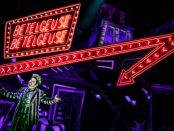
Not all cult movies need to be made into musicals, particularly those that are dependent on special effects which the cinema does better than the stage. This is demonstrated by the new Broadway musical based on "Beetlejuice," the Tim Burton horror-comedy-fantasy. This theme park-type show is visually a spectacle with a set that does all sort of tricks and changes, but as the adage goes, you can’t go home singing the scenery. And the score by Australian composer/performer Eddie Perfect (whose only other American score has been "King Kong the Musical") is eminently forgettable. In the title role, Alex Brightman, who was charismatic in a similar role in "The School of Rock," is so over-the top that he becomes tiresome very quickly. To paraphrase Mae West, too much of a good thing is not wonderful.
[more]
The epistolary "Posting Letters to the Moon" may, on the face of it, make one think of A. R. Gurney’s "Love Letters" or Helene Hanff’s "84 Charing Cross Road. "But unlike those two memorable plays, PLTTM as “compiled” by Lucy Fleming, whose mother was the British actress Celia Johnson and whose father Peter Fleming was a travel writer--as well as the older brother of James Bond creator, Ian Fleming--never really tells a story nor conveys what her parents’ relationship was like.
[more]
Poet Aziza Barnes’ first play, "BLKS," now at MCC Theater Space is raucous, vulgar, outrageous and contemporary in Robert O’Hara’s hilarious, over-the-top production. Following the adventures of three black women roommates from Brooklyn over a day and a half, it shows us how the Girls are living today - Lena Dunham would approve. However, the loud and busy production in the Newman Mills Theater stage will thrill twenty and thirty somethings, while older people may not be in tune with it. It is an insightful view of modern life today from the black female perspective and as liberated as a play can get at this moment in time. There is likely to be a generational divide to this comedy which pushes the envelope.
[more]
But, fear not! The Encores! creative team—director John Rando, music director, Rob Berman and choreographer Sarah O’Gleby—found a terrific cast led by Michael Urie in the Phil Silvers’ role of Harrison Floy and Betsy Wolfe as (Mama) Sarah Longstreet, Nanette Fabray’s role (which featured the earworm ditty “Papa, Won’t You Dance With Me?”).
[more]
Abrasive as a subpar episode of Maude and reaching a sour psychological thriller-style finale out of Craig’s Wife, Happy Talk is playwright Jesse Eisenberg’s muddled family drama. It’s the 1990’s and the New Jersey Jewish matron Lorraine is playing Blood Mary in a community theater production of South Pacific and so in addition to the jokey title we get a barrage of painfully cute musical comedy references. Scene transitions are accompanied by blaring snippets of Mitzi Gaynor who played Nellie Forbush in the film version. The combination of Mr. Eisenberg’s smug sensibility, inane contrivances, shtick-ridden dialogue, condescended-to characters, and slack construction all make it a tiresome one hour and 45 minutes.
[more]
Christopher Chen’s exquisite and mystical "Passage" being produced by the Soho Rep is inspired by E.M. Forster’s "A Passage to India," borrowing its plot and character relationships. But while Forster’s novel was simply about the British colonization of India, Chen has something bigger in mind. Chen calls the two locales Country X and Country Y so that the audience can fill in whatever two countries they wish in whatever time. Director Saheem Ali’s superb multicultural cast offers the maximum in diversity. And in this age of nations all over the world cracking down on immigrants and immigration, the play is an investigation into our complicated feelings about The Other.
[more]
Alice Ripley (Best Actress Tony Award winner for "Next to Normal") is, in a word, astounding. Her Trisha is brimming with curiosity, honesty, humor and grace; she is inspiring to watch and simply amazing. Edie’s characterization of Trisha is delicate and poignant, funny and sincere; her illuminating script is sheer writing perfection.
[more]
"Pepperland," however, will not do anything for Morris’ reputation as a choreographer. His dearth of choreographic invention—including constant repetition of a few steps, gestures and partnering tricks—was hidden behind colorful period costumes (Elizabeth Kurtzman), an odd set consisting of piles of reflective ribbons (Johan Henckens), inspired lighting (Nick Kolin) and fantastic arrangements of songs from the Beatles’ landmark 1967 "Sgt. Pepper’s Lonely Hearts Club Band" album (Ethan Iverson). There’s something to be said for simplicity, but if it were not for the other elements "Pepperland" would not hold up to some of his other ingenious masterpieces like "Grand Duo," "Dido and Aeneas" and his superb "L’Allegro, Il Penseroso ed il Moderato."
[more]
Witnessing the LOTNY production makes one wonder why "Owen Wingrave" is not performed more often: it has a small cast of eight with juicy roles for all of the characters, evenly divided between men and women’s roles, not true of either of the composer's operas, "Peter Grimes" or "Billy Budd." Although it makes use of the twelve tone scale, its dissonances are not hard on the ear. The plot is simple to follow and it can be performed in a unit set as was demonstrated by Josh Smith’s attractive and flexible design with six playing areas at the GK Arts Center. With the use of video or slide projections and atmospheric lighting, one can make the production as spooky as one wishes for this late Victorian ghost story.
[more]
The black-accented stage has a raised runway platform, a square platform, a bench and some furniture. From these basic elements, scenic designer Susannah Hyde crafts an ideal landscape for this non-realistic piece that allows its times and locations to shift smoothly. Ms. Hyde’s outstanding projection design of social media imagery and illustrative photos is shown on the stage’s back wall.Resourcefully working on a minimalist level, director Emily Lyon achieves fluidity, some lovely stage pictures and the fine performances with her inspired staging. Sammy Jelinek’s dreamy lighting design and Carsen Joenk’s beating sound design contribute to an otherworldly dimension.
[more]
Ted Chapin, the writer and host of the 92Y Lyrics & Lyricists Series’ "A Beautiful Dawning: Oklahoma! at 75," did an impeccable job creating one of the best editions of this important series. Here was a program both entertaining and informative. The information was as enjoyable as the performances of the four singers who were directed and choreographed by Parker Esse and accompanied by the incredible Andy Einhorn and his brilliant musical ensemble.
[more]
As president of International PEN, the worldwide association of writers, from 1966 – 1969, playwright Arthur Miller moved about Eastern Europe freely and witnessed a great many troubling events concerning writers of all genres. These occurrences led to his writing "The Archbishop’s Ceiling," his most political play, which was presented at the Kennedy Center in 1977. Revised after the failure of this production, it had its world premiere at the Cleveland Playhouse in 1984 but was not picked up for a New York production. Since then it has been seen in London at the Royal Shakespeare Company in 1986, Budapest in 1989, Westport, Ct., in 2006 and Denver in 2015. It has finally made it to New York courtesy of Regeneration Theatre in residence at Urban Stages.
[more]
Folks, this is no ordinary play, and it's not for everyone. Call it an absurd commentary, a daydream, a nightmare, a fantasia, a memory play--come see it and decide what you want to call it.
[more]
Laughter and oohs and ahs abound from an audience of all ages during this exuberant and wildly theatrical stage adaptation of Jules Verne’s classic adventure novel "Around the World in 80 Days." A gray cloth transforming into an elephant, model ships held aloft and actors wearing headdresses portraying a herd of buffalo are among the dazzling low-tech pieces of stagecraft on display.
[more]
In "Caroline’s Kitchen," British playwright Torben Betts ("Invincible," "The Unconquered," "Muswell Hill") has written a state of the nation farce which has no laughs. As the play under the title "Monogamy" has been very successful in England, it is possible that it just too British for American audiences. Similar to the plays of Alan Ayckbourn in dealing with middle-class people confronted with chaos not entirely of their own making, "Caroline’s Kitchen" unfortunately has only unlikable, self-absorbed characters caught up in a series of situations that simply get worse without having us on their side. Don’t blame the actors in this Original Theatre Company and Ghost Light Theatre co-production if Betts’ characters are unsympathetic although that may be his take on the nation at this moment in time.
[more]
The eternal heartbreak of show business is given a fresh spin in playwright Adam Seidel’s exhilarating contemporary drama, "Original Sound" that skewers the music industry. Mr. Seidel’s scenario has many familiar elements, but the writing is impeccable, the performances are superior, and it's electrically presented.
[more]
MasterVoices performed a beautifully sung and played rendition of the legendary 1941 musical "Lady in The Dark" as part of New York City Center’s 75th Anniversary Season for three sold-out performances. Conducted and directed by MasterVoices’ artistic director Ted Sperling and starring Tony Award winner Victoria Clark as heroine Liza Elliott, the production offered a world premiere of a new adaptation of the Moss Hart book by Christopher Hart (the author’s son) and Kim Kowalke, and the complete critical edition of the Kurt Weill/Ira Gershwin score. While the musical portions were excellent, this concert version only made clear the strengths and weaknesses of this rarely revived musical play.
[more]
Retro Productions which has staged both old and new plays has turned its attention to this unjustly neglected comedy from 1961 which has not had a New York revival that made it into the record books. Shay Gines’ production proves that it is still witty and literate and has a great many quotable one-liners. A window on the 1960’s, the problem for younger people will be the number of household names that aren’t well-known anymore like Orville Prescott, Elizabeth Arden, Jack Warner, Louella Parsons, Gerold Frank, Jackie Coogan and David Susskind, pioneers who should not have been forgotten. The show program conveniently has a Pop Culture Glossary in the back which explains them all. The problem for older people is that the pacing is a bit slow where it should be played at farce tempo which would make the repartee all that much more scintillating.
[more]
Viewing the abstract configuration onstage that could be from a Whitney Biennial before "Friendly's Fire" begins instantly informs us we’ll be in a fantasyland. Indeed, playwright John Patrick Bray offers a surrealistic odyssey fusing together the dreams and battlefield memories of a disaffected Gulf War veteran with aspects of Hollywood Westerns and other pop culture genres. Mr. Bray’s writing is intense, often striving for absurdist comedy, and has a great sense of purpose. It’s all rather baffling, somewhat interesting and mildly entertaining.
[more]
As the elderly king of Britain who deludedly decides to give up his kingdom to his three daughters, Goneril and Regan, the two older married ones, and Cordelia, his younger unmarried daughter, in exchange for their regaling him before his court with how much they love him, the 83-year-old Jackson dressed in Ann Roth’s fitted tuxedo and with a severe masculine haircut would seem believable casting. However in the first half of the evening (Acts I-III) which take about two hours, Jackson is nothing but haughty, sarcastic and arrogant, with little or no variety. In the production’s second half when the king who has been turned out of the castles of both married daughters (Cordelia having left the country to marry the King of France), Jackson seems mad but wise and more compassionate, turning the king’s anger on himself, but it is too little, too late.
[more]
The Irish Repertory Theatre ends its thirtieth season by going back to the beginning, with a sturdy revival of Sean O'Casey's "The Plough and the Stars." An historical prequel to the other two plays in O'Casey's Dublin Trilogy, it was also the Irish Rep's inaugural production, a daring choice that essentially served as an artistic mission statement, signalling a commitment not to shy away from Ireland's ever-contested past.
[more]
Ernie Morris is a middle-aged widowed African-American writer who arrives at a contemporary unnamed prison to be a volunteer. A young corrections officer explains in great detail all of the rules and regulations. The inmate she becomes closest to is James “Hakeem” Jamerson, nicknamed Wise. He is a 62-year-old African-American man who has been incarcerated for 46 years for shooting and killing a police officer during a pawn shop holdup when he was 16. Over his many years of imprisonment, he’s matured, having gotten a college degree and leading an education program. He’s been continually turned down for parole and Ernie agrees to help him with his statement for the next parole board hearing. Will they succeed?
[more]
Michael Dorsey/Dorothy Michaels still has most of his/her friends and professional acquaintances from the movie version with some new twists: Jeff Slater, his playwright roommate (a wonderfully sardonic Andy Grotelueschen) having difficulty setting words to paper; former girlfriend, hyper-paranoid unemployed actress Sandy Lester (Sarah Stiles, doing mega-ditzy with all pistons firing); leading lady Julie Nichols (Lilli Cooper, lovely, good voice, but not as romantically vivid as she should be); clueless show director Ron Carlisle who’s not quite as sexist as in the film; and, finally, lascivious actor Max Van Horn (John Behlmann, who nearly steals the show with his brilliantly acrobatic machinations), now a dull-witted, malaprop-spouter who falls hard for the older Dorothy.
[more]
Eve Wolf’s new play for the Ensemble for the Romantic Century, titled "Hans Christian Andersen: Tales Real & Imagined," suggests that the real-life Andersen might actually have appreciated whitewashed depictions of his life, maybe even the Kaye movie. The Andersen that Wolf gives us is an unattractive and unhappy misfit. We hear, though, more than once, his mantra of self-assuring optimism—which, it seems, fooled no one, including the storyteller himself:
[more]
Is a young Asian woman a ghost or a melancholiac’s hallucination? That is the haunting question vividly answered in playwright Prince Gomolvilas’ gripping thriller "The Brothers Paranormal" which crackles with tension from start to finish. It’s a masterfully written synthesis of "Blithe Spirit," "The Amityville Horror" and "The Sixth Sense" with shades of Stephen King. Comedy gives way to terror as its Asian and African-American characters also battle their own personal demons. A floating pillow is a frightening sight and Ella Fitzgerald’s 1960 live Berlin recording of “Mack the Knife” becomes a spooky touchstone.
[more]
Claire Kiechel’s "Paul Swan Is Dead and Gone" (directed by Steve Cosson) gives audiences a glimpse of the last stand of the author’s great grand-uncle, a dancer-actor-painter-sculptor who was once proclaimed “The Most Beautiful Man in the World.” Tony Torn gives a brave and memorable turn as Swan (1883-1972) in an immersive-ish production at Torn Page, a studio, salon and classroom in what was once the Manhattan home of Torn’s celebrated actor parents, Rip Torn and Geraldine Page.
[more]
"The Bigot"’s mouthpiece is the splendid Stephen Payne. Scruffy and silver-haired, Mr. Payne revels in Jim’s cantankerousness and physical decrepitude. Bellowing in his resonant twangy voice as if in a Sam Shepard play, Payne is able to make the most corrosive statements sound funny while expressing emotion. His vivid characterization emits humanity, making the crusty Jim much more than just an ogre. By the end of the play, the role has accumulated the impact of an Arthur Miller-type figure due to Payne’s intense performance.
[more]
«
1
…
26
27
28
29
30
…
64
»
Copyright Jack Quinn, 2001-2026