
Road Kills
A play that explores the concept of empathy as it relates to the death of an animal.
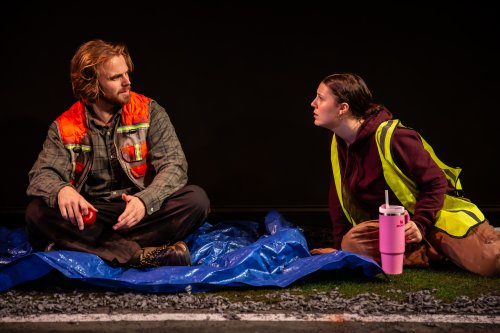
D.B. Milliken and Mia Sinclair Jenness in a scene from Sophie McIntosh’s “Road Kills” at the Paradise Factory Theater (Photo credit: Nina Goodheart)
It’s nighttime on a highway; a flash of something small in the headlights is followed by a thump. A momentary hesitation is followed by the realization that an animal has met its final moments. Unless it is something large, like a deer, the car may not even slow down. What remains in the exhaust is roadkill. It may result in a clean kill or a gruesome and bloody mess. Most drivers will never know since stopping is not usually the action taken. Many drivers see the results of these encounters in the light of day as they drive on the roads and highways of their community. What do they feel? Empathy? Sympathy? Revulsion? Nothing?
Road Kills is a superbly written, multilayered play by Sophie McIntosh, masterfully directed by Nina Goodheart. The play explores the concept of empathy as it relates to the death of an animal, and by extension, to emotionally charged interactions between people. It touches on the difference between sympathy and empathy in a subtle and measured way, uncovering emotional aspects of the two protagonists that were not even apparent to themselves.
The two characters at the center of the story are Owen (D.B. Milliken) and Jaki (Mia Sinclair Jenness). Owen is a man in his late 20s who works as the roadkill collector in a rural county in Wisconsin. Jaki is a 20-year-old woman who is doing a six-week sentence for a drunk driving violation. What unfolds over the course of the play is how these two very different people discover an emotional connection neither had ever considered which is at the core of empathy: the understanding and sharing of someone’s feelings.
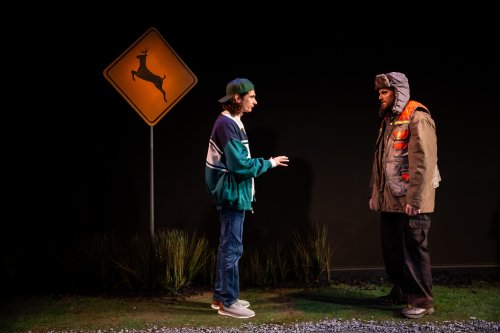
Michael Lapore and D.B. Milliken in a scene from Sophie McIntosh’s “Road Kills” at the Paradise Factory Theater (Photo credit: Nina Goodheart)
The technical structure of the production is important to the understanding of the discussion that follows. The scenic design by Junran “Charlotte” Shi fits perfectly with the small stage area of the venue. It is the lane of a blacktop road in the foreground with a grassy shoulder upstage. The venue puts the audience very close to the action, adding a visceral element to the story. Sean Franks’ prop design is a critical element in the play, with some pieces being disconcerting since they are depictions of dead animals. Other vital elements are the lighting design by Page Seber and the sound design by Max Van. These two technical aspects provide a continuity of dramatic tension, effectively connecting each of the scenes. Sawaan Tiwari’s costume design is a perfect fit for the setting.
As the audience enters the small theater space, they must pass the body of a dead fawn. It is the first roadkill to be dealt with, and it is a jarring visage to greet an audience. The scene introduces Owen and Jaki, providing a bare outline of their personalities.
On the first day of her sentence, Jaki is instructed to watch for cars and trucks on the road while Owen cleans up the carcass, which has become frozen to the road. Jaki is having a hard time dealing with the whole dead animal thing of her community service sentence. Owen reveals the sensitivity he feels toward the dead animals by the care he takes in disposing of the animal. This scene establishes the baseline for these two characters; one with sensitivity and concern, the other with indifference.
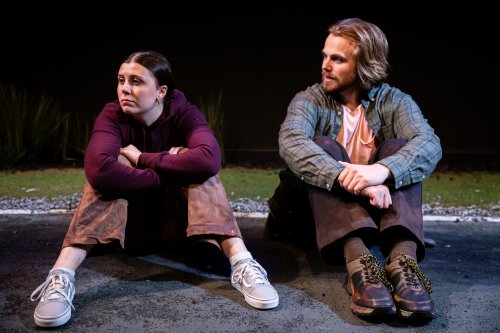
Mia Sinclair Jenness and D.B. Milliken in a scene from Sophie McIntosh’s “Road Kills” at the Paradise Factory Theater (Photo credit: Nina Goodheart)
As the wheelbarrow with the dead deer leaves the stage, the setting goes dark, and the sound of a car and the flashing of headlights fill the space. The conversation of the occupants of the car is heard as it runs over what turns out to be a skunk. When the lights come up, the body of a squashed skunk is in the middle of the road, and Owen and Jaki are there for the clean-up.
What follows throughout the play are these blackout moments, with a car hitting something, and the occupants’ reaction being heard. These auditory scenes introduce the following scenes of the interactions between Owen and Jaki, with each encounter revealing more of the emotional nature of the two.
In two of the scenes, Michael Lepore appears as two different characters. In his first appearance, he is Neil, the owner of a pet dog. This scene establishes some essential aspects of Owen and Jaki’s personalities. It is the strongest revelation of Owen’s empathic nature, as evidenced by his sensitivity to Neil during the act of transferring the dead pet. It is also a moment when Jaki reveals her insensitivity or denial of the intense emotions associated with the death of a pet. In a later scene, Lepore depicts Miles, Jaki’s cousin. This encounter reveals a deep trauma experienced by Jaki regarding her cousin. It adds to an understanding of one of the reasons she is the way she is. Lepore embodies these two characters so perfectly that it is not clear it is the same actor for both.
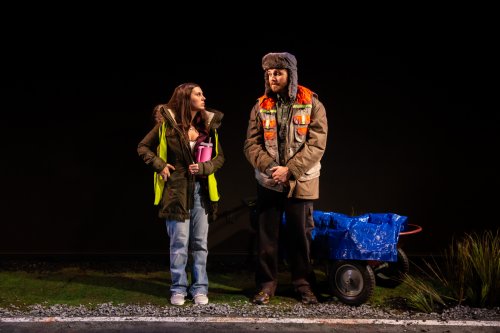
Mia Sinclair Jenness and D.B. Milliken in a scene from Sophie McIntosh’s “Road Kills” at the Paradise Factory Theater (Photo credit: Nina Goodheart)
Milliken and Jenness solidly embody their characters, revealing their reality in a skillfully balanced and insightful way. Milliken’s portrayal of Owen reveals a man of compassion and understanding, with a deep reverence for the life and death of animals. He also shows us how his singular focus on this understanding, as he goes about his clean-up tasks, is a mask for the discomfort he feels when interacting with the public as himself and not the clean-up guy.
Jenness presents her character as a young woman with a superficial attitude towards the people with whom she interacts. She dismisses their thoughts and feelings as unimportant. She hides her emotions behind a cloak of alcoholic numbness, carefully concealed from the world at large.
Owen and Jaki reach a point in their working relationship that suggests a level of understanding and acceptance. The potential lifting of the barriers to vulnerability culminates in a surprising and disturbing conclusion, followed by a thoughtful and engaging epilogue. It is a beautifully realized story worth experiencing.
Sophie McIntosh’s storytelling is both compelling and thought-provoking. When coupled with Nina Goodheart’s direction, which brings out the best in the cast, it creates a first-rate theatrical experience. See this show. You will not be disappointed.
Road Kills (through September 6, 2025)
Good Apples Collective and Ryan Duncan-Ayala
Paradise Factory Theater, 64 East 4th Street, in Manhattan.
For tickets, visit http://www.goodapplescollective.com/road-kills
Running time: 85 minutes without an intermission


Leave a comment