
Danger and Opportunity
An exploration of "crisis" on the personal level of three people in an emotional relationship.
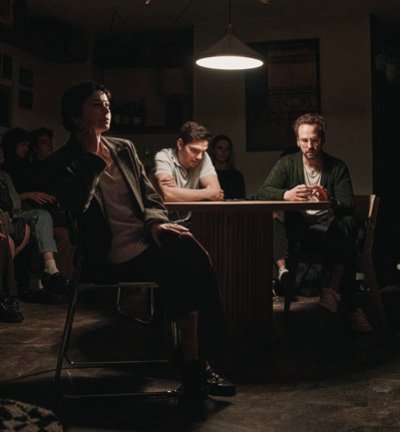
Julia Chan, Juan Castano, and Ryan Spahn in a scene from Ken Urban’s “Danger and Opportunity” at East Village Basement (Photo credit: Emilio Madrid)
There are words that combine different concepts within their definition. Crisis is such a word. Some cultures consider a crisis a moment when there is not only a risk of a bad outcome but also a chance for a new thing to arise. It also covers everything from events affecting nations, such as a natural disaster or armed conflict, to small personal events that challenge a person’s emotional well-being and view of life.
Danger and Opportunity by Ken Urban explores “crisis” on the personal level in the lives of three people. Urban calls it his “attempt to make sense of the push and pull between change as possible and impossible at a deeply personal level.” It is an apt description of what a personal crisis involves.
Jack Serio directs a strong cast of seasoned actors whose personal chemistry gives the ensemble a solidly believable portrayal of their characters. Juan Castano is Edwin, a mid-30s man married to Christian, a man ten years older, believably played by Ryan Spahn. The two men are struggling with issues in their marriage when Margaret enters the picture. Margaret is Christian’s “girlfriend” from high school and she is fully embodied by Julia Chan. They have not communicated with each other in 20 years.
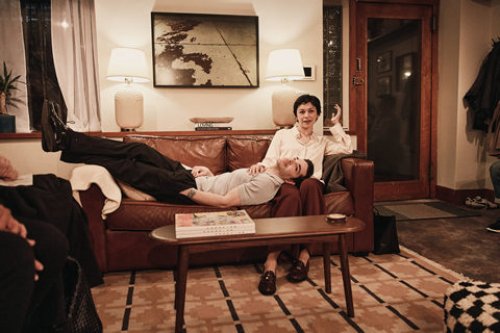
Juan Castano and Julia Chan in a scene from Ken Urban’s “Danger and Opportunity” at East Village Basement (Photo credit: Emilio Madrid)
The story follows the development of the relationships between the three over three and a half years. It is seamlessly divided into three segments covering that time with clever and effective use of lighting effects by Stacey Derosier to indicate the shifts in time.
The story opens with Christian and Edwin having wine and conversation with Margaret in their dining room. It has been 20 years since Margaret and Christian have seen each other. While catching up with all that was, Edwin is intrigued by the nature of Christian and Margaret’s relationship all those years ago. The questions lead to what was then and what is now, including comments about sexuality. Margaret comments that he is still much the same as in their high school days.
Christian’s response is to reference Friedrich Nietzsche, a 19th-century German philosopher, when he says, “Nietzsche argues in his doctrine of the eternal return–” It is at this point that Christian’s position as a history and philosophy teacher in a private school is revealed. Although Edwin tries to deflect the conversation away from Nietzsche, Margaret wants to know more. The following dialogue reveals the heart of the story when the idea of finite events in infinite time is discussed, and the question of things repeating is brought up. His response forms the heart of the drama since his former relationship with Margaret is the play’s dramatic tension.
Christian says, “repetition doesn’t negate choice. We must choose. But we must choose as if we will choose that same thing again and again. We must choose with the knowledge that this moment will repeat. We must live as if every decision, every moment of joy, every heartbreak, will happen again and again. We must stand behind what we do because imagine: we might do it eternally.”
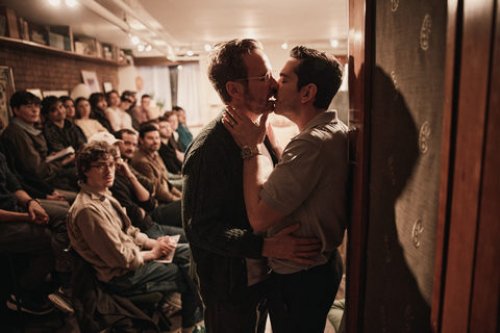
Ryan Spahn and Juan Castano in a scene from Ken Urban’s “Danger and Opportunity” at East Village Basement (Photo credit: Emilio Madrid)
The encounter over wine and conversation turns into six-months of a three-way relationship called a throuple, which is considered a balanced, consensual, and committed relationship between three people. This arrangement leads to Margaret moving in with Christian and Edwin as they fully share their lives, revealing in their interactions feelings and ideas that each has hidden from themselves and their connections with others. These explorations of feelings about self and relationships reach a critical point when an unexpected element comes into the equation in the form of a pregnancy. What transpires with the throuple as a result of this surprising development adds depth to the definition of the characters.
Each character asks, “Who am I really in this reality?” The opportunity to explore that question from both an intellectual and emotional perspective creates and sustains the partnership, up to a point. The nature of the exploration within this newly discovered relationship masks the danger lurking in the revelations of darkness hidden from each other and themselves.
Spahn, Castano and Chan give tightly focused performances. The ease with which they interact with each other through the smooth and the difficult emotional exchanges is riveting. You feel what the characters are feeling. You care about the emotional struggles they are encountering. You are left with provocative and intriguing ideas about relationships that may be new and unexpected, leading to questions about yourself and the people you know.
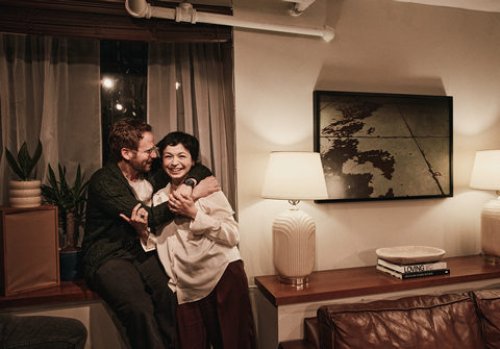
Ryan Spahn and Julia Chan in a scene from Ken Urban’s “Danger and Opportunity” at East Village Basement (Photo credit: Emilio Madrid)
The intimacy of the actors with their characters and with the audience is related not only to the actors’ skills but also to the venue. The East Village Basement theater is an intimate space, literally a basement apartment’s dining area and living room. There are 60 seats along two walls, and the audience is virtually in contact with the action. It enables the performers to speak in normal, conversational tones without needing to project or be provided with amplification. There is a closeness to the words being spoken and the emotions being expressed that are difficult or impossible to achieve in a space with greater separation from the audience. And, the actors never acknowledge the audience in any way.
In addition to the physical location, Frank J. Oliva’s scenic design completes the environment without the audience having to suspend belief for even a moment. Avery Reed’s costume design solidly defines the characters with a minimum of changes, and Avi Amon’s sound design fills in the spaces as needed, seamlessly adding to the whole.
I want to give an additional call out to Derosier’s lighting design for its effective and inventive use in guiding and following the action. My late colleague critic and professor Glenn Loney once told me that lighting calling attention to itself is bad lighting. I disagree with his view in the case of Derosier’s work. The technical sophistication of the ordinary lights of an apartment being operated in sync with scene changes is superb. The blink of the lights to signal a change in time over the course of a conversation allows for transition without losing dramatic tension. It is superlative design and execution.
Danger and Opportunity (extended through April 25, 2025)
Produced by Jacob Stuckelman, Andrew Patino, Matt Krauss, and Kyle Rogers
East Village Basement, 321 East 9th Street, in Manhattan
For tickets, visit http://www.universe.com/events/danger-and-opportunity-tickets-PHTXD9
Running time: 90 minutes without an intermission


Leave a comment