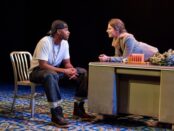
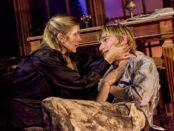
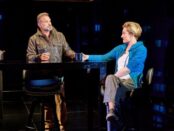
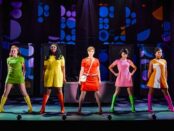
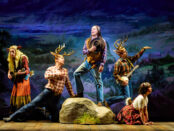
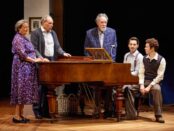
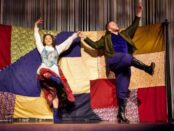
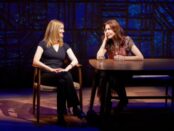
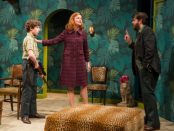
Jeremy Daniel fell in love with live theatre as a little kid, and his passion for Broadway grew so much throughout his early years that it would inevitably become his career the day he moved to New York City. His Broadway career began as a publicist, representing more than twenty acclaimed Main Stem shows, plus countless others Off-Broadway and beyond.
Through his work as a publicist, his passion eventually turned to theatrical photography, and since 2008, he has photographed dozens of notable productions on Broadway, Off-Broadway and on tour throughout the U.S., including “Waitress,” Bartlett Sher’s revivals of “The King & I” and “Fiddler on the Roof,” “The Play That Goes Wrong,” “Bandstand,” “Chicago,” “Jersey Boys,” and many more, plus productions for Cirque du Soleil, Lincoln Center Theatre, Playwrights Horizons, Roundabout Theatre Company, The Irish Rep. and Bedlam Theatre Co.
Watching these creative people misbehave is part of the fun though a great deal must be taken on faith: Julie’s tremendous talent, Raf’s inordinate fame and highly emotional depth, Ben’s genius as a filmmaker though Raf has never seen one of his movies, and that Mira’s novels earn more money than Ben’s films. However, nothing Schmidt has written for these characters demonstrates these qualities. Julie is portrayed as pretentious and overacting. Raf is so low-key it is hard to see him as having a great deal of depth on screen. With Ben's self-dramatizing and egotistical nature, it is hard to imagine him finding time to focus on his work, while the items we hear about from Mira’s novels hardly seem like the material for best sellers. Possibly Schmidt who has directed her own play needed a second pair of eyes and ears to get her play whipped into shape. [more]
"Reunion"'s lyricist Scharf and Composer Calire explore how two forgotten one-acts became a musical about second chances, memory, and the courage to reconnect. [more]
"Reunions" is a charming new Edwardian musical made up of two classic one- act plays: James M. Barrie’s 1910 “The Twelve-Pound Look” and the Quintero Brothers’ 1901 “A Sunny Morning.” Using an ensemble of six main actors who rotate roles, these two one-act musicals have the same theme: former lovers meet years later by an accident that changes their lives. However, the Barrie play deals with a middle-aged couple in a London mansion while the Quintero play brings together two septuagenarians in a Madrid park. Beautifully directed by Gabriel Barre, this is an elegant evening worthy of its Edwardian ancestry. [more]
While Broadway was once filled with plays like this a generation or two ago, "Art of Leaving" now seems very dated. It would have been more believable set back in an earlier decade. Matt Gehring’s direction emphasizes the sit-com nature of the play which is a mistake as it makes the proceedings seem all that much more shallow. Both Aaron and Diana are very thinly written so we learn little about their 25 year marriage except that Diana has lived her life to please her unhappy and demanding husband. Jordan Lage’s Aaron is a total egoist who is lacking in sympathy, while Audrey Heffernan Meyer’s Diana seems unbelievably naïve as to what is available to women today. [more]
'Duke & Roya" is an engrossing rom-com with a geo-political background, the sort of story that Hollywood specialized in during World War II. Charles Randolph-Wright’s new play makes use of the war in Afghanistan in 2017 before the American pull out in 2020. The cast is led by television stars Jay Ellis (James in "Insecure") and Stephanie Nur (Aalyiyah in "Lioness") who prove to be engaging company. The cast is filled out by veteran stage performers Dariush Kashani ("The Kite Runner," "The Band’s Visit," "Oslo") and Noma Dumezweni who created the part of Hermione in both the London and Broadway versions of "Harry Potter and the Cursed Child," winning the Olivier Award for Best Supporting Actress. [more]
In fact, the play Harmon has written is mainly about the conflict between the grandmother and the mother. While we are never really certain why Ellen and Susan refuse to be in the same room, we come to know all the details of the relationship between Renée and Ellen from three sides. The most entertaining parts of this long one-act delineate the relationship between Joshua and his Auntie Mame-like grandmother who did not believe in age-appropriate events: taking him at age seven to see "Dances With Wolves," attending a Mapplethorpe exhibit (which he did not understand) at age nine, seeing Diana Rigg in "Medea" when he was ten, and a three-movie marathon during a snow day off from school: "Secrets and Lies," "Sling Blade" and "The English Patient." Joshua credits his grandmother with changing his life making him want to be a playwright after seeing "Medea." [more]
The new version by Irish playwright Mark O’Rowe uses contemporary and spare language but has made several events more literal as if not trusting modern audiences. The director has made the same mistake starting the play as a rehearsal in which we see the opening scene three times ranging from devoid of emotion to accomplished, which is both ineffective and pointless as it does not help us into the world of the play. The thrust stage by set designer John Lee Beatty (a room in unpainted wood, a single dining room table and mismatched chairs and a wall of French doors into a conservatory) is as stripped down and as spare as the language, a fitting place for a drama of tragic proportions, but does not offset the one- dimensional acting. The bland costumes mainly in black or white by Jess Goldstein straddle both the 19th and 21st centuries, seeming to want to have it both ways, but suggesting neither. [more]
It's the play's best scene, an astounding mix of incredible absurdity and, for all the Zoom veterans out there, undeniable believability, especially with everyone talking and typing past each other. Still, while serving the play's humor, director Anna D. Shapiro must simultaneously contend with its overt underside, sick children, as well as a modern audience replete with the traumatic knowledge that, after the 2018-2019 school year, the worst is yet to come. Given that, it's an outright testament to the impressive comedic talents of Shapiro, Spector, and the play's ensemble that the subject matter of "Eureka Day" can remain a laughing matter. [more]
Great in entirely predictable ways, especially its rich musical orchestrations and arrangements from jazz genius Branford Marsalis (he's assisted by Tony Award- winner Daryl Waters), "A Wonderful World" wastes its decided advantages by keeping Armstrong at a distance while incongruously tasking him with narrating his own life. An impassive witness to himself, Armstrong is also a bizarrely unreflective one as he meanders from place to place and wife to wife, before finally appearing with his wronged women to sing "What a Wonderful World" as an ethereal eleven o'clock number on Adam Koch and Steven Royal's protean set. To say the least, it's a lackluster concluding statement on the complexities of Armstrong's marriages, as well as his feelings about a world that, despite all of its "trees of green" and "red roses too," caused him so much pain. [more]
Essentially a cri de coeur, "Vladimir" desperately wants to answer affirmatively; however, Sheffer forthrightly acknowledges that it's a dangerously knotty road to yes, requiring Raisa (Raya in the diminutive form) to not only imperil herself but also possibly cause the deaths of others. In particular, passivity is the much safer choice for Yevgeny (David Rosenberg), a financial analyst who, despite having experienced virulent anti-Semitism while attempting to navigate the Russian educational system, helps Raya link that aforementioned suspicious tax refund to the upper echelons of Putin's corrupt administration. Like Raya, Yevgeny is not purely plucked from Sheffer's imagination, as he also possesses a non-fictional counterpart, Sergei Magnitsky, who, in a tragic similarity to Politkovskaya, savagely lost his life for having the courage to tell the truth about Putin's misdeeds. [more]
Lloyd Suh writes quirky historical plays from a unique perspective as ironic comedies. In "Franklinland," the latest entry in the EST/Sloan Project, commissioning and developing plays about science and scientists, Suh creates a Benjamin Franklin like you have never seen him depicted before. Unlike Howard Da Silva’s iconic and benevolent Franklin in the now classic musical "1776," this Franklin is crotchety, irascible, arrogant and demanding. In the play’s six scenes covering 33 years, we see him in his fraught and contentious relationship with his illegitimate and only son William who though not a great mind or a scientific genius like his father goes on to do well for himself politically. [more]
Under Igor Golyak's hyper-inventive direction the production's form is masterfully daring, ignoring the barriers of past, present, and future, as well as performance and life. Golyak's double disrespect for temporal and fourth-wall distancing is most evident in the actors' frequently unsettling playfulness, including a foreboding sing-a-long with the audience during a pretend Jewish wedding. Smilingly staged by both Catholic and Jewish classmates when such interreligious bonhomie was still possible, the echoes of these characters' younger, imaginative selves continue to linger as some of them mature into monsters, their brutality imbued with an anachronistic childlike quality that strengthens the devastating sense of a lost innocence. [more]
The eye-filling sets by Hannah Beachler and video and projection design by Daniel Brodie include subtle tributes to Black Culture that not all theatergoers may notice on a first look. When Dorothy first lands in Oz, the landscape and houses are reminiscent of Tremé, the Black neighborhood in New Orleans decimated by Hurricane Katrina. The overhead set piece is inspired by the arch in New Orleans’ Louis Armstrong Park as well as incorporating patterns found in quilts on the Underground Railroad. African symbols are carved into the bark of the trees along Dorothy’s path on the Yellow Brick Road as well as depicted on the sides of the theater proscenium arch. When Glinda enters, she comes out of house at the address 1804, commemorating the year of Haiti’s independence. The red and black sets and costumes (by Sharon Davis) for the sequence in the Castle of Evilene are a tribute to West African culture. [more]
A good deal of fun is had by Brian Pacelli’s projection design which is shown on the modern and chic living room/dining room set by Christopher and Justin Swader. It takes us to the virtual reality world inhabited by Scarlett and later Kevin: forests, deserts, jungles, icescapes which change at the drop of a hat. It also lets us keep track of Kevin’s progress with fitness data and the success of the RealFit apps as to the number of new users. Emily Rebholz has created an attractive collection of clothes in monochromatic colors for these fitness-oriented people. The lighting by Jamie Roderick enhances the set and projections by changing the mood each time we find we are projected somewhere else. [more]
Peter Brynolf and Jonas Ljung, two coolly elegant Swedes—who wrote the show with Edward Af Sillén (also the show’s director)—perform one mind-boggling feat after another, fed by information culled from the audience. The two performers also speak of their own lives, although why they have to describe themselves as “two heterosexuals” is questionable. [more]
John Patrick Shanley has become our poet of lonely, desperate working class people trying to make a connection despite their inadequacies and hang-ups in such plays as "Danny and the Deep Blue Sea," "Savage in Limbo," "the dreamer examines his pillow," "The Big Funk" and "Outside Mullinger" and, of course, in his Academy Award-winning script for "Moonstruck." In all of these works, the pair makes an unlikely couple who fight against their very attachment as outside of the realm of possibility. In his latest play, the bittersweet "Brooklyn Laundry," he creates another lovely story of an unlikely couple Fran and Owen who find each other just when they need someone most. [more]
This York Theatre Company production at the New World Stages, following a presentation at Goodspeed Musicals in 2016, shoehorns these songs into a book by Lindsey Hope Pearlman from a story created by Richard J. Robin. It has an ambitious plot that glibly takes on a number of themes roiling through the turbulent Sixties: women’s lib, civil rights, the war in Vietnam, the sexual revolution, Andy Warhol, and even a premature touch of gay liberation. [more]
When she arrives dressed in a white pant suit, Labeija steals the stage with Hillary’s number “Miss Me Now” which trumps them all with a series of Broadway parodies paying tribute to Clinton’s love of the theater, with recognizable quotes from "The Sound of Music," "Company," "Gypsy," "Chicago," "Evita," "Thoroughly Modern Millie" and "Dreamgirls." However, while all of this is clever, at times the show becomes “can you identify this parody.” A “Six Mixalot” for the company takes the same place as “The Megasix” in "Six." Lena Gabrielle does fine work with the four-person all-female band but the sound design by Bailey Trierweiler, Kevin Heard and Uptown Works is often too loud for this small Off Broadway theater. [more]
At the performance under review, part of the audience found the show hilariously funny, while others proverbially sat on their hands. The show makes use of history, parody, satire, burlesque, musical comedy and tragicomedy, never being consistent to any one genre. At two and a half hours this kind of parody seems a bit too long. "Between Two Knees" is a noble effort to tell the story of one hundred years of Native American suffering through the Lakota tribe, but it seems to want to cover too much in too parodistic a style. [more]
Harmon meticulously fuses the domestic ups and downs of this bright, well-educated extended family with the overwhelming and unavoidable social upheavals that surround them whether it’s the Nazi persecutions or the rise in anti-Jewish violence and rhetoric in contemporary France. Their story is epic, but intimate. David Cromer, the director, isn’t afraid to keep "Prayer" flowing in a deliberate, unhurried pace, or pausing at times letting the play breathe. He makes the epic quite human scale. "Prayer for the French Republic" is monumental, yet human scaled, addressing a resurgent scourge with intelligence and warmth. [more]
Director Matthew “Motl” Didner manages to make what might have been just a well-staged concert of moving songs into a dramatic whole with a deep feeling for the ebb and flow of emotions from happiness to hopelessness. "Amid Falling Walls"—an apt title, unfortunately, still consequential in 2023—does come during a spike in anti-Semitism. Though an entertainment, the show provides ample historical evidence of blind prejudice. If only the message could register. [more]
Although playwright Qui Nguyen declared early in his earlier play "Vietgone" that “all characters appearing in this work are fictitious,” in his sequel "Poor Yella Rednecks" now at Manhattan Theatre, co-commissioned with South Coast Repertory, the playwright played by Jon Norman Schneider begins by interviewing his 70-year-old mother Tong Nguyen about how his parents built a life in America as Vietnamese refugees. Directed by May Adrales who also directed the earlier play in the same exuberant fashion, the resulting flashbacks are raucous, raunchy and poignant. In what was originally announced as a quintet of plays, "Poor Yella Rednecks" is now described as the middle play of a trilogy. [more]
If an audience can willingly get past the contrivance that the distant relative Stevie meets over coffee, a young white man whose family generations ago once owned (and fathered!) slaves in Stevie’s family, and who just so happens to be the live-in boyfriend of Stevie’s niece Meg, then the audience will have a good time. The four leads of Meg, her boyfriend Drew, her mom Beverly, and Beverly’s twin brother Stevie are written so well. We care so much about each of them that the revelation that they are intertwined by the horrific tale of a plantation owner that loved his slave but was not above slashing her tendons when she tried to run away sets a tone that should be devoid of all humor. [more]
Directed by Karen Carpenter, "Pay the Writer" by best-selling novelist Tawni O’Dell is slick and superficial but entertaining and engrossing. The play about the 45 year friendship between an ultimately successful gay literary agent and an unknown African American novelist who becomes celebrated and wealthy plays like a novel or mini-series with its 13 scenes and many two-character encounters but is ultimately satisfying by the time it reaches its denouement. The high powered cast plays it to the hilt, belying the fact that the characters are superficial and stereotyped, which, of course, doesn’t make it untrue. Some of the play is extremely funny with one-liners worth repeating. [more]
The family-oriented TheaterWorksUSA’s latest musical adaptation of the best-selling children’s novels of Dev Pilkey is "Cat Kid Comic Club: The Musical," an exuberant colorful one hour irreverent entertainment for children of all ages. Written by Kevin Del Aguila (book and lyrics) and Brad Alexander (music) who previously wrote the highly successful "Dog Man: The Musical" from the earlier Pilkey series, "Cat Kid Comic Club" is surprisingly faithful to the book of the same name and will not disappoint its many fans. With clever and imaginative direction by Marlo Hunter and her design team which uses puppets as well as live actors, the hard-working cast of six (almost all of whom appeared in TheaterWorks’ "Dog Man" musical) play multiple roles to tell this hilarious and surprising story. [more]
As directed by the astute Josh Sharp, Kayne begins his show as a stand-up act, but warns us “This is a comedy show. BUT it is also sad. There will be long stretches where you will not be laughing. I don’t want to feel like I tricked you, so I’m telling you in advance.” However, Kayne is able to find the absurdity in things that are inherently sad so that there is much humor in his one-man show. After his stand-up comedy routine, he gives a short math lesson using a white board and a black board (set design by Brett Banakis) to demonstrate that things are often not what they seem. [more]
Auburn (Pulitzer Prize winner for Proof) has a knack for writing complex female characters. That knack hasn’t failed him in "Summer, 1976." Diane, the lustrous Laura Linney, is an aloof artist/university professor who meets Alice, the warm and magnetic Jessica Hecht, a stay-at-home mom, via their very young daughters. Alice’s husband, the unseen, but occasionally heard, Doug, an economist on the tenure track at the university where Diane also teaches, devised a babysitting co-op that involved coupons exchanged for hours of babysitting, a system that eventually breaks down quite humorously. [more]
The Company soon loses its way as bunk beds self-destruct, lines get mangled, Peter Pan flails about in failed attempts to fly and crocodiles and mermaids parade about on skateboards. If this sounds like a normal production of Barrie’s classic tale, then I am telling it wrong. The main problem with "Peter Pan Goes Wrong" is that virtually all the jokes are physical, an unending series of scenic disasters that become not just predictable, but tiresome. Even the great physical comedians of the silent film era knew when enough was enough. [more]
Some critics would say Eric Bogosian’s "Drinking in America" is dated, but that’s very much up for argument. The script given to critics for the new production at the Minetta Lane Theatre is marked “Tweaked Drinking In America Script For Audible,” all in caps actually. In all fairness, some of the “current references” particularly with regard to in-demand actor names bandied about in the scene entitled “Wired” are names clearly from another age. That could have easily been “tweaked,” if they really wanted to do that. References to Quaaludes in the scene “Our Gang” reek of history rather than current usage, but then again, is there an easy 2023 replacement for Quaaludes, a drug that was taken off the market around the time the play was first produced? Aside from those references, the twelve scenes that comprise the play remain shockingly topical for our era. [more]
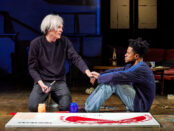
While Bettany and Pope are each very convincing as Warhol and Basquiat since they are made up to look exactly like they did in life, they seem to be in two different plays, using different acting styles. The other problem with "The Collaboration" is that it feels very superficial, like a laundry list of items for them to discuss, while at least several of the dramatic devices are taken out of context or are relocated in chronology. It is certainly a fascinating premise: an older famous and fabulously successful artist whose star is fading and a younger rising star who has taken the art world by storm and seems to be unstoppable, brought together by their shared dealer. [more]
The new production of "The Sound of Music" at New Jersey’s Paper Mill Playhouse is such an utter delight, you shouldn’t be wasting time reading this review, you should be ordering tickets right now (www.papermill.org). I’ve seen countless productions at Paper Mill since the 1970’s. This production, running through January 1st, is one of the most satisfying productions I’ve ever seen at that theater—which is saying plenty. Director Mark S. Hoebee tells the familiar story—rich with honest sentiment--clearly and well. The show, with more than 30 actors on stage and 16 musicians in the pit, is handsomely produced. [more]
Shekar’s script is extremely smart, funny at just the right moments, and morally gripping. Her characterizations of Ariel and Sanam are fully formed, uniquely individual and carefully complementary: Ariel is a crunchy-granola, bee-loving, single mom who’s desperate to prove Monsanto’s guilt, and Sanam is intense, strong-minded and honest to a fault. Through the character of Arvind, Shekar introduces the notion to Sanam that she and Ariel are looking at their study through the impartial lens of confirmation bias. The character of Dr. Hayes adds just the right amount of antagonism, almost sinister. Although there’s lots of statistics jargon in the script, it never impedes the progress of the story, thanks to the actors and director Aneesha Kudtarkar, who skillfully shapes the piece, finely intertwining the performances to maximum impact. [more]
A lure of this Broadway premiere revival is 25 years later experiencing the acclaimed performances of much of its original cast. Being a memory play, their current ages are irrelevant, especially when their talents are impeccable. With her renowned charismatic stage presence, Mary-Louise Parker is monumental as Lil’ Bit. Ms. Parker’s drawling vocal delivery and magnetism fully and poignantly realizes the character from the perspective of an older woman looking back on her dysfunctional adolescence. The soft-spoken and shattering David Morse soulfully embodies Uncle Peck, a delusional W.W. II veteran who has descended into alcoholism and pedophilia. [more]
Unfolding from a stand-up comedy routine—“A prisoner walks into a bar…!”—and set in a comedy venue designed with ingenuity and style by Walt Spangler, Turtle veers from hokey to horrible helped by the spiffy routines staged by choreographer Kenny Ingram in over-the-top, sometimes kitschy, routines. Where else can you see dancing prison guards waving their batons as they tap dance in a circle or the flexible actor Josh Marin portraying an ATM and a basketball hoop? [more]
In making her professional stage debut courtesy of Page 73, Zora Howard has written a powerful kitchen sink drama in 'Stew," as much about making a literal stew as about the emotional stew the four women in the Tucker family of Mt. Vernon find themselves in. While many of the elements are family, Howard combines them in new ways so that the play seems both new and true. With a terrific cast headed by Portia ("The Rose Tattoo," "Ruined," "Rinse Repeat," "Our Lady of 121st Street") as the family matriarch, director Colette Robert keeps the temperature continually simmering on a low boil until all of the secrets and events have been revealed. This is an American tragedy as well as a study in how we live in this era. [more]
When a playwright adapts a famous, well-known story for the stage the problem becomes how to tell it in a new way that makes it seem unfamiliar and fresh. Otherwise, why bother retelling it once again? Unfortunately, Tom Dulack’s "Paradise Lost," “inspired by the poem by John Milton,” retells the story of Lucifer’s fall from Heaven into Hell, and the eventual banishment of Adam and Eve from the Garden of Eden without any surprises. Using only contemporary language, Dulack’s play lifts the skeletal plot of Milton but lacks the poetry, as well as those elements which made this epic controversial in the 17th century (rejection of the divine right of kings, embracing divorce and marriage equality, etc.) It resembles a Sunday Bible sermon or dramatization meant for youth. [more]
Prominent Georgia attorney Dep Kirkland “decided to listen to his own voice, and walked away from the legal field altogether to pursue his previously private dream of acting, writing, and directing...” This statement comes from Mr. Kirkland’s biography in the program for the play he wrote, "MsTRIAL." Its promising He Said, She Said premise is undermined by a disjointed structure and presentational flaws. Mr. Kirkland has come up with a viable plot, appealing familiar characters and expert dialogue, but his command of dramatic writing is shaky. It’s not the explosive legal drama it aspires to be, coming across more as a screenplay being workshopped instead of a realized stage play. [more]
Now, New Yorkers who know the film (and who love it, hate it or partly love it and partly hate it) have a chance to see a streamlined (at 95 minutes) musical-theatrical spoof of the film, called "Love Actually? The Unauthorized Musical Parody." It’s a lively, silly and well-performed romp created by people who seem to have done a lot of this sort of thing: writers Bob and Tobly McSmith ("The Office! A Musical Parody") and director Tim Drucker ("Spidermusical"). The three previously worked together on "Friends! The Musical Parody." Basil Winterbottom has provided the engaging tunes and orchestrations for the McSmiths’ lyrics. [more]
"The Lightning Thief - The Percy Jackson Musical" settles down a bit more in the second act and becomes more engrossing but the damage has been done. The actors in the first act all seem to be racing for a train and the sound levels continue to damage many of the songs throughout the show. The show remains an excellent introduction to Greek mythology made relevant for our own time. Faithful to the source material, it may please both teens who have read the book and those who have not. The five of the seven-member cast playing 28 roles demonstrates their versatility as they change from one colorful three-dimensional character to another. If only the director and the production had trusted the original show and did not feel it necessary to make it bigger and better for Broadway, a common complaint when shows make the move from their smaller Off Broadway venues. [more]
Like a great many history plays, Harvey Fierstein's "Bella Bella" is as much about the present as the past, paralleling everything that's gone wrong now with what went wrong then. Unsurprisingly, it's also shamelessly biased, with the first word in the play's title apparently meant to be read in Italian as part of Fierstein's banally straightforward tribute to Bella Abzug, the feistiest of feisty 1970's New York City politicians, best known for her take-no-prisoners liberalism as a member of the U.S. House of Representatives. One's enjoyment of the play probably depends on how prone you are to clap or hiss along with the rest of the unambiguously sympathetic Manhattan Theatre Club audience, even if it's only in your own head. [more]
On Broadway every once in a while writing, acting, directing and the technical production come together to profound, memorable effect. Adam Rapp’s "The Sound Inside" at Studio 54 is a superb example of this phenomenon. Originally staged at the Williamstown Theater Festival, the move to Broadway, and a much larger theater, works incredibly well. [more]
As a writer, O’Dell seems to eschew melodramatic elements, including pat endings with fully resolved conflicts. This a work grounded in sober reality, a work that rejects the prevalent idea that “closure” is something that will surely erase all scars and “make whole” once more those who’ve lived through such traumatic incidents. If there’s any “message” that O’Dell offers, it’s that keeping silent about having been raped can only exacerbate the pain. At the same time, she suggests, women who’ve experienced such assaults need to be able to come out about them in their own time. [more]
It is not until the second act of British playwright Chris Urch’s "The Rolling Stone" that the play catches fire but from then on the drama is explosive, compelling and very disturbing. Once the play gets past the introductory exposition that sets up the plot, the production by Saheem Ali (Donja R. Love’s "Sugar in Our Wounds" and "Fireflies," and Christopher Chen’s "Passage") is taut, tense and involving. [more]
Kids may love this show—and the Dog Man books themselves—largely because the outlandish situations are similar to scenarios in their own hyper-imaginative make-believe play. Except that, at the Lucille Lortel Theatre, young audiences see a fully realized version of such fantasies, with vibrant production values plus some catchy tunes. Tim Mackabee’s cartoonish unit set—Harold and George’s treehouse—is quiet at first but is soon swarming with marauding buildings, a wacky robot and other assorted craziness. Heidi Leigh Hanson’s costumes are bright and cleverly imagined. David Lander’s lighting design helps us imagine lightning storms, bomb explosions and what amounts to a municipal volcano. Director/choreographer Jen Wineman keeps everything moving along at a quick clip. [more]
"The Bigot"’s mouthpiece is the splendid Stephen Payne. Scruffy and silver-haired, Mr. Payne revels in Jim’s cantankerousness and physical decrepitude. Bellowing in his resonant twangy voice as if in a Sam Shepard play, Payne is able to make the most corrosive statements sound funny while expressing emotion. His vivid characterization emits humanity, making the crusty Jim much more than just an ogre. By the end of the play, the role has accumulated the impact of an Arthur Miller-type figure due to Payne’s intense performance. [more]
“Everything is copy” was Nora Ephron’s maxim about the potential of all of one’s life experiences to be fashioned into narrative material if one has the cachet to be paid attention to. Actress Maddie Corman sure has a lot of copy as well the affluence and connections to get it out there in "Accidentally Brave," her 90 minute self-written solo show. It’s profanity-laden therapeutic storytelling with high production values succeeding as inspirational entertainment for those with an affinity for her upscale sensibility. [more]
In recent years the play has not fared with such acclaim. A 2008 Broadway revival starring Frank Langella eliminated the narrator character of The Common Man, the play’s cleverest device, and was not well received. Now Fellowship for the Performing Arts has brought the play to the Theater Row’s Acorn Theatre directed by Christa Scott-Reed, who also staged FPA’s revival of Shadowlands last season. Unfortunately, the academic and unimaginative production fails to bring the ideas and the tensions in the play to a boil. [more]
Obviously, this is a play for which any sort of a happy ending will be deeply compromised, but what Simpson does so beautifully is show us how these women overcome their suspicions and envy to find support in one another. It’s tempting for playwrights to work toward such an end by wallowing in sentimentality. However, it never seems that Simpson, Robert or the talented women portraying these characters are pulling frantically at our heartstrings. The plot unfolds simply and satisfyingly, with the characters’ behavior always plausible and unforced. Surprising moments of humor serve as grace notes to an otherwise somber story. [more]
Rattlestick Playwrights Theater is presenting a theatrical event by Idaho theater poet Samuel D. Hunter ("The Whale," "A Bright New Boise," "The Few," "Pocatello," "The Healing," "The Harvest"): a long one-act masterpiece (Clarkston), a 40-minute communal dinner served on picnic tables of what the characters would be eating and a curtain raiser, "Lewiston," which has the same themes and symbols as the later play. Taken as a whole this is a remarkable achievement, probably the best Hunter has created so far. Director David McCallum must be given some of the credit for this magnificent evening, and in particular actor Edmund Donovan who isn’t so much performing as living his character of Chris in "Clarkston." [more]
Mr. Harper’s taut construction, solid plotting and detailed characters all yield to a suspenseful, emotionally shattering and entertaining experience. As in the works of Henrik Ibsen, Arthur Miller and August Wilson, Harper makes valid rationales for both sides of the arguments that are being fought. [more]
Hence: "My Life on a Diet," a comically rich stroll through her career in TV, theater and film. Written by Taylor and her late husband, Joseph Bologna and originally directed by Bologna, Diet is currently at the Theatre at St. Clement’s where a contagiously comfortable Taylor, elegantly attired (gown by Pol’ Atteu) settles down in Harry Feiner’s kitschy, carpeted set to schmooze with her audience. Taylor, now in her eighties, begins with some self-deprecating humor about aging, after showing herself at various stages in her life. [more]
The audience is frequently called upon to participate onstage and from their seats with one elaborate portion involving their driver’s licenses. London vacation photos of Mr. Beckman, a guard at Buckingham Palace, and Queen Elizabeth II becomes a hilarious and mystifying routine. Plastic bottles are fodder for visual conjuring. While blindfolded Beckman guesses things that audience members have selected. A Van Gogh-inspired painting exercise is performed to the booming sound of Beethoven. Less successful is a large-scale, convoluted and confusing card trick. [more]
War, guns, Vietnam, the excesses of capitalism, toxic masculinity, blind American patriotism and feminism are among the targets of Mr. Vonnegut’s characteristically overloaded satire. Such concerns treated in a mannered fashion were all fodder for his popular novels but for the stage it’s problematic. [more]
Michael Roberts’ music is a tuneful assortment of melodies some of which have an appropriate ethnic flavor. Mr. Roberts’ lyrics range from inspired to rudimentary with the overall score being quite charming. The caustic “Visiting Your Mother” stands out as a Leonard Bernstein/Betty Comden & Adolph Green-style showstopper as sensationally performed by the appealingly forceful Sarah Beth Pfeifer as Eleanor. [more]
"Admissions" is often very funny like when Sherri has to try to explain why Melville’s Moby Dick is not being taught anymore (a book about a white whale by a dead white guy) and when Charlie is annoyed that girls in his class object to reading Willa Cather, a woman and a lesbian rather than a person of color. Although the play is intended to be unsettling to white liberals, it is too neat in its setup. It would have to be Sherri who has spent 15 years creating diversity at Hillcrest whose son may be affected by affirmative action and Charlie and Perry who have been best friends almost all their lives should be divided by Yale’s admission choices. Perry’s picture in the admissions catalogue is rejected as he photographs white and does not look like a person of color, but to find a group shot demonstrating diversity it ends up having to be staged. And Charlie’s 180 degree change of heart plunges his parents into a great dilemma: do they use their personal contacts to see what can be done, something Sherri and Bill have not been averse to in the admissions office at Hillcrest for others. [more]
The best reason to see Isobel Mahon’s "Party Face" is to see the ever-lovely Hayley Mills who used to play mischievous teens and now is playing busy-body mothers. The play is diverting though it has nothing new to say about women and their contemporary roles. Under Amanda Bearse’s direction, the play also gives Klea Blackhurst another off-beat comic role in which she shines. [more]
John Haidar’s energized production turns this material into a tour de force for Campbell and Lynch who are continually moving about spewing volumes of words, almost choreographed by movement director Naomi Said. Deeply in character, they seem to be living their adventures which include humor, fantasy and violence. However, American audiences will have difficulty with the thick Cork accents and Irish slang, as well as Pig and Runt’s private language which often resembles baby talk when it doesn’t sound like street poetry. [more]
Another irony is that while Fury is kind of a bore, another character is not. Yeah, you guessed it. Him. When the president (David O. Friedman) appears in Fury’s bedroom like the Ghost of Christmas Present, Attea’s writing finally comes to life. His take on you-know-who isn’t unique, but the situation is wonderfully silly, and Friedman’s impression is a funny profile in petulance. [more]
William Nicholson’s "Shadowlands" is one of those subtle plays that grows on you as it evolves and weaves its own spell. Based on a true story of one the most improbable love stories of the 20th century, it covers a range of human emotions that should catch you in its web. Under Christa Scott-Reed’s assured and astute direction, Daniel Gerroll gives a memorable performance as theologian and writer C.S. Lewis. A play of ideas on the meaning and varieties of faith, it is challenging as one has to follow its intellectual and spiritual arguments. However, for discriminating theatergoers, this is an added fillip for more than simple entertainment. [more]
Crumm and DeVito have a marvelous chemistry together and terrific mutual comic timing that make them seem like a real couple. Their compelling performances energize and elevate what could have been a wan, sitcom-style stage show. [more]