The Drama Desk Award-winning 59E59 Theaters is the number one Off-Broadway destination in New York City. In the heart of Midtown, just east of Central Park, 59E59 Theaters is a spectacular modern theater complex with three stages and a lively bar on the mezzanine level. http://www.59e59.org/
While the script describes the setting as simply a “rural place,” British and European productions apparently have set the play in medieval times. It is definitely pre-industrial as the farmers still need to have their grains ground at a mill and no one has yet seen a pen. Director Paul Takacs, who has staged the equally challenging Dark Vanilla Jungle by Philip Ridley in New York, has reset the play on the American frontier and made use of a multicultural cast. This grounds the play somewhat and makes it easier for Americans to identify with it, but it remains a difficult, challenging play due to its poetic language and its lack of specificity. [more]
Well-meaning and sincere," Occupied Territories" is both generic and stereotyped, offering a story television and the movies have been offering for years: the traumatic effect of a father’s Vietnam experience on his family years later. Co-written by Nancy Bannon who appears in the play and Mollye Maxner who directed it, it offers no surprises or new enlightenment. Set in two locales and time frames, the play alternates between scenes in a suburban basement on the day of Stephen Collins’ funeral and scenes from the life of the same man 45 years earlier as a rookie in the jungles of Vietnam. Ironically, the actors playing the soldiers are more convincing than the actresses playing the family members at home in America in the present. [more]
King’s "Dolores Claiborne" would seem a strange choice for dramatization as the book is a monologue told entirely by its protagonist at a police interrogation over a murder on Little Tall Island off the coast of Maine. Though J.D. McClatchy’s streamlined libretto is very faithful to the book (while eliminating some characters and complications), it never approximates the compelling and wry narrative voice in Dolores’ first-person tale which makes her sympathetic and gives a sense of urgency to her story. Mezzo-soprano Lisa Chavez creates a believably passive character as a maid/companion to a selfish, rich woman whom she is accused of killing and an abused wife saddled with an alcoholic and brutal husband who died 30 years earlier but she brings no sympathy to the role. She just seems a tired, traumatized woman, not very interesting for the leading character in an opera. [more]
In 85 minutes, we really don’t learn much Rebecca, Nolan or Sukey as Mr. Donnelly imparts scant biographical details about them, but strangely does for Padgett. Donnelly takes the perennial premise of a divorced couple’s past romantic feelings for each other being reignited and clumsily tosses in the dramatic, morbid bombshell. His glum and stilted finale at Sukey’s apartment is out of Private Lives. The title refers to Sukey’s wish that when she dies that there be no wake. [more]
Both as written by Stroppel and portrayed by Stephen D’Ambrose (Stravinsky) and Mark Shanahan (Disney), it also becomes clear that they are equally imperious--at first. Though they’re both monomaniacs, its Disney who proves more like a Trumpian narcissist. While Stravinsky says early on, “Everything I say is entirely true,” Disney, a bit later, claims, “I’m never wrong.” The fireworks begin as soon as they start to interact when Disney describes how the music evokes for him the birth of the universe and “earth--in its infancy,” not to mention dinosaurs, which remain the most memorable part of the "Fantasia" segment or sequence [more]
In fact, Harry Feiner’s marvelous, you-are-there set design for "The Violin" made me think of 'American Buffalo" (set in a shabby pawn shop) before the first words of the play were even uttered or its three cast-members (Robert LuPone, Peter Bradbury and Kevin Isola) even appeared on the stage. But whether or not playwright McCormick had that early Mamet work in mind, the main idea behind "The Violin" was probably inspired by a real event, when celebrated cellist Yo-Yo Ma left his prized cello in the trunk of a New York taxi some years ago, and paid a handsome reward for its return. [more]
As in one of Alan Bennett’s "Talking Heads" monologues, Stapleton offers a richly detailed portrait of an ordinary person that revels in the mundane. She also adds the arresting device of having the inner life of the cow depicted in fantasy sequences. [more]
While the three plays in Summer Shorts 2017: Festival of New American Short Plays – Series B have been given proficient productions each seems ultimately unsatisfactory. All seem like first drafts rather than completely fulfilling their potential. The three authors could learn a lesson from the three plays in Series A which all hit their marks. Interesting experiments but failures nevertheless. [more]
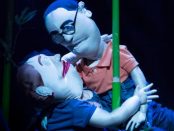
Stephen Kaplan’s "A Real Boy" is about a pair of puppets, named Peter and Mary Ann Myers, who adopt the eponymous child named Max, and it proves about as preposterous as such a premise suggests. It isn’t helped by director Audrey Alford’s often awkward staging, or by a muddled and confusing conclusion. [more]
"I wanted the audience to see 'Places,' not as a ‘museum’ piece, but a piece that was relevant TODAY. Nazimova was fighting the things in the 19th century and early 20th century that we are still fighting…," explains Nordlinger, who also wrote the show, in publicity materials for the production. Her conceit is that Nazimova exists as a ghost and cheekily addresses the audience directly. Her skillful, well-researched and assembled biographical facts are laced with feminist slanted commentary, and knowledge of events that occurred after Nazimova’s death. [more]
Two likeable people, James (Michael Jinks) and Claire (Bebe Sanders) meet online, have dinner in a local pub owned by Steve (Andrew McDonald) and take the Underground home. That’s about it. Of course, that’s only the basic, very basic, outline. What makes "Underground" a quiet delight is the way van Tricht takes this trite situation and beefs it up with insightful conversation, intriguing situations that border on the fantastic and a clear empathy with her characters. [more]
Betts' "Invincible" has been compared to Alan Ayckbourn’s work. Although there are similarities, particularly in Betts’ ear for capturing the jargon of his characters and his feel for social class distinctions, Ayckbourn’s plays are more delicately constructed and make their points—whether social or emotional—more cleverly than Betts. Even so, Invincible—the title a football reference—is satisfying as both a comedy and a drama, breaking more than a few hearts. [more]
An import from the United Kingdom, as part of the 2017 Brits Off Broadway Festival at 59E59 Theaters, Jon Brittain’s "Rotterdam" is not based on a true story relating to events in the eponymous Dutch city. It rather focuses on a British lesbian couple, one of whom decides at the beginning of the play that she’s really a man and really wants to become transgender. The crux of the drama is between Alice and her lover Fiona, who, in the course of the play, becomes Adrian. But why the two of them moved to Rotterdam seven years ago, is never really answered in the play--rather posed as a recurring question--along with the question of whether or not they’re going to remain there. [more]
The writing is poetically descriptive and moderately engrossing with plentiful profanity. It is, however, a decidedly grim scenario despite abundant humor. The conclusion is a rhetorical and optimistic rallying cry for social justice. The themes and message are all very well realized in this production. [more]
Though the printed script, such as it is, is credited to Nel Crouch, Crouch is listed in the program as only the director, and "Fossils" is rather “By” Bucket Club, described as an “associate company.” Such confusion is perpetrated throughout the production: it’s hard to say if, in the end of this extremely low-tech presentation, Vanessa has actually encountered the Monster--and/or her father--or not. "Fossils" is apparently more about what doesn’t happen than what does. [more]
Although the play seems to have something to say about economics and political systems, it is simply a very light romantic comedy making use of elements of change during the Great Depression. Ross’ production is quite proficient and fast-paced, but the characters are generic and we don’t learn much about them. As Lord Kettlewell, Brian Protheroe is the typical crotchety but wise aristocrat, Richenda Carey is most eccentric as the impoverished Lady Knightsbridge, and Lisa Bowerman is level-headed as the previously estranged Lady Kettlewell. Carol Starks’ Mrs. Lancicourt is the manipulative upper-class woman who attempts to dominate all situations. Hugh Sachs is a raisonneur straight out of classic drawing room comedy and would have been as at home in a play by Wilde, Shaw, Pinero or Galsworthy. [more]
Presented together on the same bill, "Angel & Echoes" is part of the Brits Off Broadway Festival at 59E59 Theaters (where, it’s worth noting, "Echoes" originally played last year). As written by Naylor, enacted with ferocity and vitality by Avital Lvova, and directed with dispatch by Michael Cabot, "Angel" proves the far more effective (second) half of the evening. That may be because it’s told with an in-your-face immediacy and gumption that elude Echoes, which juxtaposes the lives of two different women, who lived in that region of the world at very different times. [more]
“To some he was dad, to some he was mate,” says McNair, at the top of his monologue, “to others he was liar, cheat, addict, hero, story teller.” Over the course of the next 70 minutes, McNair will also do, with modest effects and a modicum of success, other voices including his much younger self, a schoolteacher, mates of Archie’s, and even his own mother. Through it all, the one thing we never lose sight or sound of is his love for his grandfather. [more]
Bated Breath Theatre Company specializes in original works inspired by and in partnership with museum collections and exhibitions. However, this show about the fate of the “Haddie Weisenberg Collection” painted by artist Daniel Zeigler appears to be entirely fictional. Written and directed by Mara Lieberman, executive artistic director of the company since 2012, the play uses six actors in 43 different roles from artists both famous and imaginary, to auction house sales personnel and staff, to collectors to dancers, as well as having actors impersonate free standing sculptures. Ironically, 59E59 Theaters was at one time part of Christie’s Auction House and Theatre B was actually one of the firm’s galleries. [more]
Beckett lived in rural France, and his nearby neighbor, Boris Roussimoff, helped him build a cottage on his property in 1953. Beckett grew close to the family, and offered to drive Andre to school, as the boy was reluctant to take the bus. This was because he suffered from gigantism and was self-conscious about his appearance and his difficulty in fitting into the bus. By the age of 12, he was 6’ 3” tall and weighed 208 lb. [more]
Musical star Robert Cuccioli has to call upon his experience playing both Dr. Jekyll and Mr. Hyde to become Ray in "White Guy on the Bus," a first-rate, new play by Bruce Graham, that has more than a stunning surprise or two, as it spreads out the story like a wild brush-fire burning out of control. His complicated and duplicitous “numbers man” character wants, from the beginning, to quit his high-paying job, and, like the French painter Gauguin, escape from the workaday world of banking and finance. “I don’t want to sell the house,” he tells his wife Roz in the opening scene. “I want to sell everything.” [more]
In "Kunstler," playwright Jeffrey Sweet recounts the defense attorney’s life and career in his well-written, comprehensively researched, and affectionate treatment. The conceit is that Kunstler is to address an audience of law school students at a university. Kerry is a young woman who is the vice-chair of the program committee attends him to him and becomes his foil, and is the play’s secondary character. This construction allows for a free wheeling manner of imparting the chronological details. It’s a solid take that could have certainly been at least a routine biographical exploration, but is undone here by the odd casting. [more]
The playwrights have a keen understanding of this place and time, helped by the simple, but telling scenery of Stephen C. Jones, who also lit the small performing space to give the illusion of multiple settings. Molly R. Seidel’s costumes also hit the nail on the head as far as period and character are concerned. The glamorous dress Mária creates for Irma is in direct contrast to her own dreary housedresses, and Robert’s fancy western style suit makes Robi even more eager to leave Romania. [more]
The ensuing journey is a bizarre and sometimes hilarious exploration of China and the culture within, even if it doesn’t always make the most sense. "Made in China" makes the most of the liberties that puppetry allows, and features some very impressive techniques and performances from the actors behind the scenes. Though the two main characters are both interesting, they are both made all the more entertaining by their canine companions. The two dogs, Lily and Yo-Yo (Dorothy James and Andy Manjuck among others) are completely lovable, and every single scene they are a part of is instantly heartwarming. [more]
What Evett delivers—using ample quotes from the poem and robust contributions from himself and Spangler—is a terrifying inside look of the Mariner’s experiences, beginning with being hijacked by a friend at a pub. He breathlessly illuminates what the day-to-day life was like with lurid descriptions of illnesses and exciting second-by-second reports of battles with other ships. [more]
Reading David Foster Wallace’s Infinite Jest while lying on a couch is Jay, a slacker-looking type in his 30’s. Sitting in the living room nearby is his 60ish mother who enjoys watching Dr. Phil on television and complaining about her ailments. Gabe McKinley’s Homebody is an enthralling black comedy with shades of Grey Gardens. Mother and son bicker, rehash recriminations and share their joy over the possibility of Jay’s novel being published. In 35 minutes, Mr. McKinley delivers a very well written, plotted and satisfying one-act play. It’s so pleasurable that a full-length version would be most welcome. [more]
Green’s dry delivery is in the Coward manner, crisp, almost spoken to the music, with impeccable diction. Shrubsole’s accompaniment supports him without ever getting in the way. The most famous song is probably “I Went to a Marvelous Party,” and there are five songs from Coward’s last all-original Broadway musical "Sail Away." However, there are also unfamiliar songs from "After the Ball" (“Something on a Tray”) and" Pacific 1860" (“I Saw No Shadow”), London shows that never made it to Broadway. In addition is “London Pride,” recently heard in the rediscovered post-war musical, "Hoi Polloi." Stand-alone songs include the poignant “There’s No More to Say about Love” and “I Travel Alone.” [more]
Raucous highlights include a jive reinterpretation of A Christmas Carol, “by Chazzie D, about a cat called Scrooge...who lives in Scrooge Tower.” There’s also Buckley’s irreverent take on The Gettysburg Address, “I’m a Lincoln cat.” Intertwined are Broder’s cool renditions of “On The Sunny Side of The Street” and “Georgia On My Mind.” He also demonstrates excellent saxophone and tambourine playing. [more]
It isn’t until the second act of Dan Gordon’s stage adaptation of "Terms of Endearment," based on both the Larry McMurtry novel as well as the Academy Award-winning screenplay by James L. Brooks, that the play takes off. Featuring the now grown-up film star Molly Ringwald in the role of Aurora Greenway that won Shirley MacLaine the 1984 Oscar for Best Actress, the first act jumps around, skipping huge chunks of time as you can in movie cutting, but seems like something is has been left out on stage. [more]
Though the premise is an interesting device for dissecting the friendship between two men--for surely many men are curious how they are perceived by their better halves (self included), the play doesn’t aim to say much otherwise. Acting choices, pacing and thematics are all appropriate thanks to Lee Sunday Evans' seamless direction, but it’s the script itself which is the production’s biggest hurdle. Though there are some interesting and engaging ideas presented regarding the mind of the male, the untidy and nondescript ending make no attempt to make any significant statement about any of it, ultimately shrouding the entire production in a veil of murky, middle-ground mediocrity. [more]
Healy’s treatment is faithful to the novel with a good deal of it being Clegg’s narration addressed to the audience. There are lengthy conversations between Miranda and Clegg, and her escape attempts are depicted. No matter how skillful Healy’s stage version is, it’s still two hours of often-philosophical talk between two characters in an unpleasant situation. [more]
Playwright Helen Edmundson whose stage plays have been mostly adaptations of famous literature ("The Mill on the Floss," "War and Peace," "Anna Karenina," as well as "Coram Boy" and "Thérèse Raquin" both seen on Broadway) tells her story in the leisurely way one might write a novel. While the material is both shocking and surprising, director Pamela Moller Kareman has undercut the inherent tension in the play by the choices she has made. [more]
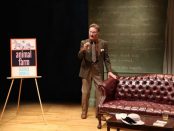
Grand highlights of Mr. Horton’s dynamic work includes an analysis of "Animal Farm" while he erases the novel’s seven animal commandments that are written on a blackboard as they are overturned one by one, by the pig Napoleon who represents Josef Stalin. There’s also a dramatic demonstration of American versus British rationing during W.W. II as Orwell produces bountiful American foodstuffs comparing them to the meager provisions allowed in Great Britain. [more]
"Bears In Space" is a story-within-a- story. An interstellar archivist, who collects “every story in the universe,” enjoys having his sons (Bertram, Darcy and Lady Susan Vernon) regularly act out his favorite tales. The Story Keeper, as the archivist is known, invites the audience to “bear” witness to the telling of one of his prized narratives from his galactic library -- "Bears In Space." The celebrated Irish theatre company, Collapsing Horse, employ their adept puppetry, comedic talents, linguistic prowess (including the fine art of punning and utilizing malapropisms to artistic advantage), and clever music making "Bears In Space" a delightful farce for puppet, improv, Disney and Simpsons’ enthusiasts alike. [more]
Unlike the original short story which was set on a rural farm in Cornwall, England, and the film which was reset in Bodega Bay, California, the play takes place entirely in the main room of an isolated house in New England. Stefan Dzeparoski’s production which puts the audience in the same room with the characters has its strengths and weaknesses making this an evening of mixed success. [more]
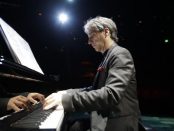
Felder’s play begins with a video of the actual Leonard Bernstein delivering a colorful, yet entertaining, illustrated lecture on music. When Felder sashays down the aisle, a cigarette in one hand and a drink in the other, the lack of resemblance is, at first, bothersome. But, somehow, sitting at a piano—which he plays impeccably—his monologue pulls you into Bernstein’s tumultuous life story. [more]
Toni Press-Coffman’s "Touch" is a rather challenging play both in that a great deal of it is narrated in recollection and also that it deals with much naked emotion. The cast led by Peter McElligott who is onstage almost throughout the evening could not be bettered. Director Nathaniel Shaw has made this under-dramatized play into a more theatrical experience. While Touch will not be for everyone, it is an impressive document of the workings of the human heart. [more]
Richard Alfredo’s 'The Dark Clothes of Night," a brilliant parody/homage to film noir and hardboiled fiction, the third play of Summer Shorts – Series B, is so good it alone is worth the price of admission. The other two plays which precede it in this year’s 10th Festival of New American Short Plays have interesting but undeveloped premises. But "The Dark Clothes of Night" is an instant classic, a humorous satire that is also a brilliantly theatrical study in paranoia, fear and evil and the elements that made film noir irresistible. Directed by playwright Alexander Dinelaris, the three actors in this memorable short work play multiple roles with assurance and aplomb. [more]
"Alice in Black and White" is a play-within-a-play. Two parallel stories are told: one of Austen’s life and relationship with Gertrude Tate, her companion for over 40 years; and one in the early 1950’s involving a Staten Island Historical Society receptionist and journalist Oliver Jensen, who later published "The Revolt of the American Woman" (which included Austen photographs) and a Life magazine article on Austen. [more]
As might be expected LaBute’s new one act, "After the Wedding," contains a shocker. However, when it arrives in Maria Mileaf’s production, it is so matter-of-fact that it has little or no impact. Elizabeth Masucci and Frank Harts play a married couple of six years. Named simply “Him” and “Her,” they alternate telling (different) versions of their years together without interacting. However, both of them recall an event that occurred on their way to their honeymoon which should have been a game-changer. For these self-absorbed people millennials, it was simply another incident along the way. Sitting in chairs facing the audience, Masucci and Harts are rather charming as the amoral couple but the play seems like a scene from a longer play not yet written. [more]
Taking place during the time of the Civil War, "Butler" is a tale of conscience, courage, and transcendence. As Major General Benjamin Butler, Ames Adamson has risen to power but is faced with a decision that could change the game for slavery in America. Many of the themes surrounding a nation divided such as injustice, prejudice, and lack of understanding remain extremely relevant today and are just as impactful with events occurring every day in our world. Instead of ignoring the issues or using power as the only weapon, Butler flips the script and uses empathy and understanding as a means to connect. [more]
Now having its American premiere in repertory with "Confusions," one of Ayckbourn’s earliest plays, with the same actors in both, the production which is directed by the author is from the Stephen Joseph Theater, Scarborough, where most of the author’s plays have had their world premieres. This is a powerful and engrossing study of friendship, love, jealousy, competition and betrayal. [more]
First performed in 1979, this is a relatively early work by the supreme British dramatist Alan Ayckbourn (b. 1939) who is as of this writing up to his 79th play, "Hero’s Welcome.' The new play is having its U.S. premiere at 59E59 Theaters and performs in repertory with "Confusions." "The Norman Conquests" is among Ayckbourn’s best-known works and "Confusions" is representative of his trademark style and concerns. Human behavior in all its complexities is dramatically rendered with depth and humor in a boldly theatrical and inventive manner. Both productions come from the Stephen Joseph Theatre, Scarborough, which has staged almost all of Ayckbourn's plays and from which he retired as Artistic Director in 2009 but where he continues to direct plays. . [more]
Part of the 2016 Brits Off Broadway lineup at 59E59 Theaters, James Fritz’s "Ross & Rachel" provides a more emotional, poignant and truthful story than what is expected when thinking of our favorite “friends” and their intense relationship. Molly Vevers takes on the role of both partners in a relationship plagued by different viewpoints and dealing with life’s hardships as a couple. This very talented actress relies on wit, candidness and sentiment to tell her story and doesn’t hold back when giving audiences the complete picture – in both the joyful and difficult times. While most people go in thinking that the show is going to be a comedic portrayal of the couple we know and love from television, Ross & Rachel flips the script and leaves you pondering the true meaning of life and one’s identity while in the confines of a relationship. [more]
A seamless production in many ways, James Phillips’ latest is nothing short of ambitious, and Rosabella Gregory’s music is the perfect companion. Thoughtful and engaging, the enchanting collection of English fairy tales known as City Stories is a serendipitous affair. [more]
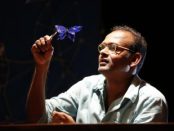
The show’s creator and director Ramesh Meyyappan also plays a character named Nabokov. The Lolita author Vladimir Nabokov was a renowned butterfly enthusiast. Naomi Livingstone plays Butterfly, a kite maker who hunts, kills and mounts butterflies. She meets Nabokov and they fall in love. Chris Alexander plays a customer who visits Butterfly’s shop and falls in love with her. Their relationships are ultimately marred by violence and tragedy. [more]
Playwright Henry Naylor achieved prominence in Great Britain as a television writer most notably for the satirical program "Spitting Image." This work is not groundbreaking but it does very effectively depict the two women and their plights with shrewdly imparted historical and cultural details that conjure up exotic imagery reminiscent of David Lean’s epic films. Humor and tragedy are seamlessly combined. There are topical references to Donald Trump, Ted Cruz, drone strikes and the British tabloids as well as 19th century specifics. [more]
Taking place in real time, Aaron Loeb's entertaining play is in the mode of Paddy Chayefsky’s "Network" with shades of "The Blair Witch Project." It also echoes the explosive style and resonant themes of psychological moral complexities that Yasmina Reza theatrically explored in her plays "Art" and "God of Carnage." [more]
"Connected" is a series of short plays, each tackling our always-connected culture from a different angle. The first of four stories is about Meghan, a high schooler with a crush on one of the most popular guys in school. Midori Francis, the charming actress playing Meghan, decides to ask her crush to the prom and, after her theatrical prom proposal gets caught on camera and uploaded to YouTube, Francis’s timid teen reaches web celeb status, with her video collecting one million views in 24 hours. This story has a lot to say about what it means to be popular, and the juxtaposition of a down-to-earth girl rising to celebrity status opens the door to a thought-provoking conversation about the fickleness of fame, and the isolation that ironically comes with it. [more]
At the onset of the production, each cast member is introduced by walking onto stage one by one. Starring intently out into the audience, there is a general sense of unrest to be found behind the eyes of each performer. The house lights of the theater are still on, and the piercing gazes coming from the actors scattered across the stage immediately destroys any notion of a fourth wall. The fourth wall, the theatrical device that the audience can usually hide safely behind, is taken away from the audience before the production even begins. There is no question: from the time the very first actor takes the stage, it is established that the audience is just as responsible for the events of Barry Malawer’s "Dead Dog Park" as any one of the fictional characters in the story [more]
The chemistry between Gabriel and Baessato is fierce and electrifying as they get to know each other, and intensifies as Van begins to observe the human-like behavior of the robot and is determined to find out more. Anjali is hesitant to let him in on the secret, but reveals that the robot has developed an emotional bond to her, and sometimes responds to certain feelings such as loneliness and separation – often uttering the words, "don't leave me" through the door. Van is fascinated at what he finds out and the two join forces to figure out how best to capitalize on the service of the sex robot and how she can accommodate a greater (and richer) clientele by playing into their fantasy of the obedient housewife. [more]
So begins a remarkable comedy-drama of two very opposite teenagers who shouldn’t have met and wouldn’t have if Anthony had not chosen the reclusive, mysterious Caroline for his partner. The play makes use of opposites, beginning with the theme of the poem, love and death, and in Whitman’s typical fashion, everything in between. But Caroline and Anthony are also opposites in every possible way: pessimistic/optimistic, sedentary/athletic, closed minded/open minded, white/black, friendless/popular, careless student/straight A student. They appear to have nothing in common, but by the end of the play they are drawn to each other through the magical words of Whitman and Leaves of Grass. Ultimately, Caroline and Anthony have revealed their dreams, fears and true selves to each other and to us. [more]
Brendan (NBC’s "Blindspot") Gall’s sexy and seductive new thriller, "Wide Awake Hearts," thrusts audiences into a challenging game of cat and mouse, as they are left to decipher the story of four friends in a case of art imitating life. An actor, director, writer and actress are faced with the intricacies of dealing with relationships, infused with passion and threats of infidelity, as they are in the process of creating a movie dealing with these very themes. [more]
The opening one is British author Lexi Wolfe’s delightfully wistful "Stand Up for Oneself." It’s a Chekhovian romantic comedy with clipped Noel Coward-style dialogue taking place in the room of a house where a party is going on. Lucas, a 42-year-old morose music professor sits alone drinking with his cane nearby when the free-spirited 26-year-old Lila enters. There is flirtation and revelations. Sensitively directed by John Pierson, the play’s very fine writing is boosted by the wonderfully detailed and effecting performances of Alicia Smith and Mark Ryan Anderson. [more]
Directed by Daisy Walker, "How Alfo Learned to Love" is chock full of Italian-American stereotypes. The characters are just heightened enough that the gimmick works, but there is also a lot of heart behind this story. Walker has brought to life a group of characters who are quirky and lovable, and in the end it really feels like a family affair. All of this is contingent on Thom’s performance as Alfo whose character arc is fleshed out and brimming with variety. This redemption story about learning to love is a rollicking good time. Backed by strong performances and direction, a slick and consistent pace, and an entertaining script which sticks to a winning formula, nary a soul is likely to leave this theater without a smile. [more]
Author Jane Martin has taken the familiar dramatic staple of a love story between two clashing opposites and rendered it compellingly here. There are plot twists, witty dialogue and violent incidents all with a tone-combining sweetness and melancholy. Jake is a depressive riddled with self-doubt and Deborah’s devoutness complicates her personal emotions. [more]
From offstage we hear the hyperbolic exclamations of a young man, Copious Fairchild, as he masturbates mixed with the soundtrack of a television cooking show. He enters the living room with a jar containing his semen and places it on the coffee table. After favorably commenting on its magnitude his young wife Hibiscus Van Der Waal, takes it and goes offstage. We soon hear her orgasmic sounds as she inseminates herself during this anti-sexual reproductive process called “coagulating.” It’s a pivotal sequence in Stephen Kaliski’s excruciating futuristic spoof "Gluten!" [more]
Kate Baldwin (John & Jen, Giant, Big Fish, Finian’s Rainbow) as self-absorbed country western star Tammy Tripp gives a big bravura performance as a mother who resents her adult son as he gives away her real age. Adam Cochran as the young songwriter Dean (Konstantin in Chekhov) has just the right combination of confusion and frustration. As Mia (Nina), his girlfriend who wants to be a singer, Ephie Aardema is quite sweet as the impressionable young woman starting out who chooses to go on her own journey. Eric William Morris as successful songwriter now producer Beck Michaels (Boris Trigorin) offers rueful regret for the career he might have had. [more]
In Aleks Merilo’s play, "The Widow of Tom’s Hill," human nature is tested in the face of a life-threatening plague. Under Rachel Black Spaulding’s direction, this play takes place in a small town off the coast of Washington in 1918, with audiences first meeting a young widow named Aideen (Lucy Lavely) struggling to provide for her young child. She must fight for survival and take caution against anyone who crosses her path. From the beginning scene, audiences can surmise the rough past she’s encountered that’s forced her to become her own soldier against the cruel, harsh outside world. [more]
Mr. Urban does an excellent job of dramatizing and explaining a complex historical situation in this fictional treatment of a real case. In 1994, Rwandan President Juvénal Habyarimana died when his plane was shot down. This assassination instigated a brutal tribal conflict between the majority Hutus who blamed Tutsi extremists for the death of the Hutu president. Varying estimates of the death toll range from 500,000 to 1,000,000. [more]