
Pygmalion
Revival of Shaw's witty comedy about the phonetics professor and the flower girl who wants to improve her English in order to get a job in a flower shop.
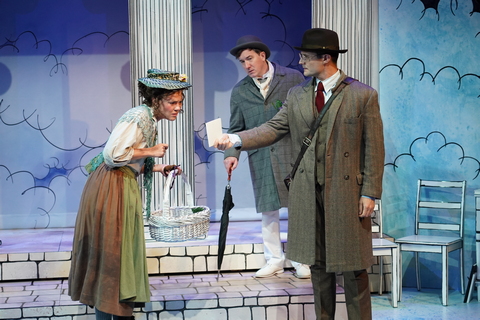
Synnøve Karlsen, Carson Elrod and Mark Evans in a scene from the Gingold Theatrical Group’s production of Bernard Shaw’s “Pygmalion” at Theatre Row (Photo credit: Carol Rosegg)
The Gingold Theatrical Group, celebrating its 20th anniversary, has famously specialized in the plays of British Nobel Prize winner George Bernard Shaw. In recent years artistic director David Staller has adapted or altered the Shaw plays in various ways, mainly updating them in his casting. Their 2018 Heartbreak House was updated to W.W. II instead of the usual W.W. I. Their 2019 Caesar and Cleopatra began on an excavation site in modern Egypt, rather than in Roman times. Their 2022 Candida was updated from 1894 London to Manhattan in the 1920’s and used a Black family for the central characters, Rev. Morrell and his wife. Their 2024 The Devil’s Disciple was performed by an all-female cast.
In their latest, Shaw’s ever-popular Pygmalion, Staller has staged Shaw’s never-used prologue created for the 1938 film version which has the gods and goddesses on Mt. Olympus recount to the modern audience the myth of Pygmalion and Galatea which inspired Shaw’s Edwardian comedy. The set by Lindsay G. Fuori creates an Al Hirschfeld-inspired Greek temple used for all of the play’s five scenes. Four of the actors dressed in white Grecian robes (courtesy of designer Tracy Christensen) greet us and tell us the myth that we will see in Shaw’s updated 20th century comedy in which the sculptor becomes a professor of language and linguistics and the statue becomes a flower girl who wants to improve her speech well enough to get a job in a flower shop. However, Staller does not stop there but has created narrative introductions for each act which is rather intrusive though it may help some first-time viewers to understand the play. (Is there any theatergoer who has not seen the play’s musical version My Fair Lady on stage or screen?)
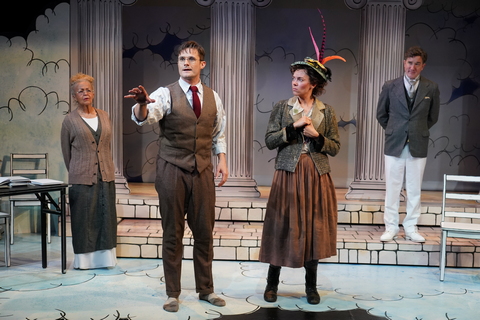
Lizan Mitchell, Mark Evans, Synnøve Karlsen and Carson Elrod in a scene from the Gingold Theatrical Group’s production of Bernard Shaw’s “Pygmalion” at Theatre Row (Photo credit: Carol Rosegg)
The production uses the version Shaw authorized for the Gertrude Lawrence’s Broadway revival in 1945. However, that production did not double the roles of Mrs. Pearce and Mrs. Higgins as well as Alfred Doolittle and Freddy Eynsford-Hill as is done here. The new production also eliminates the role of Mrs. Eynsford-Hill and combines her with her daughter Clara, giving Clara most if not all of her lines. This may be a cost saving approach but in practice it only works partially. The main cast here has some unique interpretations which may be fresh but hopefully will not become the standard versions.
Shaw’s comedy deals with caste, education, society, feminism and money in Britain using people from two social classes. Professor Henry Higgins, an authority on linguistics and phonetics, meets Colonel Hugh Pickering, authority on Indian Dialects, after an evening at Covent Garden Opera House while taking shelter from the rain in the portico of St. Paul’s Church. When flower girl Eliza Doolittle’s violets get knocked to the ground in the mad rush for patrons to attempt to get taxis, she discovers Higgins taking down her Cockney dialect in notation form. He declares that within six months of his teaching he could pass her off as a duchess at an ambassador’s ball. She overhears him invite Pickering to his home at 27A Wimpole Street.
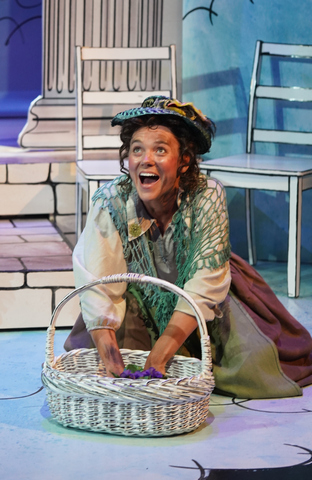
Synnøve Karlsen in a scene from the Gingold Theatrical Group’s production of Bernard Shaw’s “Pygmalion” at Theatre Row (Photo credit: Carol Rosegg)
The next day Eliza arrives at Professor Higgins’ residence to book lessons. Treated with condescension by Higgins she starts to leave, but Col. Pickering treats her so well that she decides to take Higgins’ offer to live in his home and be tutored for six months. When her unemployed father Alfred Doolittle shows up to put the touch on Higgins, the professor is so impressed with his outrageous ethics for the undeserving poor that he gives him money and sends him on his way. Unlike the musical version My Fair Lady, we do not see Eliza’s lessons from Higgins, but next meet her at the home of Mrs. Higgins, the professor’s upper class mother. We discover that she has far to go although her pronunciation is now impeccable. She also meets Freddy Eyysford-Hill (the same fellow who knocked over her flower basket at St. Paul’s Church) who does not recognize her and he is immediately smitten.
After an Ambassador’s Ball, Higgins wins his bet but Eliza is now stuck with the problem of her future: she can’t go back to selling flowers, but without money she can’t set herself up as a proper lady. And when Higgins does not congratulate her on her success, she has had enough, and she leaves Wimpole Street and Higgins to his own devices. Higgins has come to count on her to organize his calendar and discovers he is lost without her. Ultimately, Shaw’s witty play confronts the new Eliza, a tower of strength, with Professor Higgins to whom she is now his equal.
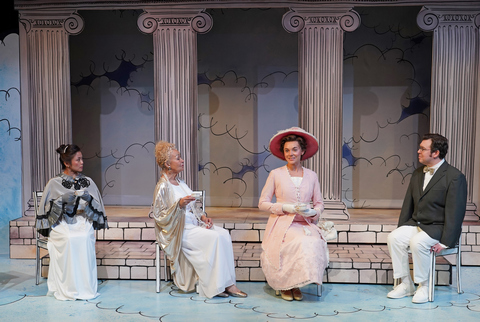
Teresa Avia Lim, Lizan Mitchell, Synnøve Karlsen and Matt Wolpe in a scene from the Gingold Theatrical Group’s production of Bernard Shaw’s “Pygmalion” at Theatre Row (Photo credit: Carol Rosegg)
Since both Pygmalion and My Fair Lady are often revived, as well as their legendary movie versions, there are many precursors for each character. Director Staller’s production uses off-beat and unconventional readings for his actors in their iconic roles which work but may take theatergoers some time to get used to. Rather than eccentric as played by Rex Harrison, Mark Evans’ Henry Higgins is academic and pedantic. While Sennøve Karlsen’s Cockney accent as Eliza Doolittle isn’t any better than Audrey Hepburn’s was in the film version, her change from street vendor to well breed lady is quite convincing. Though Colonel Pickering is usually played by a much older man making him a senior citizen, Carson Elrod is fine as more ironic and low-key, without suggesting the soldier he has been in India.
Lizan Mitchell’s role has been beefed up combining the haughty Mrs. Higgins and Higgins’s prudish housekeeper. Her performance as both women is commanding and imposing. As each, she dominates the stage whenever she appears. Matt Wolpe also doubles as Eliza’s father Alfred Doolittle who makes a terrific return in the last act and as her suitor Freddy Eynsford-Hill. Wolpe look too old to play the young fop, but is fascinating casting as the seemingly immoral but articulate Doolittle, worthy of his name. As Clara Eynsford-Hill, friend of Mrs. Higgins, who is caught in the same rainstorm as Eliza, Henry and Col. Pickering in the first act, Teresa Avia Lim’s role has been merged with her mother Mrs. Eynsford-Hill. She instead plays the daughter as one would the mother, but even more assertive and brash, which is a bit surprising from so much younger an Edwardian lady. All of the actors appear as Greek gods and goddesses except for Eliza and Henry before the play begins and between the acts.
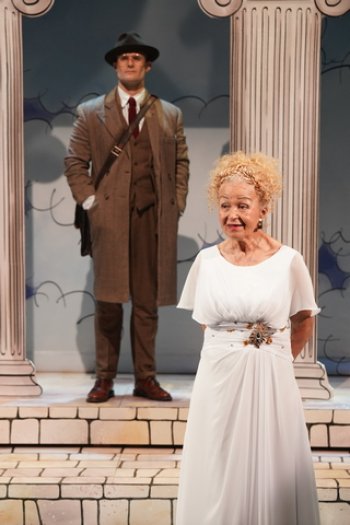
Mark Evans and Lizan Mitchell in a scene from the Gingold Theatrical Group’s production of Bernard Shaw’s “Pygmalion” at Theatre Row (Photo credit: Carol Rosegg)
The design elements are equally non-traditional making white and gold the dominant colors. Fuori’s Grecian setting in white with blue clouds behind looks like a Hirshfeld pen and ink drawing with the famous portrait of Shaw himself in the upper left hand corner (taken from the famed My Fair Lady caricature.) The costumes by Tracy Christensen put all the actors except Henry Higgins and Eliza in white and gold Grecian robes, then adds items for their future roles. Higgins and Eliza begin in brown tweed. Later Eliza graduates to blue shirt and white blouse, a pink suit and a sumptuous all-white gown for the ball at which she makes her debut in society. Pickering is attired in a grey suit jacket and matching vest, over his white pants. Of course, Higgins and Pickering are seen in tuxedos when they return from the ball. Over her white and gold sheath, Mrs. Higgins adds a white lamé jacket which makes her look quite formal, while Mrs. Pearce wears a brown sweater. All of this is bathed in the bright lighting by Jamie Roderick.
Shaw’s Pygmalion is almost indestructible so well is it written and constructed. David Staller’s reinvention for Gingold Theatrical Group works most of the time, though some of the doubling could be rethought and the interruptions by the gods and goddesses are mostly extraneous and break the tempo of the play. While it takes some time to get used to the new interpretations, by the end you will be absorbed in these people’s lives and problems.
Pygmalion (through November 22, 2025)
Gingold Theatrical Group
Theatre Row, 410 W. 42nd Street, in Manhattan
For tickets, visit http://www.GingoldGroup.org
Running time: two hours and ten minutes including one intermission


Leave a comment