
Meet the Cartozians
Riveting new play by Talene Monahon pays tribute to her Armenian heritage while satirizing racism in America.
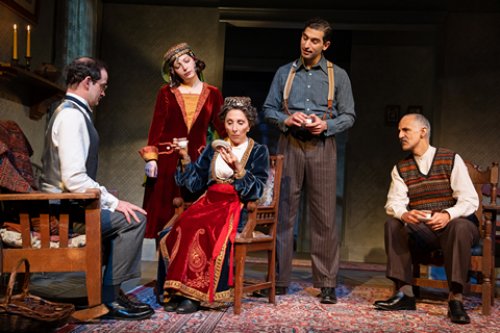
Will Brill, Tamara Sevunts, Andrea Martin, Raffi Barsoumian and Nael Nacer in a scene from Talene Monahon’s “Meet the Cartozians” at The Pershing Square Signature Center (Photo credit: Julieta Cervantes)
Talene Yeghisabet Monahon’s new play Meet the Cartozians, being presented by The Second Stage at The Pershing Square Signature Center, is simply the best new American play in New York this fall. This riveting two-part play set in two time frames 100 years apart asks the questions what does it mean to be an American, what does it mean to be white in America, and what does it mean to be an Armenian American. The timeliness of these questions will not be lost on audiences well aware of the current administration’s views on immigration particularly of non-white applicants for asylum.
The Armenian American playwright’s last three plays (How to Load a Musket, Jane Anger and The Good John Proctor) have all had historical backgrounds but this one is personal to Monahon as it deals with her own heritage. Director David Cromer who has proven himself to be a wizard with new plays as well as his brilliant reinvention of Thornton Wilder’s Our Town has chosen a superb cast led by two-time Tony Award-winner Andrea Martin and 2024 Tony Award-winner Will Brill who are all excellent playing two roles each.
The Kardashians may be the most famous Armenian American family in America today but in 1923 was the famous court case of Armenian-born Tatos Cartozian (no relation to the current celebrated family), a successful Oriental rug merchant in Portland, Oregon, who lost his recently acquired citizenship due to the ambiguous geography of whether Armenia, just after the genocide of 1.5 million Armenians by the Ottoman Empire, was in Europe, Asia or the Middle East. As Irish lawyer Wallace McCamant (Will Brill) from a white shoe firm explains to the family made up of matriarch Markrid (Martin), her son Tatos (Nael Nacer) his daughter Hazel (Tamara Sevunts) and later his son Vahan (Raffi Barsoumian), the founding fathers extended citizenship to “free white persons of good character” later expanding the proviso to include “people of African descent” after the Civil War. This may come as a shock to many Americans today who assume that every nationality has been welcomed into the United States until now.
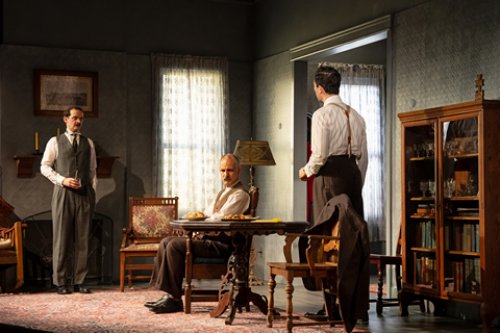
Will Brill, Nael Nacer and Raffi Barsoumian in a scene from Talene Monahon’s “Meet the Cartozians” at The Pershing Square Signature Center (Photo credit: Julieta Cervantes)
Ironically, the word “Caucasian” comes from the Caucasus Mountains originally part of Armenia so that one would assume that the question of their race is moot. The sticking points include if the family is Muslim not Christian they would not be classified as white. While they are Christian, back in Armenia their factory hires Mohammedans, and they celebrate Christmas on January 6, the Armenian Christmas, not on December 25 as do American Christians. Also their skin color varies greatly with son Vahan being the swarthiest of all. Part of the humor is derived from the fact that all the Cartozians except daughter Hazel are shaky on American idioms, not understanding correctly all that McCamant is telling them. On the other hand, he is not versed in Armenian culture (food, customs, personal relationships, etc.) and is continually getting into trouble with their view of him as an outsider. He is particularly upset when he sees the logo for their company which depicts Mohammedans and camels which is liked by their customers but puts their claims of being “white” into jeopardy.
As lawyer Wallace McCamant (based on a real person), Brill gives a very layered performance depicting every nuance from patronizing the family to falling in love with Hazel and everything in between. Martin is hilarious as matriarch Markrid taking everything he says literally leading to much of her confusion and stuffing him with her baked foods which are often too spicy for his blander palate. Balancing them is Nael Nacer as Tatos preparing to go on the witness stand, much too proud and much too serious. As his daughter Hazel, Sevunts is charming as the peacemaker, the only one with perfect English and a command of American culture. On the other hand, Barsoumian as her brother Vahan is explosive and quick to anger. Susan Pourfar makes a shocking and brief appearance as Tatos’ wife who has never been the same after being caught in the Armenian genocide. FYI, all of the actors playing the Cartozians are of Armenian heritage adding a touch of realism to the production.
If the first act is drama, the second act which takes place in Glendale, Los Angeles, in July 2024 is definitely a satire. Three leading local Armenians have gathered in the home of poet and activist Leslie Malconian (Pourfar) to tape the Christmas episode of Meet the Cartozians, hosted by the celebrity who is a direct descendant from Tatos from the first act. However, she is going to be late due to a “glam issue.” How late is, of course, not known. Cameraman Alan O’Brien (Brill) suggested that after they get into their authentic Armenian outfits provided by the film management they begin their discussion to the empty chair as though she were there. Although it is July, they have to pretend that it is December 2024. Their purpose is to educate the celebrity with more about her Armenian heritage with other Armenian people.
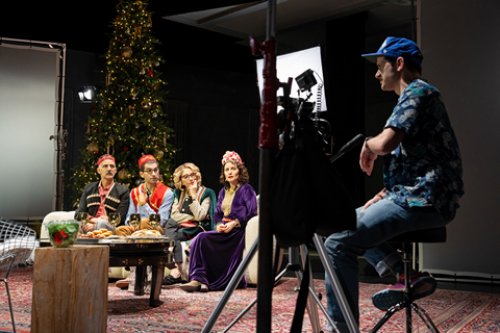
Nael Nacer, Raffi Barsoumian, Andrea Martin, Susan Pourfar and Will Brill in a scene from Talene Monahon’s “Meet the Cartozians” at The Pershing Square Signature Center (Photo credit: Julieta Cervantes)
While in the first act, the Armenian characters were all from the same family, in Act Two they are all from different families and careers. They are asked to introduce themselves to the camera: Robert Zakian (Nacer) has been a city councilman for 20 years, and born in Lebanon. Nardek Vartoumian (Barsoumian) is a Professor of History at UCLA with an emphasis in Armenian History and Displacement and also a member of the Armenian Activists Coalition and the Global Genocide Awareness Campaign, born in Tehran. Rose Sarkisian (Martin) is the President of the Armenian Historical Society of Glendale, long term member of the Children of Armenia Fund for which she has raised over 100,000 dollars. Their hostess who has prepared many Armenian desserts is Leslie Anahid Malconian, an activist and published poet and essayist, Vice President of the Armenian Activists Coalition, as well as one of the founding members of WEMEAN, the campaign for an Armenian subcategory on the new MENA classification in the 2020 census.
The mention of MENA (Middle East and North Africa) reopens a heated debate as to whether Armenia is in Asia, the Middle East or Europe. Rose wants to cut this discussion as not appropriate to promoting the Armenian community to the world. This leads to an argument over whether Armenians are considered white which brings up the 1924 case of United States v. Cartozian at which point we find out that Tatos won and was declared white.
However, several of them have had varying experiences with racism: Because of his swarthy skin, Nardek declares that he is often stopped at the airport as non-white and interrogated for hours to see if he is a terrorist. Rose facetiously points out that she always leaves several hours early for the airport. Robert is often taken for Hispanic or Jewish. On the other hand, Nardek announces that he was denied tenure the year before as they didn’t want to appoint another white man, while Leslie’s latest poem on the Armenian genocide was rejected from a POC poetry festival because she did not qualify. At which point, Alan, the cameraman speaks up, pointing out that “It feels like Armenians have this special status, right? Like you get to be white when it suits you and then you get to be people of color, when it suits you.”
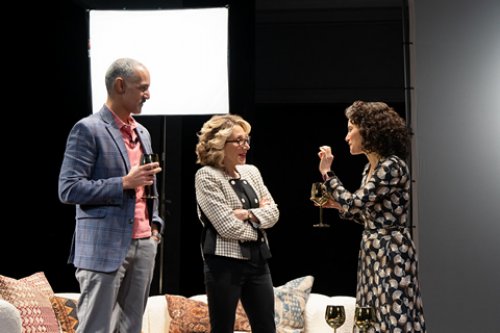
Nael Nacer, Andrea Martin and Susan Pourfar in a scene from Talene Monahon’s “Meet the Cartozians” at The Pershing Square Signature Center (Photo credit: Julieta Cervantes)
In this act, Pourfar and Martin are the most argumentative while the men this time around are rather reticent. Again as in the first act, Brill is made to stand up for his Irish heritage as well as the Cartozian family, their unseen TV personality included. When she finally does appear played by Sevunts (who was daughter Hazel in the first act), dressed in Enver Chakartash’s beautiful red gown, she is nothing like we expected, modest, self-effacing and curious. Chakartash has some fun with the authentic looking Armenian garb in the first act and the rather phony-looking costumes from the television studio in the second. Tatiana Kahvegian’s two sets are quite suitably different, typical of their eras: the 1923 Cartozian living room with its lace curtains and carved wooden furniture and Leslie’s 2024 living room with its white sofa, metal chairs, and added screens and camera for the taping. Stacey DeRosier’s lighting design beautifully shifts as the time passes making it clear that the day is fading.
On one level, Talene Monahon’s Meet the Cartozians is a serious study of racism in America both 100 years ago and today. On the other hand, it is a satire of people who wish to use racism to their own advantage. On both levels the play is both brilliant and fascinating. Of course, director David Cromer has a great deal to do with the swift tone of the play as well as this particularly fine cast of actors. This is not a play that should be missed now or at award season.
Meet the Cartozians (extended through December 14, 2025)
The Second Stage
The Pershing Square Signature Center, 480 W. 42nd Street, in Manhattan
For tickets, visit http://www.2st.com
Running time: two hours and 35 minutes including one intermission


Leave a comment