
Hans Litten: The Jew Who Cross-Examined Hitler
In this historical play, the protagonist Litten is posited as the tragic avatar of liberal democracy’s defeat at the hands of the Nazis in 1933.
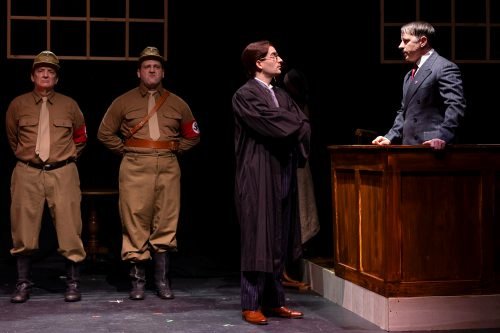
Daniel Yaiullo as Hans Litten and Zack Calhoon as Adolph Hitler in a scene from Douglas Lackey’s “Hans Litten: The Jew Who Cross-Examined Hitler” at Theater Row (Photo credit: Ben Hilder)
Hans Litten: The Jew Who Cross-Examined Hitler is a play about a lawyer in Weimar Germany who questioned Hitler on the witness stand in 1931 as part of a trial involving two Nazi stormtroopers. As a result, he was relentlessly attacked in the Nazi press, and when the regime came to power they jailed him the night of the Reichstag fire. He spent five years in various concentration camps enduring Nazi torture, and finally chose to take his own life after the Nazis imprisoned him in Dachau. The play follows Litten’s life from his early law career to his death, with Daniel Yaiullo (1+1, Kenneth Branagh’s Macbeth) in the titular role.
Screenwriter Douglas Lackey (Kaddish in East Jerusalem, Four Evangelists Walk into a Fog) worked extensively to ensure historical accuracy when possible – and when not, he chose to fill in the gaps in the historical record with material that was plausible and fit the tenor of the play, which seeks to cast Litten as a symbol of liberalism and democracy in its darkest hour. Director Alexander Harrington (The Kiss; Winesburg, Ohio), frequent collaborator of Lackey, dutifully carries out this vision. Unfortunately, the duo’s attempted beatification of Litten thoroughly cannibalizes anything interesting about this endeavor.
Despite the admirable commitment to historical accuracy, Lackey’s script is littered with flimsy side characters, muddled messages, and awkward dialogue. The result is a thematically incoherent mess that feels unaware of its own central tragedy. Hans says in Act 1 that he wants to force Hitler onto the witness stand in order to stop the Nazis from coming to power. The play seems unwilling to address that this did not work – that no amount of clever rhetoric would have been enough to stop the tide of Fascism. It would be wildly unfair to blame Hans Litten for failing to stop the Nazis, but it is a grievous omission for a play about him to explicitly frame the story that way and then refuse to grapple with the implications of him failing to do so, both for him as a character and for the ideas he is meant to represent and martyr himself for. Indeed, the play revels in the grace of Hans’ martyrdom.
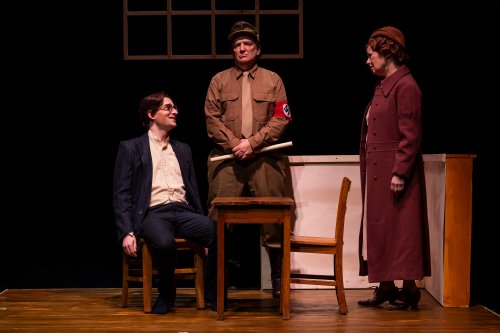
Daniel Yaiullo as Hans Litten, Robert Ierardi as Nazi Guard and Barbara McCulloh as his mother Irmgard Litten in a scene from Douglas Lackey’s “Hans Litten: The Jew Who Cross-Examined Hitler” at Theater Row (Photo credit: Ben Hilder)
The second act, which takes place after the Nazis’ seizure of power, is entirely dedicated to pushing the image of Litten as a martyr. In this play, Hans Litten is posited as the tragic avatar of liberal democracy’s defeat at the hands of the Nazis in 1933. He becomes a kind of Christ of cosmopolitanism, or perhaps the last German liberal.
Admittedly, the play does succeed in extracting some drama out of this – largely off of Harrington’s directing. The most successful scene is in the second act, when Hans, along with the other prisoners at the concentration camp, is ordered to sing the “Horst Wessel Leid” (the Nazi party’s anthem) and perform the associated salute in honor of Hitler’s birthday. Hans pointedly refuses, holding his hand in a fist and instead singing “Die Gedanken Sind Frei” (The Thoughts are Free). The blocking of the scene is such that Hans is placed all the way to the side of the group, rather than front and center. Such a directorial choice emphasizes the solitary nature of his martyrdom by having him physically off to the side. It’s a rare moment in the play that lands exactly as it should – the viscerally grotesque scene of watching concentration camp prisoners forced into a pantomime celebration of Nazism is gradually and slowly undercut by Hans’ steadfast refusal to participate. He becomes a defiant witness whose suffering is an inspiration and source of strength to others – a martyr. Placing him at the side rather than front of the group thus serves a literal purpose as well as a symbolic one – it means that both the characters and the audience take a second to notice what he’s doing. It also shows that Hans is an iconoclast to the end, but not a leader.
The unexplored central tragedy, however, is that while Hans is willing to die for his beliefs, he is unwilling to do anything else for them. He eagerly accepts his own martyrdom, directing his family to stop trying to free him and basking in the rapt praise of other prisoners. He is utterly resigned to his own fate, and by extension the fate of everyone in Germany. The fact that he, his beliefs, and his movement lost seems to not bother him whatsoever. Indeed, one gets the sense he finds great poetry in the idea of inevitable failure and slow death. There is nothing wrong with characterizing Hans this way, but the play seems unaware that it is doing so, and thus never manages to address this conflict. If anything, the play valorizes this quiet suffering as somehow noble.
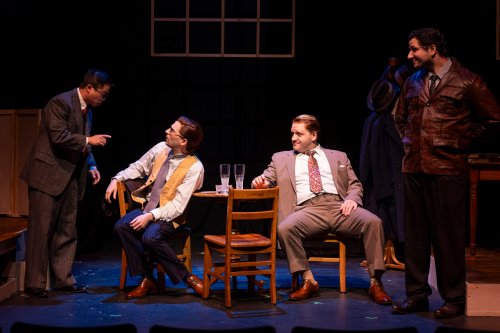
Whit K. Lee as Kurt Weill, Daniel Yaiullo as Hans Litten, Dave Stishan as Barbasch and Marco Torriani as Bertolt Brecht in a scene from Douglas Lackey’s “Hans Litten: The Jew Who Cross-Examined Hitler” at Theater Row (Photo credit: Ben Hilder)
The characterization of Hans is quite deliberate. The blocking often emphasizes how much physically smaller he is than other characters, especially his law partner Barbash and his father Friedrich – played by David Stishan (Regional: Once, A Streetcar Named Desire) and Stan Buturla, respectively. This distinction is further compounded by how often these characters forcefully shout at him. Indeed, it is a rare scene in which Hans does not get yelled at by someone. Notably, however: Hans doesn’t ever flinch when people yell at him — on the one hand, this demonstrates that he’s a nebbish, but he’s not a pushover. On the other hand, however, this further makes the character feel less like an actual human being who existed and more like an idealized secular saint.
A rare bright spot of the play is the prominent role of music. Music Director Jessica Crandall chose quite a range of works to include, from Mozart to Weill to some more political Weimar-era songs used as music during scene changes. Hans himself sings quite a bit in the show, as do other characters – from the other Dachau victims to songwriters Bertolt Brecht and Kurt Weill, played by Marco Torriani (The Green Veil, Law & Order) and Whit K. Lee (Off Broadway: The Far Country, Assassins) respectively. The duo makes a one-scene appearance when Litten and his law partner Barbasch run into them at a bar, in which they sing “The Alabama Song.” The scene is a high point of the show – it’s fun, Lee is quite charming as Kurt Weill, and it captures that sense of celebration with an air of dread hanging over it that is so common in works set in the late Weimar/early Nazi period. Indeed – it was one of the few moments in the play in which the characters felt like real people.
Every character in the play acts as if they are aware they are characters in a play about Hans Litten, rather than real people. They regularly listen with rapt attention as he recites poetry and pontificates on art, seemingly devoid of interiority of their own. Nearly every character directly states how intelligent and special Hans is – how many languages he speaks, how much he loves Mozart, how good he is at arguing, etc. – which begins to feel exhausting quite early in the play’s two-hour length. Similarly exhausting are the many awkward expositionary asides in the dialogue. Whenever specific historical moments are referenced, characters often state the exact year they happened and provide a one-two sentence summary. In one scene, for example, a character alludes to the Nuremberg laws, then specifies that they were passed in 1935 and stripped German Jews of their citizenship, rights, and ability to hold many jobs. The play is peppered with moments like this, and all seemed as if they were tacked on after the script was written. It utterly breaks the tension, because the characters are over-explaining things everyone in the scene already knows. It contributes heavily to the persistent feeling the play conjures of reading a Wikipedia page stretched out to two hours.
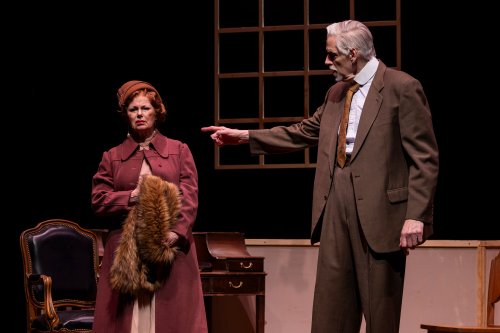
Barbara McCulloh as Irmgard Litten and Stan Buturla as Friedrich Litten in a scene from Douglas Lackey’s “Hans Litten: The Jew Who Cross-Examined Hitler” at Theater Row (Photo credit: Ben Hilder)
Daniel Yaiullo gives an insincere performance as Hans Litten. Like every other character, one gets the sense that the titular character is aware he is a character in a play about Hans Litten. Yaiullo certainly gives Hans the right kind of gravitas, yet it always feels too self-aware for him to be a real person. He deftly imbues the character with a nebbishy stoicism – Hans is an intellectual to the end, even teaching another prisoner Greek when he has time. But he also acts as someone who is entirely focused on selling an audience his own image. Throughout the play, although especially in the second act, Hans is oddly calm. He moves and speaks as someone resigned to his fate, fully convinced of his own martyrdom. Hans is remarkably unbothered by everything happening around him, yet the grace never feels sincere – it feels like hagiography rather than historical drama.
Acting aside, the production itself did not drag the play down, but was rarely notable (excepting the music). The set design (by designer Alex Roe) was appropriate to the story, if a bit uncreative. Hans’ office is littered with props, but nothing particularly stuck out as an interesting item for him to have. The lighting design (by designer Alexander Bartenieff) is similarly adequate. The entire stage is brightly lit during the trial scene, a decision that serves to differentiate the scene further from the rest of the play. The wardrobe (by costume designer Anthony Paul-Caravetta) for most characters sticks to typical Weimar-era fashion, with Hans’ mother Imegard, played by Barbara McCulloh (Peter Pan, The King and I), having slightly more interesting attire. Overall, the production is adequate, but there is no level of production quality that would have allowed the play to overcome its flaws.
The trial scene – the longest scene of the play – is built up to for most of the first act but is utterly underwhelming when it arrives. Zack Calhoon (It’s a Wonderful Life: A Live Radio Play, Wait Until Dark) plays Hitler during the trial, the only time the much-mentioned Nazi leader is actually present on the stage. Calhoon portrays the future dictator as seriously bothered by the whole affair, but only a on personal level. One never gets the sense that he feels his path to power has been threatened. Later, the audience is constantly told that Hans “humiliated” Hitler during this scene – but such a strong word is unearned from the scene itself. Hans certainly proves that he is much smarter than Hitler, but he doesn’t humiliate him.
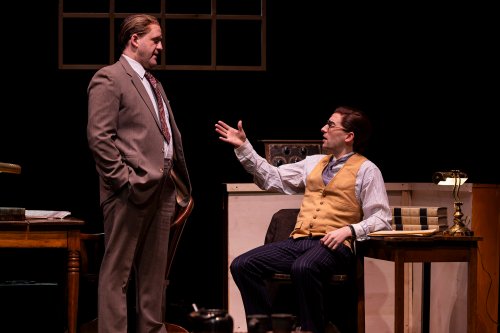
David Stishan as Barbasch and Daniel Yaiullo as Hans Litten in a scene from Douglas Lackey’s “Hans Litten: The Jew Who Cross-Examined Hitler” at Theater Row (Photo credit: Ben Hilder)
The scene does not feel much like a trial, either – Hans tries to catch Hitler in rhetorical gotchas more often than he tries to establish that the two Nazi stormtroopers on trial are actually guilty of the assault they’re being prosecuted for. The whole sequence mostly serves to build Hans’ legend as the titular Jew who cross-examined Hitler – at one point Hans, after rattling Hitler with a question, stands up on the judges’ platform, allowing the lawyer to literally overshadow over the Nazi leader. It is yet another moment in which every character behaves as if they are fully aware they are characters in a play that seeks to convince an audience how special Hans Litten was, rather than real people.
In the end, Hans’ martyrdom is fulfilled. The other prisoners at Dachau distract the guards so that he may die by his own hand. To really drive the point home, Hans both sings a Mozart hymn about Jesus and invokes the suicides at Masada before taking his own life. There’s a clear defiance in the final scene – his fellow Dachau prisoners belt out a song about being forced to endure the unendurable and their hopes for freedom, or at the very least, release. The invocation of Masada – of Jews who chose to die free rather than at the hands of their oppressors – resonates on a similar level. Yet this blunt imagery merely compounds the production’s central flaw – the obsession with constructing a martyr to venerate is the play’s undoing.
History is ultimately about narratives. The facts are what they are, but the actual practice of history is arranging them, rather than simply stating them. This play arranges history in such a way as to advocate for its titular character to be remembered as a hallowed martyr of righteousness, to the point where it is unable to address the deeper pathos of Hans Litten as a man or Hans Litten as a symbol. Furthermore, this grandiose historical narrative is allowed to eclipse the usual frameworks of theater as an art form, leading to a production that fails both historically and dramatically. Hans Litten is not a person in this play. He does not act like a person, and neither the play itself nor the other characters treat him like one. Hans is an idea, a symbol, and a martyr, but not a person. The play’s title is quite revealing – the entire endeavor is an attempt to secure Hans Litten a place in history above anything else. Grandiosity in service of nothing amounts to a play with few, if any, redeeming qualities.
Hans Litten: The Jew Who Cross-Examined Hitler (through February 22, 2026)
Philosophy Productions
Theatre Row, 410 W. 42nd Street, in Manhattan
For tickets, visit http://www.hanslittenplay.com
Running time: two hours including one intermission


Leave a comment