
Waiting for Godot
Two old friends portray two old friends in a Samuel Beckett classic about the monotonous necessity of old friends.
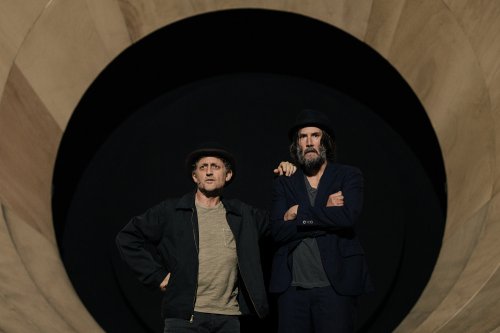
Alex Winter and Keanu Reeves in a scene from the Jamie Lloyd production of Samuel Beckett’s “Waiting for Godot” at the Hudson Theatre (Photo credit: Andy Henderson)
There is a musicality to a long friendship, its peculiar rhythms a soul-sustaining certainty against whatever the world is supposed to mean. Arguably, the best representation of that cold comfort is Samuel Beckett’s classic, mid-20th century play Waiting for Godot, though a compelling rival is totally the Bill & Ted movie franchise whose titular teenaged metalheads started causing temporal chaos for the good of humanity way back in 1989. In an unsolicited service to Gen-Xers cinematically weaned on the likable duo’s enviable camaraderie, British director Jamie Lloyd’s current Broadway revival of Waiting for Godot seeks to end the nascent debate by melding the two cultural touchstones into one bogus big chill. That the effort still manages to achieve an affecting measure of authenticity, despite Lloyd’s worst proclivities, is undoubtedly due to Beckett’s wide-ranging yet minimalistic genius, as well as to Bill and Ted.
Seriously, using a childhood favorite to throw existential dread into the increasingly lined faces of Gen-Xers isn’t a bad idea. At times, it’s even brilliant. By respectively casting the now 60-something Alex Winter and Keanu Reeves as Beckett’s tragicomic vagabonds Vladimir (née Bill) and Estragon (née Ted), Lloyd creates an often giddily effective cross-decade continuum between highbrow and popular entertainment, which likely would have pleased the Irish playwright’s vaudevillian sensibilities. Unfortunately, aside from all the usual Beckettian stuff about the futility of life, the real downer with this new production of Waiting for Godot is that Lloyd can’t stop inserting himself into it, as if he’s weirdly competing with Beckett for storytelling supremacy. Needless to note, that’s a losing proposition.
Lloyd has engaged in this type of notice-me battle before, zombifying Norma Desmond in the already reductive musical Sunset Blvd. and banishing the house from Henrik Ibsen’s A Doll’s House. In Waiting for Godot, Lloyd again does away with key props, including the physical presence of Beckett’s desolate tree whose complex visual symbolism of hope and despair is replaced by a set that evokes the circular inside of a movie camera lens (scenic design by Soutra Gilmour). That’s possibly because Winter and Reeves are better known as movie stars, which isn’t as interesting as the tree.
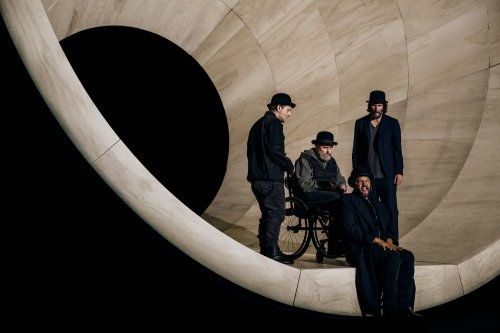
Alex Winter, Michael Patrick Thornton, Brandon J. Dirden and Keanu Reeves in a scene from the Jamie Lloyd production of Samuel Beckett’s “Waiting for Godot” at the Hudson Theatre (Photo credit: Andy Henderson)
Using hand-held cameras and a gigantic LED screen, Lloyd turned the Hollywood pedigree of Sunset Blvd. into an excuse to blend the cinematic with the theatrical until the latter mostly disappears. But, thanks to an indisputable home-turf advantage, Beckett’s words prove a stronger dramatic foe, impervious to Lloyd’s showiest instincts. The ones from the less insufferable side of the directing spectrum are sophomorically gestural: a character flipping off another, an audience clap-along, a bit of back-to-back air guitar for those in attendance who paid an absurd premium expecting to only see a live Bill and Ted reunion.
More frustratingly, Lloyd puts his own spin on the play’s other pairing, a thoroughly toxic one between the viciously aristocratic Pozzo (an invaluable Brandon J. Dirden) and his ironically named slave Lucky (Michael Patrick Thornton) who, in Lloyd’s production, uses a wheelchair (as does Thornton). That change is actually intriguing, as it merges Pozzo’s cruelty with caretaking. But Lloyd also fundamentally undermines Lucky’s emotional impact with lots more emotional agency than Beckett affords, stripping the character of his essential pathos. Insensately, Lloyd then chooses to undermine Thornton, too, hiding much of the actor’s portrayal behind a fetishistic mask or by positioning Thornton with his back to the audience.
Sadly, Lloyd’s disrespect for acting doesn’t stop there. As Vladimir and Estragon circularly banter, quarrel, and reconcile while interminably anticipating the arrival of the play’s eponymous figure (the set’s second unsubtle meaning), Lloyd becomes as domineering as that incomprehensible nonpresence. Granted, Lloyd never forces the audience to watch Waiting for Godot as an insta-flick high overhead or, in another of his trademark gimmicks, sends an actor scurrying out of the theater. Instead, his prevailing stunt is an attempt to out-opaque Beckett by backlighting Vladimir and Estragon near the ends of Acts One and Two so that they deliver their dialogue in silhouette. Admittedly, it’s a striking shot (lighting design by Jon Clark) until you quickly remember that you’re supposed to be watching a play rather than a film.
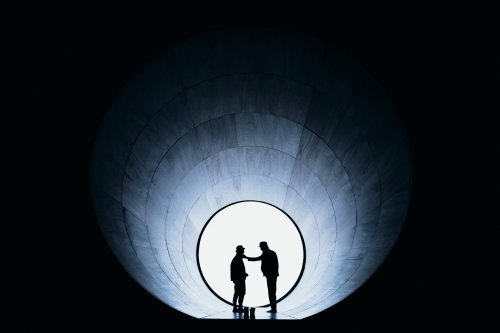
Alex Winter and Keanu Reeves in a scene from the Jamie Lloyd production of Samuel Beckett’s “Waiting for Godot” at the Hudson Theatre (Photo credit: Andy Henderson)
Although not the most revered thespians to have donned Vladimir and Estragon’s bowler hats, both Winter and Reeves earn the audience’s fullest attention. While Reeves touchingly imbues Estragon’s persistent complaints with the same confusion and fitful profundity he’s brought to many of his familiar roles, the far less famous Winter emerges as the play’s true revelation, lending an uncanny soulfulness to Vladimir’s compassionate and painful philosophizing. Undeniably, Winter has aged enough to credibly embody Vladimir’s sagging visage, but it’s the forlorn, distant look in his still-boyish eyes that defines the performance.
It’s also deeply moving that there is a palpable personal bond between Winter and Reeves that simultaneously echoes the one shared by their characters and transcends it. Perhaps that feeling is merely the figment of a nostalgic imagination, but it evoked sincere sorrow whenever Vladimir or Estragon threatened to go on alone. There’s nothing more heartbreaking than the inevitability of absent friends.
Waiting for Godot (through January 4, 2026)
Hudson Theatre, 141 West 44th Street, in Manhattan
For tickets, call 855-801-5876 or visit http://www.thehudsonbroadway.com/
Running time: two hours and five minutes including one intermission


Leave a comment