News Ticker
- December 13, 2025 in Off-Broadway // BUM BUM (or, this farce has Autism)
- December 12, 2025 in Musicals // The Faggots and Their Friends Between Revolutions
- December 12, 2025 in Cabaret // Mary Foster Conklin — Mirrors Revisited (50th Anniversary)
- December 11, 2025 in Cabaret // Kathy Kaefer — Kiss Me Once: Stories from the Homefront
- December 11, 2025 in Off-Broadway // The American Soldier
- December 9, 2025 in Off-Broadway // This World of Tomorrow
- December 9, 2025 in Cabaret // A Noel Coward Celebration — Steve Ross & Friends
- December 7, 2025 in Off-Broadway // Diversion
- December 5, 2025 in Off-Broadway // Meet the Cartozians
- December 5, 2025 in Features // Tom Stoppard: An Appreciation
- December 4, 2025 in Off-Broadway // Practice
- December 4, 2025 in Cabaret // Eddie Bruce — The Magic & Music of Tony Bennett
- December 3, 2025 in Interviews // Interview with Ty Jones, Classical Theater of Harlem
- December 2, 2025 in Features // Gingold Theatrical Group’s 20th Anniversary Gala at The Players
- December 2, 2025 in Interviews // The American Soldier – An Interview with Douglas Taurel
Archive
Cobb is titanic in this piece bringing his resonant voice and impressive physical presence to bear on the most famous classic role for a Black actor in the canon as well as his thoughts about race and the theater. His justifiable anger when the director tells an anecdote about a woman who drove across the country in diapers to confront her rival as an example of the effects of jealousy is enough to flay one alive. His analysis of the man Othello and his relationship to the white Venetians is a brilliant explication of both character and society. Cobb’s understandable problem with white directors who want to tell him how to play a Black man exposes race in America from a new point of view. American Moor may make you angry but it is always enlightening and right on target. Although Cobb’s passion gets the better of him, you will never feel that he has gone too far or misrepresented things as they are.
[more]
As John, Christopher Sears is an enjoyable pill, perfectly offset by Tommy Crawford's Paul whose amiable placidity is almost Buddha-like. More importantly, both actors have impressive musical chops, which wonderfully serves Stevens' truncated overview of Paul and John's tuneful reminiscing about their musical influences: Chuck Berry, Bobby Freeman, Gene Vincent. Sears even has the opportunity to do a bit of Elvis Presley hip swiveling that feels absolutely perfect in its oh-so-British imperfection.
[more]
Making is U.S. debut 19 years after its Scottish premiere in an actual park, Douglas Maxwell’s "Decky Does a Bronco" is a worthy addition to the dramatic literature of plays about childhood and the loss of innocence. Under the direction of Ethan Nienaber, the talented cast of five gives indelible performances which remain with the viewer long after the final curtain. The guilty that the narrator David’s expresses as to what he might have done differently leaves a poignancy that cuts very deep.
[more]
The trouble is Lee’s almost catatonic approach to Gene. He speaks in a toneless monotone and adapts a monolithic physical approach, his hands constantly held stiffly at his sides. When he does erupt in anger it registers as bizarre overacting rather than the culmination of a life of living under his father’s thumb. This leaves an emotional vacuum in the center of the play. Even when he delivers the poignant punch line—“Death ends a life, but it does not end a relationship”—what should have been an emotional wallop becomes a whimper.
[more]
Hopkins had added selections from Lewis Carroll (references to the Jabberwock and “The White Knight’s Song: The Aged Age Man,” the poem which gives her the new title), Emily Dickinson (“I’m Nobody! Who are you?”), Alfred Lord Tennyson’s “Ulysses” (“To strive, to seek, to find and not to yield”), and unidentified poems from Dylan Thomas. Aside from the fact that these are several centuries newer, all of these have a different rhythm than Shakespeare’s Lear. The music credits include Satie’s “Gymnopedie” No. 1, Chopin’s “Nocturne in E minor,” excepts from Beethoven’s Symphony No. 7 and Piano Sonata No. 23 in F minor, and “Ombra mai fu” from Handel’s opera Serse. The most outstanding problem is that we have other associations with this material so that they stick out like a sore thumb.
[more]
"Dining with Ploetz" at Theater for the New City consists of three short plays by writer, director and teacher Richard Ploetz. The program adds up to slightly under two hours’ running time (with one intermission). The plays are all billed as comedies, and—as the title implies—they all, to one degree or another, involve “dining.” They are, however, quite diverse in terms of style and tone. The first and last of them (both of which the playwright directed) hold the audience’s attention fairly well. The middle piece, directed by Steven Hauck (who acts in the other two), is riveting.
[more]
Poseidon Theatre Company’s "The Cooping Theory 1969: Who Killed Edgar Allan Poe?," described as a "new immersive paranormal experience,” is set at the RPM Underground which is more interesting than the play. This interactive event leads the audience through many of the 18 rooms, all of which are different, in this unusual venue by designer Seok Huh. As for the show, it may be “the only story-driven, multi-room immersive experience in the heart of Times Square,” but as written by Nate Raven it is very thin on information about 19th century writer Poe. As conceived and directed by Aaron Salazar it is mainly participation in a séance to reach the author in order to hear his version of his mysterious death, which is neither spooky nor scary. Poe never actually appears except in spirit and not much happens. However, it takes a long time getting there.
[more]
What raised "The Ringdove" above mere creative story-time theater was the exquisite artwork and detailed performances. The perfect, colorful costumes (by Casey Compton) that evoked everything from Greek myths to desert Bedouins were topped by Lee’s brilliant mask heads. Lee also supplied the scenery which included ephemerally leaved trees and a turtle pond that was a witty work of high art, a microcosmic version of a tiny ecosystem. Lee and his colleagues created an oasis pleasant to the eyes and ears, all the while teaching a moral about the interconnectedness of all living things.
[more]
Bess Wohl’s new play, "Make Believe," is a fascinating study of how the traumas of childhood affect our adult lives, particularly the damage seen and unseen parents inflict on their offspring. Director Michael Greif whose trenchant productions go back to the 1990 "Machinal" at the Public has piloted a fine cast of eight actors both young and mature. Make Believe is at the same time entertaining and enlightening in its dramatizing childhood and its aftermath in an inventive way.
[more]
Deborah Whitfield’s 'Tech Support" offers a clever idea in order to review feminism in the past century. Unfortunately, her rather superficial approach misses a great many opportunities. The romantic comedy aspect of the play is not entirely believable and works to the detriment of the play’s serious elements. The slick production is entertaining without ever delving below the surface even though it attempts to cover a great many important and serious issues, many of which are not yet solved today. Don’t blame the actors who do their best with the material they have been given.
[more]
The small studio theater space where the show is performed with its basic living room scenic design informs director Cameron Clarke’s resourceful and bold staging. Working in such a confined environment with the actors in close proximity to each other, Mr. Clarke emphasizes the piece’s claustrophobic, paranoid and menacing tones with vividness. Unseen ominous events taking place in the offstage bedroom and bathroom incite terror. An open window with shutters becomes a focus of dread, with the outside world represented by eerie red light and sounds of sirens. With the cast’s explosive performances and a command of the visual, Clarke realizes the play’s uneasy power.
[more]
This production is a rambunctious enterprise, and Hunter and his cast do a reasonably good job of keeping dialogue that’s made up largely of long strings of short declarative sentences (or sentence fragments) from seeming dreadfully monotonous. The actors slow down at moments, then quicken the pace, their spat lines overlapping. Some of them leave the platform in order to play in the adjacent areas for a spell. Some bring furniture onto the platform, arrange it and later reconfigure and remove it. The ensemble members work well together, and each has some fine moments. The gruff-voiced Allan-Headley, the flamboyant Reid and the lost-lamb Toth are especially memorable.
[more]
The latest edition of the recurring political humor show "Laughing Liberally" is titled "Make America Laugh Again" and is decidedly anti-Trump. It’s created by the brilliant veteran comedian John Fugelsang who is ubiquitous on radio, cable television news shows and comedy clubs. Mr. Fugelsang introduced it and his headliner 45-minute set was the finale and contained many bright spots. Each performance has a different cast in between and at the one under review, five polished comics did their acts.
[more]
Jonathan Spector’s "Eureka Day" now having its East Coast premiere at Walkerspace is a blisteringly satiric and provocative play torn right out of the headlines. Ostensibly about how one progressive elementary school handles a case of mumps due to many anti-vaxxers, the play also tackles many other hot button topics. Ultimately, the play’s message is that with too much sensitivity and too much political correctness nothing can be accomplished. It is a wake-up call for all of us.
[more]
The score with Ms. Hagedorn’s sharp lyrics and composer Fabian Obispo’s pointed melodies in the manner of Stephen Sondheim and John Kander is quite accomplished with its rousing group numbers and rich solos. Highlights include an eerie sequence with one sick person after another seeking rejuvenation, a Billy Flynn "Chicago"-style bit documenting Felix’s past popularity and an acidic anthem by a mercenary San Francisco female florist who deals in black market identity papers for illegal immigrants.
[more]
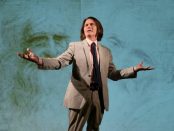
Described as a multimedia production, "Da Vinci & Michelangelo: The Titans Experience" is actually a lecture by art historian Mark Rodgers to slides of the masterpieces of these two geniuses. Both enlightening and dense, the performance by this animated and exuberant lecturer tells you a bit more than you can take in in one sitting. It is a little like two art classes back to back. However, one comes out of the show with an even higher respect for these two Renaissance men who were far ahead of their time and are still at the top of their professions after 500 years.
[more]
I'm stunned and saddened by the passing of one of the best music directors I've known--and one of the nicest gentlemen-- Hubert Tex Arnold. He died suddenly, unexpectedly of a brain aneurism. He was getting ready to play a cabaret show for Sally Maye. I liked Tex very much, both personally and professionally. He was not just an exceptionally talented pianist and arranger, he was a very giving person.
[more]
Lenore Skomal’s "The Exes" wants to revive the Broadway-style sex comedies of the 1950’s and 60’s, earlier called boulevard comedy. Unfortunately, not only is the formula passé but television sit-com now does it better. The play is also too heavily plotted with two main characters with the same name and a great many petulant, entitled people. Worse still, the play fails to deliver any witty or clever lines, instead giving us quotes and references from much better works without much point. Directed by Magda S. Nyiri, "The Exes" has at least two false endings before it comes to an unearned conclusion.
[more]
Hass directed and his stilted staging is adequate. Simple entrances and exits, cast members going through the theater’s aisle and basic character interactions occur. Some performances are excessively broad diluting the narrative’s impact. Playing a major part in a show as well as directing it is problematic. Hass’ joint choreography with Dana Norris is an uninspired series of rudimentary movement, jumping up and down, moving wheelie chairs around and clunky robotic flourishes. Hallowed masterpieces of musical theater are often alchemical artistic collaborations among a creative team. Without experienced objective directorial oversight, "Contact High" is lumpy.
[more]
Presented at Lincoln Center’s David H. Koch Theater by the China Arts and Entertainment Group Ltd., the company used its impressive resource of dancers in two large-scale ballets: "Goddess of the Luo River" choreographed by the Canadian, Peter Quanz to a Western-sounding violin concerto by the Chinese composer Du Mingxin and "Carmina Burana" choreographed by the Chinese national, Jiang Qi to the famous (infamous?) score by Carl Orff.The former was a run-of-the-mill ballet weighed down by fuzzily pretentious program notes. Three characters—Yi Ren (Fang Afang), Lian Jun (Huang Baimao) and Ruo Shui (Ma Minghao)—led the corps de ballet in several merry chases that involved processions, movements rolling down lines of dancers, non-romantic encounters and show-off solos by the male contingent, all ending in a pretty arrangement of the dancers across the Koch stage with one of the characters held imposingly high as if overlooking her kingdom.
[more]
What’s best about "Waiting for Johnny Depp" is Vivino’s performance. My, does she ever get a workout during the play’s 100-minute running time. She has 15 or so musical numbers (some of them reprises), ranging from dizzyingly ecstatic to utterly despondent. She belts, rocks out, sings pretty during the ballads. She carries nearly all of the spoken word, too, though sometimes she has exchanges with the recorded voice of Rita’s highly disagreeable mother. The ghastly ringtone whenever Mom (or that agent with his caveats) calls is like a bugle blast at the gates of hell. (Sound designer Tom Valdez gets a bit of a workout too.) Vivino bounces around the stage, executes choreographer Juson Williams’ dance steps, goes offstage for quick costume and wig changes, and interacts with both the audience and musical director/pianist Logan Medland.
[more]
The fourth piece, titled “3 with D” was choreographed by Javier de Frutos and was the only performance that included live music. Patrick Gallagher was on piano in front of the stage and Dan Gillespie Sells sang and played guitar center stage, simply and straightforward, making the most of music, which was a compilation of songs by Ivor Novello, George Gershwin, and Cole Porter. Next to Sells were two chairs – something of a “set” compared to the other bare-stage designs. Danced by Watson and Fairchild, it was more of a drama than any of the other pieces. Although there was little linear plot, it was a gay love story. The familiar lyrics of Gershwin’s “The Man I Love” had a different connotation when referring to two men. The two performers were such gorgeous dancers, and very similar body types, so when they moved in synchronistic unison, it created a beautiful effect.
[more]
On screen and stage Gyllenhaal has exhibited his talent and star quality to great effect many times. "A Life" is not one of those shining occasions as he is just passable in it. Stammering, shrugging and halting like Woody Allen in Annie Hall’s prologue is how he starts off and later alternates jokiness and histrionic emotionalism as the piece’s lugubrious events unfold. This is simply an opportunity for fans of Gyllenhaal to see him in person and the performance succeeds on that level.
[more]
Mr. Wills’ demonstrates a facility for dramatic writing with his snappy dialogue and fast-paced scenario that inspires laughter and also incites thoughtfulness. Amidst the merriment are keen insights into the gay male experience including aging, relationships and promiscuity. "Stormy Weather," though, is more Ray Cooney than Tony Kushner.
[more]
Lincoln Center’s Mostly Mozart Festival 2019 presented the lavish, yet somehow intimate, "Under Siege," a stunning production of the Yang Liping Contemporary Dance Company of China.Its chief choreographer and director Yang Liping had the audacity to put on stage an epic tale of an ancient war, the Chu-Han Conflict that pitted hundreds of thousands against each other. Her brilliant idea was to concentrate on each of the leading characters in the conflict and, by telling their fascinating stories, thereby revealing the immensity of war and its ghastly consequences.
[more]
Joseph Sissens in Sir Frederick Ashton’s “Dance of the Blessed Spirits,” in The Joyce Theater’s Ballet Festival (Program A) (Photo credit: Maria Baranova)The Joyce Theater is presenting a two-week Ballet Festival, four programs under the artistic direction of Kevin O’Hare, director of The Royal Ballet. Each program is curated by a different dance expert, the first by O’Hare, himself.Program A was divided into two parts, the first the more sedately classical, the second showing newer, more contemporary fare. It was a fascinating, focused study of the state of ballet today, featuring, appropriately, two works by the British master of classical ballet, Sir Frederick Ashton.
[more]
Feraud’s scenario is structured as a series of taut precise scenes bursting with sharp dialogue and topical references including an Uber driver with a musical recording on Spotify. She drops well-timed details that advance her agenda of tackling the issue of the preoccupation with feminine physical perfection. We learn of Peter and Joan’s strained marriage that is characterized by resentfulness over financial inequity and past infidelity. Everything reaches a realistic and dramatically satisfying conclusion.
[more]
"Midsummer: A Banquet" is an auditory and oral treat, a light entertainment for this time of year. Using Zach Morris and Victoria Rae Sook’s skillfully adapted abridgment of Shakespeare’s comedy, the evening of dinner theater is a delightful way to experience the Bard. The meal designed by Emilie Baltz contains various surprises that coincide with the events in the play and are tasty enough to be a filling repast. Shakespeare as dinner theater may not be a new idea but this is an evening of many pleasures.
[more]
William Shakespeare’s "Measure for Measure" (circa 1604)—the story of a woman who is sexually victimized by a man in power—seems as though it would lend itself to an adaptation crafted in light of the #MeToo movement. To some extent, The Acting Company’s streamlined 95-minute modern-dress version proves itself a good fit for such an approach, although there are elements of Shakespeare’s play that don’t quite conform seamlessly with what director Janet Zarish seems to be going for.
[more]
Kelley’s adaptation begins with the murder of Mary which avoids preparing us for the limited life of opportunity that Bigger leads in the Black Belt of Chicago. Told in a fragmentary form often with flashbacks within flashbacks, it is only possible to put the chronology together if one knows the novel. Kelley has also eliminated the powerful speech to the jury by Bigger’s lawyer which is one of the most famous of all statements on social racism and the constricted environmental influences on people living in the ghetto.
[more]
The score is derived from the catalog of songwriter Jim Steinman’s "Bat Out of Hell" album trilogy whose songs were immortalized by Meat Loaf. Mr. Steinman’s accomplishments as a composer and lyricist are monumental. As a librettist he is dreadful. His negligible scenario borrows heavily from "Peter Pan" (a doomed character is actually named Tink), the hoary stilted dialogue is reminiscent of Flash Gordon cliffhangers and it’s all often ill-matched with his iconic songs. Much of it is supposed to be funny. It all makes "Bat Out of Hell-The Musical" a numbing dysfunctional slog. Very often, on-stage actions are projected on to a very large screen opposite them with characters followed around by videographers dressed in black. We get to watch schlock twice simultaneously.
[more]
Composer-lyricist Joe Inconis’ follow up to his teen favorite, "Be More Chill," is not only a showcase for musical comedy actress Annie Golden but a tribute to the Blaxploitation and Martial Arts movies of the 1970’s and 1980’s. While "Broadway Bounty Hunter" is very entertaining, it might have been a better show if had not been so anxious to not be a parody or a satire. Written by Iconis and longtime collaborators Lance Rubin and Jason Sweettooth Williams, energetic cast, fully attuned with their concept has been directed and choreographed with fierce energy by Jennifer Werner who has previous created the dances for five of Iconis’ last six shows.
[more]
While Shakespeare’s "Coriolanus" has a great deal to warn us about as a cautionary tale, it is also not as deep or as poetic a play as his major tragedies. Daniel Sullivan’s production for Free Shakespeare in the Park is fine with the surface values of this historical tragedy but less so with creating the subtext of the story. In his second time around as its titular hero, Jonathan Cake is excellent as the brutal warrior, not so accomplished as the public man wrestling with his own demons.
[more]
«
1
…
43
44
45
46
47
…
114
»
Copyright Jack Quinn, 2001-2023