News Ticker
- December 13, 2025 in Off-Broadway // BUM BUM (or, this farce has Autism)
- December 12, 2025 in Musicals // The Faggots and Their Friends Between Revolutions
- December 12, 2025 in Cabaret // Mary Foster Conklin — Mirrors Revisited (50th Anniversary)
- December 11, 2025 in Cabaret // Kathy Kaefer — Kiss Me Once: Stories from the Homefront
- December 11, 2025 in Off-Broadway // The American Soldier
- December 9, 2025 in Off-Broadway // This World of Tomorrow
- December 9, 2025 in Cabaret // A Noel Coward Celebration — Steve Ross & Friends
- December 7, 2025 in Off-Broadway // Diversion
- December 5, 2025 in Off-Broadway // Meet the Cartozians
- December 5, 2025 in Features // Tom Stoppard: An Appreciation
- December 4, 2025 in Off-Broadway // Practice
- December 4, 2025 in Cabaret // Eddie Bruce — The Magic & Music of Tony Bennett
- December 3, 2025 in Interviews // Interview with Ty Jones, Classical Theater of Harlem
- December 2, 2025 in Features // Gingold Theatrical Group’s 20th Anniversary Gala at The Players
- December 2, 2025 in Interviews // The American Soldier – An Interview with Douglas Taurel
Archive
Co-conceived by Asante and Kenrik “H2O” Sandy who choreographed and directed the production, "Blak Whyte Gray" was constructed in two parts and three sections. Part I began with “Whyte,” danced by Ricardo Da Silva, Gemma Kay Hoddy and Nicole McDowall dressed in variations on straitjackets. (Sleek, pale, layered costumes by Ryan Dawson Laight.) All three were trapped in a rectangle of light which gradually shrunk making their already frantic movements even more so. The music boomed as they vibrated, twisted, pulsated and stopped with dramatic suddenness. This was desperation of the highest order.
[more]
Neil LaBute’s “Appomattox” is the most substantial of the three plays and deals with a topic new to his work. Two long-time friends, Frank, black, and Joe, white, are having a picnic in the park without their wives where they get to throw around a football. Joe tells Frank about a story he read in the newspaper that the freshmen at Georgetown University have decided to pay an annual reparation to the families of slaves who were sold off by the college centuries before as collateral to keep the school going. He is impressed that the $27.20 will be annually added to their tuition. For Frank, this is nothing but a symbolic gesture. He would like to see the figure sting a little for 400 years of slavery.
[more]
Following up on Luis Alfaro’s critically acclaimed Chicano retelling of Sophocles’ "Oedipus Rex" called "Oedipus El Rey," The Public Theater now stages his equally relevant and timely "Mojada" which melds Euripides’ "Medea" with the Latinx immigrant experience in the big American cities. Those who know the Greek myth of Jason and Medea will be prepared; those who at the performance under review obviously did not know what was coming were shocked and horrified by the ending. Either way the play is spellbinding theater. Chay Yew, artistic director of Chicago’s Victory Gardens Theater who also directed the Public’ production of Oedipus El Rey, has staged the stunning and devastating play with an excellent cast of Hispanic-American actors which is as timely as tomorrow’s headlines.
[more]
As the romantic, tubercular and charismatic Satine, the magnetic Ms. Olivo delivers a ferocious, sensual and grandiose performance that’s one of the most memorable recently seen on Broadway. Her sensational characterization is more Eartha Kitt than Nicole Kidman and all her own. Clad in slinky costumes, the voluptuous Olivo perpetually dazzles. Her titanic singing and dancing is matched by her intense acting which grounds the busy production with riveting focus. Her “Diamonds are Forever” is spellbinding and there’s saucy humor when it’s followed by “Diamonds are a Girl’s Best Friend,” “Material Girl” and “Single Ladies.”
[more]
Series A of this year’s Summer Shorts: 13th Festival of New American Short Plays is unified around the theme of death and dying and how it affects the living. Lest you think that this sounds morbid, the three provocative one-act plays that make up this first program are so beautifully handled that this is a superior theatrical evening in three totally different styles. Unlike many evenings of one acts, the productions of all three are worth of your attention and could not be bettered.
[more]
Ms. Murphy’s writing is a rich amalgam of biographical data, pivotal incidents and humane observations. The monologue structure has the three characters alternately expressing themselves in the same recurring order with often all three on stage but not interacting with each other. Through this theatrical device, Murphy enacts her eventful scenario. At 100 minutes without an intermission, it does lag, particularly the introductory portions which too leisurely introduce the characters. However, Murphy does create three zesty roles.
[more]
Co-written by and starring Rita Rudner (who is not only a playwright and performer but also an author, film writer, producer and director, with many TV appearances to her credit), "Two’s a Crowd" suggests that it’s creator has run out of original ideas and is recycling old ones--not only others, but her own. It really lands with a thud, which also may have a lot to do with trying to present it as a musical.
[more]
It is not until the second act of British playwright Chris Urch’s "The Rolling Stone" that the play catches fire but from then on the drama is explosive, compelling and very disturbing. Once the play gets past the introductory exposition that sets up the plot, the production by Saheem Ali (Donja R. Love’s "Sugar in Our Wounds" and "Fireflies," and Christopher Chen’s "Passage") is taut, tense and involving.
[more]
"Pour Some Sugar on Me" by Def Leppard in a smashing live rendition accompanies a lusty production number at a seedy Los Angeles strip club with scantily clad pole dancers and creepy patrons. It’s a splashy set piece in this uproarious Off-Broadway revival commemorating the tenth anniversary of the Broadway hit "Rock of Ages. " It’s also notable because previously Def Leppard wouldn’t allow their songs to be included in this 1980’s hit singles jukebox musical. “Rock of Ages” in a recorded version is heard after the show ends and the audience leaves.
[more]
Halley Feiffer's new comedy, the obsessively titled "Moscow Moscow Moscow Moscow Moscow Moscow," is an intermittently funny ten-minute parody of Anton Chekhov's "Three Sisters." Unfortunately, it goes on for another hour and twenty-five minutes, tiresomely recycling jokes and shallow insights until you begin to wonder if Feiffer actually read the Russian playwright's work or just a Wikipedia synopsis for her cooler-than-thou "adaptation," which seems motivated by a strange desire to ridicule not only Chekhov's characters but also anyone who might feel bad for them. So, be forewarned, if you have an ounce of sentimentality in your soul, it may seem as if the laughter heard during the production (and, to be fair, there was a lot of it) is to some extent directed at you.
[more]
The title of playwright Dianne Nora’s fascinating new work, "Monica: This Play is Not About Monica Lewinsky," is disingenuous. Is it about you-know-who? Well, yes and no. There were passing references to the title character’s notoriety and enough images of and quotes from President Clinton, among others, to imply that the title is, at best, a white lie; at worst it is a tongue-in-cheek bait-and-switch. But if that is a way of getting an audience to see this incisive and adult drama, then more power to Ms. Nora who knows how to write sharply focused dialogue.
[more]
Unfortunately, Daniel’s ambivalence proves to be an impediment to the success of Patience. It would be one thing if he were a strong character, torn about which path he’ll take moving forward. Rather, he seems to be a customarily wishy-washy guy, who avoids making choices (or “decisions”—the play suggests there’s a difference). Other characters accuse him of speaking vaguely and not answering questions directly. He certainly seems not to be socially adept.
[more]
Wearing a green prison uniform, the tall athletic blonde curly-headed Mr. Stewart who is in his early 20’s delivers an enthralling performance. Speaking in smooth rich tones that convey a youthful sensibility, Stewart powerfully details the grim experiences of life on the inside especially for a privileged white man. Not only is he riveting as Roy, Stewart masterfully portrays a gallery of figures Roy encounters. These precise impersonations include his black trans cellmate, a black Muslim he befriends, a menacing Puerto Rican gang member and an amiable corrections officer. Vocally and physically Stewart is impeccable and truly carries the play to success.
[more]
How Freddie resolves his amorous adventures is cleverly handled by Blackstone using an imaginative combination of ballet, modern dance, mime and popular dance forms. The score is made up of over twenty songs including: “Why Do Fools Fall in Love?.” “Dream Lover,” “We Are In Love,” “Bei Mir Bist Du Schoen,” “La Valse á Milles Temps,” “Makin’ Whoopee,” “I’ll Be Seeing You,” and a song written and performed live by Mike Brun.
[more]
The power and majesty of the theater are affirmed by this ravishing production of the acclaimed English playwright Philip Ridley’s two-character play, "Tender Napalm." For 75 enchanting minutes on a bare stage we follow the fantastical exploits of a young man and a young woman apparently shipwrecked on a jungle island. They engage with monkeys, aliens and serpents and time passes through a gloriously written cascade of memories, erotic verbal exchanges and biographical details. There’s mention of “A dildo shaped like a dolphin from the lost city of Atlantis.”
[more]
Written by Isaac Gomez, who lives across the border in El Paso, Texas, "the way she spoke" is a one-woman show that fails to speak to us: it’s performed by Mexican film star Kate del Castillo who attempts to give different accents and vocal mannerisms to the various characters she impersonates, without much success. She is no Whoopi Goldberg or Anna Devere Smith, who were--and in Smith’s case, still is--masters or impersonation.
[more]
The three Havel one acts, known as "The Vanek Plays," though written separately, were originally banned in Czechoslovakia and performed secretly in people’s living rooms as well as being passed around in hand-written copies. They all deal with Vanek, a dissident playwright unable to have his plays produced, who is now working in a menial job, an alter ego for its author and his experiences under Communism. The problem with filling out the program to include both Pinter’s "The New World Order" and Beckett’s "Catastrophe" (dedicated to Havel) is that since the plays all have the same theme and development, it feels like overkill.
[more]
Dressed in gray jeans, a gray T-shirt and white sneakers, the gutsy seasoned comic Ms. Novak expertly paces, gesticulates and does wild double take after double take while clutching a microphone. With her soothing yet expressive vocal tones Novak confidently delivers her masterfully crafted material. It’s comprised of a multitude of classic setup punchlines, precise observations and breezy conversational riffs. The results are very funny and thought provoking. “Death is coming” sets off a somberly pragmatic rumination as there’s more than sex to her routine.
[more]
Cluttered, lively and quaint, the zany musical comedy "I Spy A Spy" is reminiscent of the sort of lightweight material directorial legend George Abbott would have had a go at in the late 1960’s. This show recalls the Abbott efforts "How Now, Dow Jones" and "The Education of H*Y*M*A*N K*A*P*L*A*N" that William Goldman analyzed in his classic 1969 behind the scenes account "The Season." Abbott did his best with those disappointments just as the creative team for I Spy A Spy does.
[more]
Dedicated to “creating socially and politically acute theatre for the 21st century” the PTP/NYC (Potomac Theatre Project) for their 33rd season offers this exuberant revival of Tom Stoppard’s 1979 two one-act plays, "Dogg’s Hamlet, Cahoot’s Macbeth," which cheekily satirize the theater and political oppression. Inspired by Wittgenstein and his fellow Czech playwright Pavel Kohout, Mr. Stoppard as he did in his monumental "Rosencrantz and Guildenstern Are Dead" again here ingeniously appropriates Shakespeare for his own ingenious purposes.
[more]
Playwright and director Miranda Haymon has, like numerous dramatists before her, dramatized this story—except that she has significantly repurposed it. Working with three African-American actors, she has used the tale as a taking-off point for an hour-long play focused on the experience of young black men in America. As the press release puts it, “ 'In the Penal Colony' investigates the performance of power, patriarchy and punishment. Three black men convene in an unnamed penal colony, asking what it means for them to exist in the media, when observed, when consumed, when punished.”
[more]
Russian-born Maria Kochetkova, the petite ballerina who spent the major portion of her career with the San Francisco Ballet, has turned herself into a small-scale Diaghilev. Her Maria Kochetkova: Catch Her If You Can at The Joyce Theater is a gathering of five brilliant dancers (including herself) dancing the works of seven contemporary choreographers.Even with her name on the program, Catch Her If You Can was pleasantly un-self-aggrandizing, feeling more like a—very expensive—jam session.So ego-free was the evening that Ms. Kochetkova clearly felt no reluctance to pair herself with Drew Jacoby in Jacoby’s duet “Rachel, Nevada” choreographed to an eerie score by Sam Spiegel.
[more]
"Six Years Old" is a gem of a play, its facets polished by the director Helen Handelman. Every emotional revelation, no matter how subtle is illuminated by the acting of its four-member cast: Julia Weldon as the willful six-year-old Adelaide, just beginning to find her gender identity; Conor William Wright as her precocious four-year-old brother Dewey; Diane Chen as their put-upon, not very professional babysitter Kim; and Meghan E. Jones as their seemingly calm mother Rachel.
[more]
If ever a play needed a talkback afterwards, Joseph Scott Ford’s bewildering, grating and slight "Not Even the Good Things" does. By the end of its gobsmacking 75 minutes, the eerie ever-present appearance of a bedraggled little girl in a red T-shirt who interacts with a single character is never explained. Is she a ghost? A symbolic apparition? Or a figment of his depressed imagination? This is never conclusively answered.
[more]
There is a prevailing sense that the script tries to cover too much intellectual ground on the topic of reborning in too short a time frame, placing a burden on the characters to experience more than would seem realistic in an ordinary world. Nevertheless, through the efforts of the actors and valiant direction by Triolo, this dark play does succeed in bringing to light some of the complexities of motherhood, child loss and abandonment through the very unique reborning lens. Check it out for yourself.
[more]
"Rent Party" is billed as a show for the whole family, but it will be of real interest primarily to preteen children. At that, it seems a rather dull outing. The actors here tend to speak in a sing-song-y manner. Very little humor or visual excitement ensues. Jazz Cat could have been a lively and entertaining figure, but he makes infrequent appearances, often speaking a few bland couplets before retreating to a corner.
[more]
Playwright Winter Miller offers a shakily hollow mélange of Genet, Beckett and Pinter with her two women in a prison cell scenario taking place in an unnamed foreign country. Ms. Miller’s dialogue is well-shaped and achieves sporadic humor and emotional resonance but to no real purpose as her effort comes across as an artificial exercise rather than a realized play. Without explanation sometimes only one character appears, and we’re left to conclude, “Maybe it’s a flashback or one was taken away and returned. Did one of them die?”
[more]
Packed with emotion, adolescent angst and eventfully picaresque, "The White Dress" is playwright Roger Q. Mason’s passionate autobiographical saga of a “gender non-conforming queer person of color.” It’s boldly presented and contains vivid performances, but the amorphous structure and idiosyncratic writing dilute its momentum.
[more]
The world premiere “Sport,” choreographed to more than twenty bits and pieces by Erik Satie, appropriately named “Sports et divertissements” (played by the brilliant pianist Colin Fowler), was a not very exciting examination of every competitive sport from golf to sailing to swimming to running to tennis to etc. Dressed in Elizabeth Kurtzman’s colorful one-piece overalls, the cast of twelve imitated in both exaggerated and subtle ways these activities, sometimes in silence and sometimes to the Satie music. Morris is imaginative enough to turn athletics into dance, but the work was simply too episodic and disjointed even with his use of repeated motifs—like dancers being dragged across the stage on large swaths of cloth—to give the work some unity and form. The end result was more of beautifully crafted mime than a full-fledged ballet.
[more]
The second part of the program was a bonanza of Bournonville excerpts, danced to not particularly memorable scores, that worked well even without colorful scenery. The beautiful, colorful costumes, arranged by Katharina Neergaard certainly helped, particularly in “The Jockey Dance” from From Siberia to Moscow danced exuberantly by Marcin Kupinski and Alexander Bozinoff dressed in brilliant red jockey duds. The only criticism: they might have looked less glum in their facial expressions.
[more]
Whatever Glover discussed in the opening – about identity and wearing masks – may have been relevant, but the program could be seen simply as a revue. A wide variety of recorded music was played. The first music sounded like something you’d hear in a French café, and in fact was recorded by a group called French Café Ensemble. Other musical styles included classical (Bach), jazz, pop, salsa, Trinidadian, hip hop, and more, performed by Quincy Jones, Stevie Wonder, Bjork, and others. The dancing paralleled the music. Special mention must go to Brandon Stirling Baker whose lighting design created the changes in atmosphere, subtly separating the numbers.
[more]
Kids may love this show—and the Dog Man books themselves—largely because the outlandish situations are similar to scenarios in their own hyper-imaginative make-believe play. Except that, at the Lucille Lortel Theatre, young audiences see a fully realized version of such fantasies, with vibrant production values plus some catchy tunes. Tim Mackabee’s cartoonish unit set—Harold and George’s treehouse—is quiet at first but is soon swarming with marauding buildings, a wacky robot and other assorted craziness. Heidi Leigh Hanson’s costumes are bright and cleverly imagined. David Lander’s lighting design helps us imagine lightning storms, bomb explosions and what amounts to a municipal volcano. Director/choreographer Jen Wineman keeps everything moving along at a quick clip.
[more]
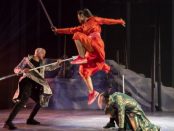
Sometimes you don’t need a long, complex story — or even an engaging one — to hook an audience. At the showing of "Dragon Spring Phoenix Rise" at The Shed that I attended, audiences clapped and hooted for heroes and villains alike, despite being given no logical reason to do so. The heroes and villains possessed no distinguishing character traits, other than differing accents, and they voiced no discernible reasons to be fighting. The fighting was just that awesome.The visual bombast and fight choreography of "Dragon Spring," a world premiere Shed commission, are thrilling enough to recommend the show as an expensive diversion, at the very least. There are moments when the show’s production elements come together so spectacularly that they almost lift the rest of the show with them. Almost.
[more]
«
1
…
44
45
46
47
48
…
114
»
Copyright Jack Quinn, 2001-2023