News Ticker
- December 13, 2025 in Off-Broadway // BUM BUM (or, this farce has Autism)
- December 12, 2025 in Musicals // The Faggots and Their Friends Between Revolutions
- December 12, 2025 in Cabaret // Mary Foster Conklin — Mirrors Revisited (50th Anniversary)
- December 11, 2025 in Cabaret // Kathy Kaefer — Kiss Me Once: Stories from the Homefront
- December 11, 2025 in Off-Broadway // The American Soldier
- December 9, 2025 in Off-Broadway // This World of Tomorrow
- December 9, 2025 in Cabaret // A Noel Coward Celebration — Steve Ross & Friends
- December 7, 2025 in Off-Broadway // Diversion
- December 5, 2025 in Off-Broadway // Meet the Cartozians
- December 5, 2025 in Features // Tom Stoppard: An Appreciation
- December 4, 2025 in Off-Broadway // Practice
- December 4, 2025 in Cabaret // Eddie Bruce — The Magic & Music of Tony Bennett
- December 3, 2025 in Interviews // Interview with Ty Jones, Classical Theater of Harlem
- December 2, 2025 in Features // Gingold Theatrical Group’s 20th Anniversary Gala at The Players
- December 2, 2025 in Interviews // The American Soldier – An Interview with Douglas Taurel
Archive
Plays about lives of quiet desperation are difficult to pull off because you run the risk of boring the audience. Liza Birkenmeier’s “Dr. Ride’s American Beach House” has all the elements of a fascinating drama but as presented by Ars Nova at Greenwich House it is all about subtext and undercurrents which may go right over the heads of many audience members. Little happens but there is much tedious talk which is a cover-up for what goes unsaid.
[more]
What this team of artists has created is a serious piece of storytelling that is also a glorious treat for the eyes and ears. If you’ve figured that the show will just be a guy narrating a short story while another guy plays violin, you’re certain to be pleasantly surprised.
[more]
LBJ’s ambitious social programs in the United States of the 1960’s being sidetracked by the folly of the Vietnam War and his mishandling of the unrest caused by the Civil Rights Movement, have been the subject of books, documentaries and television docudramas. Playwright Schenkkan’s stage treatment of this material is a clumsy waxworks affair of a multitude of forgotten and remembered personages spouting off during two choppy acts.
[more]
In a counterintuitive casting coup, handsome Jonathan Groff stars as the nebbish Seymour Krelborn who works at Mushnik’s (a funny, kvetchy Tom Alan Robbins) failing flower shop on Skid Row. Seymour discovers an odd potted plant in Chinatown after an eclipse, a plant that leads to great success for both Mushnik and Seymour. Although it is difficult to forget Groff’s physical attributes (well-hidden under Tom Broecker’s costumes), he delivers a brilliantly realized sad sack Seymour. Poor Seymour is in love with the much put upon Audrey played with ditzy perfection by Tammy Blanchard. Two-time Tony Award winner Christian Borle chews the scenery as Audrey’s sadistic dentist boyfriend, Orin Scrivello plus several other characters such as a William Morris agent and an NBC TV executive.
[more]
The enduring resonance of its source material is evident in "An Enchanted April" during this uneven stage musical adaptation. Lasting two hours and 45 minutes with an intermission, its initial frothiness gradually fizzles. The bright score is excessive, the solid book rambles, and the production is more dutiful than inspired. However, the performances are engaging, and the piece’s emotional power is palpable. The show was originally presented by the Utah Lyric Opera and this New York City premiere demonstrates its potential.
[more]
Kathleen Chalfant adds another feather to her cap as Emily Dickinson’s posthumous editor Mabel Loomis Todd in the world premiere of Rebecca Gilman’s new one-woman play, "A Woman of the World," presented by The Acting Company in association with Miranda Theatre Company at 59E59 Theaters. Staged by Miranda’s artistic director Valentina Fratti with elegant assurance, Chalfant is both fascinating and seductive as this real life woman who in the 1880’s and 1890’s scandalized conventional Amherst, Massachusetts, with her liberated and bohemian behavior long before such goings on became acceptable for women – or men.
[more]
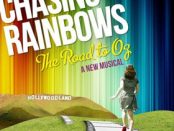
Chasing Rainbows has an exceptionally appealing cast. This is one of those rare productions where even the smallest roles are vivid. The show itself is not perfect. There are fixes that need to be made, which I'll address shortly. But there's a million dollars’ worth of talent on that stage, and some moments that are so wonderfully rewarding,
[more]
"The Lightning Thief - The Percy Jackson Musical" settles down a bit more in the second act and becomes more engrossing but the damage has been done. The actors in the first act all seem to be racing for a train and the sound levels continue to damage many of the songs throughout the show. The show remains an excellent introduction to Greek mythology made relevant for our own time. Faithful to the source material, it may please both teens who have read the book and those who have not. The five of the seven-member cast playing 28 roles demonstrates their versatility as they change from one colorful three-dimensional character to another. If only the director and the production had trusted the original show and did not feel it necessary to make it bigger and better for Broadway, a common complaint when shows make the move from their smaller Off Broadway venues.
[more]
Mr. Burnam’s futuristic conceit is engrossing and the theme of a repressed figure looking back at a more joyous way of life is potent. The present day portions are amiable but only fitfully compelling, so The Catastrophe Club doesn’t quite fulfill its striking premise. Reaching a polished and wistful conclusion, and with its site-specific presentation, it sustains its 90 minute length with interest.
[more]
The play’s title comes from Carew’s character. The “hope hypothesis” is the notion that, in our current environment, people have universally given up hope. Consequently, they are either attempting to destroy themselves or aiming to destroy others. That’s a fairly dire assessment of the world we live in, and one that Miller doesn’t strive to dispel. That she can project that kind of cynical outlook in such a sparkling entertainment is impressive and a bit unnerving.
[more]
Vieh’s script is extremely clever in its telling two sides of a story completely by separate monologues. The dialogue is real and yet extremely funny, never revealing too much, allowing the audience to piece together what’s going on as the actors deliver their lines with impeccable timing and tumult.
[more]
Like a great many history plays, Harvey Fierstein's "Bella Bella" is as much about the present as the past, paralleling everything that's gone wrong now with what went wrong then. Unsurprisingly, it's also shamelessly biased, with the first word in the play's title apparently meant to be read in Italian as part of Fierstein's banally straightforward tribute to Bella Abzug, the feistiest of feisty 1970's New York City politicians, best known for her take-no-prisoners liberalism as a member of the U.S. House of Representatives. One's enjoyment of the play probably depends on how prone you are to clap or hiss along with the rest of the unambiguously sympathetic Manhattan Theatre Club audience, even if it's only in your own head.
[more]
On Broadway every once in a while writing, acting, directing and the technical production come together to profound, memorable effect. Adam Rapp’s "The Sound Inside" at Studio 54 is a superb example of this phenomenon. Originally staged at the Williamstown Theater Festival, the move to Broadway, and a much larger theater, works incredibly well.
[more]
The first piece on the program was the most successful of the three: Mark Morris’ “The Letter V”. (There was no mention of any specific meaning of the title.) The classical music composition “Symphony No. 88 in G Major” by Joseph Haydn provided a substantial underpinning for the choreography because Morris had a beautifully uncanny way of making the movement seem to rise up from the music. The Orchestra of St. Luke’s, conducted by David Briskin, provided the fine, live, performance. Morris, in fact, always insists on live music, and that added so much to the experience.
[more]
Hillary Clinton wearing a glittery red pantsuit leading a Gene Kelly/Stanley Donen-style production number set in a Busby Berkeleyesque recreation of a McDonald’s with giant sparkling French fries is a highlight of the insipid and disjointed musical fantasia, "Soft Power." It’s just one of its many lame sequences including a "The Music Man"-type explanation of the U.S. electoral system led by a singing and dancing judge. We’re in for two hours of painfully unfunny self-indulgence. Holden Caulfield from "The Catcher in the Rye" pops up too.
[more]
While the original production had a great many one-of-a-kind stars supporting Merman, one of the distinctions of the York production is its cast: Montel has been able to obtain the services of Klea Blackhurst for Hattie Maloney, the Ethel Merman role. Blackhurst, you may know, has specialized in Merman for years including her tribute show "Everything the Traffic Will Allow" as well as appearing in the Merman roles in revivals of "Anything Goes," "Red, Hot and Blue," "Call Me Madam" and The York’s staging of "Happy Hunting." Montel has also surrounded her with seasoned theater veterans including Stephen Bogardus, Simon Jones, Gordon Stanley and David Green. The members of the singing and dancing chorus are equally talented.
[more]
There has been a recent trend to perform Shakespeare as minimally as possible and with as few actors as possible. However, the question arises what is gained? When the doubling of roles proves confusing so that when actors appear it is difficult to know who they are playing, what is the point? Here the two actors who play the murderers Macbeth hires to kill Banquo report to him and then take their seats with the guests at his banquet which is quite disconcerting. In Doyle’s version, Macbeth himself kills Lady Macduff and her children rather than his henchmen – so who is minding the palace? Antonio Michael Woodard, the young man who plays Banquo’s son Fleance, appears in this scene as Macduff’s son but we know we have seen him before.
[more]
To be sure, Serafina and Alvaro's romance is less than credible, but director Trip Cullman wisely commits to it completely, recognizing that Williams really hasn't given him any other choice. Luckily for Cullman, he has the ebullient Tomei to portray Serafina and keep the audience from losing faith that the character's happy ending is just over that lovely Gulf Coast horizon, no matter what miseries she's endured.
[more]
"The Cosby Show," "Home Improvement" and "Roseanne" are among Mr. Williams’ prominent credits as a television writer and producer. Williams also has had several plays produced and has directed a number of theater productions. Fear is in the venerable tradition of "The Petrified Forest" and "The Desperate Hours" with dashes of "The Bad Seed." It exhibits a technical facility for dramatic writing with its sharp dialogue delivered by its diverse well-drawn characters enmeshed in a suspenseful scenario out of French cinema. Lamentably, Williams doesn’t go all the way in rendering Fear’s classic whodunit aspects. It all plays out inconclusively and without satisfaction.
[more]
Last seen in New York in 2017, Danish choreographer Mette Ingvartsen has brought a newish work, "to come (extended)" to NYU Skirball Center. To come (extended) is actually a reworking and expansion of an earlier work. Unfortunately, Ms. Ingvartsen appears to be in a rut, a deep, monotonous sexual rut. She considers herself the one-woman expert analyzer of all things sexual via her repetitive choreography. Indeed, her work includes nudity and explicit sexuality (all forms of intercourse between every combination of genders, oral sex, group sex, etc.) all extremely unexciting, in fact, quite boring.
[more]
The play’s dynamic—with the two brothers trying to stay in sync even as they find themselves polar opposites in nearly all areas of their lives—seems at points to make the play a kind of clunky “what if” scenario from a modern-problems textbook (the punny title doesn’t help). However, Goodwin’s talent for writing smart, occasionally amusing dialogue and for making his characters seem like real people rather than emblems largely mitigates that concern. Also, the work of the actors in this production is quite strong.
[more]
Tracy Letts’ latest play to reach New York via the Chicago Steppenwolf production is the comedy drama, "Linda Vista," in which a 50-year-old white man in San Diego going through a messy divorce finds his life spiraling downward as he attempts to deal with his personal demons in a major midlife crisis. Presented in New York by Second Stage Theater, the play delineates a case of toxic masculinity and will most likely fascinate men and infuriate women. While Dick Wheeler played by Ian Barford, longtime Steppenwolf ensemble member, is reprehensible in the comic first act, he is redeemed by the end of the poignant second act where one’s sympathies finally go out to him.
[more]
The performances as well as the dialogue are cool and unemotional as you might expect from four professionals used to doing their jobs, until about three quarters of the way through when Winner confesses to having mailed out the document that they have been asking her about after admitting that she had printed it out to read it. From then on for the last 15 minutes, the tension rises as it become obvious that Winner will not be allowed to go home.
[more]
As is Mr. Friel’s The Faith Healer, Molly Sweeney is a monologue play. Here, instead of being separated in individual acts, the three characters appear on stage together without interacting, and speak alternately. It’s certainly a viable format and Mr. Friel gives us a gorgeous cascade of memories, biographical details, differing points of view and suspense. However, as beautiful as these reveries may be, there’s too much of them and the play’s impact is diluted. Lasting two and a half hours and comprised of two acts with an intermission, the slender plot is embellished with the leisure of a literary work rather than a taut stage play. Still, by its end, one is caught up by the characters and their fates. The arguable structural deficiencies are compensated for by the faultless presentation.
[more]
Knud Adams directs this one-set show which at times has moments of humor, but overall is a slow moving and usually depressing narrative. Ari Fliakos, who plays the son, gives a reserved performance. Too often I thought of the somber tones of The Twilight Zone’s Rod Serling. Fliakos speaks directly to the audience while seldom having conversations with his mother, played convincingly by Caroline Lagerfelt. When they do interact, it’s via a call that usually describes her mundane days.
[more]
"Games" shines a light on the long forgotten stories of two Jewish athletes in post-World War I Germany, a Germany that slid into National Socialism by the 1930’s, effecting the lives of Helene Mayer, a world-class fencer, and Gretel Bergmann, a record-setting high jumper. The play, directed with attention to pacing and unadorned expressiveness by Darren Lee Cole (assisted by Hayley Procacci) takes the protagonists through the world-changing 1936 Berlin (aka the “Nazi”) Olympics.
[more]
Written by Sean Daniels, "The White Chip" is reportedly an autobiographical play, directed with an earnest finesse by Sheryl Kaller who sometimes has difficulty keeping her three different performers in character, in terms of whom they represent. If one has difficulty following the many tangents, Kaller has to be held principally responsible for that.
[more]
Bearded, bald and utilizing a pronounced Irish accent, the physically imposing Jeffrey Bean is towering as John. The beaming Mr. Bean’s delightful bonhomie gives way to harrowing anguish as he conveys John’s dark sensibility while consuming more and more whiskey, shambling about and later coping with the bender’s aftereffects. Bean’s everyman presence endows his performance with the dimension of being a stand in for all self-pitying delinquent fathers.
[more]
As part of its Fall 2019 Musicals in Mufti Cole Porter Series, The York Theatre Company has smartly revived this 1965 Ben Bagley - Cole Porter revue not seen in New York in 54 years. Pamela Hunt’s delightfully sophisticated production uses four talented performers at the height of their powers: Danny Gardner, Lauren Molina, Diane Phelan and Tony Award nominee Lee Roy Reams, with the estimable Eric Svejcar at the piano. Hunt has tweaked the show a bit eliminating five of the songs which have inappropriate lyrics for modern sensibility and handed Reams the role of speaking Bagley’s droll narration rather than dividing it up between the original five performers. Although the Muftis are performed concert style with book in hand, these performers appear to be letter perfect and hardly look at their sheet music.
[more]
Rocky execution aside, the play is not without humor, imagination, charm and whimsy, and the same can be said about the designs by Jessie Bonaventure (scenic), Johanna Pan (costumes), Kelley Shih (lighting), and Brian Heveron-Smith, (sound), all of which work well together to allow this tale to be told. The play’s wonderfully emotional climax which has Elle, Rebecca and Ethel casting off the shackles of their lives into the winds of an oncoming storm is absolutely jubilant and makes the entire evening worthwhile.
[more]
This is the latest edition of creator, writer and director Gerard Alessandrini’s enduring musical spoof skewering present and past NYC theater that he inaugurated- in 1982 and has had over 20 incarnations. Mr. Alessandrini’s erudite, affectionate and acerbic script once again lambasts Broadway while lovingly celebrating its history during its 20 numbers. “Theater isn’t art, unless it hurts.” It’s that aching sense of the collectively treasured memorable greatness of Broadway clashing with its mercenary concerns that enables each version of the show to resonate while entertaining. Plus, it’s very funny and offers a showcase for talented malleable performers.
[more]
The play captures emotions that many of us have felt, from unrequited love, to loss. Seldom are we allowed access to such a raw story and candidness. In a time where we shield each other from truths, this stark and unapologetic performance allows us to feel what Victor meant to Edgar.
[more]
Monica Bill Barnes totally changed the mood with her thoroughly delightful “The Running Show” which used physical contests as a metaphor for dance. Barnes stood in the midst of sixteen students from Hunter College as her creative partner, Robbie Saenz de Viteri acted as a sports announcer, egging the large group on as they performed complicated patterns of finger snapping. Saenz de Viteri was the backbone of “The Running Show,” his narration, in turn witty, humorous and deeply thoughtful, drove the action which included more competitions; Barnes trying to beat her turning record; and an appearance of a young ballet dancer, Charlotte Anub. She was clearly too young to dance on point, but she had a natural stage presence as she turned and performed basic pointe work, charming the audience. “The Running Show” left a positive buzz in the audience, casting a quiet spell.
[more]
«
1
…
41
42
43
44
45
…
114
»
Copyright Jack Quinn, 2001-2023