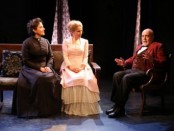
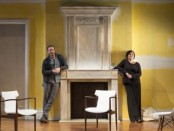
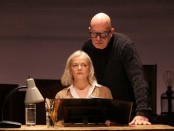
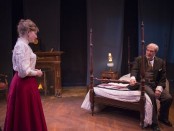
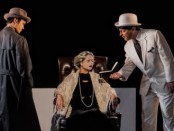
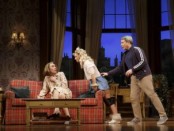
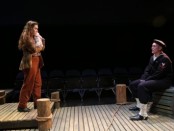
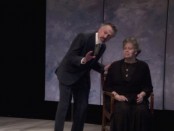
Belgian–born director Ivo van Hove has brought his London Young Vic revival of Arthur Miller’s" A View from the Bridge" to Broadway in a production so stripped down to its essentials that it seem to reinvent theater as well as this play. The minimalist director already known in NYC for his seven stagings at the New York Theater Workshop (including "The Little Foxes" and "Scenes from a Marriage") and his five at Brooklyn Academy of Music (including "Angels in America" and "Antigone") has reduced the cast list from 15 to eight, eliminated scenery and props, has the actors go barefoot, and has washed out almost all color from the stage. The result once the plot is wound up has hypnotic power that is rarely seen in our theater. The cast led by British stage star Mark Strong as protagonist Eddie Carbone includes five of the actors from the London production, as well as British stage and screen star Russell Tovey. [more]
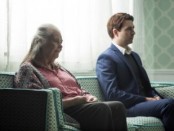
Playwright Jordan Harrison is a graduate of the Brown University M.F.A. program and the recipient of several prestigious awards such as a Guggenheim Fellowship and the Kesselring Prize. On a technical level "Marjorie Prime" is expertly constructed and contains serviceable dialogue that propels the plot, but in totality it never rises above the level of an academic contrivance. The premise is a familiar but promising one, but in execution it is flat. The exposition and setup never really become emotionally involving and the closing revelations are consciously sensationalistic. [more]
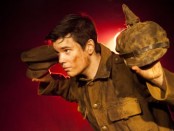
Besides playing Boyce, Gwyther depicts other British soldiers as well as Germans. It is an exhilarating display of rapid vocal and physical transformations subtly giving each brief characterization a fleeting depth. With his angular features, intense eyes, expressive voice, and limber physicality, his performance is a superb display of riveting solo theater acting. [more]
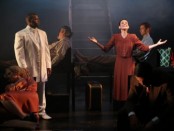
The Peccadillo Theater Company’s "A Wilder Christmas" is a gentle and genteel evening of theater: two early Thornton Wilder one-act plays, directed with an attention to detail and a leisurely sense of timing by Dan Wackerman, the company’s artistic director. "The Long Christmas Dinner" (1931) and "Pullman Car Hiawatha" (1930) together make for a rich sampling of Wilder’s familiar themes of family and the unavoidable specter of death (which, in Wilder, is only the beginning of another journey). These themes were perfected in his 1938 masterpiece, "Our Town," including the conceit of a godlike Greek chorus in the form of a Stage Manager who explains and even supervises the action. [more]
While C.S. Lewis’ famous theological allegory, "The Great Divorce," is written as a series of conversations, you might not expect that it would be suitable for stage dramatization as a religious treatise. However, the Michael McLean and Brian Watkins adaptation for Fellowship of the Performing Arts turns this into a high provocative and theatrical evening. Under the assured direction of Bill Castellino, three extremely talented actors (Christa Scott-Reed, Joel Rainwater, and Michael Frederic) play 19 characters among them, making them distinct and fully dimensional. The remarkable projections by Jeffrey Cady and the evocative original music and sound design by John Gromada make this a treat for the ear and eye as well as the mind.
[more]
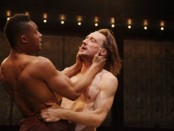
Marko Mandič is an award-winning acclaimed classical actor from Slovenia who has worked several times with Mr. Buljan. His talent, charisma, and physicality justify that acclaim as witnessed here by his performance in the title role. Vocally expressive and emotionally volatile, he is truly naked through most of the play’s second half and unselfconsciously performs heroically even through the most awkward sequences. These include the incident with the watermelon and later painting his genitals black to match those of the actor playing Orestes who doesn’t display his. [more]
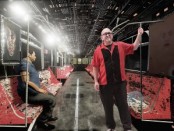
Victor Morales enters and introduces himself and notes that we are at Dixon Place. Mr. Morales who created this piece is stocky, bald, bespectacled, and possessed of a quirky everyman presence. For just under an hour, he delivers an amusing lecture with serious overtones enhanced by the illustrative projections. [more]
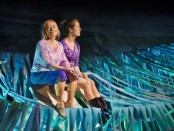
Every member of this trio has experienced love and loss, and this show explores what it truly means to be human. Moments of drama exemplify the character’s toughest challenges, and their individual approaches to solving them. The strength of a woman as the leader of a household is brought to the surface, as these women have been let down by the men in their lives. The bond they share ultimately proves that true happiness can be found whether you achieve your personal goals and dreams or find something beautiful within yourself. [more]
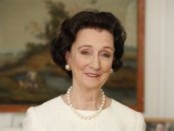
The legendary stage actress Kathleen Chalfant is appearing in her second one-woman show, a follow-up to her “Mrs. Dalloway” in The Party, from the Virginia Woolf stories in 1993. This time she plays Rose Fitzgerald Kennedy, the 79-year-old matriarch of the most famous political family in 20th century America. It is July 1969 and we meet her in the tasteful living room of her Hyannis Port, Massachusetts, home (designed by Anya Klepikov) one week after her youngest son Teddy’s tragic accident at Chappaquiddick. The premise of "Rose, The Kennedy Story as Told by the Woman Who Lived It All" is that we are members of the Ladies Auxiliary of the Knight of the Redeemer visiting from Dublin. We are invited to stay until Teddy comes back from sailing which he has been doing since the previous day. Her husband Joe, Sr., who has had a stroke eight years before is being cared for in an upstairs bedroom. [more]
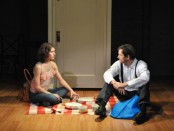
Author Jane Martin has taken the familiar dramatic staple of a love story between two clashing opposites and rendered it compellingly here. There are plot twists, witty dialogue and violent incidents all with a tone-combining sweetness and melancholy. Jake is a depressive riddled with self-doubt and Deborah’s devoutness complicates her personal emotions. [more]
Pendleton has made some strange directorial choices. Characters appear on stage and stand silently long before their entrances. This is distracting as one wonders are they supposed to hear the conversations taking place. Many of the entrances and exits take place through the main aisle of the theater which breaks the fourth wall convention continually. He has also cast several actors as older than they are described so that this shifts the character relationships appreciably. The most famous scene in the play when Nora slams the door, possibly the most iconic moment in modern drama, is diluted considerably as there is no door for Nora to slam. Harry Feiner’s set design has the drawing room and bedroom visible side by side throughout the play which seems somewhat inappropriate for the 19th century setting. [more]
The pleasure of" Night Is a Room" is watching these three expert actors speak Wallace’s rich, insightful language which veers from wittily highfalutin to excitingly vulgar. Charting their emotional reactions which teem with hyperbolic outbursts, she has her finger on the pulse of these three self-deluders. Bill Rauch directed with total comprehension, walking a fine line between permitting the audience to observe the drama and also be mystified and appalled by these awful people.
[more]
The great mid-20th century American poets Elizabeth Bishop and Robert Lowell were friends from 1947 until his sudden death 30 years later. As they were usually in different cities and countries (Bishop lived in Brazil for many years while Lowell lived in New York City and Boston), they wrote each other over 450 letters which were published in 2008 as "Words in Air: The Complete Correspondence between Elizabeth Bishop and Robert Lowell." Sarah Ruhl, an adventurous playwright whose plays tend to be very different from each other, has adapted the letters for the stage in a homage to writing and friendship called Dear Elizabeth in which all of the words are that of the poets. Kate Whorskey’s fascinating production for WP Theater (formerly The Women’s Project) has staged the play much in the manner of last year’s revival of A.R. Gurney’s "Love Letters" and also with revolving casts. [more]
Arthur Miller is having a great posthumous 100th birthday! "A View from a Bridge" opened on Broadway to sensational reviews to be followed soon by "The Crucible." Now a revival of "Incident at Vichy," his frightening, microcosmic examination of Nazi-occupied France during the height of World War II, is enjoying a fine revival at the Signature Theatre. While the first two plays are each experiencing radical re-assessments, the director of Vichy, Michael Wilson has opted for a straight-forward, naturalistic interpretation in which each character exists as a finely etched portrait and the set (by Jeff Cowie) is a real, frightening place down to the period French newspapers plastering the holes in the windows. [more]
Metropolitan Playhouse has done itself proud with its revival of the rarely seen "Alison’s House." Alex Roe’s splendid production with its accomplished cast demonstrates the vitality of Susan Glaspell’s play as well as its contemporary relevance. This is a revival of the highest caliber. [more]
From offstage we hear the hyperbolic exclamations of a young man, Copious Fairchild, as he masturbates mixed with the soundtrack of a television cooking show. He enters the living room with a jar containing his semen and places it on the coffee table. After favorably commenting on its magnitude his young wife Hibiscus Van Der Waal, takes it and goes offstage. We soon hear her orgasmic sounds as she inseminates herself during this anti-sexual reproductive process called “coagulating.” It’s a pivotal sequence in Stephen Kaliski’s excruciating futuristic spoof "Gluten!" [more]
Aside from the obvious theme of morality in politics, the play also deals devastatingly with issues of privacy in public life and in the information age. Can David keep the news of the abortion secret? How will the press deal with his Asian sister showing up? Which side are the pundits on the web on? Can the Carver campaign ride out the storm? The contemporary issue of date rape is also explored thoroughly. "Promising" ends with a sensational denouement which will leave the audience with much to think about. [more]
Ms. Rush is also the performer and she is stupendous. In addition to playing Bernadette, she portrays a gallery of characters she encounters. These include her parents, a priest, her gay male best friend, her Rockette confidante, her husband, her son and a few others. Rush effortlessly switches back and forth among these multiple roles with precision and vivid physical and vocal details, offering great depth to each. [more]
The best role in the story is that of sociopath, deranged Annie Wilkes. Metcalf runs the gamut of emotions from bliss to murderous rage and back and turns on a dime. Unlike Willis, she uses her face to show all of her moods both pleased and black. Always interesting to watch, her Annie is revealed as crazier the longer the story goes on. The scenes in which she has to get Paul back into bed suggest that her Annie not only contains tremendous emotional extremes but also enormous strength from years running her farm. Playing the role less childless-like than Kathy Bates did in the movie, she makes Annie Wilkes all her own. As the third member of the cast in the minor role of the sheriff, Brown is completely convincing but he hasn’t been given much to do in his few brief scenes. [more]
It was inevitable that legalized gay marriage would lead to plays about gay parenthood. "Dada Woof Papa Hot," Peter Parnell’s sweet-natured, but frustratingly narrow-focused, new play at the Mitzi E. Newhouse Theater explores the kind of child rearing issues formerly supposedly experienced only by straight couples, at least straight couples with large bank accounts. To bring the theme of gay marriage further into the mainstream, divorce also rears its ugly head. [more]
Admittedly, many of the ideas in the play are hardly new or revolutionary: the first measures to limit the scope of the British monarchy’s power date back to the 1215 Magna Carta and subsequent arguments challenging the divine right of kings include the American Declaration of Independence, drafted in 1776. Rather, this production’s merit lies in the shocking immediacy it brings to the subject. Acutely aware of the fact that the nearly 90 year-old Queen will not live forever, Bartlett takes us into a not-too-distant future where the inevitable change of the empire’s figurehead sends the nation into a state of upheaval. His England is just melodramatic enough that to allow us to see it as fictional yet a shade too realistic to feel truly dystopian. [more]
The title refers to three generations of women whose lives have been derailed by early pregnancies. When the play begins, we are in the modest home of embittered, single mom Maggie (Perabo) who is late for work at the Bloomingdale outlet during a nor’easter when she finds that her car has been stolen. When she also discovers that her daughter Erica hasn’t been to school that day, she realizes that her car hasn’t been stolen but taken by her daughter who it turns out has a boyfriend her mother knew nothing about. However, Maggie can’t afford to lose her job - or her mortgage - as her cushion this month is all of $23 and she is a “pizza an’ a six pack away from bouncing the electric bill.” This is life on the edge of subsistence for many Americans. [more]
The National Asian American Theater Company’s world premiere of Lloyd Suh’s "Charles Francis Chan, Jr.’s Exotic Oriental Murder Mystery" is best categorized as fiercely provocative satire. The play has two storylines. The first follows a 1960’s Frank who is developing and producing a murder mystery; the second being scenes from the aforementioned murder mystery, which is a stylized production featuring an Asian woman in white face as an elegant old debutant, and conversely an American Vietnam veteran in brown face as the Asian Detective Charles Chan, namesake to the production. [more]
Handled as stand-up comedy, Story tells us that he did not at first accept Dr. Gray’s theories until he heard one of his lectures, and then he became a convert to the concept that men and women’s thinking and feeling is so different that they might as well be from separate planets. Story uses his own life as an endless source of comic anecdotes to illustrate Gray’s ideas: his own courtship, marriage and life with his wife Megan. Basically, the theory boils down to men needing trust and approval while women need attention and understanding. Initially, Story’s mirthful tales are of how he caused unnecessary conflicts with his wife by not following these rules. Eventually, he learns the hard way through trial and error, and ultimately improves his life and marriage. [more]
For the first half of Stephen Karam’s “The Humans,” the Blake family Thanksgiving seems to be nothing but a banal seasonal gathering. And then suddenly the author’s message comes into focus and the play becomes a haunting drama and unnerving ghost story which is unlike anything you have seen lately. The superb cast headed by Reed Birney and Jayne Houdyshell under the direction of the always interesting Joe Mantello who has piloted many important new plays turns The Humans into a memorably unique experience. Karam, whose plays include Speech and Debate and Son of the Prophet, has been given a splendid Roundabout Theatre Company production for its third premiere of one of his plays. [more]
The energizing conceit of the play is its reliance on audience participation that adds considerably to the entertainment. During the action, the audience gets to ask questions of all those involved and at the intermission a detective is in the theater’s lobby to confer with. It all means that the actors besides sticking to the script must also improvise a great deal. This breaking of the “fourth wall” is done very cleverly and believably. The audience also votes on who the killer is based on all of the facts that have been presented. Therefore, each performance varies based on those in attendance. [more]
Directed with comfortable assurance and a leisurely sense of timing, this "Sylvia" benefits from a (mostly) strong cast, including three Tony Award winners: Matthew Broderick (whose wife Sarah Jessica Parker played the title role in the original off-Broadway production), Julie White and Annaleigh Ashford. The brilliant, versatile Robert Sella who expertly and drolly plays three diverse roles, rounds out the cast. [more]
Roundabout Theatre Company has commissioned yet another new stage adaptation from British playwright Helen Edmondson, whose previous plays also include stage versions of Tolstoy’s "Anna Karenina" and George Eliot’s "The Mill on the Floss." In the title role, Keira Knightley who has been associated with period drama in her distinguished film career ("Atonement," "Pride and Prejudice," "Anna Karenina," and, of course, the "Pirates of Caribbean" movies) has chosen to make her Broadway debut. She is supported by Tony Award-winner Gabriel Ebert ("Matilda"), British actor Matt Ryan, and two time Tony Award-winning actress Judith Light ("Lombardi," "Other Desert Cities," "The Assembled Parties.") Unfortunately, director Evan Cabnet has chosen to stage this most French of tales in a bloodless, refined English style which doesn’t serve with the material well. [more]
Ms. Nielsen has long been a treasured award-winning fixture of the New York stage with her quirky idiosyncratic comedic and dramatic talents. Here as the omnipotent matriarch Paige she is colossal. With her animated features, giddy voice, and frantic physicality, she delightfully mines every bit of the abundant dark comedy in the play. Alternately when slowing down to express fiercely serious sentiments she is chilling. This searing performance is yet another memorable turn from this incomparable actress. [more]
In Aleks Merilo’s play, "The Widow of Tom’s Hill," human nature is tested in the face of a life-threatening plague. Under Rachel Black Spaulding’s direction, this play takes place in a small town off the coast of Washington in 1918, with audiences first meeting a young widow named Aideen (Lucy Lavely) struggling to provide for her young child. She must fight for survival and take caution against anyone who crosses her path. From the beginning scene, audiences can surmise the rough past she’s encountered that’s forced her to become her own soldier against the cruel, harsh outside world. [more]
New Worlds Theatre Project’s mission is to present English language translations of Yiddish plays as comparable to their contemporaries Chekhov and Ibsen. Now they have turned to a first English translation by producing artistic director Ellen Perecman of David Pinski’s Yiddish classic, "Professor Brenner," which appears to have had no previous production. The reason may have been Pinski’s frankness about sexual relations and the controversial nature of the subject matter for the Yiddish–speaking community. [more]