
Plays
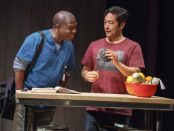
Sheppard recollected that in the Underground Railroad game his fifth grade classmates were designated to be either Union or Confederate soldiers. The Yankees (Union) tried to covertly run slaves (portrayed as “black dolls”) from a classroom “safe house” to another classroom “safe house.” The Rebels (Confederates) endeavored to prevent the Yanks from accomplishing their mission. The end goal was to secret slaves or dolls to Canada (a school lobby glass case filled with memorabilia served as Canada). [more]
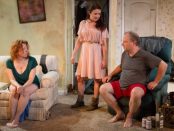
My Old Man (And Other Stories)
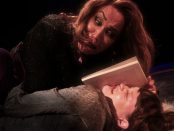
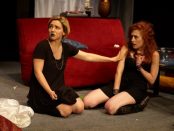
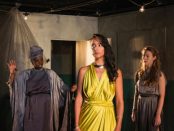
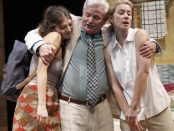
Gentili and Davis riotously appear together in a confrontational scene that’s similar in style to one of Tennessee Williams’ outlandish later works written during his 1960’s drug fueled “Stoned Age.” It culminates in an outrageous catfight right out of the campy 1960’s 'Batman" television series. [more]
Kurios: Cabinet of Curiosities (Cirque du Soleil)
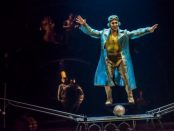
Cirque du Soleil's "Kurios: Cabinet of Curiosities" has a wonderful premise and an eye-filling mise en scène. However, without the needed narration or program notes, the idea remains still in embryo. The problem one supposes is how to narrate a show that is intended for international audiences. [more]
The Trial of an American President
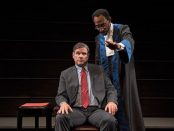
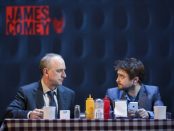
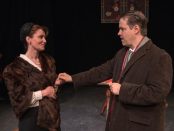
Trial is stacked against Bush from the get-go. The torrent of facts alone convicts him. The director, Stephen Eich, the author and probably the actor, Mr. Carlin, seem to have decided to make Bush weak-voiced, full of twitches, nervous eye movements and religious fervor. Had Bush been portrayed as a stronger man who truly believed in what he did, the play might have had a dramatic spine. The very fact that after being convicted by a jury of audience members Bush’s last word is a tearful outcry (“Laura”) serves to induce not empathy, but pity. [more]
Divine Comedy
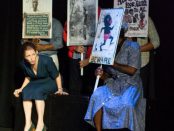
The problem with Peter Dobbins’ productions is not the quaint spiritual underpinnings of the plays but the fact that they are directed too leisurely and consequently do not generate any laughs, fatal for comedies. Several of the actors are innocuous where they should be more incisive. The rhythms of both plays seem much more formal and genteel than they need to be. The short, curtain raiser plays like an extended anecdote, while the longer, more famous play is a comedy of manners play that seems rather thin for its length. The stilted, old-fashioned translations from the French also do not help. [more]

The Encounter
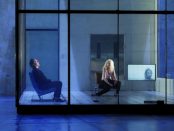
Headsets are on the backs of the audience’s seats when they arrive and which they are asked to wear throughout the show. The stage is set with a desk, several microphones and many water bottles. The back wall is adorned with foam sound proofing panels. The overall look is that of a cavernous sound studio. [more]
Twenty Thousand Leagues under the Sea
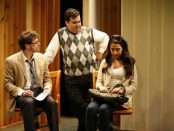
The live action elements of the show are performed on various platforms and screens on which are projected Deco Dawson’s designs which give the dramatization a 3-D look. In addition to 2 -D minatures, Miller manipulates tiny action figures (the scientists, etc.) and puppets (the Giant Squid, etc.) which are projected life size. Other moments take place in the audience. The audience is also asked to put their smart phones on mute to await developments. Among the magical moments are the walk on the bottom of the sea and the school of jelly fish. Aside from the marvelous visuals, the creators seem to want to have it both ways: although we are transported to a Victorian world, smart phones and computer monitors seem to work – although the younger members of the audience will most likely not notice the anachronisms. [more]
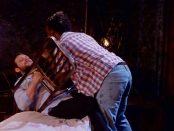
Nat Turner in Jerusalem
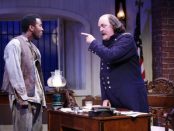
The playwright sets the action in Turner’s jail cell where he’s chained up, visited by Gray, and overseen by a guard, the night before his execution. Mr. Davis states that this situation is a fabrication inspired by the book. A possibly unreliable account is the source material for this even more fanciful dramatization. Davis even expresses through the mercenary Gray the possibility that his chronicle will be sensationally tailored in order to sell more books. [more]
All the Ways to Say I Love
"All the Ways to Say I Love You" is refreshingly free of this formula. The incidents are straightforwardly depicted and the circular conclusion is simple. LaBute palatably sets up the situation by establishing that the male student is a senior who has had to repeat a year of school, so he is clearly a young adult. It is implied that he is African-American and it is stated that Mrs. Johnson’s emotionally distant husband is of mixed race. Despite these intriguing elements, the play narratively peaks halfway through and then grinds on. [more]
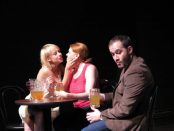
5 Guys Chillin’
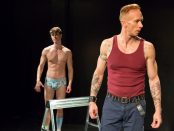
Writer and director Peter Darney’s script is based on and intertwines over 50 hours of interviews with gay men contacted through the gay social media site Grindr. From this real life material, Mr. Darney has skillfully fashioned an engaging five-person, unflinching character study. There’s no plot and no resolution but it is still a compelling take on this phenomenon. [more]
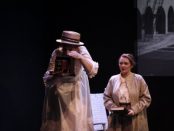
Hamlet (Mobile Unit 2016)
The single disadvantage of director Patricia McGregor’s approach is that in cutting so much text, the events of the play seem to occur one on top of each other, making the play a bit melodramatic, and a good deal of character development is sacrificed by the way. However, with dangerous-looking fight direction by Lisa Kopitsky and intriguing movement by Paloma McGregor, this is a "Hamlet" that lives up to its mission to be accessible and entertaining to all, those who know the play well and those seeing it for the first time. [more]
A Taste of Honey
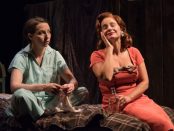
Director Austin Pendleton made some choices which don’t help the now creaky play. Although Peter is described as ten years younger than Helen, Pendleton has cast the ever reliable Bradford Cover who unaccountably looks to be Helen’s age or older. This changes the dynamic of the play as with a younger man it would be obvious why Helen doesn’t think she has much hold over him. While the apartment is described as dirty with junk all over it, Harry Feiner’s set is spotlessly clean. This changes the environment a good deal and makes Jo’s life much less intolerable than described. In addition to the on-stage jazz combo which was also part of the original 1958 London production, Pendleton has several of the characters occasionally speak directly to the audience which makes this play more surreal than the kitchen sink milieu would imply. All of this makes the revival much less affecting than it might have been. [more]
What Did You Expect? – Play 2 of The Gabriels: Election Year in the Life of One Family
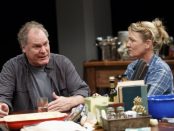
Like his "Apple Family Plays," Nelson’s "The Gabriel" cycle all take place in a kitchen on a specific day in almost real time using the same six actors to play the family members. These are occasional plays which define a moment in time, as well as being chamber plays, small cast plays set in one place. Not much happens but much gets said and discussed. Described as “Chekhovian” by Oskar Eustis, artistic director of the Public, "What Did You Expect?" is less so as there really is no dramatic event as in such Chekov plays as "The Cherry Orchard" or "The Sea Gull." However, leisurely told and extremely detailed, "What Did You Expect?" offers its own rewards but may not be for all theatergoers. It is an evening of excellent talk which defines a family of have nots in our own time. [more]
Empathitrax
Playwright Ana Nogueira has a facility for often arch dialogue but not much else. The play’s potentially promising sci-fi premise is undermined by its bizarre vagueness. Not only do the leading characters not have names, there is no biographical data about them imparted. Their professions and life details are never described. Most crucially HIM’s thesis is mentioned several times but what the subject of it was is not stated. Ms. Nogueira basically presents two ciphers that are difficult to truly care about. Ultimately, it’s all a hollow and smug exercise. [more]
Dead Shot Mary
While proud of how she is portrayed in the press, as a woman who couldn’t be broken, McPhee delves beneath the surface to illustrate how Shanley really felt once she returned to an empty apartment at the end of the day -- with her beloved dog as her only real company. Like everyone else, she experiences confusion, loneliness, and pain and only can hope that her good choices and desire to help mankind outweigh the mistakes that she has made. [more]
Phaedra(s)
During the three and a half hours of "Phaedra(s)," Huppert masturbates, menstruates, throws up, fellates several versions of Hippolytus, flails about with masochistic glee, and screams so loudly and continuously as to cause fears for her vocal health, all in the service of getting to the core of the title character as imagined by Sarah Kane, Wajdi Mouawad and J.M. Coetzee (with dramaturgy by Piotr Gruszczynski.) Director Krzysztof Warlikowski did little more than keep the over-the-top emoting and sexuality from exploding out to Fulton Street. [more]
The Birds
Unlike the original short story which was set on a rural farm in Cornwall, England, and the film which was reset in Bodega Bay, California, the play takes place entirely in the main room of an isolated house in New England. Stefan Dzeparoski’s production which puts the audience in the same room with the characters has its strengths and weaknesses making this an evening of mixed success. [more]
Maestro
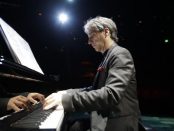
Felder’s play begins with a video of the actual Leonard Bernstein delivering a colorful, yet entertaining, illustrated lecture on music. When Felder sashays down the aisle, a cigarette in one hand and a drink in the other, the lack of resemblance is, at first, bothersome. But, somehow, sitting at a piano—which he plays impeccably—his monologue pulls you into Bernstein’s tumultuous life story. [more]
Bachelorette
This comedy revival of Leslye Headland’s 2010 play, that was adapted for the 2012 film of the same name, "Bachelorette," is as caustic and outrageous as ever. While looking ahead to a wedding day is supposed to generate feelings of excitement and bliss as women band together to stand by their girlfriend as she prepares to say “I Do,” this is often times not the case with several different personalities in the same room. It can be a very stressful time as emotions heighten and feelings get hurt, and "Bachelorette" humorously and dramatically represents this experience as three girls meet up to celebrate the night before their friend’s wedding in a swanky hotel suite. [more]
Aubergine
Playwright Julia Cho has crafted an engaging and universal work that unevenly blends reality with mysticism. The characters are all very well delineated and the dialogue is flavorful and realistic. It’s structured as a series of short scenes that include monologues, flashbacks and fantasies. The play’s two-act form diminishes its momentum, running two hours and fifteen minutes with an intermission. Repetitiveness and a preoccupation with profundity sidetrack its effectiveness at times. [more]
Crackskull Row
Director Kira Simring’s superior staging theatrically presents the play’s complicated situations with clarity and surrealistic flourishes. Characters often enter and exit through unlikely places such as through the audience or from a side door. Though the play lasts only 75 minutes, Ms. Simring’s physical realization of it makes it seem lengthier with the depth she has brought to it. Her results with the cast, some of who play dual roles is superb. [more]
The Layover
Following "Bachelorette" and "Assistance," Leslye Headland’s latest play, The Layover, is a taut psychological thriller told in an updated film noir style. Trip Cullman, who has directed all of her New York productions, has made the play a tour de force of tension and unease. As acted by Annie Parisse, Adam Rothenberg, Amelia Workman, John Procaccino and Quincy Dunn-Baker, the tone is marvelously sustained. The only fly in the ointment is the ending which will take you entirely by surprise and may feel unmotivated. [more]
About Clarence and Me
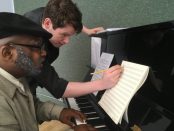
To call "About Clarence and Me" simply a play is misleading, as the project features an entirely original score by co-writer Scott Hiltzik. A classical musician, Hiltzik’s music is technically striking but carries a modern flare. In additional to their finely tuned performances, both DeMone and Roll impress as musicians as well. Roll proves himself to be quite the accomplished classical pianist, demonstrating mastery of the keys by way of precision and constraint. DeMone, ever his opposite, produces from the piano a sound descendent of a ragtime piano roll, at times accompanied by the veteran singer’s sonorous growl. Directed by Hiltzik’s co-writer Jones, the duo’s intimacy with the material is plain to see in the final product. Full of nuanced moments both thematically and in performance, the writing team’s hands-on approach is responsible for this well-rounded and solid production. [more]
The Trojan Women
Written in 415 B.C. as a criticism of the Athenian capture of Melos and the subjugation of its population earlier that year, "The Trojan Women" has remained relevant throughout the last 2,500 years due to mankind’s penchant for war. Although Ellen McLaughlin’s new adaptation makes some changes to the Euripides original, it retains its power pertinent for our own time in the wake of the refugee crisis. While at times callow, Anne Cecelia Haney’s production for The Bats is persuasive, potent and poignant. It also provides an excellent introduction to the plays that make up Greek tragedy for those who have not experienced them on stage. [more]
The Jamb
Besides achieving sensitive and strong performances from the cast, director David Drake masterfully fulfills the playwright’s intentions with his lively and brisk staging. The collaborative group UnkleDave's Fight-House’s fight direction is thrillingly realistic for several physical conflicts. [more]
Caught
The beauty of Chen’s technique lies in engaging the audience in a guessing game that they don’t immediately know they are a part of – presenting them with certain messages that appear to be true, but challenge them to think about it from a different perception. One of the main themes is examining the different viewpoints between the Chinese and American cultures and how perceptions can be skewed. The result is a clever and eye-opening puzzle that teaches important lessons around the human experience in a shocking way by offering extremes. [more]
A Day by the Sea
Now that we have been through all the angry play movements, literate writers like N.C. Hunter and Terence Rattigan are once again ripe for revival. While in his own time, Hunter was criticized for being too much like Chekhov that now seems a plus in the days of sloppy craftsmanship and plays that are really movie scenarios staged in the theater. "A Picture of Autumn" was obviously a post-war British variation on Chekhov’s "The Cherry Orchard," while Waters of the Moon resembles "The Sea Gull." "A Day by the Sea" owes a great deal to Chekhov’s "Uncle Vanya" and includes the same basic cast of characters. [more]
Touch
Toni Press-Coffman’s "Touch" is a rather challenging play both in that a great deal of it is narrated in recollection and also that it deals with much naked emotion. The cast led by Peter McElligott who is onstage almost throughout the evening could not be bettered. Director Nathaniel Shaw has made this under-dramatized play into a more theatrical experience. While Touch will not be for everyone, it is an impressive document of the workings of the human heart. [more]
To Protect the Poets (The New York International Fringe Festival 2016)
"To Protect the Poets" shows how readily lines can be crossed when “street justice” is employed, instead of the judicial system. This first-rate, timely and intelligent play is a just representation of how two people who love each other deal with violent crimes against women and police brutality. [more]
LUNT AND FONTANNE: “The Celestials of Broadway” (The New York International Fringe Festival 2016)
While "LUNT AND FONTANNE: The Celestials of Broadway" is a fine and concise review of their careers for people who have never heard of them, Murphy and Lang make them seem more superficial than necessary. It is true that Fontanne was born in England, but Murphy and Lang play both of them as very English and exceedingly refined and proper, not backed up by their performances as themselves in "Stage Door Canteen." The Lunts’ famous use of overlapping dialogue which was years ahead of its time can be seen in the video of their film of "The Guardsman." Murphy and Lang often use it to talk over each other’s lines making them unintelligible, while the Lunts came in on the last syllable of their cues which is much more realistic. The Lunts may have appeared in many light drawing room comedies, but to portray them as delivering their lines on the same level all time would not have made them as famous as they were. [more]
NIGHT OF THE LIVING N-WORD!! (The New York International Fringe Festival 2016)
Laden with jokes, sight gags and flamboyant characters, Mr. Free’s well-constructed and startling work combines the outrageous sensibilities of John Waters’ films with the social consciousness of Norman Lear’s television sitcoms. Free’s giddily convoluted scenario is dense with flashbacks, fantasies and surprises. Just when a thread is exhausted he is seamlessly on to another. The classic horror film "Night of the Living Dead" is emulated for the deadly serious dénouement. [more]
Implications of Cohabitation
Directed by Leni Mendez, "Implications of Cohabitation" is a smooth running machine, albeit some undeveloped moments in the script. The staging is fluid and the story is clear, but some exchanges between characters are borderline inauthentic. The set design by Anna Grigo is effective, but slightly repetitive. The main set piece is an empty apartment, and the decorum of the apartment is changed to reflect the change in location. Unfortunately, these changes are minimal and don’t do much to enhance or differentiate one scene from the next. [more]
Summer Shorts 2016 – Series B
Richard Alfredo’s 'The Dark Clothes of Night," a brilliant parody/homage to film noir and hardboiled fiction, the third play of Summer Shorts – Series B, is so good it alone is worth the price of admission. The other two plays which precede it in this year’s 10th Festival of New American Short Plays have interesting but undeveloped premises. But "The Dark Clothes of Night" is an instant classic, a humorous satire that is also a brilliantly theatrical study in paranoia, fear and evil and the elements that made film noir irresistible. Directed by playwright Alexander Dinelaris, the three actors in this memorable short work play multiple roles with assurance and aplomb. [more]
Naked Brazilian (The New York International Fringe Festival 2016)
Writer Gustavo Pace is the handsome, youthful and animated performer of this autobiographical exploration. He loudly rattles on in Portuguese and English while adequately portraying himself and several characters. These include his father, brother, a female therapist working on turning him straight, and various others he encounters. It’s an amiable and passable performance that’s heavy on volume and shaky on intelligibility. [more]
Troilus and Cressida
While "Troilus and Cressida" is rarely staged, Daniel Sullivan’s production full of bombs and smoke suggests that in our time of endless wars it speaks to us again, and the play’s cynicism also seems to capture the current zeitgeist. It also features memorable performances from John Glover, John Douglas Thompson, Max Casella, Sanjit de Silva, and Alex Breaux, among others. [more]
Crimes and Crimes
The August Strindberg Repertory Theatre presents this production. Since 2012, they have produced a number of the author’s works in New York City and for this one it was decided to condense and update it in order bring out its humor. The result is pretty much laugh-free. [more]
Alice in Black and White
"Alice in Black and White" is a play-within-a-play. Two parallel stories are told: one of Austen’s life and relationship with Gertrude Tate, her companion for over 40 years; and one in the early 1950’s involving a Staten Island Historical Society receptionist and journalist Oliver Jensen, who later published "The Revolt of the American Woman" (which included Austen photographs) and a Life magazine article on Austen. [more]
Paradiso: Chapter 1
A new media and sophisticated ticket booking system is brought into play even before the play begins. In order to buy tickets, a theatergoer has to give out his/her cell phone number for text follow-up information as to confirmation of time and the Midtown location. The immersive theater is kept secret until the day of booking the event. The address of where "Paradiso: Chapter 1" is being held is texted only four hours before the participant’s allotted time. [more]
Austin
Thomas G. Waites has a long list of major credits that go back to the film "The Warriors" in 1979. As Austin, he gives one of the strangest performances in memory. It’s a monotonously upbeat steamroller turn that recalls the hyper enthusiasm of the young Donald O’Connor combined with the cloying seriousness of the older Mickey Rooney at his most lachrymose. Watching Mr. Waites is exhausting and bewildering. [more]
Men on Boats
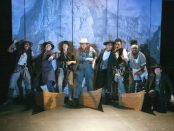
In this swashbuckling comedic play, 'Men on Boats" takes an innovative approach by casting ten women in the roles of the first “white” discovers of the Grand Canyon. However, this was not a nod to the current trend of casting cisgender or transgender actors. The use of “on boats,” instead of “in boats,” indicates the state of being in which the actresses find themselves — a history panorama where gender and race play little part. [more]
Summer Shorts 2016 – Series A
As might be expected LaBute’s new one act, "After the Wedding," contains a shocker. However, when it arrives in Maria Mileaf’s production, it is so matter-of-fact that it has little or no impact. Elizabeth Masucci and Frank Harts play a married couple of six years. Named simply “Him” and “Her,” they alternate telling (different) versions of their years together without interacting. However, both of them recall an event that occurred on their way to their honeymoon which should have been a game-changer. For these self-absorbed people millennials, it was simply another incident along the way. Sitting in chairs facing the audience, Masucci and Harts are rather charming as the amoral couple but the play seems like a scene from a longer play not yet written. [more]
Butler
Taking place during the time of the Civil War, "Butler" is a tale of conscience, courage, and transcendence. As Major General Benjamin Butler, Ames Adamson has risen to power but is faced with a decision that could change the game for slavery in America. Many of the themes surrounding a nation divided such as injustice, prejudice, and lack of understanding remain extremely relevant today and are just as impactful with events occurring every day in our world. Instead of ignoring the issues or using power as the only weapon, Butler flips the script and uses empathy and understanding as a means to connect. [more]
BenDeLaCreme’s Inferno A-Go-Go
“We’re actually going to be talking about 14th century Italian literature,” proclaims BenDeLaCreme near the start of his/her entertaining multimedia solo show" BenDeLaCreme’s Inferno A-Go-Go." It’s very loosely and irreverently based on Dante Alighieri’s The Divine Comedy. That literary classic describes a journey through hell including The Ninth Circle. Here it’s used as a clever pretext for an hour of inspired silliness with flashes of seriousness. [more]
A Class Act
While "A Class Act" covers material dramatized elsewhere, Norman Shabel’s play, seen at The Playroom earlier this year, is always absorbing, always unpredictable. The seven member cast is totally believable in their roles as lawyers and corporate bigwigs. This is a tense and enlightening evening in the theater that demonstrates the startling inner workings of the legal system even in what seems like an open and shut case. [more]
Quietly
“The characters in this play both the living and the dead are completely fictional.” This statement explains the play’s overall contrived quality. Both of the lead characters have such striking similarities that at times they come across as mouthpieces academically articulating “The Troubles,” the 30-year war in Northern Ireland between The British and Catholic natives that ended in 1998. [more]
The Mushroom Cure
In the course of 90 minutes, we follow the ups and downs of Strauss’ professional, mental health and romantic lives in great detail. To his credit, Strauss gives the impression of delivering these stories as if for the first time. He was fresh and very involved, yet sensitive to the audience’s reactions. He managed to make a tediously unattractive condition fascinating and also managed to make himself affecting and human, his disability notwithstanding. OCD has never been as attractively rendered. [more]
Small Mouth Sounds
Inspired by the playwright’s attending a silent spiritual retreat at an upstate New York institute in the woods, this is an absorbing play which immediately causes the viewers to listen intently as our world is never really silent. In Stowe Nelson’s remarkable soundscape, the play begins with a torrential rain, and then proceeds to a great many sounds we usually take for granted (both performed by the actors and recorded): breathing, laughing, clicking of a pen, sighing, a gong ringing, whispers, giggling, crickets chirping, the crunching of chips, birds, a sip of tea, a sneeze, coughing, a cell phone ringing. As a result of this state of affairs and the fact that the actors (in general) don’t speak, we become attuned to watch the smallest facial expression and other forms of non-verbal communication. [more]
Privacy
Playing his most mature role to date, Radcliffe, late of Harry Potter, is charming as he begins as an introverted, reticent Englishman and then slowly panics as he realizes the extent to which his obsession with the Internet has left him vulnerable to outside forces. He is particularly fine in the computer dating sequence in which he must do a great deal of quick thinking and ad libbing as the participants change nightly. The mainly British production team includes set designer Lucy Osborne who has created a witty New York apartment for The Writer made up almost entirely of boxes made to look like iconic skyscrapers, and the clever projection design of Duncan McLean. [more]
Strange Country
These are among the choice zingers in playwright Anne Adams’ emotionally raw, earthy and often very funny contemporary dysfunctional Texas-set, family drama, "Strange Country." This entertaining piece of Americana has the humanity of Lanford Wilson, the quirkiness of Beth Henley and the unruliness of Sam Shepard. [more]
Oslo
Bartlett Sher complements Rogers by punctuating the play with visual puns that substantially add to the drama and importance of the enfolding events. A dinner party at Mona and Larsen’s home is disturbed by two phone calls, ringing at the same time. Larsen fields a call from Israel and Mona takes a call from the P.L.O. Phone cords or wires are crossed, as Larsen and Mona exchange mouthpieces and try to arrange meetings and facilitate a place and time for the negotiations in Norway. [more]
A Man Like You
Stannah, who gives a wrenching and emotionally present turn as the diplomat in distress, rarely leaves the stage for more than thirty seconds out of the entire 100 minute production with no intermission. Whether he is being choked, thrown to the ground, or wrestling with his captors, Stannah’s performance is as impressive physically as it is emotionally. His performance is certainly enhanced by that of his scene partner Abdi, the Somali interrogator and captor played by Jeffrey Marc. Marc’s Abdi is an intelligent man--or rather a “child” if one were to ask Patrick North’s opinion--whose political motivations are complex and unflinching, but inevitably puzzling to any outsider. Stannah and Marc’s duologue is concise and briskly paced, and the intensity at the heart of the production is as a result of the palatable on-stage chemistry between the pair. [more]
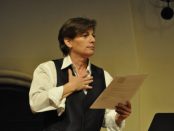
Shakespeare and the Alchemy of Gender
Dressed in black slacks, a white shirt and a black vest, Ms. Wolpe demonstrates a fluid physicality and a soothing vocal expressiveness. Wolpe quite adeptly offers rich characterizations of some of those most illustrious roles. In addition she seamlessly switches to delivering revelatory reminiscences and concise analysis of the plays with élan that recalls Spalding Gray’s monologues. The combination of these elements yields to a wonderful performance. [more]
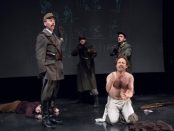
No End of Blame: Scenes of Overcoming
Director Richard Romagnoli who also staged the 2007 production and he has done an excellent job of visualizing the scope of the scenes. Action on the battlefield, political conflicts in Moscow and German atrocities in the Ukraine are all exciting. A life drawing class sequence at a Budapest art school is quite compelling. A longhaired female model makes sardonic observations from atop a ladder as the students in long white coats swirl around her. It recalls the stunning achievements of Derek Jarman and Peter Greenaway in their art house films. [more]
2 by Tennessee Williams: “27 Wagons Full of Cotton” & “Kingdom of Earth”
While the play can be a tour de force, Kathryn Luce Garfunkel is so one dimensional that her Flora has little weight. She exudes languidness and laziness, but fails to make Flora anything other than whiney and needy over the course of the play’s three scenes. Even after her encounter with Vicarro she doesn’t seem that much different. Holcomb seems miscast as the wily Latin though he does make Vicarro shrewd and knowing. Keller gives the most convincing performance as the sinister and abusive Jake. Unfortunately, the rhythms of the production do not make the play either the comedy that Williams subtitled it or the tense revenge drama that it also is. [more]
The Red Room
After a less then engrossing hour of prattling and a too stylized presentation, in its last thirty minutes "The Red Room" becomes the powerful family drama it intends to be. [more]
Simon Says
Three-time Tony nominee Brian Murray returns to the New York stage for the first time in four years as a retired professor of parapsychology who has put aside his own career to foster that of a young psychic from the time he was a teenager who is able to channel a spirit named Simon. However, the play belongs entirely to virile newcomer Anthony J. Goes who plays psychic James. The role is both vocally and physically demanding and he is totally convincing in a play that asks you suspend your disbelief. [more]
Phoenix Rising: Girls and the Secrets We Keep
"Phoenix Rising: Girls and the Secrets We Keep" takes place in two worlds: the New York CBGB punk scene of 1985, and a dark, Greek mythological other world of indeterminate time and place. In 1985, a high school social worker by the name of Grace mentors an after-school, trauma therapy session. In the other world, the Archetypal Mother/Storyteller presides over her “damaged souls” and reads from an ancient tome, the “Phoenix Book.” [more]
Out of the Mouths of Babes
At one point stumbling around in a sleep mask and wearing a colorful nightgown, the 88 year-old Estelle Parsons has a field day as the 88 year-old Evelyn, a former journalist for The International Herald Tribune. Ms. Parsons delightfully barrels through the play growling, cursing, and exhibiting vibrant physicality. Being the skillful old pro that she is, Parsons has the technique to tone it down when needed. [more]
On the Verge
As the women find themselves further and further in the future, it is how each reacts and is forever changed that give the play its emotional weight. Two manage to adjust quite well; one not so much. The whirlwind of mid-twentieth century America takes its toll on these intelligent travelers, outwardly in their clothing and inwardly on their attitudes toward life. The paths each takes at the end of "On the Verge"aren’t just theatrically satisfying—having been telegraphed subtly in many ways—but actually quite moving. Suddenly Overmyer, with the decided support of three fine actresses, ably directed by the astute Laura Braza, turns these silly, living cartoons into flesh and blood. And, that is the real journey of On the Verge. [more]