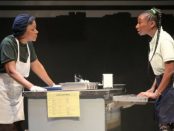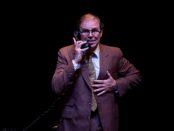
Plays
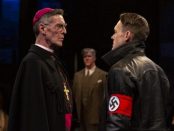
In the final analysis, "Ink" is too swift and too slick for its own good--or should I say, for our good? Even if you know some of the details it traffics in, they zoom by at such a rapid clip, that it’s sometimes hard to follow. Director Goold is to be faulted for the pace, no less than the playwright, Graham: it’s as if they both wanted to cram in too much information; and, despite the rave reviews this play and production continue to receive, some of it was lost on this particular reviewer. [more]
Socrates
For all you philosophy junkies out there—and you know who you are—Tim Blake Nelson’s world premiere "Socrates" at The Public Theater, the shining light of The Public’s Onassis Festival, is a treasure trove of ideas bantered, tossed, shredded and otherwise analyzed by a stage-full of ancient Greeks, led by the title character played with dignity and passion by the phenomenal Michael Stuhlbarg (the father in the film "Call Me By Your Name") and a cast of 16 mostly playing multiple roles. [more]
Entangled
Culturally relevant, emotionally resonant but languidly conceived, "Entangled" dramatizes the issue of gun violence in the contemporary United States. Playwrights Gabriel Jason Dean and Charly Evon Simpson’s structure is that of alternating monologues for its two characters. The play’s chief flaw is their overly literate dialogue that would be suitable for a graduate writing seminar or one of Edward Albee’s more rococo works. “Inside, the funeral home smells like potpourri and middle-class despair.” [more]
Fruiting Bodies
With "Bodies," playwright Sam Chanse attempts to explore the realities of Japanese-American culture in the 21st century, but gets lost in the process. Bodies is at its core an exploration of familial ties and meaningful human connections, as is made clear by the time it reaches its multiple emotional climaxes. Its monologues about mushrooms and self-worth suggest a more ambitious artistic treatise, but ultimately weaken those other core themes. [more]
The Poor of New York
One of the theater's most skilled 19th-century melodramatists, Boucicault was uninterested in the finer points of history, character development, or narrative objectivity which, of course, is why, as the Metropolitan Playhouse's lively revival of "The Poor of New York" demonstrates, his works are often so much fun. That doesn't mean they're untruthful; it's just that Boucicault wasn't prone to letting a bunch of cumbersome details and ho-hum dramaturgical considerations get in the way of a good story or a necessary cause. But if you're aching to learn how Andrew Jackson's monetary policies and the peculiarities of his personality might have contributed to a downturn in the American economy, there's always the hope Aaron Sorkin will eventually write that play. [more]
All My Sons
Unfortunately in a play that is already crammed full of ominous hints, O’Brien’s production is very heavy-handed, underscoring the foreshadowing with a double line under each and every clue and signal of things to come. While the play has been given a most realistic production for the backyard of a house on the outskirts of an Ohio town by set designer Douglas W. Schmidt and costumes by designer Jane Greenwood that are redolent of the late 1949’s, the actors have been allowed to emote from the moment the curtain goes up. If you don’t guess the surprise ending in this production, you haven’t been paying attention. This may be intended to suggest Greek tragedy by the final curtain but there is no need to make it look like an antique production of "Medea," "Electra" or "Oedipus the King" – which would probably be more subtly staged today. [more]
Link Link Circus
“Welcome to the smallest circus in the world!” exclaims the beaming Isabella Rossellini at the start of her self-written whimsical performance piece "Link Link Circus." “This show is a theatrical conference on the subject of Can animals think, feel, and have emotions?” explains Ms. Rossellini about the aim of this enchanting exploration containing scientific flourishes where she is joined by her dog and a puppeteer for a delightful 80 minutes. [more]
Instructions for American Servicemen in Britain
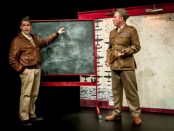
Likability is in short supply nowadays and the three playwright/performers who created this comedy, based on an actual pamphlet handed to Americans during World War II, have spun the dry, inadvertently funny, official publication into a delightfully involving charmer. (Copies of the actual pamphlet are available in the lobby.) Dan March, James Millard and Matt Sheahan, the actors, along with John Walton, the show’s director and co-author, treat the audience members as the American soldiers on English soil for the first time, totally ignorant of the British customs, language, sports, food, etc. There’s a lot of winking going on to be sure as Lieutenant Schultz (Millard) and Colonel Atwood (March), Americans, and Major Gibbons (Sheahan), an Englishman, share with us everything we wanted to know about Britain but were afraid to ask. [more]
Burn This
For one thing, it takes far too long for Pale, Wilson’s most outrageous and flamboyant creation, to arrive on the scene. (Malkovitch was Pale in the original production and Adam Driver is Pale now, with different but equally effective results.) For another, the premise of the play requires Anna to be overly reserved and subdued, in contrast with Pale’s constantly explosive character. The customarily sure-fire director Michael Mayer somehow seems to have accentuated those problems with lethargic consequences. [more]
Gary: A Sequel to Titus Andronicus
Playwright Taylor Mac’s Broadway debut, "Gary: A Sequel to Titus Andronicus," comes with a great many pluses: three consummate clowns, Nathan Lane, Kristine Nielsen and Julie White, directed by George C. Wolfe, and a terrific set by Santo Loquasto. This ribald yet philosophical downtown comedy is making its debut at the Booth Theatre, usually home to sedate, serious dramas. While low humor seems to be the name of the game, the play also has a good deal to say on various topics like comedy and tragedy, political systems, class structure, the little people who generally do the dirty work, and parodying Elizabethan revenge plays. The humor in Gary is not for everyone, but those who relish low comedy will have a ball as do the actors on stage. [more]
safeword.
Mr. Asher here continues to mine the subject of human sexuality, but lightning has not struck twice. That is chiefly due to Asher’s misguidedly grandiose direction (with associate director Mika Kauffman) emphasizing stylish spectacle at the expense of the clunky plot. It also slows down the numerous scene transitions. One ends, there’s dragged-out showy lighting and loud music, characters often walk around and then finally it’s on to the next scene. [more]
Killing Time
This British production is a family effort, as Forsyth and Mills are mother and daughter in real life. The play is worth seeing primarily for the sharp and uncompromising performance of Forsyth, whose blunt-talking, often-witty Hester is a joy to watch, even in her darkest moments. The production also uses Forsyth’s skills as a cellist—and as a composer—to great effect. [more]
17 Border Crossings
"17 Border Crossings" is one of the most technically adroit Off-Broadway shows to be seen thanks to the split second cooperation between Phillips’ spare scenery design, David Todaro’s brilliantly inventive lighting and Robert Kaplowitz’ sound design and occasional music. How Phillips uses the table alone is astonishing, literally creating multiple angles of observation, including an astonishing simulation of peering at the Passenger from up above. [more]
Hillary and Clinton
Laurie Metcalf and John Lithgow are such consummate stage performers that they could read the phone book and keep us mesmerized. As directed by Joe Mantello in Lucas Hnath’s "Hillary and Clinton," they have the kind of rapport of actors who have worked together for years. Unfortunately Hnath, who gave Metcalf a Tony Award winning role in his "A Doll House, Part II" in 2017, hasn’t given them much to work with. True, his play inspired by real people is entirely supposition with enough true facts to make us curious. But at 80 minutes playing time, Hillary and Clinton seems padded, and set in 2008 there isn’t a lot to wait for as we all know it how turned out. [more]
Then They Forgot About the Rest
Playwright Georgina Escobar presents an exuberant hodgepodge of sci-fi elements and satirical corporate bits with a feminist slant. Ms. Escobar’s punchy pseudo-scientific dialogue carries her choppy scenario with its shades of "Eternal Sunshine of the Spotless Mind" to sustaining the mildly entertaining 80 minutes. Escobar has a command of language, sprinkling catchphrases that land throughout. Early onset, end of days, extreme memory vetting, protein inhibitor and Petro Corp all get a lot of mileage. It doesn’t all gel, vagueness abounds but there’s spirited integrity. “…I’m asking improbable questions seeking impossible answers,” Escobar states in her program notes. [more]
The Pain of My Belligerence
Jaw-dropping plot twists, painfully forced au courant dialogue, awkward sex scenes and a jagged central performance all make the world premiere of Halley Feiffer's "The Pain of My Belligerence" a fascinating doozy of a bad play. The tone is a blend of Ingmar Bergman and Nora Ephron and the cosmopolitan milieu is reminiscent of Woody Allen and Lena Dunham. There’s the sensation of guiltily scanning a highway car accident scene that you can’t take your eyes away from. [more]
White Noise
After she won the Pulitzer Prize for "Topdog/Underdog," one approached a new play by Suzan-Lori Parks with great expectations--expectations that are strongly rewarded by her latest work, "White Noise." While the title refers specifically to the hissing sound made by sleep machines, meant to lull and keep you asleep, it also hints at the many racist issues this new, smart work traffics in. [more]
Twelfth Night (Duende Productions)
By stripping down the show and performing it in a white box theater space with minimal scenery and costumes, the eight actors, doubling up on parts, have fun interpreting Shakespeare’s luscious comedy of unrequited love and mistaken identity for each other, often bringing the viewers into the action (with mixed results). This is probably the friendliest Twelfth Night I’ve ever seen since the musical Your Own Thing in the sixties. [more]
Mrs. Murray’s Menagerie
Those who loved The Mad Ones’ "Miles for Mary" which had an extended run at Playwrights Horizons last year after its premiere at The Brooklyn Starr in 2016, will be greatly disappointed by their latest group effort called "Mrs. Murray’s Menagerie." The beautifully renovated Greenwich House offers the first play of the Ars Nova residency a lovely venue for this new play and the Lila Neugebauer production is impeccable acted and designed. However, this fictional recreation of a focus group, like most cinema verité, has no discernable dramatic event, making it a long 90 minutes. [more]
All Our Children
“These are difficult times, a character observes in playwright Stephen Unwin's engrossing historical drama, "All Our Children," that crackles with tension. Nazi Germany’s forced euthanasia program for the mentally and physically impaired is the play’s searing concern. In a concise 90-minutes Mr. Unwin’s masterful writing expertly blends exposition, documentary detail and drama in this American premiere seen in London in 2017. [more]
Ain’t No Mo’
Delving into black life and attitudes now, the play is hilarious - but not laugh-out-loud funny. Unfortunately, in Stevie Walker-Webb’s fine production at The Public’s LuEsther Theater, the sketches go on too, long, way past their due date and long after we have gotten the point of the satire. Of the talented cast of six African American actors, five are all in the majority of the scenes while playwright Cooper appears in three solo sketches. [more]
The Humours of Bandon
The blonde, animated and spunky Ms. McAuliffe portrays 16-year-old Dublin resident Annie who’s been dancing since childhood. Wearing tights, a T-shirt and a varsity jacket, McAuliffe’s delightful characterization is marked by wise girlishness. She alternates between playing Annie, her sturdy stage mother, friends, and a few incidental characters, all with detailed verve and a pleasing accent. Her writing is a concise breezy amalgam of factual details, well drawn figures, and momentum. [more]
Juno and the Paycock
From this group of familiar faces, O'Reilly and Keating are particularly strong in their second go-around, finding notes in Jack and Joxer's codependent relationship that are both hilarious and hideous. With his almost sneering delivery of Joxer's obsequious and vowel-rich responses ("it's a darlin' funeral, a daarlin' funeral"), Keating's performance is especially brilliant, pitched just before the point when servility turns into hate. As for Jack, O'Reilly brushes aside his litany of faults to make him a first-rate charmer, capable of snatching a smile from Juno even after he's brought the overburdened woman to her wit's end. [more]
Miracle in Rwanda
The one-woman show "Miracle in Rwanda"—starring Malaika Uwamahoro and directed by George Drance—relates the true-life experiences of Immaculée Ilibagiza. As a young woman, she survived the 1994 Genocide against the Tutsi in Rwanda by hiding for more than three months in a 3x4 foot bathroom along with five—and, eventually, seven—other human beings: all women and girls. The play uses the tag line “An Inspirational True Story of Hope and Forgiveness,” but how much inspiration can be gleaned from such a horrific story? [more]
Charlie’s Waiting
Ludovica Villar-Hauser, the play’s keen eyed and eared director (and artistic director of Parity Productions the company responsible for this presentation), paces the fine actors for the ultimate tension, making the most of every innuendo. All three actors portray their characters with subtlety, their eyes revealing as much as their voices, carefully avoiding sliding into what might have been melodrama. [more]
The Lehman Trilogy
A three and half hour play with only three actors spanning 163 years might not be your idea of entertainment, but the National Theatre’s production of "The Lehman Trilogy" is one of the most exciting theatrical events to be seen in New York in over 50 years. Making its North American premiere at the Park Avenue Armory, Sam Mendes’ swiftly paced production of Stefano Massini’s play features Simon Russell Beale (often called the finest classical actor of his generation), Ben Miles (Cromwell in the Royal Shakespeare’s production of "Wolf Hall"), and Adam Godley (Broadway’s 2002 "Private Lives" and 2011 "Anything Goes"), three of the most versatile British actors alive today. While "The Lehman Trilogy" tells the story of the three brothers who founded the family institution that eventually became one of the leading financial firms on Wall Street and later precipitated the crash of 2008, it also recounts the story of the rise of modern banking with the financial history of the last 150 years. [more]
I Carry Your Heart
Though playwright Kelly strives for poetry at times--in addition to that last quote, consider Josh’s mother calling him a “terminal optimist” and also learning that the play’s title is taken from e. e. cummings--it’s more or less done in by her contrivances. She also conveys too much of the exposition through her biggest contrivance of all: Debra, an author, has left behind a memoir for Phoebe to read, and she reads it aloud to Blake, thereby imparting much of Debra’s story. [more]
No Exit
Absent scenery, with a character excised and fiercely performed, this stripped down taut revival of Jean-Paul Sartre’s "No Exit" is quite compelling and faithful to the spirit of the original work. An operatic prologue is another novel flourish.It is presented by the Fusion Theatre which was founded by the Irish actress Eilin O'Dea in 2016 with the “concept that synthesizing the worlds of theater and opera can provide the ultimate theatrical experience.” Ms. O'Dea is truly the mastermind of this enticing production. [more]
Bathsheba’s Psalms, Or a Woman of Unusual Beauty Taking a Bath
Ranger spins the story for a 2019 audience mindful of and vigilant about sex and gender issues—especially those involving consent, privilege and toxic masculinity. The play transpires in a sort of limbo-like dimension that is part Iron Age and part near-future. It’s a world in which the old gender rules are fully in play. Powerful men can take and then discard women as they please, and if a woman goes to a pharmacy to pick up a morning-after pill, she’ll get turned down with sneering derision: “We’re a Christian nation now. No more murdered babies on our hands.” [more]
Do You Feel Anger?
In Mara Nelson-Greenberg’s new play, "Do You Feel Anger?," which had its world premiere at the 2018 Humana Festival of New American Plays at Actors Theatre of Louisville, she has attempted to write a Theater of the Absurd dark comedy about sexism in the workplace. Starting out offbeat and humorous, it quickly devolves into repeating itself endlessly without enough new material to keep us amused or shocked. In the Vineyard Theatre production, director Margot Bordelon and the high powered cast of seven are fully in tune with the author’s sensibility. Unfortunately, there are not enough surprises in this schematic play to keep us interested although the subject matter is eminently topical. [more]
June Is the First Fall
The personable Alton Alburo as Don manages to make this underdeveloped character compelling with his charming presence. Playing his father David with easygoing humor and poignancy is the outstanding Fenton Li. Stefani Kuo as Jane offers a winning portrait of familial sturdiness with her solid performance. Scott is vividly brought to life by Karsten Otto with his engaging blend of goofiness and soulfulness. Mr. Otto brings much depth to his scenes with Mr. Alburo regarding Don’s feelings for him. Speaking mostly in Chinese and existing as a domineering vision, Chun Cho does achieve a pleasing distinctiveness in the difficult role of Yu Qin. [more]
What the Constitution Means to Me
The premise of the show (directed by Oliver Butler) is that the 2019 Schreck has decided to recreate one of the many presentations she participated in at American Legion halls around the country, back when she was a 15-year-old high-schooler from Wenatchee, Washington. These presentations were apparently oration/debate hybrids. They were vigorous exercises—and lucrative ones. Schreck was able to pay fully for her college education with prize money from these competitions, which centered on the content and implications of the U.S. Constitution and its amendments. Back in the day, young Heidi was a pro-Constitution “zealot.” [more]
The White Devil
Not seen in New York since 1965, John Webster’s Jacobean revenge play, "The White Devil," has been given a juicy, vigorous modern dress production by Red Bull Theater which specializes in Elizabethan and post-Shakespearean dramas. While not as great as Webster’s "The Duchess of Malfi" or Shakespeare’s psychological dramas, this second-rung tragedy from 1612 has been directed by Louisa Proske with live video and contemporary trappings in a style that is always riveting, always engrossing, particularly notable for a play that will be unfamiliar to most theatergoers. [more]
The Tragedy of Julius Caesar
Shakespeare’s politically charged Roman tragedy, "Julius Caesar," has always been a touchstone for inflaming emotions. In earlier times, monarchs used to ban the play when uprisings were imminent. In the 1930’s, the play was presented as an anti-Fascist rallying cry. In our own era, it has been presented with various American presidents as the stand-in for Caesar. While Shana Cooper’s production for Theatre for a New Audience here called "The Tragedy of Julius Caesar" is vigorous, lusty and lucid, it offers no political point of view. We never understand why the conspirators want to get rid of Caesar nor what they want to replace him with instead. [more]
Faust 2.0
Director Sharon Ann Fogarty’s colossal staging weaves together the many disparate technical elements into a unified mini-epic event. Actors sit at a long rectangular table and their images are on display in front of them facing the audience. Hanging monitors show Jeff Sugg’s arresting video design of stylized imagery of clouds, the sun and abstractions. Numerous characters appear on video. Paris and Helen of Troy are represented with a gorgeous Paul Taylor-style dance by choreographer Kristi Spessard. [more]
Perp
Alexandro and Ben-Victor as the soul-stained detectives are excellently cast, playing off each other without a single misstep. The gender-blind casting of Alexandro as Jack is especially funny when she gets to deliver the hilarious line “I got a hard on a mile long” without blinking. Grant is brilliant as the soulful felon Myron, locked away for an unknown crime but brimming with goodness. Molina is spot-on as the creepy, anguished killer looking for love and redemption. [more]
Southern Promises
Playwright Thomas Bradshaw seems to have taken literally the dictum in theater to “Astonish!” His plays like "Burning," "Intimacy," "Job," and "Fulfillment," to name only a few seen in New York in recent years, are shocking, disturbing and an assault on both the actors and audience. In The Flea Theater revival of his 2008 play, "Southern Promises," director Niegel Smith seems to have taken this one step further. In this play about race relationship between masters and slaves set in 1848 Virginia, an antidote to the theory of the benevolent slave owner, the ten-member cast of The Bats, The Flea’s young repertory company, informs us that they are all people of color and that they do not have legacy of confronting slavery on their terms. Several of them reveal that they have had DNA tests performed and discovered that they are of mixed blood, making them both black and white. [more]
Shareholder Value
Attea’s point concerns business models that are overly focused on the needs of shareholders, rather than on those of management and employees. But the play is curiously bloodless. Strong plays about the ferocity of capitalism—from Arthur Miller’s "Death of a Salesman" to David Mamet’s "Glengarry Glen Ross"—take interest in the human equation. They focus on the personal anguish that the system can induce. Attea doesn’t delve that deeply here. [more]
Nantucket Sleigh Ride
John Guare’s career as a playwright has had three stages. His early plays were examples of Theater of the Absurd with an American accent. Later his plays became more realistic, sometimes based on a true story or historic characters. In his new play "Nantucket Sleigh Ride" now at Lincoln Center Theater’s Mitzi E. Newhouse, he has returned to his absurdist roots with a wild comedy, configured in the form of a memory play by a former playwright which returns him to the summer of 1975. With a cast led by Broadway stars John Larroquette, Will Swenson and Douglas Sills, the play initially has a fascinating premise but goes off the deep end in its second half. Don’t blame the actors who work very hard to try to keep the play on the rails. [more]
Women Behind Bars
Referencing the 1950 women’s prison drama "Caged" and synthesizing all of the conventions of that cinematic genre, the late playwright Tom Eyen crafted the 1975 camp classic "Women Behind Bars." It’s been hilariously revived at the historic 13th Street Repertory Theatre in a punchy production lovingly directed by Joe John Battista. [more]
Life Sucks
“Did you know that this play is called "Life Sucks"?” says a character in playwright Aaron Posner’s meta-theatrical Life Sucks. It’s a wild yet emotionally resonant work “sort of adapted from Uncle Vanya by Anton Chekhov.” Characters address the audience directly, they engage in sly wordplay, lollipops are consumed, overlapping dialogue is common and absurdism abounds in this free-form yet faithful treatment. [more]
Fleabag
If Phoebe Waller-Bridge’s "Fleabag" sounds familiar, it may be because of the cult television show now in its second season adapted from this one-woman play. Having premiered at the Edinburgh Festival Fringe in 2013 and having had three successful London runs, it finally arrives in New York with its author-star in a sold out production at the SoHo Playhouse. Not only is this a riveting, liberated evening in the theater, it marks the local debut of a supremely talented actress and writer. [more]

After
You can hear a pin drop during Michael McKeever’s "After," an exciting, riveting play about the aftereffects of bullying. During the final scene in Jo Brancato’s production now at 59E59 Theaters, the tension is so thick that no one in the audience seems to be breathing to see how it will play out. Like McKeever’s "Daniel’s Husband," the author wants us to see the events from more than one side but his message is clear by the end: parents make excuses for their children and allow for bullying to go on unchecked. Bad parenting is as bad as bullying children. [more]
Accidentally Brave
“Everything is copy” was Nora Ephron’s maxim about the potential of all of one’s life experiences to be fashioned into narrative material if one has the cachet to be paid attention to. Actress Maddie Corman sure has a lot of copy as well the affluence and connections to get it out there in "Accidentally Brave," her 90 minute self-written solo show. It’s profanity-laden therapeutic storytelling with high production values succeeding as inspirational entertainment for those with an affinity for her upscale sensibility. [more]
The Fat Lady Sings
Jean-Claude van Itallie, one of the key figures in New York’s Off-Off Broadway theater in the 1960’s, takes on Trumpian politics in his new play, "The Fat Lady Sings" (directed by David Schweizer). Clearly, van Itallie still feels at home at the La MaMa Experimental Theatre Club, where he developed some of his most influential early work, including parts of his landmark anti-war trilogy, "America Hurrah." The fire in this playwright’s belly can still radiate heat in the East Village more than a half century after the premiere of his most famous title. [more]
The Day I Became Black
A searing epiphany at "The Day I Became Black"’s climax redeems its uneven mixture of confessional and stand-up. The show is written and performed by the engaging biracial young comedian and actor Bill Posley. During 80 cluttered minutes we sketchily learn about his stern though supportive African-American father and Caucasian mother of Kentucky “white trash” origin. The Boston-reared Mr. Posley charts the complexities of his racial background due to his black appearance. Navigating through society, dating women and interacting with the police are concretely explored. That Posley is an Iraq War veteran is mentioned only in passing. [more]
Vilna
"Vilna," written by Ira Fuchs, is one of the more successful stage dramas to deal with the Holocaust, a notoriously difficult subject to portray on stage. That this play succeeds as well as it does is to the credit of its director Joseph Discher who assiduously avoids clichés and stereotypes and its cast of fine actors, led by the great Mark Jacoby, a star of Broadway musicals, here displaying heart-breaking depth of emotion in two parts. [more]
Strangers in the World
You may leave "Strangers" with mixed reactions. The proceedings onstage may make you feel as disoriented and tetchy as the villagers themselves. The characters’ words as they vainly try to maintain some of their former sanity and decorum seem at times to be pure nonsense. But if you’re diligently sleuth-like—or lucky enough to read and study Sharp’s playscript—you’ll piece together some fairly coherent and rich back stories. [more]
The Mother
Huppert, the consummate actress, commands the stage at all times, making all the other performers pale in comparison. As Anne, she travels from familiar to sarcastic to manic to depressed to suicidal. Initially her heavily French accented English and her staccato rhythms are difficult to follow, but eventually it becomes accessible, even appropriate to this very French play. While the role does not require much action, Huppert has found all sorts of ways of building her character: stretching out on the sofa as if sleeping, playing with a cigarette, dancing with her son in manic fashion, examining herself in a mirror. Anita Yavich’s chic costumes fit her to perfection: the severe grey turtleneck and black shirt that we first see her in, and later the short red party dress with black stockings that looks like it might be a throwback to her youth. [more]
The Cake
Brunstetter overloads the issue in the play by making Jen have doubts about being in love with a woman against her parents’ religious teachings, even though she cannot imagine life without the caring, compassionate, uninhibited Macy. Additionally, when Della quotes the Bible to Macy, Macy retaliates by pointing out that as a childless woman Della has not fulfilled her religious duty as a wife. The plot then goes in another direction to show us Della and her husband Tim who has lost interest in sex since he discovered he had too low a sperm count. The play builds to Jen revealing her real childhood feelings to Macy, as well as Della demanding that after years of estrangement Tim make passionate love to her as he did at the beginning of their marriage. Ultimately, Brunstetter wants to have it both ways with an ending that does not resolve the religious question at all. [more]
The Importance of Being Earnest: Two Ways
It’s billed as “Two Ways” because this event is comprised of differing versions performed in repertory. There is the self-explanatory “Conventional Casting” and the “Reversed Casting” where the same superb ensemble plays a different role of the opposite gender in the identical previous performer’s costume. Each incarnation is a frothy delight faithfully affirming Wilde’s insightful wit and supreme dramatic construction through theatrical magnificence. [more]
Surely Goodness and Mercy
Chisa Hutchinson’s "Surely Goodness and Mercy" has its heart in the right place but as produced by Keen Company at the Clurman Theatre it is not a play at all but an after school movie script. We know we are in trouble when we see seven sets side by side on stage on three levels when we first enter the theater. Jessi D. Hill has directed her adept cast to believable characterizations but the script is so short at 73 minutes (plus a totally unnecessary intermission) and the 30 scenes so brief (some no more than four exchanges) that we never learn enough about them. It is as though the whole story has been told in a kind of shorthand and we are expected to fill in the dots. [more]
A Jewish Joke
"A Jewish Joke" brings immediacy to not only the personal and professional effects of the Hollywood blacklist, but to the current onslaught of internet finger-pointing and fear-mongering that can, and does, ruin lives even more quickly than in the slow-moving fifties. Watching Bernie squirm and sweat over issues not of his own making, but issues that will take him down, is made only slightly more palatable by his self-deprecating humor. [more]
Hatef**k
There’s stinging dialogue, solid construction and high powers of observation that accurately render the fractious literary milieu with Imran’s offstage agent a major figure. These all enable Ms. Mirza to spin out her enticing scenario over eight scenes in 90 often charged minutes, spanning several months. The characters are impeccably detailed and behave so realistically, causing the possible dynamic for the viewer of siding with one over the other. [more]
“Daddy”
Jeremy O. Harris’ “Daddy” is the work of a unique voice, a little self-indulgent in its length, and a little underwritten in its characterizations. It attempts to shock with its use of nudity and sadomasochistic sex, but nothing we have not seen before. The play’s message is not entirely clear but the play is provocative nevertheless. It is a work for the mature playgoer who wants to see a new direction that our theater is heading. [more]
Fiercely Independent
Let’s talk about the talent: Gallogly and Smith are, in a word, fantastic in "Fiercely Independent." They listen to each other intently, their responses are spontaneous and natural, and their chemistry is evident. Even when they’re not speaking, their inner dialogues are continuous and their intents are crystal clear. Gallogly and Smith are by turns playfully fun and painfully electric. [more]
Boesman and Lena
The production of "Boesman and Lena" at The Pershing Square Signature Center directed with attention to every detail by Yaël Farber is stark and unforgiving in a way that would have been shocking in 1970. Even though apartheid has been lifted, this play still resonates with its bleak display of human survival in the face of unimaginable terrors and its condemnation of racial inequity. [more]
If Pretty Hurts Ugly Must Be a Muhfucka
Dynamically presented and sensationally performed, "If Pretty Hurts Ugly Must Be a Muhfucka" is playwright Tori Sampson's maddeningly overblown adaptation of a fable with music. A surfeit of extraneous devices and a heavy-handed agenda overwhelm and drag out a tender and potentially resonant tale. There’s repetitive jokiness, a lumbering ghostly gospel sequence and an anti-climactic pretentious finale. Amidst the frustrating tangents are bright spots during a straight through nearly two hour [more]
Actually, We’re F**ked
In between scenes, the play’s lighting (by Paul Miller) and sound (by M.L. Dogg) conspire to create a hallucinogenic, disorienting slideshow of animals and rotting metropolises — a reminder of the massively dysfunctional world in which the characters of "Actually, We’re F**ked" are potentially raising children. Mind you, the question of whether or not to raise a child in 2019, along with lengthy discussions about genitalia, is essential to this play. And the answer to that question, according to "Actually, We’re F**ked," is much more lovely and hopeful than you might expect. So go see this show if you want a road map for emotionally processing the very f**ked America we live in right now — or very detailed and accurate instructions on how to break into a company server. That is something that appears in this play as well to quite amusing effect. [more]
Sea Wall/A Life
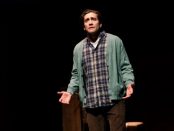
Both plays deal with young husbands who are coping with new fatherhood as well as their new responsibilities and their relationships with the dominant male figures in their lives. In Stephens’ "Sea Wall," Sturridge speaks admiringly of his father-in-law, while in Payne’s "A Life," Gyllenhaal speaks with love of his own father. Both men are madly in love with their wives who they could not consider living without. These plays are ultimately tragedies of the accidental kind, events that one has no control over and cannot see coming. The double bill is performed on a basically empty stage with a brick wall behind (designed by Laura Jellinek), on which Peter Kaczorowski’s poetic and atmospheric lighting is a kind of additional onstage character. Carrie Cracknell's assured direction pilots both plays. [more]