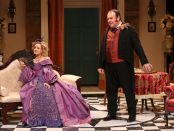
Dion Boucicault’s "London Assurance" is still a witty and lively play after almost 180 years. With its farcical elements laid over a drawing room comedy plot, Charlotte Moore’s adroit production for the Irish Repertory Theatre mines the play for all of its humor and wisdom concerning the foibles of human nature and self-delusion. With a superb cast, Rachel Pickup is awarded the acting honors for her marvelous depiction of Lady Gay Spanker, a bon vivant who knows how to get the most out of life and other people. [more]
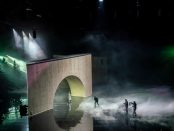
A product of the tumultuous thirties whose work was banned by the Nazis even though he was not Jewish, Von Horváth was particularly interested in social criticism of the middle-class and warnings about the rise of fascism. His major themes include tales of herd psychology and moral responsibility. By dealing with these timely topics, Judgment Day given a monumental visual production design by set designer Paul Steinberg in the cavernous Drill Hall at the Armory, the play seems as powerful and relevant as if it had been written in this decade, not 80 years ago. The production makes this expressionistic drama as contemporary as if this style were newly born. Starring Luke Kirby (Emmy Award for his Lenny Bruce in "The Marvelous Mrs. Maisel") in the leading role of Stationmaster Thomas Hudetz, the play offers juicy roles to several of the minor characters. [more]
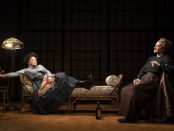
Beloved television stars Harry Hamlin (L.A. Law) and Stefanie Powers (Hart to Hart) return to the New York stage in Joshua Ravetch’s "One November Yankee" which they previously performed at the Delaware Theatre Company, was initially seen in Los Angeles’ NoHo Arts Center Theatre in 2012. It is their star power which keeps this old-fashioned, rather sit-com-ish, interconnected triple bill as lively and as entertaining as it is despite clichéd writing and passé jokes. Playing three different sets of siblings all connected by one plane crash, they manage to be convincing in weak material. [more]
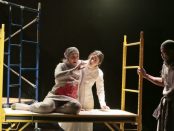
Told in leisurely style, Greater Clements is about the decline (and possible fall) of the American dream. Hunter appears to be saying that this is a long-time coming and its roots go very deep. The play begins with a flashback prologue with Maggie’s son Joe giving a tour of the mine, describing the 1972 fire on the 6,400 foot level that killed 81 men including his grandfather. However, on the weekend that the play takes place Maggie is expecting Billy, her high school beau, a Japanese-American who took her to the prom, now a widower and who is returning to visit 50 years later. Maggie, now 12 years divorced from Caleb who left her for another man, may be at loose ends but this is possibly a new beginning. [more]
Besides Mr. Skittles, there are 18 other characters of different races, ages, genders and sexualities. They’re a cross section of the downtrodden and those involved with aiding them. Ex-convicts, the homeless, an Iraq war veteran, drug addicts, battered women and their children, social workers, staff members, law officers, a trans woman who incites divisiveness, and a wily Catholic priest who once threw a man off the roof of a building are all vividly realized by Mr. Guirgis’ supreme command of dramatic writing. Each one of these many figures are majestically fleshed out, some in great detail. Guirgis goes beyond offering a loving mosaic of character studies by gradually injecting a suspenseful narrative that reaches a bleak yet hopeful conclusion. [more]
The story itself has potential, yet despite the actors’ heroic attempts to bring truth to it, the script has its characters written to say and do so many unrealistic things that the core authenticity of what’s unfolding can’t be upheld. Physical and emotional boundaries get crossed in questionable ways, and unreasonable demands are made to unbelievable responses. Characters drop vague references and make mysterious insinuations, demonstrating resentment and distrust in each other without explanation. Understanding who is what to whom just takes too long to be revealed, and the audience must buffer so many mysterious references and unexplained pieces of information for so long that by the time the play concludes with a battery of accusations and revelations, the audience isn’t sure what’s happening and thrown up its hands in disbelief. [more]
After pillaging Ibsen in "A Doll's House, Part 2" and lampooning the former First Couple for "Hillary and Clinton," vaunted playwright Lucas Hnath’s latest piffle, "The Thin Place" is a Wallace Shawn-style talkathon aptly dedicated to the late magician Ricky Jay as it’s an exercise in flimflam. There is more craft and profundity in the first season "I Love Lucy" episode “The Séance” with its immortal lines, “Ethel to Tillie. Ethel to Tillie. Come in Tillie.” [more]
After marveling at Ken Jennings’ power of memorization, one has to admire his ability to deliver the entire text of "The Gospel of John" with unwavering clarity and devotion to its meaning both as literature and as a Christian lodestone. An agile actor (and singer), Jennings (the original Tobias in "Sweeney Todd"), deftly tells the story of Jesus as seen through the eyes of John the Baptist. The actor roams about a simple raised platform in front of a rough-hewn back curtain made of wrinkled tan cloth. What looks like a handmade bench—a subtle reference to Jesus’ vocation?—completes the set. [more]
Houses on the Moon Theater Company’s delightful and earnest mission is to “dispel ignorance and isolation through the theatrical amplification of unheard voices.” "The Santa Closet," another one-man show written and performed by the company’s co-founder Jeffrey Solomon, doesn’t reach the lofty goals of some of his other plays; however, the newly updated, tenth-year anniversary production of this frothy, zany tale is nevertheless aloft with quite a few grins and chuckles. [more]
Cariou is now appearing Off-Broadway as the titular character in playwright George Eastman’s slight though moving two-character work, Harry Townsend's Last Stand. Sharp one-liners, funny set ups and punchlines and wistful observations abound throughout Mr. Eastman’s effective familiar scenario. It is playwrighting at its basic best, delivering two hefty empathetic roles for actors to attack while delighting the audience. [more]
Another way to look at the play is as the twelve stages of man and woman, going Shakespeare five more steps. Unlike Tracy Letts’ Mary Page Marlowe, in which the heroine was played by a different actress at each stage of her life, here we are asked to adjust to multiple versions of Chris whose name changes in each of the play’s 12 scenes: Chris, Christine, Kris, Christopher, Kristin, Topher, Christoph, Kit, Christina, and finally Khris. [more]
Prominent Georgia attorney Dep Kirkland “decided to listen to his own voice, and walked away from the legal field altogether to pursue his previously private dream of acting, writing, and directing...” This statement comes from Mr. Kirkland’s biography in the program for the play he wrote, "MsTRIAL." Its promising He Said, She Said premise is undermined by a disjointed structure and presentational flaws. Mr. Kirkland has come up with a viable plot, appealing familiar characters and expert dialogue, but his command of dramatic writing is shaky. It’s not the explosive legal drama it aspires to be, coming across more as a screenplay being workshopped instead of a realized stage play. [more]
Having won the 2014 Harold and Mimi Steinberg/American Theatre Critics Association New Play Award for "I and You," this is the fourth production of a Lauren Gunderson play in New York since then including her solo play "Natural Shocks" on domestic abuse which was produced in 100 American theaters in 2018. A specialist in biographical plays, her "The Half-Life of Marie Curie" is of particular interest in that it tells a little-known story of a very famous figure. It is also notable for the vivid performances of Kate Mulgrew and Francesca Faridany. Although Gunderson is not yet a household name, she has been the most produced American playwright since 2016. [more]
Maddeningly alternating between being an absorbing historical drama and a grating exercise in self-indulgence, "A Bright Room Called Day" is author Tony Kushner’s reimagining of his 1985 first play. “It never worked” states a character regarding the play. It still doesn’t, but parts of it are entrancing. In contrast to his gargantuan two-part opus, "Angels in America," this runs a tolerable two hours and 45 minutes including an intermission. [more]
While María Irene Fornés' "Fefu and Her Friends" is considered a feminist statement, in performance the play seems not to be very revealing about women or their positions other than the fact that the cast is entirely female. Set among the very rich in the 1930’s, the play is liberated only to the extent that the women have enough money to do what they wish. With its attractive sets and stylish clothes and the novelty of moving from one set to the other, the play seems to be rather a period piece than a statement of women’s lib. Unlike such all-female plays as Hazel Ellis’ "Women without Men," Clare Boothe’s "The Women" and Jane Chambers’ "Last Summer at Bluefish Cove," "Fefu and Her Friends" does not have a lot to say although it remains entertaining throughout. Of course, it is possible that a women critic might have a very different take on this work. [more]
Yes, Mr. Foote’s eloquent take on the souring of the American Dream has shades of Arthur Miller’s "Death of a Salesman," but with his idiosyncratic and powerful command of dramatic writing he creates a distinctive narrative. Looming over and central to the play is the implied and intimated notion that Will and Lily Dale’s unmarried son was gay and committed suicide. He had moved to Atlanta, taken a marginal job and lived in a rooming house, sharing space with a male “friend” who was ten years younger. This companion is an unseen though pivotal figure who perpetually contacts the grieving parents with shattering results. [more]
An old man who is an homage to Noam Chomsky is metamorphosed into an owl through the aid of a cloth mask and a print costume with a technician behind him flapping the wings, accompanied by thunderous music and ethereal singing. This bewildering coup de théâtre is the lame finale to the arid "Other Than We," the audience’s dubious reward for enduring and staying awake through its two soporific intermission less hours. [more]
Stephen Brown’s "Everything Is Super Great" is a small, unpretentious play about an American family in crisis. That is not a novel theme, of course, but "Everything" rises gracefully to the occasion. Brown demonstrates his considerable skill for creating characters you can latch onto and root for. Director Sarah Norris—along with a gifted quartet of actors—has gently and thoughtfully taken Brown’s story up a notch, finding colors that may not have been evident on the page but that augment the script nicely. The resulting production is a lovely thing to behold. [more]
As produced by Bedlam in association with The Nora, Arthur Miller’s 1953 tragedy, "The Crucible," based on the Salem Witch Trials proves to be both riveting and relevant all over again. In the past, the play was seen as a cautionary tale about the McCarthy Era witch hunt that destroyed so many lives. Now in 2019 it becomes a story of truth and lies, fiction and fact. One of the judges refers to the situation in Salem as “this swamp.” In the age of Trump, Miller’s play has new meaning for our time. You could hear a pin drop during Eric Tucker’s unfussy production which becomes more and more scary as the Salem witch trials progress and the townspeople become entirely carried away by the hysteria. [more]
Political plots can be dry as toast. Hatem attempts to spice things up by crossing the genders of the actors playing Carter and young Cynthia; the convention is an interesting choice although it really doesn’t add any new light to the characters or story and is sometimes distracting. Not to worry, though, the script is smart, imaginative, humorous at the right times and keeps its audience interested. [more]
Following a comically exaggerated shootout, the two men make out. A cowgirl and a Mexican woman get together. At one point performers blindfold audience members for a brief bit. There’s a hula-hoop dance number. Monologues detailing homophobia, racism and gay bashing are enacted. It’s all cryptic, edgy and well-executed entertainment for devotees of non-traditional theater. [more]
Told as a series of alternating, interlocking monologues, there is a "Rashomon"-esque quality to "Pumpgirl" that grows more obvious as the play's story comes into focus. Not only do the relationships between the characters subjectively deepen as they each take their turns speaking under lighting designer Michael O'Connor's isolating glare, but a life-altering crime is also revealed, one that is committed with stomach-churning cruelty. Though, unlike in the Kurosawa movie, its details are never in doubt. [more]
"Slava’s Snowshow" is a unique experience. It is clowning of a sophisticated sort with its wordless skits which takes it beyond language. Its set pieces are outrageous enough to transcend anything other clown shows are doing at present. At 110 minutes, it is just long enough to not overstay its welcome. The audience participation sequences will make you feel that you are part of the show and the clowns play off of audience reactions throughout. However, as the clowns are more somber than playful it may not be for people easily depressed or very young children who have not seen the magic of theater before. [more]
The Reverend Al Sharpton, Angela Davis, and Sonny Carson are among the two dozen celebrities, cross section of New Yorkers, and male and female integral figures of diverse ethnicities that are given astounding portrayals by actor Michael Benjamin Washington. These simulations occur during this bedazzling revival of conceiver and writer Anna Deavere Smith’s acclaimed 1992 solo play about the Crown Heights Riots, "Fires in the Mirror." [more]
Migdalia Cruz’s "Fur" (presented by Boundless Theatre Company at Next Door @NYTW) has the sensibility of a folk tale, the coherency of a fever dream, and the trappings of a horror movie. It’s an unsettling piece of theater. After you’ve seen it, don’t be surprised if it noses its way into your psyche and burrows into your personal dreamscape. This production, directed by Elena Araoz, is the play’s New York City premiere. (It debuted in Chicago in 1995.) According to Cruz’s stage directions, it takes place in a post-apocalyptic Los Angeles suburb, but the playwright isn’t necessarily concerned about specifics of time or place. In fact, the play seems to transpire in some shadowy corner of the collective unconscious. [more]
In 1957 Truman Capote disingenuously misled the legendary actor Marlon Brando into opening up to him under the guise of helping to publicize the soppy melodrama, Sayonara which Brando was then making in Kyoto. This now infamous interview caused quite a stir for its snarky tone and caustic observations about Asian women. In their "BrandoCapote," Sara & Reid Farrington have sliced and diced this article, added music, fanciful Japanese costumes and rather severely stylized choreography and come up with a fascinating theater piece. [more]
Seven vibrant and diverse women of color take the stage and speak, sing and dance at the start of this shining revival of author Ntozake Shange’s landmark play, "For Colored Girls Who Have Considered Suicide /When the Rainbow Is Enuf." They’re wearing costume designer Toni-Leslie James’ beautiful fluorescent dresses, each in a different color, and some have regal headpieces. The dynamic cast of Sasha Allen (Lady in Blue), Celia Chevalier (Lady in Brown), Danaya Esperanza (Lady in Orange), Jayme Lawson (Lady in Red), Adrienne C. Moore (Lady in Yellow), Okwui Okpokwasili (Lady in Green), and Alexandria Wailes (Lady in Purple) vividly perform Ms. Shange’s self-invented “choreopoem,” a theatre piece embracing poetry, movement, and music. Each of these magnetic performers brings distinction and individuality to their roles. [more]
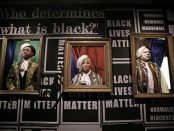
Revolutionary War patriots Thomas Jefferson, John Adams, Richard Henry Lee, John Hancock and Benjamin Franklin are eerily represented by male and female black performers wearing tweaked 18th century garb, half-white wigs and garish makeup. They’re on a raised platform sitting on period furniture and cynically thrashing out The Declaration of Independence with the aim of enforcing white male hegemony. This is the satirical wild opening of "The Black History Museum...According to the United States of America." It’s an immersive two-hour performance art piece performed all over the two floors of New York City’s HERE theater complex. [more]
Richard Nelson’s latest play, "The Michaels" (subtitled a “Conversation During Difficult Times”) is a thing of beauty. Low-key like his "Apple Family" quartet and his "The Gabriels" trilogy, it is Chekhovian in the best sense of the word: very little happens but life passes by. The characters who sit in a Rhinebeck, New York, kitchen (also the setting for the other seven plays) talk of life and death, love and desire, memories and accomplishments. They reveal secrets and ponder changes and ultimately make decisions. Not much takes place but then again all of life occurs in the course of the play’s two hours. [more]
A seated actor dressed all in black wearing a beret beats a conga drum on a confined playing area. Other actors in period costumes sit at small cabaret tables and chairs as thick wafts of smoke envelop the stage. On the back wall is a white screen and from behind it is the shadow of a woman dancing. Such is the arresting 1950’s classic beat coffee house imagery director Joe John Battista conjures up for playwright Claude Solnik’s fascinating fantasia derived from the life of J.D. Salinger (1919-2010), "A Life in the Rye." [more]
As directed by Moritz von Stuelpnagel, the play is fast-paced and engrossing and the smell of garlic coming from the stage convinces us that real cooking is going on. The completely working industrial kitchen designed by Tim Mackabee is a wonder of economy on the small stage of the Susan & Ronald Frankel Theater at The Robert W. Wilson MCC Theater Space as we watch many meals get prepared in record time. The flaw in the play is that Esparza’s Harry spends so much time ranting about his beliefs and requirements that he becomes both tiresome and unsympathetic. Harry may be an artist fighting capitalist necessities, but he also sabotages his own success. We eventually discover that he is not as ethical as he pretends to be even though he claims not to care about money – or adulations. And as none of the money in the restaurant is his, ultimately he has no say in what is decided. [more]
Plays about lives of quiet desperation are difficult to pull off because you run the risk of boring the audience. Liza Birkenmeier’s “Dr. Ride’s American Beach House” has all the elements of a fascinating drama but as presented by Ars Nova at Greenwich House it is all about subtext and undercurrents which may go right over the heads of many audience members. Little happens but there is much tedious talk which is a cover-up for what goes unsaid. [more]
What this team of artists has created is a serious piece of storytelling that is also a glorious treat for the eyes and ears. If you’ve figured that the show will just be a guy narrating a short story while another guy plays violin, you’re certain to be pleasantly surprised. [more]
LBJ’s ambitious social programs in the United States of the 1960’s being sidetracked by the folly of the Vietnam War and his mishandling of the unrest caused by the Civil Rights Movement, have been the subject of books, documentaries and television docudramas. Playwright Schenkkan’s stage treatment of this material is a clumsy waxworks affair of a multitude of forgotten and remembered personages spouting off during two choppy acts. [more]
Kathleen Chalfant adds another feather to her cap as Emily Dickinson’s posthumous editor Mabel Loomis Todd in the world premiere of Rebecca Gilman’s new one-woman play, "A Woman of the World," presented by The Acting Company in association with Miranda Theatre Company at 59E59 Theaters. Staged by Miranda’s artistic director Valentina Fratti with elegant assurance, Chalfant is both fascinating and seductive as this real life woman who in the 1880’s and 1890’s scandalized conventional Amherst, Massachusetts, with her liberated and bohemian behavior long before such goings on became acceptable for women – or men. [more]
Mr. Burnam’s futuristic conceit is engrossing and the theme of a repressed figure looking back at a more joyous way of life is potent. The present day portions are amiable but only fitfully compelling, so The Catastrophe Club doesn’t quite fulfill its striking premise. Reaching a polished and wistful conclusion, and with its site-specific presentation, it sustains its 90 minute length with interest. [more]
The play’s title comes from Carew’s character. The “hope hypothesis” is the notion that, in our current environment, people have universally given up hope. Consequently, they are either attempting to destroy themselves or aiming to destroy others. That’s a fairly dire assessment of the world we live in, and one that Miller doesn’t strive to dispel. That she can project that kind of cynical outlook in such a sparkling entertainment is impressive and a bit unnerving. [more]
Vieh’s script is extremely clever in its telling two sides of a story completely by separate monologues. The dialogue is real and yet extremely funny, never revealing too much, allowing the audience to piece together what’s going on as the actors deliver their lines with impeccable timing and tumult. [more]
Like a great many history plays, Harvey Fierstein's "Bella Bella" is as much about the present as the past, paralleling everything that's gone wrong now with what went wrong then. Unsurprisingly, it's also shamelessly biased, with the first word in the play's title apparently meant to be read in Italian as part of Fierstein's banally straightforward tribute to Bella Abzug, the feistiest of feisty 1970's New York City politicians, best known for her take-no-prisoners liberalism as a member of the U.S. House of Representatives. One's enjoyment of the play probably depends on how prone you are to clap or hiss along with the rest of the unambiguously sympathetic Manhattan Theatre Club audience, even if it's only in your own head. [more]
On Broadway every once in a while writing, acting, directing and the technical production come together to profound, memorable effect. Adam Rapp’s "The Sound Inside" at Studio 54 is a superb example of this phenomenon. Originally staged at the Williamstown Theater Festival, the move to Broadway, and a much larger theater, works incredibly well. [more]
There has been a recent trend to perform Shakespeare as minimally as possible and with as few actors as possible. However, the question arises what is gained? When the doubling of roles proves confusing so that when actors appear it is difficult to know who they are playing, what is the point? Here the two actors who play the murderers Macbeth hires to kill Banquo report to him and then take their seats with the guests at his banquet which is quite disconcerting. In Doyle’s version, Macbeth himself kills Lady Macduff and her children rather than his henchmen – so who is minding the palace? Antonio Michael Woodard, the young man who plays Banquo’s son Fleance, appears in this scene as Macduff’s son but we know we have seen him before. [more]
To be sure, Serafina and Alvaro's romance is less than credible, but director Trip Cullman wisely commits to it completely, recognizing that Williams really hasn't given him any other choice. Luckily for Cullman, he has the ebullient Tomei to portray Serafina and keep the audience from losing faith that the character's happy ending is just over that lovely Gulf Coast horizon, no matter what miseries she's endured. [more]
"The Cosby Show," "Home Improvement" and "Roseanne" are among Mr. Williams’ prominent credits as a television writer and producer. Williams also has had several plays produced and has directed a number of theater productions. Fear is in the venerable tradition of "The Petrified Forest" and "The Desperate Hours" with dashes of "The Bad Seed." It exhibits a technical facility for dramatic writing with its sharp dialogue delivered by its diverse well-drawn characters enmeshed in a suspenseful scenario out of French cinema. Lamentably, Williams doesn’t go all the way in rendering Fear’s classic whodunit aspects. It all plays out inconclusively and without satisfaction. [more]
The play’s dynamic—with the two brothers trying to stay in sync even as they find themselves polar opposites in nearly all areas of their lives—seems at points to make the play a kind of clunky “what if” scenario from a modern-problems textbook (the punny title doesn’t help). However, Goodwin’s talent for writing smart, occasionally amusing dialogue and for making his characters seem like real people rather than emblems largely mitigates that concern. Also, the work of the actors in this production is quite strong. [more]
Tracy Letts’ latest play to reach New York via the Chicago Steppenwolf production is the comedy drama, "Linda Vista," in which a 50-year-old white man in San Diego going through a messy divorce finds his life spiraling downward as he attempts to deal with his personal demons in a major midlife crisis. Presented in New York by Second Stage Theater, the play delineates a case of toxic masculinity and will most likely fascinate men and infuriate women. While Dick Wheeler played by Ian Barford, longtime Steppenwolf ensemble member, is reprehensible in the comic first act, he is redeemed by the end of the poignant second act where one’s sympathies finally go out to him. [more]
The performances as well as the dialogue are cool and unemotional as you might expect from four professionals used to doing their jobs, until about three quarters of the way through when Winner confesses to having mailed out the document that they have been asking her about after admitting that she had printed it out to read it. From then on for the last 15 minutes, the tension rises as it become obvious that Winner will not be allowed to go home. [more]
As is Mr. Friel’s The Faith Healer, Molly Sweeney is a monologue play. Here, instead of being separated in individual acts, the three characters appear on stage together without interacting, and speak alternately. It’s certainly a viable format and Mr. Friel gives us a gorgeous cascade of memories, biographical details, differing points of view and suspense. However, as beautiful as these reveries may be, there’s too much of them and the play’s impact is diluted. Lasting two and a half hours and comprised of two acts with an intermission, the slender plot is embellished with the leisure of a literary work rather than a taut stage play. Still, by its end, one is caught up by the characters and their fates. The arguable structural deficiencies are compensated for by the faultless presentation. [more]
Knud Adams directs this one-set show which at times has moments of humor, but overall is a slow moving and usually depressing narrative. Ari Fliakos, who plays the son, gives a reserved performance. Too often I thought of the somber tones of The Twilight Zone’s Rod Serling. Fliakos speaks directly to the audience while seldom having conversations with his mother, played convincingly by Caroline Lagerfelt. When they do interact, it’s via a call that usually describes her mundane days. [more]
"Games" shines a light on the long forgotten stories of two Jewish athletes in post-World War I Germany, a Germany that slid into National Socialism by the 1930’s, effecting the lives of Helene Mayer, a world-class fencer, and Gretel Bergmann, a record-setting high jumper. The play, directed with attention to pacing and unadorned expressiveness by Darren Lee Cole (assisted by Hayley Procacci) takes the protagonists through the world-changing 1936 Berlin (aka the “Nazi”) Olympics. [more]
Written by Sean Daniels, "The White Chip" is reportedly an autobiographical play, directed with an earnest finesse by Sheryl Kaller who sometimes has difficulty keeping her three different performers in character, in terms of whom they represent. If one has difficulty following the many tangents, Kaller has to be held principally responsible for that. [more]
Bearded, bald and utilizing a pronounced Irish accent, the physically imposing Jeffrey Bean is towering as John. The beaming Mr. Bean’s delightful bonhomie gives way to harrowing anguish as he conveys John’s dark sensibility while consuming more and more whiskey, shambling about and later coping with the bender’s aftereffects. Bean’s everyman presence endows his performance with the dimension of being a stand in for all self-pitying delinquent fathers. [more]
Rocky execution aside, the play is not without humor, imagination, charm and whimsy, and the same can be said about the designs by Jessie Bonaventure (scenic), Johanna Pan (costumes), Kelley Shih (lighting), and Brian Heveron-Smith, (sound), all of which work well together to allow this tale to be told. The play’s wonderfully emotional climax which has Elle, Rebecca and Ethel casting off the shackles of their lives into the winds of an oncoming storm is absolutely jubilant and makes the entire evening worthwhile. [more]
The play captures emotions that many of us have felt, from unrequited love, to loss. Seldom are we allowed access to such a raw story and candidness. In a time where we shield each other from truths, this stark and unapologetic performance allows us to feel what Victor meant to Edgar. [more]
As a writer, O’Dell seems to eschew melodramatic elements, including pat endings with fully resolved conflicts. This a work grounded in sober reality, a work that rejects the prevalent idea that “closure” is something that will surely erase all scars and “make whole” once more those who’ve lived through such traumatic incidents. If there’s any “message” that O’Dell offers, it’s that keeping silent about having been raped can only exacerbate the pain. At the same time, she suggests, women who’ve experienced such assaults need to be able to come out about them in their own time. [more]
The problem with Vaynberg’s play, now being given its Off Broadway premiere, in which she plays the lead female role, is that it has so many interlocking plots that it can give you a headache trying to keep them straight. And as all of the actors play two and five roles it is difficult to always know who is who. While director Geordie Broadwater keeps the pace zipping along, this often makes it more of a strain to follow the convoluted plotting. Plus the extensive quoting from Tennyson’s Arthurian narrative poem, Idylls of the King (not identified until late in the play) doesn’t help a bit. [more]
A mulatto slave is sodomized with a large black dildo while in a canopy bed by his master’s wife who is decked out in Madonna-style dominatrix regalia. A white indentured servant fellates the boot of his black overseer after they’ve performed a balletic dance in their underwear. A snarling whip- wielding white overseer is abusive to a female black slave as she cleans his shack while twerking to Rihanna’s “Work.” Welcome to playwright Jeremy O. Harris’ overblown and overrated racial, social and sexual satire, "Slave Play." Striving for hilarity, it’s painfully unfunny. The wan shock value is more in the spirit of Mel Brooks than Jean Genet. [more]