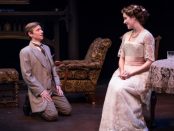
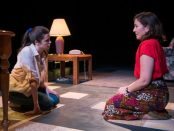
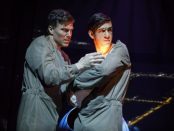
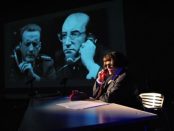
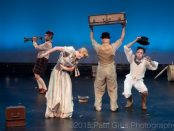
Stanley Houghton’s once controversial "Hindle Wakes" explodes everything you have ever been taught about the double standard and the place of women in society. The irrefutable logic of the characters in this play can only leave you with one conclusion. Gus Kaikkonen’s superb production for the Mint Theater Company restores this forgotten play to its rightful place in British drama. Had the playwright not died prematurely the year after "Hindle Wakes"’ premiere, the play would most likely have not fallen into an almost 100 year eclipse. Ironically, the Me-Too movement reminds us that the philosophy that “boys will be boys” is both immoral and indefensible. [more]
... in Deen’s mad dash to portray Shireern’s elderly Indian father and mother--who live in Connectictut--her girlfriend, Molly, and so many other figures, including even a housecleaner at a Motel 8, where Shireen attempted suicide--he seems to have a different voice and demeanor for every one of them. He even--on his knees and with a little girl’s voice--plays Shireen’s five-year-old niece, Rabia. [more]
Greg Pierce, the author of "Slowgirl" and "Kid Champion," has often tackled hot button issues. Here in Cardinal being given its world premiere at Second Stage Theater, he takes on urban renewal, Chinese entrepreneurs, racism and amateurs in politics, all worthy of investigation, in comic fashion. However, in this satire his plot seems to reinvent itself in every other scene, with twists and turns you can’t see coming. The three sets of characters (Lydia and Jeff, Nancy and Nat Prenchel, owners of the Bread & Button Bakery, and Chinese businessman Li-Wei Chen and his son Jason) seem totally separate until he brings them together in a rather improbable finale. He also loads the deck with such plot complications as Lydia and Jeff beginning an affair (as she looks so much like her sister who he dated in high school and hasn’t gotten over.) [more]
The best reason to see Isobel Mahon’s "Party Face" is to see the ever-lovely Hayley Mills who used to play mischievous teens and now is playing busy-body mothers. The play is diverting though it has nothing new to say about women and their contemporary roles. Under Amanda Bearse’s direction, the play also gives Klea Blackhurst another off-beat comic role in which she shines. [more]
Classic movies such as "It’s a Wonderful Life," "Miracle on 34th Street" and "Moonstruck" are citied in the play and author June Daniel White is clearly inspired by and seeks to emulate them in this fable. Those films resonate due to their appealing characters and well-crafted scenarios. "Delta in the Sky with Diamonds or Maybe Not"’s rambling plot is too ambitious as a stage play. [more]
Though there’s a major surprise lurking at the top of the second act, and though it’s about how sins of the past can impinge on the present, Scott Organ’s "The Thing with Feathers" is ultimately a play without many virtues. Early references to Emily Dickinson and poetry--the title apparently comes from a bastardization of a Dickinson poem--fail to lift the work out of the made-for-TV movie-of-the-week sensibility that keeps bringing it down. [more]
“I never met a peanut butter junkie” is one of the many sharp zingers in Fran Handman’s romantic park bench meetup, "A New York Encounter" (directed by Elowyn Castle) between an older man and woman. It’s in the well-trod, zany territory of Murray Schisgal, Elaine May and Herb Gardner, and it’s well-trod again here. The red-haired and vivacious Marie Wallace and the quirky James Nugent are priceless. [more]
Playwrights Kevin Armento and Bryony Lavery take the well-known facts that have been explored in documentaries and in the feature film "Battle of the Sexes" and shovel on a cascade of imagined sub plots, heavy-handed theatrical techniques and sociological trimmings. The opening voice-over prologue is a wry pseudo-scientific lecture about men and woman. This narrator sounds like Jane Lynch at her most sarcastic and it’s supposed to be funny but falls flat. The strident tone of the show is set. [more]
The problem with Laura Braza’s production is the lack of chemistry between Vasile Flutur’s Jericho and Hannah Sloat’s Julie. While Jericho should be charming and seductive, Flutur is only sinister and arrogant. Sloat is convincing at the innocent young girl routine but less so as the self-sacrificing woman in love where she comes off as rather bland. Just as McDonald walked off with the honors as Julie’s friend Carrie in the last Broadway revival of "Carousel," Ginna M. Doyle is most believable as the friend here called Mary (Marie in Molnár’s version.) Vivacious and sparkling, Doyle lights up the stage every time she appears as a woman in love with an ambitious but conventional doorman who climbs the ladder of success. So too Jack Sochet as Jericho’s criminal friend, here called Tynk, devious to his last breath and as wily as a coyote, appears to be living inside of his character. [more]
And that’s essentially the problem with "A Kind Shot." Clocking in at 75 minutes, the “performance” feels more like a motivational speech than a theatrical event. It’s well-meaning and well-told, but other than the charismatic Mateer, there isn’t much else to it. The set, a masking tape outline of a shrunken basketball key, accomplishes so little visually that it begs the question, “Why bother at all?” Mateer completes the obvious motif with a flower-emblazoned basketball, which she dribbles around a bit and bangs off the wall as if she’s making shots. I’m all for audience imagination, but, come on, just hang up a basketball hoop. [more]
Soviet born actor Ilia Volok is quite personable and definitely commands the stage; his performance is heroic but it is so intense and his accent is often intrusive. Comical and sensitive portions are overshadowed by the perpetual ranting. It’s 70 minutes of an actor’s bravura performance as he plays a character mentally unravelling and the plot gets sidetracked. There’s a lot of histrionics that don’t pay off. [more]
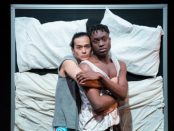
Kyoung H. Park's "Pillowtalk" mixes the mysteries of passionate, but flawed, love with the realities of racism in today’s society, specifically, Brooklyn, New York, where Sam (Basit Shittu), a hunky African American and former Olympic swimmer is married to Buck (JP Moraga), a sleek Asian American journalist. Both are in a constant battle with the White-dominated society which constantly undermines the lives of people of color. Park’s direction of his play is straightforward and “in your face” giving this rarely seen corner of society some needed exposure. [more]
Murky, glacial and hypnotic, "Sheila" is a dreamy reunion drama among two 28-year-old women who haven’t seen each other in 10 years. It recalls the sort of off-beat female-centric play director Robert Altman might have staged in the 1980’s and then filmed. The script is collaboratively written by members of The Associates, the theater company who is presenting it. It comes across as a collaboration with a feminist slant rather than an organic play. Still, its 70 minutes have an enigmatic appeal. [more]
Ms. Orlandersmith skillfully organizes the material into short monologues that are revelatory, insightful and often tinged with humor. Visually striking with her animated facial features and flowing dreadlocks, Orlandersmith subtly yet forcefully offers a series of rich characterizations. Varying her vocal inflections and altering her physiognomy she conveys the essence of each individual. It’s a riveting performance of range and depth. [more]
John Haidar’s energized production turns this material into a tour de force for Campbell and Lynch who are continually moving about spewing volumes of words, almost choreographed by movement director Naomi Said. Deeply in character, they seem to be living their adventures which include humor, fantasy and violence. However, American audiences will have difficulty with the thick Cork accents and Irish slang, as well as Pig and Runt’s private language which often resembles baby talk when it doesn’t sound like street poetry. [more]
Dull, smug and interminable," The Undertaking" is a multimedia play written by Steve Cosson that explores the meaning of death. Jean Cocteau, Marcel Duchamp and Greek mythology are trotted out during this 80-minute hodgepodge. Mr. Cosson is also the director and his physical staging ranges from sedate to overdrive, with the actors incited to be manic. The ending, however, does have an affirmative simplicity. [more]
With the support of film director, screenwriter and playwright Neil LaBute, the St. Louis Actors’ Studio has held an annual festival of one-act plays since 2013. This is the third year that the festival has been presented at 59E59 Theaters in New York City, and it’s a very enjoyable program. [more]
Playwright Robert O’Hara’s fertile premise might have made for a provocative, sober sci-fi take on gender roles, sexuality and parenthood. Instead, it’s broadly conceived and lame. The flat dialogue is in the vein of Abbott and Costello with numerous jokes about “fathers” since there are no mothers. The “Dude, I’m pregnant” bit gets painfully recycled. [more]
Shaw employs the gruff cadences of George C. Scott and Weaver has the calm and measured tone of Peter Sellers and both are thoroughly delightful. Their tremendous rapport is most evident in the phone scene from the film between the U.S. president and the Soviet leader: “How do you think I feel?” [more]
Washington, D.C.’s acclaimed Happenstance Theater is making is New York debut with its 2015 show "BrouHaHa," which has been seen previously in Baltimore, Maine and New Haven. Taking for its theme what would you do if the world were about to end, this “clownesque escapade collaboratively devised and performed by the ensemble” follows the company of six through a series of skits and journeys almost all of which lead to death but from which the actors bounce back. While the company members are extremely talented, the material lacks impact and structure and cries out for both a playwright and a director. Although intended to be comic, there are no laughs in this show though it may provoke smiles. [more]
While not as memorable as several previous Fiasco Theater productions, this "Twelfth Night" takes a while to get where it is going. After winding up the plot in the first half, it settles down to sparkling comedy in its second. A bare-bones production, it focuses attention on the language and the music rather than the usually rich trappings. It is an easy production to follow without being distracted by extraneous interpretations or ideas. [more]
As adapted for the stage by Anthony E. Palermo, it’s roughly half the length of the film. But it still tells the same story about George Bailey, who on Christmas Eve in 1946 intends to take his life, only to be saved by an angel named Clarence. While saying there’s “a Tom Sawyer quality to you, George,” Clarence still turns George around by showing him what “a different world” it is without him, as if he had never been born. And it seems to be amazingly complete--even while the focus of the presentation is on the live radio version, including a banner that says, W.I.R.T. (duh, for Irish Repertory Theatre) and several different “words from our sponsors,” such as “Lucky Strike” (“clears your lungs”) and “Carter’s Liver Pills.” [more]
The themes of Rajiv Joseph’s latest political play are not only valid but relevant in today’s climate. However, "Describe the Night" is too convoluted for its own good and attempts to make connections where none actually exist. While the cast led by Danny Burstein and Zach Grenier give solid performances, they never seem to develop in any way even though the play covers 90 years. Such momentous events as the Stalinist Purges and the fall of the Berlin Wall are treated almost in passing without their real significance being explored. Ambitious and epic in scope, Describe the Night becomes tiresome rather than enlightening. [more]
Anton Chekhov once advised that if you show an audience a gun you are required to have it go off. Set on September 8, 1976, Seth Zvi Rosenfeld’s new play, "Downtown Race Riot," being given it world premiere by The New Group, never takes us to this forgotten event which happened in Washington Square Park but depicts the forces and people involved in the 100 minutes before the riot is to happen. This overheated melodrama which goes on a bit long takes on many important themes (racial hatred, drug addiction, petty crime, sexual identity, financial insecurity, etc.) without making any pertinent point about any of them. While the dialogue and the milieu are gritty, Downtown Race Riot recycles a great many stereotypes and clichés. [more]
William Nicholson’s "Shadowlands" is one of those subtle plays that grows on you as it evolves and weaves its own spell. Based on a true story of one the most improbable love stories of the 20th century, it covers a range of human emotions that should catch you in its web. Under Christa Scott-Reed’s assured and astute direction, Daniel Gerroll gives a memorable performance as theologian and writer C.S. Lewis. A play of ideas on the meaning and varieties of faith, it is challenging as one has to follow its intellectual and spiritual arguments. However, for discriminating theatergoers, this is an added fillip for more than simple entertainment. [more]
With expressive and limber physicality, animated facial features, piercing eyes, and a smoothly resonant voice, Mr. de la Fuente vividly depicts Mr. Hirabayashi from youth to old age. Magnifying his towering performance, de la Fuente also plays a gallery of characters that include Hirabayashi’s parents, his friends, and American military personal as well as other incidental characters. His uniformly sharp characterizations are accomplished with ease, precision and depth. He is totally commanding during the play’s 90 minutes. [more]
In the central character of Buffalo Bill Cody, Michael Hardart plays only the one role. The play seems to be his coming to terms with the mythologizing of his achievements. Although twice he is given the line about fearing death in his makeup, there is no sense that he gains any self-awareness in the course of the play. As a result, he does not become a tragic hero with a fatal flaw. His bland, tame performance fails to hold the play and its many scenes together. [more]
David Gow is the show’s producer and he also plays Tommy Flowers. Mr. Gow perhaps saw this showy role as a vehicle for him to shine in and he does up to a point. Gow is an appealing, very talented young man who gives an admirable performance in such problematic material. The part is up there with Ibsen’s epic Peer Gynt and Quentin in Arthur Miller’s verbose "After the Fall" in terms of duration. Mr. Gow winningly displays stamina and range. However, it would take a colossus of the likes of a Robert Morse in "How to Succeed in Business Without Really Trying" to make this play even a qualified success. [more]
There is nothing much very wrong with Susan Miller’s '20th Century Blues" that a few more revelations or dustups wouldn’t solve. Beth Dixon, Franchelle Stewart Dorn, Polly Draper, Kathryn Grody and Ellen Parker play believable, recognizable women at a plateau in their lives when some taking stock is in order as they approach the age of being considered senior citizens. A pleasant evening in this form, but Miller’s play gives an aftertaste that will leave you hungry for more. It seems that in order not to offend, she is playing it too safe. [more]
Crumm and DeVito have a marvelous chemistry together and terrific mutual comic timing that make them seem like a real couple. Their compelling performances energize and elevate what could have been a wan, sitcom-style stage show. [more]
Philip’s shaggy-dog yarn keeps exposing him as what used to be known as a pathological liar. And with little more than a wooden deck chair, a small table, a wooden slated floor and a sky-blue background (the set is by Alexander Dodge, the lighting by Alan C. Edwards), Crudup’s tour-de-force performance is a potent reminder that all you need for good theater is the actor’s voice--as well as a good script, of course. It’s also testimony to his having been well directed by Leigh Silverman, who seems to have gotten the best out of Crudup with his multiple voices and varied expressions. [more]
While this is not a Bedlam production as was Hamill’s hugely successful stage version of Austen’s second published novel, "Sense and Sensibility," director Amanda Dehnert has staged the play in their inimitable style for this co-production of Primary Stages and Hudson Valley Shakespeare Festival and has created a clever 19th century entertainment with a decidedly 21st century sensibility. The versatile Hamill has also given herself the plum role of Elizabeth Bennet, here known as Lizzy. [more]
Such changes as Captain Hook being a woman or Tinker Bell speaking French are neither explained nor meaningful, while some of the doubling simply makes the play hard to follow as the characters are not listed in the programs which are given out after the performance. A voice-over which appears to read stage directions from the original is both intrusive and inconsistent: why some characters but not others? There is a dark psychological story hidden in Barrie’s tale of a boy who refuses to grow up but this isn’t it. Whereas the original play is joyful, Bedlam’s Peter Pan is a glum affair in which no one seems to be having a very good time. Where is the Bedlam which brought such purposeful insight and visual dazzle to its previous work? The actors, mostly playing children, try hard but fail to bring the work to life. [more]
Not only is Julia Cho’s "Office Hour" rivetingly acted by Sue Jean Kim and Ki Hong Lee, it is one of the few plays in recent memory to tackle a major social problem and offer an explanation or answer to society’s needs. Under Neel Keller’s astute direction and the production team’s superb physical production, "Office Hour" is both an important play and a compelling event in the theater. You may not agree with Cho’s conclusions but you will not be bored for a moment. [more]
Ms. Bioh’s snappy dialogue perfectly renders the rhythms of teenage lingo and the pain beneath the bravado, emitting the universality of adolescence. Bioh’s construction is meticulous as the events play out over 70 tight minutes. Besides the foreign setting there’s nothing really “new” about the play but’s it’s so well written and gloriously presented. [more]
Tunde Skovran as Shari and Julia Ubrankovics as Clara are sensational. The brunette Ms. Skovran and the blonde Ms. Ubrankovics are a dynamic team who each offer vivid portrayals with their powerful physicality and resonant voices that emit differing degrees of an East European accent. The outrageous finale has them gloriously carrying on in an extended, celebratory dance sequence. [more]
The conversations revolve around the topics of the New York Shakespeare Festival’s poor finances in 1958, Vaughan’s defection to the Phoenix Theatre which was paying a living wage while the NYSF was not, the choice of Mary Bennett (Vaughan’s choice) or Peggy Papp (Papp’s choice) to play Olivia, George C. Scott’s defection to the movies in his unnamed first film, the House UnAmerican Activities Committee appearances by both Papp and Gersten which has put their jobs in jeopardy, and whether Free Shakespeare in the Park can survive without charging admission. However, none of these conversations are allowed to erupt into real conflict. We are placed in the center of the action as though we are in the room where it happened, but the dialogue remains on the level of chit-chat rather than life or death threatening decisions. The problems never seem to be resolved and the play moves on to its next topic. [more]
Adhering admirably to its cultural mission, Kairos Italy Theater is treating downtown audiences to a double-bill of smartly written Italian one-acts, each exploring the contentious topic of immigration in their own unique and achingly human ways. Minimally staged, but with talented actors, the beauty of the plays is largely in the playwrights’ words, which seemingly have lost nothing in translation. Though if either play is appreciably better in Italian, some language lessons and a long trip is in order. [more]
Guirgis and Brokaw manage to find the back-handed humor and pathos of this scene which sets the mood for a profane and scatological play that hits the audience between the eyes with its fresh use of language and its deep understanding of the two main characters. Guirgis turns profanity into a poetic x-ray of the human psyche. [more]
There is a fascinating story to be told in Franz Kafka’s involvement with the Yiddish theater in Prague during 1912 but Lu Hauser’s play isn’t it. "Prague, 1912 (The Savoy Café Yiddish Theatre)" is both episodic and repetitious without being clear as to the point that it is making. It simply seems to be a collection of scenes on the same themes that endlessly repeats itself. As Paula Vogel’s "Indecent" has demonstrated, there is a renewed interest in the Yiddish theater but "Prague, 1912" has not brought to life this world that is now gone with the wind. [more]
Played to perfection with an infectious joy by one and all, the entire cast also takes a deadly serious attitude towards their lines and their actions. Indeed Ludlam’s "Conquest" invokes "Hamlet" in its final scene, when many of the characters die--even following a previous “gravedigger” scene. And as staged by Quinton, the final “banquet” scene also invokes Da Vinci’s “The Last Supper.” All I can say is, go and enjoy! [more]
The problem is that under Albert Bonilla’s stolid and matter-of-fact direction, Elizabeth Ingham and Zack Calhoon's characters never come alive. Just trading quips is not a sophisticated style and as all of their lines are said the same way without variety, it becomes tiresome quite soon. While Donze continually surprises us as Beth, Melissa and Dave remain the same throughout. And the production design doesn’t help much. While the couple discusses what good taste Melissa has in buying Dave’s shirt, Viviane Galloway’s costumes are extremely conservative and colorless, no proof of any special taste whatever. [more]
With her marvelously fluty voice, imperious bearing, expressive physicality and animated facial features, Maja Wampuszyc as the haughty Corrine recalls Geraldine Page in all her grand glory. Ms. Wampuszyc is mesmerizing, delivering a searing performance of tremendous depth. She vividly conveys the character’s dysfunctional sensibility with heightened emotionalism and dry humor. [more]
With "What We’re Up Against," Theresa Rebeck looks back a quarter century to a time when gender inequality in the workplace was a real problem. Oh, wait…yep, unfortunately, if Rebeck’s script didn’t tell us the year was 1992, it would be pretty easy to believe she was writing about the present, especially given the recent avalanche of news concerning sexual harassment and assault in the entertainment industry. The story Rebeck tells never sinks to this horrific level, though it’s possible to imagine that it could have, if she had wanted to follow the male anger she portrays to a place it often leads. [more]
The hype that surrounds an award-winning performance on one side of the Atlantic can often preclude its impact if and when it arrives on the other side. This is not the case, I’m happy to report, with the overwhelmingly powerful performance of Denise Gough who deservedly won the Olivier Award as Emma in "People, Places & Things," a new play by Duncan MacMillan, which premiered in London in 2015, and is now enjoying its American premiere at St. Ann’s Warehouse in Brooklyn. [more]
It’s New Mexico in 1881, and during a series of short scenes, Billy contemplates his life. His stern mother, rough father, stalwart girlfriend and his sly pursuer, Sheriff Pat Garrett, all periodically appear. The dialogue is stiff, lofty, peppered with profanity and doesn’t impart much biographical details. [more]
Playwright Jonathan Leaf’s prodigious research, accomplished dramatic construction and clever device of threading a mystery throughout the events make the play quite engrossing. There’s also the sociological angle as the characters eloquently state and defend their differing beliefs and agendas that include careerism versus motherhood. [more]
Like the great comedy teams, Jos Houben and Marcello Magni are a study in contrasts. The Belgian Mr. Houben is tall, animated and relies on breezy patter. The Italian Mr. Magni is short, often dour and mostly silent. They have collaborated with Peter Brook at his Théâtre des Bouffes du Nord in Paris, and have performed together around the world. [more]
While the script describes the setting as simply a “rural place,” British and European productions apparently have set the play in medieval times. It is definitely pre-industrial as the farmers still need to have their grains ground at a mill and no one has yet seen a pen. Director Paul Takacs, who has staged the equally challenging Dark Vanilla Jungle by Philip Ridley in New York, has reset the play on the American frontier and made use of a multicultural cast. This grounds the play somewhat and makes it easier for Americans to identify with it, but it remains a difficult, challenging play due to its poetic language and its lack of specificity. [more]
Complementing his gorgeous stage pictures, director Craig Smith’s vibrant staging has the actors in constant motion on the small playing area. The cast precisely paces, dashes and undulates, achieving a propelling pace and focus. Chanting monks roaming through the audience is an eerie highlight. Slapstick, high comedy, bawdiness and dramatic truth are all vividly rendered by Mr. Smith’s superior sense of stagecraft. [more]
With so many interruptions, it hardly makes for riveting theater, and it never becomes as riveting as a genuine tennis match can be, even though one is ostensibly taking place from the beginning of the play to the end, which essentially presents a chronological series of sets between the two players, the Russian Sergei (Alex Mickiewicz) and the American Tim (Wilson Bethel). [more]
Cleverly staged by Kail ("In the Heights," "Hamilton," "Dry Powder") on Rachel Hauck’s magnificently realistic set for the ground floor of a suburban house subtly lit by Jennifer Moeller, "Tiny Beautiful Things" is entertaining, poignant and enlightening. You may hear audible sobs at times during the evening as Sugar’s personal stories touch a nerve or a chord in her viewers. Vardalos tells us how she took over the “Dear Sugar” column though she had never written one before nor did she have any training in therapy. Her remarkable success was due to her using her personal experiences as well as her “radical sincerity and open arms.” Her empathy is infinite. [more]
Well-meaning and sincere," Occupied Territories" is both generic and stereotyped, offering a story television and the movies have been offering for years: the traumatic effect of a father’s Vietnam experience on his family years later. Co-written by Nancy Bannon who appears in the play and Mollye Maxner who directed it, it offers no surprises or new enlightenment. Set in two locales and time frames, the play alternates between scenes in a suburban basement on the day of Stephen Collins’ funeral and scenes from the life of the same man 45 years earlier as a rookie in the jungles of Vietnam. Ironically, the actors playing the soldiers are more convincing than the actresses playing the family members at home in America in the present. [more]
Martha Graham called her dancers “athletes of God.” Watching David Greenspan perform all the roles in a six-hour marathon performance of Eugene O’Neill’s 1928 melodrama, Strange Interlude, caused me to wonder what I might call David Greenspan. Would “Son of Thalia” (the Greek goddess of theater) do? “Olympian of O’Neill”? [more]
In Jonathan Silverstein’s production, Arnie Burton and Matt McGrath as two friends who handle their fears of an unnamed epidemic in opposite ways do not seem to connect as real friends would. Ironically, while they are both known for their outrageous over-the-top comic performances, here they remain low-key and rather flat. The play may have been more involving if they had been allowed to give the kind of performances which they are most famous for. The play ultimately has a poignant denouement but it takes a long time getting there. [more]
Director John Collins, founder of ERS, has set the play in an office or conference room with three long tables (in Jim Findlay’s design which eventually grows tiresome) and a great many stick telephones by which the characters often call each other to relay Shakespeare’s lines as if they are working from their offices. The walls of the set become screens for the text to scroll upwards through most of the play; at time we even see it five ways including the ceiling and with four panels in the back as well as on the back wall. Whether this is to remind us that this is a play of language, it is usually distracting and not very revealing. Often the actors speak so fast that it impossible to follow them and then in a brilliant coup de theatre one scene (that between brother and sister Claudio and Isabella) is spoken so slowly that it seems to reveal hidden meanings not noticeable before. [more]
Set designer Charlie Corcoran ingeniously has the small stage’s walls adorned with sections of a yellow cab. Off to the side is a piece containing the steering wheel from where McDonagh periodically speaks. Above this, is a screen bordered by vintage billboard pictures. This showcases Chris Kateff’s dazzling projection design that illustratively displays imagery of New York City from various eras, video clips and slides such as the 1975 New York Daily News headline, “Ford To City: Drop Dead.” [more]
It is possible to enjoy Brian Friel’s "The Home Place" without knowing the background to this historical play set in rural Ireland in 1878 as a Chekhovian representation of a world about to come to an end. However, the play will be much more meaningful if one knows the historical events that have led up to this turn of events. Charlotte Moore’s handsome and genteel production will be enjoyed most by those who understand the play’s undercurrents and implications. The low-key staging of this subtle play which does not spell everything out requires the audience to be adept at reading between the lines. [more]
While the acting is compelling, the threesome does not reveal many layers to their characters; they establish a persona and stick to it, without divulging any further information. As Mae, Nicole Villamil is both stoical and passive, a rather flat reading of this ambitious though down-trodden young woman. Julian Elijah Martinez’s Lloyd definitely comes from the lower depths with his vulgar language, his self-pity and his inability to help himself. However, there is little variety in his performance and we have no idea what his relationship with Mae has been up to this time. He does get noticeable stronger after he begins taking the pills the clinic has prescribed. Unaccountably dressed in a sport jacket and a tie in Sarita Fellows’ costume design, Nelson Avidon’s Henry is the biggest enigma of the three. At first reticent and later lascivious, he tells us little about his attraction to Mae - or where he comes from. [more]