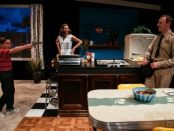
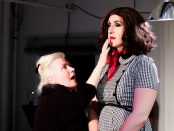
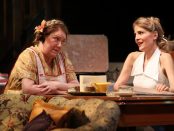
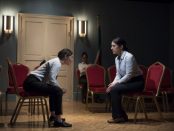
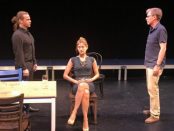
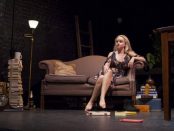
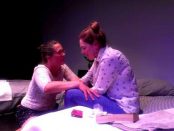
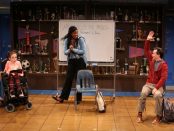
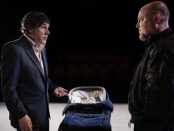
It would be a pleasure to report that A.R. Gurney’s last play entitled “Final Follies” performed with two early works, is one of his best, but that is not the case. As directed by David Saint on a triple bill celebrating the work of this major satirist who died in 2017, this comedy is minor Gurney. In fact, part of the problem with this evening produced by Primary Stages is that Saint has used three separate acting styles, one for each of the plays, all of which are wrong for the material. Surprising considering that Saint’s 2002 direction of Gurney’s full length, "The Fourth Wall," was quite delicious. However, his touch seems to have deserted him here. [more]
Mercer’s direction coordinates the outstanding design components into an aesthetically successful presentation with some neat stage pictures and tableaux. However, the deliberate quest for stylization leads to an exaggerated tone in the performances as opposed to the movie’s straightforward naturalism resulting in an overall distancing effect. There’s the sense of experiencing a stilted art project rather than being engrossed by a play. [more]
What our mothers owe us - and what we owe them - is at the heart of Leenya Rideout's one-woman autobiographical show, "Wild Abandon." In it, the prodigiously accomplished singer, songwriter, playwright, actor, and multi-instrumentalist comes to terms with both her mother's life and her own. Perhaps these twin goals converge a bit too neatly, especially given the harrowingly true complications Leenya introduces along the way, but there are so many hard-earned and poignant insights in "Wild Abandon" that the end result is successful nonetheless. [more]
Though going off on tangents, the captivating performer Heidi Schreck’s self-written fascinating theatrical memoir "What the Constitution Means to Me" is a feminist-centric personal odyssey that uses the device of high school oratory. The blonde and animated Ms. Schreck’s persona combines the dramatic qualities of Laura Linney with the quirky comedic essence of Teri Garr. After introductory remarks, the Washington state native discloses the show’s conceit. [more]
Gill expertly writes each character as three dimensional, giving each complex backgrounds, making it clear that each benefits from knowing the others. A mundane Scrabble game is as revealing as Truth or Dare. Phone calls uncover the wonderful interdependencies of this group. [more]
What gives "A Lovely Sunday for Creve Coeur" its special cachet in the Williams canon is that its storyline and heroine called Dorothea very much suggest a prequel to A Streetcar Named Desire set ten years earlier, when Blanche was still teaching and coping with life, though already needing liquor and pills to get her over her anxieties. Some enterprising theater group ought to schedule these two plays in repertory with the same actress in the leading role in each. [more]
Previous experiments from this adventurous theater group helmed by artistic director Eric Tucker include two versions of Twelfth Night performed in repertory, Hamlet and Saint Joan performed with casts of only four actors, and an updated Pygmalion which was double cast in its smaller roles. In "Uncle Romeo Vanya Juliet," Tucker has tried something new: a mashup of both Anton Chekhov’s "Uncle Vanya" and Williams Shakespeare’s "Romeo and Juliet," with scenes from the two alternating. The result is not confusing, but irritating and irrelevant, with neither play gaining from the combination. The advertisement for this show reads “5 actors, 2 plays, 1 performance,” but to what point? [more]
Stranger still is the choice of Angelica Page to play Dickinson who looks rather too healthy to be the famously thin and sallow-faced writer known from the one famous photograph. She makes Dickinson sarcastic, arrogant, cynical, self-important and haughty which goes against the voice of the woman in the poems. At times she has been given arty stage directions like posing by a mantelpiece or sleeping on the ground next to what we assume is alongside of her father’s grave. [more]
If these characters sound familiar, they are based on real people who populated Albany politics four decades ago. "The True," a world premiere play by Sharr White ("The Other Place," "The Snow Goose") gives four-time Emmy and two-time Golden Globe Award winner Edie Falco another bigger-than-life role and she is magnificent. The cast also includes television stars Michael McKean (Mayor Corning) and Peter Scolari (Peter Noonan) as well as Glenn Fitzgerald (Howard C. Nolan) and John Pankow (Charlie Ryan) who under the direction of The New Group’s artistic director Scott Elliott create a true ensemble, making us feel that these people have lived their roles. [more]
In Craig Lucas’s "I Was Most Alive with You," two down-on-their-luck television writers mine recent personal tragedy for their latest project, hoping, with the Book of Job as their inspirational guide, to set both their careers and the universe in order. Although suffering has touched each of them, Ash (Michael Gaston), a late middle-aged recovering alcoholic in a bad marriage, is the much more forlorn figure. Like Job, Ash has hit one of those rough patches in life, where, if you’re a person of faith, you might start to suspect that your higher power doesn’t like you very much. [more]
Ms. Anselmi succeeds at imparting her solid research on the subject through her sharp dialogue spoken by her strong characters. The play falters with the addition of a chorus who are actors that appear in darkness during scene transitions to intone the names of disparate celebrities such as Charles Dickens, Johnny Cash and Mother Theresa. The explanation for these many names that are cited is that due to their personality quirks they would have been sterilized in North Carolina. That supposition is arguably a stretch, the main thing is this obtrusively weakens the momentum considerably. [more]
Considering the repetitiveness of the material and the fancifulness of the play, Megan McQueen as Rosie Ramirez and Kevin Rico Angulo as Det. Jimmy Marks make a great deal more of their characters than is in the writing, while the rest of the actors in underwritten roles do quite a bit less. Both attractive performers, they make us care about their characters though not much is happening. It is to be hoped that they find more substantial roles soon that will showcase their talents. [more]
Exhibiting talent and charm but with relatively impassive vocal deliveries are the trio who portray Anna Politkovskaya and other characters such as soldiers, medical personnel and military officials. They are Nadine Malouf, Nicole Shalhoub and Stacey Yen. They’ve been styled to have similar appearances and directed to be distant so that their performances are in the mode of recitation rather than distinctive characterizations, resulting in a lack of emotional impact. [more]
The intellectual level of "Hurricane"’s characters may not be as high as George, Martha, Nick and Honey’s. Nevertheless they reveal their inner psychological turmoil, secret fears, secret yearnings and sense of isolation with equal intensity. Thigpen’s astutely observed dialogue and Maria Dizzia’s vivid whirlwind direction lift "Hurricane" from foul-mouthed melodrama to passionate character study. [more]
The 2014 police shooting of Michael Brown inspired this exuberant concert-style presentation of Sophocles’ classic Greek tragedy entitled "Antigone in Ferguson." Director Bryan Doerries’ faithful adaptation lasts an hour and is performed by a rotating name cast in connection with a lively choir. Mr. Doerries’ proficient staging transforms it all into a novel, entertaining and emotionally charged experience. Tickets are free by making a reservation. [more]
A play that tends to say or do too much can often end up saying too little. Such is the case with "The Other Day," a play in which one development after another keeps cancelling each other out. In the opening scene, which also marks the beginning of their relationship, Mark and Santo don’t exactly meet cute, but they do get right to their problems relating to life--and to each other. They are, after all, at a “Narcotics Anonymous Meeting, divulging their addictions and their problems. [more]
The actual subtitle of Silverman’s play gives one pause: “In Essence, A Queer and Occasionally Hazardous Exploration; Do You Remember When You Were in Middle School and You Read About Shackleton and How He Explored the Antarctic?; Imagine the Antarctic as Pussy and It’s Sort of Like That.” While this might suggest that the play is overwritten and self-indulgent, it belies the concise, tight writing and structure of Silverman’s comic/angry play which is always surprising, always inventive, always inducing laughter. The play does use Brechtian supertitles to announce the scenes but these are comic and informative, rather than didactic or preachy. [more]
Exhibiting the dazzling wizardry of someone who trained at the École Jacques Lecoq in Paris, Murfi is breathtaking as he clowns, mimes and barrels all over the space while distinctively rendering each character. His synthetic gray hair, malleable facial features, striking eyes that are in constant motion and affable presence enable him to swiftly shift from one denizen to another and he also channels several simultaneously. He plays Kitsy, Pat, a busybody who runs the newspaper store, a family friend, priests, and an assortment of colorful locals. [more]
While Barry was to become famous writing plays about the very rich, the Whites are of the middle class and live on earned money. In the play’s second act, eight months have passed, and money, not so surprisingly, has become tight for both Maitland and Ricky. However, this would be fine if the artificial style of the play and the dated twenties slang did not seem arch and affected. And while director Michael Hardart’s production is always stylish and graceful, he has not helped greatly with his casting or his mannered and theatrical approach to the material. The characters talk in an elevated, literate language but they are basically very simple people, not the kind who sit around tossing off bon mots. Here they speak Barry’s realistic lines as though they do. [more]
"James & Jamesy in the Dark" is apparently the product of a long trial and error rehearsal process according to the aforementioned program notes. The self-involving process, unfortunately, seems to have insulated them from unintentionally synthesizing themes from the works of Samuel Beckett and Eugène Ionesco (isolation, repetition, existential angst). Their endless wanderings about the stage mirror Waiting for Godot and their nonsensical dialogue could easily have come directly from" The Bald Soprano." [more]
Conceived and written by Kevin Doyle, "THE AЯTS" offers sophomoric antics that are a virtual parody of performance art techniques. There’s a lot of buzzers à la Richard Foreman. The show is a presentation of Sponsored By Nobody, “an international theatre company in search of a blue-collar avant-garde” that creates interdisciplinary works of “abrasive theatre.” [more]
Unfortunately, Worsham’s efforts just confirm the play’s central problem: only the relationship between June and Charlie has any real depth. As for the rest of the characters, although McMullen’s writing is clever, too many of the lines are focused on eliciting laughs rather than explaining why these people are choosing to shelter together. It doesn’t help matters that the play’s lighting by Cheyenne Sykes and sound design by Daniel Melnick are wholly devoted to overdramatizing Charlie’s Asperger’s while failing to offer much-needed periodic reminders of the torrential plot device that keeps everyone from fleeing the cramped apartment. [more]
Farce meets tragedy in a fictional unnamed Latin American country in "The Conduct of Life." It’s a raucous yet insightful fantasia about military oppression taking its toll on the populace by the celebrated playwright María Irene Fornés. First performed in 1985 it is being given an inspired revival by the Boundless Theatre Company that is “spearheaded by women and theatre-makers of color.” The play is structured as 19 short, often absurdly funny and sometimes unsettling scenes, some lasting just a few seconds, that total 75 fascinating minutes. [more]
Though the large ensemble of 11 actors is uniformly first rate--whether going through their balletic paces or tossing the invisible basketball and grasping it by clapping their hands, Pamela Afesi gives a particularly strong performance as Calvin’s mother, Viola, as does Barbra Wengerd as Edgar’s mother, Annabelle. Indeed, the crux of the play comes during an overlapping exchange with these two mothers--whose husbands abandoned their families--and their sons. [more]
Gingold Theatrical Group’s "Heartbreak House" is an interesting but misguided attempt to update Shaw’s Edwardian masterpiece and make it seem more relevant to our times. Despite the stellar cast, the unfocused production by the usually reliable David Staller undermines much of the play’s humor and message. While the adept cast is stylish, they never gel into a true ensemble. This new version adapted from Shaw’s earlier 1914 script rather than the more famous 1919 published text will be of interest to Shaw devotees who will have never seen this rendering before. [more]
Ms. McCarrick’s appealing premise of redemptive romance is in fact subsidiary to the IRA angle as in the program she states that this event is the inspiration for her play. The two threads haven’t been skillfully fused together, resulting in a disjointed experience totaling 13 scenes. McCarrick packs in a great deal of backstory to her well-drawn characters and her effective dialogue is marvelously Irish in style with plenty of wit, eloquence and reflectiveness. [more]
In 14 concise scenes lasting 85 minutes, Ms. Lyman quite skillfully transforms the familiar premise of a resolute aged person clashing with her relatives over giving up her independence into an engrossing play. The characters are all fully developed, background information is smoothly imparted and the dialogue is a rich blend of humor and emotion. The plot has suspense and resonance as both arguments are set forth with equal validity. Lyman has also written a great part for herself. “I got a nice leg of lamb. Not as nice as what Eileen and Ed used to raise, but now she’s in Florida and Ed’s dead. Costco’s my butcher now.” [more]
Director Miranda Haymon’s electric staging of her pared down yet faithful adaptation is filled with dialogue characteristic of Kafka and bracing sequences. Basketball is a key visual metaphor as the performers mime shooting hoops, run in place, do pushups and vigorously glide from bit to bit. Ms. Haymon’s commanding technique is combined with technical production achievements. Zack Lobel’s intense lighting design and sound designers Anthony Dean and Matthew Catron’s blaring whistles and pulsing renditions of electronic music all yield to an entrancing presentation. This plays out on scenic designer Tekla Monson’s stark bare black-accented set that is backed by a mirror. [more]
Wearing a realistic period uniform and donning a metal helmet, the youthful and animated Mr. O’Regan recalls the electric persona of the young Tom Courtney as he vividly portrays numerous characters besides the wide-eyed Thomas. Utilizing his rich vocal talents and wiry physique, these strong characterizations include his solid brother, a vicious old woman, and various martinets. If nothing else, Private Peaceful showcases O’Regan’s considerable talents. [more]
More in the style of informative advocacy event for the lecture circuit then a theatrical work, "Intrusion" wanly tackles the subject of rape. "I set out to create a show that addresses the systemic problem of rape culture from an intellectual standpoint…” is how writer-performer Qurrat Ann Kadwani describes her solo play that was inspired by the 2012 fatal gang rape of Jyoti Singh in India. Ms. Kadwani’s intellectual approach is the problem. Instead of a raw depiction of the topic, this is a dry recitation. [more]
This production is presented by The Flea and the cast is drawn from their resident acting company, The Bats. Exhibiting heartbreaking resilience Alana Raquel Bowers as Aisha dominates the play. The captivating Tanyamaria is very funny yet conveys Adriana’s melancholy. With his lithe physique, sunniness and serene presence Michael Oloyede’s performance as Calvin is commanding. Roland Lane’s charisma and animation enrich his portrayal of the difficult role of Jean-Baptiste. [more]
"Days to Come" fills in the gap in Hellman’s career between her first play, the controversial "The Children’s Hour," and the immediate successors, the hugely commercial hit and often revived, "The Little Foxes" and the New York Drama Critics Circle Award-winning "Watch on the Rhine." Completists will want to see this play which has not been seen in New York for over 40 years. The Mint Theater Company’s revival of "Days to Come" is an example of a worthy, lost play whose problems haven’t yet been solved – if they ever will. See it now as there probably will not be another chance anytime soon. The Mint is to be applauded for taking a chance on this rarely seen, but estimable failure. You will not be bored but you may not be convinced. [more]
War, time and death are hauntingly explored in the eerie high-tech performance piece "Remnant," a company project by Theater Mitu. It’s based on interviews with a cross section of people that have been shaped into a swirling and absorbing event. The audience wears headsets as they experience the show while watching the actions taking place inside of three separate “boxes” named A, B and C. Original and previously composed songs including one by Kate Bush are performed to great effect, as are electronic melodies. [more]
Presented by NAATCO (National Asian American Theatre Company), it has a virtually all-Asian excellent cast of sixteen, several of whom play roles of opposite genders. Creatively conceived by Stephen Brown-Fried and superbly directed by him, his Orson Welles-like vision transcends the difficult material. This sterling production is also an inspired example of Americans succeeding at Shakespeare. [more]
Comedian/monologist Mike Birbiglia, best known for "Sleepwalk with Me," has the remarkable knack of finding humor in autobiographical crises that shouldn’t be funny but in his hands are uproarious. His latest show, "The New One," is just as hilarious as the previous ones. When Mike and his wife, the poet Jennifer Hope Stein, got married he pointedly told her that he did not ever want to have children, and she agreed. Ten years later Jen has changed her mind and tells him, “A baby wouldn’t have to change the way we live our lives,” probably the understatement of the century. [more]
Though there are recurring references to Woody Allen and more specifically to "Annie Hall" during the 90-minute piece, "Less Than 50%" bears as much resemblance to that Oscar-winning film as Gianmarco does to a matinee idol. (According to Gianmarco, his play is not a “rip-off” of "Annie Hall," as Laura says it is, but an “homage.”) It’s telling that instead of the hysterical scene with lobsters in the kitchen in "Annie Hall," we have to contend with a mouse and a mousetrap in "Less than 50%." [more]
Gambling, palace intrigue and poetry abounds in playwright Jonathan Leaf’s imaginative and engrossing historical drama "Pushkin." In the course of two acts and numerous scenes, the eventful life of the great Russian author is skillfully dramatized during this lavish presentation that takes place from 1834 to 1837. [more]
Translated into English from the Swedish by Charlotte Barslund, Ms. Langseth’s trite sexual obsession scenario is reminiscent of the novels of Patricia Highsmith and the French thriller films of Claude Chabrol. Langseth lays on sociological concerns to give the work more cultural heft. There are bromides about the class system and rebelling against the patriarchy. [more]
Along with its twists and turns, Bohjalian’s "Grounded" is so fully explored that it is hard to believe that it is a first play. On the long wait on the runway at Kennedy Airport for a flight bound for London, stewardess Karen discovers that her co-worker, 24-year-old Emily who has been in this line of work for two years, has a fear of flying and has never flown over the ocean. When Emily begins her story she reveals that her life coach thought she was too grounded and dared her to become a stewardess. [more]
That renowned man of the theater Austin Pendleton’s concept to adapt and combine portions of William Shakespeare’s "Henry VI, Part 3" with Richard III is intriguing and textually successful. The first 40 minutes give background of the English Civil War in the 1400’s, impart exposition, flesh out the motivations of Richard III, and depict his adoration of his father, the Duke of York. This mashup also gives a fresh spin to those only familiar with "Richard III" and there’s plenty of neat stabbings. [more]
Gardley makes use of a little known piece of American history: while Louisiana was under Spanish and later French rule, it had a three-tiered racial system. Aside from white settlers and black slaves, there was a third class: free women of color (mostly Creoles) could enter into a relationship with white men as common-law wives. Their children could inherit part of their estates. Some of these so-called “colored” women became extremely rich. This system was called plaçage and such women were known as placeés. The lighter the woman’s skin color the higher her social caste. However, when Louisiana was sold to the new United States in 1803, this system was frowned upon and eventually went out of style around 1813 due to legal challenges. [more]
The plays in Summer Shorts 2018 - Festival of New American Short Plays have often had a theme running through all the offerings in one evening, however they were concealed or obscured. This year’s Series B is about two-character relationships at a tense moment in their developments, sort of sparring partners as one of the plays calls it. Unfortunately, the plays in this series by Neil LaBute, Claire Zajdel, and Eric Lane all need further work as they are premises rather than finished plays. [more]
Reveling in their grating vocal affectations, gesticulating at a fever pitch or moving catatonically and projecting snarky personas they hold forth on their revered subject in various permutations that are video broadcast without making any impact. This involves interviewing each other, acting out bits from "The Real Housewives" and mouthing the words to scenes from it. Periodically the clips are also on the back wall’s large screen with their images superimposed. Personal asides include discussions of being single, a cold take on pornography and their fabulous lives. At one point, Mr. Breslin sheds his hat to put on a blond wig and women’s clothing to furiously dance in what is supposed to be a tour de force. [more]
Hence: "My Life on a Diet," a comically rich stroll through her career in TV, theater and film. Written by Taylor and her late husband, Joseph Bologna and originally directed by Bologna, Diet is currently at the Theatre at St. Clement’s where a contagiously comfortable Taylor, elegantly attired (gown by Pol’ Atteu) settles down in Harry Feiner’s kitschy, carpeted set to schmooze with her audience. Taylor, now in her eighties, begins with some self-deprecating humor about aging, after showing herself at various stages in her life. [more]
Three actors—Yelena Shmulenson, Allen Lewis Rickman (Velvel in the Coen Brothers’ “A Serious Man”) and Shane Baker (“the best-loved Episcopalian on the Yiddish stage today”)—manage the feat of bringing five of Aleichem’s stories—adapted and translated by Baker and Rickman—to life under Rickman’s incisive and warm direction. Sourcing the original, nitty-gritty shtetl-soaked tales, makes "Tevye Served Raw," if possible, more passionate and involving than the musical. [more]
Built in 1904, Dreamland was considered the most elegant and ambitious of Coney Island’s amusement parks--until it burnt to a crisp in 1911. A new play by Rinne Groff, "Fire in Dreamland" is ostensibly about the disaster, in which no humans but most of the animals perished. But to add that it’s set a little more than a century later--in 2013, or some months after Super Storm Sandy wreaked havoc on the east coast--should begin to suggest that there’s more going on here than, unfortunately, ever meets the eye. [more]
A central concern of the play is detailing Wellington’s five love interests: a white guy he meets at a hilarious Brooklyn vegan party, an Indian young man, an 18-year-old Muslim food cart vendor, his older married agent and the drug dealer he’s known since his California days. Well into the show there’s a rapid bit where each of them enter as Wellington imparts factoids about them and it’s a neat theatrical device that swiftly informs us of the pertinent details. However, previously we’ve spent a lot of time repetitiously going back and forth between these figures. This thread’s deficiency is compounded by the play’s incessant non-linear structure as we get the same basic information over and over in a different order. [more]
But when things slow down a bit, especially during the musical interludes and longer dramatic pieces, Petosa’s eight performers -- four lead (Christine Hamel; Jake Murphy; Harrison Bryan; and Carla Martinez) and four supporting (Miguel Castillo; Sebastian LaPointe; Olivia Christie; and Ashley Michelle) -- are an absolute wonder, gracefully tackling a head-spinning array of difficult subjects, including xenophobia, social inequality, and infanticide. And thanks to Hallie Zieselman’s bare set, Annie Ulrich’s modest costumes, and Joe Cabrera’s vibrant lighting, they accomplish it all in a decidedly Brechtian way. [more]
If "The After-Dinner Joke"’s 66 scenes seem cinematic, that is due to the fact that it originally was a teleplay commissioned by BBC for the series "Plays for Today" examining public issues. Churchill chose to deal with the politics of charitable institutions. Selby, personal secretary to the sales manager, decides that she gets no fulfillment from her work and tells her boss Mr. Price that she is resigning to be a do-gooder. Price offers her a job at the same salary working as a campaign organizer raising funds in towns throughout Britain for one of the charities that he has founded. [more]
Its maddening structure, extraneous scenes and superfluous characters diminish but do not totally obliterate the potency of playwright Jerry Small’s romantic drama, "Before We’re Gone." What could have been a focused and poignant work in the manner of William Gibson’s duologue "Two for the Seesaw" is instead an erratic jumble. [more]
n what easily could have become a one-man show, playwright Strand has cleverly created dramatic tension by first introducing us to a second character and later a third. Set during the 2012-2013 term of the Supreme Court, the play begins with a lecture by Scalia to a law class where he explains his philosophy of being an “originalist,” that is, someone who interprets the Constitution as it was originally written and understood by its drafters in 1789. This presupposes that it is not a living document that should reflect each era, but something carved in stone which does not change but may need interpretation. [more]
As the sleek and black-clad Tanya Marquardt vigorously wraps up her self-written 60-minute autobiographical show "Stray," with her giddy dancing and hurling her ponytail around, the aimless first half has been redeemed by the more cohesive second half. It’s been like traveling back in time to Club 57, The Pyramid Club or another of the East Village performance venues of the 1980’s. [more]
Mr. Gray infuses his straightforward 70-minute interview treatment with tension, suspense and drama. A third character, Norm Hansen is a 60-year-old straight married board member of Pendarvis who is a close friend of Hellum’s. He provides skillful exposition and while present at the discussion stuffily keeps trying to steer it away from personal disclosures. The dialogue is smooth, efficient and dotted with references to figures of that time such as Frank Lloyd Wright, Syrie Maugham and Duncan Hines. [more]
The cast list in the program reads more like a medieval phone-directory--even if there were no phones in the Middle Ages--than it does a dramatis personae. And then there’s what happens to the characters during the course of the play which is as hard to say as it is to remember all of their names, let alone pronounce them. [more]
After establishing himself as one of our finest playwrights with such works as "Killer Joe" and "August: Osage County," Tracy Letts seems to have somewhat lost his way with his more recent "Mary Page Marlowe." Now playing at the Second Stage Theater in New York, "Mary Page Marlowe" premiered at Chicago’s Steppenwolf Theater two years ago. With six different actresses representing the title character at many different times in her life, it essentially relates a single, long life span, in only 90 long minutes. [more]
Structured as a series of confessional vignettes, Innit begins in the school psychologist’s office and alternates between there and Kelly’s home. Her 34-year-old mother works at a sandwich shop and is a part-time prostitute. Her absent ne'er-do-well father abandoned the family and went back to his native Ireland some time ago. Money is tight and so is hope. Kelly is combative and doesn’t really have friends. She gets free cigarettes for allowing boys in gym class to take manual liberties with her. The dialogue is earthy, conveying a youthful sensibility with “dick head” being a favored exclamation. [more]
Though designed as an agitprop exploration with one woman as “Bad” and the other as “Good,” Ms. Brennan's simple yet effective writing elevates it into a quietly powerful work. The dialogue is a skillful blend of mundane details, biographical data and expressions of world views that all strongly delineate the characters. The structure is essentially two women in their 30’s in a room talking. Brennan’s command of plotting injects suspense, surprises and momentum, all combined with emotional resonance. [more]
Filloux in collaboration with director Amy S. Green have distilled the raw data they gathered into a searing and poignant narrative containing absurdist flourishes that include a talking laboratory mouse. The play is structured as a series of short pungent scenes. Filloux’s dialogue poetically conveys the harsh realities the underprivileged face and their bleak worldview. [more]
Add to this list Mike Lew’s new witty and clever "Teenage Dick" (being given its world premiere by Ma-Yi Theater Company in association with the Public Theater), both an update and a parody of Richard III now set in Roseland High School. However, while most of these other adaptations just want to demonstrate the contemporary relevance of Shakespeare’s Elizabethan stories, "Teenage Dick" has an additional agenda: does society’s bullying lead to defining the personalities of those with disabilities? [more]
Sixtyish Eric Miller is an angry white man, hating Catholics, Blacks, homosexuals, women, and other groups. He has also become very nationalistic. He not only wants to tell the world, he thinks he should act on it. Middle America in the age of Trump? Actually, the same problem appears to be happening in Northern Ireland according to David Ireland’s dark play, "Cyprus Avenue," having its American premiere at the Public Theater courtesy of a co-production by The Abbey Theatre (Dublin) and Royal Court Theatre (London). Problem is for all the sound and fury, Cyprus Avenue, which is a brilliant character study, outlives its welcome long before it is over in this 100 minute play. [more]