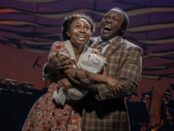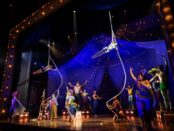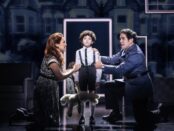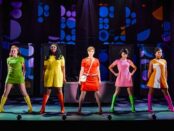

Not only is the show authentically written with Spanish sprinkled throughout, (much of it perfectly obvious as to its meaning,) but Sergio Trujillo’s superb production which he has both directed and choreographed, has been cast with an almost entirely Hispanic cast who are utterly engaging. Best is Justina Machado, a Broadway veteran of "In the Heights" and "A Free Man of Color," as the indomitable Carmen who can only imagine one path – though she herself left everything behind in Mexico to come to the United States. Following a close second are Broadway debuting Tatianna Córboda as the feisty Ana who has learned how to run rings around her elders and also debuting Florencia Cuenca as her weary sister Estela who has the weight of everyone’s aspirations on her shoulders. [more]
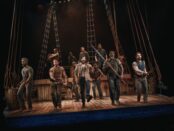
Not seen on Broadway since 1982 but racking up 26 productions up to that time since its New York premiere in 1879, the Roundabout Theatre Company’s new version of the Gilbert and Sullivan classic operetta, "The Pirates of Penzance," has been given a delightful facelift: retitled "Pirates! The Penzance Musical" is has now been Americanized and reset in a jazzy 1880 New Orleans by the team of director Scott Ellis, adapter Rupert Holmes, choreographer Warren Carlyle and music director and co-orchestrator Joseph Joubert. The energetic cast is led by Ramin Karimloo as the Pirate King, Jinkx Monsoon as Ruth and two-time Tony Award-winner David Hyde Pierce as Major-General Stanley, backed by a lusty crew of singers and dancers. [more]
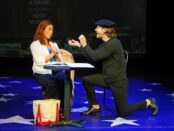
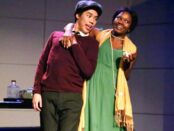
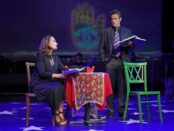
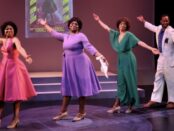
Fast-forward to 2025, and City Center has once again turned to this dependable crowd-pleaser, reportedly as a last-minute substitute for Michael John LaChiusa’s "The Wild Party." The choice makes logistical sense: "Wonderful Town" offers hummable tunes and a quirky, heartfelt book by Joseph Fields and Jerome Chodorov. But under the direction of Zhailon Levingston—whose past work includes "Table 17" and the vogue-infused "Cats: The Jellicle Ball"—this new iteration stumbles. Lacking Marshall’s instinct for the show’s fine balance between earnestness and irony, Levingston’s staging never quite finds its rhythm, veering too far into knowing kitsch and losing the tender charm that once made Wonderful Town feel, well, wonderful. [more]
Unfortunately, while the carnival atmosphere in the field above the cave increases, the musical is mostly a waiting game: if and when Floyd Collins will be brought up from the deteriorating cave. The emotions that you would expect as time begins to run out as passageways become either waterlogged or impassible are not in evidence except for Floyd’s father who is more concerned with finances that his son’s life. Floyd himself is often depicted as delirious or depressed so that we don’t get much of an arc of his emotions. [more]
At times the show directed by Stroman seems to be a satire or a parody, while the choreography by Bergasse mostly looks like ersatz Bob Fosse which seems inappropriate for the Marilyn Monroe story. As star Ivy Lynn playing Marilyn, Hurder seems to be doing a Megan Hilty impersonation from the TV series, rather than bringing anything new to the role. (Of course, Hilty is appearing around the corner in Death Becomes Her.) Bowman’s Karen is fine as far as she is allowed to go but the role seems underwritten. Nielsen ass The Actors Studio coach, (compared to Margaret Hamilton as the Wicked Witch of the West) is so unpleasant that you wonder why her character isn’t fired long before it happens in the story line. [more]
But, top-notch as all of that is, the musical's unmitigated highlight is the Broadway newcomer Rogers as Betty Boop. While the character's trademark look and mannerisms certainly contour Rogers's performance, they do not obscure a wealth of touching flesh-and-blood emotions that all come out in an underwhelming eleven o'clock number, "Something to Shout About," that, because of Rogers, manages to overwhelm. It seems that "Boop! The Musical" has a new star rather than an old one. [more]
Although there are humorous moments, the production doesn't work for various reasons, including characterizations and technical issues with sound reproduction. None of the eight songs are memorable, and the characters do not engage the audience, which is a question of direction and acting. While the performers work hard at portraying their characters, the effect is uneven. Some characters appear two-dimensional, and performances feel like a college or community theater production. The vocals are problematic, with some performances being overpowered while others pitchy. Overall, the show doesn't engage the audience in caring about the characters or their stories. [more]
Except for a couple of main characters, the people in his life seem to come and go making it a little bit difficult to follow. While the opening of each act is in the form of a Technicolor musical, the limited budget and the staged reading format does not allow for this. Actor Michael Halling is tall enough to represent the 6’4” Hughes but he does not portray his undoubted charisma to have taken the world by storm. There are also many anachronisms as well as at least one scene which is out of order and facts that are inaccurate. [more]
The new musical attempts to out Monty Python "Monty Python" by creating a full-length show and story in their style, although its origins also go back to British Music Hall where there is also much cross-dressing (i.e. men playing women and women playing men). Those who love Monty Python will have a great time; those who don’t may find the two hour and 30 minute show heavy going. The show is also Very British and a great many of the jokes and gags don’t land for American audiences. However, the hard working cast is impressive playing many roles each and Robert Hastie’s fast paced direction doesn’t give a lot of time to think about the antics on stage. [more]
The second in the York Theatre’s Spring New2NY series is "Who Is Jimmy Pants?," an entertaining spoof of bio-jukebox musical, a genre that could use some taking down. Presented concert-style with book-in-hand, as were the York’s Mufti Series, the high-powered cast of nine directed by Stephen Nachamie (Ken Ludwig’s "Dear Jack, Dear Louise") make the rather clichéd material seem better than it is. [more]
"The Trojans" effortlessly blends sharp, often hilarious high-school dialogue with an inventive and evocative score, creating a musical experience that feels both contemporary and nostalgic. The characters’ voices ring true to their age and environment, and their dialogue flows seamlessly into the show’s musical numbers. The soundtrack, crafted from cassette tape loops and vintage analog synths, infuses the production with an infectious energy, while also echoing the show's 1980s-inspired aesthetics. There are exceptional songs throughout the score but "Boys are Bad," a standout solo for Lucas (Daphne Always), not only delivers a memorable melody but also weaves in pointed commentary on masculinity—a theme that reverberates throughout the production. [more]
"Avalona, A Musical Legend," created by Dina Fanai, with music and lyrics, is a concept album with elements of modern opera. While not a musical in the usual sense of that form, it fits in a class of shows with the feel of a musical, such as "Jesus Christ, Superstar," which in its original form was a concept album concert with some notable productions being in the form initially conceived by Sir Andrew Lloyd Webber, but many not. It is a show at the edge of being a spectacle in the best meaning of that word, and one to be experienced as if viewing oneself on an immersive journey of discovery and transformation. [more]
With the same preternatural gusto she brought to "Wicked" and "If/Then," Idina Menzel is back on Broadway in "Redwood" to, once again, confront musicalized trauma, this time as Jesse, a middle-aged art gallery owner from New York who, after her twentysomething son Spencer (Zachary Noah Piser) dies of a drug overdose, manically speeds across the country to climb an exceptionally tall tree. Coinciding with the show's deterministic title, that's where grief pulls Jesse: to a California redwood to grapple high above the ground with soul-crushing sorrow while having nothing to hold onto except for the healing virtue of a trite metaphor. Though it's, of course, easy to sympathize with Jesse's brutal ordeal, unfortunately the creative team responsible for Redwood never takes Jesse as seriously as her suffering, instead relying on Menzel's soaring vocals to defy gravity despite the burden of a leaden score and book. [more]
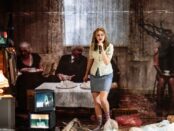
"Safe House" is an amorphous mosaic of sight and sound just out of reach of being any one thing. It is at once a song cycle, memory play, comedy, tragedy, a visual and aural potpourri of sensation resembling a modern avant-garde opera more than a theatrical musical or play with music. Written and directed by Enda Walsh with music by electronic-acoustic composer Anna Mullarkey, the show tells the story of Grace, a young, homeless Irish woman living on a handball court in Galway. According to Walsh, it is a story of survival in the chaotic jumble of memories mixed with dreams and fantasies of a different life. [more]
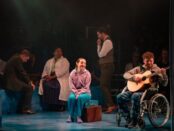
Bitch turns herself inside out in ways sometimes difficult to bear, particularly with her frank, anatomical language, but she communicates her joy and anguish so honestly and unflinchingly that it is all somehow totally fine. "B*tchcraft" is a collaboration between Bitch and her director Margie Zohn. Between them they have crafted a powerful show that is both personal and universal in its emotional heft. The language and imagery are strong, maybe not for everyone, but they resonate with Bitch’s totality. [more]
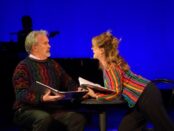
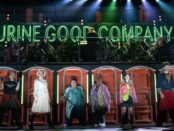
“What an awful name for a musical,” spouts Little Sally (a brilliantly talented Pearl Scarlett Gold) as one of the narrators of the New York City Center Encores’ witty production of the 2001 surprise hit "Urinetown." Yes, it is, but it’s also an entertaining show that actually has inadvertent relevance to today’s audience with its artful jabbing at big business. [more]
If only he had carried through on that idea. We will never know if this staging might have worked as Herskovits has sabotaged all that is best in the original and made it both more confusing and less entertaining. Originally produced with 27 actors, Herskovits has reduced the cast to ten with so much doubling that it is difficult to know who is who. At least one character (Parthy Hawkes) is sometimes played by two actresses simultaneously which does not make for coherency. While the majority of the characters are white, Herskovits has cast it mainly with Black actors who wear sashes across their chest identifying them as white which is distracting rather than edifying. If you have not seen one of the two famed movie versions recently, it is impossible to follow the story line. Some actors switch gender as well as character or race. [more]
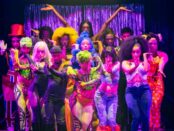
The trio demonstrates that their voices are as supple and fine as they ever were. Each gets to play their best suit: Winokur’s loud, clarion voice, Bundy’s wry wit and Butler’s recounting her hilarious but painfully missed opportunities even though she has appeared in 12 Broadway shows and been nominated for the Tony Award. Their patter and narration is entertaining and hilarious and the musical numbers are both tributes to their careers as well as songs we have not heard them sing before. [more]
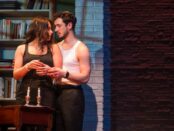
"Welcome to The Big Dipper" is a musical comedy with music and lyrics by Jimmy Roberts and a book by Catherine Filloux and John Daggett (inspired by the play "All Dressed Up and Nowhere to Go" by Filloux). It is under the direction of DeMone Seraphin and is billed as being based on an actual event. However, the nature of the event is never revealed. It is a mixed bag of things that work and don’t, which leads to confusion about what it’s about and where it’s trying to go. [more]
“Glitter and Be Gay” is not just a Leonard Bernstein aria from Candide, but the perfect description of the campily funny new musical "Death Becomes Her" which just hit the Lunt-Fontanne Theatre like a friendly tornado. Double entendres explode in all directions. Take the song titled “For the Gaze,” as a tongue-in-cheek example. Based on the 1992 film of the same name, the creators of the musical—Marco Pennette (book), Julia Mattison and Noel Carey (music and lyrics)—have taken the smarmy, star-studded film and turned it into an entertaining, equally star-studded musical. [more]
Besides the fact that many know the story of the Essex (later told in Melville’s "Moby Dick") or the Mignonette told in The Avett Brothers’ album of the same name, Logan has made his main characters totally generic without given names. We learn too little about each for them to be three-dimensional characters: the Mate, cynical and corrupt; the Captain, at the end of a long career, melancholy and philosophical; Big Brother, religious and judgmental, and Little Brother, innocent and curious. A knife is flashed soon after the survivors find themselves on the lifeboat and we know how that will end. Just like the voyage of the whaling ship, their time on the lifeboat is a waiting game: how long can they survive and who will be the first to go? [more]

While the musicians are exemplary, it is Lipton who does the heavy lifting in the show. With what amounts to a very witty hosting duty, his singing voice is one that is rich and quite comfortable in various genres. Director Leigh Silverman keeps him moving and talking at all times, always engaging the audience even when he is being upstaged by his “Grandpa Morrie,” a Roomba that speaks (and sings) in Roomba-ese. Morrie has the audience wrapped around his finger, rather circuitry, when Lipton asks him to wait backstage and Morrie can’t make it back up the ramp without help. Morrie later duets with Lipton and at one moment stops cold. Lipton’s attempts at restarting Morrie fail (is this what Roomba death looks like?) until bass player Riggs offers a battery from his own mouth to recharge Morrie. The whole audience goes “Awww” and applauds. [more]
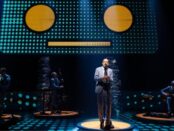
Great in entirely predictable ways, especially its rich musical orchestrations and arrangements from jazz genius Branford Marsalis (he's assisted by Tony Award- winner Daryl Waters), "A Wonderful World" wastes its decided advantages by keeping Armstrong at a distance while incongruously tasking him with narrating his own life. An impassive witness to himself, Armstrong is also a bizarrely unreflective one as he meanders from place to place and wife to wife, before finally appearing with his wronged women to sing "What a Wonderful World" as an ethereal eleven o'clock number on Adam Koch and Steven Royal's protean set. To say the least, it's a lackluster concluding statement on the complexities of Armstrong's marriages, as well as his feelings about a world that, despite all of its "trees of green" and "red roses too," caused him so much pain. [more]
While incorporating the film's most memorable lines and story beats into their book, Bob Martin and the late Thomas Meehan also excised what they could to make room for composer Matthew Sklar and lyricist Chad Beguelin's brassy score, though it's not enough to prevent "Elf the Musical" from being about an hour longer than its cinematic version. Still, fret not accompanying adults, Sklar and Beguelin humorously reward persisting through the added length, with the laugh-inducing cleverness reaching its creative heights in the numbers that respectively kick off Acts I and II: "Happy All The Time," performed by a ridiculously high-spirited elven chorus line, and "Nobody Cares About Santa," a hilarious cry for appreciation from a despairing group of professional St. Nicks. Choreographer Liam Steel delightfully enhances the silliness, especially for the former number in which he cuts his impressively adaptable dancers down to an appropriate size. [more]
By all outward appearances, the Church of St. Paul and St. Andrew on West 86th Street is an unlikely location for a performance space, but deeply nestled into its 2nd floor can be found the West End Theatre, current home of the new country-western musical "Music City," featuring songs and lyrics by successful songwriter J.T. Harding. Harding’s songs have been sung by the likes of Kenny Chesney, Blake Shelton, Keith Urban and others, but they are a perfect fit for this small musical with a big heart. [more]
"Ragtime," thought of as an unwieldy musical with too many characters and too many themes, hit Broadway in 1998. Based on the 1975 E.L. Doctorow novel of the same name, the many storylines were artfully tamed by the team of Terrence McNally (book), Stephen Flaherty (music) and Lynn Ahrens (lyrics). New York City Center has chosen "Ragtime" as its 2004 Annual Gala presentation in a brilliantly streamlined production directed with an eye to its still-important message by Lear DeBessonet with a large and exceptional cast and an excellent orchestra under the baton of James Moore playing William David Brohn’s original rich orchestrations. [more]
Now, director Jamie Lloyd has taken the clunky—but entertaining—Andrew Lloyd Webber musical "Sunset Blvd." (1993) and stripped it of all realistic scenery—and a few songs—hoping to get to the nitty-gritty of its Hollywood characters and period with enormous projections which suggest an expressionistic silent film. The results are decidedly mixed mostly due to a failure to settle on a tone plus some head-scratching additions that have nothing to do with the story. Lloyd, most recently represented by his dreary, stripped-down A Doll’s House and an equally spare production of Pinter’s Betrayal, has shepherded this production with a combination of brilliance and self-indulgence. [more]