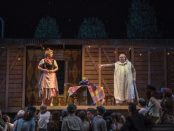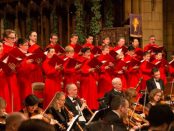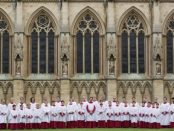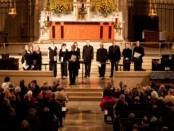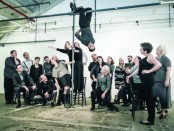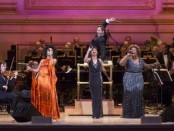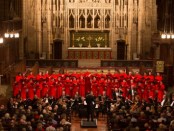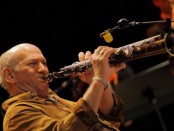
Before the concert, audience members were invited to a special showing of the Zurbarán exhibit at the Frick; the museum and the site of the concert – Madison Avenue Presbyterian Church – are just four blocks apart. The music of the concert was organized around the successful and felicitous conceit of a journey: the concert, according to Keene’s program notes, “follows the progress of the Zurbarán paintings themselves from their creation into the hands of the Bishop of Durham.” According to the ‘geography’ of the program, “the trail starts in Seville, home not only to the artist but to three of the finest composers of Spain’s Golden Age,” then moves to Lima, Peru with the music of Roque Ceruti – because of guesses that Zurbaran’s paintings were “intended for the New World” – and then concludes with the arrival of the paintings in England. Excerpts from George Frederick Handel’s oratorio, "Joseph and His Brethren," whose manuscript is maintained in the Durham Cathedral archives, completed the journey: Jacob and his painted sons had arrived in their permanent – and, with Handel, musical – home. [more]
Eleanor Roosevelt gets the biggest round of applause during the projected cultural icons slideshow as Queen’s “We Are The Champions” is histrionically performed in "Rocktopia." It’s a hokey musical extravaganza that mashes together classical, rock and opera. Singalongs, coerced clapping, dancing in the seats and standing ovations abound. The cheerfully innocuous entertainment level is comparable to that of a bland PBS pledge break concert. [more]
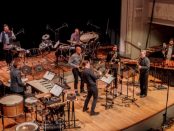
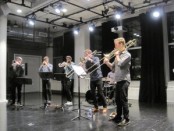
After the four musicians connected by eye contact to exactly synchronize their ‘phones, the piece began; sound emanated entirely slowly – it seemed like almost a minute before a steady something audible materialized from the steel sheet. The extent to which it might be considered ‘music’ remained unclear until the sound was joined, initially almost equally imperceptibly, by definitively musical synthesizer notes. Within the context of steady sound, passages of shifting intensity -- ranging from pianissimo to mezzo forte, never louder – rose and fell in discrete, discernible rhythms. Over the course of the piece, the musicians at each corner took turns playing music; only occasionally did two musicians play at once, producing instrument overlaps of embrace, enhancement, mutual revelation and then separation. Mostly, however, the musicians floated their musical energies in each other’s directions like invisible shimmers through the audience’s fairly settled quiet. [more]
"Jerry Springer - The Opera" is not for opera purists nor is for people who are easily offended by four letter words and other bad language of which there is a multitude. However, its irreverence skewers social, religious and political hypocrisy. The New Group’s production directed by John Rando is one of the most exciting musical theater experiences to be currently obtained in New York. It actually seems more relevant in Trump America where this sort of thing is cable-fodder every night of the week. If you are a dedicated theatergoer, miss this show if you dare. [more]
Of the twelve soloists, several were outstanding. Tenor Scott Mello’s "Nigra Sum" was a virtuosic, romantically charged reveling in sensuality. The soprano duet, "Pulchra Es," with Molly Quinn and Melanie Russell, though it began a little shakily, finished well: as the two women’s voices came together in extremely difficult passages, the modernity of Monteverdi’s “secunda prattica,” or “newer style,” shone. [more]
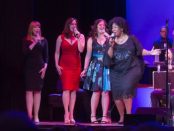
Thus begins the unique show, "Black Light," which is a concert cum confessional. In her sequenced gowns--and there are five costume changes during the 90-minute performance--and with her red lipstick and frizzy, frazzled, dark hair, Jones sometimes provides a strong, alto voice for her intermittent songs, ranging from ballads (“Crossroads”) to hard rock (“Life is motion”). [more]
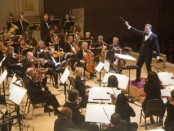
"Candide"’s giddy overture was of course the euphoric opening number of the 92nd Street Y’s Lyrics & Lyricists Series: "Lenny’s Lyricists." This was a splendid concert celebrating Leonard Bernstein’s centennial by spotlighting his collaborators. The novelty here was that we watched footage of a close up of the hands of pianist Ray Wong as he superbly played via video projected onto a large screen as artistic director Rob Fisher turned the score’s pages. [more]
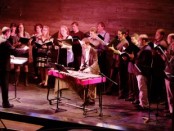
Equally exciting is Lorelei’s celebration of each of the ensemble’s individual voices. Peter Gilbert’s "Tsukimi (Moon Viewing)," commissioned by Lorelei and premiered in 2013, offers each of the nine singers a solo moment within the context of a complex choral work: a subtle Heian dynasty text celebrating anthropological and mythological reverence for the moon provides a splendid vehicle for the examination of each woman’s unique voice and gifts. [more]
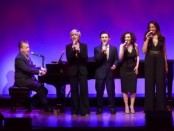
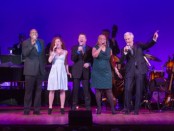
“September” by Earth, Wind and Fire was gorgeously mashed up with Kool & The Gang’s “Celebration” and was the soaring opening number of The New York Pops’ exhilarating rhythm and blues concert, "Heart and Soul." The event celebrated African American History Month and Valentine’s Day. [more]
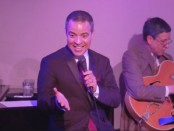
Presiding over the entire piece and working in close artistic collaboration with Keene was actor F. Murray Abraham; he read the King James Bible based narrative from Ascension’s commandingly high pulpit. He was magisterially marvelous: whether speaking the omniscient ancient story-tellers’ words or God’s own, Abraham contributed as much as Keene did to the movement, shape and coherence of the "King David" presentation. [more]
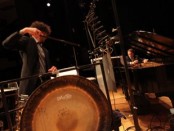
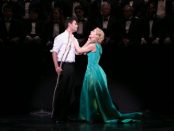
Whether bantering with the audience, displaying energetic dance moves, reciting factual details or performing Bobby Darin’s signature songs, the boyish Groff was sensational. “Splish Splash,” “Mack The Knife” and “If I Were a Carpenter” were all given galvanizing renditions. There was his soaring treatment of the emotional “Once in a Lifetime” near the end of the show. [more]
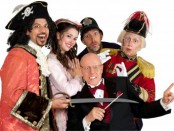
Along with some contemporary updating which always gets a laugh, Albert Bergeret’s direction is sharp and shrewd and his conducting of Sullivan’s sprightly and animated score is equally assured as well. The diction is crystal clear, a must for Gilbert’s intricate and clever lyrics. With an attractive and realistic setting by Albère and pleasingly color-coordinated costumes in blue, white and red (the colors of the Union Jack) by Gail J. Wofford, this is a delectable and entertaining revival for both those familiar with it and others discovering its pleasures for the first time. [more]

The set for the opera was itself a living, organic phenomenon; it functioned as an additional character in the opera. IONE sat near the moveable stage-flats; her back was to the audience, yet she was one of us. Hovering above the stage set were great canvas triangles – mildly billowed faluka sails – on which IONE projected Victorian and Edwardian era images of the British Empire in all its beauty and its ugliness. Priestess and manager, oracle and medium, IONE was at once a participant in the visual commentaries on Kitchener’s internal dramas and their director. [more]
Chen Yi’s music is, in the best possible sense, powerful: it affirms. Musicians and audience alike, at the end of each piece, are strengthened in the continuing determination to do one’s best. The evening’s concluding work, "Sparkle" (1992), a rugged, intricately disciplined wildness of both melody and rhythm, felt like an exposition of new ways of putting sounds together to create music, an immersion in how layering and linearity can coexist. The work’s sudden end – too soon and, simultaneously, at the only possible right moment – was gorgeously big and exciting [more]
The Tallis Scholars’ most recent turn in the Columbia University Miller Theatre Early Music Series was billed as “Heinrich Isaac at 500.” This concert title wasn’t quite accurate: the evening was a more like a bouquet of music by Isaac (c.1450-1517) and three contemporaries, Josquin des Prez (c. 1450-1521), Nicolas Gombert (c. 1495-1560) and John Browne (1453-c. 1500). – What a fabulous bouquet it was! [more]
Fairchild speaks well and communicates much with his physique, but his choreography is repetitive and uninventive. Here was a chance to breathe new life into a too familiar character. All Fairchild could come up with is lurching movements and awkward falls to the floor. He takes the obvious path to create his character with movement when he had a chance to illuminate the Monster’s inner emotions. [more]
Cohen then spoke; he presented the four-movement structure of the piece about to be performed. Although various passages in "Voyagers" evoked the diversity of music offerings on the Golden Record, highlighting “both the fragility and the power of human artistic expression,” the fairly traditionally structured piece was inspired by three main Golden Record offerings – what Cohen referred to as “source material” – a late Beethoven quartet, an Indian Raga and a Renaissance dance. "Voyagers"’ four movements are entitled Cavatina, Bhairavi, Galliard, and Beyond the Heliosphere. [more]
Playing both traditional and modern instruments, usually amplified, all four musicians supplement and expand Ukrainian folk melodies and songs with rhythmic and stylistic adaptations as well as other-culture borrowings from music from as far away as Australia, North Africa, North America and India as well as from other former Russian Empire provinces. The result, unexpectedly, is stunningly coherent. [more]
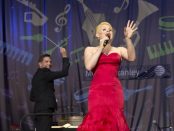
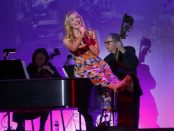
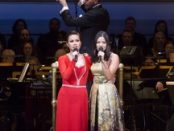
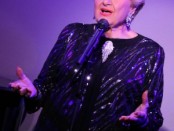
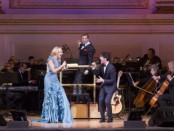
Joni Mitchell’s “River” was given a powerful rendition by guest artist Megan Hilty. The blonde and statuesque Ms. Hilty was a glorious vision wearing a luminous white wedding dress as she sang in her throaty, expressive and emotional voice. In the first act Hilty wore a shimmering black gown. The Broadway performer and star of the television series "Smash" excelled at traditional perennials as well as eclectic selections such as that bittersweet one by Ms. Mitchell. [more]
Like most C4 concerts, this one had a theme: it was an evening of “songs about love – both for and against.” Songs’ ideas and purposes mirrored, echoed, anticipated and challenged each other. The organization of this program, however, was unusual. Small groups of songs from a single piece – internationally acclaimed Bernard Rands’ 1991 "Canti d’Amor," settings of James Joyce poems – framed both the concert as a whole and both of its two parts: Rands’ Joyce songs opened the concert, closed the first half, opened the second half and then closed the concert. [more]
With his commanding and emotionally expressive baritone voice, the eternally boyish Holbrook wearing formal wear, vividly performs a program drawn from show tunes, Hollywood musicals, classical music, jazz and The Great American Songbook. The numbers are connected with his concise and engaging patter. [more]
The two soprano soloists were marvelous. Hélène Brunet combines supple lyricism with technical elegance. Clara Rottsolk’s voice is at once silvery and earthy, delicate and powerful. In their individual arias, both women committed to highly ornamented interpretations; both were able to make ornament feel like a spontaneous, unplanned and experimental development of ideas. In his conducting, Crawford gives his best singers – such as Brunet and Rottsolk – considerable room to make the music their own without ever losing coherence or the appropriate tempo. When singing together, as in “Domine Deus, Rex caelestis,” these sopranos’ voices were beautifully matched. [more]
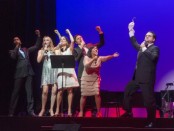
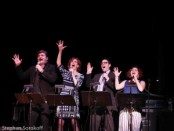
"American Idol" winner Candice Glover, "The Voice"’s Josh Kaufman, "America’s Got Talent"’s Bianca Ryan and the attractive, married couple Peter Hollens and Evynne Hollens, who are popular on YouTube, comprise the youthful cast. They all bulldoze their way through more then 20 classics. The vocal grandstanding is matched with overly expressive gestures and grimaces that invariably crush the meanings of the songs. [more]
Leave it to George S. Kaufman and collaborator Morrie Ryskind (the Marx Brothers’ "The Cocoanuts," "Animal Crackers," "A Night at the Opera" as well as the Gershwins’ "Strike Up the Band"), lyricist Ira and composer George to come up with the first all satirical political musical and be prophetic as well. Led by Tony Award nominees Bryce Pinkham, Denée Benton, Kevin Chamberlin, Brad Oscar and Tony winner Chuck Cooper, this concert adaptation proves that there is still life in the 86-year-old musical. [more]
Christen Lien is an exciting artist, playing innovative music for viola, combining formal and informal, classical and electronic elements. She brings an eclectic intelligence, alternately divergent and focused, to her work; her confident musicianship, based on both technical facility and wide-ranging experimentation, enables her to develop a performance style that is simultaneously intense, serious and seductive. Lien talks to her audience; she tells stories, developing the intellectual contexts for her music. She amplifies her viola and uses loop pedals to create complex layers of sound; in her all-out, passionate performing, she describes the constant changes of human response to the complex project of being alive. [more]
King’s "Dolores Claiborne" would seem a strange choice for dramatization as the book is a monologue told entirely by its protagonist at a police interrogation over a murder on Little Tall Island off the coast of Maine. Though J.D. McClatchy’s streamlined libretto is very faithful to the book (while eliminating some characters and complications), it never approximates the compelling and wry narrative voice in Dolores’ first-person tale which makes her sympathetic and gives a sense of urgency to her story. Mezzo-soprano Lisa Chavez creates a believably passive character as a maid/companion to a selfish, rich woman whom she is accused of killing and an abused wife saddled with an alcoholic and brutal husband who died 30 years earlier but she brings no sympathy to the role. She just seems a tired, traumatized woman, not very interesting for the leading character in an opera. [more]
Possessed of a soaring tenor baritone voice that forcefully hits every note, an immensely likeable persona and boundless energy as he dances with brio, Moss commands the stage for 70 minutes. Periodically overcome with emotion, he gracefully collects himself and moves on. It’s a moving display of therapeutic showmanship. [more]
Because the first three pieces of the program had established an intellectual across-time dialogue between Bach and Glass and an examination of Glass’ Bach ‘ancestry,’ the unabashedly Romantic quality of Glass’ new piece came as a surprise: in spite of the presence of familiar Glass rhythmic and harmonic motifs, the concerto contained new cadences and directions. In both piano-strings simultaneities and in the four piano cadenzas, explorations of uncertainty and of distances from longed-for resolutions felt like new territory for Glass. The piece as a whole moved from monumentality through moments of increasing quiet to Dinnerstein’s final poignant movement into silence. [more]
This 1877 operetta, now celebrating its 140th anniversary, has been reduced to the nine major roles and the chorus has been eliminated. The result is a streamlined version that moves along at a steady pace under Albert Bergeret’s music and stage direction. The problem with the production is that although this is listed as a comedy, the new NYGASP revival wasn’t very funny except for several contemporary references such as “Amazon Prime” and the “changes at the White House.” [more]
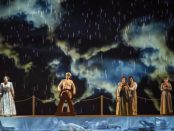
The newly reconstituted New York City Opera opened its second full season with a shared production of Puccini’s rarely performed "La Fanciulla del West" created in collaboration with the Teatro di Giglio di Lucca, Italy; Teatro Lirico di Cagliari, Sardinia; and Opera Carolina of Charlotte, North Carolina. Ivan Stefanutti’s production is solid but old-fashioned and traditional except for huge projections that fill the back wall of the three sets, some which work and some which don’t. Conducted by James Meena, Opera Carolina’s general director and principal conductor, with a cast led by soprano Kristin Sampson in the title role, both the orchestra and cast gave sturdy though only intermittently exciting performances in this unusual Italian opera. [more]
Projected titles indicate place and year—beginning with Arles, 1888 and progressing until van Gogh’s suicide—which we hear as an offstage gunshot—in July of 1890. The audience is treated to Vincent’s thoughts on his painting technique, his poverty, his mental health, his fellow artists, stars, sunflowers, all interrupted by chamber music by Debussy, Fauré, Chausson and Franck played—in various combinations—by Henry Wang (violin), Yuval Herz (violin), Chich-Fan Yiu (viola), Timotheos Petrin (cello), Max Barros (piano) and Renana Gutman (piano). [more]
Interestingly, some of the most raucously explicit material of protest came not from the Peace and Social Justice Concert 24 but from the Wil(helms/liams)burg Concert 26, a collaboration of musicians and performing artists from Brooklyn and Hamburg, Germany. In the opening work, "Trumpen," for clarinet, piano, cello and laptop performers, Georg Hajdu created a piece based on the destructive and fracturing words of Donald J. Trump. This piece introduced the Unheard-of//Ensemble – Ford Fourqurean/clarinet, Daniel Anastasio/piano and Thea Mesirow/cello – who played throughout the concert, demonstrating remarkable technical control and versatility; this group “is a contemporary chamber ensemble dedicated to the development and performance of new music by living composers.” In "Trumpen," Trump’s words are altered and devolved into an ever-increasing intensity of chaos; the audience is witness to the mess – and is part of it as well – as this replicates political protest at its best, at once ancient and contemporary. [more]
n light-hearted Rationalize (concert 27), composer Cody Brookshire combined found and manipulated sounds created by the audience with live music on bass clarinet and marimba. Brookshire created SynkroTakt, an audio streaming technology. Before the piece began, the composer instructed the audience on the seven-step procedure required to enable their devices to create sounds streamed into synchronous audio tracks; the audience, in this way, became the collective ‘artist/musician’ and provided one half of the ‘duet’ of electronic sounds and live instruments. The result was an unexpectedly sweet and pretty piece, a bauble in which sounds produced by an unusually concocted combination of chance and intention became a contemporaneous agent of creativity. [more]