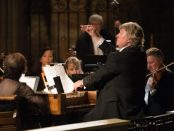
The Tallis Scholars’ most recent turn in the Columbia University Miller Theatre Early Music Series was billed as “Heinrich Isaac at 500.” This concert title wasn’t quite accurate: the evening was a more like a bouquet of music by Isaac (c.1450-1517) and three contemporaries, Josquin des Prez (c. 1450-1521), Nicolas Gombert (c. 1495-1560) and John Browne (1453-c. 1500). – What a fabulous bouquet it was! [more]
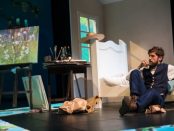
Fairchild speaks well and communicates much with his physique, but his choreography is repetitive and uninventive. Here was a chance to breathe new life into a too familiar character. All Fairchild could come up with is lurching movements and awkward falls to the floor. He takes the obvious path to create his character with movement when he had a chance to illuminate the Monster’s inner emotions. [more]
Cohen then spoke; he presented the four-movement structure of the piece about to be performed. Although various passages in "Voyagers" evoked the diversity of music offerings on the Golden Record, highlighting “both the fragility and the power of human artistic expression,” the fairly traditionally structured piece was inspired by three main Golden Record offerings – what Cohen referred to as “source material” – a late Beethoven quartet, an Indian Raga and a Renaissance dance. "Voyagers"’ four movements are entitled Cavatina, Bhairavi, Galliard, and Beyond the Heliosphere. [more]
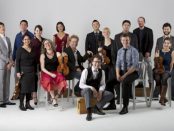
Playing both traditional and modern instruments, usually amplified, all four musicians supplement and expand Ukrainian folk melodies and songs with rhythmic and stylistic adaptations as well as other-culture borrowings from music from as far away as Australia, North Africa, North America and India as well as from other former Russian Empire provinces. The result, unexpectedly, is stunningly coherent. [more]
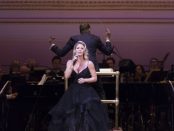
Joni Mitchell’s “River” was given a powerful rendition by guest artist Megan Hilty. The blonde and statuesque Ms. Hilty was a glorious vision wearing a luminous white wedding dress as she sang in her throaty, expressive and emotional voice. In the first act Hilty wore a shimmering black gown. The Broadway performer and star of the television series "Smash" excelled at traditional perennials as well as eclectic selections such as that bittersweet one by Ms. Mitchell. [more]
Like most C4 concerts, this one had a theme: it was an evening of “songs about love – both for and against.” Songs’ ideas and purposes mirrored, echoed, anticipated and challenged each other. The organization of this program, however, was unusual. Small groups of songs from a single piece – internationally acclaimed Bernard Rands’ 1991 "Canti d’Amor," settings of James Joyce poems – framed both the concert as a whole and both of its two parts: Rands’ Joyce songs opened the concert, closed the first half, opened the second half and then closed the concert. [more]
With his commanding and emotionally expressive baritone voice, the eternally boyish Holbrook wearing formal wear, vividly performs a program drawn from show tunes, Hollywood musicals, classical music, jazz and The Great American Songbook. The numbers are connected with his concise and engaging patter. [more]
The two soprano soloists were marvelous. Hélène Brunet combines supple lyricism with technical elegance. Clara Rottsolk’s voice is at once silvery and earthy, delicate and powerful. In their individual arias, both women committed to highly ornamented interpretations; both were able to make ornament feel like a spontaneous, unplanned and experimental development of ideas. In his conducting, Crawford gives his best singers – such as Brunet and Rottsolk – considerable room to make the music their own without ever losing coherence or the appropriate tempo. When singing together, as in “Domine Deus, Rex caelestis,” these sopranos’ voices were beautifully matched. [more]
"American Idol" winner Candice Glover, "The Voice"’s Josh Kaufman, "America’s Got Talent"’s Bianca Ryan and the attractive, married couple Peter Hollens and Evynne Hollens, who are popular on YouTube, comprise the youthful cast. They all bulldoze their way through more then 20 classics. The vocal grandstanding is matched with overly expressive gestures and grimaces that invariably crush the meanings of the songs. [more]
Leave it to George S. Kaufman and collaborator Morrie Ryskind (the Marx Brothers’ "The Cocoanuts," "Animal Crackers," "A Night at the Opera" as well as the Gershwins’ "Strike Up the Band"), lyricist Ira and composer George to come up with the first all satirical political musical and be prophetic as well. Led by Tony Award nominees Bryce Pinkham, Denée Benton, Kevin Chamberlin, Brad Oscar and Tony winner Chuck Cooper, this concert adaptation proves that there is still life in the 86-year-old musical. [more]
Christen Lien is an exciting artist, playing innovative music for viola, combining formal and informal, classical and electronic elements. She brings an eclectic intelligence, alternately divergent and focused, to her work; her confident musicianship, based on both technical facility and wide-ranging experimentation, enables her to develop a performance style that is simultaneously intense, serious and seductive. Lien talks to her audience; she tells stories, developing the intellectual contexts for her music. She amplifies her viola and uses loop pedals to create complex layers of sound; in her all-out, passionate performing, she describes the constant changes of human response to the complex project of being alive. [more]
King’s "Dolores Claiborne" would seem a strange choice for dramatization as the book is a monologue told entirely by its protagonist at a police interrogation over a murder on Little Tall Island off the coast of Maine. Though J.D. McClatchy’s streamlined libretto is very faithful to the book (while eliminating some characters and complications), it never approximates the compelling and wry narrative voice in Dolores’ first-person tale which makes her sympathetic and gives a sense of urgency to her story. Mezzo-soprano Lisa Chavez creates a believably passive character as a maid/companion to a selfish, rich woman whom she is accused of killing and an abused wife saddled with an alcoholic and brutal husband who died 30 years earlier but she brings no sympathy to the role. She just seems a tired, traumatized woman, not very interesting for the leading character in an opera. [more]
Possessed of a soaring tenor baritone voice that forcefully hits every note, an immensely likeable persona and boundless energy as he dances with brio, Moss commands the stage for 70 minutes. Periodically overcome with emotion, he gracefully collects himself and moves on. It’s a moving display of therapeutic showmanship. [more]
Because the first three pieces of the program had established an intellectual across-time dialogue between Bach and Glass and an examination of Glass’ Bach ‘ancestry,’ the unabashedly Romantic quality of Glass’ new piece came as a surprise: in spite of the presence of familiar Glass rhythmic and harmonic motifs, the concerto contained new cadences and directions. In both piano-strings simultaneities and in the four piano cadenzas, explorations of uncertainty and of distances from longed-for resolutions felt like new territory for Glass. The piece as a whole moved from monumentality through moments of increasing quiet to Dinnerstein’s final poignant movement into silence. [more]
This 1877 operetta, now celebrating its 140th anniversary, has been reduced to the nine major roles and the chorus has been eliminated. The result is a streamlined version that moves along at a steady pace under Albert Bergeret’s music and stage direction. The problem with the production is that although this is listed as a comedy, the new NYGASP revival wasn’t very funny except for several contemporary references such as “Amazon Prime” and the “changes at the White House.” [more]
The newly reconstituted New York City Opera opened its second full season with a shared production of Puccini’s rarely performed "La Fanciulla del West" created in collaboration with the Teatro di Giglio di Lucca, Italy; Teatro Lirico di Cagliari, Sardinia; and Opera Carolina of Charlotte, North Carolina. Ivan Stefanutti’s production is solid but old-fashioned and traditional except for huge projections that fill the back wall of the three sets, some which work and some which don’t. Conducted by James Meena, Opera Carolina’s general director and principal conductor, with a cast led by soprano Kristin Sampson in the title role, both the orchestra and cast gave sturdy though only intermittently exciting performances in this unusual Italian opera. [more]
Projected titles indicate place and year—beginning with Arles, 1888 and progressing until van Gogh’s suicide—which we hear as an offstage gunshot—in July of 1890. The audience is treated to Vincent’s thoughts on his painting technique, his poverty, his mental health, his fellow artists, stars, sunflowers, all interrupted by chamber music by Debussy, Fauré, Chausson and Franck played—in various combinations—by Henry Wang (violin), Yuval Herz (violin), Chich-Fan Yiu (viola), Timotheos Petrin (cello), Max Barros (piano) and Renana Gutman (piano). [more]
Interestingly, some of the most raucously explicit material of protest came not from the Peace and Social Justice Concert 24 but from the Wil(helms/liams)burg Concert 26, a collaboration of musicians and performing artists from Brooklyn and Hamburg, Germany. In the opening work, "Trumpen," for clarinet, piano, cello and laptop performers, Georg Hajdu created a piece based on the destructive and fracturing words of Donald J. Trump. This piece introduced the Unheard-of//Ensemble – Ford Fourqurean/clarinet, Daniel Anastasio/piano and Thea Mesirow/cello – who played throughout the concert, demonstrating remarkable technical control and versatility; this group “is a contemporary chamber ensemble dedicated to the development and performance of new music by living composers.” In "Trumpen," Trump’s words are altered and devolved into an ever-increasing intensity of chaos; the audience is witness to the mess – and is part of it as well – as this replicates political protest at its best, at once ancient and contemporary. [more]
n light-hearted Rationalize (concert 27), composer Cody Brookshire combined found and manipulated sounds created by the audience with live music on bass clarinet and marimba. Brookshire created SynkroTakt, an audio streaming technology. Before the piece began, the composer instructed the audience on the seven-step procedure required to enable their devices to create sounds streamed into synchronous audio tracks; the audience, in this way, became the collective ‘artist/musician’ and provided one half of the ‘duet’ of electronic sounds and live instruments. The result was an unexpectedly sweet and pretty piece, a bauble in which sounds produced by an unusually concocted combination of chance and intention became a contemporaneous agent of creativity. [more]
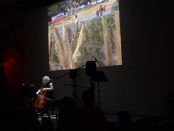
In spite of the Festival’s lengthy booklet and daily concert updates, the rich creative vitality of the electroacoustic musical community remains only tangentially documented: composers and performers clearly work in close collaboration. Internationally recognized cellist Madeleine Shapiro, for instance, director of the important NewMusicMannes ensemble at the New School’s Mannes College of Music, is on the NYCEMF 2017 Steering Committee, and performed in several of the 2017 Festival’s concerts. She is clearly the sort of artist who can turn her instrument into both the composers’ muse and their servant. Shaprio’s ability to incorporate the cello’s entire history into its creative use in contemporary classical and experimental music suggests expanded incorporations of cello sounds in new music to contemporary composers. [more]
In the seven concerts of the second half of the 2017 New York City Electroacoustic Music Festival held this month at National Sawdust in Brooklyn, New York, the full diversity and eclectic versatility of electroacoustic music was on vibrant, energetic display; the densely packed weekend of music was exciting, sometimes disconcerting and sometimes thrilling, and always fascinating. Sixty-six works by sixty-six composers were performed … a dizzying array of instruments, equipment, performers, sensibilities and effects! [more]
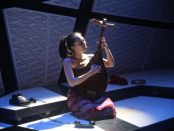
After fifteen years of formal study, Shyu incorporates five distinct music traditions in her newest work: “epic storytelling (Pansori), East Coast shaman music (DongHaeAhnByeolShinGut), and Binari, usually performed as a blessing for an audience, all from Korea; music from sub-districts Aileu and Atauro ferom East Timor; Hengchung Folk Song with moon lute from Taiwan; Ledhekan, which combines Javanese dance with improvisational singing (Sindehenan) from Indonesia; and the ‘speaking-the-song’ or ‘katari’ with Japanese bias, the rare 4-stringed instrument originally used by monks and priests.” [more]
C4’s last concert of the season was a typical C4 concert. The concert had one intermission; in both halves of the concert, there were one or two pieces that were new to C4 and one or two that they’d performed before. In this concert, there were also three premieres. Some pieces were a cappella; some were accompanied by a somewhat unexpected set of instruments, in this case, electronic … hence this concert’s name, “Electric: Choral works with electrified ensemble.” Almost all of the composers featured were either current or former C4 members; singers conducted each others’ works. Individual singers moved easily between solo parts and “just” being a section member. The extensive program notes were, as always, extremely useful. [more]
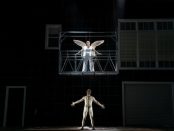
By eliminating most of the extended fantasy elements of the play, they reduced the storyline to the domestic turbulence of two couples and a deservedly ugly portrait of Roy Cohn. Add in a visit by the iconic Bethesda Fountain Angel (here totally generic) and some very dramatic, brass-heavy music and you have this intriguing production by New York City Opera that succeeds as an opera as long as one is not familiar with the source material. What seemed heavy going and existential in the original comes across on a much more human level in the opera. [more]
The artistic team responsible for this "Butterfly" made radical decisions and changes. Puccini’s original three acts of linear story – love and “wedding,” waiting, betrayal and death – are reorganized and abbreviated into three scenes of waiting, remembered love, and then betrayal. Some minor characters in the original opera are eliminated to create a caste of just five singing characters. The entire orchestra is reduced to a chamber orchestra of just six musicians, the Cantata Profana. The adaptation of Puccini’s orchestral score for this small chamber group by Daniel Schlosberg is remarkable: unexpectedly, its absolute faithfulness to Puccini’s musical intent at almost every turn made up for the diminished number of musicians. [more]
The show’s writer and host, Rob Berman, introduced many of the songs and, essentially, gave us the story of Lerner and Loewe’s difficult, on-again, off-again partnership. Referring to them, at one point, as an “odd couple,” Berman explained that the composer Frederick (or “Fritz”) Loewe was an “old world” European, and lyricist Alan Jay Lerner a “New York sophisticate,” who was educated in England. Berman also claimed that the common denominator for all of their musicals was a kind of “idealism,” making the pair “dreamers.” [more]
From the beginning, one core component of Rosenbaum’s mission has been the cultivation of a contemporary American repertoire and the regular commission of new works. Rosenbaum is, in fact, an enthusiastic champion of young composers. This May concert, consisting of ten new works, reflected this focus … and was a wonderful celebration of young talent and achievement. [more]
But the concert didn’t have the satisfaction of a big blockbuster – such as Haydn’s Creation, with which the season began – or of two or three masterworks. Music of the Anglican tradition is the bone and blood of St. Thomas’ work: it’s the music in which the choir excels. The formal musical curriculum in which St. Thomas students are immersed serves them well in any musical endeavor or style, but the Anglican vocabulary is the one these young musicians are most comfortable with. In this particular concert, the music of non-Anglican-tradition composers was well presented, demonstrating the skills of the singers, both young and old, but wasn’t thrilling. [more]
"Elliott loves bebop" is a much more satisfying piece than either "Sonerna" or "No slash" on their own. It would be no matter what. But the experience of having listened to the two quartets one after the other immediately before the octet immeasurably enriched the experience of hearing the octet: the octet’s complexities were more intelligible and the patterns of their interconnections were more clear. Without compromising or simplifying the work’s density, its meanings were more accessible. [more]
The sensational highlight of the concert was a medley from "South Pacific." “I’m Gonna Wash That Man Right out of My Hair” had the luminous Ashley Park euphorically performing that showstopper. Ms. Park was filling in for the previously announced and indisposed Laura Osnes. Female members of The Camp Broadway Kids Ensemble, who were dressed in colorful outfits and sailor caps, wonderfully joined Park. This thrilling production number was representative of Cynthia Thole’s vigorous direction and choreography. [more]
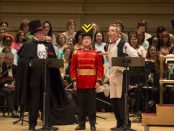
Victor Herbert’s 1903 operetta "Babes in Toyland" was presented by MasterVoices (formerly The Collegiate Chorale), in a splendid concert production, to celebrate its 75th anniversary. Music director and artistic director, Ted Sperling superbly conducted the dynamic Orchestra of St. Luke's, and the terrific MasterVoices choral group, that appeared onstage with them. [more]
“A really fun mix-tape of some our favorite songs…with no through line,” was how Steven Reineke, the exuberant music director and conductor of The New York Pops, described this delightful tribute to notable singer-songwriters from the past 60 years. [more]
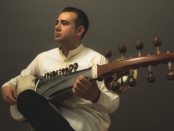
Thanking his packed audience at Le Poisson Rouge for coming to hear him play, Alam Khan described his music on this evening as a tribute to his father, Ali Akbar Khan, whose ninety-fifth birthday it would have been. But it was more than an ancestral honoring: it was a tribute to a rich centuries-old tradition of Hindustani classical music. [more]
"Vespers of 1610" is a big and oddly sprawling work. It makes no liturgical sense, and, in terms of texts, has little programmatic unity beyond a consistent Marian devotion. But it is a coherent whole of musical and spiritual experience. It gives the impression of limitlessness, as though there were no end to what Monteverdi could have kept on telling us, precisely because the sacredness and meaning of God’s sacred words are infinite. [more]
Over the course of Salif Keita’s recent appearance at The Town Hall there was a story whose shape reflected both Keita’s identity and his music. At 7:00 p.m., there was a question-and-answer session with Keita, musician and writer Banning Eyre of www.afropop.org, and translator Isabelle Dupuis. By the end of the evening, audience and performers were inseparably merged; singing and dancing had become one, and Keita had made us all his own. Far from needing any explanation or translation, the music of Salif Keita is entirely universal. [more]
This production was a co-effort with Fondazione Teatro Lirico di Cagliari whose orchestra joined forces with the New York City Opera Orchestra under the baton of Ira Levin who brought out every bit of color in the music. Maestro Levin was sensitive to the needs of the singers, knowing just how to mold the orchestra’s sounds so that their voices soared over the often over-orchestrated score (not helped by the wrong-headed scrim used in the forest scenes). [more]
Beginning in the 1980s, Glass and Suso collaborated on several projects. Genet’s difficult, demanding, essentially un-actable and relentlessly fracturing play, "The Screens," elicited from Glass and Suso unexpectedly warm and affirming music. The setting for Genet’s play – the wretchedness of the French Algerian War – calls for music that is both European and African, but to imagine Glass’ contribution as “the European one” and Suso’s as its African opposite is to misunderstand the creative relationship. [more]
LoftOpera is a feisty little company that operates around Brooklyn, especially Bushwick. They are giving" Otello" in LightSpace Studios, a disco on Flushing Avenue about the size of a high school gymnasium. There’s a small orchestra (27, about half the size Rossini wrote for), kept under tight but lyrical control by the company’s maestro, Sean Kelly. The singers do not appear to be looking at him for cues while they are enthusiastically playing out the story, but they only got lost once at Saturday night’s performance. [more]
“It looks like when you got your Kennedy Center Honor!” exclaimed Mr. Reineke, as a spotlight shone on John Kander, who was attending the concert from a first tier box at Carnegie Hall. He grinned to a thunderous reaction. Sitting with him, was Susan Stroman, who has directed several Kander and Ebb productions. Near the end of the show, at Reineke’s instigation, the house lights went up, and the orchestra and the audience joined in for “Happy Birthday” to Kander. [more]
Neither a “Western composer” nor a “Japanese composer,” Mochizuki hasn’t sought to manufacture some sort of mix-and-match blend. She doesn’t borrow or build add-ons. Instead, seeking inspiration in nature on the one hand and in human projects as diverse as photography, genetics and cooking on the other, she produces music that is about both being and story. Embedded within every piece one beginning after another, her stories unfold from each; then she builds them into each other. Though she incorporates elements of theater in the use of lighting and musicians’ movements around the stage, her music is fundamentally unpretentious and unfussy; her writing is equally straight-forward and optimistically fresh. [more]
This is serious work. Without defiance of traditional or conservative contemporary classical music simply for mere defiance’s haughty sake, Furrer is developing his own particular vocabulary. And successful performance of Furrer’s music requires serious musicians. The musicians of Either/Or are a good match for this composer. Their technical skills are superb, marked by both muscular stamina and virtuosic creativity; equally important, their willingness to take performance risks is grounded in intellectual and artistic integrity. [more]
The second work of the evening was the world premiere of Ivan Moody’s Vespers Sequence. In careful, clear program notes, Moody described his goals in his compositions in general and in this new Vespers Sequence in particular: he seeks to “bring the concepts and principles underlying Orthodox spirituality … into dialogue with modernity” … in the “creation of a specifically Orthodox para-liturgical repertoire that brings together liturgy and concert.” Moody collaborated closely with New York Polyphony in conceiving and then finalizing this work; although the sacred texts and many of the originating aesthetic impulses of the work are ancient, the overall feel, in this premiere performance, was of something vital and contemporary. [more]
The show began with Arlen’s first hit, “Get Happy,” 1930, and ended with his 1939 score for the MGM film, "The Wizard of Oz." The first half of the evening was devoted to Arlen’s stand-alone popular tunes, his songs written for the Cotton Club Revues (1932-1934), and musical numbers for early sound movies. Blackhurst recounted how Arlen (born Hyman Arluck of Buffalo, New York), was a child prodigy singing in his father’s choir when he was seven, forming his own bands in his late teens, and occasionally appearing as a vocalist with them on records in his twenties. [more]
The concept of Love for Sale, though not particularly original, is not a bad one, except for one very important factor: Ms. Burke is not up to either the singing or acting demands of Love for Sale, a voyage from innocence to jaded sophistication as told in mostly dark, melodramatic songs, ironically influenced by the American films that flooded Europe in the twenties and thirties. It’s an extraordinarily difficult repertoire that constantly threatens to be silly expressions of impossibly colorful and desperate characters. [more]
Linda Lavin, padded and badly bewigged, comes across more like a Jewish yenta than the victim of the vagaries of Eastern European warfare. She has only one song, “Easily Assimilated,” a silly attempt at seduction, which is a shame. This character had several numbers in the original, including one that actually referred to why she is “missing the half of my backside.” Lavin is a star, but is ill-used here. [more]
In keeping with Sullivan having been hit over the head, the cast is clothed in a motley collection: a combination of late Victorian and Japanese styles. Some are in all Japanese, some in all Victorian, most are in a combination of the two. Even the Victorian costumes have baroque additions to make them look exotic. The women all wear Victorian gowns with bustles open in the back just as though they had not finished dressing. The concept while colorful is quite a mess with every possible variation on stage at the same time. [more]
It was a Tallis-perfect performance. Palestrina has long been one of the most sure-fire dazzling jewels in the Tallis Scholars' treasury. In writing sacred music, Palestrina made his particular kind of beauty – elegance, intellect, decorous sensuality – a kind of theology of mediation, a meeting place for the human and the divine. The Tallis precision of diction and tone and their ability to reveal every rhythmic and melodic nuance in the music they sing make Palestrina marvelous. The bright acoustic features of St. Mary the Virgin provide a wash of light on the singing. [more]
Green’s dry delivery is in the Coward manner, crisp, almost spoken to the music, with impeccable diction. Shrubsole’s accompaniment supports him without ever getting in the way. The most famous song is probably “I Went to a Marvelous Party,” and there are five songs from Coward’s last all-original Broadway musical "Sail Away." However, there are also unfamiliar songs from "After the Ball" (“Something on a Tray”) and" Pacific 1860" (“I Saw No Shadow”), London shows that never made it to Broadway. In addition is “London Pride,” recently heard in the rediscovered post-war musical, "Hoi Polloi." Stand-alone songs include the poignant “There’s No More to Say about Love” and “I Travel Alone.” [more]
“The Little Drummer Boy” was an emotionally shattering highlight of Richard Holbrook: "Always December." Mr. Holbrook’s performance of this perennial was revelatory due to the intensity he brought to it. This was performed in tandem with the equally moving “Some Children See Him.” [more]
The beautiful wreath and garlands hanging above the stage were festively lit up for the wonderful finale, the “Jingle Jangle Sing-Along.” All of the performers appeared and encouraged the audience to join in for convivial group singing of “Rudolph the Red Nosed Reindeer,” “Frosty the Snowman,” “Here Comes Santa Claus,” and “Jingle Bells.” [more]
For those who could not understand the lyrics of Traore's songs – he sang in Mali's French – each song was an experience of four interconnected musical sounds: the calabash thump and click rhythms, the harmonica, the amplified acoustic guitar, and Traore's voice. The songs' lyrics – love songs, folk tales, celebrations, imprecations – added particular locations and stories to what, all together, was a full, rich exploration of human experience through the lens of the blues, of hard-won wisdom and infinite empathy for joy and anguish, for hope and despair. [more]
The consistency – the from-the-very-beginning wholeness – of Bach's genius was clear in this chronological arrangement. The kinds of writing techniques and subjects – the sequences and suspensions, chromaticisms and counterpoint intricacies – that Bach transformed from craft common to hundreds of composers to art unique to only a few became, over the years, Bach's vehicles for examinations of all aspects of being human. In this single program, Crawford's choice of music from almost all major liturgical seasons enabled his singers to present grief and joy, despair and hope, prayer and praise. And this they did marvelously. [more]
Joined by percussionist John Ferrari and conductor Jeffrey Means, the five members of the Da Capo Chamber Players – Curtis Macomber/violin, Chris Gross/cello, Patricia Spencer/flute, Meighan Stoops/clarinet and Steven Beck/piano – recently presented a concert inspired by the vibrant, important music of Milton Babbitt (1916-2011) on the occasion of the centennial of his birth. One piece was written by Babbitt himself, but all the other pieces, ranging in date from 1981 to 2013, were written by contemporary composers who at one point or another had studied with Babbitt at either Princeton or Juilliard. [more]
Performed the evening before the American election, the theme and purpose of the concert – remembrance of John F. Kennedy and Martin Luther King, Jr., two “outstanding stewards of humanity,” in Merriweather's words, whose lives were cut short by violence – embodied for musicians and audience alike art's core purposes. Art locates, grounds and inspires us; it gives us vocabularies for understanding ourselves. In the case of the works on this program, the American music of remembrance, contained in pieces by Steven Stucky and David Hurd, reminds us that moral and political conscience transcends individual lives and is strong within us all, even when our heroes are slain; and Mozart's "Requiem" calls up the universality of hope for salvation and pleadings for peace. [more]
Music director Steven Reineke led a perfectly respectable concert with the help of The Soldiers’ Chorus of The U.S. Army Field Band (First Lieutenant Alexandra Borza, Associate Bandmaster), a robust ensemble that proved itself song after song, including several songs in which soloists emerged to sing as in Barry Manilow’s “Let Freedom Ring” and the Toby Keith/Chuck Cannon “American Soldier.” [more]
From the very first opening bars of the "Chaos" overture, Hyde set the tone for the evening: conducting with gentlemanly authoritativeness, Hyde led the Orchestra of St. Luke's – who were all in exceptionally fine form – in a performance of expansive energy and optimism. Theologically, God's working material for his creation may have been unfathomably chaotic and formless, but in this particular artistic account of creation, Haydn's description of chaos is so informed by elegance, wit and bravura that the primordial chaos seems to have been imbued with goodness. [more]
Gordon created the role of Gertrude Stein with mezzo-soprano Stephanie Blythe in mind. Blythe’s monumental presence, thanks to a towering, charismatic, forceful voice, is meant to arrest and command attention. Blythe captures Stein’s complicated personality – her genius, her stalwartness, her humor and her occasional, brutal judgments about the artistic quality of her bon mots. [more]
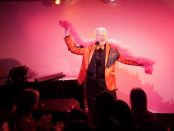
"Lavender Songs: A Queer Cabaret in Weimar Berlin" has the mature and slim Mr. Lawrence in drag virtually for the entire length of the performance. In a dirty-blonde curled wig, his face garishly made up, twirling a red and purple boa, and wearing a sleeveless sequined black dress, Lawrence is like an Otto Dix painting come to life. [more]
In the first concert of the 2016-2017 Composer Portraits season at Columbia University School of the Arts' Miller Theatre, current music of American composer John Zorn (b. 1953), including five premieres, was presented and enthusiastically received. More accurately: Zorn's music-making – his understanding of individual composing and collegial collaborating as interconnected projects – was exuberantly celebrated. [more]
Introducing what he dubbed a pair of “Comedies of Crime,” NYGASP’s artistic director Albert Bergeret offered what he said was a first of a new series for the company: intimate performances of works by Sir Arthur Sullivan in the jewel box Marjorie S. Deane Little Theater performed to one piano, rather than to the usual full orchestra. In addition, the cast of "Trial by Jury" was comprised of the NYGASP’s Wand’ring Minstrels, a quintet of singers made up from the company, rather than using the full chorus, while the production of "Cox and Box" featured a newly edited version by singer/director David Macaluso. The new format for these delightfully entertaining productions had their advantages and disadvantages. [more]