Music
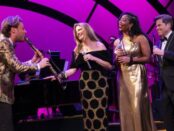
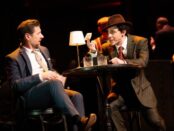
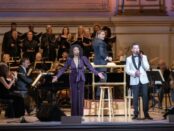
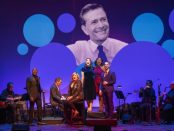
Legendary composer Burt Bacharach died in 2023 and it has taken until now for there to be a fitting stage tribute to his 1,000 song output (mainly written with lyricist Hal David) which includes six Grammy Awards and three Academy Awards. Entitled Going Bacharach: The Songs of an Icon, the musical revue has been conceived by producer Jack Lewin along with Will Friedwald (who has been called “the poet laureate of vintage pop music,”) musical supervisor Tedd Firth and musical director Adrian Galante, who is also responsible for the arrangements and orchestrations as well as playing piano and clarinet in the show. While Bacharach was best known for his mellow sound as sung by Dionne Warwick who recorded most of the songs in the show, the volume of this Going Bacharach is very loud, though this may be the fault of sound designer Matt Berman. Those of us who grew up with these songs won’t recognize the arrangements while younger people may be pleased to experience them for the first time. [more]
Hildegard
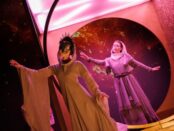
Sarah Kirkland Snider’s first opera arrives with a confidence that feels almost paradoxical: it is at once tightly focused and lavishly expansive, a work that fixes its gaze on a single hinge in medieval history while allowing the implications of that moment to ripple outward in all directions. "Hildegard" does not so much resurrect Hildegard von Bingen as acknowledge what she has always seemed to be—a figure who belongs as much to myth as to chronology, a woman whose historical footprint feels improbably modern, even futuristic. [more]
Amahl and the Night Visitors
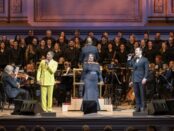
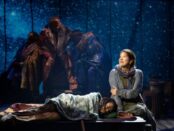
Albert Rhodes, Jr. and Joyce DiDonato in a scene from the Lincoln Center Theater and the [more]
The New York Pops: “A Place Called Home” with Megan Hilty
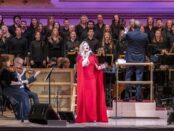
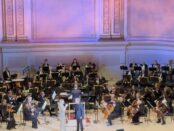
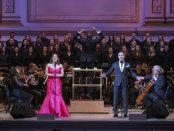
The opening sequence established that tone. “Deck the Hall” and “We Need a Little Christmas” moved briskly and confidently, their energy functional rather than decorative. Reineke kept the wit light and the pacing tight. When guest artist Megan Hilty entered for “It’s the Most Wonderful Time of the Year,” she did so not with flash, but with command — a voice arriving fully present, already in conversation with the orchestra. This was Hilty’s second Christmas concert with The Pops. The first came eight years ago, shortly after her son was born. Friday night, that same son sat in the audience, now eight years old. The fact wasn’t underlined from the stage, but it registered — not as sentiment, but as grounding. There was a sense of continuity in her presence, a confidence shaped over time. [more]
Mary Foster Conklin — Mirrors Revisited (50th Anniversary)
Mary Foster Conklin’s Mirrors Revisited stripped Peggy Lee’s 1975 art-album down to its core. With a tightly aligned ensemble led by John DiMartino, Yoshi Waki’s bass, Vince Cherico’s percussion and luminous violin from Sara Caswell, the performance revealed the cycle’s psychological through-lines and affirmed Sue Matsuki’s thoughtful curatorial vision for Winter Rhythms. [more]
Kathy Kaefer — Kiss Me Once: Stories from the Homefront
Kathy Kaefer’s Kiss Me Once: Stories from the Homefront transforms 1940s wartime songs into moving portraits of real families, lovers, and soldiers. Through tender storytelling and beautifully sung classics, she honors the Greatest Generation not with nostalgia, but with living, breathing remembrance. [more]
A Noel Coward Celebration — Steve Ross & Friends
Steve Ross and a gifted ensemble brought Noël Coward’s world vividly to life at the Episcopal Actors’ Guild, blending wit, longing, and theatrical history. Highlights included Shana Farr’s luminous “Someday I’ll Find You,” young Austin Hardy’s charming poem, and a show-stopping turn from 100-year-old Dorothy. A night of artistry with purpose. [more]
Eddie Bruce — The Magic & Music of Tony Bennett
Eddie Bruce brings warmth, wit, and timeless swing to Winter Rhythms, marking his first Urban Stages appearance with charm, heart, and musical finesse. [more]
Sweet Smell of Success
The film version starring Burt Lancaster as sleazy yet powerful gossip columnist J.J. Hunsecker (similar to the notorious Walter Winchell) and Tony Curtis as hungry press agent protégé Sidney Falco was not a success as the ugly underbelly of tabloid journalism was not what filmgoers wanted from some of their favorite box office stars in 1957. Some of the same problems apparently recurred when nice guy John Lithgow took on the role in the stage musical in 2002. The reedited version by Guare and Carnelia (which is closer to what they originally intended) remains faithful to the original plot but gives a more humanizing backstory and a more palatable ending. They have also restored the original opening (“Rumor”) and a duet for Hunsecker’s sister Susan and her boyfriend Dallas (“That’s How I Say Goodbye”), cut on the road. [more]
GLORIA! — Canterbury Choral Society
GLORIA! from the Canterbury Choral Society unites Vivaldi, Puccini, and Arnesen in a luminous performance shaped by expressive voices and rich ensemble color. [more]
The New York Pops: Everything I Know: Mandy Gonzalez Sings Lin-Manuel Miranda
These highlights stood out not because they were big, but because they were grounded. Nothing felt inflated or overworked. Reineke kept the orchestra responsive, and Gonzalez moved through Miranda’s catalog with the ease of someone who knows the material from the inside out — from the early basement-club creativity of "Freestyle Love Supreme" to the cross-platform storytelling that carries him from "In the Heights" to "Encanto" without changing his fingerprint. [more]
Bruno Giraldi: Love or Death? at Don’t Tell Mama
Bruno Giraldi’s "Love or Death?" at Don’t Tell Mama blends cabaret performance, philosophy, and intimate storytelling. Each idea leads to a personal revelation; each revelation breaks into song. This cabaret review highlights a show where love, loss, and music intertwine, creating a powerful emotional journey on a small New York stage. [more]
Sue Matsuki and the Heartbeat of Winter Rhythms
At Winter Rhythms, the lights warm, the lobby hums, and Sue Matsuki runs Urban Stages with the grace of a mentor and the stamina of a producer who loves every beat of the work. More than 150 artists gather for 11 nights of music, community, cookies, and the unmistakable generosity that defines this festival. [more]
The New York Pops —2025 Opening Night
Steven Reineke and The New York Pops opened their Carnegie Hall season with a luminous concert tracing the path of great songs from Broadway to Hollywood. Hugh Panaro and Elizabeth Stanley lent the evening its beating heart, blending theatrical soul with cinematic sweep. [more]
Oratorio for Living Things
To describe "Oratorio" is to flirt with the inadequacy of language. It is a musical work—a sung-through piece in the formal lineage of the oratorio, that 17th-century form that eschews staging and dialogue in favor of spiritual rumination through voice. Think Handel’s "Messiah," and then think again—"Oratorio for Living Things" shares the same bones, but not the flesh. Christian, ever the aural alchemist, reclaims and “rewilds” the form, unbinding it from its ecclesiastical constraints and infusing it with a heady blend of the sacred, the scientific, and the speculative. [more]
Celebration of Song — Freedom and Hope (Open House New York 2025)
As part of this year’s Open House New York festival, the Episcopal Actors’ Guild presented Celebration of Song — Freedom and Hope at the Church of the Transfiguration, affectionately known as The Little Church Around the Corner. It was an inspired afternoon of music and fellowship—part history lesson, part hymn, and part rallying cry. [more]
Mozart’s Don Giovanni: A Rock Opera
Ambition, that perilous double-edged sword, can elevate a work of art to soaring heights—or leave it flailing in the rafters, reaching desperately for resonance it cannot quite grasp. Such is the case with "Mozart’s Don Giovanni: A Rock Opera," Adam B. Levowitz’s audacious and heartfelt, if uneven, adaptation of Mozart’s canonical masterpiece. This leaner, louder take on "Don Giovanni," recognizing the latent synergy between operatic grandeur and rock bravado, now playing at The Cutting Room through August 26, replaces the classical orchestra with a ten-piece rock band and pares down the original three-hour-plus opera to a taut two hours and ten minutes. If only its dramatic momentum had received the same rigorous attention as its runtime. [more]
Zemlinskys Zimmer/Zemlinsky’s Room
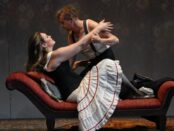
Conducted expertly by Tiffany Chang in a new chamber orchestration by Roland Freisitzer, this three-character opera is inspired by the lush romantic sound of Richard Wagner and Richard Strauss. As the libretto is based on a German prose translation of the Wilde play by Max Meyerfeld, there are no arias per se but the leading character Simone, a Florentine fabric merchant, has many long passages. Artistic director Philip Shneidman who staged the evening has chosen to set it in turn-of-the-last-century Vienna, home to Zemlinsky, rather than Florence in the 16th century as Oscar Wilde’s play is set. This takes a bit of getting used to considering the plot and the subject matter. However, Kylee Loera’s projection design of historical photographs of Vienna city streets and then an art nouveau wallpapered room sets the proper mood for pre-W.W. I Vienna. [more]
Faust (Heartbeat Opera)
We get evocative shadow screens, puppetry and a silent-film fantasia. Heartbeat Opera’s two-hour whirlwind adaptation has everything—except an intermission. True to the company’s bold, iconoclastic style, this fiercely distilled staging trades grand opera’s lush orchestra for a lean, expressive band led by artistic director and violinist Ashworth. Brass and reeds give the score grit and immediacy, while the unexpected addition of a harmonium injects a raw, streetwise character—part cabaret, part back-alley prayer. The result? A "Faust" not of gilded prosceniums, but of shadows, sweat, and sharply focused vision. [more]
Strike Up the Band
David Pittu, Victoria Clark and John Ellison Conlee in a scene from the MasterVoices concert [more]
Krzysztof Knapczyk: A New Face of Classical Music with Global Ambitions
Krzysztof Knapczyk, who has performed in countries such as Greece, Germany, and the U.S., aims to expand the Pop Opera project to American and international audiences. "Performing in New York was a huge step for me," he says. "Now, I want to bring this concept to stages all over the world—bridging the gap between opera, pop, and musicals in a fresh and exciting way." [more]
Beyond the Horizon (Teatro Grattacielo)
The libretto by the composer and musicologist Walter Simmons is very faithful to the O’Neill play, almost entirely dialogue taken from the original script. Unfortunately, they chose to shorten the text by 25% (as well as cutting the two intermissions) so that the tragedies happen one on top of the other with little time for intense emotional flights. This also dilutes the sense of irony that all the characters are down on their luck. Reducing the cast list by two tightens the play but changing the little daughter to a son and then keeping in the reference to playing with dolls seems inappropriate. Using O’Neill’s original text leaves hardly any room for arias and the opera sounds mostly like recitative set to music. The orchestrations which began with trumpet calls and included triangle and violin solos added to the power of the story. Conductor Christian Capocaccia did fine work with the orchestra but putting them behind the stage affected both the sound and the singers ability to follow them. [more]
Lyrics & Lyricists Series: “Wonder of Wonders: Celebrating Sheldon Harnick”
While most of the songs presented were standards, there were some oddities and curiosities like five cuts songs, one song from a Ford Motor Company industrial show by Bock and Harnick, and two songs Harnick wrote with others, one to his own lyrics. Sperling himself sang three of the five cuts song, starting with Amalia’s song of anxiety before her date with “Dear Friend” pen pal for the unashamedly romantic "She Love Me," “Tell Me I Look Nice,” replaced by the more powerful “Will He Like Me?” (created by Barbara Cook, and sung here by Zavelson). [more]
Christopher Caswell: Listen to My Heart
Christopher Caswell: "Listen to My Heart" took the audience into his confidence as he opened up about his personal life: friends, loves, children and, of course, show business. His show had the intimacy of being in Caswell’s living room in the guise of the Laurie Beechman Theatre, just off the theater district. Lean, youthful and handsome, Caswell—who admits to being sixty-plus—opened with a stroll through the audience singing the title song, which, after many personal revelations, also ended the show, taking on a different meaning. [more]
The Reef (opera workshop)
On April 10, 2024, Merkin Hall at Kaufman Music Center presented a tantalizing teaser of a musical evening with the world premiere workshop of only the first act of 2020 Pulitzer Prize-winning composer Anthony Davis’ new opera, "The Reef." With a libretto adapted by Joan Ross Sorkin, from the 1912 novel by Edith Wharton, this was the first time that the work has been adapted for the stage, though it has been filmed as Passion’s Way. The workshop was sponsored by the Berkshire Opera Festival using a cast of emerging artists all of whom were vocally capable of singing the work. [more]
Eugene Onegin
Enter young baritone Edwin Joseph. He has that dark curly hair and handsome face, yes, and the crucial understanding of the necessary swagger and selfishness that carries this character through the opera, yes. Mr. Joseph brings to mind the earthy and always sexy television star Shemar Moore, someone who has the confidence without even trying; it’s just there, and in spades. Joseph is helped with Mr. Wills’ ingenious staging. Tatyana’s letter scene is performed with Onegin perched on the top stairs of a stage ladder in full view just stage left of her bedroom space. The implication that he is well aware he is desired by Tatyana is there long before he reads the letter. He doesn’t need to read her outpouring of her soul to know he has that effect on her. In the birthday party scene, it’s not the flaunting of Onegin’s flirtations with Olga that sets the tone for Lensky’s challenge to a duel, it is a brazen handjob administered by Onegin to an already emasculated Lensky off in a corner where Lensky hopes no one sees that is the trigger for everything that follows. And throughout, particularly in his closing aria in Gremin’s palace, Joseph with his rich resonant baritone has this score in the palm of his hand. [more]
The New York Pops: The Best Christmas of All with Norm Lewis
Joy filled Carnegie Hall with The New York Pops’ annual two-night Christmas concert entitled "The Best Christmas of All" led by genial host, music director and conductor Steven Reineke. This year’s guest artist was Broadway baritone Norm Lewis who was joined by several announced and several surprise guests: soprano Vanessa Williams (Friday night only), Pastor Bobby Lewis (actually a cousin of Norm Lewis), 14-year-old percussionist Jonathan Logan making his third Carnegie Hall appearance, guest conductor Ruthanne Ruzika and the annual visit of Santa Claus with elf Pecan Pie. The program was mainly made up of old favorites and one or two unfamiliar compositions which were greeted with ovation after ovation from the sell-out crowd. [more]
One Night Only: An Evening with Sutton Foster & Kelli O’Hara and The New York Pops
The pairing of Broadway legends Sutton Foster and Kelli O’Hara proved felicitous just like the previous pairing of Julie Andrews and Carol Burnett, with each lady using her special gifts: Foster was best in the comic moments and O’Hara was ravishing in the semi-operatic musical numbers, just as had been Burnett and Andrews in their three concerts. Backed by the glorious New York Pops orchestra led by Maestro Steven Reineke, Foster and O’Hara made the most of this unique concert staging directed by Dick Scanlan. The many uncredited costume changes put the singers in either stunning red, black or white outfits. Throughout the evening the singers were supported by their own music directors at the piano, Dan Lipton for Kelli O’Hara and Michael Rafter for Sutton Foster. "One Night Only: An Evening with Sutton Foster & Kelli O’Hara" proved to be a memorable evening and one that is hoped to be the first of many. [more]
The Frogs
MasterVoices acquitted itself well in this deliciously comic concert staging of "The Frogs." Why this Stephen Sondheim score is not better known or revived more often remains a mystery after seeing the fine production that fit the Fredrick P. Rose Hall of the Rose Theater. Hopefully, this concert will lead to more fully staged productions now that MasterVoices demonstrated how many star turns are available in this comic masterpiece by Shevelove, Lane and Sondheim. [more]
American One Acts, a double bill
The little OPERA theatre of ny has become known for its adventurous programing of rarely seen and heard operas in English including the New York premieres of Benjamin Britten’s opera for television, "Owen Wingrave," and Carlisle Floyd’s final work for the stage, "Prince of Players," as well as new translations of works by Gluck, Mozart and, Rossini. Now in association with Harlem Opera Theater and National Black Theatre, they have presented an unusual double bill of contrasting "American One Acts," both set in the American South. Act I was a performance of "Highway 1, U.S.A." (1962) by William Grant Still, called the Dean of African American Composers, and the first Black composer to have an opera performed by a major company, his "Troubled Island" premiered by the New York City Opera in 1949. The second half of the bill was Kurt Weill’s "Down in the Valley," a folk-opera intended for schools and community groups, written for the radio in 1945 and then revised for stage production in 1948 at Indiana University by the Bloomington Opera Workshop. After its premiere it had 85 amateur productions in the following ten months. However, it has not remained in the repertory. [more]
Iolanthe (MasterVoices)
MasterVoices concluded its 2022-23 season with a lovely concert staging performance of Gilbert and Sullivan’s rarely seen comic opera "Iolanthe (or The Peer and the Peri)" staged and conducted by artistic director Ted Sperling. The cast was mainly made up of Tony Award winners (Christine Ebersole and Santino Fontana) and Broadway regulars (David Garrison, Jason Danieley and Phillip Boykin) with some fast rising young opera singers (Ashley Fabian and Schyler Vargas) and a principal ballerina from the New York City Ballet (Tiler Peck). All seemed to be thoroughly enjoying their Carnegie Hall outing. The 120-member Master Voices chorus and orchestra gave a glorious rendition of the 141 year old score. [more]
Lady M (Heartbeat Opera)
Heartbeat Opera seems to have found the way to separate themselves from the rest of the pack of alternative opera companies here in New York. Their way is to inject the standard repertory of grand opera with fresh ways of presenting the rich beloved scores. Enter music director Daniel Schlosberg, a Brooklyn-based composer-pianist who is their ingenious arranger for both Puccini's "Tosca" and Verdi's renamed "Lady M," and conductor and pianist for "Lady M." He arranges "Tosca" for a band of eight, "Lady M" for a band of six. Consider both of these Herculean feats with sumptuous results. [more]
Tosca (Heartbeat Opera)
Just when you think you’ve seen an opera so many times you can’t imagine it being told anew along comes Heartbeat Opera with a riveting take on Puccini’s "Tosca." Director Shadi G. sets it as a thriller in Teheran, Iran with a cast of singers trying to get through a performance in defiance of the censors. The opera "Tosca" has always been set under a dictatorship of an authoritarian regime. It is usually set 1800 with the Kingdom of Naples’s control of Rome threatened by Napoleon’s invasion of Italy. The Heartbeat production underlines the usual terror with Irani police officers in shadows, hidden in stairwells and behind stage entrances ready to arrest the performers if they do anything outside the strict code of ethics and behavior in the Irani culture. This added layer to the story provides a lot of exciting running exits into the audience to avoid capture by the authorities. [more]
Iceland
Composer/librettists O-Lan Jones and Emmett Tinley have created what they refer to as “a re-Creation Myth” in this fascinating interdisciplinary opera theater work entitled "Iceland." It is profoundly musical in that it embraces both opera and contemporary musical theatre by casting 12 opera singers as The Hiddenfolk and Mythic Beasts of Icelandic folklore and two musical theater singers who would be equally comfortable sitting on the Billboard Hot 100 as the two leads that are pushed together romantically over the course of 17 hours one New Year’s Eve in Iceland. [more]
One Night Only: An Evening with Heather Headley and The New York Pops
Pairing The New York Pops with Broadway star Heather Headley brought out the best in each. The energy zipping between the orchestra’s music director Steven Reinecke and Headley was palpable. The program was a wonderful musical portrait of Headley. Reinecke, and Headley’s accompanist and personal music director, Ron Colvard did not just support her but became “the wind beneath her wings.” [more]
Lady in the Dark
Unfortunately, this is musical comedy and does not need operatic voices, Lawrence being famously a singer with a very small range, while Kaye came from cabaret and night club. With all of the leads double cast, Sunday matinee’s singers seemed either miscast or poorly directed by Eric Lamp and Benjamin Spierman. Matthew Imhoff’s sets which are carried on and off by the singers took an inordinately long time and there were moments of dead time during office scenes which also seemed underpopulated. While conductor and artistic director Michael Spierman gave a creditable performance of the complete score, it did not seem to hang together but felt like individual numbers, unlike many other Weill scores which feel integrated and whole. [more]
H.M.S. Pinafore (NYGASP)
While Albert Bergeret’s old-fashioned production does not sparkle, it is a solid, steady ship that satisfies with all its jokes intact plus a few new ones like the hilarious drunken scene between the captain and the First Lord of the Admiralty. Associate conductor Joseph Rubin kept the orchestra in close harmony and gave an excellent account of Sullivan’s lilting score. Albère’s attractively realistic scenery looked brand new and created interesting stage pictures. The lovely late Victorian costumes by Gail Wofford helped complete the stage picture. Benjamin Weill’s lighting design bathed the stage in sunlight for the daytime scenes in the first act, and used blues and purples for the evening scenes of the second act. [more]
Richard Holbrook: “Christmas Magic in the Big Apple”
"Christmas Magic in the Big Apple" continues Richard Holbrook's many years of presenting Christmas season shows. What sets his productions apart from many other performers is his view that this time of year is a time for celebrating family and friends. It is not simply a time of religious holidays but more of an all-encompassing recognition of the joyous spirit that moves people to engage with one another in a celebration of life. His shows are a creative mix of holiday songs with a universal theme. Holbrook commented, “Not everyone celebrates Christmas, and I don't want people coming to my show being made to feel uncomfortable." His playlists over the years have exemplified that view, with the current show being the latest in the series. [more]
Melissa Etheridge Off Broadway: My Window – A Journey Through Life
Etheridge may be 61, but she sounds just as she did when she first came on the American rock scene in 1988: full-throated emotion and raspy vocals that bring honesty and pathos to intensely personal and confessional lyrics. The accomplishment in "Melissa Etheridge Off Broadway: My Window – A Journey Through Life" is not in the many scenes of heartache and a dense song list, but in the strength and the resilience that carries her to artistry that she shares so unselfishly and unselfconsciously to speak to and heal a legion of fans. [more]
Faust et Hélène & L’heure espagnole
Maurice Ravel’s delightful 'L’heure espagnole," usually paired with his other opera, "L’enfant et les sortilèges," is here paired with "Faust et Hélène," an obscure cantata by Lili Boulanger, one of Ravel’s contemporaries. Hearing her exquisite Faust et Hélène is comparable to discovering a diamond you didn’t know you had. New Camerata Opera opens its seventh season with this very engaging double-bill. Director John de los Santos has envisioned a world where the passage of time is the focus of both of these operas. While the set for the Boulanger is spare, Mr. de los Santos is aided in this concept for the Ravel with projections of striking clockwork photography and a set filled with a collection of stylized grandfather clocks from NYC-based artist Atom Moore. Ashley Soliman’s costumes are timeless for the Boulanger work – the men are shirtless and barefoot in a variation on dhotis or male harem pants while Hélène is in an orange gown with a virtually endless train. [more]
Sacco and Vanzetti: A New American Opera
The finished score by Lehrman is 50% music he created based on themes by Blitzstein: pieces of his unproduced 1932 opera "The Condemned" (an earlier work about Sacco and Vanzetti), a march, a cabaret song, a song cycle, a piano piece for mezzo-soprano Brenda Lewis who had starred in Blitzstein’s 1949 opera "Regina" (based on Lillian Hellman’s "The Little Foxes"), and portions of 13 songs from "Reuben, Reuben," his 1955 folk opera set in Little Italy which failed in Boston and which he had been recycling in later works. Blitzstein’s libretto for the three-act "Sacco and Vanzetti"(performed at Lehman College in two parts) was based on transcripts, letters, and interviews with the principals involved in the case. One addition approved by the estate was the inclusion of Governor Michael Dukakis’ exoneration of Sacco and Vanzetti in 1977, the 50th anniversary of their execution, as a fitting new ending to the opera. [more]
Anyone Can Whistle
Although when MasterVoices chose the third of the four Stephen Sondheim/Arthur Laurents collaborations, "Anyone Can Whistle," as part of their 80th season at Carnegie Hall, they had no way of knowing that it would prove to be a memorial to the late Mr. Sondheim rather than a tribute. This rarely revived show, now considered a “cult classic,” a euphemism for a quick flop in 1964 running only nine performances, was ahead of its time, attempting a new form, one that Sondheim has called “the first absurdist musical.” Performed by stars Vanessa Williams, Santino Fontana, Elizabeth Stanley, Douglas Sills, Eddie Cooper, Michael Mulheren, and Joanna Gleason as the narrator, it was beautifully sung under the direction of maestro Ted Sperling, but can’t hide the fact that Laurents’ libretto is extremely scattershot taking on far too many targets for one show. Subtitled “A Musical Fable” in its first publication, the musical is really a cartoon satirizing everything imaginable. The theme is one of individualism versus conformity, a big trope for shows and movies in the turbulent 1960’s, now symbolized by the more famous "King of Hearts" (1966), "Your Own Thing" (1968), "HAIR" (1968) and "Easy Rider" (1969). [more]
Goodbye, Mr. Chips
The production is a combination of film and theater techniques which keep reminding us that we are watching a dramatization: realistic sets (designed by Jacquelyn Scott) give way to scenes in which we are on a stage. Sets also revolve for no specific reason except possibly to show the passage of time. As seen up-close on camera, they all look too clean and tidy which suggest theater sets. The 20 members of the Young People’s Chorus of New York City, augmented by an additional 20 voices (all conducted by Francisco J. Núñez), are only seen in video that appears on Chips’ blackboard or behind the windows of various rooms. We never get a sense of Chips’ running a class or his interaction with a roomful of boys. [more]
Intimate Apparel
The new opera, "Intimate Apparel" is a very impressive, accessible work. If it has a fault, it is completely humorless but then the original play did not include comic relief either. Unlike Ricky Ian Gordon’s last opera, the recent Garden of the Finzi-Continis, the music here is not only beautiful but suitable and appropriate as the singers and the music are one. Lynn Nottage’s libretto is a masterpiece of economy, though her play was too. Will the opera supersede the play? Probably not, but it should certainly do well in other intimate opera houses where its charms can be fully appreciated. [more]
The Garden of the Finzi-Continis
While Gordon has said in interviews that his model for the music was Puccini, in fact, the atonal orchestral score sounds more like operas by Gian Carlo Menotti, Carlisle Floyd and Dominick Argento. The singers are usually so loud that they tend to drown out the orchestra which is playing something different than the vocal score. Placed on the far right of the stage, the orchestra plays to the side wall muffling the sound. The orchestral score suggests background music for a film rather than music for the opera house. On paper, Korie’s text reads fairly well; however, in performance the singers are punching his rhymed couplets so hard that they seem a mistaken intrusion. At almost three hours, "The Garden of the Finzi-Continis" feels overwritten though episodes have been left out of the original novel. In the libretto provided to the press in advance, Alberto’s story deviates from that of the novel, but on opening night this was changed back to the book’s ending. [more]
Camille O’Sullivan: “Where Are We Now?”
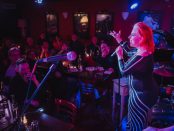
David Bowie’s "All the Young Dudes" triumphantly rendered with a touch of Dixieland is one of several grand numbers in the spirited Irish-French performer Camille O'Sullivan’s engaging theatrical concert, “Where Are We Now?” in which she’s backed by a sensational band. That anthem’s familiar rousing opening notes are done justice by Omar Kabir on trumpet. Then clad in a shimmering sequined black skirt suit, black blouse and silver shoes, the long dark-haired alluring Ms. O'Sullivan sings the lyrics in her soaring gutsy voice. That’s while she is wonderfully dancing and miming all over the stage of Irish Arts Center’s $60 million new building and in the aisles. [more]
The New York Pops Underground Cabaret featuring Max von Essen
Von Essen did sing a couple of songs from a living composer, one Andrew Lloyd Webber. He relayed the story of going on for Ricky Martin in Evita, where the curtain had to be held so that all the box office refunds could be processed; he won the sympathy of every ear in the house on that retelling. He also declared that although auditions for both the parts of Raul and the title character of "The Phantom of the Opera" did not yield successful results for the Broadway production, he did get to play said Phantom in "Love Never Dies," which was a perfect segue to “Till I Hear You Sing.” It seemed the evening was specifically shaped to present this “power ballad” as the 11 o’clock number, and von Essen truly pulled out his most formal, rich and dramatic voice for it, earning him spontaneous applause in the middle of the song and even a few standing ovations afterward. As for the other Webber song, well, I did not think I’d ever want to hear this song again, in or out of its "Evita" context; yet von Essen put Magaldi completely aside and sang a most stunningly beautiful and exquisite version of “On This Night of a Thousand Stars” as one could ever imagine hearing. His sublime and subtle tenor notes were completely glorious, and this song became the superlative number of the evening for this listener. [more]
Sun & Sea
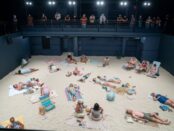
Performed by a cast of 15 singers and enacted in pantomime by numerous local volunteers all dressed in swimwear, Sun & Sea is a typical day at the beach in which we hear the thoughts of the singers, some of whom worry about the state of the world while others are entirely oblivious to it. Not only is it opera lite and a great deal of fun without being funny, it is also a very subversive way to communicate a message on as serious a subject as climate change. While the singers communicate their thoughts, the beachgoers frolic and enjoy their day oblivious to us but not to each other. The cast is a cross-section of all ages and races, including young children and two well behaved dogs – but no vendors. The totally realistic action (aside from the singing) includes reading, texting, eating, chatting, drinking, walking, cuddling, tanning, playing ball or games, while the children dig in the sand and build sandcastles. Some sit on beach chairs or chaise lounges while most lie on blankets on the sand or stand. [more]
At Home with Nigeria’s Breakthrough Star AcebergTM and his Debut EP “Far From Home”
Now ready to take on a global circuit, we started working on promoting AcebergTM’s brand new debut EP "Far From Home" which was just released on April 16th, 2021 along with his music video for one of his singles “DANCA.” “DANCA” is a perfect blend of Afropop mixed with Amapiano beats that can make you head to the dancefloor or groove while sipping on a strong drink. Our DANCA dance challenge is in full swing on TikTok/Instagram with more social media excitement on the way and his EP is being hailed by critics and tearing up the charts. While we have placed advertising campaigns in some of the major cities including, but not limited to, New York, Los Angeles and Atlanta, we have and continue to engage the music community at large, bookers for late night talk shows, music supervisors for TV/Film and beyond to share AcebergTM with more of the world. [more]
Sutton Foster: “Bring Me to Light”
Sutton Foster, one of the shining lights of New York City’s currently dimmed theater scene, glowed in Sutton Foster/Bring Me to Light. Her voice and interpretations were the richest they have ever been. Add to this her choice of repertoire and her talented guests and Bring Me to Light is a beacon of light in a dark year. As we see New York City Center’s backstage staff prepare for the performance, Foster performed the Rodgers and Hammerstein classic “Cockeyed Optimist” segueing to Stephen Sondheim’s “Everybody Says Don’t” and Kander and Ebb’s “Yes,” all upbeat, optimistic songs that should resonate with today’s pandemic-strained audiences. [more]
92Y Lyrics & Lyricists Series: Jerry Herman: You I Like
Music director Andy Einhorn who conceived the show was a genial, informed host. Having worked as the music supervisor and music director for the most recent revival of "Hello, Dolly!," he was at times overcome with emotion as the show, directed by Cady Huffman, revealed all of Herman’s richness and, yes, sophistication. Listening to and quoting Herman really got to Einhorn whose beautiful arrangements buoyed all the songs. [more]
The New York Pops: “Find Your Dream: The Songs of Rodgers and Hammerstein”
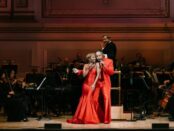
The New York Pops’ latest concert, Find Your Dream, was a glorious tribute to nostalgia. Not only was it an evening of the beloved songs of Rodgers and Hammerstein with selectionsfrom all 11 of their collaborations, it also recreated a performance first presented five years ago by The Pops. The guests artists on the evening of January 24 were British musical theater star Laura Michelle Kelly (Broadway’s "Mary Poppins" and "Finding Neverland") first seen in a flaming red, off the shoulders gown and American musical theater star Max Von Essen (Broadway’s "An American in Paris" and "Anastasia") in a midnight blue jacket. Joining The Pops as usual was Judith Clurman’s Essential Voices USA who were an integral part of the show with the famous choral numbers. [more]
92Y Lyrics & Lyricists Series: E.Y. “Yip” Harburg: Follow the Fellow Who Follows a Dream
The 92nd St. Y’s Lyrics & Lyricists, one of New York’s leading propagators of the Great American Songbook, featured the witty and sardonic songs of E.Y. “Yip” Harburg in its most recent edition: "E.Y. 'Yip' Harburg: Follow the Fellow Who Follows a Dream." Harburg, famous for writing the lyrics for "The Wizard of Oz" and "Finian’s Rainbow," wrote over 600 songs with many collaborators. The show gracefully explored his oeuvre and his life using the extraordinary talents of five fine singers and a superb band led by Paul Masse who supplied the often surprising orchestrations. They were helped by vivid projections by Dan Scully that showed New York City street scenes, theater marquees, historic programs and posters as well as photos of a genial looking Harburg who tried all his life to defy all the prejudices and inequities of his time and replace them with his complex and colorful lyrics that featured witty rhymes and references. [more]
Me & Mr. Jones: My Intimate Relationship with David Bowie
With her richly expressive character voice, alternating between appealing deepness and wonderfully hitting high notes, she beautifully does justice to each song. We see every hallowed surrealistic image contained in “Life On Mars” due to her precise phrasing and crisp enunciation. Written in 1995, with its incendiary title, harsh lyrics and considering the state of the nation today, “I’m Afraid of Americans” becomes a prophetic terrifying showstopper as performed by the dynamic Cion. [more]
The Mikado or, The Town of Titipu (NYGASP)
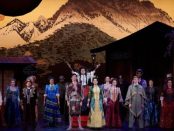
The framing device is not a completely elegant solution to the problem, but it gets the job done. Gilbert gets knocked out cold while examining the contents of the trunk. While incapacitated, he imagines the members of the company playing the roles that he and Sullivan will eventually create. In this fantasy 'Mikado," the citizens of the town of Titipu are more British townsfolk than Japanese villagers. They dress in bright Victorian-era costumes by Quinto Ott. The set by Anshuman Bhatia includes a railway depot from which the characters who have arrived in town emerge (giving a multiple meaning to the lyric “Comes a train of little ladies…”). The cast consists of actors of various racial backgrounds. [more]
Where Are We Now
Possessed of an awesome soaring tenor voice, the magnetic Dutch-German Mr. Ratzke offers not a conventional cover band-style tribute show with slavish imitation, but instead a thrilling performance piece. His vivid singing is characterized by his slight accent, occasional hints of Bowie’s timbre and shades of Anthony Newley, an early Bowie influence. Ratzke is accompanied by only the impish silent foil and beaming German virtuoso Christian Pabst on grand piano who enchants with his sustained high caliber musicianship and jazzy solos. [more]
Let ‘Em Eat Cake
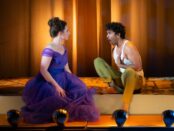
Having had a success with Of Thee I Sing in 2017, MasterVoices had chosen to stage the sequel with an equally starry cast made up of most of the singers from the previous show in the same roles. With a chorus of 125 voices in this most choral of musicals and nine stars, "Let ’Em Eat Cake" was gloriously sung. The orchestra of St. Luke’s under the baton of artistic director Ted Sperling gave the complex score a vigorous reading, suggesting that it is more than just a musical. While the story is quite silly (the White House gets painted blue, among other things), it is also quite dark predicting a fascist takeover of the American presidency - which may explain its quick failure in its own time. Topical in 1933, many of the topics and issues are currently in the headlines again as Washington deals with an imperial White House. The musical also offered a great many unfamiliar Gershwin songs aside from its one hit “Mine,” and familiar and unfamiliar reprises from "Of Thee I Sing" like “Wintergreen for President.” [more]
John Burns Is a Sexy Beast
Gracefully clomping around in silver pumps and clad in a short-sleeved black jumpsuit, the upper portion adorned with shimmering multi-colored sequins in the configuration of the rainbow, the heavyset, bald, mature and bespectacled Burns is a triumphant vision of gay pride. This visual quality is matched by his outstanding vocal abilities. Possessed of a soaring tenor voice, distinctive phrasing and absolute aural clarity he richly mines each well-selected song to optimum effect. [more]
Julie Madly Deeply
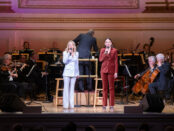
Andrews’ worldwide success with the films "The Sound of Music" and "Mary Poppins" is well represented here, as is the Broadway musical that established her in the first place, "My Fair Lady," even if "The Boyfriend" preceded it. The current run of "Julie Madly Deeply" at 59E59 Theaters follows its playing first in London’s West End and then in Toronto. It was written by Young, with contributions from Russell Lucas, who has also directed the show in a full-steam-ahead mode. [more]
Baby Jane Dexter Has Died and Everybody Hurts
Baby Jane Dexter (Photo credit: Stephen Mosher) [avatar user=”John Hoglund” [more]