Victor Gluck was a drama critic and arts journalist with Back Stage from 1980 – 2006. He started reviewing for TheaterScene.net in 2006, where he was also Associate Editor from 2011-2013, and has been Editor-in-Chief since 2014. He is a voting member of The Drama Desk, the Outer Critics Circle, the American Theatre Critics Association, and the Dramatists Guild of America. His plays have been performed at the Quaigh Theatre, Ryan Repertory Company, St. Clements Church, Nuyorican Poets Café and The Gene Frankel Playwrights/Directors Lab.
n what easily could have become a one-man show, playwright Strand has cleverly created dramatic tension by first introducing us to a second character and later a third. Set during the 2012-2013 term of the Supreme Court, the play begins with a lecture by Scalia to a law class where he explains his philosophy of being an “originalist,” that is, someone who interprets the Constitution as it was originally written and understood by its drafters in 1789. This presupposes that it is not a living document that should reflect each era, but something carved in stone which does not change but may need interpretation. [more]
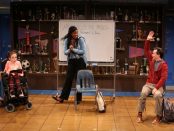
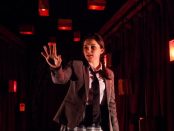
Add to this list Mike Lew’s new witty and clever "Teenage Dick" (being given its world premiere by Ma-Yi Theater Company in association with the Public Theater), both an update and a parody of Richard III now set in Roseland High School. However, while most of these other adaptations just want to demonstrate the contemporary relevance of Shakespeare’s Elizabethan stories, "Teenage Dick" has an additional agenda: does society’s bullying lead to defining the personalities of those with disabilities? [more]
Sixtyish Eric Miller is an angry white man, hating Catholics, Blacks, homosexuals, women, and other groups. He has also become very nationalistic. He not only wants to tell the world, he thinks he should act on it. Middle America in the age of Trump? Actually, the same problem appears to be happening in Northern Ireland according to David Ireland’s dark play, "Cyprus Avenue," having its American premiere at the Public Theater courtesy of a co-production by The Abbey Theatre (Dublin) and Royal Court Theatre (London). Problem is for all the sound and fury, Cyprus Avenue, which is a brilliant character study, outlives its welcome long before it is over in this 100 minute play. [more]
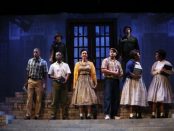
Using a tremendously talented and versatile cast of nine actors (three black male actors, three black female actors, as well as three white performers) playing from three roles to 12, the story of the year these heroic teenagers spent integrating the previously segregated high school becomes high drama. Rasean Davonte Johnson’s unit setting with its banks of stairs makes copious use of Wendall K. Harrington’s projection design for the many locations in the city of Little Rock, inside and outside of the school and the homes of the participants, as well as historical footage of the events and the people. "Little Rock" also includes snatches of 14 songs, some sung as choruses and others as solos including “Eyes on the Prize” and “We Shall Overcome,” which add a human dimension to the often startling events depicted. [more]
Unlike the musicals "Rent" (an update on Puccini’s "La Boheme"), and "Miss Saigon' (inspired by Puccini’s "Madame Butterfly") both of which had all new music by other composers for their contemporary stories, "Carmen Jones" uses the original Bizet score. However, it is not simply an English translation. Hammerstein has written all new lyrics to place the story in a W.W. II Southern community (possibly North Carolina) and with the characters ending up in Chicago for the denouement. While "Carmen Jones" was a smash hit originally running for 503 performances at the Broadway Theatre during the war years, some like then critic James Baldwin found the dialect that Hammerstein had used for his African-American characters both embarrassing and demeaning, and the show has not had a New York revival until now. Notwithstanding, the first London production in 1991-92 was also a tremendous success at the Old Vic Theatre with a mix of both opera and theater stars in the cast. [more]
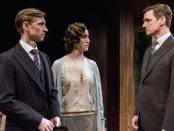
With Miles Malleson’s 1925 "Conflict," being given its New York premiere, the Mint has uncovered a brilliant political and social drama which has tremendous relevance for today with its dissection of conservative and liberal points of view. It resembles Shaw and Tom Stoppard in its debate of ideas and Galsworthy and Arthur Miller in its moral integrity. Superbly directed by Jenn Thompson ("Women Without Men") with a crackerjack cast, this is not only one of the Mint’s best offerings, it is also the most satisfying play in town. Framed as both a thriller and a romantic comedy, Conflict is absorbing and exciting theater throughout, the sort of play that has you hanging on every word to see which way it will go. [more]
Harmon’s new play resembles "Admissions," his last New York offering seen at Lincoln Center this March, in that it debates a topic from many sides but then fails to give us the author’s point of view on it at the end. Like all of his four plays so far it offers a strong character who has a very big gripe with the way things are and who attempts to change people accordingly. And like the others, "Skintight" is very funny while it deals with a serious topic but ultimately seems rather superficial, though here that maybe because of the extremely wealthy milieu in which money is no object and things magically appear via live-in servants. As is Harmon’s wont, the acerbic repartee is tossed about plentifully and as directed by Daniel Aukin, the six actors get the most out of their snappy lines. [more]
Jackie Sibblies Drury is a unique new voice in the American theater. Her use of metatheater is all her own. "Fairview" has a great deal to say about race in America and the angle you see things from and she is able to cleverly shift it from scene to scene. However, this new play is a bit too long for its content, with scenes overstaying their welcome. Nevertheless, Drury is a playwright well worth watching. [more]
Although the advance publicity for Ben Josephson’s "The Property" refers to it as a comedy, there is nothing funny about it, neither jokes nor comic situations. In fact, the heroine’s desperate need for security ends up destroying five people. The themes are relevant in an era when people are downsized after many years of work and have trouble paying their mortgages but the stilted artificial dialogue and the melodramatic events damage the serious issues at stake. While veteran director Robert Kalfin has staged the play as though it were a drawing room comedy, its content presupposed that it is a tragedy on the lines of such better plays as George Kelley’s Pulitzer Prize winning "Craig’s Wife" and William Inge’s "The Dark at the Top of the Stairs." [more]
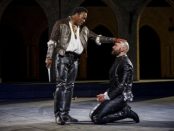
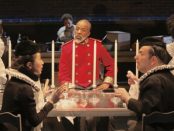
In the recent Metropolitan Opera production of Verdi’s "Otello," Otello was white which left no reason for his jealousy if he was identical to all the Venetians around him. In the current Shakespeare in the Park production, using color blind casting, Santiago-Hudson chooses to make at least five of the leading characters people of color so that Othello is no longer an outsider, nor are they. The meaning of the theme is diluted in such a reading. It may be politically correct, but in this play about race there is no getting away from its original meaning. Even The Public Theater’s artistic director Oskar Eustis’ program notes remark that Othello is only one of two explicitly black characters in all of Shakespeare, the other appearing in "Titus Andronicus." Other than this casting choice, the production offers no new interpretation of the play or characters, making it more like a staged reading than a full production. [more]
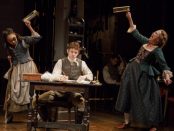
Director Lucy Gram uses six actors to play 11 roles which has worked for such companies as Bedlam and Fiasco. However, here the four actresses play both men and women, three of them never change their costume, voice or look when they return as their other characters so it is very difficult to keep the roles straight. Aleca Piper playing the roles of Calianax (an elderly man), Lysippus (a younger man) and Dula, a lady-in-waiting, first takes off her white sweater, then puts up her hair, but if you are not following this very carefully, the changes are lost on you. Her use of a loud, booming voice does not help in differentiating her roles or in understanding her lines. Erin Roché and (Ms.) Sydney Battle play men and women alternately with no changes of any kind. [more]
The chance to see Anton Chekhov’s first produced play, "Ivanov," not only in the original Russian (with English surtitles) but in modern dress proves to be a revelation. Staged by Russia’s State Theatre of Nations and as presented by the Cherry Orchard Festival, this is a rare opportunity to see this usually neglected Chekhov classic, seen in New York in English on only three occasions since it was first written: 1966 on Broadway with Sir John Gielgud, 1998 at Lincoln Center with Kevin Kline, and in 2012 at the Classic Stage Company with Ethan Hawke. Like the recent Australian version of Chekhov’s first written play, "Platonov" (renamed "The Present" in Andrew Upton’s update), Timofey Kulyabin’s production is not only in modern dress but updated to a drama set in our time. [more]
Her newest work, "Fruit Trilogy," an evening of three one acts, “Pomegranate,” “Avocado” and “Coconut,” has all of the strengths and weaknesses of her previous stage plays which include going on at too great length when the audience has already gotten the point. Directed by Mark Rosenblatt who staged the world premiere at the United Kingdom’s West Yorkshire Playhouse, the play features Kiersey Clemons and Liz Mikel who are frightening in their intensity and realism. Although the three settings are unstated, the fact that both actresses are black suggests that the plays may have been inspired by Ensler’s humanitarian work in Africa. Although it will not be immediately obvious to theatergoers, the plays move from two women enslaved, to a woman traveling to freedom, to finally a woman finding liberation through her own body. [more]
Though it wouldn’t be fair to reveal it here for audiences about to see the play, the “secret” actually turns out to be one that has been widely known for some time as it is all over the Internet. The play’s assertion that Bronowski died immediately after his November 1973 television appearance is inaccurate as he died the following summer while visiting friends on Long Island. Nor is there evidence that there was ever a locked room. As Bronowski had four daughters, it is unlikely that one of them was a grandson named “Jamie Bronowski.” The frequent use of technology in the play like having actors walk on the wall as if traversing photographs has been done much more effectively by Cirque du Soleil and others. The quality of the black and white video clips leaves much to be desired. [more]
The letters alternate with the musical portions played by Ji on piano, Ari Evan on cello and Stephanie Zyzak on violin in various combinations which are beautiful but it is never clear in what way the selections relate to Madame von Meck except for the Piano Trio in A minor, op. 50, which Tchaikovsky reveals at the beginning of the second act that he is writing for her. It is not stated whether the two excerpts from The Nutcracker, for violin and piano, and for solo piano were created for her. [more]
While "Brokeback Mountain" impresses in its sincerity, it does not move which is a serious problem considering the romantic and tragic plot. Director Jacopo Spirei’s cast is in fine form as singers though the music and its libretto fail to fulfill this story’s potential. Daniel Okulitch and Glenn Seven Allen as the two doomed lovers make indelible impressions of men in a repressed society which does not allow them freedom of expression - even though they are not given the kind of music that can move the heart to tears. Brokeback Mountain which is fine as far as it goes offers the same disappointment of many new modern operas in that its writing falls short of its high-reaching intentions. [more]
While "The Beast in the Jungle" is a musical for our time it contains a message that was dear to the heart of writer Henry James, that of the unlived life. Ultimately very moving when the story reaches its conclusion, the exquisite Vineyard Theatre production is for elite tastes but all dedicated theatergoers, not the casual entertainment seekers, should see it. It may well start a new trend in theatre musicals, one in which the emotional sections are danced rather than sung. [more]
Standing in the way of the show’s success is the workshop-like production. Some of Pellegrino’s melodies are pleasant but musical director Michael Wittenberg’s piano playing drowns out many of the weak voices. The lyrics tend to be very thin and extremely repetitious. The uncredited set is actually that of another show with unnecessary portions covered over in brown cloth, giving the look of the show no atmosphere whatever. The uncredited costumes are mainly coordinated in bland brown and white which does not help recall the period one bit. Stone’s choreography is extremely basic and not very decorative. If you sit on the left side of the theater, you are likely to be blinded periodically by designer Christina Verde’s two spotlights aimed right into the eyes of the viewers. [more]
We learn a great deal about hospice, possibly more than one might want to know in a play. While most death watch plays like Edward Albee’s "All Over" and Scott McPherson's "Marvin’s Room," take place in another room from where the elderly person is dying, Mary Frances alternates between the downstairs living room/dining room and the upstairs bedroom of her split-level house. Unfortunately, this 21-scened play with at least a dozen more scenes which switch between Mary Frances’ bedroom and the living room where the rest of the family eat or watch television requires endless jump cuts like a film and endless lighting cues from designer Tyler Micoleau. [more]
Played as older than either Viola or Sebastian, Elizabeth Heflin is charmingly eccentric as the strong cougar who becomes lovesick and yielding at the sight of Cesario and then Sebastian. In the role of the melancholy Duke Orsino who is often played as dull and sluggish, tall handsome Matthew Greer is both dashing and athletic, seen both coming from hunting and athletics. Surprisingly Susanna Stahlmann as Viola/Cesario is very bland and colorless, but this may be intentional: it allows the other characters to read into her/him what they wish. As her twin brother Sebastian made up to look like her mirror image, John Skelley is both avid and keen, willing to go along with a seeming jest though he does not know where it will take him. [more]
Unlike many of the recent New York stagings, Eyre’s production makes it clear that the thrust of this four act play is an attempt for the Tyrones to exorcise their demons in one alcoholic infused night. Before it is over, each and every character will have bared his or her soul in one night of regret, guilt, despair and anger. So much gets revealed, there does not seem to be anything left unsaid by the final devastating curtain. He also has staged the first two acts (before the one intermission) with the characters talking so fast that it as if they do not want to have to stop and notice what they are running away from. Although Rob Howell’s bright and airy set (at least until night falls and the darkness creeps in) seems huge, all of the characters seemed to be caged animals pacing back and forth in forced confinement. [more]
Hodges’ play is quite lively with each scene dramatizing one point and the cast of characters made up entirely of real people, not all of them still famous. The real problem is with the unsubtle and one-dimensional acting of the mostly deficient cast. The play also assumes that the audience is familiar with a great many Elizabethan names and personages like poet Michael Drayton and courtier and literary patron Sir Thomas Walsingham. "Marlowe’s Fate" dramatizes the “last nights” of both first Marlowe and then Shakespeare 23 years later, plus a spirited "Punch and Judy" interlude between Marlowe and Shakespeare for credit to the plays published under Shakespeare’s name. [more]
Every once in a while the exactly right actor is matched with the right role and magic occurs. Such is the case with Juan Francisco Villa as the 34-year-old Tennessee Williams (before he became famous) in Philip Dawkins’ "The Gentleman Caller." Looking exactly like the playwright did at that age and sporting Williams’ well-known Southern accent, Villa is so ebullient, irrepressible and high-spirited that one has the feeling one has met the playwright himself. With perfect timing for Williams’ verbal comeback, many of which are taken from his own letters, quotes and diaries, Villa gives an extraordinarily three-dimensional performance in a role that has been depicted in other recent plays and one-man shows about the author. Some of the credit must go to director Tony Speciale for helping to craft this remarkable portrayal. [more]
Although the title covers part of the plot, the play is really a trenchant social history of Britain from 1925 – 1985 in four short sequences, showing the changes that take place in one house over 60 years and following the career of one everyman, Anthony Spates, known familiarly as Tony. It also follows the women in Tony’s life who help him, love him and leave him in each of four decades. While Antony Eden plays the phlegmatic Tony at four stages in his life (17, 37, 57 and 77) with equal aplomb, the rest of the cast play four characters each, a remarkable feat, as time marches on. "A Brief History of Women" has the depth of a novel and the breath of an epic. [more]
Aside from being a tight domestic drama, The Jewish King Lear has several other differences from Shakespeare’s tragedy. Gordin’s Lear has a wife who is sorely put upon and under her husband’s thumb, as well as the old traditions. Gloucester and his sons are eliminated and Kent and the Fool are combined as Trytel, the steward, who often “rhymes like a real wedding jester.” Taybele, the Cordelia character, gets ahead through education and science rather than marriage to a noble. Gordin’s Lear is not only an advocate for the Jewish traditions of his forefathers he is also very much opposed to scientific advances and education for women, shades of Ibsen who was writing at the same time as Gordin. Dovidl’s heath speech does not take place outdoors but in his own house, now ruled by his son-in-law who has replaced him. [more]
The play is narrated by Carr through his memories as an doddering 80-year-old man, returning him (and us) to his days as a 30-year-old resident of Zurich. As such he both unreliable, altering his story as he narrates his life, with “time turns” allowing us to see the same scene in an alternate form. Travesties is set in both his apartment as well as the then new Zurich Public Library simultaneously, while scenes from "The Importance of Being Earnest" keep intruding into his story both in literally as well as satirical form with Tzara as Ernest Worthing, Joyce as Lady Bracknell and Carr playing his original stage role of Algernon Moncrieff. Shades of Oscar Wilde, his sister named Gwendolyn is Joyce’s secretary as he writes his novel "Ulysses," while the librarian who is helping Lenin on his book is named Cecily. Gwendolyn and Cecily also play out the breakfast scenes from Wilde’s play around the tea table. A knowledge of Wilde’s comedy is mandatory. [more]
As Cristofer, Juan Castano is riveting in his honesty and his assurance. You could hear a pin drop during several of his monologue confessions as to why he didn’t do as well as he might have. His performance is almost frightening in its intensity. As the bookish Clarence, Ato Blankson-Wood is his diametric opposite, well-spoken, sensitive to other people, politically correct, well-mannered and able to hold his own in an intellectual conversation. He is equally intense in a quieter, more refined manner. Although both young actors have impressive New York credits, they should be better known after this. [more]
What makes the storytelling riveting are the performances by the talented cast. As the free-spirited Beatriz fighting for her life, Rubin-Vega is at her fiercest and she is a memorable three-dimensional character. Jiménez as the confused, angry Olivia is charming as she reveals her best childhood memories, lists her favorite books which have been a refuge, and grows up in the course of the road trip. David Patrick Kelly and Michael Mulheren are suitably touching as a gay couple who have loved each other for 50 years. Danny Bolero is sensitive as the still grieving widower who takes a shine to Beatriz. [more]
Fey has made two successful changes to theatricalize her original screenplay. The story is now cast as a flashback narrated by best friends Goth Janis (Barrett Wilbert Weed) and Damian (Grey Henson), described as “almost too gay to function,” to the new freshman class as a cautionary tale as to “how far you would go to be popular and hot.” She has also updated the story to include smartphones, selfies, and reference to current events (the Russians and President Trump’s twitter account.) [more]
In performance, "One Thousand Nights and One Day" is a like a play with songs shoehorned in as none of them forward the story but take the emotional temperature of the characters instead. With all of the actors playing at least two parts, modern and ancient, with little costume change, it is often difficult to be certain where we are at any moment. Some play very similar characters, others play against their earlier incarnation. Erin Ortman’s direction is assured with the characterizations but she cannot solve the problems inherent in the writing. [more]
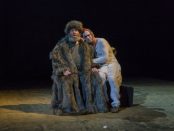
The Royal Shakespeare Company’s latest "King Lear," as directed by Gregory Doran, is one that needs no explanation and no program notes. At one and the same time both medieval and contemporary, this production solves many of the questions that often go unanswered. In a glorious cap to his distinguished career, Sir Antony Sher gives a memorably luminous and unambiguous performance in the title role which should stand as a bar by which others will be measured. This is not only the perfect starting point for those unfamiliar with the play but also an excellent and notable interpretation for those who know it well. [more]
The Q Brothers Collective (made up of GQ, JQ, Jackson Doran and Postell Pringle) is best known in New York for their hip hop variations on Shakespeare: "Othello: The Remix" in 2016 and "The Bomb-itty of Errors" in 2000. As the entire show is in rhyme and rhythm, there are very few discrete songs, but the couplets come so fast that it is at times difficult to make out the clever lyrics. The upside of the new show has all the hijinks of a teen musical but with the unsophistication of a college parody (the downside). It is the latest musical version of Aristophanes’ most famous comedy, but unlike the 2011 "Lysistrata Jones," "ms. estrada" has eliminated all of the politics for an exploration into the social aspects instead. [more]
Ethical integrity versus moral turpitude is the theme of Kenneth Lonergan’s "Lobby Hero" now having its Broadway debut at The Second Stage’s newly renovated home, The Helen Hayes Theater. Although Trip Cullman’s production is very leisurely for at least the first half of this talky and long play first seen in New York in 2001, his quartet of impeccably cast players (Michel Cera, Brian Tyree Henry, Bel Powley and Chris Evans in his Broadway debut) have a field day with these ethically challenged police and security officers. "Lobby Hero" may appear at first to have a great many meaningless conversations, but it all becomes a tight web of intrigue as the tension rises in the second act. [more]
Rapp’s plays are so different from each other that it is difficult to classify him. As of now he has written conventional dramas, experimental plays, futuristic and science fiction plays, and dramas on hot button social issues, among others. "The Edge of Our Bodies" is in yet another form: a monologue spoken by Bernadette, a 16-year-old girl who has left her boarding school on a Friday afternoon without permission to come to New York City to tell her 19-year-old boyfriend Michael that she is pregnant. Carolyn Molloy, who does not at all look 16, reads her story from a diary for much of the play and her delivery is that of a reading, not a dramatic performance. [more]
Disney Theatrical Productions’ long anticipated stage version of the beloved animated film "Frozen" has arrived on Broadway in a lavish and faithful version of the screenplay by Jennifer Lee who also wrote the book of the new stage show. The Kristen Anderson-Lopez and Robert Lopez score from the movie (including the Academy Award-winning anthem, “Let It Go”) is intact with the addition of 12 new numbers. The hard-working cast is headed by the commanding Caissie Levy as Princess Elsa and charming Patti Murin as her younger sister, Princess Anna. The real question has been how the musical would put the frozen world of the North on stage. Visually the show is attractive rather than breathtaking, with Christopher Oram’s wing and drop sets resembling those for the ballet rather than a musical. They are eye-filling, but not awe-inspiring. His costumes seem to be conventional 19th century Scandinavian garb. Ironically, the show is stolen by Greg Hildreth as Olaf, the snowman, and Andrew Pirozzi as Sven, the reindeer. [more]
Under the assured direction of Maria Mileaf in a production which started at the Hartford Stage earlier this year, Sharon Washington is a captivating and entertaining presence both as she narrates her story and also gives commentary and hints of her life since then. Told with the innocence of childhood, "Feeding the Dragon" will also enchant readers and nostalgia buffs alike, for the world that she describes does not exist anymore now that libraries are high tech places ruled by computers and other media – and without apartments for a live-in staff at the top of the building. [more]
Lauria, best known for his work on "The Wonder Years," makes Simon an immensely private and enigmatic figure. His erratic behavior changes by the moment, keeping Peter (and us) guessing. We are never certain whether he had incipient dementia or is faking or is suffering from malnutrition or dehydration living for so long in a cabin in the woods. This is a big performance and Lauria brings great authority to his role. [more]
Scenic designer John McDermott has turned the black box space at the Sheen Center into an intimate amphitheater with the audience sitting around three sides of Higgins’ laboratory/study with no viewer more than four rows from the action. When Eliza arrives to arrange for lessons on her small income, we discover what we already suspected: this Eliza has been born in India and she is prone to speak in Hindi when she gets excited, just like her father Alfred Doolittle does when he follows her to Wimpole Street to see what he can get out of her good fortune - when she sends for her things but not her clothes. This adds a new, contemporary level to the play: Eliza is an immigrant rather than an East End cockney which contributes to the play’s current relevance. [more]
aithful to the story and like the film, this stage adaptation uses narration from Dinesen’s story. However, not only are the actors used as storytellers, some of the characters also narrate themselves. Set in a small town in Berleväg, Norway, the most northern outpost of the continent of Europe, the story takes place in 1883 but flashes back to earlier days using hardly any props, much in the same way that Thornton Wilder’s "Our Town" tells its story. [more]
"Admissions" is often very funny like when Sherri has to try to explain why Melville’s Moby Dick is not being taught anymore (a book about a white whale by a dead white guy) and when Charlie is annoyed that girls in his class object to reading Willa Cather, a woman and a lesbian rather than a person of color. Although the play is intended to be unsettling to white liberals, it is too neat in its setup. It would have to be Sherri who has spent 15 years creating diversity at Hillcrest whose son may be affected by affirmative action and Charlie and Perry who have been best friends almost all their lives should be divided by Yale’s admission choices. Perry’s picture in the admissions catalogue is rejected as he photographs white and does not look like a person of color, but to find a group shot demonstrating diversity it ends up having to be staged. And Charlie’s 180 degree change of heart plunges his parents into a great dilemma: do they use their personal contacts to see what can be done, something Sherri and Bill have not been averse to in the admissions office at Hillcrest for others. [more]
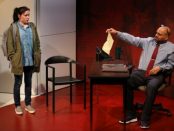
"Education," Brian Dykstra’s new play, is an incendiary investigation into censorship, free speech and responsibility in electric theater. It purports to be about Art as a Weapon but its themes go much further than that. The protagonist Mick, a biracial 17-year-old high school senior, has a rant that lists all the things wrong with American society at this time which is simply scorching. All high school students should be so articulate. In the astute hands of director Margarett Perry, the play moves like greased lightning. You may be dizzy from the provocative ideas but you will not be bored. [more]
Bruce Norris’ plays are so different from each other that you have to take his fingerprints to recognize his hand. His recent New York plays have dealt with racism and gentrification ("Clybourne Park"), politics ("Domesticated"), sexual mores ("The Qualms"), theories of time and space (A Parallelogram), and now in his latest production to reach NYC, "The Low Road" at The Public Theater, he offers a fascinating take on capitalism and the free market told as a picaresque and ribald 18th century tale of colonial America on the brink of statehood. Of course, its real target is today’s untenable global economic situation but his criticism is couched as an historical parable. [more]
It would be a pleasure to say that Musicals Tonight! is going out on a high but that would not be accurate. While the book by Ronald Hanmer and Phil Park based on the play by Charles K. Freeman is very old-fashioned and the original score by Sammy Fain and Paul Francis Webster is quite derivative, the real problem is with the production staged by Devin Vogel making his Off Broadway directing debut. While the Wild West material suggests color and ambiance, this "Calamity Jane" is devoid of those things. [more]
On the basis of “Is God Is,” Aleshea Harris is a new voice in the American theater whose work bears watching in the future. The play is the latest in a long line of revenge stories from the Bible to Quentin Tarantino. The nagging question becomes does Harris have an underlying theme other than the righting of past wrongs by violence. However, Magar’s riveting production never gives the viewer a chance to ponder on this dilemma while the tightly written drama is unfolding before you. While the play has a dark humor throughout, in a parody of the famous Louis Jordan song, it seems to ask the question, “Is God is or is God ain’t?” After witnessing the retribution of the sisters, only the viewer can decide for him or herself. [more]
Casting of Brewer (best known for her several roles on "American Horror Story"), an individual with Down syndrome, is a real coup as she doesn’t have to be inventing a role she knows intimately. Her feistiness, timing and personality make Amy a three dimensional character from the time we first meet her. (A program note tells us that her understudy is another individual with Down syndrome, Edward Barbanell and when he plays the part the play is known as "Andy and the Orphans" in a rewritten version.) Another note reveals that Ferrentino’s heroine is based on her Aunt Amy who grew up with Down syndrome when the medical community had no idea how to deal with it except to institutionalize such people rather than to give them training and support. The play is a fitting tribute to Ferrentino’s aunt who the playwright never got to know as much as she would have liked. [more]
Except for the frustration level of the characters, there does not seem to be a movement towards change or catharsis which may partly explain why the play seems so long. Harris and Madigan retain their cool as therapists throughout until almost the end when they can’t hold in their emotions any more. The most dramatic story is that of 12-year-old Frannie beautifully and realistically played by young Rileigh McDonald. However, as written the role of her foster mother played by Rhea Perlman is a one-note tale and doesn’t give her much wiggle room to make it her own. [more]
"Jerry Springer - The Opera" is not for opera purists nor is for people who are easily offended by four letter words and other bad language of which there is a multitude. However, its irreverence skewers social, religious and political hypocrisy. The New Group’s production directed by John Rando is one of the most exciting musical theater experiences to be currently obtained in New York. It actually seems more relevant in Trump America where this sort of thing is cable-fodder every night of the week. If you are a dedicated theatergoer, miss this show if you dare. [more]
Originally titled "A Test Case" when the play had its premiere in New York in 1892, it is one of Daly’s many adaptations of European successes, this one based on a German comedy of Blumenthal and Kadelburg. While "A Marriage Contract" is a charming evening and has much satire that is still relevant, its genre is that of drawing room comedy. While stylish and graceful, Alex Roe’s production is much too broad to be entirely successful. Several of the actors give over-the-top characterizations of recognizable types which somewhat unbalances the play. In the manner of the popular form of 19th century popular theater, the play is a bit too long for its content and could use a bit of trimming. Nevertheless, the production is entertaining though many of the surprises are telegraphed long in advance of their revelations on stage. [more]
Jordan Harrison’s "The Amateurs" is certainly an ambitious new play acted to the hilt by its cast of six. However, at times it bites off more than it can handle, at other times its anachronisms tear at the fabric of its story, and finally it goes out of its way to draw connections that the audience has already made. The play may need a stronger director than Oliver Butler has proved to be to pull this unwieldy drama into more satisfactory shape. [more]
"Subways Are for Sleeping" is a valentine to New York and projection designer Lacey Erb has created atmospheric slides and streaming video of such iconic locations as Grand Central Station, Park Avenue, Rockefeller Center and the Metropolitan Museum of Art. Unfortunately, the original problem with the material has not been solved: Tom and Angie are just not very interesting. They have little or no back story and no outstanding characteristics. As was famously true in the original production, the show is stolen by the secondary leads. With their continually inventive schemes to get through each day, slacker Charlie who lives off his former friends and would-be nightclub performer Martha with her Southern accent are a total delight. Unfortunately, they are off stage most of the time. The rest of the many characters are simply walk-ons. [more]
Although an interesting idea, James Inverne’s "A Walk With Mr. Heifetz" has lofty ambitions which it is unable to fulfill. While the advertisement proclaims that these two encounters “changed the world as we know it,” none of that comes through in the play. The thinness of the material and the two-dimensional characters fail to bring the story to life. Much more needs to be known or revealed to flesh out this intriguing but undramatized story. [more]
Marcus Gardley’s "X: Or, Betty Shabazz V. The Nation" is a powerful indictment of forces within a movement which help to destroy it. Performed by The Acting Company under the direction of Ian Belknap, their artistic director, the play is riveting throughout while it follows its investigation where it may. It also requires a good deal of knowledge of the events of the 1960’s which many contemporary theatergoers may not come equipped to follow it. [more]
The cast seems to have been mostly chosen for their comic skills rather than their singing skills. Nevertheless, Josh Waldren and Matthew Fairless as the visiting travelers turn “Dear Old Syracuse” into a delightful soft shoe number complete with straw hats and canes, and Walden has a lovely duet with Darrell Morris, Jr. as Luciana to “This Can’t Be Love (Because I Feel So Well).” Shapiro's Luce and Ian Fairlee as Dromio of Ephesus have a big success with the witty, “He and She,” a comic specialty number. However, much of the show has been eroticized and there is a “wink wink” feeling to the overall approach. [more]
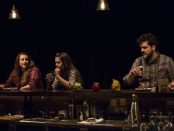
Stop me if you’ve heard this one before: three people walk into a bar where they are known by the drinks they order. Only in Kate Benson’s new play "[Porto]," the unnamed bar is in a gentrified neighborhood in Brooklyn, and is defined as a “boushy bar,” a portmanteau word made up of "bourgeois" and "douchey." We know that because it serves “serious food, serious beer, serious wine, serious spirits.” And what of the story the play tells? Like an episode of "Seinfeld," 'Friends" or "Girls," it will probably please Millennials most, those who are living the life of spending evenings in trendy bars to find companionship. The second play this year following "Miles for Mary" to transfer from Brooklyn’s Bushwick Starr to Manhattan, [Porto] is now at the WP Theater for an Off Broadway run. [more]
"Bar Mitzvah Boy" may not be a top-drawer Jule Styne musical, but Jack Rosenthal’s original story and David Thompson’s new book are excellently observed to have the ring of truth. The family chaos in planning the affair and problems precipitated by the young son’s behavior are sharply and shrewdly detailed enough to be absorbing in a way that all can relate to. Annette Jolles’ production for The York Theatre Company gets a great deal out of the material even in a version without the trappings of a full production. It is also a pleasant surprise to see an unfamiliar musical by major talents which fills in a gap in their careers. [more]
Playwrights Horizons has a real winner with the first entry in its new Redux Series bringing back worthy Off Off Broadway plays for a longer run Off Broadway. First up is "Miles for Mary," a company project from The Mad Ones, a New York City-based troupe dedicated to creating “ensemble-driven highly detailed theatrical experiences that examine and illuminate American nostalgia.” Seen previously at The Bushwick Starr during the 2016-17 season, "Miles for Mary" is a brilliant satire on group dynamics in an ongoing school fund-raising committee told in real time. While hilarity abounds as the committee does its pedantic and minimal work, an inevitable explosion is promised by the end and it is a doozie when it finally occurs. [more]
We are never told the name of the play being rehearsed or who the characters in the play within the play are. In the second act, the performers dressed in their costumes for Gabriele’s play reveal that it is a Renaissance costume drama but we still learn nothing about it. Nothing much is revealed about Italian theater of the time though the play being rehearsed does not seem to be in the naturalistic mode of drama that was creeping into the legitimate stage in 1899. And why did the author pick that year? No clues are given. [more]
Whereas Kennedy became famous with plays that use myth, history, surrealism and Theater of the Absurd to tell their stories, this play tells a realistic tale in poetic form, its very brevity belying its depth of feeling. The play incorporates the styles of romantic drama, Elizabethan tragedy, old-fashioned operetta, a murder mystery, and recent history of the not so distant past. Events in the play were suggested by Kennedy’s mother and her own visits to her grandparents in the Jim Crow South. [more]
Stanley Houghton’s once controversial "Hindle Wakes" explodes everything you have ever been taught about the double standard and the place of women in society. The irrefutable logic of the characters in this play can only leave you with one conclusion. Gus Kaikkonen’s superb production for the Mint Theater Company restores this forgotten play to its rightful place in British drama. Had the playwright not died prematurely the year after "Hindle Wakes"’ premiere, the play would most likely have not fallen into an almost 100 year eclipse. Ironically, the Me-Too movement reminds us that the philosophy that “boys will be boys” is both immoral and indefensible. [more]
Greg Pierce, the author of "Slowgirl" and "Kid Champion," has often tackled hot button issues. Here in Cardinal being given its world premiere at Second Stage Theater, he takes on urban renewal, Chinese entrepreneurs, racism and amateurs in politics, all worthy of investigation, in comic fashion. However, in this satire his plot seems to reinvent itself in every other scene, with twists and turns you can’t see coming. The three sets of characters (Lydia and Jeff, Nancy and Nat Prenchel, owners of the Bread & Button Bakery, and Chinese businessman Li-Wei Chen and his son Jason) seem totally separate until he brings them together in a rather improbable finale. He also loads the deck with such plot complications as Lydia and Jeff beginning an affair (as she looks so much like her sister who he dated in high school and hasn’t gotten over.) [more]