
Articles by Tony Marinelli

About Tony Marinelli

The Wild Party (New York City Center Encores!)
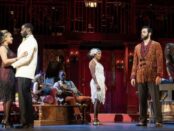
In the hands of Michael John LaChiusa (music, lyrics and book) and George C. Wolfe (book), the feral, syncopated verse of Joseph Moncure March’s Prohibition-era poem is not so much adapted as reforged—heated, hammered, and hurled forward as a kind of theatrical locomotive. Their "Wild Party" arrives like a runaway train of jazz, gin, and envy, its momentum at once intoxicating and annihilating. It careens down the rails with a velocity that promises, even as it seduces, an inevitable and exquisitely catastrophic derailment. [more]
Entangled: 12 Scenes in a Circle K off the I-40 in New Mexico

In "Entangled:12 Scenes in a Circle K off the I-40 in New Mexico," the beguiling and philosophically mischievous collaboration between Mona Mansour and Emily Zemba, the American desert becomes less a landscape than a condition of thought—a place where the ordinary laws governing time, consequence, and human attachment appear to have loosened their grip. Set in the fluorescent limbo of a Circle K somewhere in the New Mexico expanse—30 miles from the nearest outpost of civilization, and perilously close to both an atomic testing site and a nuclear laboratory—the play hums with a low-grade metaphysical dread that it wears, with admirable restraint, as comedy. [more]
Spare Parts

What begins as a satirical clash between corporate swagger and academic idealism gradually deepens into a more unsettling inquiry. The play’s true subject, it turns out, is not merely the arrogance of billionaires but the universal temptation to trespass upon the limits of the body. Humanity, after all, has always been drawn toward transgression—whether through cosmetic surgery, pharmaceutical enhancement, or the relentless drive to improve the species one experiment at a time. [more]
Body Count

If the show’s point of view occasionally feels one-sided, that imbalance ultimately serves its chief purpose: entertainment. 'Body Count' may not function as a comprehensive treatise on contemporary sexual politics, but it is undeniably electric as a performance vehicle. Knowles’ Pollie is charismatic to the point of hypnosis—funny, sharp, wounded, and persuasive enough to feel utterly real. Her barbs may sometimes be a shade too neat, a shade too gleefully cruel, but they land with a sting that lingers. Long after the laughter subsides, one finds oneself turning the lines over again, wondering what uncomfortable truths might be hidden inside the joke. [more]
Marcel on the Train
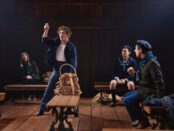
Slater’s performance is a revelation of synthesis. Known for his buoyant athleticism in Broadway’s "SpongeBob SquarePants" and his chilling portrayal of the Balladeer and Lee Harvey Oswald in Classic Stage’s brilliant "Assassins," he here channels that dexterity into something at once lighter yet more harrowing. His Marceau moves with balletic precision: fingers unfurl like petals; wrists trace invisible architecture; the torso leans into unseen walls. Butterflies tremble from his cupped hands, a flower blossoms and droops along the line of his arm. Guided by movement consultant Lorenzo Pisoni, Slater achieves an embodiment so exacting it appears to suspend the laws of bone and gravity. [more]
Hold on to Your Butts
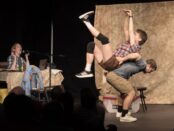
Actors Kerry Ipema and Natalie Rich, joined by the live Foley artist Kelly Robinson, proceed to conjure Spielberg’s dinosaur epic. They marshal an arsenal of materials so defiantly homespun it borders on subversive: cardboard cutouts standing in for apex predators, skeletal wooden frames sketching out jeeps and laboratories, pocket flashlights pressed into service as cinematic chiaroscuro, and a scattering of objects manipulated with priestly concentration, shot for shot—all deployed with an almost ascetic economy of means that make the absence of machinery feel not like deprivation but like principle. [more]
Mother Russia
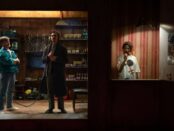
In Lauren Yee’s exuberant and stealthily devastating new comedy, "Mother Russia," history arrives not with a bang but with an order of fast food. Two young men, perched at the lip of a new world order, cradle their first-ever Filet-O-Fish sandwich from McDonald's as though it were a sacred relic. They tear into it with the devotional hunger of converts, pausing only to roll their eyes heavenward and lick tartar sauce from their fingers with an abandon that feels both comic and liturgical. Capitalism, Yee suggests, is best introduced as a condiment. [more]
Hate Radio
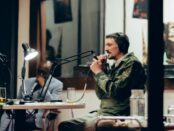
The premise—a radio broadcast—might seem theatrically inert, yet Rau ingeniously implicates the audience by issuing each spectator a set of headphones. We are not merely watching propaganda; we are tuning in. If we need to gauge our own humanity while we watch the hideous display, all we need to do is look straight ahead - on the other side of where the actors play sits the other half of the St. Ann’s Warehouse audience. The isolation produced by the earphones intensifies the intimacy of the rhetoric. One hears the laughter, the rhythm, the coded exhortations as if they were meant for one’s own ear. The imaginative leap—who would listen to this? who would believe it?—collapses. The seduction of format, the familiarity of tone, do much of the ideological work. [more]
MANO A MANO
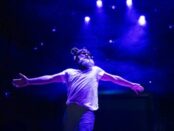
To enter the performance space of Paul Pinto’s "MANO A MANO" is to find oneself seated not before a proscenium, but around a giant Arthurian round table, a scenic choice that immediately dismantles the distance between the observer and the observed. One is not merely an audience member; one is a guest at a grim, historical banquet where the main course is the fractured psyche of the British Isles. Pinto, a playwright-composer-performer of singular, manic energy, has crafted a libretto that functions as a rhythmic autopsy of masculinity, tracing a lineage of "headless alpha males" from the Trojan War to the contemporary boxing ring. [more]
Ai Yah Goy Vey! – Adventures of a Dim Sun in Search of His Wanton Father
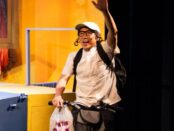
Chang is an agile performer, and his quick shifts among characters recall the early solo work of urban shapeshifters who built entire neighborhoods out of voice and posture. Yet here the gallery of types is unevenly realized. Too often, figures arrive as the sketch of a stereotype rather than the surprise of a person. When Chang draws on the stylization of Chinese opera—particularly in the rendering of Jackie’s diva-like mother—the show briefly discovers a richer theatrical language, one in which Eastern and Western performance traditions spar and flirt on equal terms. Such moments hint at a more adventurous piece than the one that predominates. [more]
The First Line of Dante’s Inferno
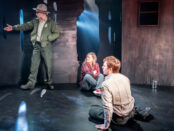
The opening gesture of Dante Alighieri’s "Inferno"—that immortal confession of midlife disorientation in which a wanderer finds himself astray from the “straight road” and deposited in a “dark wood”—has rarely felt as theatrically apt as it does in "The First Line of Dante’s Inferno," Kirk Lynn’s sly, searching, and disarmingly funny new experiment in staged storytelling. Lynn, a polymath of the American theater—playwright, novelist, screenwriter, educator, and guiding spirit of the Austin collective Rude Mechs—treats Dante’s premise less as a theological map than as a psychological condition. His forest is not an allegorical afterlife but a contemporary wilderness in which several souls, one quite literally at midlife, appear to have misplaced the coordinates of their former selves. [more]
High Spirits (New York City Center Encores!)
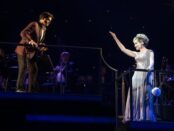
The afterlife has always enjoyed a sturdy tenancy on the musical stage, but "High Spirits"—Hugh Martin and Timothy Gray’s tuneful graft onto Noël Coward’s "Blithe Spirit"—has, until now, seemed a ghost itself: spoken of fondly by aficionados, seldom seen, and rarely summoned with conviction. That New York City Center Encores! has revived it, in its first professional New York outing since 1964, makes its long absence feel less like neglect than a curious collective lapse in memory. For this effervescent score and Coward’s indestructible farce reveal themselves, in performance, to be not merely viable but positively tonic. Under Jessica Stone’s direction, "High Spirits" is presented with a spareness that registers as notable even within the intentionally stripped-down aesthetic long associated with Encores! The concert format, here, feels less like a stylistic choice than a visible process: once again scripts remain firmly in hand, and the performers give the impression of artists still negotiating their relationship to the material in real time. At moments we are treated to some hilarious spontaneous reactions, tongue-in-cheek banter when one actor has turned too many pages in his or her binder. [more]
Manon! (Heartbeat Opera)
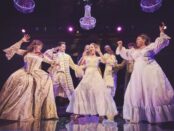
For Heartbeat Opera’s presentation of Massenet’s exquisite "Manon," the co-adaptors Rory Pelsue, who also directs, and Jacob Ashworth, the company’s artistic director, take a scalpel to Massenet’s expansive five-act opéra comique, paring it down to a fleet, intermissionless ninety minutes. In the process, they excise subsidiary characters and the bustling choral tableaux that French opera has traditionally treated as both ornament and social panorama. What remains is not a diminished work but a distilled one: the narrative’s spine emerges with unusual clarity, its emotional stakes thrown into sharper relief by the absence of decorative detours, oh, and it’s performed in English and retitled "Manon!" [more]
King Lear (Compagnia de’ Colombari)

By loosening the moorings that usually tether one actor to one role, director and adaptor Karin Coonrod peers, with unusual intimacy, into Lear’s psychic weather. The choice to distribute him among ten bodies does not dilute the character; it refracts him. We are invited to watch a consciousness under siege, a man stripped so thoroughly of title, certainty, and familial illusion that what remains is not a king discovering wisdom so much as a human being stumbling toward self-recognition. Lears circulate through the auditorium, each member of the company outfitted by Oana Botez in a palette of muted greige, topped by gilded paper crowns, courtesy of Tine Kindermann, that rise a good foot and a half into the air, their fragile grandeur at once comic and faintly forlorn—a visual joke that curdles into a metaphor. The multiplicity supplies a chorus of selves: monarch and parent, tyrant and child, sovereign and supplicant. At times they seem to echo one another; at others they compete for the same thought, as if Lear’s mind were a crowded room he can no longer govern. The image captures something essential about the play’s cruelty: identity, once propped up by power and praise, proves alarmingly divisible. [more]
Watch Me Walk
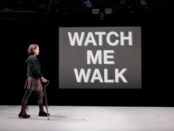
Anne Gridley begins "Watch Me Walk" by taking its title at punishingly literal face value. She introduces herself, grips her walking stick—never a cane, a semantic correction that quickly reveals its philosophical weight—and proceeds to walk the length of the stage again and again, in near silence, for so long that the initial charge of provocation slowly discharges. What remains is not suspense but facticity. In another theatrical ecosystem, this might register as endurance art or a sly conceptual prank; here, in a Soho Rep production presented in association with the recently concluded 2026 Under the Radar Festival, it operates as a recalibration of spectatorship itself. We arrive alert, waiting for the performance to “start,” only to discover that it already has—and that the only thing lagging behind is our attention. [more]
Try/Step/Trip
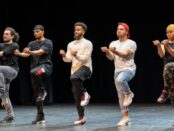
The choreography by Toran X. Moore is exquisitely attuned to both context and cast. Moore’s steps and motifs create a full canvas of movement that breathes with the beat and bends to the demands of the narrative. "Try/Step/Trip" announces itself through a distinct physical vocabulary, one that is not merely stylistic but historical and communal: step, the percussive dance form forged and refined within historically Black colleges and universities. Here, the body becomes both instrument and archive—feet striking, hands clapping, chests resonating in rhythms that carry lineage as much as sound. The choice of step is not ornamental; it is foundational, lending the work a muscular, collective language that insists on presence, discipline, and shared breath, and that roots the piece in a tradition where movement functions simultaneously as music, memory, and social bond. Rooted firmly in Black dance, the choreography adapts itself to the tonal shifts of each song and scene, turning the evening into a literal and figurative adventure. At 90 minutes, the piece demands stamina and precision from its performers, and the ensemble meets that challenge with discipline and collective resolve. [more]
Hildegard
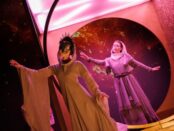
Sarah Kirkland Snider’s first opera arrives with a confidence that feels almost paradoxical: it is at once tightly focused and lavishly expansive, a work that fixes its gaze on a single hinge in medieval history while allowing the implications of that moment to ripple outward in all directions. "Hildegard" does not so much resurrect Hildegard von Bingen as acknowledge what she has always seemed to be—a figure who belongs as much to myth as to chronology, a woman whose historical footprint feels improbably modern, even futuristic. [more]
If We Kiss
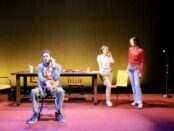
What "If We Kiss" captures, with rare delicacy, is the way young people experience such convergences as both comic and catastrophic. The play treats adolescent feeling with respect, refusing to condescend to its intensity while still allowing space for humor and grace. In doing so, it reminds us that first love is never merely personal: it is social, moral, and—when the generations begin to rhyme—quietly political. [more]
The Baker’s Wife
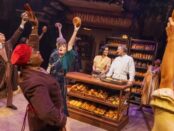
Greenberg’s greatest achievement is his refusal to inflate or apologize for the material. He treats "The Baker’s Wife" as what it is: a musical of sensibility rather than momentum, concerned with romance, regret, and the cost of impulsive desire. There is a deliciously vaudevillian, music-hall bustle to “Bread,” the ensemble number that marks the village’s first ecstatic encounter with Aimable’s handiwork. The song clatters and skips with comic precision, its rhythms suggesting both hunger and sudden abundance, and Stephanie Klemons’ dances here leans into that sense of organized chaos, shaping the townspeople’s delight into a playful choreography of anticipation, consumption, and communal relief. Paul’s dynamic rendition of “Proud Lady,” with its Brel-inflected toughness, certainly gets its desired effect. In revealing the show’s emotional coherence, Greenberg demonstrates that The Baker’s Wife was never broken beyond repair—only misunderstood. Here, at last, it feels whole. [more]
BUM BUM (or, this farce has Autism)
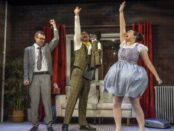
In "BUM BUM (or, this farce has Autism)," EPIC Players—New York’s indefatigable standard-bearer for neuroinclusive performance—unfurls a world premiere that feels less like a conventional new play and more like a controlled theatrical detonation. Written by autistic playwright Dave Osmundsen, the play arrives disguised as farce, yet beneath its slapstick velocity lies an exacting critique of how neurodivergent lives are shaped, softened, and rendered consumable for mainstream audiences. It is a work that understands comedy not as an escape from politics but as one of its most effective instruments. Under the brisk, clear-sighted direction of Meggan Dodd, EPIC Players has assembled a company of actors on the spectrum to bring to life the buoyantly subversive text of award-winning Osmundsen—a writer whose instinct for farce is matched only by his ear for the humiliations, large and small, that so often attend the rhetoric of “inclusivity.” [more]
The Faggots and Their Friends Between Revolutions
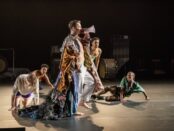
In the cavernous expanse of the Park Avenue Armory, where spectacle often arrives inflated to mythic proportions, "The Faggots and Their Friends Between Revolutions" materializes as a frequently mad, occasionally mystical, and resolutely LGBTQIA+ fantasia. Adapted from Larry Mitchell and Ned Asta’s 1977 queer fable-book—part manifesto, part utopian parable—this incarnation, shaped by composer Philip Venables and director Ted Huffman (who first unveiled it to British audiences in 2023), announces itself with a great deal of theatrical flourish. For all its conjurations and incantatory ambition, it is ultimately a work whose whimsy gleefully shines on the backs of this diamond’s many facets. [more]
A Bodega Princess Remembers La Fiesta de los Reyes Magos, 1998

Iraisa Ann Reilly in her one-woman show “A Bodega Princess Remembers La Fiesta de los Reyes [more]
Full Contact
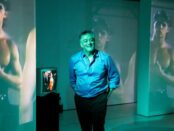
In its final form, the piece stands as both elegy and proclamation: a testament to a heritage reclaimed, and to the fierce, necessary act of making contact—full, unguarded, and profoundly human—with oneself. Estrada exists here in a purgatorial tension, suspended between the gravitational pull of guilt and the stark instinct toward survival. The play chronicles not simply his attempt to move forward but the Herculean labor of taking even the first tremulous step toward healing—an act rendered as perilous as any physical combat he has ever undertaken. At times it seems his own mind, a treacherous and labyrinthine opponent, threatens to drag him beneath its tide. And yet, in the fragile space between collapse and catharsis, the work finds its most haunting register: a portrait of a man grappling to reclaim his narrative before the darkness that shaped him claims him once more. [more]
HardLove

By the time the play reaches its understated yet piercing climax, the question is no longer whether ChiChi and Theodore are “right” for one another—though that question lingers—but rather what it means for any of us to seek connection in a world where desire is both compass and mirage. "HardLove" distills the fragile thrill of two strangers attempting to divine each other’s contours—emotional, physical, moral—and uses that single night’s encounter as a prism through which larger anxieties of belonging, expectation, and becoming refract. In the end, this bold, darkly funny, and unexpectedly tender work stands as a testament to the theater’s capacity to anatomize intimacy without anesthetizing it: a funny, poignant hour that leaves its audience pondering not only these two characters but the mysterious machinery of desire itself. [more]
Rob Lake Magic With Special Guests The Muppets
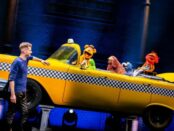
If the Muppets are deployed as window dressing, the illusions themselves are a museum of inherited gestures. Lake presents the familiar canon of contemporary stage magic: the bifurcated assistant, the levitating woman afloat above a bed of water (which, in its defense, has the best stage accoutrements of the evening), the interlocking wedding rings that actually make it back to their owners, the transmogrified paper rose born of a Kleenex, the sealed-box prediction trick. These are the old reliables, charming chestnuts of the craft. And to be fair, if it is your first encounter with such wonders in the flesh, they retain an undeniable potency. Something impossible happens before your eyes, and for a moment one senses the naïve astonishment that once greeted Houdini or Blackstone. But the long shadow of 20th-century spectacle looms large. When David Copperfield made a woman vanish, he seemed to risk something existential—his illusions were staged with the gravitas of a metaphysical wager. Doug Henning, all fringe and mystical glow, imbued the form with a countercultural buoyancy. Lake’s versions, by comparison, feel perfunctory, the delivery mechanical rather than miraculous. To deploy the same tricks as one’s predecessors is no sin, but to do so without reimagining them—or without doing them better—is a kind of aesthetic resignation. [more]
Bat Boy: The Musical
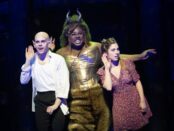
Beneath the camp and chaos, 'Bat Boy" remains what it always was: a parable with a pulse. O’Keefe’s rock-opera score jabs with wit but bleeds sincerity; his lyrics cut deep with irony and compassion. The story still howls against hypocrisy—the intolerance of difference, the fear of the Other, the absurd theatre of morality that masquerades as virtue. "Bat Boy" feels less like a musical and more like a communal exorcism of repression, guilt, and joy. In the capable, chaotic hands of this remarkable company, it doesn’t just sing—it soars, claws, and howls. To want to belong has rarely felt this thrilling. What emerges, through all the shrieks and laughter, is something profoundly moving: a hymn to belonging, a love letter to strangeness, a primal scream for empathy. [more]
The Wasp
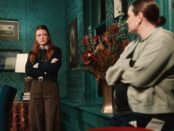
'The Wasp" is not for the faint of heart. It confronts the audience with themes of mental illness, domestic violence, and sexual trauma, yet resists the easy descent into nihilism. For all its darkness, there is a fragile thread of mercy woven through the play’s venomous fabric—a suggestion that even amidst cycles of cruelty, one might still choose compassion. Malcolm leaves us with the uneasy sense that the line between victim and aggressor, between wasp and spider, may be far thinner than we care to admit.
And so, like the sting of its namesake, "The Wasp" lingers long after the curtain falls—sharp, unsettling, and impossible to forget. [more]
Hannah Senesh
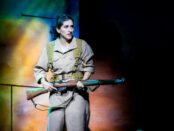
At the center of it all stands Apple, whose performance is nothing short of revelatory. As Catherine, she is brittle yet unbowed; as Hannah, she radiates vitality and purpose. Her voice—both spoken and sung—cuts through the air with the precision of belief. A stirring portrait of resistance, resilience, and unyielding hope, Apple’s one-woman tour de force unfolds with the emotional breadth and intensity of a full ensemble. Apple commands the stage with a virtuosity that transcends mere performance; she channels something elemental and deeply human, crafting an experience that lingers long after the lights fade. It is as inspiring as it is unforgettable—a testament not only to the power of storytelling, but to the indomitable spirit it so eloquently celebrates. Around her, Simon Feil lends quiet gravity as the spectral voices of Hannah’s brother and her Nazi captor. [more]
Did You Eat? (밥 먹었니?)

To have emerged from a childhood like Zoë Kim’s—with enough self-awareness, critical distance, and sheer emotional stamina to craft a piece of theater with even a hint of uplift—is in itself an act of tremendous courage. The piece’s very existence is a quiet triumph: a testament to survival, to the insistence of choosing a path of identity in the face of sheer cruelty, and to the reclamation of one’s own narrative. Yet "Did You Eat?" accomplishes something beyond testimony. Artistically, it is a layered, deeply felt work that reveals Kim’s aesthetic intelligence and her willingness to experiment with form, language, and the body. [more]
Heaux Church

In "Heaux Church," writer-performer Brandon Kyle Goodman does not so much deliver a sermon as they detonate one—turning the pious pulpit upside down and shaking loose its centuries of shame, repression, and whispered taboo. What emerges from the rubble is something gloriously unholy and defiantly sacred: a new gospel of pleasure, pride, and personal liberation. Directed with ecstatic precision by Lisa Owaki Bierman, and buoyed by the ecstatic ministrations of DJ Ari Grooves, enveloping sound design of Christopher Darbassie, and flirty adult puppets of visual provocateur Greg Corbino, Goodman presides over a theatrical communion that is part revival, part stand-up confession, and part drag-tinged spiritual exorcism. [more]
oh, Honey
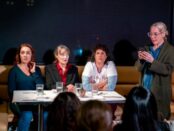
Under Carsen Joenk’s clean, clever direction, Scotti’s writing finds a delicate equilibrium — biting, funny, and deeply humane. The quartet of women are precisely dressed by designer Iliana Paris — Lu (played with steely authority and a glint of battle-worn wisdom by Dee Pelletier), Bianca (played as a confection — all sugar, charm, and the gentle fizz of conviviality — yet beneath that polished surface something acrid brews, by Jamie Ragusa), Vicki (Karo, radiating a pitch-perfect, Aquarius-inflected, “healing crystal” chaos), and Sarah (Mara Stephens) — are not friends, as Lu icily reminds us. “We can’t talk to real friends about this crap,” she declares. “They already talk enough shit about us behind our backs.” This crap, we soon learn, is the devastating, unshareable truth they orbit: each has a son accused of sexual assault. [more]
Oratorio for Living Things
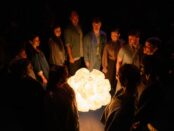
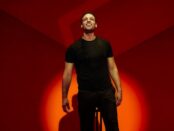
To describe "Oratorio" is to flirt with the inadequacy of language. It is a musical work—a sung-through piece in the formal lineage of the oratorio, that 17th-century form that eschews staging and dialogue in favor of spiritual rumination through voice. Think Handel’s "Messiah," and then think again—"Oratorio for Living Things" shares the same bones, but not the flesh. Christian, ever the aural alchemist, reclaims and “rewilds” the form, unbinding it from its ecclesiastical constraints and infusing it with a heady blend of the sacred, the scientific, and the speculative. [more]
Nothing Can Take You from the Hand of God

Jen Tullock in the one-woman play “Nothing Can Take You from the Hand of God” at Playwrights [more]
Italian American Reconciliation
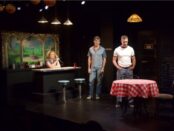
"Italian American Reconciliation" may not be peak Shanley, but in the capable hands of this cast and creative team, it becomes something rare: a flawed but full-hearted theatrical reverie, equal parts barroom confessional and back-alley sonnet. It may be second-tier Shanley, but even Shanley’s second tier can outshine the top shelf of lesser playwrights. [more]
The Least Problematic Woman in the World

Under the weight of the show's ambition, Dylan Mulvaney is a star. Not in the manufactured influencer sense, but in the time-honored theatrical tradition of the charismatic truth-teller who can command a stage with little more than timing, talent, and tenacity. She invites us to laugh with her, cry with her, rage with her—and then, perhaps, go out into the world a little more willing to see the humanity in people who are simply just trying to “be.” "The Least Problematic Woman in the World" is not without flaws—but like its creator, it dares to be seen in all its contradictions. And that is the most radical act of all. [more]
Slaughter City
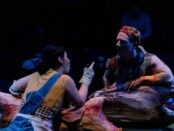
It has taken nearly three decades, but Naomi Wallace’s feverish proletarian dreamscape "Slaughter City" has finally carved its way onto a New York stage—and in doing so, has made a queasily persuasive case for its own urgency. First mounted by the Royal Shakespeare Company (January 1996) and the American Repertory Theatre (March 1996), this bruising, bloodstained fable—set in a slaughterhouse where class war, labor unrest, and the surreal intermingle like steam off a fresh carcass—feels, depressingly, like prophecy fulfilled. In the years since its debut, the power of organized labor has withered in many corners of American life. But Wallace’s dramaturgy doesn’t so much wither as wound: the play’s beating heart remains the same—pulsing with the traumas of exploitation, the rot of institutional racism, and the inextinguishable ache of the working class for dignity, love, and survival. That "Slaughter City" now arrives in New York under the direction of Reuven Glezer, via Alex Winter and Small Boat Productions, feels not belated but inevitable. And its resonance today, in our era of “essential” workers and renewed labor militancy, is uncanny. [more]
The Glitch

Though it ends on a note of ambiguity—as any good speculative work should—'The Glitch" is resoundingly clear in its testament to the power of theater to interrogate our technological anxieties with grace, wit, and emotional intelligence. In this age of rapid AI proliferation, Koenig’s play reminds us that while machines may evolve by version number, human hearts upgrade by reckoning—and not always successfully. [more]
From Trinity to Trinity
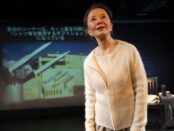
Among her most haunting and meditative works is the slim yet searing "From Trinity to Trinity," an autobiographical pilgrimage undertaken in 1999 to the Trinity Site in New Mexico where the world’s first atomic bomb was tested. It is, in essence, a journey back to the beginning of the end. Published in 2000 and rendered into English by Eiko Otake—half of the hauntingly expressive performance duo Eiko & Koma—the work was later published in 2010, bringing Hayashi’s voice to new ears, and new hearts. But it was in 2009 that Eiko, recognizing the performative potential and piercing immediacy of Hayashi’s words, reached out to the accomplished New York-based actress Ako—known for her roles in "Shogun," "God Said This," and "Snow Falling on Cedars," and the visionary founder of the Amaterasu Za theater company. Eiko posed a proposition: Could this text—so personal, so painful, so charged with historical weight—be embodied on stage as a one-person play? The answer, though tentative and reverent, was yes. It is Ako’s own adaptation for the stage that she performs today. [more]
Last Call, A Play with Cocktails
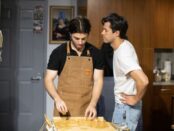
The conceit is clever: each performance takes place in a real home, the precise address dispatched only the day before, like a speakeasy or secret society. A password grants entry. There’s a frisson to ringing an unfamiliar doorbell in a neighborhood you’ve selected but don’t know, expecting to be welcomed inside. And welcomed you are—by a host (a literal homeowner, not an actor), who hands you a letter (“Congratulations on leaving the comfort and safety of your homes during this crisis…”) and offers wine and chatter before ushering you toward a makeshift audience configuration: a scatter of couches, dining chairs, bar stools, forty-some options in all, arranged with deliberate casualness. Just as you begin to wonder how, exactly, this will become a play, your (bar)Tender arrives. He’s late. He’s distraught. He’s encased—hilariously, ominously—in the hard shell of a full-sized USPS mailbox, which he declares is “protective gear.” (A detail as absurd as it is revealing—after all, in a crumbling state, even the mail must wear armor.) [more]
we come to collect: a flirtation, with capitalism
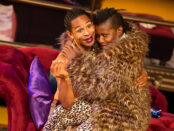
Jennifer Kidwell’s "we come to collect: a flirtation, with capitalism" is not so much a theatrical production as it is a revelation—an offering, a conjuring, a glittering séance of self-examination draped in velvet and lit by the shimmer of a slightly crooked chandelier. Co-conspirators Kidwell and Brandon Kazen-Maddox are not here to collect, as the title slyly suggests. No, far from it. They have arrived bearing gifts: extravagant, irreverent, and comforting…gifts of laughter, of vulnerability, of truth. Gifts that ask nothing in return but your full, unguarded presence. Premiering at The Flea Theater in TriBeCa, this audacious production gleefully dismantles the social and economic scaffolding that props up our daily lives, only to replace it with something far more anarchic, more tender, and ultimately more human. [more]
Color Theories

And by the time we arrive at "Fantasmas"—his 2024 HBO series that feels less like television and more like a guided tour through the psyche of a queer mystic armed with a glitter pen and a penchant for unresolved metaphor—it becomes abundantly clear that Torres is not dabbling in a style so much as building a universe. "Color Theories," then, is not an outlier but an extension—another window into that universe, pastel-hued and ever-so-slightly haunted. But don’t call it a play—at least not in the Off Broadway sense. Call it a chromatic séance, a theatrical mood board, or perhaps a dispatch from the dreamworld of a lonely child with a glitter pen and a grudge against Helvetica. [more]
House of McQueen
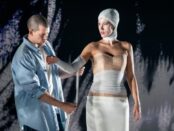
Crafted with sensitivity and spectacle by playwright Darrah Cloud and brought to life with unflinching precision by director Sam Helfrich, "House of McQueen" dares to unravel the mythos of the late, great Alexander McQueen (1969–2010), the enfant terrible of British fashion. Here, the theater becomes both confessional and catwalk, memory palace and mausoleum, as the production careens through the designer's short but incandescent life. McQueen's nephew, Gary James McQueen, serving as Creative Director, lends the production an air of intimacy and authenticity rarely achieved in biographical theater. This is no sanitized tribute, no saccharine memorial. It is raw. It is fractured. It is McQueen. [more]
Sober Songs
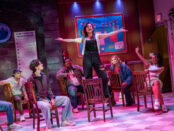
Still, for a piece that purports to tackle the complexity of addiction, "Sober Songs" often fails to excavate its deepest layers. Relapses, romantic entanglements, suicidal ideation, and earnest confessions flit across the stage, but many are handled with a frustrating brevity, giving the sense that we are skimming the surface of lives meant to be far more turbulent than the book or score allows them to be. [more]
Alan Turing & The Queen of the Night
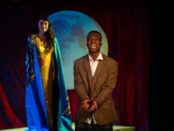
There’s a lot going on in this new musical about Alan Turing—and perhaps too much. In attempting to encompass the breadth of Turing’s extraordinary life, the production ends up overwhelmed by its own ambition. It is too long to sustain its narrative with somewhat underdeveloped characters, and too short to provide the necessary depth to the relationships that are meant to drive its emotional core. [more]
well, i’ll let you go
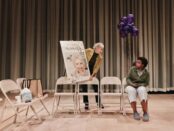
"well, i’ll let you go," Bubba Weiler’s exquisitely devastating new work, staged with unpretentious yet profound grace by director Jack Serio leading a magnificent cast at the Space at Irondale in Brooklyn is, in a word, haunting. The play unfolds as a poignant, slow-burning elegy to ordinary lives and the extraordinary grief that can shatter them. It is a tender meditation on loss, memory, and the fragile architecture of community—one that both embraces and exposes the complex, often contradictory, human heart. [more]
Wesley
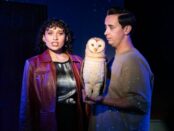
Austin Phillips’s puppet design deserves special mention. His owlet creation is imbued with uncanny charm—Wesley is clearly an owl, yes, but one whose subtle articulation suggests personality rather than anthropomorphism. The puppet becomes a living character, thanks in large part to the finely tuned performance of Daniel Sanchez, making an impressive Off-Broadway debut. As Wesley, Sanchez navigates a delicate balance: he gives the owl presence, agency, even affection, without sacrificing the essential strangeness of the animal. His portrayal renders the owl’s devotion to Casey moving and believable, even as we are always aware that this is a bird, not a human in disguise. As he dances with Casey during the “Winter is Coming” sequence we are painfully aware of how little time they can expect to share together. [more]
Mozart’s Don Giovanni: A Rock Opera

Ambition, that perilous double-edged sword, can elevate a work of art to soaring heights—or leave it flailing in the rafters, reaching desperately for resonance it cannot quite grasp. Such is the case with "Mozart’s Don Giovanni: A Rock Opera," Adam B. Levowitz’s audacious and heartfelt, if uneven, adaptation of Mozart’s canonical masterpiece. This leaner, louder take on "Don Giovanni," recognizing the latent synergy between operatic grandeur and rock bravado, now playing at The Cutting Room through August 26, replaces the classical orchestra with a ten-piece rock band and pares down the original three-hour-plus opera to a taut two hours and ten minutes. If only its dramatic momentum had received the same rigorous attention as its runtime. [more]
Prince Faggot
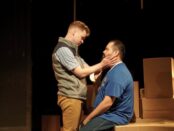
In a sharply observed and emotionally layered turn, "Prince Faggot" brings a fresh perspective to the classic "meet the parents" trope—with a royal twist. John McCrea’s George, the openly gay Prince of England, brings his boyfriend Dev (an excellent Mihir Kumar) home to meet his parents: the seemingly progressive Prince William (K. Todd Freeman, masterfully restrained) and Princess Kate (a poised and quietly complex Rachel Crowl). At first glance, the royal welcome is warm, even congenial. But beneath the polished surface lies a prickly nest of social expectation, national identity, and unacknowledged privilege. [more]
At the Barricades
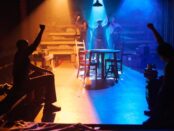
In great theater, history is not merely recounted but resurrected with breath and pulse, defiance and hope. In 'At the Barricades," the indomitable company What Will The Neighbors Say? breathes new life into one of the 20th century’s most harrowing yet heroic chapters — the Spanish Civil War of 1937. We find ourselves in Madrid not as tourists, but as comrades in struggle, embedded within a city and a country fraying at the seams, on the verge of succumbing to the iron fist of fascism. And yet, in the shadow of tyranny, a radiant flicker of international solidarity takes flame. [more]
Medea of the Laundromat
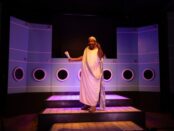
This is not merely a delightful evening of theatre—it is a defiant, sequined middle finger to theatrical complacency. The cast, many of whom trained under the maverick George Ferencz at La MaMa, bring authentic chops to the chaos. Morrison is transcendent, as raw as he is precise. Vath is a hurricane in scrubs (and let it be known she is the hardest working actress south of the TKTS line as she races from her curtain call at Theater Row Theater’s production of Cracked Open to aid and abet the sorceress on the cover of Child Abuse Monthly). Howard’s Jason is laughable, pitiable, and oddly endearing—a fallen hero undone by hubris and soap suds. [more]
The Moby Dick Blues
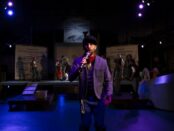
"The Moby Dick Blues" is nothing short of a working-class opera for the Anthropocene—equal parts "Trainspotting" and "The Perfect Storm," churning with fury, addiction, and mythic ambition. In Michael Gorman’s daring reimagining, Melville’s epic is filtered through the hard truths of the contemporary opioid crisis, reframing Captain Ahab as a tragic addict and the White Whale as a haunting symbol of narcotic oblivion. The reframing lands with seismic force, compelling us to reconsider not only Melville’s obsession-driven narrative, but our own self-destructive relationships with nature, legacy, and escape. [more]
Chiaroscuro: A Light and Dark Skin Comedy

If "Chiaroscuro" occasionally falters under the weight of its ambition, it ultimately dazzles with its daring. Rahman has crafted a bold, theatrical puzzle box — part satire, part sermon, part séance — that speaks to the depths and contradictions of Black desire in all its shadowed hues. The play doesn’t just shine a light; it refracts it—casting humor and heartache in tandem. With "Chiaroscuro," Rahman leaves us with a final, luminous testament to her unique voice—both searing and sublime. [more]
Eurydice
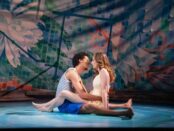
Orpheus’ song—aching, persistent—guides him deep into the Underworld in search of his lost Eurydice. Whether or not you’ve encountered this myth before, Sarah Ruhl’s "Eurydice" invites a new question: not just will they reunite, but should they? The tension isn’t only mythic—it’s emotional, intimate. As Eurydice teeters between the memory of her father and the love of her husband, the audience is left to wonder: can love pull them both from the brink, or will they vanish into the River of Forgetfulness, together yet apart?
This revival, directed once again by Les Waters more than two decades after he first helped bring Ruhl’s script to life, is a poignant reminder that some stories don’t age—they resonate. The production hums with urgency and heart, made vivid by a cohesive, impassioned ensemble that grounds the myth in emotional truth. [more]
Cracked Open
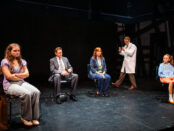
At an hour and 40 minutes, "Cracked Open" is an earnest but often exhausting theatrical experience. Its heart is unquestionably in the right place—tackling the vital and still-stigmatized subject of mental illness with sincerity—but the journey can feel more dutiful than illuminating. Despite these shortcomings, the cast’s unwavering commitment and playwright Kriegel’s courage in confronting such difficult terrain deserve commendation. [more]
Seagull: True Story
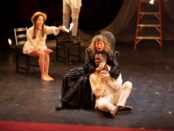
Now premiering at La MaMa’s Ellen Stewart Theatre in a co-production with the MART Foundation and En Garde Arts, "Seagull: True Story" is a barbed, meta-theatrical cri de coeur from creator-director Alexander Molochnikov, with a script by Eli Rarey. Drawing heavily on Molochnikov’s own experiences, the piece is not a retelling of Chekhov but a searing dispatch from the frontlines of artistic exile. It charts not only the cultural deep freeze imposed by Putin’s regime but also turns its gaze, with mordant wit, on the subtler constraints of the American arts ecosystem. The production skewers both overt authoritarianism and the velvet-gloved mechanisms of Western cultural gatekeeping with equal parts satire and sorrow. Bitterly funny and disarmingly candid, the play asks whether escape from tyranny guarantees liberation—or whether a different kind of captivity awaits on this side of the ocean. [more]
Faust (Heartbeat Opera)
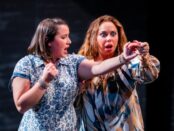
We get evocative shadow screens, puppetry and a silent-film fantasia. Heartbeat Opera’s two-hour whirlwind adaptation has everything—except an intermission. True to the company’s bold, iconoclastic style, this fiercely distilled staging trades grand opera’s lush orchestra for a lean, expressive band led by artistic director and violinist Ashworth. Brass and reeds give the score grit and immediacy, while the unexpected addition of a harmonium injects a raw, streetwise character—part cabaret, part back-alley prayer. The result? A "Faust" not of gilded prosceniums, but of shadows, sweat, and sharply focused vision. [more]
Fat Cat Killers
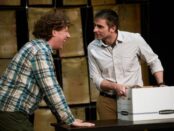
Timing, as they say, is everything in comedy—and in revolution. In "Fat Cat Killers," playwright Adam Szymkowicz delivers more than just a sharp-edged satire of corporate greed—he peels back the glossy veneer of big business to expose the raw, unsettling truths beneath. The play skewers the systemic exploitation of workers, the yawning chasm between executive privilege and employee precarity, and the emotional toll of soulless labor with biting wit and unflinching clarity. But while it aims its critique squarely at the power structures of late capitalism, it doesn’t let its would-be revolutionaries off the hook. [more]
Wonderful Town (New York City Center Encores!)
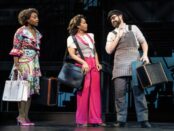
Fast-forward to 2025, and City Center has once again turned to this dependable crowd-pleaser, reportedly as a last-minute substitute for Michael John LaChiusa’s "The Wild Party." The choice makes logistical sense: "Wonderful Town" offers hummable tunes and a quirky, heartfelt book by Joseph Fields and Jerome Chodorov. But under the direction of Zhailon Levingston—whose past work includes "Table 17" and the vogue-infused "Cats: The Jellicle Ball"—this new iteration stumbles. Lacking Marshall’s instinct for the show’s fine balance between earnestness and irony, Levingston’s staging never quite finds its rhythm, veering too far into knowing kitsch and losing the tender charm that once made Wonderful Town feel, well, wonderful. [more]