
Articles by Scotty Bennett
The production by Adult Film, in association with BKE Productions, incorporates a multimedia approach to telling the story, based on a translation and adaptation by John Christopher Jones, who appears as the character Firs in filmed sequences. The show is dedicated to him, as he passed away before the show was scheduled to open. Ryan Czerwonko, the artistic director of Adult Film, is both the director of this production and plays Ermolai Alexeyevitch Lophakin, the son and grandson of serfs once owned by the estate, who has now become a very successful merchant. Lophakin is the principal protagonist of the tale who will resolve the fate of the cherry orchard and the estate. The ensemble of actors beautifully embodies the characters, exploring some of the subtler elements of their personalities. [more]

Blood Orange
"Blood Orange" by Abigail Duclos is a play dealing with the ultimate consequences of trauma in the lives of two adolescent girls, with a third acting as a contrast. Vernice Miller skillfully directs three excellent actors in exploring how some teenage girls manage the challenges of adolescence when faced with tragedy and physical and psychological abuse. Miller and Duclos have added an interesting element to this production by having the three principals perform in repertory. It is a dark, disturbing drama worth experiencing. [more]
Hucka
The background on the story indicates that "The Adventures of Huckleberry Finn" by Mark Twain was an inspiration for the story, but the only connections to that book seem to be the idea of traveling on a river and speaking a dialect of English typically associated with poorly educated people. Two examples of the form are in the first two scenes. Hucka (Brooke Elizabeth) in the opening monologue says, “I don haf ta pay hardly pay no attention to ‘em." And in the next scene, Cain (Carson Merrick) says, "Ya tol me ya war gointa finish this ‘fore sunup.” [more]
The Life and Death of King John
An element of the story is the behavior of the English noblemen. They switch allegiances depending on the behavior of either King John or King Philip II. It is not easy to follow these shifting loyalties in the context of the internecine conflict being played out, and this is made more difficult by the fact that many of the characters are portrayed by the same actors. Since some in the ensemble are tasked with playing two or three characters, this introduces an element of confusion in the production. Given the constraints imposed by the need to play multiple characters, the cast makes a solid effort to achieve a reasonable level of transparency. [more]
Road Kills
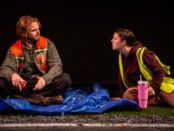
The two characters at the center of the story are Owen (D.B. Milliken) and Jaki (Mia Sinclair Jenness). Owen is a man in his late 20s who works as the roadkill collector in a rural county in Wisconsin. Jaki is a 20-year-old woman who is doing a six-week sentence for a drunk driving violation. What unfolds over the course of the play is how these two very different people discover an emotional connection neither had ever considered which is at the core of empathy: the understanding and sharing of someone’s feelings. [more]
The Animals Speak
While the ensemble is solid in their portrayals of the characters, the play lacks a clear dramatic line regarding the main point of the story. Bossert's portrayal of Disney and his emotional struggles appears to provide the scaffolding for a story that, in reality, is about Lillian Disney and her influence on the decisions that will ultimately be attributed to Walt. Her careful guidance of Walt's presentation style ultimately enabled him to speak in public with greater confidence and engage more effectively with his audience. Her conversations and skillful guidance of Mary Blair's view of herself as an artist, independent of her husband, led to Mary's increased confidence in herself and ultimately to Walt's recognition of her talent. [more]
Gene & Gilda
The show deals with the emotional impact of their not being able to have children after a series of miscarriages, and finally leading to the diagnosis of ovarian cancer. Gitter adds emotional depth to the story with an understanding and sensitivity to the affection Gene and Gilda had for each other in these moments of stress, culminating in an ending that underscores their love. [more]
Open
"Open" is an award-winning love story by Crystal Skillman that uses magic as the emotional hook, taking an audience on a journey through the trials, tribulations, and triumphs of the challenges some people face in the pursuit of love in a socially and politically complicated world. In this case, two young women are drawn to each other by their love of the magical and mysterious. [more]
Out of Order
The idea presented in this prologue is that Holder, after 20 years in his theatrical life, has reached a dead end in his interest in playwriting. He is looking for something to re-energize himself, or he will give it all up and move on to something else. The prologue reader pulls a string, releasing a cascade of 36 folded cards from a box on the ceiling. The claim is that everything that is to transpire is real, and if Holder doesn't complete all of the tasks listed on the cards, he will quit the theater forever. [more]
The Man Who Shot Liberty Valance
A famous line from the John Ford film "The Man Who Shot Liberty Valance" is spoken by the newspaper reporter character, Maxwell Scott, near the end of the film, after hearing the true story about the death of Liberty Valance. When asked if he will print the facts, Scott replies: “When the legend becomes fact, print the legend.” These words do not appear in the original story by Dorothy M. Johnson nor the stage version by Jethro Compton. Still, they form the central theme of both. Compton’s play, "The Man Who Shot Liberty Valance," directed by Thomas R. Gordon, is a beautifully realized revival of the 2022 production with most of the original cast. It is a classic story of the Old West presented by a solid ensemble. If you enjoy a good story, well-told, see this one. [more]
A Letter to Lyndon B. Johnson or God: Whoever Reads This First
"A Letter to Lyndon B. Johnson or God: Whoever Reads This First" is a gem of a play written, directed, and performed by Xhloe Rice and Natasha Roland. This two-hander makes a connection between a couple of Boy Scouts in the early 1960s and grunts in Vietnam at the end of the decade. While billed as an "absurdist" production, given the various definitions of "absurd," this show is anything but absurd. The words that come to mind are humorous, poignant, comedic, dramatic, provocative, and compelling. [more]
Manifest Destiny
Manuel Ortiz’s masterful play "Manifest Destiny" lays bare the complicity of the United States in the overthrow of the Chilean presidency of Salvador Allende and the authoritarian repression of Augusto Pinochet in an engaging, thoughtful and entertaining way. Ortiz’s direction seduces the audience into the darkness of political repression with humor and edgy, light-hearted banter, delivering an unforgettable statement on what happened in Chile and the U.S. organizations bearing responsibility for those events. It is a skillful blend of past, present, and perhaps future, and a show to be experienced by everyone who loves a compelling story solidly presented by an outstanding ensemble. [more]
Point Loma
Wolf’s direction skillfully manages the emotional tension to maintain the horror element of the story while also paying homage to B-movie scare tactics and tropes. Mulligan uses a device between scenes, featuring brief interludes of Rick and Kim watching scary movies, with Rick displaying fear and Kim being bored. It is an interesting and subtle way of adding definition to the two characters. [more]
The United States vs Ulysses
"The United States vs Ulysses" by Colin Murphy is a multi-layered play about a seminal case concerning censorship in publishing. The story is set in 1933 in the studios of the CBS radio show "The March of Time." The radio show reenacted recent news stories, including one about the trial of James Joyce’s then controversial novel "Ulysses," but the tapes of it no longer exist. Murphy imagined what that show may have been like, and it forms the framework of the play. [more]
Mystic Conversations
The play is a nicely developing mystery fantasy story about the paranormal, but when the teenage boy is revealed as the Spirit Child, the show goes off track. The idea presented is that the Spirit Child is the child who would have been born except for the miscarriage. This idea is a stretch in believability for the dramatic structure of the show. It introduces the idea that a consciousness once attached to a developing embryo continues to be attached to the woman who was carrying that embryo even after the tissue has been expelled through a miscarriage. It turns on its head the whole idea of developmental psychology. How is it possible for the miscarried tissue that was not even old enough to definitively determine sex to become a spirit that ages as if it had been born? [more]
Soulmate
Clarke's direction is uneven, giving the show a rehearsal or community theater vibe. The narrative line is unclear as to whether the main characters are real or a hallucination of one of them. The songs, what few there are, are extraneous to the action, adding nothing of importance to understanding the point of the story. The main characters are Cyrene (Shannon Wong) who is the wife of Caleb (Zachery Michael Shook), a construction manager. According to the play notes they are involved in pushing "the boundaries of love, desire, and intimacy." The major problem with this dramatic idea is Cyrene is a memory of Caleb's dead wife, who is directing him to find new and provocative sexual relationships with other women. The character is a constant presence with Caleb but is not seen by any other person. This dramatic element is hinted at but unclear until halfway through this short play. [more]
minor•ity
"minor•ity" is a wonder of a play written by francisca da silveira and skillfully directed by Shariffa Ali telling a tale of clashing artistic egos encompassing issues of Black identity, cultural influences, and financial support. The cast of three leaves no question in the viewers’ minds that what is being witnessed are real people telling a story through their actions, not actors playing roles. There is a message in the name of the show presented in the script but not in the show. [more]
Scammed into Love
Although there are humorous moments, the production doesn't work for various reasons, including characterizations and technical issues with sound reproduction. None of the eight songs are memorable, and the characters do not engage the audience, which is a question of direction and acting. While the performers work hard at portraying their characters, the effect is uneven. Some characters appear two-dimensional, and performances feel like a college or community theater production. The vocals are problematic, with some performances being overpowered while others pitchy. Overall, the show doesn't engage the audience in caring about the characters or their stories. [more]
Danger and Opportunity
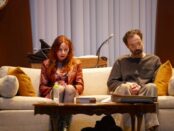
Jack Serio directs a strong cast of seasoned actors whose personal chemistry gives the ensemble a solidly believable portrayal of their characters. Juan Castano is Edwin, a mid-30s man married to Christian, a man ten years older, believably played by Ryan Spahn. The two men are struggling with issues in their marriage when Margaret enters the picture. Julia Chan is Christian's "girlfriend" from high school. They have not communicated with each other in 20 years. [more]
Remembrance
"Remembrance" by Patricia GoodSon is a story about her journey, for more than a decade, in dealing with her mother's Alzheimer's disease. As directed by Joan Kane, it is told from the perspective of a woman working with a therapist to unravel the emotional impact of those years of caregiving. It is not about the impact of the disease on the person with it but on the effect on the caregiver. [more]
Maybe Tomorrow
"Maybe Tomorrow," written by Max Mondi and directed by Chad Austin, is a play about such a place and the person who created it. Inspired by a true story, Austin directs a cast of two in an exploration of a person lost in the present and locked within a mental space defined by the four walls of a bathroom, a person mediating the outside world through a computer and contact with one human caregiver but unable to move from a world they have defined as "safe" into the unknown world beyond the walls of a room. [more]
Lists of Promise
The scene with Adam and Eve establishes the structure for the show, with each of the ensuing vignettes being conducted in a call-and-response format. The second explores a list of rules established during the Victorian Era. In this set, the aerial performers represent a young girl just coming of age and two older, more established women. The aerial characters make the call with the response coming from different members of the Grounded Women, each expanding on the list of comments being made by the aerialists. The set ends with the Contemporary Woman bringing together some of the ideas presented in the call and response, presenting the state of a woman's status in society as the result of the list of rules. [more]
Fog and Filthy Air
It is essential for the audience to become fully engaged with the story and to care about the characters. When that does not happen, the show falls flat. While Homeyer and McGrath make an effort as Father and Mother, they are saddled with one-dimensional characters whose interactions lack chemistry. Gamble’s character is more developed but lacks a believable emotional connection with the other two. The dialogue touches on emotional issues within the family but does not effectively build dramatic tension with those issues. In the final analysis, the play lacks a compelling emotional hook. [more]
Wounded
"Wounded," written by Jiggs Burgess, is a story using a cloak of humor to obscure the pain and dark feelings being hidden by the protagonists. Although referred to as a comedy or dark comedy, it should be noted that the simple addition of humor does not make it so. This play is a serious drama, in the full meaning of that form, with some humorous elements. Del Shores skillfully directs an excellent ensemble of three players to expose layers of emotional and physical wounds in the characters. Shores and the cast successfully create a deceptive cover for the story's final destination, with the dramatic tension slowly building to a surprising and unexpected ending. It is a play worth experiencing, even with a few issues concerning the logic in some of the characters' interactions. [more]
Avalona: A Musical Legend
"Avalona, A Musical Legend," created by Dina Fanai, with music and lyrics, is a concept album with elements of modern opera. While not a musical in the usual sense of that form, it fits in a class of shows with the feel of a musical, such as "Jesus Christ, Superstar," which in its original form was a concept album concert with some notable productions being in the form initially conceived by Sir Andrew Lloyd Webber, but many not. It is a show at the edge of being a spectacle in the best meaning of that word, and one to be experienced as if viewing oneself on an immersive journey of discovery and transformation. [more]
The Audit & The American Dream
Urban Stages conducted a Dynamic Duos playwriting competition for one-act, two-character stories covering any subject during their 2023-24 season. Eight plays out of over three hundred submissions were chosen for staged readings. Two were selected for a full production as part of the current season. Those shows, "The Audit" by Lynda Crawford and 'The American Dream" by Juan Ramirez, Jr., opened on February 27 in a twin bill. They are both interesting stories told well with solid performances. [more]
Safe House
"Safe House" is an amorphous mosaic of sight and sound just out of reach of being any one thing. It is at once a song cycle, memory play, comedy, tragedy, a visual and aural potpourri of sensation resembling a modern avant-garde opera more than a theatrical musical or play with music. Written and directed by Enda Walsh with music by electronic-acoustic composer Anna Mullarkey, the show tells the story of Grace, a young, homeless Irish woman living on a handball court in Galway. According to Walsh, it is a story of survival in the chaotic jumble of memories mixed with dreams and fantasies of a different life. [more]
After Endgame
Doyle’s storytelling skillfully blends didactic commentary with humorous anecdotes, holding the audience’s attention throughout and resulting in a thoroughly satisfying evening of entertainment. Whether you are a chess person or not, it is a show worth seeing. Afterward, you can hang around in the "Soho Chess Lounge," the Huron Room performance space skillfully transformed by set designer and chess consultant Charles “Chuck” Matte. [more]
Night Sings Its Songs
"Night Sings Its Songs" by Norwegian author Jon Fosse (pronounced FAH-suh), the 2023 Nobel Prize-winning playwright, explores alienation and emotional disconnection by a couple in a dysfunctional marital relationship. Fosse's works are often compared to those of Henrik Ibsen and Harold Pinter. His minimalist style fits into the Norwegian existential and psychological drama tradition. Fosse is one of the most performed contemporary playwrights globally, but he is not well-known in the United States. The play, directed by Jerry Heymann from a translation by Sarah Cameron Sunde, never engages the audience in caring about the characters' emotional struggles. There is a feeling of "so what” or “why should I care” rather than one of concern or empathic understanding. [more]

How Is It That We Live or Shakey Jake + Alice
In reading the script, I didn't see how the story made any sense or could have been given a reasonable life on stage. I was very wrong on both scores. The four actors of the ensemble breathe life into each of the characters, creating a compelling narrative even given the minimalist sets used. Director Hayes did a superb job blending reality with the fantastic, delivering a compelling story of love found, lost, and found again. [more]
Cymbeline
The modern verse translation reasonably maintains a semblance of the Elizabethan iambic pentameter form supported by the ensemble's solid delivery of the lines. People familiar with Elizabethan dramatic poetry may be put off by the change in the wording but not necessarily by the presentation of the text. Overall, it is an enjoyable show worth spending time on whether or not one is an admirer of Elizabethan drama done to a modern beat. [more]

Sheltered
"Sheltered" by Cate Wiley is a story about what it is to be a homeless woman in a city in the United States. As directed by Liz Peterson, this play tells the stories of these women trapped by circumstances in systems of neglect and half-measures that are often beyond their control. In some cases, homelessness is a choice to escape something in the home, usually an abusive partner or spouse. Drugs, alcoholism and mental illness play a role as well. All of these things are depicted by a hardworking cast who effectively delivers a snapshot of the day-to-day reality of homelessness. It is an emotionally powerful play with an important story to tell. It is not a blockbuster play, but it is a play that should be seen for the compelling story it tells. [more]

January
"January" presents a story about the emotional impact of the killing of one child by another by weaving together the thoughts and actions of the two single mothers involved and how the national media treats the event. There are scenes blending memories and dreams with reality, presenting the protagonists' thoughts as if they existed in real-life moments with an almost hallucinogenic quality. These dramatic devices work most of the time. Still, there is a critical point in the play where what is being presented goes on for too long, almost to the point of losing the story thread. The projections used are effective but sometimes come very close to being propagandistic. Even with some of the unevenness of the production, it does present an important story that needs to be told. "January" is a heavy lift emotionally but ultimately worth the effort. [more]
My Mother’s Funeral: The Show
Charlotte Bennett directs an exquisite cast of three in an exploration of these themes. Nicole Sawyerr solidly leads the ensemble in the lead role of Abigail Waller, a working-class playwright. Sawyerr is supported by Samuel Armfield, who perfectly embodies two characters: an unnamed theatrical director with a class-based condescending attitude and Darren, Abigail's brother. The third member, Debra Baker, skillfully takes on a number of other characters, the two most important of which are Abigail's mother and an actress portraying the character of a mother in a play written by Abigail. Baker gives distinctly different presentations of these two pivotal characters. She also takes on a number of other ancillary characters who voice supporting elements to the overall story. [more]
A Shift of Opinion
There are a number of problems with these vignettes, ranging from the individual characterizations of the men involved to the superficial nature of the historical details of the events being discussed. Sheppard overacts in portraying O. Henry as a barely coherent alcoholic. It is not credible that a person as "drunk" as O. Henry would be engaged in any serious discussion with the likes of Mark Twain and William Hearst, let alone Teddy Roosevelt or even Schiff. The performances don’t engage the viewer to care about who the character is and what he has to say. In a number of the scenes, the dialogue seems contrived to present a particular socio-political viewpoint without any explication or depth. [more]
Racecar Racecar Racecar
Sarah Blush directs a cast of five in the story of a father and daughter on a road trip from New York City to a storage unit in California. It is a trip that is both se in the present and past, and it is filled with a flow of information that mixes reality with fantasy in a liminal space between sanity and insanity. This story operates from a different dimension the moment one walks into the performance space. The set is a large orange square, shag-carpeted pit with no clues as to the staging. The two principal characters making this trip by car never sit as if they are in a car but casually walk the raised outside edge of the box. It is an element of this stagecraft that adds beautifully to the edginess of the production. [more]
Welcome to the Big Dipper
"Welcome to The Big Dipper" is a musical comedy with music and lyrics by Jimmy Roberts and a book by Catherine Filloux and John Daggett (inspired by the play "All Dressed Up and Nowhere to Go" by Filloux). It is under the direction of DeMone Seraphin and is billed as being based on an actual event. However, the nature of the event is never revealed. It is a mixed bag of things that work and don’t, which leads to confusion about what it’s about and where it’s trying to go. [more]
Woman on a Ledge
"Woman on a Ledge" is an adaptation by Hershey Felder of harpist Rita Costanzi’s writings about her life. Ms. Costanzi is a world-renowned harpist whose life experiences have been woven into a fascinating and highly engaging theater piece. As directed by Lissa Moira, this one-woman production beautifully integrates Ms. Costanzi’s superlative playing with her solid storytelling. One does not have to be a harpist or classical music fan to enjoy this production. Her storytelling alone is worth the time spent, and it becomes exceptional when coupled with her exquisite playing, used to underscore elements of her story. [more]
Okuni: The Woman Who Created Kabuki
Ako's portrayal of Izumo no Okuni combines traditional Japanese dance movements with Western-style acting. The nature of the script limits the impact of her performance. The dialogue is simplistic, verging on a museum presentation. The story being told is too small for someone who is such a large character in the folklore of Japan. It is a story that calls for a larger cast to show the impact her dance and performance style could have on audiences. Okuni certainly did not dance alone, so what needs to be added is the pageantry and bravado of a fully engaged dance ensemble. Ako also portrays Lady Yodo, the mistress of the late Toyotomi Hideyoshi, credited with the unification of Japan that led to the establishment of the Tokugawa shogunate. [more]
Café Utopia
"Café Utopia" by Gwen Kingston and directed by Ashley Olive Teague tells the tale of a juice bar that, on the surface, appears to be socially progressive, but behind the scenes, is a different story. Based on real stories from workers involved in the current efforts to unionize juice bars and coffee shops, this play lays bare the corporate behavior that puts profits before workers. During changes in some scenes, different characters read statements collected from workers about their work-related experiences. These moments are important in underscoring the overall content of the show as it relates to the plight of workers who lack union protection. [more]
Loneliness Was a Pandemic
Haller has created a world where robots have conquered all of humanity through the ability to copy, with precision, the technical aspects of a functional society. The lack of understanding of human artistic creation keeps them from destroying a particular element of human culture: creative artists. The missing element in the totality of their superior nature is the spark of artistic creation. It is an aspect of humans they do not fully understand. So, they keep alive those humans considered to be creative artists in an attempt to understand and replicate the human ability of singular artistic creation. [more]
Medea: A Musical Comedy
Fisher directs a solid ensemble through a production of "Medea" that is a spoof of a college production with a gay man in the role of Jason and a feminist as Medea. It takes place from the last days of rehearsals to opening night. It is a play within a play with a romantic entanglement between the actor playing Jason and the actor playing Medea. It is amazing that with all the different elements of two storylines being played out the show works as well as it does. [more]
Rawshock
"Rawshock" is a powerful, insightful, compelling play that lays bare the craven manipulation of corporate healthcare in the name of profits. It is beautifully written by Rita Lewis and superbly directed by Ken Wolf, who also did the lighting and sound design. It is a story about a group of patients in a psychiatric hospital setting and what happens to them when the new corporate owners of the hospital disrupt their therapeutic group. It is a gem of a show with outstanding performances that should not be missed by anyone who enjoys solid dramatic theater. [more]
Honeyland
The story weaves together the group's history with flashbacks to their childhood, high school years, and a time immediately after college. It is a show that tries to cover too much territory without getting a solid handle on any of it. There are two potential dramatic threads, either of which would provide a strong story arc if developed as the heart of the story. One is the Vietnam War's social, political, and personal impact on the group members, and the other is the interpersonal romantic relationships within the group. These two themes are the strongest in the show but lack the depth to explore the dramatic possibilities fully. [more]
Lakeplay
Welcome to 'Lakeplay," a character study-play written by Drew Valins and directed by Hamilton Clancy. It is billed as “a terrifying adventure” but does not live up to that description. There are moments of suspense, but not terror-filled. If being frightened by a story is what you are looking for, this is not the show for you. The show is more of a work in progress with issues relating to the venue, sets, and unevenness of some of the scenes. [more]
Dickhead
"Dickhead," written by Gil Kofman and directed by Richard Caliban, is a story about the patriarch of a dysfunctional family in the midst of a near-total disintegration. The action is centered on Richard (Ezra Barnes), an abrasive, abusive lawyer who is rightly called “a dick” by his wife and just about everyone who interacts with him. He is also called Dick, as a nickname for Richard. The only time he is called "Dickhead" is midway through the action, in a maybe friendly comment by his oldest friend Howard who is given a solid portrayal by Chuck Montgomery. In the opening scene, Richard is in the office of his therapist Dr. Adams (Frank Licato) on a cell phone call with a tech support person at the internet company. This action provides a portrait of Richard’s personality: nasty, abrasive, ego-centric; a real dick. It also indicates that things are not going well in Richard's home life and job. Barnes' performance is well-tuned to the character, although, at times, getting close to being too much of a dick. Licato effectively embodies the therapist who is not as balanced as he appears to be in the opening. Licato gives a good performance of another character late in the play, the doctor’s wife. [more]
Honor
"Honor," a one-act play, written and superbly directed by T.J. Elliott, explores the conceptual nuances of “honor” within the context of a corporate investigation into a case of harassment and intimidation brought against a corporate executive. It is a clashing of privilege and ego between executives, revealing some ugly truths about corporate management while also dealing with the ambiguities of personality and individual perceptions. The play is short and solidly to the point, and I don’t see how expanding it will add anything to the mix. It is a beautifully executed production and will resonate with anyone with a passing familiarity of executive corporate culture. [more]
The Diamond as Big as the Ritz
This adaptation, directed by John Hickok, uses the Fitzgerald story as a counterpoint to a tale of a couple caught in the legal vagaries of the United States and Canadian immigration laws. The connection between their experiences at the border and the satirical nature of the Fitzgerald piece does not work even with the addition of musical numbers. It would be better to make a show of the original story without the contemporary border issues thrown into the mix. [more]
In Search of Elaina
"In Search of Elaina" is a story by Kara Ayn Napolitano that digs into the weeds of a remembered past. It explores what happens when the life left behind catches up and crashes into the carefully laid-out landscape of now. Joy Donze skillfully directs a strong ensemble on this journey into the clash of the now with the memory of then. [more]
The Tempest (Smoking Mirror Theatre Company)
Although meaningful dialogue is written in iambic pentameter, not all text is so structured. There is a skill in delivering lines within the structure of iambic pentameter, but it is equally important that the rhythm of all the dialogue be consistent. The lines must be spoken as if they were a normal speech pattern without paying attention to the structure. Unfortunately, the delivery by the ensemble varies widely, ranging from sounding like a textual reading to a clear, direct delivery to one completely out of character for the words spoken. As a result, the interconnections between the elements of the story are lost, causing a breakdown in clarity. [more]
Odd Man Out
"Odd Man Out" takes what is essentially a radio drama and puts the audience within the physical context of the story. You can hear the characters moving. You can smell the flowers in the garden or the blooming tree in the yard. You can hear and feel the rain. It is a sensory augmentation of what was once only an aural experience. Smelling a rose is no longer an act of imagination but one of immediacy, and that enhances the suspension of disbelief that an audience undergoes to make them actual though passive participants in the action of the story. [more]
When My Cue Comes
The cast does a beautiful job interpreting their characters. Watson plays Reynaldo as an anxious, emotionally fragile person ready to fulfill their employer's slightest request. Moore imbues Jacques de Boys with the haughty imperiousness of someone who feels his position is one of substance and importance, even if only for a brief moment on stage. Ethridge puts an interesting spin on his Boatswain, giving him a laid-back, almost California surfer vibe. It is not quite what one may expect from a character in a 17th century play but the characterization provides an interesting contrast. Parks embodies the Stage Manager with a flat-affect, matter-of-fact efficiency as expected until she reveals an inner child excited about trying new ways of being. DeBoer gives The Messenger an energy and perspective that delivers the play's central theme by showing the other characters and the audience that it is possible to escape the limitations of a static definition of self and explore the wonders of imagination. [more]
It’s Not What It Looks Like
"It’s Not What It Looks Like," is a two-hander, written by John Collins in collaboration with Chesney Mitchell. It is the winner of the 2023 Soho Playhouse Lighthouse Series competition for new plays. The play is a cleverly devised procedural drama that does justice to its title: somebody died, but the how and why are unknown. It is a mystery with which to spend a summer evening. [more]
A Hundred Circling Camps
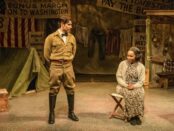
A Hundred Circling Camps, written by Sam Collier and superbly directed by Rebecca Wear, is a story based on the "Bonus March" of 1932. It is more than a play about a historical event. It is also a commentary on the nature of citizens exercising their right to assemble and petition the government to redress grievances, rights established in the First Amendment to the U.S. Constitution. It is a show worth seeing because of its story and the actors' performances. The Bonus March of 1932 was a demonstration by veterans of World War I asking that the financial promises made by the U.S. government be honored in advance of the original payment date of January 1945. The economic situation for people in the United States was desperate during the Great Depression, and the veterans, most with families to support, felt that the money promised would help them survive. [more]
Bill’s 44th
"Bill’s 44th" is a story of loneliness told within the context of a birthday celebration. It is a wordless puppet show for grown-ups created and presented by Dorothy James and Andy Manjuck. James and Manjuck combine to inhabit Bill, a middle-aged man with a belly paunch and a paper-maché bald head with bushy eyebrows, a mustache, and deep, empty eye sockets. His legs are those of Manjuck, and his arms are those of James and Manjuck. It is a remarkable display of puppetry. Their collaboration brings emotional heft to the puppet with actions that are choreographed to perfection. Jon Riddleberger plays a supporting role as a pizza delivery man and later as the puppeteer of a human-sized dancing carrot stick. [more]
A Man Among Ye
"A Man Among Ye" is episodic, with flashbacks and confusing dialogue. It is filled with sword fights, sea shanties, revenge plots, mermaids, witches, and mythical creatures. As a highly stylized dark comedy, it misses more than it hits. Despite the claims that it is based on a true story, it is mostly fiction and fantasy and lacks consistent explication. It needs a more straightforward, consistent storyline, and, in several cases, there is superficial character definition and development. The cast does a respectable job of trying to make sense of a show that doesn't know what it wants to be. [more]
cunnicularii
"cunnicularii," beautifully written by Sophie McIntosh and sensitively directed by Nina Goodheart, is a fantasy that deals with many of the adjustments in attitudes and perspectives encountered by new parents. It is a fable focusing on the sometimes overwhelming physical and emotional issues faced by mothers on their first time into the world of motherhood. It is a beautifully realized drama, both funny and serious. If you enjoy good theater, with solid acting, it will be very much worth the effort to see this production. It will only be around for a short time, so make the time to see it. [more]
Isabel
"Isabel" is a story written by reid tang and directed by Kedian Keohan. It uses various stylistic techniques to tell the story of a trans sibling relationship. It has elements of dark comedy mixed within a dramatic arc of psychosexual exploration of gender, all wrapped within a framework of dark mystery but without a clear point of view. The performances are uneven, the “smoke” special effect is distracting, and the staging misses defining the locales of the scenes. The production comes across as more of a dress rehearsal than a fully-realized staging. [more]
The Employees: A Workplace Novel of the 22nd Century
"The Employees: A Workplace Novel of the 22nd Century" is a tone-poem play adapted by Lauren Holmes and Jaclyn Biskup from a novel of the same name by Danish poet and novelist Olga Ravn (translated by Martin Aitken). Biskup directs an ensemble of four who portray multiple crew members on a spaceship sent to search for a new planet for the people of Earth. The novel's structure of narrative reports to tell a story about the human condition, the future of work, and the ills of late-stage corporate capitalism does not transfer well to a dramatic stage presentation. [more]