Articles by Joseph Pisano
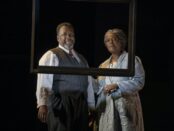
To be clear, the casting isn't colorblind; it's just casting, with director Miranda Cromwell delicately drawing out a different set of lived experiences from Miller's almost untouched words. The play's West-End co-director Marianne Elliott has not made the journey across the pond with its ongoing contributors, all of whom deserve kudos for the revelatory production, especially Wendell Pierce ("Broke-ology," "The Wire," "Treme") as Willy and Sharon D. Clarke ("Caroline, or Change") as Linda, his long-suffering wife. Though Pierce devastatingly pulls Willy apart in front of our eyes until all that's left is his sense of failure, it's Clarke who gives Willy's downfall its saddest dimension, convincing the audience, beyond any doubt, that the very-flawed Willy is loved. If seeing previous productions of "Death of a Salesman" has inured you to Willy's ultimate fate, this one should bring back the tears, and Clarke deserves a lot of credit for that difficult gift. [more]
Cost of Living
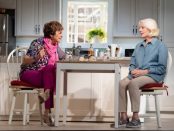
Perhaps because of its prestigious accolade, or just undeniable merit, "Cost of Living" is the first of Majok's heartfelt efforts to make the journey from off-Broadway to on-Broadway in the Manhattan Theatre Club’s production, a transition that, thanks to director Jo Bonney's returning and unflinching guidance, hasn't diminished any of the play's intimacy or daring. If anything, on Wilson Chin's Bergman-meets-Bayonne turntable set, gloomily lit in unrelenting twilight by Jeff Croiter, "Cost of Living" has become even more persuasive and poetic. Invaluably serving that dramatic growth are actors Gregg Mozgala and Katy Sullivan, repeating their roles from the play's 2017 New York City Center premiere by MTC. [more]
Jasper
Most poignantly, when Drew starts to wonder if maybe their son's survival has been the opposite of a blessing, Andrea expresses horror for a thought that, thanks to Pimentel's touchingly subtle performance, we know she's had herself. To its strongest credit, MacDermott's play affords all three of its actors the opportunity to find meaning beyond their characters' words. Though, of course, with a less capable trio, this sort of dramatic freedom could have been a disaster. [more]
Kinky Boots
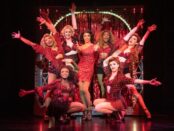
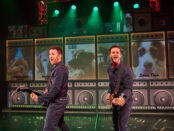
Several years after vacating its Broadway home, "Kinky Boots" has settled in to a cozier off-Broadway venue, Stage 42, at a presumed discount for theatergoers, albeit with a much smaller orchestra and actors whose talents far exceed their name recognition (and no mask mandates, which might be a dealer breaker for some). Also returning is director/choreographer Jerry Mitchell who gives the resized production the same energy as the original, nurturing a buoyant vibe that, as before, underscores the show's positive messages about celebrating difference, particularly as it relates to hoary conceptions of masculinity. But, when everything is said and sung, Fierstein and Lauper's joyously uplifting, but shallow, efforts are only memorable for meaning well. That's not nothing, especially these days, but the show could have been so much more. [more]
Lessons in Survival: 1971
Originally broadcast on "Soul!," an early PBS program dedicated to showcasing Black arts and politics, Baldwin and Giovanni's one-on-one echoes contemporary concerns while also remaining decidedly of its era. Unearthed by a theater collective and other trapped-at-home artists during the pandemic for an online recreation, it has now been transformed again, this time into a staged adaptation titled "Lessons in Survival: 1971." In truth, "googled" is likely the more appropriate verb for how someone found the Baldwin-and-Giovanni conservation, since it is entirely available on YouTube, where, to be honest, it is best experienced, not least because in that digital form it can be rewound for another listen, which a few of Baldwin and Giovanni's complex, unannotated arguments definitely require. [more]
Islander: A New Musical
An import from the Edinburgh Fringe Festival, "Islander" embraces that renowned international jamboree's artistry and experimentalism, most notably by forgoing musicians for sound looping machines operated by Findlay and Tennick themselves. Especially for the technophobic (cough, cough), it's an extraordinary feat to witness actors become part of the production crew without the conceit ever feeling gimmicky or compromising the flow of the storytelling. That's no doubt due mostly to Findlay and Tennick's on-the-spot sound engineering abilities, which, to be sure, still take a backseat to their even more remarkable singing and acting. [more]
American Buffalo
The 1975 play "American Buffalo," now onstage at the Circle in the Square Theatre in a crackling revival, remains the quintessential Mamet experience, the one that should be seen to fully appreciate what has been lost. Essentially a two-hander masquerading as a three-hander, it's a character study short on plot and long on self-delusion as a couple of small-time crooks imagine themselves as much more than they are while planning an ambitious heist. To say they're all talk gets to the satirical heart of Mamet's play. [more]
Suffs
Unfortunately, while Wells (Nikki M. James) and Mary Church Terrell (Cassondra James), another renowned Black suffragist, occasionally pop up to offer intersectional insights, they mostly come across as an addendum to the all-female and nonbinary musical's Paul-centric narrative. Taub knows Wells and Terrell obviously belong in the story she's trying to tell, but she hasn't figured out how to dramatize their inclusion yet. Other suffragists whose names should be much more well known today also receive paper-thin characterizations: Lucy Burns (Ally Bonino); Doris Stevens (Nadia Dandashi); Ruza Wenclawska (Hannah Cruz); Inez Milholland (Phillippa Soo). [more]
The Little Prince
Essentially, Mouron boils the story down to a couple lines about love and beauty, while eliding any sense of the loss, isolation, and dread that the novella also poetically conveys. Her little prince is a man-child incapable of engaging with life's pain rather than Saint-Ex's courageously inquisitive child-man who can't help but look for happiness in sorrow and vice versa. In the absence of this existential heft, the production makes room for co-director Anne Tournié's, admittedly, often charming choreography. A pas de deux between Zalachas and Sulty is particularly lovely, thanks in part to the latter's stunning, and protean, red dress from costume designer Peggy Housset. [more]
Alex Edelman: Just for Us
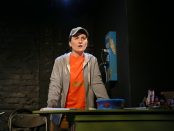
Despite the familiar visual trappings--mic stand, performer-blinding stage lights, and a dull curtain backdrop--Edelman's deceptively free-flowing talents hew more towards the monologist Spalding Gray than those of Williams. Like Gray, Edelman is an entrancing storyteller capable of stitching together personal anecdotes into a rich thematic tapestry. In Just for Us his canvas includes mental pictures of growing up Orthodox Jewish in a Boston where white privilege is starkly stratified; his brother's 2018 Winter Olympics participation as a member of the Israeli team in possibly the least athletic competition; witnessing the actions of a predictably conceited Jared Kushner at synagogue; and the touching time his family celebrated Christmas in order to console a bereaved non-Jewish friend. [more]
A Touch of the Poet
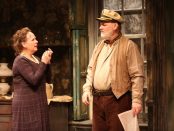
Director Ciarán O'Reilly confidently lets the clever cast explore their characters' profound complexities, which means forcing the audience to simply accept a few psychological contradictions. At its best, watching the play feels like eavesdropping on a real family whose lives are unfolding before us naturally. Dramatically, it's a little messy but also much more human. Where the play falters somewhat is at the very beginning, with a long, exposition-laden exchange between a gossipy bartender (James Russell) and Con's old war buddy (Andy Murray) that is less a scene than an information-delivery system. Fortunately, the put-upon Russell and Murray enjoy later opportunities to put their estimable skills to better use. [more]
Space Dogs
Heyman and the rest of the production team quickly turn "Space Dogs" into an exercise of quantity over quality. More lights. More noise. More projections. More props. It's theater as sensory overload, with success measured by distraction. The major problem is that it also leads to a lot of other annoyances, with Nathan Leigh's sound design doing nothing for the intelligibility of Hughes and Blaemire's lyrics, Mary Ellen Stebbins' concert lighting occasionally blinding the audience in MCC's small off-Broadway space, and Stefania Bulbarella's numerous projections just stoking the meaningless hurly-burly. [more]
Made by God
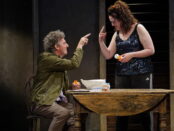
It's just that, as the fictional Eva supplants the non-fictional Ann onstage, the play reverses course and sacrifices its human scale back to the rhetorical, with pro-life Eva and pro-choice Michael's gentle discord eventually turning toward the upcoming 2018 Irish referendum to repeal the Eighth Amendment. Actually, the far more spirited debate is being held in Eva's own head as her religious upbringing wrestles with a sense of culpability for a recent tragedy that has cast doubt on her previously rock-solid convictions. Unfortunately, the much too-on-the-nose parallels between Ann's fate and what is tormenting Eva's conscience amount to a bundle of contrivances that touch off a cascade of underwhelming revelations not nearly as thought-provoking as the play's beginning scenes involving Ann and Mikey. [more]
Long Day’s Journey into Night
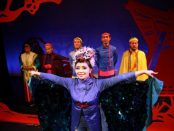
But, again, O'Hara does these actors no favors, forcing them to contend with incongruous historical information while also depriving them of the greatest acting benefit O'Neill's four-act play affords: time. The characters' drawn-out, if not periodically downright tedious, interactions are fundamental to establishing the family dynamic and, more importantly, necessary for giving the work it's much-needed oppressive weight. It's nice that O'Hara wants to spare us from that suffering, but it doesn't help the play. [more]
The Streets of New York
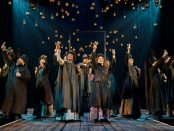
Cue the Irish Rep and its remounting of artistic director Charlotte Moore's musical "The Streets of New York," which the theatre first premiered twenty years ago in the aftermath of September 11. An affectionate adaptation of Dion Boucicault's 1857 melodrama "The Poor of New York," it returns in the wake of a different tragedy--a global pandemic that has claimed nearly 800,000 American lives and more than five million human beings worldwide--sharing the same social conscience as the Dickens classic but also encouraging the audience to do something more fun and cathartic: hiss at the greedy old man. Perhaps it's the Christmas story we actually need this year. [more]
A Girl Is a Half-formed Thing
Performed as one long 80-minute monologue, A Girl is a Half-formed Thing also offers actor Jenn Murray little, if any, respite, laying on her shoulders complete responsibility for telling every detail of its emotionally unyielding story. Besides the girl, she must give voice to all of the other unnamed characters in the play, too, distinguishing them so that the staged version of McBride's novel, where it's impossible to simply reread a sentence, has an immediate intelligibleness. By itself, this feat is enough to make Murray's performance astonishing, but it's only the tip of her accomplishments. [more]
Autumn Royal
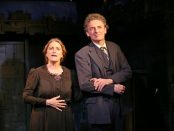
Previously only known for his novels and short stories, first-time playwright Kevin Barry brings the same full-hearted doom and gloom to the stage in "Autumn Royal" that was evidenced in his Booker-Prize-longlisted "Night Boat to Tangier," unravelling May's and Timothy's forlorn existences with a compassion apparently meant not only for these two characters but also for anyone in the audience whose time is slipping away faster than their ability to enjoy it. In other words, Autumn Royal is the perfect midlife-crisis-cum-Covid play. (I dare the Irish Rep to use that in the advertisements!) Though Barry wrote it before the pandemic's onset, this fraught two-hander has gained, perhaps against its will, a far deeper resonance from the subsequent worldwide catastrophe, a fact that doesn't escape director Ciarán O’Reilly who turns Charlie Corcoran's spare and icy set into a very lonely domestic island for May and Timothy to neither share nor experience anything fundamentally new other than, of course, the neighbors' priggish judgment for wanting to shed their father for greener pastures. [more]
Six: The Musical
More concert than musical, the 80-minute show's libretto adds little to its cast album, with the lyrics of each queen's autobiographical song also pruning their individual histories to a point even a Wikipedia writer might consider reductive. The English nursery rhyme "Divorced, beheaded, died, divorced, beheaded, survived," which the women recite at the beginning of the sing-off, pretty much sums up writers Lucy Moss and Toby Marlow's level of interest in the lives of Catherine of Aragon (Adrianna Hicks), Anne Boleyn (Andrea Macasaet), Jane Seymour (Abby Mueller), Anna of Cleves (Brittney Mack), Katherine Howard (understudy Courtney Mack in the performance I saw), and Catherine Parr (Anna Uzele). In between the songs, the women disparage one another's suffering, all in an attempt to snipe their way to the grand prize: leader of the group and, with it, the audience's adulation. [more]
Stranger Sings! The Parody Musical
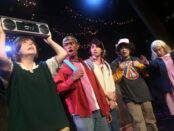
Since it's difficult to make fun of something that was never meant to be taken seriously in the first place, Hogue and director Nick Flatto are often left to spin their wheels by simply rehashing their subject matter's underbaked characters and shamelessly derivative storytelling, which all-too-often turns "Stranger Sings! The Parody Musical' into a glorified clip show. Hogue further hampers himself by largely sticking to the series' first season, as if he only had time to skim the second and third. It's an especially odd choice that leaves Hogue needing to rely on unfunny, if not downright offensive, parodic padding. [more]
Tumacho
To review dramatist/lyricist/composer Ethan Lipton's "Tumacho" almost feels like missing the point of this endearingly oddball "play with songs," a comic pastiche of Western and horror tropes that is essentially the theatrical equivalent of an old Hollywood B-movie. Its major goal is to shamelessly please the audience, something it largely achieves through top-notch performances and an abiding strangeness, if not necessarily a consistent quality of jokes or characterizations or plotting. Obviously, all of the latter should matter, but the fact that it doesn't only attests to the show's bizarre charm. [more]
Lady G: Plays and Whisperings of Lady Gregory
It might be about 90 years too late, but writer/director Ciarán O'Reilly is throwing a good old-fashioned Irish wake, with poems, songs, and a slice of barmbrack (Irish sweet bread) or each of the lucky attendees. And he's also summoned the dearly departed herself, Lady Isabella Augusta Gregory, and a few of her more notable friends (some guys named Yeats, O'Casey, and Synge) to join in the celebration, stitching together her words with some of theirs to create the waggishly titled "Lady G: Plays and Whisperings of Lady Gregory." It's a charming and touching tribute to a woman whose literary efforts are usually far less appreciated, unfortunately, than her advocacy. [more]
Grand Horizons
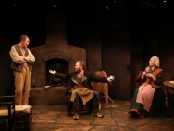
Bess Wohl's "Grand Horizons" opens with a pas de deux of marital inertia as Nancy (Jane Alexander) and Bill (James Cromwell), two near-octogenarians wasting their twilight days in a so-called independent living community, wordlessly go through the motions of sitting down to dinner. Their silence, and apparently 50-year marriage, are finally both broken when Nancy dispassionately declares that she "would like a divorce" and with equal nonchalance Bill responds, "All right." Confidently staged, or rather choreographed, by director Leigh Silverman, it's an extraordinary scene that, in truth, could stand alone as its own very brief play with the audience, possibly to its experiential chagrin, imaginatively filling in everything that came before. [more]
Maz and Bricks
Created and first performed during the run-up to the 2018 national referendum that eventually led to the amendment's repeal, Maz and Bricks, a part of the Origin Theater Company’s 1st Irish Festival, hasn't suffered any loss of social relevance, because O'Connor is not a single-issue polemicist. Her play brims with many pointed ideas about modern Ireland, which, with greater and lesser success, are woven into a beguiling tale that follows its two titular characters on a Joycean ramble through the streets of Dublin, tripping up most significantly at the end when O'Connor shoehorns in a needlessly melodramatic coda intended to tie together a few loose plot threads that really shouldn't have been there at all. [more]
Jagged Little Pill
Given the personal nature of Morissette's artistic output, it might be surprising to learn that the Broadway version of Jagged Little Pill doesn't take the easy biographical route for its book, mimicking, say, the mega-popular "Beautiful: The Carole King Musical," whose subtitle pretty much says it all. Instead, Morissette's album (Glen Ballard co-wrote the music) and a few of her other songs support an entirely original story from theater-novice Diablo Cody, whose Oscar-winning screenplay for "Juno" was funny, affecting, and decidedly superficial. This same descriptive mixed bag also holds true for Jagged Little Pill, which rises above typical jukebox musical fare, but not as much as it could have, largely because Cody is interested in hot-button issues, not characters. [more]
A Christmas Carol
Campbell Scott as Ebenezer Scrooge and Dashiell Eaves as Bob Cratchit in a scene from Jack [more]
Pumpgirl
Told as a series of alternating, interlocking monologues, there is a "Rashomon"-esque quality to "Pumpgirl" that grows more obvious as the play's story comes into focus. Not only do the relationships between the characters subjectively deepen as they each take their turns speaking under lighting designer Michael O'Connor's isolating glare, but a life-altering crime is also revealed, one that is committed with stomach-churning cruelty. Though, unlike in the Kurosawa movie, its details are never in doubt. [more]
Bella Bella
Like a great many history plays, Harvey Fierstein's "Bella Bella" is as much about the present as the past, paralleling everything that's gone wrong now with what went wrong then. Unsurprisingly, it's also shamelessly biased, with the first word in the play's title apparently meant to be read in Italian as part of Fierstein's banally straightforward tribute to Bella Abzug, the feistiest of feisty 1970's New York City politicians, best known for her take-no-prisoners liberalism as a member of the U.S. House of Representatives. One's enjoyment of the play probably depends on how prone you are to clap or hiss along with the rest of the unambiguously sympathetic Manhattan Theatre Club audience, even if it's only in your own head. [more]
The Rose Tattoo
To be sure, Serafina and Alvaro's romance is less than credible, but director Trip Cullman wisely commits to it completely, recognizing that Williams really hasn't given him any other choice. Luckily for Cullman, he has the ebullient Tomei to portray Serafina and keep the audience from losing faith that the character's happy ending is just over that lovely Gulf Coast horizon, no matter what miseries she's endured. [more]
Mothers
The first act of Anna Moench's "Mothers" concludes with a genuine shock as the playwright startlingly upends all of our expectations. Visually punctuated by Wilson Chin's suddenly not-so-stable set, this audacious turn suggests Moench's intermittently funny satire of upper middle-class motherhood at a "Gymboree-style playroom" has only been a prelude to something much more challenging and profound. Unfortunately, what you soon begin to suspect is that Moench just ran out of narrative steam and started writing something else. [more]
Only Yesterday
As John, Christopher Sears is an enjoyable pill, perfectly offset by Tommy Crawford's Paul whose amiable placidity is almost Buddha-like. More importantly, both actors have impressive musical chops, which wonderfully serves Stevens' truncated overview of Paul and John's tuneful reminiscing about their musical influences: Chuck Berry, Bobby Freeman, Gene Vincent. Sears even has the opportunity to do a bit of Elvis Presley hip swiveling that feels absolutely perfect in its oh-so-British imperfection. [more]
The Plough and the Stars
The Irish Repertory Theatre ends its thirtieth season by going back to the beginning, with a sturdy revival of Sean O'Casey's "The Plough and the Stars." An historical prequel to the other two plays in O'Casey's Dublin Trilogy, it was also the Irish Rep's inaugural production, a daring choice that essentially served as an artistic mission statement, signalling a commitment not to shy away from Ireland's ever-contested past. [more]
The Poor of New York
One of the theater's most skilled 19th-century melodramatists, Boucicault was uninterested in the finer points of history, character development, or narrative objectivity which, of course, is why, as the Metropolitan Playhouse's lively revival of "The Poor of New York" demonstrates, his works are often so much fun. That doesn't mean they're untruthful; it's just that Boucicault wasn't prone to letting a bunch of cumbersome details and ho-hum dramaturgical considerations get in the way of a good story or a necessary cause. But if you're aching to learn how Andrew Jackson's monetary policies and the peculiarities of his personality might have contributed to a downturn in the American economy, there's always the hope Aaron Sorkin will eventually write that play. [more]
Juno and the Paycock
From this group of familiar faces, O'Reilly and Keating are particularly strong in their second go-around, finding notes in Jack and Joxer's codependent relationship that are both hilarious and hideous. With his almost sneering delivery of Joxer's obsequious and vowel-rich responses ("it's a darlin' funeral, a daarlin' funeral"), Keating's performance is especially brilliant, pitched just before the point when servility turns into hate. As for Jack, O'Reilly brushes aside his litany of faults to make him a first-rate charmer, capable of snatching a smile from Juno even after he's brought the overburdened woman to her wit's end. [more]
The Shadow of a Gunman
Director Ciarán O’Reilly handles O'Casey's abrupt tonal shifts well, transitioning from laughter to tears to horror with barely a hint of contrivance. A top-notch production team greatly aids O’Reilly's quest for authenticity, turning the performance space into an impressive simulacrum of war-torn Dublin. Leading the effort is Charlie Corcoran whose incredibly detailed set spreads out into the audience, where a gloomy, ramshackle corridor deposits theatergoers into seats bracketed by crumbling brick walls and overhung with clotheslines burdened by the tenants' latest washings. [more]
Alone It Stands
Breen's script, a succession of rapid-fire vignettes divided in half by an unnecessary intermission, tries to compensate for its lack of depth with imagined multitudes. According to a promotional flyer, the production's six actors portray a total of sixty-two characters. While I feel confident enough in my counting abilities to verify the former, I'll leave the latter to someone whose obsessiveness exceeds my own. That person might also have to be a little generous in regards to defining what constitutes a character. [more]
The Emperor’s Nightingale
Although Chua is less interested in beauty for beauty's sake than Andersen, the look and sound of "The Emperor's Nightingale" is still stunning, drawing on a wealth of traditional Chinese art forms to both enliven and culturally ground the story. Leading the way are Joseph Wolfslau's period-inspired score and You-Shin Chen's eye-popping set, which pays lovely tribute to the art of Chinese paper cutting. Leslie Smith's lighting design nicely highlights all of the wonderful colors in Chen's set, as well as those found in Karen Boyer's lambent costumes, which do imaginative justice to human and animal alike. [more]
The Thanksgiving Play
Many comic artists have noted that great humor often comes from great tragedy, though, inevitably, sometimes the latter overwhelms the former, and all you’re left with is a lot of indignation and nobody laughing. As the late Joan Rivers once remarked, "comedy is anger, but anger is not comedy." It's a maxim that the Sicangu Lakota writer Larissa FastHorse takes to heart in "The Thanksgiving Play," as she manages to keep us smiling while four white characters attempt to turn a half-millenium of genocide into a 45-minute children's show. [more]
I Was Most Alive with You
In Craig Lucas’s "I Was Most Alive with You," two down-on-their-luck television writers mine recent personal tragedy for their latest project, hoping, with the Book of Job as their inspirational guide, to set both their careers and the universe in order. Although suffering has touched each of them, Ash (Michael Gaston), a late middle-aged recovering alcoholic in a bad marriage, is the much more forlorn figure. Like Job, Ash has hit one of those rough patches in life, where, if you’re a person of faith, you might start to suspect that your higher power doesn’t like you very much. [more]
Agnes
Unfortunately, Worsham’s efforts just confirm the play’s central problem: only the relationship between June and Charlie has any real depth. As for the rest of the characters, although McMullen’s writing is clever, too many of the lines are focused on eliciting laughs rather than explaining why these people are choosing to shelter together. It doesn’t help matters that the play’s lighting by Cheyenne Sykes and sound design by Daniel Melnick are wholly devoted to overdramatizing Charlie’s Asperger’s while failing to offer much-needed periodic reminders of the torrential plot device that keeps everyone from fleeing the cramped apartment. [more]
Comfort Women: A New Musical
In telling the rest of this shattering story, the creators of Comfort Women, inexplicably, rely heavily on musical theater conventions that result in wrongheaded, if not downright offensive, choices. The most cringeworthy is the choreographed sequence of a Korean woman being gang raped by Japanese soldiers. At some point, in their effort to visualize this atrocity, director Dimo Hyun Jun Kim and choreographer Natanal Hyun Kim should have realized that they were, in fact, trivializing it. [more]
Brecht on Brecht
But when things slow down a bit, especially during the musical interludes and longer dramatic pieces, Petosa’s eight performers -- four lead (Christine Hamel; Jake Murphy; Harrison Bryan; and Carla Martinez) and four supporting (Miguel Castillo; Sebastian LaPointe; Olivia Christie; and Ashley Michelle) -- are an absolute wonder, gracefully tackling a head-spinning array of difficult subjects, including xenophobia, social inequality, and infanticide. And thanks to Hallie Zieselman’s bare set, Annie Ulrich’s modest costumes, and Joe Cabrera’s vibrant lighting, they accomplish it all in a decidedly Brechtian way. [more]
Desperate Measures
Shakespearean spoofs are almost as old as Shakespeare himself, dating back to at least the Restoration period. Although the vast majority has faded into history, there are still some real standouts like the classic musical "Kiss Me, Kate," which thanks largely to Cole Porter is arguably even more enjoyable than its source material, a rare feat that the relatively new musical "Desperate Measures," now in its second off-Broadway run, also accomplishes. [more]
Woman and Scarecrow
Unfortunately, O'Reilly’s heavy reliance on the production team is also indicative of a significant problem: the play is repetitive. Despite finding new, and often lovely, poetic ways to convey the centrality of death to life, Carr’s thoughts and arguments quickly begin to sound like the same melody over and over again, just in a different key. O’Reilly tries to distract us from this fault by giving the Gottlieb-Rumery-Corcoran trio creative free rein; the deathbed, for example, frequently looks like it’s floating somewhere in the cosmos. But the images invariably keep giving way to the words, which, though beautiful, grow tiresome by the second act. [more]
Light Shining in Buckinghamshire
There’s a brilliant play buried somewhere in Caryl Churchill’s "Light Shining in Buckinghamshire," a bottom-up historical epic about the English Civil War that the acclaimed British writer developed collaboratively with director Max Stafford-Clark and a group of actors back in 1976. Fifteen years later, it premiered stateside at the New York Theatre Workshop, where it has just returned for a ploddingly drawn-out second go-around that yielded a lot of empty second-act seats on the night I attended. [more]
Replay
To be sure, there are examples of talented playwrights who have also been able to tread the boards without tripping over their feet, or tongues. Harold Pinter, Noël Coward, Tracy Letts: they all come quickly to mind. Some theater historians have even argued that Shakespeare might have been a pretty good actor, too. But, still, it’s exceedingly rare to find a playwright like Nicola Wren, who can bring her words to life with as much passion and grace as she set them down. [more]
We Live by the Sea
Devised collaboratively by Patch of Blue, a London-based theater company, the play also benefits from a talented supporting cast. Alexandra Simonet makes Hannah’s caretaker fatigue evident before she even says a word, but, somehow, you also never doubt her commitment to Katy. And Lizzie Grace is an absolute delight as Paul Williams, especially during a monologue late in the play, in which she pontificates on the importance of imaginary friends and gives insights into Katy that are both touching and profound. As for Ryan, Tom Coliandris does what he can with his character’s tacked-on back-story, but he shines when he’s simply required to be a warm, caring and decent presence. [more]
This Flat Earth
But, unfortunately, Ferrentino squanders this intriguing setup, getting lost in existential musings that end up being nowhere near as complicated as her subject matter. The first signs of trouble are actually percolating even before the play begins. As we enter the theater, Cloris (Lynda Gravátt), Julie and Dan’s elderly neighbor, is already perched in the upstairs apartment of Dane Laffrey’s two-story set. And there she remains for the entire play, a constant presence hovering over the action below. Initially, you wonder about her and, then, you feel sorry for the actor, hoping she’ll be given something more to do than just putter around. Eventually, however, after a couple of pat exchanges with Julie, it all becomes cringingly clear. Cloris isn’t a character at all; she’s an inspirational device, one that Ferrentino unleashes with full, and shameless, force at the play’s tear-jerking conclusion. [more]
Three Small Irish Masterpieces
It’s impossible to discuss the history of modern Irish drama without reference to William Butler Yeats, Lady Gregory, and John Millington Synge, who, at the beginning of the last century, helped to found the National Theatre of Ireland. With "Three Small Irish Masterpieces," this literary trinity receives a heartfelt, if somewhat exaggerated, nod from the Irish Repertory Theatre, which, over the last few decades, has proven its own indispensability, too. [more]
Three Wise Guys
Just in time for Easter, TACT/The Actors Company Theatre has adapted and combined two Christmas-themed Damon Runyon short stories into the seasonally inappropriate, but nonetheless very charming, "Three Wise Guys." Gleefully peppered with Runyon’s distinctive demi-monde argot, or Runyonese, the comedic play depicts a Prohibition-era New York of principled crooks and hustlers who, in true Runyon style, end up having hearts much bigger than their ill-gotten bankrolls, which, of course, doesn’t mean they’re ready to commit to their matrimonially frustrated gal pals. Like another Runyon adaptation about some guys and dolls, the sparsely musical "Three Wise Guys" fancifully speaks to the, perhaps not so unreasonable, belief that those on the make are much more trustworthy than the ones who’ve already made it. [more]
Terminus
In the semi-autobiographical "Terminus," part of a seven-play cycle set in the fictional town of Attapulgus, Georgia, playwright Gabriel Jason Dean unleashes this intriguing Southern Gothic setup which touches off a deeply felt personal story about racism in a place that is obviously more real to Dean than imagined. Unfortunately, as it goes along, Dean’s initially captivating ghost story exponentially loses steam, finally grinding to a halt well before Eller’s big, shameful secret is revealed at the play’s not-so-stunning conclusion. [more]
The Pill
This comedy/drama/fitful musical also suffers from major tonal challenges, as it strains to push all of our emotional buttons. It’s a shame, because the cast gives it their all. Particularly good is Zoe Wilson, as Leni, a severely depressed teenager whose body dysmorphia has led to self-cutting and bouts of suicidal ideation. Wilson is just the right mix of pained and angry. Whenever she speaks, or sings, The Pill feels centered and we’re ready to delve deeper into Leni’s personal struggles. [more]
A Kind Shot
And that’s essentially the problem with "A Kind Shot." Clocking in at 75 minutes, the “performance” feels more like a motivational speech than a theatrical event. It’s well-meaning and well-told, but other than the charismatic Mateer, there isn’t much else to it. The set, a masking tape outline of a shrunken basketball key, accomplishes so little visually that it begs the question, “Why bother at all?” Mateer completes the obvious motif with a flower-emblazoned basketball, which she dribbles around a bit and bangs off the wall as if she’s making shots. I’m all for audience imagination, but, come on, just hang up a basketball hoop. [more]
America’s Favorite Newscaster
Another irony is that while Fury is kind of a bore, another character is not. Yeah, you guessed it. Him. When the president (David O. Friedman) appears in Fury’s bedroom like the Ghost of Christmas Present, Attea’s writing finally comes to life. His take on you-know-who isn’t unique, but the situation is wonderfully silly, and Friedman’s impression is a funny profile in petulance. [more]
A Regular Little Houdini
Daniel LLewelyn-Williams in “A Regular Little Houdini” (Photo credit: Sheri Bankes) In 1905, [more]
Cross That River: A Tale of the Black West
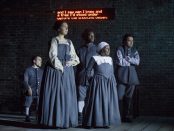
Serving as both narrator and protagonist, Harris portrays Blue, a runaway slave who crossed the Sabine River from Louisiana to Texas in search of his elusive freedom. To tell us everything that came before and after this momentous event, Harris is joined by three other impressive vocalists/performers in a concert-style presentation that has all the charm and verve of an old radio play. [more]
AlieNation: The Journey I Never Made & A Story of Love and Soccer
Adhering admirably to its cultural mission, Kairos Italy Theater is treating downtown audiences to a double-bill of smartly written Italian one-acts, each exploring the contentious topic of immigration in their own unique and achingly human ways. Minimally staged, but with talented actors, the beauty of the plays is largely in the playwrights’ words, which seemingly have lost nothing in translation. Though if either play is appreciably better in Italian, some language lessons and a long trip is in order. [more]
Billy and the Killers
In their new rock musical "Billy and the Killers," lyricist/librettist Jim Shankman and composer Peter Stopschinski channel Nicholas Ray, David Lynch, Elvis Presley, and Dashiell Hammett to concoct a muddled tale of teenage rebellion that dead-ends in an even less coherent murder trial. Along the way, there are some well-performed songs whose lyrics seem to be tied to the plot, but it’s often hard to tell, since, as you probably already know, proper enunciation is not what rock ‘n’ roll is all about, man. [more]
What We’re Up Against
With "What We’re Up Against," Theresa Rebeck looks back a quarter century to a time when gender inequality in the workplace was a real problem. Oh, wait…yep, unfortunately, if Rebeck’s script didn’t tell us the year was 1992, it would be pretty easy to believe she was writing about the present, especially given the recent avalanche of news concerning sexual harassment and assault in the entertainment industry. The story Rebeck tells never sinks to this horrific level, though it’s possible to imagine that it could have, if she had wanted to follow the male anger she portrays to a place it often leads. [more]
Arden/Everywhere
Signaling that we’re in for something different, Bauman has redubbed the play "Arden/Everywhere," a hint that home, and the emotional impact of losing it, is at the heart of her reimagining. Largely through design choices, but also some modest changes to the text, Bauman connects the diasporic struggles of the play’s characters to those experienced by the 65 million refugees the United Nations has identified throughout the world today, effectively arguing that, in both cases, the pain is there for anyone to see. [more]
Mesquite, NV
Most of the humor is at the expense of the Mesquite City Council and its steely-eyed mayor Linda Hadley (Liz Amberly) who could be accurately described as a Margaret Thatcher wannabe, if she had any idea who Margaret Thatcher was. With rapacious resolve, she has set her sights on doing something no other mayor has ever done in the entire history of Mesquite: win a second term. She is assisted in this quest by her right-hand toady (Jeff Paul), the financial backing of a shady resort magnate (Jed Dickson), and an underwhelming pool of potential challengers, led by Will Brown (the wonderful Joe Burby) whose hapless sincerity is seemingly no match for the mayor’s small-town realpolitik. [more]