Articles by archive
"Tales Of Tinseltown" is a bouncy and affectionate pastiche of 1930’s Hollywood that was inspired by Kenneth Anger notorious exposé Hollywood Babylon. The plot is a zany spoof of behind the scenes of the movie business. [more]

Midnight Kill
As the actors interact with each other and work to share this story, the spirit and tenacity in which they do so is something remarkable. Their presence and focus in bringing a significant time in history to life leaves the audience with chills. While it is so important to pay attention to the subtitles in this production, as it signifies when time and seasons pass, it is hard to tear your eyes away from the living story taking place on stage. With a set design also by K.K. Wong that uses simple props to illustrate the basic lifestyle of the residents, audience members get a feel for the day-to-day life in this community. At times, it is challenging to keep up with processing the subtitles and watching the action on stage, and intense concentration is essential in understanding the continued series of events. [more]
Do I Hear a Waltz?
Ms. Errico gives a smashing musical theater performance. Her gutsy broad that’s tough on the outside and unraveling on the inside characterization is quite captivating. Her singing of several of the wan attempts at showstoppers exhibits her charismatic range. It’s definitely a case of a performer elevating weak material with their talents. Her commitment is as intense here as if she were playing either Sally or Phyllis from Follies particularly for the boozy ode to self pity, “Everyone Loves Leona.” [more]
Saloons: Some Enchanted Evenings
Cabaret has always been a mixed bag. The golden age is gone. However, in today's schizo world of nightclubs, things are looking pretty good. It is a milieu unique in the entertainment industry. And, it continues to reinvent itself. The late cabaret critic Martin Schaeffer wrote in Back Stage in 1993,“There cannot be a better night of classic American music than a Bobby Short gig at The Carlyle.” He was right; especially if you're a purist of the Great American Songbook. [more]
Murrow
Many members of the American public and the journalism community continue to revere Edward R. Murrow as a paragon of integrity in the field of news reporting. Due to the skillfully writing of Joseph Vitale, Joseph Menino’s tremendous performance and its strong physical production, Murrow affirms his noble legacy. [more]
The Imaginative Space of the African Horizon
Playwright Rick Pulos has crafted a well researched and emotionally involving documentary drama that goes overboard with its multimedia elements. The writing is a combination of fine simplicity and the pseudo-poetic that achieves a tender sincerity. [more]
Either/Or: Music of Gyorgi Ligeti
In the hands of less virtuosic musicians, Ligeti's material can spin out of control. Kigawa, Choi and Drehmann, however, from the very opening, invited the audience into an experience of listening based on complete trust. The work's elegant, almost wistful conclusion – a distillation of harmonic lines into quiet, unresolved ambiguities – was compelling. [more]
Gorey: The Secret Lives of Edward Gorey
Before the fascinating biographical exploration "Gorey: The Secret Lives of Edward Gorey" begins, the audience is able to walk around the stage and see up close the totemic objects used in the show.
Gorey’s fur coat, an old record player, an artist’s table, vintage luggage and trunks, shelves of books and records are among the items on display. The back wall of the stage is adorned with reproductions of manuscript pages of his writing and drawings and during the show home movies, animations, slides of his work, and images of his residence are projected. [more]
Idiot
Director and choreographer Kristin Marting masterfully coordinates everything into a spectacle with sensational movement and dance. Robert Lyons who is credited with “Text by” has done a skillful, flavorful and faithful distillation. Ms. Marting and Mr. Lyons jointly conceived and adapted this production. It’s initially stimulating but the incessant franticness of their vision becomes distracting. [more]
The New York Pops: Do You Hear the People Sing
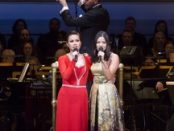
Inspired by the musical Olivier! was "La Révolution Française" that was Mr. Boublil Mr. Schönberg’s first collaboration. Created in 1973, this was the first French rock opera and dealt with The French Revolution. The rousing “Parisians, Awake and Rise/ Français, Français” was performed by Ms. Glover, Mr. Jordan, Mr. Scatliffe and Essential Voices USA. The original French Cossette from "Les Misérables," Marie Zamora, was a marvelous Marie Antoinette for the wistful song “Au petit matin/In the early morning.” [more]
Long Day’s Journey into Night
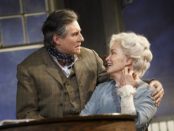
Jessica Lange and Gabriel Byrne joyously enter through a porch door after the sounds of the ocean have been heard. Their love and attraction for each other is palpable. Mr. Byrne embraces her and with his Irish accent says, “You’re a fine armful now, Mary, with those twenty pounds you’ve gained.” It is instantly clear that this revival of "Long Day’s Journey into Night" is going to be beautiful. [more]
All Over the Map
The cheery Mr. Bowers also explains that in the mime tradition only mimes in whiteface are silent. He simply but breathtakingly mimes a multitude of actions, objects and situations that precisely conjure up the intended imagery. Written by Bowers, the show is comprised of a series of stories of varying length that perfectly transition from one to the other. [more]
Butterfly
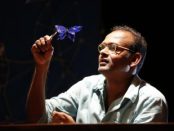
The show’s creator and director Ramesh Meyyappan also plays a character named Nabokov. The Lolita author Vladimir Nabokov was a renowned butterfly enthusiast. Naomi Livingstone plays Butterfly, a kite maker who hunts, kills and mounts butterflies. She meets Nabokov and they fall in love. Chris Alexander plays a customer who visits Butterfly’s shop and falls in love with her. Their relationships are ultimately marred by violence and tragedy. [more]
A Girl is a Half-formed Thing
Ms. Duffin portrays the heroine as well as a multitude of characters using a strong Irish accent, expert physical transformations and her strong presence. Barefoot, wearing plaid lounge pants and a blue T-shirt Duffin holds forth on the black walled stage that has a few slits of lights and a floor strewn with earth. Though she is commanding, the nature of the material ultimately renders her performance and the overall experience of the play as wearying. [more]
One Funny Mother
Blizzard doesn’t miss a beat as she keeps the whole room in stitches during the course of this 80 minute performance. Her wit, charm, and wisdom are comedic gold and make for a flawless piece of entertainment. Hidden underneath the humor is the important theme of togetherness and female solidarity as she emphasizes needing your girls to get through life, as they understand many of the emotions/dilemmas that men aren’t able to understand. It is empowering to hear her truth about not trying to be perfect and admitting that sometimes the “crazy” is proof that you are doing this whole thing (“adulthood” and “parent thing”) correctly. [more]
Echoes
Playwright Henry Naylor achieved prominence in Great Britain as a television writer most notably for the satirical program "Spitting Image." This work is not groundbreaking but it does very effectively depict the two women and their plights with shrewdly imparted historical and cultural details that conjure up exotic imagery reminiscent of David Lean’s epic films. Humor and tragedy are seamlessly combined. There are topical references to Donald Trump, Ted Cruz, drone strikes and the British tabloids as well as 19th century specifics. [more]
Another Son of Venezuela
Dynamic performer Migguel Anggelo exhilaratingly recalls the showmanship of Desi Arnaz and the performance art of Klaus Nomi in his terrific autobiographical cabaret act, "Another Son of Venezuela," that has the razzle dazzle of a Bob Fosse production. [more]
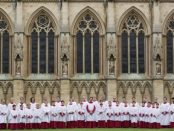
The Choir of St. John’s College, Cambridge
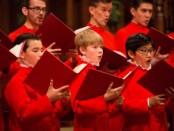
Since the 1670’s, the Choir has consisted of voices ranging from bass to treble, all students at St. John's College or the College School. There are currently six basses, five tenors, four counter-tenors and seventeen trebles; of the trebles – two or three of whom are no bigger than buttons – there currently appear to be thirteen families represented. In some senses, the trebles are the stars of the show: that such young boys should demonstrate such consistently high levels of both innate musicianship and disciplined formal training is remarkable. The sweetness of tone inherent to boys' soprano voices is not like anything else: its combined ethereality of the moment and promise of future sturdiness make it a perfect instrument for the invocation of angels, heavenly beauty and divine wisdom. [more]
92Y’s Lyrics & Lyricists Series: Everything’s Coming Up Ethel: The Ethel Merman Songbook
“Our goal is not to impersonate her but to channel her,” said Mr. Sperling, the artistic director, writer and director of this entertaining event. In addition to these tasks, he also sang, played piano and as the genial host effortlessly delivered his authoritative biographical statements. A fan of Merman’s since childhood, Sperling’s conception and execution of this show was a very well done labor of love. His patter skillfully documented her renowned charisma, saltiness and, most importantly, her unique vocal abilities. [more]
Keep
This trio certainly embodies the dynamic of most family relationships – with sisters struggling to get along and the eldest child having to take responsibility. Comerzan acts as a parent to her youngest sister and uses her compassionate nature to try and take charge of the situation. D’Angelo is the firecracker in the mix and keeps the audience in stitches with her snappy one-liners and sarcastic comments. Krane plays well to the youngest child part – attempting to be understood while making sense of her bizarre hobby. As the play develops, the audience learns about the fourth sister, Margo, played by Leslie Marseglia, whose life path and relationship with Naomi has greatly impacted her sister’s life and means of coping. [more]
Beckett Trilogy: Not I /Footfalls/ Rockaby
Scholars, critics, actors and audiences have long been entranced and intrigued by these plays. They appear to reflect Beckett’s perpetual theme of despair and joy coexisting within the human condition. This mesmerizing production of "Beckett Trilogy: Not I/Footfalls/Rockaby" vividly captures that expression with Lisa Dwan’s titanic performance and its striking presentation. [more]
Primary
Instead of a satirical take as in the film "The Candidate" (1972) or HBO’s television series "Veep," the treatment of the subject here is realistic in the mode of Norman Lear’s 1970’s situation comedies such as Maude. The toll of the campaign on Laura’s good-natured husband Arthur, her troubled nine year-old daughter Sophie and her resourceful young campaign manager Nick are insightfully explored. [more]
Dave Douglas Meets The Westerlies
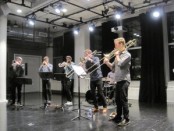
The Douglas-Westerlies music, whether its subject is lament or celebration, protest or affirmation, is artistically coherent: testing and stretching traditional genres, the music is about forward movement, about the exploration of “Great American Themes” as they end in felicitously determined encouragement and optimism. This music's informing energy and spirit shine and summon. Audience and listeners are invited into a musical experience in which history provides context, inspiration and goad; references to the political, musical and cultural past do not tether the music to old habits but liberate it for new conversations. Together, Douglas, Royston and the Westerlies generated a warm and rich brass-and-percussion sound; the Westerlies' happy virtuosity, discipline and irrepressible affection for the full range of their instruments' sounds make them a perfect collaborative partner for Douglas' genre mixing and generously imaginative expansion of the artistic possibilities of trumpet, trombone and drums. [more]
Votes
Under Gabrielle L. Kurlander’s intricate direction," Votes" presents a moving and personal picture of the real lives and feelings of an extremely powerful couple in America. Votes brings a more human side to their relationship – recalling how Melanie, played by Lisa Wright-Mathews, and William Jefferson (Wayne Miller), met as law students at Yale. It shines a light on their early plans to do some good in the world – all with a twinkle in their eyes as Melanie recalls how she first fell in love with the “pimply kid from Arkansas.” As this couple ages, they question if it was all worth it and consider what they are actually playing for, as this Election 2016 offers the bold chance to do something different. [more]
Antlia Pneumatica
Rachel Hauck’s scenic design is the most outstanding feature of the interminable "Antlia Pneumatica." Ms. Hauck accurately and vividly represents the Texas ranch setting by an elaborate kitchen counter top in the center of the bare stage that is surrounded by shrubbery. It’s very functional as much of the activities involve preparing a feast. [more]
Ensemble Pamplemousse
And Ensemble Pamplemousse, an exciting and distinctive six-member “composer performer collective” founded in 2003, and performing at Miller Theatre for the first time, had all sorts of fine surprises to offer. Each of the musicians composes and performs; each seems able to play several traditional and non-traditional instruments, though their publicity material identifies one primary instrument of each. All six, fresh off their extensive recent European tour – Natacha Diels/flutes, Jessie Marino/cello, Andrew Greenwald/drums, David Broome/keys, Bryan Jacobs/electronics and Ross Karre/miniature drumset – contributed equally to their recent Pop-Up performance. [more]
Cagney
Shoving a grapefruit into Mae Clarke’s face in "Public Enemy," George M. Cohan’s "Yankee Doodle Dandy" song and dance numbers for which he won the Academy Award for Best Actor, and the “Top of The World, Ma!” finale from "White Heat" are among the exciting factual highlights of this old-fashioned chronicle. [more]
1776
The prime instigator of the events, John Adams, was rotund and abrasive. Here he is played by the handsome Santino Fontana who was Prince Charming in the recent Broadway production of Cinderella. Though Mr. Fontana bears no physical resemblance to Adams he conveys his rage, frustration and humanity with his dynamic performance. Fontana’s soaring voice captures the emotion and humor of the score, particularly on "Is Anybody There?" [more]
Locusts Have No King
Much of "Locusts Have No King" by J. Julian Christopher appears to be in the well-mined terrain of Mart Crowley’s "The Boys in the Band," Edward Albee’s "Who’s Afraid of Virginia Woolf?" and the works of Terrence McNally. Gay relationships are explored in blistering detail but gradually there is the Jean Genet bombshell that the action takes place in the contemporary Long Island rectory where they all live. [more]
The Saint Thomas Church Choir of Men and Boys: Seven Last Words from the Cross
The last piece of the concert was James MacMillan's substantive and moving 1994 "Seven Last Words from the Cross," a 35 minute piece of seven different movements, varying in length from nine to one-and-a-half minutes each, for choir and orchestra. As the piece progresses through the final Passion drama, from Jesus' plea for forgiveness for his executioners to his exhausted last breath, MacMillan explores aspects of prayer and petition, anguish and fear – Jesus' and humanity's – in music that bears close allegiance to Romantic liturgies and Requiems. Here, the Choir and the orchestra were elegant, boys and men singing with superb control, lush expressivity … and their usual clear diction. [more]
The Hundred We Are
Swedish novelist and playwright Jonas Hassen Khemiri’s new play, "The Hundred We Are," presents an emotionally compelling view on the different stages of one’s self encountered over a lifetime. From the time we are born, until the time of our passing, we learn to adapt to our surroundings and transition from life phase to life phase, with our evolution as a human being marked as life’s most important journey. Audiences are in for a treat as this provocative and progressive new play examines many of the important social issues occurring throughout the world in a fresh and truly thought-provoking way. [more]
¡Figaro! (90210)
Virtually performed all in English with some Spanish for comic effect," ¡Figaro! (90210)" is true to the art form with recitative and arias, that is sung speech and grand solos rather then integrated dialogue and songs that characterize traditional musical comedy. Supertitles are projected above the stage for anything that may be vocally indecipherable. [more]
C4: Unusual – Music of the strange, the absurd, and the surreal
For the winter concert of their eleventh season, the twenty-three member C4: The Choral Composer Conductor Collective – elected to honor “Unusual - music of the strange, the absurd, the surreal.” The evening included three premieres, all by current C4 composers, among the eight pieces performed. Some of the works were splendid and some weren't, but all were presented with C4's characteristic superb musicianship and artistic integrity as well as their willingness to take risks. [more]
Witchcraft: The Jazz of Cy Coleman
“He was tied to the life of jazz clubs,” said Billy Stritch of Cy Coleman, the subject of The 92nd Street Y’s Lyrics & Lyricists Series Presents: "Witchcraft: The Jazz Magic of Cy Coleman." Mr. Stritch was the personable host, artistic director, and performed on piano and was a vocalist along with four other talented singers during this very entertaining and jazzy concert. [more]
Richard Malavet in The Billy Eckstine Project: Songs In the Key of “B”
“He was the premier balladeer of his generation and the first African-American to sing a song on network radio,” Malavet declared of the entertainer. Billy Eckstine (1914-1993) was a Virginia born African-American jazz and pop singer, bandleader and songwriter. He sang with the bands of Earl Hines, Duke Ellington and Count Basie. During a career lasting over 50 years, Eckstine had several hit singles, toured extensively and appeared on major television network programs. [more]
Ideation
Taking place in real time, Aaron Loeb's entertaining play is in the mode of Paddy Chayefsky’s "Network" with shades of "The Blair Witch Project." It also echoes the explosive style and resonant themes of psychological moral complexities that Yasmina Reza theatrically explored in her plays "Art" and "God of Carnage." [more]
Composer Portrait: Iancu Dumitrescu with Either/Or
The evening was less about contemporary Romanian composer Dumitrescu, born in 1944, than about the music for which he is, in some mysterious sense, a medium. Each work is unique, each a premiere, even if its originating shape has existed before. The style of music in which Dumitrescu operates has recently been called Romanian Spectralism. Dumitrescu himself doesn't much use this phrase; he calls his music and the impulse to make music 'Orphism,' describing it, variously, as “natural, alive and intuitive” and “sonorous and refined ...from archaic sources.” [more]
Boy
In his widely produced 1977 play," The Elephant Man," Bernard Pomerance employed the theatrical device of having the grotesque John Merrick portrayed by an actor (invariably a handsome one) without makeup. "Boy" is similar in that the magnetic Bobby Steggert plays Samantha and later Adam without any external differentiation. Acclaimed for his New York City appearances in such musicals as "Yank" and the 2009 Broadway revival of "Ragtime," as well as the Terence McNally play "Mothers and Sons," Mr. Steggert here delivers a powerful performance. Low-key yet animated, he commandingly conveys all of the anguish and endurance of the character with heartbreaking effect. His characterization is particularly outstanding considering he alternates between being a child, an adolescent and an adult throughout the play. Each permutation is depicted with absolute focus. [more]
The Goodbye Room
Eric Gilde’s new drama, "The Goodbye Room," realistically and powerfully captures a family’s journey after losing a loved one. The worst of times always seems to bring the deepest of emotions to the surface as we prepare to say good-bye to someone close to us, while also dealing with the family and friends that surround us in our time of need. It is not only difficult for a family as a unit, but it individually takes a toll, as each member deals with grief in a different way. The result is a storyline that is eye opening, stirring and poignant. [more]
The New York Pops: 42nd on 57th: Broadway Today
A pulsating medley from Kander and Ebb’s musical "Chicago" was the thrilling second act opening number of The New York Pops’ pleasant concert of eclectic show music, "42nd on 57th: Broadway Today." The evening opened with a lush and dramatic selection from Andrew Lloyd Webber’s "The Phantom of The Opera." "Les Misérables" also received a superb symphonic treatment, as did the lovely overture from "Ragtime." Hearing these familiar melodies performed by this supremely accomplished 78 piece orchestra was uniquely enthralling. [more]
Widowers’ Houses
Director David Staller has ingeniously staged this small-scale production with numerous theatrical flourishes. Scene transitions are accomplished with actors in character moving furniture, there are hilarious slapstick bits, voice-over recordings are heard representing a character’s thoughts and the very precise stage choreography all enrich the presentation while faithfully representing the author’s intentions. Mr. Staller has also assembled a first-rate cast of talented actors who are all expert at crisply delivering Shaw’s wordiness while sustaining vivid characterizations. There is also clever double casting. [more]
Composer Portraits: Alex Mincek with Yarn/Wire and Mivos Quartet
In the compositions of New York composer Alex Mincek (b. 1975), music is explored by means of separating out its constitutive elements: as indicated in Miller Theatre program notes for his Composer Portrait concert, Mincek examines “sound worlds,” music states and the “sense of interconnectivity that reveals underlying qualities of coherence and unity.” These principles were on full display as two stellar contemporary groups, Yarn/Wire and Mivos Quartet, presented four recent Mincek works, including two world premieres. [more]
One Way to Pluto!
Patrick Brian Scherrer plays Peter, appearing in all 11 scenes, often in intense situations. The very personable Mr. Scherrer’s performance is quite heroic as he boldly embraces the play’s many painful episodes with his boyish charm. He is painfully believable as this wide-eyed struggling artist in the cruel big city and is instrumental to the play’s success. [more]
Familiar
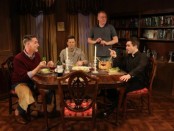
The family tension is defined in terms of the strong female relationships between mother Marvelous (Tamara Tunie) and the bride-to-be, who differ when it comes to wedding plans as well as the bride and her younger sister, Nyasha (Ito Aghayere) who clash over lifestyle choices. Big sister is the accomplished, serious professional woman who is strongly tied to her religious beliefs and customs, and the free-spirited little sister (who wasn't even asked to be a bridesmaid) who is tired of being berated for her choices. Tendi looks more to her aunt from Africa for guidance than her mother and is determined to have her look upon her choices as favorable. The source of comic relief in Familiar is Donald, the father (played by Harold Surratt), who sits back observing all the conflict and tries his best to take it all in stride. This family is one for the ages and how they deal with each other and common familiar issues is something all audiences can relate to. [more]
Hughie
When the audience enters, the curtain is up and Christopher Oram’s imposing scenic design of the faded hotel lobby is in view. The visual effect of its industrial greenish walls, dirty stone columns, chipped wooden adornments, ancient elevator, central staircase, frayed threadbare furnishings, severe front desk, and grimy windows is that of a stunning representation of hellish imprisonment. Also on view while the audience waits the play to start is the night clerk staring into space. [more]
American Classical Orchestra: “L’Isola Disabitata”
The most psychologically complex role is Silvia's. Over the course of the opera, she moves from childlike naïveté to loving generosity of heart. Energetic and intelligent, she unlearns her sister's morbid lessons about men's wickedness so completely that as a newly emerged adult, she falls in love without reservation or fear. Sherezade Panthaki's Silvia was marvelous: the full evolution of her character was reflected in singing that moved from light sweetness to exuberant, vigorous sensuality. In her artistry, Panthaki made her Silvia a young woman with neither inhibition nor fear; Panthaki took every possible risk with Haydn's music and made it all feel like happiness in the process of being discovered. [more]
92Y’s Lyrics & Lyricists Series: “Battle for the Airwaves: The Songbook Meets Rock and Country”
Breezily delivering his erudite script from a music stand, black-backed cards that he occasionally held, and from memory, Naughton cited Jazz, Gospel, The Blues, Country and Doo-wop. He also imparted historical facts and biographical details about the key figures involved. These included Nat King Cole, The Mills Brothers, Hank Williams, Jr., Louis Jordan, Jerry Lee Lewis, Elvis Presley, The Everly Brothers, Patsy Cline, The Coasters, The Platters, and Ray Charles. Much of the commentary was accompanied by appropriate slide projections. [more]
The Good Girl
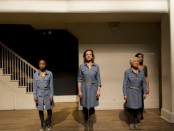
The chemistry between Gabriel and Baessato is fierce and electrifying as they get to know each other, and intensifies as Van begins to observe the human-like behavior of the robot and is determined to find out more. Anjali is hesitant to let him in on the secret, but reveals that the robot has developed an emotional bond to her, and sometimes responds to certain feelings such as loneliness and separation – often uttering the words, "don't leave me" through the door. Van is fascinated at what he finds out and the two join forces to figure out how best to capitalize on the service of the sex robot and how she can accommodate a greater (and richer) clientele by playing into their fantasy of the obedient housewife. [more]
Cabin in the Sky
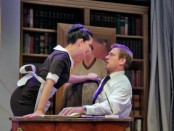
Director Ruben Santiago-Hudson has inventively and thoughtfully staged the show with vibrant precision. Mr. Santiago-Hudson’s work combined with Camille A. Brown’s often stunning choreography makes for an eye-catching spectacle including the dream sequence with The Queen of Sheba in a golden gown and headdress. Santiago-Hudson also collaborated with Encores! artistic director Jack Viertel in adapting Lynn Root’s original book into an engagingly flowing narrative with depth. [more]
Defendant Maurice Chevalier
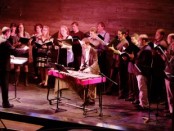
His great grandnephew, the French-born and raised Alexis Chevalier has written this well researched play with music that is based in part on Maurice Chevalier’s memoirs. It is structurally problematic with fantasy episodes, extraneous musical and dance sequences, and numerous often-lengthy scenes that don’t cohere. The dialogue is straightforwardly purposeful imparting historical facts and details with occasional bursts of poetic qualities. [more]

Company XIV’s Snow White
Company XIV founder, director and choreographer Austin McCormick recycles his stylistic techniques that include a having troupe of physically attractive and dynamic dancers in skimpy costumes, pop tunes interspersed with classic music and standards, and circus flourishes. [more]

Monte Cristo
safe guess would be that most audiences coming to see New Light Theater Project’s adaptation of Alexandre Dumas’ "The Count of Monte Cristo," one of most classic and exhilarating works of all time, are quite familiar with the material. A tragic tale of a man imprisoned for a crime he didn’t commit leads sailor Edmund Dantes to seek justice as he becomes the wealthy Count of Monte Cristo. [more]
Sojourners
Ms. Udofia’s dialogue is richly expressive and she renders the four characters with depth and detail. The relationships between the characters are fully explored and their interactions where they voice their hopes and desires are often poignant. This is most particularly felt in the growing camaraderie between Abasiama and Moxie. [more]
The Burial at Thebes
Robert Langdon Lloyd’s eloquent performance as the blind prophet Tiresias energizes what had been a stilted presentation of this small-scale production of "The Burial at Thebes." Before Mr. Lloyd’s commanding midway appearance there had been a good deal of static expositional recitation and declaiming with only slight dramatic sparks. [more]
Wide Awake Hearts
Brendan (NBC’s "Blindspot") Gall’s sexy and seductive new thriller, "Wide Awake Hearts," thrusts audiences into a challenging game of cat and mouse, as they are left to decipher the story of four friends in a case of art imitating life. An actor, director, writer and actress are faced with the intricacies of dealing with relationships, infused with passion and threats of infidelity, as they are in the process of creating a movie dealing with these very themes. [more]
What the Horse Saw
The collaborative script is by the One Idiot troupe’s writers that include Jon Bershad, Aaron Burdette, Allie Kokesh, Kristy Lopez-Bernal, Nathan Min and Katelyn Trela. It’s a smart mash-up of plot points and characters that those familiar with Williams’ play will recognize and those who aren’t would still find funny due to the franticly goofy presentation. The writing is also characterized by an abundance of vulgarity and scatological humor that is relatively tame rather then being offensive. [more]
The Screwtape Letters
This Grand Guignol concept is sensationally realized by the striking physical production. John Gromada’s chilling sound design configures his spooky original score with its dominant organ along with bomb blasts and other sound effects for very effective results. Cameron Anderson’s scenic design is a dazzling haunted house affair with the stage wall covered in tiny bones and skulls, a ladder and ramp for the creature to scamper on, and manor-style furnishings. Hellish red hues are prominent features of Jesse Klug’s eerie lighting design. [more]
2016 LaBute New Theater Festival
The opening one is British author Lexi Wolfe’s delightfully wistful "Stand Up for Oneself." It’s a Chekhovian romantic comedy with clipped Noel Coward-style dialogue taking place in the room of a house where a party is going on. Lucas, a 42-year-old morose music professor sits alone drinking with his cane nearby when the free-spirited 26-year-old Lila enters. There is flirtation and revelations. Sensitively directed by John Pierson, the play’s very fine writing is boosted by the wonderfully detailed and effecting performances of Alicia Smith and Mark Ryan Anderson. [more]
A Man and His Prostate
Asner’s appearance in "A Man and His Prostate" is a delightfully thrilling opportunity to experience his considerable talents live. He vividly grouses, grimaces, and perfectly lands every joke with his monumental comic timing. The seriousness of the play is also conveyed when he skillfully tones his performance down to recite medical facts and to express the fears of the ramifications of the character’s condition and prognosis. Sitting raised above the audience at times he looks and sounds like a sage. [more]