Archive
Although meaningful dialogue is written in iambic pentameter, not all text is so structured. There is a skill in delivering lines within the structure of iambic pentameter, but it is equally important that the rhythm of all the dialogue be consistent. The lines must be spoken as if they were a normal speech pattern without paying attention to the structure. Unfortunately, the delivery by the ensemble varies widely, ranging from sounding like a textual reading to a clear, direct delivery to one completely out of character for the words spoken. As a result, the interconnections between the elements of the story are lost, causing a breakdown in clarity. [more]
Lifeline
However, instead of telling Fleming’s story in chronological order, it travels backwards and forwards in time beginning with Fleming’s Nobel Prize acceptance speech in Stockholm in 1945, then skipping to Athens, Greece, in 1952, then traveling back to New York and London’s St. Mary’s Hospital in 1946, then further back to St. Mary’s lab in 1940, and finally ending Act 1 with Fleming’s discovery of penicillin at St Mary’s in 1928. Not only does all this alternate with the Jess/Aaron story in Edinburgh in the present, it often divides the stage in two and tells both stories simultaneously. There seems to be no gain in telling Fleming’s story out of order, as it makes it confusing and hard to follow, while asking us to keep track of the contemporary story with its permutations and additional characters at the same time. [more]
Now Comes the Fun Part
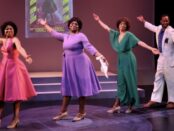
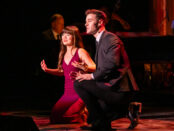
The revue alternates between skits by James Hindman and Lynne Halliday and songs with music by Jeffrey Lodin (who is also the music director at the piano) and lyrics by Mark Waldrop, the intrepid director. While the material is diverting and entertaining, it feels derivative rather than original. There appears to have been an attempt to not offend anyone so that everything is rather low key and tame. Some of the tropes though pertinent have already been dramatized: “To You, My Friend,” sung by two women at a college reunion, resembles but feels like a pale imitation of Jerry Herman’s “Bosom Buddies” while “Gonna Get the Band Together” suggests the 2018 Broadway musical with a similar name. “Reunion” in which two old friends reminisce has too much the feel of a "Saturday Night Live" skit. [more]
Hurricane Season
"Hurricane Season" is the sort of vanity production in which one assumes that the author thinks he or she has invented the next step in the avant-garde. Unfortunately, Estes’ production will give most theatergoers a headache attempting to follow his play as well as the unnecessary flashing video. Whatever the play wants to say about “erotic desire and national anxiety,” it is lost in the proceedings on stage. Incidentally in the cause of transparency, Hurricane Season is not the least bit erotic though there is a certain amount of simulated sex. [more]
Pretty Perfect Lives
Tarlton’s work is not without promise. As a social critique of people who are surgically attached to their smartphones, it is somewhat spot-on. (Heaven forbid we miss that recent post documenting what was ordered in the latest restaurant!) At points when actors were immersed in their phones rather than looking at or speaking to each other, the silence of audience realization, or rather revelation, was deafening. [more]
A Quick Look at Some Theatrical Plays Associated with Casinos
Even those who are not necessarily fans of the theatre will find it difficult to deny the talents of the actors on stage. There are also a handful of themes that provide a truly engrossing experience from the perspective of the viewer. [more]
Once Upon a Mattress
Foster is a joy as the princess from the swamps who can swim, lift weights, dance all night, commit multiple contortions as she tries to get a good night sleep, and field any disaster that comes her way including the queen’s disdain. She is quick on her feet and in her tongue. She also stops the show with her rendition of the score’s most famous song “Shy” (used as the title to Mary Rodgers’ memoir published in 2022) but she is also memorable singing “The Swamps of Home” and “Happily Ever After,” with their witty lyrics by Barer, who often collaborated with Mary Rodgers. Is there anything she can’t do and anything she can’t make funny? [more]
Someone Spectacular
Doménica Feraud who has also written "Rinse, Release" has made a career of writing about very human psychological problems. While "Someone Spectacular" is rather untheatrical in its presentation as there are no fireworks which you might have expected in the situation, the characters become more absorbing as we get to know them, their stories and their problems. Not only is it all very real but it is easy to identify with one or the other as we all have gone through some loss in our lives. Tatiana Pandiani’s direction is smooth and fluid if a bit too serene. Some may also find the play comforting if they are going through the same thing or have suffered a loss recently. For the record, that title is explained near the end when Thom states “I lost someone spectacular” which how all the characters feel about their losses. [more]

Odd Man Out
"Odd Man Out" takes what is essentially a radio drama and puts the audience within the physical context of the story. You can hear the characters moving. You can smell the flowers in the garden or the blooming tree in the yard. You can hear and feel the rain. It is a sensory augmentation of what was once only an aural experience. Smelling a rose is no longer an act of imagination but one of immediacy, and that enhances the suspension of disbelief that an audience undergoes to make them actual though passive participants in the action of the story. [more]

Airport and the Strange Package
"Airport and the Strange Package" effectively combines good old-fashioned paranoia with witty references to Kafka’s classic. King and his collaborators have fashioned a frightening but entertaining portrait of airport security gone crazy. After all, what modern traveler hasn’t feared the awesome, if arbitrary, power of the Transportation Security Administration? [more]
Job
Max Wolf Friedlich's "Job" starts out with a bang or, more accurately, a near bang that elicits a couple of immediate worries: first, something awful will happen to a seemingly benign character and, second, a potentially overreaching playwright does not have anywhere dramatically to go after such a skillfully crafted throat-grabber. While the stress of the former concern rises and falls and rises again, the sense of foreboding from the other one eventually fades away as the thoughtful depths of Friedlich's compact, mind-bending two-hander become increasingly apparent. Given this gradual profundity, Job is the rare work that genuinely rewards repeat attendance, an opportunity undoubtedly appreciated by theatergoers who have seen Job in either or both of its off-Broadway stints during the past year (the play's world premiere at the SoHo Playhouse received an enthusiastic review from our Editor-in-Chief Victor Gluck). [more]
Cats:”The Jellicle Ball”
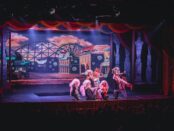
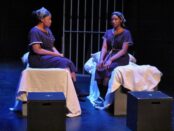
The dynamic and exciting dances include the five elements of voguing: catwalk, duckwalk, hand performances, floor performances and spins and dips in various combinations. The competitions which include almost every song are taken from real ballroom events and the names are appear on the rear wall over the glitter curtain in Brittany Bland’s projection design. These include Virgin Vogue, Pretty Boy, Realness, Body, Bizarre, Opulence, New Way Vs. Old Way, Labels, Women’s, and All American. One razzle dazzle competition is the Tag Team Performance to the song “Mungojerrie & Rumpleteaser” which pitted “knockabout clowns” Jonathan Burke and Dava Havuesca in matching costumes with ballerina Baby as Victoria and gymnastic Bryce Farris subbing for Primo as Tumblebrutus. [more]
Pilobolus: Summer 2024 Season
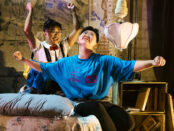
"Memory" brought back “Untitled,” a masterpiece from 1978. This work had everything that made Pilobolus the world class dance troupe it became. Choreographed by Pilobolus founders Robby Barnett, Alison Chase, Martha Clarke, Moses Pendleton, Michael Tracy and Jonathan Wolken, and using disarmingly and misleadingly pleasant music by Robert Dennis, “Untitled” began with two women (Feliz and Klinkman) wearing ornate 19th century dresses as they lay on the ground having a pleasant picnic. (Costumes by Kitty Daly and Malcolm McCormick.) As they rose they slowly grew into giants, their legs clearly those of men. These now eight-foot tall women moved gracefully about soon joined by two fully dressed men (Loman and Langford) who flirt with them. As the two ladies were lowered onto their own legs, their supporters proved to be two naked men (Chaparro and Ellis), a bit of a shock to the audience, softened by the beauty of the two. The two women wafted about blissfully unaware of the four men until the naked men resumed their positions under the women’s skirts as they floated off. This combination of period nicety, nudity and psychology and superb movement made for a hauntingly memorable work. [more]
The Meeting: The Interpreter
Seemingly not trusting the material, director Brian Mertes has used all kinds of stage gimmicks including having the two actors photographed live by a team of three videographers whose equipment runs on a track around one side of the stage while a huge screen covers the second half on which we see the actions of Wood and Curran blown up to one story high. (Aside from the distraction, those who sit in the audience on stage left may find this blocks part of their view.) The meeting at Trump Tower which precipitates the ostensible action is played by the two actors and six miniature (nude!) puppets by famed designer Julian Crouch. At various points the two actors enter a booth in the back of the stage for no explained reason, as if in a session at the United Nations. There is also unexplained dancing and singing that seems to have little to do with the events at hand. [more]

When My Cue Comes
The cast does a beautiful job interpreting their characters. Watson plays Reynaldo as an anxious, emotionally fragile person ready to fulfill their employer's slightest request. Moore imbues Jacques de Boys with the haughty imperiousness of someone who feels his position is one of substance and importance, even if only for a brief moment on stage. Ethridge puts an interesting spin on his Boatswain, giving him a laid-back, almost California surfer vibe. It is not quite what one may expect from a character in a 17th century play but the characterization provides an interesting contrast. Parks embodies the Stage Manager with a flat-affect, matter-of-fact efficiency as expected until she reveals an inner child excited about trying new ways of being. DeBoer gives The Messenger an energy and perspective that delivers the play's central theme by showing the other characters and the audience that it is possible to escape the limitations of a static definition of self and explore the wonders of imagination. [more]
The Sabbath Girl: A New Musical
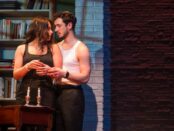
When was the last time you saw a new play in which you cared about the characters and wanted them to end up together? "The Sabbath Girl: A New Musical" is that kind of show. A delightful and charming rom-com adapted by Cary Gitter from his 2020 play of the same name, "The Sabbath Girl" brings together two unlikely people from very different worlds, both at crossroads in their lives. With sensitive performances by Marilyn Caserta and Max Wolkowitz, lovely music by Neil Berg, graceful and emotional lyrics by Berg and Gittter, and a poignant story, The Sabbath Girl is a must-see this summer. [more]
It’s Not What It Looks Like
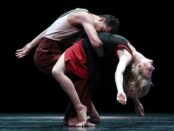
"It’s Not What It Looks Like," is a two-hander, written by John Collins in collaboration with Chesney Mitchell. It is the winner of the 2023 Soho Playhouse Lighthouse Series competition for new plays. The play is a cleverly devised procedural drama that does justice to its title: somebody died, but the how and why are unknown. It is a mystery with which to spend a summer evening. [more]
Bringer of Doom
The play doesn’t tell us enough about any of the characters which gives the actors little to work from. What does Lotte do for a living or is she a trust fund kid? As Lena Drake plays her, she seems totally adrift besides her hatred of her mother. While David Z. Lanson’s Demetrius is described as a professional (albeit failed) comedian, he has nothing to say that is very funny. The jokes tend to fall flat. Asking for drink, Demetrious says, “Anything you’d use on a medieval axe wound is fine.” As the entitled Esme, Laura Botsacos is self-absorbed, egotistical and unsympathetic. However, the author makes us think that she is the wisest one of all as she is usually right. It is she who says “At what point in life do we stop blaming mom?” - a statement the audience must be thinking as well. While James Andrew Fraser’s Clancy at first appears very dense, he does have a large vocabulary and catches many nuances, so he is not as dumb as he comes across on a first impression. [more]
ON THE TOWN WITH THE “LAST OF THE RED HOT MAMAS” AT BUCKS COUNTY PLAYHOUSE
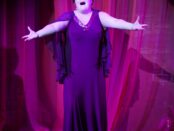
I just got back from the Bucks County Playhouse, which I always enjoy visiting, to catch the world-premiere production of “Last of the Red Hot Mamas,” a new musical about Sophie Tucker. The show’s not ready for Broadway yet. It’s got lots of flaws which need fixing, and I’ll get to those flaws shortly. But—and this is rarer and much more important--it’s also got lots of vitality. [more]
8 Leading Performing Arts Colleges in London
So, this was all about the best-performing arts colleges in the London list. There are many scholarships available for theatre and drama in the UK. Furthermore, you can get in touch with private organisations and other government bodies that offer aid to students. Needless to say, you’ll have to practice a lot to emerge as a successful individual in the field.
[more]
Inspired by True Events
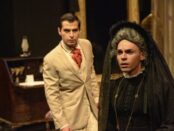
Actor Ryan Spahn’s first play "Inspired by True Events" at the new Theatre 145 (formerly the Ohio Space) is a professional, skillful production. Unfortunately, as a backstage thriller it leaves something to be desired. The first shock does not occur until two-thirds of the way through, making most of the play a simple waiting game for something to happen. What the playwright needs is to study classic stage thrillers like Emlyn Williams’ "Night Must Fall" and Frederick Knott’s "Wait Until Dark" to learn how suspense is built into this genre. [more]
La Viuda (The Widow)
María Irene Fornés’ rediscovered "La Viuda" is a valuable addition to her better known canon. It is a challenging play in that it is basically an 80-minute monologue with other characters in flashback occasionally interrupting Angela’s narration. Director Olga Sanchez Saltveit makes a fine case for this play with a spirited and lively production but she has not solved all of the play’s inherent problems. Performed in repertory with Sam Collier’s "A Hundred Circling Camps," "La Viuda' is a worthy part of Dogteam Theatre Project’s inaugural season. [more]
A Hundred Circling Camps
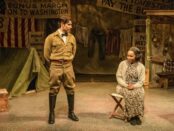
A Hundred Circling Camps, written by Sam Collier and superbly directed by Rebecca Wear, is a story based on the "Bonus March" of 1932. It is more than a play about a historical event. It is also a commentary on the nature of citizens exercising their right to assemble and petition the government to redress grievances, rights established in the First Amendment to the U.S. Constitution. It is a show worth seeing because of its story and the actors' performances. The Bonus March of 1932 was a demonstration by veterans of World War I asking that the financial promises made by the U.S. government be honored in advance of the original payment date of January 1945. The economic situation for people in the United States was desperate during the Great Depression, and the veterans, most with families to support, felt that the money promised would help them survive. [more]
Bill’s 44th
"Bill’s 44th" is a story of loneliness told within the context of a birthday celebration. It is a wordless puppet show for grown-ups created and presented by Dorothy James and Andy Manjuck. James and Manjuck combine to inhabit Bill, a middle-aged man with a belly paunch and a paper-maché bald head with bushy eyebrows, a mustache, and deep, empty eye sockets. His legs are those of Manjuck, and his arms are those of James and Manjuck. It is a remarkable display of puppetry. Their collaboration brings emotional heft to the puppet with actions that are choreographed to perfection. Jon Riddleberger plays a supporting role as a pizza delivery man and later as the puppeteer of a human-sized dancing carrot stick. [more]
Ain’t Done Bad
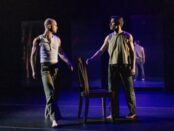
Jakob Karr conceived, choreographed and directed his full-length dance/drama, "Ain’t Done Bad" currently heating up the Irene Diamond Stage at the Pershing Square Signature Center just west of Times Square. It is a courageous, if generic look at the trials and tribulations of a young gay man confronting his inner demons and his hard-as-stone father. [more]
Empire
In "Empire," Caroline Sherman and Robert Hull attempt to tell a very big story but are unable to bring this unwieldy tale into suitable shape. The time traveling framework is both unnecessary and obtrusive. Both the historic characters and the fictional ones are underwritten and there are too many names to keep straight. While the music is catchy, the lyrics are often too unsophisticated and repetitious to make their mark. The cluttered setting and the busy staging don’t help to tell the story. "Empire" is an ambitious but unsuccessful musical which is defeated by its very form. [more]
Clowns Like Me
Ehrenpreis’ "Clowns Like Me" is sad, but true, and with the help of writer and director Jason Cannon, the brutally honest tale finds all the humor that’s possible. Within a very few minutes we are introduced to all the tools to discuss an obvious manifestation of his obsessive-compulsive disorder: cleanliness. Out come the goggles, gloves, cleaning rag, spray bottle and his co-stars Swiffer and Dirt Devil in this elaborate Ginger and Fred dance to clean where the average person would see no dirt. [more]
N/A
Correa who for many years worked for Congresswoman Constance A. Morella knows his way around government and his characters are very convincing. The casting of Diane Paulus’ production is superb and Taylor and Villafañe make excellent sparring partners. The encounters which take place mainly in N’s congressional office that of first Minority Leader and then later Speaker of the House (the same set by Myung Hee Cho) include fast-paced repartee, quips, retorts and wordplay, all worth listening to. You are required to listen intently as the dialogue is fast paced and rapid fire. When we meet them A has just won her first primary in the Bronx and Queens, defeating the Democratic Party candidate that N has supported. In the course of the five scenes of the play, we next meet them when N needs A’s vote to regain the Speakership, while the last scene takes place four years later when the Republicans have regained the House and N is packing up her office, having stepped down from her position as party leader. [more]
A Man Among Ye
"A Man Among Ye" is episodic, with flashbacks and confusing dialogue. It is filled with sword fights, sea shanties, revenge plots, mermaids, witches, and mythical creatures. As a highly stylized dark comedy, it misses more than it hits. Despite the claims that it is based on a true story, it is mostly fiction and fantasy and lacks consistent explication. It needs a more straightforward, consistent storyline, and, in several cases, there is superficial character definition and development. The cast does a respectable job of trying to make sense of a show that doesn't know what it wants to be. [more]
CHIP DEFFAA’S “GEORGE M. COHAN TONIGHT!” RELEASED FOR HOME-VIEWING!
The film of Chip Deffaa's "George M. Cohan Tonight!"--with Jon Peterson reprising his highly acclaimed stage performance--is being released on the day that Cohan always proudly claimed as his birthday--the Fourth of July. "Some folks say that Cohan was actually born on the third of July," acknowledges Deffaa. "But Jon Peterson and I are offering this birthday present for the Father of the Broadway Musical on the day that he chose to celebrate. Happy birthday, George!" [more]
Most Famous Theater Places in The World
Visiting live theater cannot be compared to any other live experience; it's the captivating anticipation before the performance starts and the pure delight when actors immerse you in their story.
Theaters should not be equated with cinemas, as the latter often lack dynamism and are monotonous. Live actor movements on stage, genuine emotions, and unfolding stories right before your eyes simply cannot leave you indifferent. [more]
IN SEARCH OF LOST IRVING BERLIN THEATER SONGS…
Berlin, incidentally, could not write music. He could play piano—not too well, and in only one key. He would play, sing, and hum songs that he created, which a musical secretary would then take down and put into written form for him. The typed lyrics that Shaw saved (with the words “you’re a dumb kop”) may have been typed by Berlin himself or may have been dictated by Berlin to a musical secretary. In any event, the songs “Angelo” and “It Can’t Be Did” have survived only because Lillian Shaw happened to be a “saver.” By contrast, Shaw’s good friend, Fanny Brice, for whom Berlin also wrote special material, was not a “saver.” [more]
cunnicularii
"cunnicularii," beautifully written by Sophie McIntosh and sensitively directed by Nina Goodheart, is a fantasy that deals with many of the adjustments in attitudes and perspectives encountered by new parents. It is a fable focusing on the sometimes overwhelming physical and emotional issues faced by mothers on their first time into the world of motherhood. It is a beautifully realized drama, both funny and serious. If you enjoy good theater, with solid acting, it will be very much worth the effort to see this production. It will only be around for a short time, so make the time to see it. [more]
Ella the Ungovernable
David McDonald has discovered onto an obscure and interesting story: 15-year-old Ella Fitzgerald’s incarceration in the New York Training School for Girls in Hudson, New York, after her mother was killed crossing the street, and her miraculous escape from it. While little is known of her life during this period, McDonald calls his play "Ella the Ungovernable" “speculative fiction.” As co-directed by actress Michele Baldwin (who plays Ella’s mother Tempie, short for Temperance) and the playwright, the play feels a bit long without an intermission. [more]
Isabel
"Isabel" is a story written by reid tang and directed by Kedian Keohan. It uses various stylistic techniques to tell the story of a trans sibling relationship. It has elements of dark comedy mixed within a dramatic arc of psychosexual exploration of gender, all wrapped within a framework of dark mystery but without a clear point of view. The performances are uneven, the “smoke” special effect is distracting, and the staging misses defining the locales of the scenes. The production comes across as more of a dress rehearsal than a fully-realized staging. [more]
The Welkin
It is the first year that Haley’s comet has been predicted. Sally Poppy, trapped in a loveless marriage at age 21, has committed a murder with her lover of a child from a rich family she has worked for. She has been sentenced to death by hanging and then to be anatomized (you really don’t want to know). However, she has declared she is with child. If it is true, she will be deported to America after the child is born. But is it true? Twelve local matrons have convened in an unheated upper room of the courthouse to decide on the truth of her statement, from women who know her to be a liar, to those who pity her hard life, from older women with many children, to young ones about to have their first child, from a gentlewoman down to a simple farmer’s wife. The central character is Elizabeth Luke (played by film and television star Sandra Oh), the local midwife who does not wish to see injustice occur. She has brought Sally into the world but though she doesn’t know her since, she feels that the all-male court has not given her a fair chance. On the opposite side is Mrs. Charlotte Cary, a colonel’s widow who is convinced from private knowledge that Sally is a bad one and could be guilty of any crime. [more]
The Employees: A Workplace Novel of the 22nd Century
"The Employees: A Workplace Novel of the 22nd Century" is a tone-poem play adapted by Lauren Holmes and Jaclyn Biskup from a novel of the same name by Danish poet and novelist Olga Ravn (translated by Martin Aitken). Biskup directs an ensemble of four who portray multiple crew members on a spaceship sent to search for a new planet for the people of Earth. The novel's structure of narrative reports to tell a story about the human condition, the future of work, and the ills of late-stage corporate capitalism does not transfer well to a dramatic stage presentation. [more]
Tomorrow We Love
The play is framed, movie style, by a trial of the leading character, so that the bulk of the play becomes a flashback to what led up to it. However, the show which is occasionally amusing is too dependent on name dropping and 1950’s references: "Leave It To Beaver," "Dragnet," Sputnik, Charles Atlas, Jack LaLanne, Flannery O’Connor, James Bond, Geritol, Jane Wyman, Henny Youngman, "Valley of the Dolls," Jack Kerouac, and quotes from "Damn Yankees," "South Pacific" and "A Star is Born." While the sound design by Morry Campbell is often witty with snatches of the themes from "Written the Wind," "A Summer Place," "West Side Story" and Alfred Hitchcock thrillers, much of the exaggeration is too farfetched without being remotely believable: Farley refers to his ex-wife Lena Horne and claims to have been brought up at The White House by President Calvin Coolidge and his wife. [more]
Introdans: Energy (triple bill)
The Netherlands-based dance troupe Introdans (Roel Voorinthoff, artistic director) exploded onto The Joyce Theater stage in an aptly titled program, "Energy," making a very welcome return to this esteemed home for dance. Although worlds apart stylistically, the first two works, “Kaash” and “Concerto,” were choreographically similar, their form based on repetition of simple themes that gathered strength as each work progressed. [more]
Titanic
The tapestry Stone weaves with his multitude of characters—too many to mention here—is always fascinating in its subtle details. Each person stands on his or her own helped by superb performances by the entire cast under the skilled direction of Anne Kauffman ("Mary Jane" and "The Sign in Sidney Brustein’s Window"). Under her care they all sing magnificently helped by guest music director Rob Berman’s sensitive handling of the Yeston score, directing the large Encores! Orchestra to bring out all the facets of the almost operatic music. [more]
Home
No matter where you grew up, that place always elicits a tangled mix of memories, including sorrows that were often beyond one's control. That's certainly true for Cephus Miles (Tory Kittles), the Black protagonist of "Home" who endures a particularly powerless coming of age in lawfully segregated North Carolina. The play, which earned Tony Award-nominated success on Broadway, in 1980, after a critically acclaimed downtown run, was revived Off-Broadway at the Signature Theatre in 2008 as part of a season-long tribute to the Negro Ensemble Company, the artistic home of "Home" and its author Samm-Art Williams. Sadly, he passed away right before previews began for his sensitive work's current and only Broadway reappearance, a beautiful production that has now also turned into a fitting memorial. [more]
David, A New Musical
"David" now at the AMT Theater is an ambitious Off Broadway musical dramatizing the story of the youth of the hero David, later second king of Israel. It has a bouncy contemporary score by Albert Tapper and a large talented cast. Somewhat indebted to Andrew Lloyd Webber’s Biblical musicals, it is narrated by the older King David on his deathbed to the Prophet Nathan. Most of David’s adventurous exploits take place off stage, while the dramatized scenes are mainly political and dramatic. [more]
Push Party
"Push Party" is a story by Nia Akilah Robinson that reaches into the supportive community spirit that celebrates a woman’s status as a mother, independent of a child or children. It is a story that explores the relationships of a group of friends as they gather to celebrate the impending birth of a new child to one of their numbers, but in this case, a child that has been born but is not yet in the arms of her mother. It would be a relatively simple story if that were the only focus, but Robinson gives something much more with socio-political commentary on the conditions under which pregnant women must endure in a patriarchal society, and most especially, women of color. [more]
Midnight Coleslaw’s Tales from Beyond The Closet!!!
Perhaps "Midnight Coleslaw’s Tales from Beyond The Closet!!!" ’s tagline “an evening of boner-chilling terror” was not meant to be a typo. The premise of an evening of one-act plays that explore queer culture and perspective through (low) comedy and the macabre could be entertaining, if only the end result had enough macabre to fill out the evening. One act gives a truly creepy story of a young couple falling for a chair that appears to be made of human skin with a gender all its own that pleases both members of the heterosexual couple. The second act finds a lesbian couple on the eve of one of them turning her mother over to an assisted living facility. She in turn is haunted by the ghost of her long deceased father as the couple ready the mother’s house for sale. The last act is for the most part a monologue of a gay man that may or may not be celebrating his last birthday on earth. [more]
ON THE TOWN WITH CHIP DEFFAA … AT THE IRISH REP’S TOWN HALL GALA
They’ve created a theater that actors love to work in. And that was reflected by the terrific array of actors (including assorted Tony and Drama Desk Award winners and nominees), who gathered at Town Hall to reprise numbers they’d performed at the Irish Rep over the past 35 years.
[more]
The World According to Micki Grant
Grant’s work is well-known to many, but this intimate, compact little revue featuring four actors, Matelyn Alicia, April Armstrong, Patrice Bell and Brian Davis, is an enjoyable, informative, and intimate love letter celebrating Grant anew. Although known for writing the 1959 single “Pink Shoe Laces” (sung by bobby sox darling Dodie Stevens), and the more visible musicals "Your Arms Too Short to Box with God" and "Cope," the evening’s offerings include many lesser-known works by Grant as well as unpublished songs, narratives, and poems, all demonstrating the broad, deep, and cutting edges of her humor, observation, and thought provocation in subjects running the gamut from love, war, rebellion, and justice. Days later, I’m still singing her two big songwriting numbers from the Stephen Schwartz musical "Working," “Cleanin’ Women” and “If I Could’ve Been” in my head. [more]
Lyrics & Lyricists Series: “Wonder of Wonders: Celebrating Sheldon Harnick”
While most of the songs presented were standards, there were some oddities and curiosities like five cuts songs, one song from a Ford Motor Company industrial show by Bock and Harnick, and two songs Harnick wrote with others, one to his own lyrics. Sperling himself sang three of the five cuts song, starting with Amalia’s song of anxiety before her date with “Dear Friend” pen pal for the unashamedly romantic "She Love Me," “Tell Me I Look Nice,” replaced by the more powerful “Will He Like Me?” (created by Barbara Cook, and sung here by Zavelson). [more]
Party Clown of the Rich and Famous & The Hungry Mind Buffet
There’s so much fascinating material in "Party Clown of the Rich and Famous" and its companion compendium of four short works, "The Hungry Mind Buffet" that it pains me that the works aren’t presented with classier production values, unfortunately a reality in cash-strapped Off-Broadway presentations. Even so, the evening offers much to savor. [more]
Breaking the Story
The dialogue is smart and sophisticated. The author’s unfocused theme seems to be the conflict between Marina and Nikki as to journalistic ethics. Marina believes in reporting the story whatever it is and let the audience decide. Nikki only reports on people and stories she can champion not wanting to give an outlet to evil-minded people. (There is something to be said for both points of view.) However, Scheer doesn’t take this argument very far and drops it quickly each time the two reporters clash without a resolution. The playwright also flirts with the idea that the danger of her work is adrenaline for Marina who couldn’t live without it, rather than just obtaining and breaking the story. Aside from the obvious meaning of the title, Nikki wants to name her podcast on Marina “Breaking the Story: The Life of Marina Reyes.” [more]
How to Eat an Orange
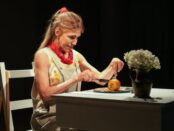
This is the story of Claudia Bernardi, a visual artist and activist, as told in a one-woman show, "How to Eat an Orange." It tells of Bernardi’s time growing up in Argentina in the profound gloom of the military junta and the stories of the “desaparecidos,” the missing ones. It was written by Catherine Filloux, a French Algerian American playwright who traveled to and wrote plays about human rights conflicts in countries worldwide. She brings a first-hand narrative understanding of what Bernardi experienced during and after the time of the junta and her work in other countries with this collection of desaparecidos' stories. [more]
The Opposite of Love
Ashley Griffin’s "The Opposite of Love" is not afraid to tackle questions of sex, intimacy, abuse and suicide. It does so with great sensitivity and delicacy. It is as though the author does not want to frighten off those who have similar problems. However, it is this very timidity that makes the play feel so tame, as though not only are the actors awkward around each other but the author is too coy with her material. However, the actors and the direction always hold our attention even when the subtext is left to the audience. [more]
The Fires
Raja Feather Kelly, an award-winning choreographer of recent Broadway musicals "A Strange Loop" and "Lempicka," as well as "Teeth," the recent Playwrights Horizons success imminently getting a commercial Off-Broadway run, makes his debut as a playwright with "The Fires," a work drenched in sorrow. The play examines three, actually four, Black men who inhabit the same third floor South Brooklyn railroad apartment in vastly different eras: 1974, 1998 and 2021. [more]
Three Houses
Someone once coined the adage, “Write what you know.” For the past few seasons, we have seen many writers have a lot to say about surviving the Covid lockdown, but none so eloquently as Dave Malloy in "Three Houses." Where there is often the sameness in the stories we’ve heard thus far, Malloy chooses to give us three not so disparate individuals each with a particular heartbreaking loneliness. All three tales are prefaced “so this is the story of how i went a little bit crazy living alone in the pandemic.” Where aloneness is ripe for scenes that are maudlin, Malloy setting these tales to music is rapture. [more]
All of Me
Laura Winters’ "All of Me" is a lively rom-com of rich boy meets poor girl much on the lines of 1930’s film comedies. However, the new wrinkle here is that Lucy is disabled using a motorized scooter and a text-to-speech Augmentative and Alternative Communication device to speak, while Alfonso uses a motorized wheelchair and also uses an AAC device to speak as well. Both are independent people though Lucy needs a great deal of help while Alfonso’s wealth gives him staff to take care of his needs. They would seem a perfect fit for each other except that their mothers don’t think so. Ashley Brooke Monroe’s production is spirited and animated. What she cannot overcome in the smart and nimble dialogue is the delay in the response time using AAC devices so that there is an unavoidable pause between the responses in the repartee. Another problem is that though the main characters are played engagingly by Madison Ferris and Danny J. Gomez, the rest of Lucy’s dysfunctional family seems clichéd and familiar. [more]
Winesday: The Wine Tasting Musical
When it comes to coffee klatches, wine seems to be a good substitute, or at least that is the case with the women in "Winesday: The Wind Tasting Musical," with book and lyrics by Jenne Wason and music by Joseph Benoit. It is a show that could leave you tipsy at the end but generally satisfied with the experience. The songs are clever and well-sung by a solid group of five actors, and the book doesn't rely on a straightforward plot but provides a series of entertaining vignettes that help define the characters' lives with details about their ups and downs. Jamibeth Margolis's direction effectively guides the cast to deliver funny, well-integrated performances in a constrained setting. [more]
A Groundbreaking Achievement of Outrageous Importance That People Scroll By, Barely Impacted
Playwright Jake Shore has something serious on his mind but his scatter-shot take on Artificial Intelligence does not make the case. The repetitious dialogue and events only undercut the intended satire. The attempts at humor like “You just make sure to tell the cell phone you’re dating that I’m excited to meet her,” “Love is like … a charcuterie board. All different types of pretzels and cheeses … and crackers,” and “I think I want to triple major in English, Math and Non-human Biologics” are neither funny nor absurd enough to count as satire. The acting and directing style fail to elevate all this to a level of farce or lampoonery. There is a very important play to be written about the dangers of Artificial Intelligence but this isn’t it. [more]
The Rise of Immersive Theater: A New Trend in College Theater Productions
Immersive theater is revolutionizing the way stories are told and experienced in college settings. It not only challenges students to think creatively and adaptively but also enriches their educational journey by placing them within the narrative. [more]
Musical Theater in Colleges: Shaping Social Awareness Through Art
Musical theater at the college level often pushes boundaries, challenging traditional narratives and fostering innovation in storytelling. This creative experimentation is essential, enabling students to harness both creative and critical thinking skills necessary for effective communication. The dynamic nature of musical theater, with its blend of music, dialogue, and dance, offers a powerful means of cultural expression and critique. [more]
Reviving Classic Musicals in College: New Takes on Old Favorites
Discover how college students are reimagining classic musicals to resonate with modern audiences. See how innovation meets tradition in college theater. [more]
Unleashing the Drama: A Guide to Theater Plays Every Student Should Experience
For educators and students alike, "Hamlet" offers numerous avenues for exploration—from its rich language and intricate plot to its deep philosophical questions. Teachers can engage students through interactive performances, critical essays, and group discussions to dissect the layers of Shakespeare’s most introspective work. This approach not only enhances students' analytical skills but also their appreciation for classical literature. [more]