News Ticker
- December 16, 2025 in Broadway // Marjorie Prime
- December 14, 2025 in Broadway // Oedipus
- December 14, 2025 in Interviews // Conversation with Dominick LaRuffa Jr.
- December 14, 2025 in Off-Broadway // The Surgeon and Her Daughters
- December 14, 2025 in Features // A Seasonal Salon Worth Noting
- December 13, 2025 in Off-Broadway // BUM BUM (or, this farce has Autism)
- December 12, 2025 in Musicals // The Faggots and Their Friends Between Revolutions
- December 12, 2025 in Cabaret // Mary Foster Conklin — Mirrors Revisited (50th Anniversary)
- December 11, 2025 in Cabaret // Kathy Kaefer — Kiss Me Once: Stories from the Homefront
- December 11, 2025 in Off-Broadway // The American Soldier
- December 9, 2025 in Off-Broadway // This World of Tomorrow
- December 9, 2025 in Cabaret // A Noel Coward Celebration — Steve Ross & Friends
- December 7, 2025 in Off-Broadway // Diversion
- December 5, 2025 in Off-Broadway // Meet the Cartozians
- December 5, 2025 in Features // Tom Stoppard: An Appreciation
Archive
All the actors in the band play their instruments with panache and perfect period style, including Cott whose piano doodling is terrific. James Nathan Hopkins plays the cute, upbeat saxophonist, Jimmy Campbell; Brandon J. Ellis, the joking teddy bear of a guy, Davy Zlatic, the bassist; Alex Bender, the intensely dramatic trumpeter, Wayne Wright; Geoff Packard, the germ phobic trombonist, Wayne Wright; and Joe Carroll as Johnny Simpson, the percussionist who survived a scary accident during the War.
[more]
Retro Productions’ 50th anniversary revival of Paul Zindel’s "And Miss Reardon Drinks a Little" put the spotlight on an almost forgotten play that is worthy of revival. Shay Gines’ production with a game cast of seven is absorbing and compelling theater with characters that are bigger than life. Paul Zindel’s semi-autobiographical play comes alive in their hands. There may be more theatrical treasures to be mined from his collected plays.
[more]
All the acting is sharp, from the upper-crusters taken in by Paul (Lisa Emery, Michael Countryman and Ned Eisenberg) to their kids (Colby Minifie, Keenan Jolliff, Ned Riseley, and Cody Kostro), Chris Perfetti as Trent who, sexually intoxicated by Paul, fills him in on the ways and means of all the people he will eventually swindle, and finally, to the young lovers (Peter Mark Kendall and Sarah Mezzanotte) whose fate reveals just how psychologically damaging Paul can be.
[more]
Though the printed script, such as it is, is credited to Nel Crouch, Crouch is listed in the program as only the director, and "Fossils" is rather “By” Bucket Club, described as an “associate company.” Such confusion is perpetrated throughout the production: it’s hard to say if, in the end of this extremely low-tech presentation, Vanessa has actually encountered the Monster--and/or her father--or not. "Fossils" is apparently more about what doesn’t happen than what does.
[more]
The two leads David Spadora and Morgan Cowling are charming but that isn’t really enough to carry the show. The script isn’t too kind to their parents. As Big Harry, Lenny Wolpe is overbearing and possessive and as Sherri’s mom Francine, Robin Skye is controlling and possessive. Both are quite convincing and unpleasant – just as the script wants them to be. As the Village Voices, Chavez, Manocherian and Saunders demonstrate tremendous versatility playing all sorts of roles and are excellent singers.
[more]
That this production has such an ideal Sloane puts it into the stratosphere. With his sculpted physique, prevalent musculature and chiseled features that recall the young Malcolm MacDowell (who played the role in a 1975 London revival), Matt Baguth is mesmerizing. Speaking in a whispery, low, lightly accented voice, Mr. Baguth commands attention. Whether wearing Mod clothing or encased in black leather, and a tight white T-shirt, Baguth vividly captures the predatory nature of this youthful interloper with sly conviction.
[more]
"Elliott loves bebop" is a much more satisfying piece than either "Sonerna" or "No slash" on their own. It would be no matter what. But the experience of having listened to the two quartets one after the other immediately before the octet immeasurably enriched the experience of hearing the octet: the octet’s complexities were more intelligible and the patterns of their interconnections were more clear. Without compromising or simplifying the work’s density, its meanings were more accessible.
[more]
Mr. Karl gives a captivating performance that’s a whirlwind of energy, charisma and exceptional singing and dancing. It’s a commanding star turn that cannot quite compensate for the show’s hollowness. When getting dressed in the mornings, Karl’s leg brace was visible at the performance attended. This was the result of an injury that he had on April 14, 2017, while performing, near the end of the show.
[more]
Although the play seems to have something to say about economics and political systems, it is simply a very light romantic comedy making use of elements of change during the Great Depression. Ross’ production is quite proficient and fast-paced, but the characters are generic and we don’t learn much about them. As Lord Kettlewell, Brian Protheroe is the typical crotchety but wise aristocrat, Richenda Carey is most eccentric as the impoverished Lady Knightsbridge, and Lisa Bowerman is level-headed as the previously estranged Lady Kettlewell. Carol Starks’ Mrs. Lancicourt is the manipulative upper-class woman who attempts to dominate all situations. Hugh Sachs is a raisonneur straight out of classic drawing room comedy and would have been as at home in a play by Wilde, Shaw, Pinero or Galsworthy.
[more]
The clarity of this new play by J.T. Rogers does not only rely on the smart yet surefire way it’s written, but also on the masterful staging by Bartlett Sher, who, after recent productions of both "South Pacific" and "The King and I," is no stranger to directing gargantuan shows at Lincoln Center. Given its subject--the Oslo Accord or peace treaty between Israel and the Palestine Liberation Organization (P.L.O.) in 1993--Oslo is ultimately, an enormous play. But it is told in intimate terms.
[more]
The original film is brazen in its guerilla-style filmmaking, a good deal of which was surreptitiously produced right under the noses of the Institution’s officials. To anyone who knows or watched the original 1967 film, James Sewell’s choreographic rendition would seem tame, certainly lacking the shocking visions of naked men abused and humiliated by sadistic guards, ridiculously backward psychologists and a nutritional staff intent on starving the patients. (Images abound of skeletal men wandering aimlessly.) The film begins with the eponymous follies, the men singing and dancing to a bizarre version of “Strike Up the Band” and showing off their other talents, only to quickly descend into a vision of hell on earth.
[more]
The sensational highlight of the concert was a medley from "South Pacific." “I’m Gonna Wash That Man Right out of My Hair” had the luminous Ashley Park euphorically performing that showstopper. Ms. Park was filling in for the previously announced and indisposed Laura Osnes. Female members of The Camp Broadway Kids Ensemble, who were dressed in colorful outfits and sailor caps, wonderfully joined Park. This thrilling production number was representative of Cynthia Thole’s vigorous direction and choreography.
[more]
But the Broadway version of Charlie doesn’t really come alive until we’re introduced to Augustus Gloop (F. Michael Hayne), the fat little German boy who finds the first of the five gold tickets, and whose mother (Kathy Fitzgerald) sings along with him--as wurst links burst forth from his pockets, and the almost always, lively choreography by Joshua Bergasse, suddenly features clogging steps, with dirndls and lederhosen.
[more]
Victor Herbert’s 1903 operetta "Babes in Toyland" was presented by MasterVoices (formerly The Collegiate Chorale), in a splendid concert production, to celebrate its 75th anniversary. Music director and artistic director, Ted Sperling superbly conducted the dynamic Orchestra of St. Luke's, and the terrific MasterVoices choral group, that appeared onstage with them.
[more]
Provocative, startling, and theatrical, "Her Opponent" is a recreation of the 2016 U.S. presidential debates between Hillary Clinton and Donald Trump. The twist is that actors of reverse genders portray them.
[more]
New York City based actress Catherine Russell, has much to celebrate this spring, as she reaches an important milestone in her career – being the first actress in theater history to perform 30 years in the same role. Ms. Russell has played leading lady Margaret Throne Brent in NY’s longest running play, "Perfect Crime," a thrilling murder mystery that leaves audiences on the edge of their seats as they work to piece the clues together. Additionally, this extraordinary actress has expanded her love and knowledge of the industry by taking on many other roles throughout her career -- including general manager, producer, teacher, builder, etc. -- and receives pleasure in a job well done. In fact, it’s key to her success as Ms. Russell credits happiness and fulfillment in your work being the main contributors to good health and well-being.
[more]
Every new play by Annie Baker is a marvel over the play before. It’s been nothing less than a privilege to accompany her on her journey, as she has been joining ranks with the best American playwrights. Part of what makes Baker the “best,” is that she has her own voice. Whether with "Circle-Mirror Transformation," the marvelous "The Flick," or her latest and current, "The Antipodes," Baker seems to devote a certain amount of attention to group dynamics, which is, after all, the basis of any drama. And how can I have left out reference to John, Baker’s play from last year, which was her first as part of her enrollment with the Signature Theater, and arguably the best of all?
[more]
The dialogue of Ileana Alexandra Orlic’s English translation is problematic. Floating around are a few Shakespearean snippets, but otherwise it’s rather stilted. Without much verbal grandeur there’s a prevalent flatness. There’s not a compelling momentum, and so it never really rises above being a curiosity. However, overall this play does somewhat succeed as a spirited condensation, especially for those familiar with the original work.
[more]
The company is in great shape. It’s a difficult task to combine ethnic themes with ballet and modern dance, but somehow Eduardo Vilaro has been succeeding terrifically. His troupe entertains, titillates and even educates (if that isn’t a dirty word).
[more]
Written by the same team that created the musical version of "Grey Gardens" (Doug Wright, book, Scott Frankel, music, and Michael Korie, lyrics) which gave Ebersole the two best roles of her career, the new show is absorbing, elegant and urbane hewing closely to the facts while at times compressing time and offering a few composite characters. Suggested by the joint biography "War Paint" by Lindy Woodhead and the documentary film, "The Powder and the Glory," the musical tells the parallel stories of the rivalry and careers of these two remarkable women from the 1935 to 1964. As they are never reported to have met, Wright’s book for the musical either alternates their lives or uses a split stage effect to show us both at the same time in their own milieu. Occasionally, they lunch at the St. Regis at the same time but avoid meeting each other seated on their own banquettes.
[more]
"Indecent" is, on the surface, the history of Yiddish writer Sholem Asch’s brave Yiddish play "God of Vengeance" which was—incredibly, considering its wise understanding of the Jewish demimonde—written in 1906 during the height of anti-Jewish pogroms. (Asch actually witnessed a pogrom and its ugliness tainted his life thereafter.) It is far more, though. The play is a look at the sweep of Jewish life in the twentieth century using Asch’s creation as the hook.
[more]
Alternating between flavorfully humorous and darkly revealing dialogue, Mr. McLure vibrantly renders his characters’ personalities and motivations. There’s a hilarious analysis of the incompatibility of eating a Baby Ruth candy bar while drinking beer. With this sociological slice of life, McLure has created three strong roles for actors, and this production’s cast plays them with assurance.
[more]
As the ageing matinee idol who never forgets to check his appearance in the mirror, Kline plays a man who is always acting, both on stage and off. His animated physicality in his roles has always been in evidence but here he outdoes himself. Using his arms, hands, head, face and body as his canvas, he is almost never still showing us what can be done on each and every line. He makes even an ordinary line into a witticism and his comebacks wither with every additional jibe. He cajoles, seduces, emotes, wheedles and at the same time suggests he pities himself. He creates a bigger than life character (is John Barrymore his model?) and watching him is a lesson in consummate acting. So completely does he make Garry Essendine his own, you cannot imagine anyone else in the role – although among other New York revivals he has been played by such stars as George C. Scott, Frank Langella, Victor Garber and Coward himself.
[more]
“A really fun mix-tape of some our favorite songs…with no through line,” was how Steven Reineke, the exuberant music director and conductor of The New York Pops, described this delightful tribute to notable singer-songwriters from the past 60 years.
[more]
If this all sounds a bit over-intellectual, well, so is the play. Though the intelligent script may be based on real people, they are forever describing themselves--and each other--in ways that real people never do. Think about practically any play by George Bernard Shaw, and you begin to get the picture. (Archbishop McQuaid even says, “I do find political theory most compelling.”) And although Moore, as director, has done much to compensate for the tiny stage space on which the expansive story unfolds--particularly with helpful projections by Chris Kateff and a cramped but effective set by John McDermott--she isn’t abetted very much by her actors.
[more]
Matthew Montelongo is particularly effective in conveying Mitchell’s anti-marriage convictions, only to make us feel Mitchell’s subsequent anguish. Anna Holbrook is also outstanding as the self-centered Lydia, smartly dressed in Jennifer Caprio’s always dead-on costumes. But it would be an oversight not to also applaud Ryan Spahn as Daniel, Lou Liberatore as Barry, and Leland Wheeler as Trip. If Montelongo and Holbrook somehow emerge as acting victors, it may be because they have, in some respects, the two richest roles. (Mitchell and Lydia duke out their ultimate conflict offstage, in a court of a law.) In an odd way, "Daniel’s Husband" is ultimately the age-old story about THE mother-in-law, which may have given rise to many a comedian’s jokes, but, can often have lethal consequences for any married couple--whether they’ve literally tied the knot or not.
[more]
The dialogue is sparse as various mundane activities are depicted, such as learning to drive, shaving and ordering food from a deli. The infants are played by adult actors. The cast wears matching wigs. Andrea Hood’s authentically simple costume design is comprised of jeans, shorts, trousers, plaid shirts, and T-shirts. The production all has a Thornton Wilder-style quality.
[more]
The play seems to be in the genre of the classic Western movie though highly poeticized and slow-paced. It resembles the 60’s films of Sergio Leone and Sam Peckinpah but with much less plot and without the scenic vistas. It follows the rules of the old West but creates a mysterious world of its own. Very little is revealed by the characters about themselves, most of whose names are generic (the Supervisor, the Messenger, the Drunk, the Cowboy, the Beast). Much could be read into the events but they remain opaque and obscure as do the characters who reveal little. This is a Samara of the imagination, not a real geographic place.
[more]
Presented together on the same bill, "Angel & Echoes" is part of the Brits Off Broadway Festival at 59E59 Theaters (where, it’s worth noting, "Echoes" originally played last year). As written by Naylor, enacted with ferocity and vitality by Avital Lvova, and directed with dispatch by Michael Cabot, "Angel" proves the far more effective (second) half of the evening. That may be because it’s told with an in-your-face immediacy and gumption that elude Echoes, which juxtaposes the lives of two different women, who lived in that region of the world at very different times.
[more]
Thanking his packed audience at Le Poisson Rouge for coming to hear him play, Alam Khan described his music on this evening as a tribute to his father, Ali Akbar Khan, whose ninety-fifth birthday it would have been. But it was more than an ancestral honoring: it was a tribute to a rich centuries-old tradition of Hindustani classical music.
[more]
"Vespers of 1610" is a big and oddly sprawling work. It makes no liturgical sense, and, in terms of texts, has little programmatic unity beyond a consistent Marian devotion. But it is a coherent whole of musical and spiritual experience. It gives the impression of limitlessness, as though there were no end to what Monteverdi could have kept on telling us, precisely because the sacredness and meaning of God’s sacred words are infinite.
[more]
In between the scenes between the two men in Beau’s living room, Rufus records Beau’s reminiscences of his life and times. In this way, Sherman gives us a review of what things were like for gay men from 1940 up to the present, from the stories Beau had been told about the war years to his own personal and painful experiences from 1960 on. Beau’s memories include gay life in New Orleans, New York, San Francisco, Paris and London and cover police brutality and the rise of AIDS. Besides being flattered to be asked to tell his story, Beau also want to pass on his experiences to the next generation who have had its easier. While the play becomes schematic alternating scenes between the two, Fierstein is so convincing in these authentic but surprising tales of the past that it never becomes simply a device.
[more]
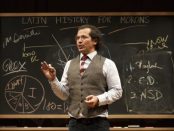
While setting out to “undo” our “whole, entire education” of Latin history--and to compensate for the textbook neglect of the impact of the Aztecs and the Incas on our culture and civilization--Leguizamo focuses on his son’s coming to terms with being the son of a Latino celebrity--namely, himself. Given that his wife is Jewish, and therefore, “very intolerant of intolerance,” Leguizamo never imagined that his “son was going to have to go through the same rite of passage that I did,” he says, at the beginning of this, his latest one-man show, which is filling the seats at The Public Theater.
[more]
«
1
…
74
75
76
77
78
…
114
»
Copyright Jack Quinn, 2001-2023