News Ticker
- December 16, 2025 in Broadway // Marjorie Prime
- December 14, 2025 in Broadway // Oedipus
- December 14, 2025 in Interviews // Conversation with Dominick LaRuffa Jr.
- December 14, 2025 in Off-Broadway // The Surgeon and Her Daughters
- December 14, 2025 in Features // A Seasonal Salon Worth Noting
- December 13, 2025 in Off-Broadway // BUM BUM (or, this farce has Autism)
- December 12, 2025 in Musicals // The Faggots and Their Friends Between Revolutions
- December 12, 2025 in Cabaret // Mary Foster Conklin — Mirrors Revisited (50th Anniversary)
- December 11, 2025 in Cabaret // Kathy Kaefer — Kiss Me Once: Stories from the Homefront
- December 11, 2025 in Off-Broadway // The American Soldier
- December 9, 2025 in Off-Broadway // This World of Tomorrow
- December 9, 2025 in Cabaret // A Noel Coward Celebration — Steve Ross & Friends
- December 7, 2025 in Off-Broadway // Diversion
- December 5, 2025 in Off-Broadway // Meet the Cartozians
- December 5, 2025 in Features // Tom Stoppard: An Appreciation
Archive
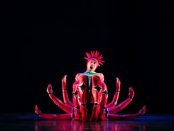
In eighteen short sections, Pendleton and his dancers evoke images of the western deserts of the U.S., using whatever means necessary, be it skateboards, puppetry, classical Indian dance, acrobatics, technological gimmickry or a truckload of imaginative costumes.
[more]
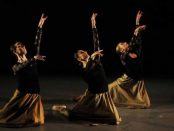
Johnson’s choreographic ethic borders on the minimalistic, repeating some basic movements, particularly certain arm gestures, in all of the works. In two of the three ballets, it works, in one it fails terribly, and in the fourth, it merely comes up short.
[more]
The animated and charismatic Mr. Spitaletta is the standout of the cast, vibrantly appearing in numerous roles. Highlights of his portrayals are a commanding Russian agent spoofing Danny Kaye’s tongue-twisting patter number "Tschaikowsky (and Other Russians)" from Kurt Weil’s "Lady in The Dark," and a rollicking caricature of Richard Nixon. Mr. Spitaletta is an ever-present delight.
[more]
He has updated the play to a contemporary city rife with decadence and corruption. The audience enters the theater from backstage in order to visit Mistress Overdone’s brothel with sex toys and rooms for peep shows on display. Twelve members of the audience sit on either side of the thrust stage, a jury for morality one would suspect. The second act begins in a night club called "The Moated Grange” where Mariana is now a singer with the on-stage band. Six audience members are invited up to sit at the café tables that now dot the stage.
[more]
Told mainly in reenacted flashbacks, In a Word plays multiple language games. It also proves the limits of language. Can you really describe exactly what happens at any given moment? And if you misunderstand a word or take it to mean something else the whole meaning changes. After two years, Guy wants to know what Fiona didn’t tell him on the day Tristan disappeared. Fiona brings evidence to the detective but fails to be exact in her suspicions. Tristan misunderstands things he is not meant to hear and proceeds on his own explanations.
[more]
The play is enlightening for a physically abled audience as to the needs of the disabled both physically and emotionally. Both stories include a tender, poignant bathing scene as the caretakers learn how to adapt to their charges. However, there is more to Majok’s story. Both Jess and Eddie are dealing with their own problems. We discover that Jess is a first generation Princeton graduate down on her luck, all of her family having returned to her native country, never named. Eddie has been a long time alcoholic (which probably wrecked his marriage) and has lost his license and his job after a DUI charge. Ultimately, we discover that Jess and Eddie are coping less well than their charges and adversity is just around the corner.
[more]
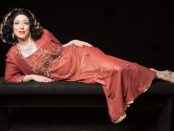
The show also explores Lamarr’s improbable career as an inventor. She and composer George Antheil held a patent for a miniaturized player-piano mechanism that was synchronized with radio signals. They donated it to the U.S. Navy who neglected it. This technology was instrumental to the U.S. Defense Department in dealing with The Cuban Missile Crisis in 1962. Their invention is used today in cell phones, WiFi, CDMA, GPS, Bluetooth and military satellites.
[more]
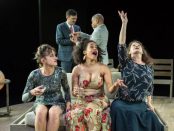
Soon little rends in the fabric of normalcy became apparent. Bits of dialogue are repeated senselessly and the five revelers keep returning to the same positions (three on a couch, one alone at the border of the space and one behind the bar). Attempts at dancing get more and more inelegant, even leading to a bit of physical sparring. Even worse, there is an intermittent ominous, crackling sound emanating from deep in the floor, as if the house were about to collapse.
[more]
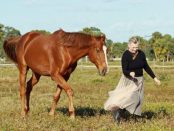
Martita Goshen’s love of horses, one in particular, and nature in general, is a driving force in “Sanctuary,” her gentle and genteel dance recently performed by her troupe, Earthworks at the Paul Taylor Dance Studio. “Sanctuary” is the final section of a three-part work dedicated to the memory of the famous equine, Barbaro, who died tragically after an injury.
[more]
Ms. Bentley has vibrantly coordinated all of the presentational elements into an intriguing 75-minute production with her commanding staging. The present, the past, and inner lives all converge through the flawless unison of movement, dance and stage effects.
[more]
Loaded with many characters and incidents, "Terezin" focuses on two sisters, Alexi (Natasa Petrovic) and Violet (Sasha K. Gordon) who, along with their father, Kurt (Sam Gibbs, playing his complex palette of emotions quite well) and mother, violinist Isabella (Sophia Davey, a calm presence who returns frequently as a spirit) are savagely grabbed by the SS for deportation to Terezin. (One of the shocking first events is the rather realistic strangulation of one of the characters followed soon by the usual vile language—“Jewish swine,” etc.—used by the clichéd glowering Nazis.)
[more]
C4’s last concert of the season was a typical C4 concert. The concert had one intermission; in both halves of the concert, there were one or two pieces that were new to C4 and one or two that they’d performed before. In this concert, there were also three premieres. Some pieces were a cappella; some were accompanied by a somewhat unexpected set of instruments, in this case, electronic … hence this concert’s name, “Electric: Choral works with electrified ensemble.” Almost all of the composers featured were either current or former C4 members; singers conducted each others’ works. Individual singers moved easily between solo parts and “just” being a section member. The extensive program notes were, as always, extremely useful.
[more]
Two likeable people, James (Michael Jinks) and Claire (Bebe Sanders) meet online, have dinner in a local pub owned by Steve (Andrew McDonald) and take the Underground home. That’s about it. Of course, that’s only the basic, very basic, outline. What makes "Underground" a quiet delight is the way van Tricht takes this trite situation and beefs it up with insightful conversation, intriguing situations that border on the fantastic and a clear empathy with her characters.
[more]
I am so happy I got to see my longtime friend Victoria Leacock Hoffman--a very special person; kind, smart, instinctive, and “giving” by nature--honored by the Keen Company in New York City. Artistic Director Jonathan Silverstein presented her with his theatrical company's first annual "Vision Award." The gala celebration, held in a Fifth Avenue penthouse space, was quite a night. There was a lot of love in that room,. expressed via songs and words by Amy Spanger, Molly Ringwald, Monica Lewinsky, Jonathan Silverstein, Kathleen Chalfant, and others.
[more]
By eliminating most of the extended fantasy elements of the play, they reduced the storyline to the domestic turbulence of two couples and a deservedly ugly portrait of Roy Cohn. Add in a visit by the iconic Bethesda Fountain Angel (here totally generic) and some very dramatic, brass-heavy music and you have this intriguing production by New York City Opera that succeeds as an opera as long as one is not familiar with the source material. What seemed heavy going and existential in the original comes across on a much more human level in the opera.
[more]
The Pulitzer Prize-winning Foote (1916-2009) was acclaimed for his cycle of plays that celebrated his native, rural Texas that included "The Trip to Bountiful." In "The Traveling Lady," he characteristically depicts the human condition with everyday conflicts, regional dialogue, and richly delineated and lovingly rendered characters. Those qualities make these vivid roles for actors.
[more]
Betts' "Invincible" has been compared to Alan Ayckbourn’s work. Although there are similarities, particularly in Betts’ ear for capturing the jargon of his characters and his feel for social class distinctions, Ayckbourn’s plays are more delicately constructed and make their points—whether social or emotional—more cleverly than Betts. Even so, Invincible—the title a football reference—is satisfying as both a comedy and a drama, breaking more than a few hearts.
[more]
Ms. Donovan’s enthralling opening sequence sets the tone for the production. Behind the curtains are actors in silhouette with their shadows on view. Other cast members appear to the side of the auditorium and proceed on to the stage. There are numerous gorgeous stage pictures and compelling movement and dance numbers. The play’s infamous violent set pieces are boldly realized.
[more]
Featuring an energetic, game cast headed by bigger-than-life Ashley D. Kelley as the title character, "Bella" follows this “big booty Tupelo girl,” as she travels (under an assumed last name) to meet her staid fiancé, Buffalo Soldier Aloysius T. Honeycutt (handsome, sweet voiced Britton Smith) and to escape the law. She meets a slew of fascinating characters—some who really existed and some fictitious—and finds her life taking a surprising turn in her bumpy road to marital bliss.
[more]
Lazarus’ score is an entertaining blend of rock, pop and show tunes. None of Elvis Presley’s actual songs are heard, but there are a number of clever takeoffs such as “Viva Milwaukee!” and “Spread the Word of Hound Dog.” His good-natured book is a shambles. The serious, campy and satirical elements don’t connect. The plot is crammed and wayward. It recalls the 1960’s "Batman" television show as well as counterculture fantasies such as the 1968 film "Wild in The Streets" and Brian De Palma’s movie, "The Phantom of The Paradise."
[more]
In the play which is billed as “a dramatic verse tapestry,” playwright Joseph Pearce ably weaves together poems and diary entries by Sassoon and Owen with extracts of other writers of the era. Though Mr. Pearce identifies the characters as the English Sassoon and Owen, he provides scant biographical details about them. From this treatment, they could be any British young men of that time.
[more]
"A Hunger Artist" takes morbid subject matter and turns it into a metaphorical look at obsession and human suffering. By focusing on one hunger artist, Luxenberg and Levin manage to make a universal statement that leaves the audience bereft, images of unbelievable suffering lingering long after leaving the theater.
[more]
Bearded, stocky and with that distinctive, wild comb-over of salt and pepper hair and wearing an artist’s smock, Brochu vividly conveys the visual, vocal and personality characteristics of the Broadway legend. For 90 enthralling minutes, he dramatizes and enacts the remarkable life and career of that unforgettable performer.
[more]
The ostensible theme of Sperling’s series of performances at the Baryshnikov Arts Center was climate change. Had spectators not read that in the program they would have come away from Sperling’s performance thinking it was an ode to spring with some cosmic overtones in Huestis’ colorful slide projections of circular forms that evoked the earth, the moon, Mars, stars, subtle earth formations and, of course, clouds.
[more]
Created by the documentarian theatre company Sister Sylvester, "Maps for a War Tourist" was intended to be a biographical exploration of the life of Deniz Karacagil. A former Turkish art student, Ms. Karacagil was arrested three years ago for wearing a red scarf outside. That was interpreted by the authorities as a provocative gesture in support of socialism.
[more]
Ludlam also starred in "Artificial Jungle," his last of 29 plays, which he also directed. It took its inspiration from Emile Zola’s "Therese Raquin," which had already inspired James M. Cain to write "The Postman Always Rings Twice" and "Double Indemnity," each of which became a hit film. Ludlam also set out, with Jungle, to write a crowd-pleaser, and he succeeded with critics and theatergoers alike.
[more]
"Sweetee" is an admirable attempt to depict determination in the face of prejudice in the Deep South 80 years ago. While the cast appears to be older than their characters, they make a valiant attempt to make more out of the material than the show has going for it. Unfortunately, "Sweetee" seems rather thin considering the possibilities inherent in the story line. The score is pleasant but innocuous and unmemorable, always a deal breaker in a musical. Ironically, the most effective musical numbers are the actual interpolated hymns: "Amazing Grace," "This Little Light of Mine," and "Joyful, Joyful."
[more]
Carlo Adinolfi plays John, the performance artist. With his British accent and wiry physicality he has an intense presence but possesses limited charisma. Mr. Adinolfi’s simple but inspired scenic design with its aesthetically arranged white sheets and white bench and white cabinet with wigs provides a compelling landscape for the actions.
[more]
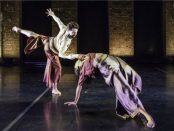
Wearing pale, simple but elegant costumes with small colorful patches around the hips (designed by Sue Julien and Brenner) the dancers in “Soul River/Blues” entered singly at first up a diagonal, almost as if sneaking on. As the dance unfolded they rolled and paused, looking over their shoulders to a score by Ry Cooder and V.M. Bhatt which was a hybrid of Indian classical and bluesy American guitar styles. One man (Aaron Selissen) and four women (Kara Chan, Ruth Howard, Sumaya Jackson and Kristi Ann Schopfer) interacted in slow lifts and groupings that became ever more complex in their angles and internal relationships.
[more]
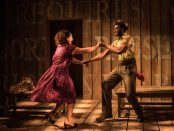
Like in a Noel Coward comedy, the witty zingers come fast and furious: “That her big white Cadillac looks like a pregnant Frigidaire,” “Did you say she was from Newark or Noah’s Ark?”, “Harlem has gotten to be such a cesspool of nobodies,” “You can’t raise a rose in a junkyard,” “The ribbon around your neck is loose. Tighten it.” It also offers some very wise statements on the relationships between men and women: “women grow old from neglect and not from age,” “Regardless of how bad we women look in the morning, Oscar, we never wake up needing a shave,” “She loves the ground he staggers on.” However, the play also makes clear the rivalry between various Black enclaves: Harlem, Brooklyn and Washington, D.C. Dolly, Tillie and Mrs. Pace make pronouncements on the classiness of each.
[more]
The artistic team responsible for this "Butterfly" made radical decisions and changes. Puccini’s original three acts of linear story – love and “wedding,” waiting, betrayal and death – are reorganized and abbreviated into three scenes of waiting, remembered love, and then betrayal. Some minor characters in the original opera are eliminated to create a caste of just five singing characters. The entire orchestra is reduced to a chamber orchestra of just six musicians, the Cantata Profana. The adaptation of Puccini’s orchestral score for this small chamber group by Daniel Schlosberg is remarkable: unexpectedly, its absolute faithfulness to Puccini’s musical intent at almost every turn made up for the diminished number of musicians.
[more]
The show’s writer and host, Rob Berman, introduced many of the songs and, essentially, gave us the story of Lerner and Loewe’s difficult, on-again, off-again partnership. Referring to them, at one point, as an “odd couple,” Berman explained that the composer Frederick (or “Fritz”) Loewe was an “old world” European, and lyricist Alan Jay Lerner a “New York sophisticate,” who was educated in England. Berman also claimed that the common denominator for all of their musicals was a kind of “idealism,” making the pair “dreamers.”
[more]
The goal of their three week Women in Theatre Festival is “a direct response to gender disparity in theatre leadership, casting, and production, the objective of WIT is to broaden the opportunities for women artists, engage with an audience who seek an indie theatre experience, and add to the canon of women playwrights writing roles for women actors.” "Great Again" quite successfully fulfills these commendable aspirations.
[more]
«
1
…
72
73
74
75
76
…
114
»
Copyright Jack Quinn, 2001-2023