News Ticker
- December 16, 2025 in Broadway // Marjorie Prime
- December 14, 2025 in Broadway // Oedipus
- December 14, 2025 in Interviews // Conversation with Dominick LaRuffa Jr.
- December 14, 2025 in Off-Broadway // The Surgeon and Her Daughters
- December 14, 2025 in Features // A Seasonal Salon Worth Noting
- December 13, 2025 in Off-Broadway // BUM BUM (or, this farce has Autism)
- December 12, 2025 in Musicals // The Faggots and Their Friends Between Revolutions
- December 12, 2025 in Cabaret // Mary Foster Conklin — Mirrors Revisited (50th Anniversary)
- December 11, 2025 in Cabaret // Kathy Kaefer — Kiss Me Once: Stories from the Homefront
- December 11, 2025 in Off-Broadway // The American Soldier
- December 9, 2025 in Off-Broadway // This World of Tomorrow
- December 9, 2025 in Cabaret // A Noel Coward Celebration — Steve Ross & Friends
- December 7, 2025 in Off-Broadway // Diversion
- December 5, 2025 in Off-Broadway // Meet the Cartozians
- December 5, 2025 in Features // Tom Stoppard: An Appreciation
Archive
That renowned man of the theater Austin Pendleton’s concept to adapt and combine portions of William Shakespeare’s "Henry VI, Part 3" with Richard III is intriguing and textually successful. The first 40 minutes give background of the English Civil War in the 1400’s, impart exposition, flesh out the motivations of Richard III, and depict his adoration of his father, the Duke of York. This mashup also gives a fresh spin to those only familiar with "Richard III" and there’s plenty of neat stabbings.
[more]
"This Ain’t No Disco" is a compressed, zany look at the years in the 1970s that Studio 54 ruled the social whirl of New York City, complete with debauchery, drugs, loud music, semi-nudity and dancing (brilliantly evocative choreography by Camille A. Brown—herself no slouch with "Once on This Island" under her belt.) The libretto hews closely to the facts about the rise and fall of this mecca of A-list celebrities, including real people—Steve Rubell, Andy Warhol (here called The Artist)—and a host of fictional characters who represent a cross-section of the clientele, from pretty boy bartenders/drug dealers to undercover government agents looking for a chink in Rubell’s armor. The Mudd Club also makes a guest appearance as well as the homes of several of the characters whose mixing and matching drive the play.
[more]
Gardley makes use of a little known piece of American history: while Louisiana was under Spanish and later French rule, it had a three-tiered racial system. Aside from white settlers and black slaves, there was a third class: free women of color (mostly Creoles) could enter into a relationship with white men as common-law wives. Their children could inherit part of their estates. Some of these so-called “colored” women became extremely rich. This system was called plaçage and such women were known as placeés. The lighter the woman’s skin color the higher her social caste. However, when Louisiana was sold to the new United States in 1803, this system was frowned upon and eventually went out of style around 1813 due to legal challenges.
[more]
It’s easy to see why MOMIX is one of the most popular dance troupes in the world. Beauty, strength, ingenuity combine in often ingenious choreography. A generous program of short works that range from raunchy to sensual to dreamy is pulling in audiences at the Joyce Theater where MOMIX regularly plies its colorful wares. The repertoire this season was handpicked from a smorgasbord of several previous programs, but also included a impressive new work called “Paper Trails.”
[more]
The plays in Summer Shorts 2018 - Festival of New American Short Plays have often had a theme running through all the offerings in one evening, however they were concealed or obscured. This year’s Series B is about two-character relationships at a tense moment in their developments, sort of sparring partners as one of the plays calls it. Unfortunately, the plays in this series by Neil LaBute, Claire Zajdel, and Eric Lane all need further work as they are premises rather than finished plays.
[more]
Thanks to the Internet, word tends to get around very quickly about what is being done in theatres everywhere-even in college theatres. Cohen told me, for example, that students at Towson University mounted a production of "Rent" with an unauthorized changed ending; in their revision of "Rent," the character of "Mimi" died at the end. Cohen reflected: "Theatre is sort of self-monitoring. Fans of musical theatre are so passionate that when they see that a show has been changed, they'll quickly say that something is not right here. They may comment in online blogs or on chat boards." And thus, the unauthorized changes to "Rent" very quickly came to the attention of MTI, which licenses "Rent." Cohen added that the director of the Towson University production of "Rent" seemed to imagine she had the right to change the ending of the show-but to him that simply indicated her naivete or ignorance of the law.
[more]
Having added the 200-seat indoor Touchstone Theatre in 2009 to the outdoor Hill Theater with a capacity of 1,089, the season which began on June 14 now runs until November 18. It currently serves 110,000 patrons annually, one of the largest audiences for classical outdoor theater in the United States. Another perk of visiting the neighborhood is to tour Taliesin East, Frank Lloyd Wright’s fascinating private home as well as his school for architects, both of which are only one mile away from the theater.
[more]
Reveling in their grating vocal affectations, gesticulating at a fever pitch or moving catatonically and projecting snarky personas they hold forth on their revered subject in various permutations that are video broadcast without making any impact. This involves interviewing each other, acting out bits from "The Real Housewives" and mouthing the words to scenes from it. Periodically the clips are also on the back wall’s large screen with their images superimposed. Personal asides include discussions of being single, a cold take on pornography and their fabulous lives. At one point, Mr. Breslin sheds his hat to put on a blond wig and women’s clothing to furiously dance in what is supposed to be a tour de force.
[more]

Hence: "My Life on a Diet," a comically rich stroll through her career in TV, theater and film. Written by Taylor and her late husband, Joseph Bologna and originally directed by Bologna, Diet is currently at the Theatre at St. Clement’s where a contagiously comfortable Taylor, elegantly attired (gown by Pol’ Atteu) settles down in Harry Feiner’s kitschy, carpeted set to schmooze with her audience. Taylor, now in her eighties, begins with some self-deprecating humor about aging, after showing herself at various stages in her life.
[more]

In telling the rest of this shattering story, the creators of Comfort Women, inexplicably, rely heavily on musical theater conventions that result in wrongheaded, if not downright offensive, choices. The most cringeworthy is the choreographed sequence of a Korean woman being gang raped by Japanese soldiers. At some point, in their effort to visualize this atrocity, director Dimo Hyun Jun Kim and choreographer Natanal Hyun Kim should have realized that they were, in fact, trivializing it.
[more]

Three actors—Yelena Shmulenson, Allen Lewis Rickman (Velvel in the Coen Brothers’ “A Serious Man”) and Shane Baker (“the best-loved Episcopalian on the Yiddish stage today”)—manage the feat of bringing five of Aleichem’s stories—adapted and translated by Baker and Rickman—to life under Rickman’s incisive and warm direction. Sourcing the original, nitty-gritty shtetl-soaked tales, makes "Tevye Served Raw," if possible, more passionate and involving than the musical.
[more]
Steven Skybell’s Tevye warms up from a salt-of-the-earth, everyday philosopher to the much put-upon tragic existential hero upon whom God—to whom he speaks frequently—has heaped much tsouris. By the time he has lost a third daughter Khavele, this time to a Russian Christian, his interpretations of the songs and his line readings are heart-breaking.
[more]
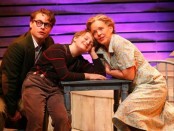
This plotless, mostly sung-through exhibition conveys the tumultuous 20th century urban African-American experience through Micki Grant’s dazzling score for which she wrote both the music and lyrics. “Universe in Mourning,” “Harlem Streets,” “Ghetto Life” and “Billie Holiday Blues” are some of the titles.
[more]

Built in 1904, Dreamland was considered the most elegant and ambitious of Coney Island’s amusement parks--until it burnt to a crisp in 1911. A new play by Rinne Groff, "Fire in Dreamland" is ostensibly about the disaster, in which no humans but most of the animals perished. But to add that it’s set a little more than a century later--in 2013, or some months after Super Storm Sandy wreaked havoc on the east coast--should begin to suggest that there’s more going on here than, unfortunately, ever meets the eye.
[more]
A central concern of the play is detailing Wellington’s five love interests: a white guy he meets at a hilarious Brooklyn vegan party, an Indian young man, an 18-year-old Muslim food cart vendor, his older married agent and the drug dealer he’s known since his California days. Well into the show there’s a rapid bit where each of them enter as Wellington imparts factoids about them and it’s a neat theatrical device that swiftly informs us of the pertinent details. However, previously we’ve spent a lot of time repetitiously going back and forth between these figures. This thread’s deficiency is compounded by the play’s incessant non-linear structure as we get the same basic information over and over in a different order.
[more]
But when things slow down a bit, especially during the musical interludes and longer dramatic pieces, Petosa’s eight performers -- four lead (Christine Hamel; Jake Murphy; Harrison Bryan; and Carla Martinez) and four supporting (Miguel Castillo; Sebastian LaPointe; Olivia Christie; and Ashley Michelle) -- are an absolute wonder, gracefully tackling a head-spinning array of difficult subjects, including xenophobia, social inequality, and infanticide. And thanks to Hallie Zieselman’s bare set, Annie Ulrich’s modest costumes, and Joe Cabrera’s vibrant lighting, they accomplish it all in a decidedly Brechtian way.
[more]

If "The After-Dinner Joke"’s 66 scenes seem cinematic, that is due to the fact that it originally was a teleplay commissioned by BBC for the series "Plays for Today" examining public issues. Churchill chose to deal with the politics of charitable institutions. Selby, personal secretary to the sales manager, decides that she gets no fulfillment from her work and tells her boss Mr. Price that she is resigning to be a do-gooder. Price offers her a job at the same salary working as a campaign organizer raising funds in towns throughout Britain for one of the charities that he has founded.
[more]
Its maddening structure, extraneous scenes and superfluous characters diminish but do not totally obliterate the potency of playwright Jerry Small’s romantic drama, "Before We’re Gone." What could have been a focused and poignant work in the manner of William Gibson’s duologue "Two for the Seesaw" is instead an erratic jumble.
[more]
n what easily could have become a one-man show, playwright Strand has cleverly created dramatic tension by first introducing us to a second character and later a third. Set during the 2012-2013 term of the Supreme Court, the play begins with a lecture by Scalia to a law class where he explains his philosophy of being an “originalist,” that is, someone who interprets the Constitution as it was originally written and understood by its drafters in 1789. This presupposes that it is not a living document that should reflect each era, but something carved in stone which does not change but may need interpretation.
[more]
As the sleek and black-clad Tanya Marquardt vigorously wraps up her self-written 60-minute autobiographical show "Stray," with her giddy dancing and hurling her ponytail around, the aimless first half has been redeemed by the more cohesive second half. It’s been like traveling back in time to Club 57, The Pyramid Club or another of the East Village performance venues of the 1980’s.
[more]
Mr. Gray infuses his straightforward 70-minute interview treatment with tension, suspense and drama. A third character, Norm Hansen is a 60-year-old straight married board member of Pendarvis who is a close friend of Hellum’s. He provides skillful exposition and while present at the discussion stuffily keeps trying to steer it away from personal disclosures. The dialogue is smooth, efficient and dotted with references to figures of that time such as Frank Lloyd Wright, Syrie Maugham and Duncan Hines.
[more]
Street Theatre.
“I’ll be delivering the longest soliloquy from any Shakespeare play,” Mr. de Rogatis explained about the substitution of Richard III’s celebrated opening line for a speech from Henry VI, Part 3 that comes 25 minutes in. “It makes total sense. It’s ten times better. It will show a more vulnerable and innocent Richard who perhaps only really loved his father. After his tragic death that sets him into a very unstable place. That soliloquy gives birth to the Richard III we all know. To compare it to Star Wars, that’s the moment Anakin becomes Darth Vader.”
“I’m not like other actors. I don’t have headshots and I don’t audition. I control my own destiny,” said the burly, soft-spoken but animated New Jersey native about his unique New York City stage career. He took some years off from acting following becoming burnt out by a lack of career progress. The Kean University graduate who majored in psychology had little formal acting training by choice, developing his talent while onstage. Between his theater turns he sustains himself as a bartender.
[more]
The cast list in the program reads more like a medieval phone-directory--even if there were no phones in the Middle Ages--than it does a dramatis personae. And then there’s what happens to the characters during the course of the play which is as hard to say as it is to remember all of their names, let alone pronounce them.
[more]
Rebecca Aparicio’s book is a skillful fictionalization of the true story of Operation Pedro Pan, which facilitated the immigration of over 14,000 children from Cuba to the United States between December 1960 and October 1962. Ms. Aparicio successfully dramatizes the harsh era of the Castro regime, the promise of freedom in the U.S. and the realities of racism, all through a child’s perspective. The incidents are illustrative, historical facts are imparted, and the dialogue is engagingly simple yet effective.
[more]
After establishing himself as one of our finest playwrights with such works as "Killer Joe" and "August: Osage County," Tracy Letts seems to have somewhat lost his way with his more recent "Mary Page Marlowe." Now playing at the Second Stage Theater in New York, "Mary Page Marlowe" premiered at Chicago’s Steppenwolf Theater two years ago. With six different actresses representing the title character at many different times in her life, it essentially relates a single, long life span, in only 90 long minutes.
[more]
Naharin is known for having “invented” a movement language called Gaga. Frankly, I’ve never been able to distinguish Gaga from any other movement palette. If Gaga means disconnected bits of movement utilizing hints of modern, ballet, hip-hop, mime and even ethnic movements, then it’s not particularly original. All these movement vocabularies were on display in “Naharin’s Virus” whose sixteen-member cast was put through their paces for an overlong hour. (The work could easily have been edited down by at least twenty minutes and been more effective, particularly by eliminating a long monologue about a self-abusing young lady.)
[more]
Structured as a series of confessional vignettes, Innit begins in the school psychologist’s office and alternates between there and Kelly’s home. Her 34-year-old mother works at a sandwich shop and is a part-time prostitute. Her absent ne'er-do-well father abandoned the family and went back to his native Ireland some time ago. Money is tight and so is hope. Kelly is combative and doesn’t really have friends. She gets free cigarettes for allowing boys in gym class to take manual liberties with her. The dialogue is earthy, conveying a youthful sensibility with “dick head” being a favored exclamation.
[more]
Though designed as an agitprop exploration with one woman as “Bad” and the other as “Good,” Ms. Brennan's simple yet effective writing elevates it into a quietly powerful work. The dialogue is a skillful blend of mundane details, biographical data and expressions of world views that all strongly delineate the characters. The structure is essentially two women in their 30’s in a room talking. Brennan’s command of plotting injects suspense, surprises and momentum, all combined with emotional resonance.
[more]
Filloux in collaboration with director Amy S. Green have distilled the raw data they gathered into a searing and poignant narrative containing absurdist flourishes that include a talking laboratory mouse. The play is structured as a series of short pungent scenes. Filloux’s dialogue poetically conveys the harsh realities the underprivileged face and their bleak worldview.
[more]
Add to this list Mike Lew’s new witty and clever "Teenage Dick" (being given its world premiere by Ma-Yi Theater Company in association with the Public Theater), both an update and a parody of Richard III now set in Roseland High School. However, while most of these other adaptations just want to demonstrate the contemporary relevance of Shakespeare’s Elizabethan stories, "Teenage Dick" has an additional agenda: does society’s bullying lead to defining the personalities of those with disabilities?
[more]
"Husband" is also receiving a sublime production this summer at the Stratford Theatre Festival in Ontario, Canada, featuring a bubbly Brad Hodder as the “good-for-nothing” Lord Goring, who “leads such an idle life” and often serves as Wilde’s spokesman. There is also a haughty Bahareh Yaraghi as the shrewd Mrs. Laura Cheveley (who knows “such pleasant scandals about all her friends,” while creating some of her own), a no-nonsense Joseph Ziegler as the Earl of Caversham, Tim Campbell as Sir Robert Chiltern and Sophia Walker as his wife, Lady Gertrude. Though she has the lesser role of Lady Markby, Marion Adler also shines whenever she’s on stage.
[more]
Sixtyish Eric Miller is an angry white man, hating Catholics, Blacks, homosexuals, women, and other groups. He has also become very nationalistic. He not only wants to tell the world, he thinks he should act on it. Middle America in the age of Trump? Actually, the same problem appears to be happening in Northern Ireland according to David Ireland’s dark play, "Cyprus Avenue," having its American premiere at the Public Theater courtesy of a co-production by The Abbey Theatre (Dublin) and Royal Court Theatre (London). Problem is for all the sound and fury, Cyprus Avenue, which is a brilliant character study, outlives its welcome long before it is over in this 100 minute play.
[more]
Mr. Kahn’s dialogue is a witty amalgam of up to the minute lingo, well-observed lifestyle data, psychological insights and emotional depth that all realistically and artfully conveys the characters’ Millennial sensibility. Allusions to "Friends" and "Sex in the City" abound, apps are analyzed, real estate is obsessed over and salaries are disclosed. The passage of time is connoted by Claire’s birthdays that flow from one to the next.
[more]
«
1
…
58
59
60
61
62
…
114
»
Copyright Jack Quinn, 2001-2023