News Ticker
- April 7, 2026 in Musicals // No Singing in the Navy
- April 7, 2026 in Off-Broadway // Uncle Vanya, scenes from country life
- April 7, 2026 in Off-Broadway // The Last Audition
- April 2, 2026 in Columns // THE EXPLOSIVE GROWTH OF FILM AND TV PRODUCTION FACILITIES IN THE NEW YORK / NEW JERSEY AREA
- April 1, 2026 in Musicals // Gotta Dance!
- March 31, 2026 in Off-Broadway // Jesa
- March 30, 2026 in Musicals // Monte Cristo
- March 30, 2026 in Off-Broadway // The Unknown
- March 30, 2026 in Off-Broadway // Antigone (This Play I Read in High School)
- March 30, 2026 in Off-Broadway // Antigone in Analysis
- March 29, 2026 in Off-Broadway // Bughouse
- March 28, 2026 in Musicals // The Paparazzi
- March 27, 2026 in Broadway // Giant
- March 26, 2026 in Off-Broadway // Ivanov
- March 25, 2026 in Musicals // Blood/Love
- March 24, 2026 in Off-Broadway // Touch
- March 24, 2026 in Music // The Silent Serenade
- March 23, 2026 in Musicals // The Wild Party (New York City Center Encores!)
- March 22, 2026 in Broadway // Every Brilliant Thing
- March 22, 2026 in Multimedia // Burnout Paradise
- March 20, 2026 in Musicals // Chasing Grace
- March 20, 2026 in Off-Broadway // Entangled: 12 Scenes in a Circle K off the I-40 in New Mexico
- March 19, 2026 in Off-Broadway // Trash
- March 17, 2026 in Concerts // The New York Pops: “United in Sound: America at 250”
- March 17, 2026 in Musicals // Bigfoot! A New Musical
- March 14, 2026 in Off-Broadway // Spare Parts
- March 14, 2026 in Off-Broadway // Zack
- March 13, 2026 in Off-Broadway // Dear John
- March 10, 2026 in Off-Broadway // Our House
- March 10, 2026 in Off-Broadway // Body Count
- March 8, 2026 in Off-Broadway // Chinese Republicans
- March 7, 2026 in Off-Broadway // The Mall The Mall The Mall
- March 7, 2026 in Off-Broadway // The Reservoir
- March 1, 2026 in Off-Broadway // Marcel on the Train
Archive
A farming couple who have been married 50 years go out into their western Kentucky field to watch a lunar eclipse. Nothing much happens but, on the other hand, they review their entire lives. There is little we don’t know about them by the end of the eclipse. Under the direction of Kate Whoriskey, Pulitzer Prize-winner Donald Margulies’ latest play, "Lunar Eclipse," with veteran actors Reed Birney and Lisa Emery is extremely poetic and sensitive about people and their feelings. If you are looking for action, this will not be for you. However, if you think plays should reveal the human condition, then you will be caught up in this very human story of lives lived with regrets but always to the best of their abilities.
[more]
Hassan has managed to raise the strident, repetitive street rhythms and language of rap into an art form that gets to the heart of what ails these three colorful figures. To be frank, the language is often harsh, but just as often poetic.
[more]
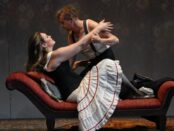
Conducted expertly by Tiffany Chang in a new chamber orchestration by Roland Freisitzer, this three-character opera is inspired by the lush romantic sound of Richard Wagner and Richard Strauss. As the libretto is based on a German prose translation of the Wilde play by Max Meyerfeld, there are no arias per se but the leading character Simone, a Florentine fabric merchant, has many long passages. Artistic director Philip Shneidman who staged the evening has chosen to set it in turn-of-the-last-century Vienna, home to Zemlinsky, rather than Florence in the 16th century as Oscar Wilde’s play is set. This takes a bit of getting used to considering the plot and the subject matter. However, Kylee Loera’s projection design of historical photographs of Vienna city streets and then an art nouveau wallpapered room sets the proper mood for pre-W.W. I Vienna.
[more]
Creating his third outstanding and needed adaptation in conjunction with director Jesse Berger ("The Government Inspector," 2017; "The Alchemist," 2021), Jeffrey Hatcher has salvaged yet another comedy from the classic world theater which has been sorely neglected in the United States. All of these are large cast plays with lengthy speeches that have long needed pruning and updating for contemporary audiences. With Berger’s light touch and swift-paced production, this Molière is not only a delicious treat but a timely satire.
[more]
Smith’s script, which is heartily laden with day-to-day chatter and feels slightly long, still finds perfect opportunities to divulge important messages about friendship, love, empowerment, loyalty, dignity, and perseverance. The play's conclusion is heartwarming, although there is a missed opportunity for rejoicing, when the ultimate success of the strike is written to occur between scenes. Director Awoye Timpo and dramaturg Arminda Thomas expertly weave the energy of the actors and their keenly intentional listening into a compelling tapestry. Though minimal, the opening choreography by Adesola Osakalumi and Jill M. Vallery is striking; this, and the few instances of singing spur the imagination with thoughts of what a great musical could be born from this material.
[more]
Wolf’s direction skillfully manages the emotional tension to maintain the horror element of the story while also paying homage to B-movie scare tactics and tropes. Mulligan uses a device between scenes, featuring brief interludes of Rick and Kim watching scary movies, with Rick displaying fear and Kim being bored. It is an interesting and subtle way of adding definition to the two characters.
[more]
Although Cobb makes references to Iago, Othello’s, second-in-command, and Barbary, the maid to Desdemona’s late mother who brought her up, Nine Moons does not tell us anything we don’t already know from Shakespeare’s play. Since the one thing we are waiting for is Othello’s wooing of Desdemona which will result in their elopement, this does not begin until one hour and five minutes into this 115 minute play. What transpires before that is chit chat about the state of Venice and Cyprus, Othello’s unease in this new city, and Cassio’s army ambitions at odds with his drinking problem, all of which is covered in Shakespeare’s later tragedy.
[more]
If "Chiaroscuro" occasionally falters under the weight of its ambition, it ultimately dazzles with its daring. Rahman has crafted a bold, theatrical puzzle box — part satire, part sermon, part séance — that speaks to the depths and contradictions of Black desire in all its shadowed hues. The play doesn’t just shine a light; it refracts it—casting humor and heartache in tandem. With "Chiaroscuro," Rahman leaves us with a final, luminous testament to her unique voice—both searing and sublime.
[more]
Orpheus’ song—aching, persistent—guides him deep into the Underworld in search of his lost Eurydice. Whether or not you’ve encountered this myth before, Sarah Ruhl’s "Eurydice" invites a new question: not just will they reunite, but should they? The tension isn’t only mythic—it’s emotional, intimate. As Eurydice teeters between the memory of her father and the love of her husband, the audience is left to wonder: can love pull them both from the brink, or will they vanish into the River of Forgetfulness, together yet apart?
This revival, directed once again by Les Waters more than two decades after he first helped bring Ruhl’s script to life, is a poignant reminder that some stories don’t age—they resonate. The production hums with urgency and heart, made vivid by a cohesive, impassioned ensemble that grounds the myth in emotional truth.
[more]
In this Czech play, a 1930s transgender/intersex athlete, long forgotten, is brought back to center stage. Yet one can’t help but be disappointed at how little this play actually has to say about its ostensible subject matter of professional sports, fascism, persecution, transgender and intersex people, or even Zdeněk himself. Excellent directing and compelling performances don’t save a cruel script. Zdeněk never gets his moment to speak. Instead, he rides off into the sunset to be forgotten again.
[more]
The twisty, but clichéd, choreography was not without its clever and eye-catching moments, but try as he might Ramírez Sansano never fully defined the characters, hindered by the equally colorless setting and costumes. The only variation on the relentless white of the ever-morphing pile of white bits and pieces that made up the set were several black-gray-white drops which divided the space and punctuated the action. The painting had clear references to Picasso’s masterpiece, "Guérnica."
[more]
In the title role, Amber Iman makes a sensational return to Off Broadway after her Tony Award and Drama League-nominated performance in "Lempicka" last season. This beautiful statuesque actress brings poise and elegance to the role of the goddess who comes down to earth in human form. Her magnificent singing brings the audience to its feet for her final solo. Austin Scott is a stalwart Omari both in his singing and saxophone playing which also impresses. As the excitable Rashida and Ahmed, Arica Jackson and Nick Rashad Burroughs make a terrific team playing off of each other.
[more]
At an hour and 40 minutes, "Cracked Open" is an earnest but often exhausting theatrical experience. Its heart is unquestionably in the right place—tackling the vital and still-stigmatized subject of mental illness with sincerity—but the journey can feel more dutiful than illuminating. Despite these shortcomings, the cast’s unwavering commitment and playwright Kriegel’s courage in confronting such difficult terrain deserve commendation.
[more]
Now premiering at La MaMa’s Ellen Stewart Theatre in a co-production with the MART Foundation and En Garde Arts, "Seagull: True Story" is a barbed, meta-theatrical cri de coeur from creator-director Alexander Molochnikov, with a script by Eli Rarey. Drawing heavily on Molochnikov’s own experiences, the piece is not a retelling of Chekhov but a searing dispatch from the frontlines of artistic exile. It charts not only the cultural deep freeze imposed by Putin’s regime but also turns its gaze, with mordant wit, on the subtler constraints of the American arts ecosystem. The production skewers both overt authoritarianism and the velvet-gloved mechanisms of Western cultural gatekeeping with equal parts satire and sorrow. Bitterly funny and disarmingly candid, the play asks whether escape from tyranny guarantees liberation—or whether a different kind of captivity awaits on this side of the ocean.
[more]
Six quite diverse works made up the program, four by Parsons and two by guest artists (Robert Battle and Rita Butler) who pushed the dancers to their limits. The guest choreographers worked the company in ways that challenged them after being used to Parsons’ style, which is a witty combination of ballet and modern dance, most particularly the modern dance exemplified by the late Paul Taylor with whom Parsons notably danced for a number of years.
[more]
We get evocative shadow screens, puppetry and a silent-film fantasia. Heartbeat Opera’s two-hour whirlwind adaptation has everything—except an intermission. True to the company’s bold, iconoclastic style, this fiercely distilled staging trades grand opera’s lush orchestra for a lean, expressive band led by artistic director and violinist Ashworth. Brass and reeds give the score grit and immediacy, while the unexpected addition of a harmonium injects a raw, streetwise character—part cabaret, part back-alley prayer. The result? A "Faust" not of gilded prosceniums, but of shadows, sweat, and sharply focused vision.
[more]
And what does it all mean? The new musical takes on pop fandom, celebrity, the Internet, MTV, pop culture, influencers, Gen Z and everything in between. "The Last Bimbo of the Apocalypse" is not only cutting edge but it may presage the dawning of the next kind of musical – which may not be to all tastes. It may also take you by surprise as to how much it pulls you into to its story and investigation of a period a little less than two decades old.
[more]
Unfortunately, The Fire Weeds’ production directed by Jaclyn Bethany (who appears in both plays) is very uneven. An attempt at expressionism handled differently in each does not work for these Tennessee Williams’ plays. While “The Pretty Trap” eschews props for pantomiming, in “Interior: Panic” lighting designer Zoe Griffith has taken the stage direction “the light is normal” and literally bathed the stage in pink-red light periodically to suggest Blanche’s hallucinations. However, this is both distracting and intrusive. Of course, theatergoers are likely to know the longer more famous versions which are more fleshed out and have pertinent information not in the one act versions.
[more]
A scene from the Epic Players’ production of Flaherty and Ahrens’ musical “Seussical” at
[more]
The show at The Players Theatre is not exactly the same show that played in London's West End with book by Shaun McKenna and Steven Dexter which like the original novel was set in San Francisco. Now the show has been reset in New York’s East Village. Unfortunately, this also means Finney’s tribute to silent film stars is entirely missing which is one of the original novel’s strong suits. Additionally, the authors do not make use of the new setting except for a scene under the Queensboro Bridge.
[more]
I don’t like the way the new Broadway production of “The Last Five Years” was directed. But that unique Jason Robert Brown musical—long a favorite of mine--still offers rewards aplenty…. And what a wonderful surprise the Sinatra School’s production of “Tartuffe” was—with a show-stealing turn by one Harrison Gan. I’m currently holding auditions for projects. If any newcomer that talented turns up, I’ll be more than satisfied.
[more]
The show and production is perfect for the chosen venue, a newly opened theater. Director Lori Kee makes excellent use of the intimate space, full of bookshelves that wrap around the room to give a lived-in look that enhances the setting dramatically. Production manager Akash Inti Katakam and prop coordinator Josie Underwood arrange the set so the audience really feels as if they’re casually inside Ruth’s home. The cramped living room, old desk, and well-worn big chair all create the feeling that someone has lived there for decades. Even the books themselves seem carefully chosen to elucidate Ruth’s life and character, from a copy of "The Autobiography of Malcolm X" to tomes on psychology and classical music.
[more]
Scenes progress, and it becomes clear that nothing which happens in Dick and Jane’s house makes a whole lot of sense, and that’s absolutely the point of Leverett’s witty, clever, and smart play. Giving a firm nod to the absurdist playwriting genre first popularized in the mid-1950s, "We Do the Same Thing Every Week" imparts the mindless, repetitive, and boring existence of humankind, which no amount of parlor games, huge vacuums (household or existential), duets, tap-dancing Things, or anthropomorphized cats and fish can overturn.
[more]
"The United States vs Ulysses" by Colin Murphy is a multi-layered play about a seminal case concerning censorship in publishing. The story is set in 1933 in the studios of the CBS radio show "The March of Time." The radio show reenacted recent news stories, including one about the trial of James Joyce’s then controversial novel "Ulysses," but the tapes of it no longer exist. Murphy imagined what that show may have been like, and it forms the framework of the play.
[more]
Groff is simply sensational in both his roles, charming as himself and astonishing in his revelatory Darin. He confesses to being “a wet man.” He proves it with his near aerobically paced performance, which included much singing and dancing and even a touch of beefcake. (Well, if you got it—and Groff got it—flaunt it!)
[more]
Not only is the show authentically written with Spanish sprinkled throughout, (much of it perfectly obvious as to its meaning,) but Sergio Trujillo’s superb production which he has both directed and choreographed, has been cast with an almost entirely Hispanic cast who are utterly engaging. Best is Justina Machado, a Broadway veteran of "In the Heights" and "A Free Man of Color," as the indomitable Carmen who can only imagine one path – though she herself left everything behind in Mexico to come to the United States. Following a close second are Broadway debuting Tatianna Córboda as the feisty Ana who has learned how to run rings around her elders and also debuting Florencia Cuenca as her weary sister Estela who has the weight of everyone’s aspirations on her shoulders.
[more]
Not seen on Broadway since 1982 but racking up 26 productions up to that time since its New York premiere in 1879, the Roundabout Theatre Company’s new version of the Gilbert and Sullivan classic operetta, "The Pirates of Penzance," has been given a delightful facelift: retitled "Pirates! The Penzance Musical" is has now been Americanized and reset in a jazzy 1880 New Orleans by the team of director Scott Ellis, adapter Rupert Holmes, choreographer Warren Carlyle and music director and co-orchestrator Joseph Joubert. The energetic cast is led by Ramin Karimloo as the Pirate King, Jinkx Monsoon as Ruth and two-time Tony Award-winner David Hyde Pierce as Major-General Stanley, backed by a lusty crew of singers and dancers.
[more]
Timing, as they say, is everything in comedy—and in revolution. In "Fat Cat Killers," playwright Adam Szymkowicz delivers more than just a sharp-edged satire of corporate greed—he peels back the glossy veneer of big business to expose the raw, unsettling truths beneath. The play skewers the systemic exploitation of workers, the yawning chasm between executive privilege and employee precarity, and the emotional toll of soulless labor with biting wit and unflinching clarity. But while it aims its critique squarely at the power structures of late capitalism, it doesn’t let its would-be revolutionaries off the hook.
[more]
The play is a nicely developing mystery fantasy story about the paranormal, but when the teenage boy is revealed as the Spirit Child, the show goes off track. The idea presented is that the Spirit Child is the child who would have been born except for the miscarriage. This idea is a stretch in believability for the dramatic structure of the show. It introduces the idea that a consciousness once attached to a developing embryo continues to be attached to the woman who was carrying that embryo even after the tissue has been expelled through a miscarriage. It turns on its head the whole idea of developmental psychology. How is it possible for the miscarried tissue that was not even old enough to definitively determine sex to become a spirit that ages as if it had been born?
[more]
Fast-forward to 2025, and City Center has once again turned to this dependable crowd-pleaser, reportedly as a last-minute substitute for Michael John LaChiusa’s "The Wild Party." The choice makes logistical sense: "Wonderful Town" offers hummable tunes and a quirky, heartfelt book by Joseph Fields and Jerome Chodorov. But under the direction of Zhailon Levingston—whose past work includes "Table 17" and the vogue-infused "Cats: The Jellicle Ball"—this new iteration stumbles. Lacking Marshall’s instinct for the show’s fine balance between earnestness and irony, Levingston’s staging never quite finds its rhythm, veering too far into knowing kitsch and losing the tender charm that once made Wonderful Town feel, well, wonderful.
[more]
"Stranger Things: The First Shadow" concludes with a Netflix joke that, besides being pretty funny, also represents a bit of chest-thumping for the play's outsized number of developers who manage to successfully blur the line between theater and television. Whether that's a good thing is a matter of taste, or a lack of it, but there's no denying that "Stranger Things: The First Shadow," which has journeyed from the West End to Broadway, is exactly the type of experience it wants to be: immersive; scary; and, even if you've never seen an episode of the streaming series from whence it comes, familiar. That's because, imaginatively befitting its source material, the play is a storytelling stew of cultural callbacks that owes a debt--presumably unpaid-- to Stephen King, Wes Craven, and other unsettling shapers of Gen-X childhoods.
[more]
At this vantage point 55 years after its premiere, like the Wilson plays which intentionally cover the previous 100 years, "Ceremonies in Dark Old Men" feels like an historical play wedded to its own time period. Its story and characters are a combination of a Black version of "Death of a Salesman" and a Harlem version of "A Raisin the Sun." Like the story of Willy Loman and his hapless family, the tale of Russell Parker and his two wastrel sons could only have a tragic ending, as their values are so hollow. And like "A Raisin the Sun," the Parker family is so desperate to succeed as Black people in Pre-Civil Rights Era America that they put their hopes in a man that even a child would not have trusted.
[more]
Unfortunately, while the carnival atmosphere in the field above the cave increases, the musical is mostly a waiting game: if and when Floyd Collins will be brought up from the deteriorating cave. The emotions that you would expect as time begins to run out as passageways become either waterlogged or impassible are not in evidence except for Floyd’s father who is more concerned with finances that his son’s life. Floyd himself is often depicted as delirious or depressed so that we don’t get much of an arc of his emotions.
[more]
Wesley Wray (center at microphone) and the company of the Broadway musical “Buena Vista Social
[more]
That balance—between emotional vulnerability and razor-sharp humor—is what elevates "Hold Me in the Water" beyond the sea of solo shows that mine personal experience for applause. Haddad’s artistry lies in his fierce honesty and unsparing introspection. He examines his own longing, joy, and heartache with something approaching clinical precision, yet never loses the pulse of the deeply human. He never asks for pity, and when disappointment inevitably arrives, he extends surprising compassion—even to the one who’s let him down.
[more]
At times the show directed by Stroman seems to be a satire or a parody, while the choreography by Bergasse mostly looks like ersatz Bob Fosse which seems inappropriate for the Marilyn Monroe story. As star Ivy Lynn playing Marilyn, Hurder seems to be doing a Megan Hilty impersonation from the TV series, rather than bringing anything new to the role. (Of course, Hilty is appearing around the corner in Death Becomes Her.) Bowman’s Karen is fine as far as she is allowed to go but the role seems underwritten. Nielsen ass The Actors Studio coach, (compared to Margaret Hamilton as the Wicked Witch of the West) is so unpleasant that you wonder why her character isn’t fired long before it happens in the story line.
[more]
Clarke's direction is uneven, giving the show a rehearsal or community theater vibe. The narrative line is unclear as to whether the main characters are real or a hallucination of one of them. The songs, what few there are, are extraneous to the action, adding nothing of importance to understanding the point of the story. The main characters are Cyrene (Shannon Wong) who is the wife of Caleb (Zachery Michael Shook), a construction manager. According to the play notes they are involved in pushing "the boundaries of love, desire, and intimacy." The major problem with this dramatic idea is Cyrene is a memory of Caleb's dead wife, who is directing him to find new and provocative sexual relationships with other women. The character is a constant presence with Caleb but is not seen by any other person. This dramatic element is hinted at but unclear until halfway through this short play.
[more]
The performers inhabit a shared space that hums with latent connectivity, even in the absence of direct dialogue. Their presence to and for one another—unspoken yet palpable—forms the quiet backbone of the piece. What unfolds is a relentless swirl of Marxist theory and grand philosophical overtures, repeated like mantras against a backdrop of absurdist physicality. Narrative cohesion is eschewed in favor of thematic resonance: a professor marks chalk outlines around a silent woman while students volley fervent monologues; later, those same students offer murmured asides as the professor ascends to a pulpit-like presence. Though no linear thread binds them, their trajectories intersect often and with theatrical charge, forming a constellation of meaning just out of reach.
[more]
Time passes slowly during "Grief Camp" as a bunch of adolescent characters and the audience watching them struggle collectively to figure out the point of being there. Playwright Eliya Smith fails to provide that enlightenment, though director Les Waters does his best to pretend it might be forthcoming, stretching the emptiness of Smith's script until it simply has to be acknowledged. Set in the actual town of Hurt, Virginia, the play's narrative development is mostly in its title and that correspondingly unsubtle location choice, where Smith hazily depicts a sleepaway camp for young people coping with death at an age when life is painful enough.
[more]
The cumulative effect of the four plays is greater than the sum of its parts. The quartet of plays seems to demonstrate Caryl Churchill in a new mode. While the plots are slight, the themes are of major importance and suggest new ways of thinking about them. James Macdonald’s production and the acting of his cast are quite assured even though the plays are mainly non-realistic and require their own kind of suspension of disbelief.
[more]
"minor•ity" is a wonder of a play written by francisca da silveira and skillfully directed by Shariffa Ali telling a tale of clashing artistic egos encompassing issues of Black identity, cultural influences, and financial support. The cast of three leaves no question in the viewers’ minds that what is being witnessed are real people telling a story through their actions, not actors playing roles. There is a message in the name of the show presented in the script but not in the show.
[more]
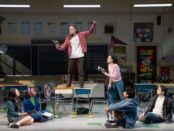
While Belflower’s play is clever and insightful, it is also contrived and manipulative attempting to shoehorn almost every feminist hot button topic into one story overlaying "The Crucible": date rape, sexual abuse, sexual harassment on the job, toxic masculinity, patriarch dominance. It makes all of the male characters look like idiots and all of the women victims which is not exactly a reflection of real life. It also overloads the deck while at the same time copping out in the end. While New York teens are probably much more liberated than those in rural Georgia, the language of the play is incredibly devoid of swear or curse words which usually pepper the speech of adolescents. Finally, it borrows from Ivo van Hove’s 2016 staging of "The Crucible" in which a modern classroom also turns into a telling of Miller’s play.
[more]
However, it is not just the remarkable video design which uses sometimes up to six screens to convey the action of the story plus live action, but we get inside of the head of protagonist Dorian Gray in ways not possible before. Also seeing or hearing Snook as all the characters in different voices is quite a remarkable feat. Andrew Scott only plays eight in his Vanya one-man show, but here Snook also changes costumes repeatedly before our eyes and emerges as someone else. Beginning as the narrator, she slowly becomes Dorian Gray who eventually takes over completely. We also see her as Lord Henry Wotton, painter Basil Hallward, actress Sibyl Vane and later her brother James, the Duchess of Harley, and former friend and Oxford classmate Alan Campbell.
[more]
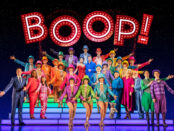
But, top-notch as all of that is, the musical's unmitigated highlight is the Broadway newcomer Rogers as Betty Boop. While the character's trademark look and mannerisms certainly contour Rogers's performance, they do not obscure a wealth of touching flesh-and-blood emotions that all come out in an underwhelming eleven o'clock number, "Something to Shout About," that, because of Rogers, manages to overwhelm. It seems that "Boop! The Musical" has a new star rather than an old one.
[more]
Bringley, making his theatrical debut as himself, delivers a performance marked by restraint and quiet intensity. His words, drawn largely from the memoir, reveal a man of thoughtfulness and delicacy—someone who seeks refuge not in action, but in observation, retreating to the hushed galleries of The Metropolitan Museum of Art, where he once worked as a guard. “You lose someone,” he tells us, simply, “and it puts a hole in your life—and for a time you huddle down in that hole.” It’s in that stillness, that huddling, that the piece finds its quiet power.
[more]
Before he was a Nobel laureate, before his name was canonized in the firmament of world literature, Wole Soyinka was a young playwright—barely in his mid-twenties—when he penned "The Swamp Dwellers" in 1958. And yet, this early work bears the unmistakable gravitas of myth: a compact, hour-long domestic drama that pulses with elemental force. In director Awoye Timpo’s hauntingly grounded revival, the piece reverberates with contemporary resonance. It is at once a family portrait and a parable, steeped in the muddy waters of postcolonial Nigeria and rippling outward into modern-day concerns—climate change, disillusionment with institutions, and the aching silence left by absent gods.
[more]
The Steppenwolf Theatre Company production of Branden Jacobs-Jenkins’ "Purpose" follows on the heels of their magnificently staged "August: Osage County," but unlike that dysfunctional family drama, this play has a great deal to say as well as major themes. Like the title of the author’s "Appropriate," "Purpose" has many meaning all used here at the same time. And never forget how much fun it is to have a private look in at the private lives of a rich and famous (but fictional) family when they are on their worst behavior. Do not be surprised if this play wins this year’s Tony Award followed by next year’s Pulitzer Prize. You can say you heard it here first. While the play is quite long, it is tremendously rewarding as great plays should be.
[more]
Although there are humorous moments, the production doesn't work for various reasons, including characterizations and technical issues with sound reproduction. None of the eight songs are memorable, and the characters do not engage the audience, which is a question of direction and acting. While the performers work hard at portraying their characters, the effect is uneven. Some characters appear two-dimensional, and performances feel like a college or community theater production. The vocals are problematic, with some performances being overpowered while others pitchy. Overall, the show doesn't engage the audience in caring about the characters or their stories.
[more]
Except for a couple of main characters, the people in his life seem to come and go making it a little bit difficult to follow. While the opening of each act is in the form of a Technicolor musical, the limited budget and the staged reading format does not allow for this. Actor Michael Halling is tall enough to represent the 6’4” Hughes but he does not portray his undoubted charisma to have taken the world by storm. There are also many anachronisms as well as at least one scene which is out of order and facts that are inaccurate.
[more]
With one exception, however, Marber's cast of notable wisecrackers treats Mamet's punchy dialogue solely like punchlines, even when they're face down on the canvas. As Shelley "The Machine" Levene, a loser among losers, Bob Odenkirk opens an Act I triptych of two-handers that are all set within a capacious Chinese restaurant, nonsensically designed by Scott Pask to indicate a gigantic establishment apparently getting along just fine serving no more than a couple of liquid-lunchers at a time. On the verge of being fired for bringing up the rear in a sales contest for a shiny new Cadillac--that old-timey signifier of virile American success--Levene tries to sweatily sweet-talk the best leads from Donald Webber, Jr.'s insensate office manager, a pleading effort that quickly devolves into a pathetic attempt at bribery.
[more]
Horwitz and Williams perfectly match each others’ energy on stage. Indeed, at times it seems as if each is trying to one-up the other’s exaggerated mannerisms. In one scene, a famous artist might dip into nonsensical French phrase, only for an interviewer to ratchet it up further by over-emphasizing an accent on a word that doesn’t need it. One might not-so-subtly flirt by bringing up a mutual past lover while the other awkwardly deflects, only spurring on further attempts. Throughout each scene, the pair’s back-and-forth is consistently excellent. They have an easygoing chemistry that makes every scenario feel fresh.
[more]
If only film star George Clooney and his co-script writer Grant Heslov had hired an actual playwright to adapt their acclaimed screenplay for the 2005 film "Good Night, and Good Luck." for the Broadway stage. What worked in close up in the film does not have the same effect on the huge stage of the Winter Garden Theatre. And while David Strathairn as Edward R Murrow in the film, the role now played by Clooney on Broadway, also seemed wooden and unemotional, his every flicker of emotion on his face was telegraphed through the extreme close ups of every frame. With its cast of 22 on a huge CBS studio set, most of the characters are undefined or unidentified. At times it is difficult to know who is talking or where their voices are coming from on the multileveled setting.
[more]
Eric Bogosian’s "Humpty Dumpty" was first written 25 years ago and premiered at the McCarter Theatre Center, Princeton, in 2002. At that time the idea of quarantining due to a local or national disaster seemed a fantasy. However, since then, we have all lived through the Covid Pandemic and what was inconceivable became our daily existence. Not only does Bogosian’s play seem tame now, it also seems predictable and dated. Director Ella Jane New does not help the script much by allowing the vapid characters to all seem one dimensional. Possibly with a satiric approach or powerhouse performances, the play might have something new to say to us as its entitled people show their true colors.
[more]
Jack Serio directs a strong cast of seasoned actors whose personal chemistry gives the ensemble a solidly believable portrayal of their characters. Juan Castano is Edwin, a mid-30s man married to Christian, a man ten years older, believably played by Ryan Spahn. The two men are struggling with issues in their marriage when Margaret enters the picture. Julia Chan is Christian's "girlfriend" from high school. They have not communicated with each other in 20 years.
[more]
The results of this updating are bold, and Andrews’ intellectual ambition is undeniable. At times, his revisions might seem questionable but when the production clicks, it strikes with a thrilling originality. The production pulses with an urgency often missing from more traditional revivals of "The Cherry Orchard," a play about people running out of time. The central conflict remains: Liubov, the bankrupt widow haunted by the ghosts of her past, returns to her family estate for the inevitable sale of the land that defines her family’s history. Practical solutions are needed, but neither she nor her hapless relatives can take decisive action.
[more]
Brian Stokes Mitchell, Andrea Rosa Guzman, Christopher Jordan and Kate Baldwin in the opening scene
[more]
While most of the audience will probably not have graduated in the last ten years (though you never know), the play speaks to all of us about the closeness and personal relationships of our college years. Playwright Natalie Margolin knows how to create tension from hints casually dropped and director Jaki Bradley has created a cohesive cast who could have been together the last four years. "All Nighter" is one of the few plays set at a college that seems to come from the author’s own firsthand experiences.
[more]
The new musical attempts to out Monty Python "Monty Python" by creating a full-length show and story in their style, although its origins also go back to British Music Hall where there is also much cross-dressing (i.e. men playing women and women playing men). Those who love Monty Python will have a great time; those who don’t may find the two hour and 30 minute show heavy going. The show is also Very British and a great many of the jokes and gags don’t land for American audiences. However, the hard working cast is impressive playing many roles each and Robert Hastie’s fast paced direction doesn’t give a lot of time to think about the antics on stage.
[more]
"Remembrance" by Patricia GoodSon is a story about her journey, for more than a decade, in dealing with her mother's Alzheimer's disease. As directed by Joan Kane, it is told from the perspective of a woman working with a therapist to unravel the emotional impact of those years of caregiving. It is not about the impact of the disease on the person with it but on the effect on the caregiver.
[more]
In "Amm(i)gone," Mansoor masterfully delves into the delicate nuances of cultural and personal differences, exploring the connections that bind us even in our diversity. Co-directed with Lyam B. Gabel, this meta-theatrical production—spanning a compact yet potent 80 minutes—recounts the journey of Mansoor and his mother as they embark on the project of translating "Antigone" into Urdu. Surrounded by designer Xotchil Musser’s evocative set of wooden cutouts and intricate mosaics, and serene candles for effect, Mansoor guides the audience through their creative process, blending dialogue, video and audio recordings, and projected imagery to weave a story that is both intimate and expansive. The production’s clever use of multimedia enhances the emotional weight of their shared task, inviting the audience to reflect on the complexities of language, family, and legacy.
[more]
«
1
…
3
4
5
6
7
…
64
»
Copyright Jack Quinn, 2001-2026