News Ticker
- April 8, 2026 in Off-Broadway // Desi SNL
- April 7, 2026 in Musicals // No Singing in the Navy
- April 7, 2026 in Off-Broadway // Uncle Vanya, scenes from country life
- April 7, 2026 in Off-Broadway // The Last Audition
- April 2, 2026 in Columns // THE EXPLOSIVE GROWTH OF FILM AND TV PRODUCTION FACILITIES IN THE NEW YORK / NEW JERSEY AREA
- April 1, 2026 in Musicals // Gotta Dance!
- March 31, 2026 in Off-Broadway // Jesa
- March 30, 2026 in Musicals // Monte Cristo
- March 30, 2026 in Off-Broadway // The Unknown
- March 30, 2026 in Off-Broadway // Antigone (This Play I Read in High School)
- March 30, 2026 in Off-Broadway // Antigone in Analysis
- March 29, 2026 in Off-Broadway // Bughouse
- March 28, 2026 in Musicals // The Paparazzi
- March 27, 2026 in Broadway // Giant
- March 26, 2026 in Off-Broadway // Ivanov
- March 25, 2026 in Musicals // Blood/Love
- March 24, 2026 in Off-Broadway // Touch
- March 24, 2026 in Music // The Silent Serenade
- March 23, 2026 in Musicals // The Wild Party (New York City Center Encores!)
- March 22, 2026 in Broadway // Every Brilliant Thing
- March 22, 2026 in Multimedia // Burnout Paradise
- March 20, 2026 in Musicals // Chasing Grace
- March 20, 2026 in Off-Broadway // Entangled: 12 Scenes in a Circle K off the I-40 in New Mexico
- March 19, 2026 in Off-Broadway // Trash
- March 17, 2026 in Concerts // The New York Pops: “United in Sound: America at 250”
- March 17, 2026 in Musicals // Bigfoot! A New Musical
- March 14, 2026 in Off-Broadway // Spare Parts
- March 14, 2026 in Off-Broadway // Zack
- March 13, 2026 in Off-Broadway // Dear John
- March 10, 2026 in Off-Broadway // Our House
- March 10, 2026 in Off-Broadway // Body Count
- March 8, 2026 in Off-Broadway // Chinese Republicans
- March 7, 2026 in Off-Broadway // The Mall The Mall The Mall
- March 7, 2026 in Off-Broadway // The Reservoir
Archive
Upton’s version solves some problems and creates others. Updated to the 1990’s, the play is no longer about life in Tsarist Russia but the post-Perestroika world of Glasnost. While the original has characters talk about how much better life will be in the future, the new version has the characters wax nostalgic about the recent past but also talk about the challenge of the new Russia in the present. It is not obvious for much of the first scene that the play takes place in the Russian country.
[more]
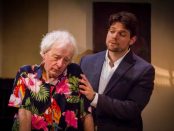
As Paul Harold, a 60ish artist, Pendleton has a leading role that wonderfully showcases his idiosyncratic and considerable talents. With his unruly white hair, limber physicality and distinctive vocal twang, he mines all of the humor and depth of this fascinating character. Sharing the memory of when he met Pablo Picasso in his youth is a vivid moment.
[more]
O'Connell’s script is a well-structured series of confessional anecdotes interwoven with the lore of the movies. His performance is a riveting blend of stand-up comedy and grand stage acting with Shakespearean flourishes. The audience is on three sides of the very small theater. This intimate space at times feels too constrained for the unbridled emotionalism on display.
[more]
In "DannyKrisDonnaVeronica," playwright Lawrence Dial bitingly delves into the lives of two Brooklyn couples each with two small children. Through his precise, often humorous and realistic dialogue, Mr. Dial has his very well-drawn characters who all in their mid 30’s eloquently express their conflicted feelings and despair. Short on actual plot, the play is rich in incident and is a wistful character study.
[more]
The stories included are equal parts humorous, stirring or sobering but always meaningful and intimately personal. Deblinger is a natural storyteller, and every tale is polished and fully developed, and--more importantly--consistent with the show’s overall theme. Further, Deblinger is a fantastic impressionist, and the show contains no less than 15-20 fully realized character impersonations. The versatility he displays is a testament to both his natural abilities as well as his dedication to his craft.
[more]
Mr. Rosenblum’s dense book is a rudimentary and repetitive serio-comic treatment imparting the minutia of that cause célèbre. In 1972, burglars connected to Republican President Richard Nixon’s re-election campaign broke into the Democratic National Committee’s headquarters in the Watergate building complex in Washington, D.C. This resulted into a calamitous scandal and inept cover-up causing a national crisis. Rosenblum’s treatment doesn’t totally succeed at tying together all of its complicated threads.
[more]
Linda Lavin, padded and badly bewigged, comes across more like a Jewish yenta than the victim of the vagaries of Eastern European warfare. She has only one song, “Easily Assimilated,” a silly attempt at seduction, which is a shame. This character had several numbers in the original, including one that actually referred to why she is “missing the half of my backside.” Lavin is a star, but is ill-used here.
[more]
Never before seen on mainland U.S.A, the current show is an amalgam of the four existing shows ("P.F.C. Mary Brown;" "Hi, Yank!;" "About Face" and "OK, USA") of the six that were written. Directed and adapted by Tom Ridgely, co-artistic director of Waterwell, the entertaining show is a co-production of Waterwell in association with the Intrepid Sea, Air & Space Museum under the auspices of the Public Theater’s Under the Radar Festival. Performed on the hangar deck of the USS Intrepid just like it might have been done in 1944 or 1945, the show is a site-specific environmental production with limited scenery but using a combination of Broadway stars and featured players, Waterwell members, Active Duty U.S. military and veterans, and Reserve Special Members. The dance chorus is provided by the Limón Dance Company.
[more]
Set in The Afterlife, a crossroad between Heaven and Hell, the play presupposes a trial of Luther on the grounds of being guilty of “the unforgiveable sin.” The prosecuting attorney is The Devil and the defending attorney is Katie von Bora, also known as Mrs. Martin Luther, with Saint Peter acting as judge. The witnesses called are Hitler on Luther’s anti-Semitism in his later years, Dr. King on Luther’s stance on civil rights, Dr. Freud on Luther’s Oedipus complex, and the current Pope on the Catholic Church’s stance on Luther’s objections today. Along the way, the play also dramatized scenes from Luther’s life. Ultimately, it ends with a recreation of Luther’s trial before the Diet of Worms officiated over by the Holy Roman Emperor in 1521.
[more]
All the choreographers displayed over-intellectualization and overuse of gimmicks, avoiding dealing directly and honestly with their subjects. Homosexuality raised its head in two of the works but was handled superficially. Perhaps, there’s an “Asian sensibility” that eluded me, but the vocabulary used was decidedly Western and has to be assessed in those terms.
[more]
Playwright Beth Hyland’s very effective conceit is that we’re watching the dress rehearsal of Annie Lambert’s memorial celebration in an auditorium of the State University of New York at Onondaga. There, students act out Ms. Lambert’s story in the manner of a Greek chorus often directly addressing the audience. “What would Annie have wanted?”
[more]
While Harms has a fine ear for dialogue, the play moves by revelation and incident. Consequently, it plays like a sophisticated soap opera as every scene brings a new wrinkle not previously suggested. Drew Foster’s direction is smooth and polished but he can’t prevent the play’s plot from having too many incidents that aren’t foreshadowed. Steven Hauck, Elizabeth Rich and Amy Bodnar are charming in a worldly, cultivated way. However, we learn so little about each of them other than how events affect them that they seem one-dimensional. Important facts are left out: what is the rooming situation, are Julian and Agnes married, etc.? The sexual tension is clearly defined: dancing seems to be foreplay to sex. But one can’t live on love alone.
[more]
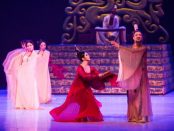
This dance/theater piece is subtitled “Teacher, philosopher, man who shaped a nation,” a rather big theme to dramatize effectively, especially when the mandate is spectacle. Mr. Liu’s barebones, chronological script (consisting of little more than narrative plot advancements and quotes from Confucius) first finds Confucius a defiled presence in the court of the Duke of State (Zhu Yin, zestfully portraying the enervation of over-indulgence) whose evil Minister (Guo Haifeng, zingingly evil) works overtime to frustrate Confucius’ effort. Confucius becomes the love object of and mentor to the Concubine (lovely, floating Tang Shiyi) and, finally becomes the beloved and respected sage.
[more]
In keeping with Sullivan having been hit over the head, the cast is clothed in a motley collection: a combination of late Victorian and Japanese styles. Some are in all Japanese, some in all Victorian, most are in a combination of the two. Even the Victorian costumes have baroque additions to make them look exotic. The women all wear Victorian gowns with bustles open in the back just as though they had not finished dressing. The concept while colorful is quite a mess with every possible variation on stage at the same time.
[more]
Surprisingly, Eleanor Reissa’s production for New Yiddish Rep has made some debatable choices which damage the power of the play. First of all and most obviously, although not a word has been updated, the characters wear contemporary clothing and use modern objects like headphones, a plastic umbrella and platform shoes. Since there are references to opening a horse stable and the sexual mores of 1907 have changed considerably, this is both distracting and confusing. (The word “roubles” has been eliminated for the more innocuous bucks and coins.)
[more]
The real reason to see the new "Sweet Charity," its third major New York revival, is for Sutton Foster’s bravura performance. Aside from nightclub singer Reno Sweeney in Anything Goes, Foster has usually played innocent, clean-cut young women caught up in unusual situations. Here she again plays to type – but with a difference: Charity Hope Valentine works as a taxi dancer in a New York dance hall, a sleazy environment. However, she keeps her infectious innocence and her indomitable spirit despite one unfortunate romantic encounter after the other due to her gullibility. Under Leigh Silverman’s direction, Foster may just be the most convincing actress to ever play Charity.
[more]
It was a Tallis-perfect performance. Palestrina has long been one of the most sure-fire dazzling jewels in the Tallis Scholars' treasury. In writing sacred music, Palestrina made his particular kind of beauty – elegance, intellect, decorous sensuality – a kind of theology of mediation, a meeting place for the human and the divine. The Tallis precision of diction and tone and their ability to reveal every rhythmic and melodic nuance in the music they sing make Palestrina marvelous. The bright acoustic features of St. Mary the Virgin provide a wash of light on the singing.
[more]
“r-Evolution, Dream.” was a jaunty new ballet by Ailey member Hope Boykin to music by Ali Jackson plus narration spoken by Leslie Odom, Jr. which included a Shakespeare sonnet, “A Negro’s Complaint” by William Cowper, “If I Can Help Somebody as I Pass Along” by Alma Irene Bazel, etc. This delightful romp pitted four groups of dancers against each other, occasionally joining forces, particularly in a fleet finale in which the lines interwove and “interbred.” The dancers—including members of Ailey II—were defined by the color of their chic costumes (black, white, purple and green, designed by Ms. Boykin) all led by Ailey veteran, Matthew Rushing whose Pied-Piper performance gave a center of gravity to what might have been a pleasantly disorganized entertainment. Standing out was Megan Jakel whose whirling, undulating solo evoked spontaneous applause.
[more]
Director and choreographer Jessica Burr has created a number of dazzling moments with her precise unison of expressive staging, movement and dance. With only a few vintage trunks and a door, all on wheels, Ms. Burr achieves many vivid stage pictures. Walking up a flight of imaginary stairs is a thrilling display of mime. Burr’s work with the ensemble, most of whom play several roles is excellent with their colorful characterizations as evidence.
[more]
Green’s dry delivery is in the Coward manner, crisp, almost spoken to the music, with impeccable diction. Shrubsole’s accompaniment supports him without ever getting in the way. The most famous song is probably “I Went to a Marvelous Party,” and there are five songs from Coward’s last all-original Broadway musical "Sail Away." However, there are also unfamiliar songs from "After the Ball" (“Something on a Tray”) and" Pacific 1860" (“I Saw No Shadow”), London shows that never made it to Broadway. In addition is “London Pride,” recently heard in the rediscovered post-war musical, "Hoi Polloi." Stand-alone songs include the poignant “There’s No More to Say about Love” and “I Travel Alone.”
[more]
We knew it was a great novel, but who knew Leo Tolstoy’s "War and Peace," Part I, would make such an exciting and innovative electro pop-rock opera? Not that the epic novel isn’t a fantastic read, but how to successfully put this 1,200 page novel on the stage? (Prokofiev’s opera needed 70 characters and 13 sequences.) First seen in 2012 for a sold-out 39 performance run at Ars Nova, this sung-through electro pop-rock opera, was then presented in 2013 at a supper club called Kazino (Russian for “Casino”) in the Meatpacking District, twice the size of the Ars Nova space, built specifically to house the show, and later it was moved uptown to a Kazino put up on 45th Street.
[more]
The Heath, The McKittrick Hotel’s restaurant, bar and music venue, has been dressed up with appropriate signs and objects such as a stuffed wolf to resemble a pub in Scotland. After the audience seat themselves, actors roam around and talk with them. They’re told to rip up the white napkins on the tables into little pieces. Later, they’ll be cued to throw them in the air to simulate a snowstorm for a cool effect. They’re also told that there are complimentary shots of whiskey at the bar where other drinks are sold. During the intermission, the staff offers small ham and cheese sandwiches. It’s all quite atmospheric.
[more]
Two ways to invigorate Shakespeare in our time is to either cast actors not identified with classical roles or to reset the play in some unfamiliar setting. Sam Gold’s magnificent production of "Othello" at the New York Theatre Workshop has done both.
[more]
“The Little Drummer Boy” was an emotionally shattering highlight of Richard Holbrook: "Always December." Mr. Holbrook’s performance of this perennial was revelatory due to the intensity he brought to it. This was performed in tandem with the equally moving “Some Children See Him.”
[more]
Aaron Port (Josh Radnor), a down on his luck writer, is reduced to teaching Adult Ed classes in middle class/middle brow 1960’s Levittown, Long Island. Richard Greenberg ("Take Me Out," "Our Mother’s Brief Affair") in his new play, "The Babylon Line" at the Mitzi E. Newhouse, has Port frequently speak directly to the audience, doling out information and setting the scene, from the vantage point of 2015. Although it’s an awkward device it does come in handy, particularly at the end when a number of plot strands come together. Port’s frustration with his career is exacerbated by having a successful friend, Jay, confront him en route to his teaching assignment.
[more]
The beautiful wreath and garlands hanging above the stage were festively lit up for the wonderful finale, the “Jingle Jangle Sing-Along.” All of the performers appeared and encouraged the audience to join in for convivial group singing of “Rudolph the Red Nosed Reindeer,” “Frosty the Snowman,” “Here Comes Santa Claus,” and “Jingle Bells.”
[more]
Seven musicians of Egypt’s Alexandria Ceremonial Police Orchestra have been sent to Israel to open the new Arab cultural center at Petah Tivah. Due to a mix up at the border, they end up in the dead-end desert town of Bet Hatikva which has no hotel, no culture, and no bus until the morning. However, their visit is the most interesting thing to happen in Bet Hatikva in years as these unlikely visitors represent something different from the outside world. Restaurant owner Dina (Lenk) once a dancer in a big city, now resigned to her boring fate, takes pity on them, feeds them and arranges for them to stay the night in three places including her home. She takes dour, formal conductor Tewfiq (Shalhoub) and young ladies’ man, Haled (Ari’el Stachel). Although the visit is only one night, none of them will ever be the same again.
[more]
The score by Kristen Anderson-Lopez, James-Allen Ford, Russ Kaplan and Sara Wordsworth is a pleasant collection of serviceable songs. Their book, based on their original concept, is a workmanlike blueprint of peppy clichés. It does have topical references such as the Pizza Rat. The show lasts one hour and 40 minutes without an intermission and somewhat lags due to the familiar plot threads.
[more]
For those who could not understand the lyrics of Traore's songs – he sang in Mali's French – each song was an experience of four interconnected musical sounds: the calabash thump and click rhythms, the harmonica, the amplified acoustic guitar, and Traore's voice. The songs' lyrics – love songs, folk tales, celebrations, imprecations – added particular locations and stories to what, all together, was a full, rich exploration of human experience through the lens of the blues, of hard-won wisdom and infinite empathy for joy and anguish, for hope and despair.
[more]
The consistency – the from-the-very-beginning wholeness – of Bach's genius was clear in this chronological arrangement. The kinds of writing techniques and subjects – the sequences and suspensions, chromaticisms and counterpoint intricacies – that Bach transformed from craft common to hundreds of composers to art unique to only a few became, over the years, Bach's vehicles for examinations of all aspects of being human. In this single program, Crawford's choice of music from almost all major liturgical seasons enabled his singers to present grief and joy, despair and hope, prayer and praise. And this they did marvelously.
[more]
Raucous highlights include a jive reinterpretation of A Christmas Carol, “by Chazzie D, about a cat called Scrooge...who lives in Scrooge Tower.” There’s also Buckley’s irreverent take on The Gettysburg Address, “I’m a Lincoln cat.” Intertwined are Broder’s cool renditions of “On The Sunny Side of The Street” and “Georgia On My Mind.” He also demonstrates excellent saxophone and tambourine playing.
[more]
On Beowulf Boritt’s set of three apartment towers of fire escapes and store fronts, the musical begins with a doo-wop group singing a cappella in close harmony under a Belmont Avenue sign, setting a properly nostalgic mood. The musical follows the plotline of the original. The main character, the Chazz stand-in, is young Calogero, first seen as a youngster (a wonderfully unaffected Hudson Loverro) and then as a young man (handsome and passionate Bobby Conte Thornton), whose father Lorenzo (Richard H. Blake, totally believable) is a hard-working, honest bus driver and whose mother is a housewife Rosina (Lucia Giannetta who makes the most of a small part).
[more]
While the visual aid is being projected in the background, a rock concert/spectacle is taking place on stage in front of the screen, and this is--thankfully--more interesting that the latter content. Billy Lewis Jr. is the physical manifestation of Kelly’s Dante; a rock star whose belting is a metaphorical echo of his counterpart’s internal strife. Lewis Jr. is a natural at singing rock music, and his vocal prowess is a saving grace for the production.
[more]
Rockwell who also choreographed has turned each of the songs into an extravagant, go-for-broke production number. Best are Wardell’s “Noel’s Lament” in which he reveals he wants to be Monique Gibeau, a French street walker in black lingerie à la Marlene Dietrich’s Lola Lola, and Misha’s rap number, “This Song is Awesome” which segues into “Talia,” in which he reveals his rage and passion. Rohm’s semi-operatic aria, “The Ballad of Jane Doe,” has her flying over the audience as she continues to sing.
[more]
The audience sits on either side of the large runway stage that set designer Laura Jellinek has arrestingly fashioned into an indoor soccer field. It’s a green vista of Astro Turf that gives the sense “…that the field goes on forever,” writes playwright Sarah DeLappe in her stage directions.
[more]
The title means “sea view,” a metaphor for the fact that his mother’s happiest memories involved being mesmerized by large bodies of water. All the places she felt happiest were by the sea, even—with a stretch of the imagination—the suburb of Mar Vista, L.A., with its wispy view of the Pacific. It was, therefore, dramatically sensible that the final scene should take place on the island off Istanbul where his mother’s family vacationed.
[more]
LeFranc’s dialogue is a marvelous blend of the realistic and mundane. The well-delineated main characters all express themselves with true to life simplicity. Plot developments are the combination of subtle details that gradually do build to a satisfying resolution. It all has the sense of John Cheever’s suburban short stories where the darkness behind bonhomie is revealed. Swimming pools are mentioned in passing.
[more]
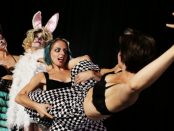
The final sections of this theater/dance work were more effective than the earlier scenes and they included a game show knockoff call “The Price is Right to Be a Queen,” a rigged quiz show which included rather strained audience participation. (Throughout the work the performers zipped into and out of the audience, touching, tweaking and grabbing surprised theatergoers!). The famous “Chess Match” led directly to a totally naked, well choreographed pile-up of bodies reaching for a shiny crown, just out of reach. When Alice grabbed the crown it had a real feeling of triumph.
[more]
"The Big Uncut Flick is a 1953 live, mid-day movie program broadcast on the Dumont network. The audience is addressed as if they were the studio audience. The stereotypical hosts are a married couple. Jack Sheldon is a hyper announcer type and Arlene Lewis is a grand dame. During commercial breaks they extoll dog food, cigarettes, frozen dinners and laxatives. There’s a quiz show portion as well. References to Sen. Joseph R. McCarthy and the Red Scare are also tossed in.
[more]
"This Day Forward" shows much tighter control than many of Nicky Silver’s early anarchic plays. However, aside from offering a few wonderful characters in Malka and the older Irene, the play is disappointing as it sets up expectations which don’t play out. When "This Day Forward" is over, it leaves a feeling of something missing that has failed to take place. It can’t simply be saying that the sins of the parents are visited on the children – or could it?
[more]
There is no plot, just a series of verbal jousts played out on Riccardo Hernandez’ sleek, two-tier set with just the image of trees looming over the actors wearing Montana Blanco’s colorfully exaggerated costumes. From the childlike Prunes and Prisms of Ms. Sithole to the angrily twisted Bigger (a reference to Richard Wright) of Mr. Piniella, the actors recite the difficult lines, goaded to do their finest by director Lileana Blain-Cruz who totally understands the work.
[more]
The real life Internet hacktivist and Reddit developer Aaron Swartz contrives to have his fictional childhood friend Billy, who is a theater teacher of prisoners, to collaborate on a play about Bradley Manning in order to galvanize public opinion in favor of his clemency. During the moving climax, they act out the roles of Manning confronting President Barack Obama.
[more]
Is there a more stunningly beautiful troupe of dancers than the Nederlands Dans Theater? This very international array of performers is not only good looking but dances with thrilling precision and a style that clearly says “company,” thanks to artistic director Paul Lightfoot and general director Janine Dijkmeijer.
[more]
The framework is a fictional fiftieth anniversary party given in a New York art gallery by collaborating media/visual/performing artists Malik “Mk Ultra” (Christopher Livingston) and Jimmy “Primo” (William Ruiz a.k.a. Ninja) to commemorate the creation of both the Black Panther Party and the Young Lords. Their interest is familial: Jimmy is the nephew of Tito (Jesse J. Perez), a former Young Lords Party member still involved with union organizing, and Primo is a “Panther Cub” as he is the son of a Panther member now in prison. They want to pay homage as well as reveal unspoken truths. Malik and Primo have created a video of the many former party members that they have interviewed that they plan on debuting at the event. The party with people who have not spoken for years will be a charged reunion. The troubled legacy of the two organizations is thoroughly explored in the course of "Party People."
[more]
Joined by percussionist John Ferrari and conductor Jeffrey Means, the five members of the Da Capo Chamber Players – Curtis Macomber/violin, Chris Gross/cello, Patricia Spencer/flute, Meighan Stoops/clarinet and Steven Beck/piano – recently presented a concert inspired by the vibrant, important music of Milton Babbitt (1916-2011) on the occasion of the centennial of his birth. One piece was written by Babbitt himself, but all the other pieces, ranging in date from 1981 to 2013, were written by contemporary composers who at one point or another had studied with Babbitt at either Princeton or Juilliard.
[more]
[esc], staged by Penn & Teller, Mr. Barnett, Ms. Jaworski and Mr. Kent, is a Penn & Teller homage to Harry Houdini. To a musical background of pop songs, the performers—Messrs. Fitzgerald Ahern, Banks-Sullivan, Coalter & Loman and Mlles Krystal Butler & Jordon Kriston—were variously locked in an “escape-proof” box (assembled by two audience volunteers), squeezed into a carry-on bag, handcuffed to a 13-foot pole and duct-taped to a chair. Their escapes, accompanied by Penn’s humorous narration were exciting, energetically performed, but, in the last analysis, a bit long-winded.
[more]
It isn’t until the second act of Dan Gordon’s stage adaptation of "Terms of Endearment," based on both the Larry McMurtry novel as well as the Academy Award-winning screenplay by James L. Brooks, that the play takes off. Featuring the now grown-up film star Molly Ringwald in the role of Aurora Greenway that won Shirley MacLaine the 1984 Oscar for Best Actress, the first act jumps around, skipping huge chunks of time as you can in movie cutting, but seems like something is has been left out on stage.
[more]
Watching these three actors is an incredible experience. As Willie, the slower, funnier tea room worker, Sahr Ngaujah, often the butt of the jokes, never loses his humanity. Noah Robbins finds all the complexity in the adolescent Harold, and Leon Addison Brown makes dignity palpable and believable as Sam.
[more]
Besides guiding these engaging performances, director Christopher Martin has meticulously staged the action on the arresting minimalist set that he designed. The floor and brick walls are white. There is a small black rug on the floor near the two plush black cube chairs. Red leaves are strewn about and there’s a pile of them as well. In view are the theater’s windows, an air conditioner and a shelf with a coffee service and drinks.
[more]
Moore’s adaptation successfully uses the small, recently renovated stage of the Irish Repertory Theatre so that even with 13 actors the performance area always looks populated with the people of Rainbow Valley. James Morgan’s clever unit set is redolent of the South with its huge live oak draped above the stage. Mary Jo Dondlinger’s lighting is redolent of the warm southern sun as well as the cool evening moonlight. The four piece orchestra sits neatly tucked in the back of the stage without distracting from the performance.
[more]
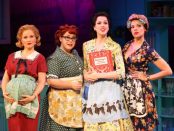
During the first half of the 20th century, the perception of women and their place in society was archaic and harmful to say the least. In fact, it wasn’t until the late 1950’s that the widely accepted oversimplification of the role of women was truly called into question and brought under scrutiny. Documenting the influential and crucial decade between the ‘50’s and ‘60’s, Debra Barsha and Hollye Levin’s new musical "A Taste of Things to Come" is a very pointed yet enjoyable exploration of these transformative years for the housewife, told through the eyes of four women who have a common interest in cooking.
[more]
"Man in Snow" begins and ends in tragedy. In between there is an insightful, sometimes banal, study of a middle-aged man, David (an awesomely complex Will Lyman), his bumpy relationship with his wise wife, Franny (Sandra Shipley, whose even-handed façade hides deep emotions), his daughter Emily (lovely, bright Ashley Risteen) who harbors grudges that pore out at the most unfortunate times and his beloved son Joey whose death in a car accident opens the play.
[more]
Musical numbers are catchy and silly while sharing important life lessons. “What Are Friends For” and “All Alone” examines feelings of sadness, loneliness, and finding your tribe no matter your family circumstances. You may not be able to choose your family, but these babies will always have each other’s back. The emotional ballad, “We Will Get through This,” tugs at the heartstrings and is sung beautifully by Mallory. The scenic and lighting design by Josh Iacovelli brings light and warmth to the space with minimal props as not to distract from the group dynamic on stage – while ensuring that the babies are comfy and cozy in their distinctive onesies.
[more]
Mr. Irving has an amazing singing voice that soars from octave to octave. His witty songs include a funny one about texting. He tells an epic story about his parents meeting. His musicianship is tremendous as he plays banjo, bouzouki, shruti box, mbira, jew's harps, whirly tube, scacciapensieri, and the ocean harp during the show. He does a wild dance to America’s “A Horse With No Name.”
[more]
That sequence is just one of the highlights of John Doyle’s commanding direction. Best known for his vibrant minimalist approach to musicals, Mr. Doyle brings that precise and visually expressive focus to this play. The cast of ten is expertly placed and moved around the relatively bare and spacious stage creating tension, excitement and striking tableaus that all connect to the story. There are also many presentational flourishes.
[more]
In this smart, clever version of the story, Iago, slightly uptight longtime member of Othello’s crew believes that he is not appreciated when newcomer Cassio, a much happier rapper who just enjoys performing gets more notice from Othello. As in the original, Iago plots Othello’s downfall by making him jealous, hinting that Cassio was romancing Desdemona, Othello’s love. Roderigo, the nerdy techie, with a lisp and a heavy heart, also yearns unrequitedly for Desdemona.
[more]
Though the premise is an interesting device for dissecting the friendship between two men--for surely many men are curious how they are perceived by their better halves (self included), the play doesn’t aim to say much otherwise. Acting choices, pacing and thematics are all appropriate thanks to Lee Sunday Evans' seamless direction, but it’s the script itself which is the production’s biggest hurdle. Though there are some interesting and engaging ideas presented regarding the mind of the male, the untidy and nondescript ending make no attempt to make any significant statement about any of it, ultimately shrouding the entire production in a veil of murky, middle-ground mediocrity.
[more]
“He” and “She” are a 40ish upper middle class couple who divorced ten years earlier following the traumatic death of their young son who was hit by a car. Due to toxic waste from a nearby gas factory, 200 graves, including their son’s will have to be dug up and the remains reinterred elsewhere. This unpleasant circumstance instigates this reunion after a long estrangement at a cemetery in Holland.
[more]
The actors make the characterless space come alive. Elizabeth Van Dyke (Zora Neale Hurston) shrouds Zora with the same purity and authority that she conveyed in the 1998 production. Zora never pandered to convention -- Harlem Renaissance beliefs (Langston Hughes or Richard Wright) or white America politics. Zora walked her own path and was unwaveringly true to who she was and her ideas about art, politics, men and women, academia, and Black culture. Van Dyke towering performance is one that depicts Zora's all these character traits, as well as having a vulnerability and zest for life.
[more]
There were a number of fine performances on the stage. But the performance I enjoyed the most was given by the fellow who, I noted last year, gave the most commanding performance of any fellow I’d seen star in a college musical production anywhere in recent years, Michael Caizzi. I’d likened him to a young Zero Mostel when I reviewed his performance in “Fiddler on the Roof” at Hofstra a year ago.
[more]
«
1
…
44
45
46
47
48
…
64
»
Copyright Jack Quinn, 2001-2026