Archive
The acting isn’t detailed or expansive enough to make Leaf’s words come alive or give the slightest notion of the intelligence of these three. Ms. Dobbins’ McCarthy is far too girlish. Yes, the playwright’s point is to show how even an intellectual can be seduced by a good-looking person, but she never boils over. The closest to anger she achieves is petulance. [more]
Linda
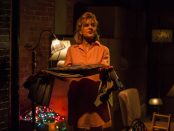
A revolving stage permits set designer Walt Spangler to depict, with dead-on realism and dispatch, not only Linda’s home--including an upstairs bedroom, which her daughters share--but also various offices at Swan Corporation, among numerous other sites. After a certain point, the dizzying, rotating stage becomes akin to a swirling merry-go-round, as director Lynne Meadow has it turning and turning, with different characters walking on and off, and through different doors, without any dialogue whatsoever, in subdued but effective lighting by Jason Lyons. It all becomes part of the accelerating gallop of the play itself, which ultimately spins out of control, as Linda learns that she’s lost her--well, let’s just say, in the end, everything. [more]
The Gravedigger’s Lullaby
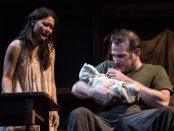
Playwright Jeff Talbott offers an overall well-written and plotted social drama that detours into a strident political battle over capitalism. The sympathetic characters are trapped by their circumstances, as well as by Mr. Talbott’s rudimentary scenario. [more]
Villa
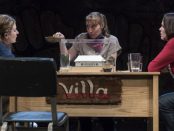
Chilean playwright Guillermo Calderón constructs a simple, engrossing and often funny scenario. Three women, all named Alejandra, have been selected as members of a deliberative, special committee from a larger body who could not reach a decision over a searing national issue. There’s suspense, shocking revelations and Survivor-like machinations. [more]
Composer Portraits Series: Misato Mochizuki
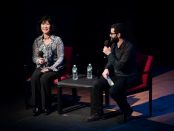
Neither a “Western composer” nor a “Japanese composer,” Mochizuki hasn’t sought to manufacture some sort of mix-and-match blend. She doesn’t borrow or build add-ons. Instead, seeking inspiration in nature on the one hand and in human projects as diverse as photography, genetics and cooking on the other, she produces music that is about both being and story. Embedded within every piece one beginning after another, her stories unfold from each; then she builds them into each other. Though she incorporates elements of theater in the use of lighting and musicians’ movements around the stage, her music is fundamentally unpretentious and unfussy; her writing is equally straight-forward and optimistically fresh. [more]
Book Review: “The Actor Uncovered: A Life in Acting” by Michael Howard
Mr. Howard is eminently qualified to hold forth on the subject, having been a prominent New York City acting teacher for over 60 years. Concurrently with an active theatrical career, he studied with Sanford Meisner at The Neighborhood Playhouse, and with Lee Strasberg as a member of the Actor’s Studio. In 1953, he founded The Michael Howard Studios. [more]
The Penitent
Perhaps because Mamet-regular Jordan Lage is so effective as Richard, the scenes between Charles and his own attorney prove the most effective. While Laura Bauer’s sensible costumes do all they can to make her seem real, Rebecca Pidgeon proves robotic as Kath, detracting from her character’s constant bewilderment. (Come to think of it, maybe it was a stylized choice for playing the part, because of Kath’s befuddlement and uncertainty, at every turn.) The last scene is set in a rehab room, where Kath has been confined, following a mental collapse or nervous breakdown. [more]
The Skin of Our Teeth
Thornton Wilder’s "The Skin of Our Teeth" with its benign belief in the resilience of the human condition is unlike any other American play you are likely to see. Both heavily influenced by earlier European experiments in theater, it is also influential in itself. While Arin Arbus’ production for Theatre for a New Audience at times seems as though it need tighting up, it is a play that must be experienced in the theater which is why it has never been turned into a Hollywood movie. Go and see for yourself what only the live theater can do to expand your imagination. [more]
Nibbler
Urban may have an admirable mission, in attempting to document the customary passage from youth to adulthood--or high-school to college, to be more precise--as he focuses on five graduating seniors in a middle-class suburb, in 1992, when one of them, Adam, remains behind, without any prospects for a glorious future. But the otherwise realistic play that unfolds quickly veers into surreal territory, as an alien from another planet enters their midst, and the eponymous “Nibbler” becomes ever more real a presence on stage, via a puppet, manipulated by several of the quite visible cast-members. [more]
Nihon Buyo Dance by Geimaruza
Three musical pieces displayed the instruments on which the music is made. “Nagare (Flow)” was played on two shamisen (stringed instruments) by Touon Minamidani Mai and Touon Sakata Maiko, completing in ever faster, improvised sounding, themes, all based on traditional melodies (kind of like a gentler version of “Dueling Banjos” from Deliverance). “Toki (Japanese Crested Ibis)” featured a long fue (flute) solo by Tosha Suiho, whose passionate musicianship was overwhelming. The third work, “Shishi (Lion)” combined all the different percussion instruments and the flute to great dramatic effect. [more]
Messenger #1, A New Ancient Greek Tragedy
In addition to the swiftness of the storytelling and the use of contemporary language, Jackson uses a sort of upstairs-downstairs approach. Aside from what is happening to the royals, we also see everything from the point of view of the three messengers. The messengers deliver their reports to us the populace, interact with each other, and interpret for us how the events of their world affect them. They also work as the chorus but each has something different to reveal rather than speaking in unison as in ancient Greek drama. Jackson has tweaked the legend somewhat which makes his version all the more surprising and absorbing. [more]
Kid Victory
It would be difficult to imagine anything darker than the content of the second musical collaboration by John Kander and Greg Pierce having its New York premiere at the Vineyard Theatre. Possibly Kander’s own"Cabaret" or "The Visit" - but both take place long ago and in faraway lands. Kid Victory relates the tale of a 17-year-old youth who was kidnapped for a year and has returned to his Kansas family. All the members of the community want to behave as though nothing has changed but for Luke Browst nothing is the same and things can’t go back to the way there were before. [more]
All the Fine Boys
Playwright Erica Schmidt has a minor aptitude for believably snappy dialogue, but not much else. Her tired scenario is astonishingly familiar and offers no fresh insights. That adolescence is tough is about all there is. That territory has been mined in John Hughes’ films and numerous television shows. There was also the 1985 movie "Smooth Talk," starring Laura Dern and Treat Williams that was based on a Joyce Carol Oates short story. [more]
Louisiana Purchase
Based on a story by lyricist/bookwriter/producer B.G. DeSylva (“Good News,” “The Best Things in Life Are Free,” “The Varsity Drag”), this musical satire sends unworldly, teetotaler Oliver P. Loganberry, “the Watchdog of the Senate,” to New Orleans to investigate the corrupt dealings of the Louisiana Purchasing Company run by Jimmy Taylor, Colonel Davis, Junior Davis, Dean Manning of the university, and Captain Whitfield of the city government. Jimmy, the president of the company, who was out of town when the others used his powers of attorney for their illegal scheme, is left to sort out the mess. [more]
Everybody
The original was aimed at an audience that most certainly was illiterate, so that the clever creators used cartoonish, unsubtle characters who spoke in popular jargon, even spouting profanity, which must have tickled the medieval audiences’ sensibilities and kept them following the actors in their juicy parts. Jacobs-Jenkins follows suit, but with his tongue firmly in his cheek, writing his characters, particularly Stuff (played with a no-nonsense, “from the block” insouciance by Lakisha Michelle May), as immediately recognizable twenty-first century caricatures. When cutie pie child Lilyana Tiare Cornell, playing the character Time, spouts the word “shitty,” the audience at the Diamond Stage giggles nervously. [more]
Dear World
Having played such indomitable women as Mama Rose and Maria Callas, Daly slips into the role of the Madwoman of Chaillot which fits her like a glove with her crisp, authoritative delivery. As a woman who refuses to see reality for what it is, she gives a powerful rendition of “I Don’t Want to Know,” the show’s only hit song. She does a lovely job with the new number, “A Sensible Woman,” as well as the haunting ballad, “And I Was Beautiful.” [more]
Interview: A New Musical
Composer Soo Hyun Huh’s original music is a fine and eclectic assortment of modern melodies. The English lyrics are written by Bryan Michaels. The combined results are stilted and pedestrian. The score is primarily sung dialogue with some actual if indifferent songs. Mr. Michaels has also translated Jung Hwa Choo’s book into English. [more]
Turning Page
Much is made of her numerous Oscar nominations, and this reaches a wonderfully presented climax. She finally wins the award for Best Actress on her eighth nomination for the 1985 screen adaptation of Horton Foote’s play, "The Trip to Bountiful." “Is that per week?” “No. That’s for the whole thing,” was Geraldine Page’s agent’s incredulous reaction to the low salary that was offered for it. [more]
Leah, the Forsaken
Nevertheless, while the play is startlingly not politically correct, the acting is of a high caliber. In the title role, Regina Gibson (who appeared last season in the rediscovered operetta "The Golden Bride" by the National Yiddish Opera Folksbiene) gives an impassioned, persuasive performance. In the ingénue roles, Jon Berry (Rudolf) and Noelia Antweiler (Madalena) are charming. Jeffrey Grover captures all of the self-righteousness of the bigoted schoolmaster Berthold. Joe Candelora as the Magistrate Lorenz and Ron Nummi as the Doctor and Barber (which he never stops telling us) give hearty, comic portrayals. The rest of the large cast of 15 also throw themselves into their respective roles. [more]
Evening at the Talk House
However, as the title implies it is also a very verbose, long-winded affair giving an excellent cast made up of such veterans as Matthew Broderick, John Epperson (a.ka.a Lypsinka), Jill Eikenberry, Larry Pine, Claudia Shear and Michael Tucker not much to do. Shawn has written the best role for himself but that is not saying much. While the play may be meant as a cautionary tale, it is also over-written and self-indulgent. Long before you realize where the play is going you may have lost interest due to all the explanations. [more]
Kunstler
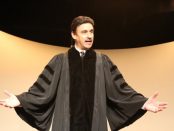
In "Kunstler," playwright Jeffrey Sweet recounts the defense attorney’s life and career in his well-written, comprehensively researched, and affectionate treatment. The conceit is that Kunstler is to address an audience of law school students at a university. Kerry is a young woman who is the vice-chair of the program committee attends him to him and becomes his foil, and is the play’s secondary character. This construction allows for a free wheeling manner of imparting the chronological details. It’s a solid take that could have certainly been at least a routine biographical exploration, but is undone here by the odd casting. [more]
Man from Nebraska
Birney seems to have cornered the market on sensitive, ordinary guys and his performance is similar to his awarding-winning “Erik” in The Humans. However, here he is extremely sympathetic and heartbreaking while in the earlier play he was revealed to be complicit in criminal behavior. Birney’s work is so subtle and low-key that he suggests worlds of unspoken feelings, which is quite a remarkable feat. O’Toole, who recently appeared on the New York stage in "Hamlet in Bed" in 2015 and "Southern Comfort" in 2016, just keeps getting better and better, and her emotional collapse as Nancy is extremely well delineated. As their daughter Ashley, Boras beautifully captures the whiney demands of the adult child with a black and white view of the world who has never seen her parents as separate people with needs of their own. [more]
Fish Men
Each character is conveniently a different, representative type of oppressed nationality. Though Tirado goes overboard in detailing these culturally diverse, downtrodden characters’ backstories with sociological overtones, and despite numerous tangents, there are very compelling portions, and the roles are rich opportunities for the talented cast. [more]
See Reverse
Presented by the acclaimed Broken Box Mime Theater, "See Reverse" consists of ten short pieces with some even shorter vignettes sometimes in between. Lasting close to two hours with an intermission, it’s a lot of mime. [more]
Cabaret Spotlight: Hey There, Good Times
The measure of a singer's worth is in the ear of the beholder. What is one person's Piaf is another person's Barbra. There's no magic formula to being one of the great ones. All one can do is be dedicated to the art and have a willingness to experiment and keep at it come rain or shine. The rest is a matter of luck and timing, talent and tenacity. For some, the call might come late. But when answered, there's no turning back. [more]
Life According to Saki
The evening is narrated by Saki (played by an appealing and suave David Paisley) talking to us from the trenches of France, in 1916. His five soldiers (played by Phoebe Frances Brown, Ellen Francis, Tom Lambert, Tom Machell and Caitlin Thorburn) all like stories and he obliges. As he tells his eight tales, the cast enact them, using slight costuming added to their uniforms and occasionally use puppets to represent animals and children. [more]
Ring Twice for Miranda
Although "Ring Twice" is filled to the brim with socio-political symbolism, it’s not likely that the author was trying for any direct reference to the current maddening political scene since gestation periods for plays are notoriously long. Clearly this play was written well before the 2016 election, so any vague commentary appears to be inadvertent. This is not to say that the metaphors and symbols Hruska uses aren’t intriguing in their own way. [more]
The Dressmaker’s Secret
The playwrights have a keen understanding of this place and time, helped by the simple, but telling scenery of Stephen C. Jones, who also lit the small performing space to give the illusion of multiple settings. Molly R. Seidel’s costumes also hit the nail on the head as far as period and character are concerned. The glamorous dress Mária creates for Irma is in direct contrast to her own dreary housedresses, and Robert’s fancy western style suit makes Robi even more eager to leave Romania. [more]
Sunset Boulevard
The score remains an uneven but catchy patchwork that has yielded several choice songs amidst the acceptable filler. Mr. Lloyd Webber’s music is a heady pastiche of old movie melodies with discernable portions of his" Evita" and "The Phantom of The Opera." Don Black and Christopher Hampton’s lyrics range from inspired to pedestrian. [more]
Adam
With slicked back hair, a melodiously rough voice and a smooth physical presence, Timothy Simonson offers an accurate impression of Powell that captures his swagger. Mr. Simonson’s appealing performance forcefully recounts Powell’s rise and fall with histrionic relish. Simonson is particularly stirring when describing the hardscrabble life of Powell’s father from poverty in Virginia to prominence and wealth as a minister in New York City. [more]
Composer Portraits Series: Beat Furrer featuring Either/Or
This is serious work. Without defiance of traditional or conservative contemporary classical music simply for mere defiance’s haughty sake, Furrer is developing his own particular vocabulary. And successful performance of Furrer’s music requires serious musicians. The musicians of Either/Or are a good match for this composer. Their technical skills are superb, marked by both muscular stamina and virtuosic creativity; equally important, their willingness to take performance risks is grounded in intellectual and artistic integrity. [more]
The Object Lesson
Illusionist/actor Geoff Sobelle’s show is a combination of happening, art installation, and a meditation on the role objects have in our lives. Using audience participation, objects both hidden and seen, and magical illusion, Sobelle forces us to examine out relationship to the objects in our lives as well as how they ultimately define us when seen altogether as the detritus of a life. Performed in 11 segments with no intermission, "The Object Lesson" is not for everyone, but for those willing to go with the flow and give themselves up to Sobelle’s droll reflection, self-examination and visual theatrics, the evening is fascinating and rewarding. [more]
Berlin to Broadway with Kurt Weill: A Musical Voyage
One of the remarkable things about the theater songs of Kurt Weill is that like the later songs of Stephen Sondheim they are all really little one act plays which give the performers a great deal of latitude in how to perform them. As sung by Karl Josef Com, Rachel de Benedet, Michael Halling and Meghan Picerno and as narrated by Brian Charles Rooney, Berlin to Broadway with Kurt Weill is an extraordinary musical voyage through some of the greatest theater songs of all time written by among the best talents of the 20th century. [more]
Complexions Contemporary Ballet 2017 at the Joyce
“Star Dust,” Rhoden’s tribute to rock original David Bowie forced Rhoden to study and use each of the nine chosen songs as vignettes to comment on Bowie’s magic, the superb quirkiness of his dancers and display subtlety in his use of steps sometimes missing from his wham-bang, jet engine choreography. Rotating lights and disco balls beamed mood-changing pools of light on the stage (designed by the hard-working Mr. Korsch with psychedelically colorful costumes and makeup by Ms. Darch which exposed a lot of skin.) [more]
Jonah and Otto
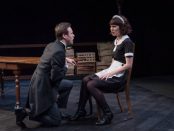
While the play is at times Pinteresque, it is talky in a way Pinter never is, explaining everything over and over, covering the same ground again and again. Nothing much happens other than that the men become more confiding and reveal more of their personal pasts. The play implies that Jonah is menacing, but under Hughes’ direction, he never seems much of a threat. The pace is slow and methodical, too slow for its own good. Sean Gormley’s Otto and Rupert Simonian’s Jonah are well-rounded characters but the acting style is too refined, too genteel to make much impression. [more]
The Big Broadcast on East 53RD
Rounding out the cast are Alexis Bronkovic as Ruth--Penny’s best friend--and Bill Tatum, who plays Ray’s boss. Once again, the driving motivation behind nearly every character is nowhere to be found. It seems that simply for the sake of creating a play about fake news, Brukenfeld opted to fill his script with lifeless characters that don’t question anything and are content to believe that Ray is dead. The performances across the board are unsympathetic and played mind-bogglingly straightforward. For what it’s worth, the actors do all that they can with the material at hand, turning in acceptable performances given the circumstances. [more]
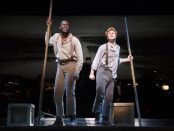
Big River: The Adventures of Huckleberry Finn
Red-haired, animated and engagingly boyish, 18-year-old Nicholas Barasch is sensational as Huckleberry Finn. Mr. Barasch is onstage virtually the entire time and winningly carries the show. As Jim, the runaway slave, Kyle Scatliffe brings dignity, forcefulness and powerful vocal ability during his commanding performance. [more]
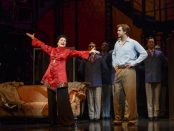
Boys of a Certain Age
This volatile quartet battle over the personal and the political during a Scotch-fueled weekend at Ira’s Fire Island house. There’s not much in the way of plot, but secrets are revealed, scores are settled and life goes on with new insights. It’s reminiscent of a Terrence McNally play but lacking in polish. [more]
Batsheva Dance Company: “Last Work”
The centerpiece of “Last Work” was the image of a single dancer, in a blue costume, jogging on a treadmill far upstage while the rest of the troupe, dressed in chic practice outfits by Eri Nakamura went through its paces in a performance area defined by two lines of upright panels lining each side of the stage (designed by Zohar Shoef). The dancers’ outfits changed later on which, for some reason, made it seem as if there were many more dancers on stage than there really were. [more]
Hi-Fi | Wi-Fi | Sci-Fi: Predictions Past Present and Future
The only real high-tech exchanges take place only three times during the run of the show. At the performances of February 6, 9 and 17, one of the roles in "Camera Obscura" will be performed telematically from Seoul Institute for the Arts in Korea and directed by Il Kyu Park. "Hi-Fi | Wi-Fi | Sci-Fi" which uses a great many sound specialists for little effect is an interesting idea but doesn’t go far enough either dramatically or in terms of modern technology to have much impact. As a cautionary tale, time has caught up with these plays and passed them by. [more]

The Mother of Invention
Playwright James Lecesne has been acclaimed for his solo performance works, most recently "The Absolute Brightness of Leonard Pelkey." Here, he has written a traditional play employing theatrical devices that’s a mélange of David Sedaris, Charles Busch and Modern Family. There are one-liners galore, wacky situations and a decidedly campy sensibility. It’s a bunch of superficial antics that never really meaningfully connect. [more]
Bound to Rise
Unfortunately, Policoff’s book is too cluttered with characters too allow for much development. While some of his lyrics are clever, most are prosaic and heavy-handed. As played by music directors Gregory Nissen and Jonathan Matthews, the score sound tinny, rather than melodic, for its 1890’s period. The direction by Oliver Conant, with an assist by Paul Murphy and Regan Batuello, is all over the place using various parts of the shabby (uncredited) set, so that it is too busy for its own good. This free-wheeling approach would be more suitable to a movie rather than the stage without a much strong hand in control. Occasionally the actors make a pithy remark about society or the political order and then freeze, starring at the audience. This Brechtian technique goes against the grain of the rest of the production, as does various character narrating themselves or others. [more]
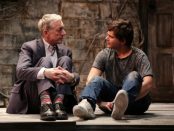
The Liar
However, it is Ives’ joy in language that is the most infectious. The rhymed couplets keep coming and surprising us over and over again (bitter/twitter; prize/rhapsodize, jocular/interlocutor, kiss/dentrifice, carbuncle/uncle). He has also created remarkably agile, felicitous and contemporary turns of phrase: meet-and-greet/ bittersweet; Chanel perfume/key to my room; perfect ten/tragic flaw again; chance to laugh/some dumb gaffe; believe this boy/pure trompe l’oeil. Considering the nature of lying, the anachronisms like contact lens, superglue, outed me, Kid Dorante, party clown, pants on fire, etc., seem like natural hyperbole for these poseurs who take themselves all too seriously. So too Kahn’s clever direction is highly in tune with this style: Dorante and Alcippe’s duel is fought without swords in pantomime and Cliton appears with a modern paper coffee cup. [more]
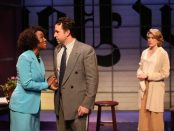
Made in China
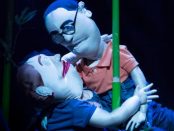
The ensuing journey is a bizarre and sometimes hilarious exploration of China and the culture within, even if it doesn’t always make the most sense. "Made in China" makes the most of the liberties that puppetry allows, and features some very impressive techniques and performances from the actors behind the scenes. Though the two main characters are both interesting, they are both made all the more entertaining by their canine companions. The two dogs, Lily and Yo-Yo (Dorothy James and Andy Manjuck among others) are completely lovable, and every single scene they are a part of is instantly heartwarming. [more]
New York Polyphony: Palestrina’s “Marcellus Mass”
The second work of the evening was the world premiere of Ivan Moody’s Vespers Sequence. In careful, clear program notes, Moody described his goals in his compositions in general and in this new Vespers Sequence in particular: he seeks to “bring the concepts and principles underlying Orthodox spirituality … into dialogue with modernity” … in the “creation of a specifically Orthodox para-liturgical repertoire that brings together liturgy and concert.” Moody collaborated closely with New York Polyphony in conceiving and then finalizing this work; although the sacred texts and many of the originating aesthetic impulses of the work are ancient, the overall feel, in this premiere performance, was of something vital and contemporary. [more]
92Y’s Lyrics & Lyricists Series: “Get Happy: Harold Arlen’s Early Years”
The show began with Arlen’s first hit, “Get Happy,” 1930, and ended with his 1939 score for the MGM film, "The Wizard of Oz." The first half of the evening was devoted to Arlen’s stand-alone popular tunes, his songs written for the Cotton Club Revues (1932-1934), and musical numbers for early sound movies. Blackhurst recounted how Arlen (born Hyman Arluck of Buffalo, New York), was a child prodigy singing in his father’s choir when he was seven, forming his own bands in his late teens, and occasionally appearing as a vocalist with them on records in his twenties. [more]
Drunkle Vanya
Periodically the cast calls for a “Family Meeting.” The theme from Jeopardy is played on a kazoo and three audience members are picked to come up. The one who is wearing the funniest nametag that relates to dialogue from the play is the winner, receiving a free vodka shot. Drinking games also take place. All of these festive tangents never sidetrack the plot of the play. Ms. Hudson is also the director, and her giddy, all-over-the-place staging in this large living room, enhances the exuberance of the piece. Improbably and cleverly, Chekov’s tone and intentions survive the mayhem. [more]

Yen
There are many questions that the author fails to answer. Although the boys have not attended school in years and Bobbie has been diagnosed as ADHD and should be in the British equivalent of special education, no social worker seems to have visited to check up. Who is paying the rent or the electricity? Is the mother on welfare and are these items paid automatically? There is no explanation of how the boys are eating and how Taliban stays alive if they have not been feeding it for days or even weeks. While the neighbors are aware of Bobbie’s stealing, he seems to be getting away with it. The dog’s continual barking from his locked room can be heard on the street but no complaints have been filed. Is all this a metaphor or a slice of life drama? [more]
Incident at Hidden Temple
Behind the theme of war," Incident at Hidden Temple" is a thriller of sorts. Sisters Ava (Ying Ying Li) and Lucy (Briana Sakamoto), first seen in China travelling on a train littered with American soldiers, are separated when a disturbing road block forces their train to a halt. With some time to kill, the sisters exit the train and are introduced to a mysterious stranger--Dinh James Doan as a blind man with a penchant for speaking in riddles--who tells them about a Hidden Temple located just a short ways away. The temple, the blind man cryptically tells them, is filled with lost treasures but will only be revealed to those of pure heart. [more]
Georgie: My Adventures with George Rose
What truly distinguishes the show is Dixon’s fearless psychological focus on Rose and himself. The predominant theme is of hero worship and its bruising disappointments. It also attempts to explore the issue of the often-dark contrast between the on-stage and off-stage lives of great entertainers. In examining their involvement, Dixon doesn’t spare Rose or himself from honest scrutiny. [more]
Making Dreams a Reality: First Miss America’s Outstanding Teen Shares Her Journey to Off Broadway Musical
I’ve been watching Miss America since I was very little, and my sister and I would get dressed up every year in crowns and gowns and banners and I saw Miss Pennsylvania, Marla Wynne, in '92 or '93 and her talent was ventriloquism and I fell in love with it, and decided that I wanted to learn to make my Barbie’s talk. I went to my bedroom and sat in front of the mirror and figured out how to talk without moving my lips. I then got my first puppet at around age seven and started performing, but it all started watching Miss America. [more]
Milk and Honey
While the jokes may be hoary, Unger’s production has cut down on the show’s sentimentality and given it a sharp edge which elevates the material. As the heroine Ruth, Runofsson is genuine, contemplative and sympathetic, while Delavan’s Phil is the strong silent type. They have the bulk of the songs and give lovely renditions of “There’s No Reason in the World,” “That Was Yesterday,” “Let’s Not Waste a Moment,” “As Simple As That.” Korey as the gossipy yente Clara Weiss who is free with her advice steals every scene she is in and gets to sing the clever ode to her late husband, “Hymn to Hymie” as well as lead the hilariously staged number, “Chin Up, Ladies” which includes witty audience participation. [more]
Jitney
Director Ruben Santiago-Hudson has himself won a Tony Award for his performance in Wilson’s "Seven Guitars" and has directed acclaimed Off Broadway revivals of "The Piano Lesson" and "Seven Guitars." He has assembled a cast of nine in which seven of the actors are veterans of Wilson play including Antony Chisholm who appears in the 2000 production. A true ensemble led by John Douglas Thompson and André Holland (currently in "Moonlight"), a better staging could not be imagined of this involving and engrossing play. [more]
Yours Unfaithfully
One problem is that the play (unlike Noel Coward’s "Design for Living" or Somerset Maugham’s "The Constant Wife" which cover similar territory) is neither witty not clever, and none of the lines are particularly sparkling or original. While the play may delineate liberated sexual behavior, its drawing room comedy format is too conventional and refined. All five performers always seem to be acting as their style is too arch to be truly believable. [more]
Golgotha
Mr. Refael’s simple but well-crafted scenario takes place in a contemporary apartment in Israel, and has the elderly Salvado looking back at his past. This is theatrically achieved by having him directly addressing the audience. His best friend and fellow survivor is to be honored at the Holocaust memorial center Yad Vashem during a ceremony where he will light a torch. When he becomes incapacitated, that task falls to Salvado. This situation instigates a flood of painful reminiscences that explore his guilt at having survived. [more]
Love for Sale
The concept of Love for Sale, though not particularly original, is not a bad one, except for one very important factor: Ms. Burke is not up to either the singing or acting demands of Love for Sale, a voyage from innocence to jaded sophistication as told in mostly dark, melodramatic songs, ironically influenced by the American films that flooded Europe in the twenties and thirties. It’s an extraordinarily difficult repertoire that constantly threatens to be silly expressions of impossibly colorful and desperate characters. [more]
PEER GYNT & the Norwegian Hapa Band
A major flaw is Peer Gynt. Personable, co-composer Park plays the title role. When we first see him, he’s wearing a hipster wool cap, plaid shirt and eyeglasses. Possessed of a good singing voice, his acting ranges from pleasantly monotonous to ineptly excessive. He strains to be charismatic especially in his dance moves and doesn’t succeed. Park’s performance has stamina but lacks grandeur to carry the leading role of this full-length musical. [more]
The Great American Drama
Essentially it’s a glorified and arch 90-minute, scripted, sketch comedy show. The conceit is that it’s inspired by audience suggestions. The composition of the program changes from performance to performance. Throughout the show, slides are projected of printed extracts from online surveys of people’s theatrical preferences with the dates that they responded. These have been collected over a period of many months. The cast then performs a scene based on these answers. [more]
Orange Julius
On the one hand, it is a punch in the gut dramatizing the cold hard facts of disintegrating with this disease; on the other, the non-linear time scheme is difficult to follow, offering more questions than it answers. What "Orange Julius" really is could be described more accurately as a screenplay or a teleplay with cuts and fades. There is a powerful work hiding in this material but it still remains unshaped. Under Dustin Wills’ fast-paced direction, Jess Barbagallo, Ruy Iskandar, Irene Sofia Lucio, Stephen Payne and Mary Testa give fine performances despite the fact that the play seems to wander around trying to find its center. [more]
Albatross
What Evett delivers—using ample quotes from the poem and robust contributions from himself and Spangler—is a terrifying inside look of the Mariner’s experiences, beginning with being hijacked by a friend at a pub. He breathlessly illuminates what the day-to-day life was like with lurid descriptions of illnesses and exciting second-by-second reports of battles with other ships. [more]