News Ticker
- December 16, 2025 in Broadway // Marjorie Prime
- December 14, 2025 in Broadway // Oedipus
- December 14, 2025 in Interviews // Conversation with Dominick LaRuffa Jr.
- December 14, 2025 in Off-Broadway // The Surgeon and Her Daughters
- December 14, 2025 in Features // A Seasonal Salon Worth Noting
- December 13, 2025 in Off-Broadway // BUM BUM (or, this farce has Autism)
- December 12, 2025 in Musicals // The Faggots and Their Friends Between Revolutions
- December 12, 2025 in Cabaret // Mary Foster Conklin — Mirrors Revisited (50th Anniversary)
- December 11, 2025 in Cabaret // Kathy Kaefer — Kiss Me Once: Stories from the Homefront
- December 11, 2025 in Off-Broadway // The American Soldier
- December 9, 2025 in Off-Broadway // This World of Tomorrow
- December 9, 2025 in Cabaret // A Noel Coward Celebration — Steve Ross & Friends
- December 7, 2025 in Off-Broadway // Diversion
- December 5, 2025 in Off-Broadway // Meet the Cartozians
- December 5, 2025 in Features // Tom Stoppard: An Appreciation
Archive
Soutra Gilmour’s setting is a sort of empty runway with the audience sitting on either side. The other props are two black chairs at either end for the two doctors. Scenes are created entirely by Jon Clark’s impressive lighting which turns a portion of the stage into a white square, the rest being kept in darkness. Since Connie and Tristan meet in various dorm rooms, doctor’s offices, examination rooms, etc., there is no sense of place. The problem is that each scene looks the same as the previous one and the many scenes covering the four weeks tend to become tiresome without an intermission to break the mood. Gilmour’s costumes which put the doctors in all black and the patients in all white are equally monotonous.
[more]
This production could be more balanced in the performances, with some characters being solidly played and others being line-readings lacking body movements that add to the dialogue. There are also changes to how the story is told. A number of passages have been removed that are important in establishing Medea's state of mind and exploring her internal struggle over how she will punish Jason for his betrayal. In addition to the revisions to some of Medea’s dialogue, the changes in the responses from the three women of the chorus are impactful. The chorus' purpose is to fill in gaps in the story and to clarify the thought processes being exposed by various characters. While the overall thrust of the story has not been altered, some of the nuances of the characters' behaviors have been lost.
[more]
The play is treated like a rehearsal (a conceit also used by Bedlam in their incomprehensible and lame "Henry IV" workshop in Brooklyn in 2023) with the director (Andrew Rothenberg who also plays Shaw’s Caesar) stopping the action periodically and breaking the mood. The costumes (production designed by director/adapter Eric Tucker, wardrobe supervisor Damarius Kennedy) are contemporary; whether this is supposed to be rehearsal clothes or a modern dress version is never made clear. (It is obviously cheaper than having to create period correct Egyptian and Roman costumes.) In terms of continuity, there are two Caesars: Rajesh Bose as Shakespeare’s Caesar and Rothenberg as Shaw’s which destroys any transition from one play to another. In fact, the segues from one text to the other are non-existent with one scene following another from the other play without any transition.
[more]
Kahn has a good ear for the subtleties of each character and the period. However, "Fair Winds" doesn’t handle all the major themes smoothly and the use of the narrator sometimes feels like a way to make up for her storytelling shortcomings, although Maisonett is an accomplished enough actor to make it work.
[more]
I think the city’s top performing-arts schools—Fiorello LaGuardia High School of Music & Arts, and the Performing Arts; PPAS; and the Frank Sinatra School of the Arts—are among the crowning glories of the school system.
[more]
What a terrific, beautifully layered performance Ben Levi Ross gives in “The Connector”—a moving, original new musical from Jason Robert Brown, Jonathan Marc Sherman, and Daisy Prince.
[more]
Seadog Theater’s current revival of "Tuesdays with Morrie," with exceptional direction by Erwin Maas, is a beautifully orchestrated presentation starring Len Cariou as Professor Morrie Schwartz and Christopher J. Domig as author Mitch Albom . The chemistry between these actors is riveting, grabbing one’s attention solidly but gently from the opening moments to the tearful end. They are a perfect match to tell this story. Don’t hesitate, for a moment, to see this production. You will laugh, cry, and come away feeling that you just experienced something extraordinary.
[more]
Itamar Moses’ 'The Ally" is a play of ideas not only torn from today’s headlines but tomorrow’s as well. Ostensibly dealing with the Israeli-Palestinian question on college campuses today, it also deals with censorship, anti-Semitism, racism, capitalism, colonialism, patriarchy and white supremacy. The play protagonist, a Jewish liberal teacher on a college campus, is asked to sign a social justice manifesto and finds that it challenges his political, marital, academic, American and Jewish beliefs. This is a good deal for one play to take on, possibly too much, but Lila Neugebauer’s production for The Public Theater almost gets all of it right for this provocative and heady play, with one caveat.
[more]
The text created by Bogart in collaboration with Maddow and Zimet is a collage of assembled passages from the works of Sartre and de Beauvoir, amongst others. Maddow and Zimet don’t often speak to each other in the piece, yet they are still very much “in dialogue.” The piece is designed as to keep them separate, though inseparable. The moments where they share stage action: putting away groceries, having sex (brief, then on to the next thought), and dancing is charming as comic relief in contrast to all the other serious content of the piece. One tongue-in-cheek moment that sheds light on how much history they share is their little jazz dance routine abruptly segueing into the Jim Carroll Band’s New Wave classic, “People Who Died.” The change is as abrupt as it is disconcerting, but it is seamlessly incorporated into the stage business.
[more]
John Patrick Shanley has become our poet of lonely, desperate working class people trying to make a connection despite their inadequacies and hang-ups in such plays as "Danny and the Deep Blue Sea," "Savage in Limbo," "the dreamer examines his pillow," "The Big Funk" and "Outside Mullinger" and, of course, in his Academy Award-winning script for "Moonstruck." In all of these works, the pair makes an unlikely couple who fight against their very attachment as outside of the realm of possibility. In his latest play, the bittersweet "Brooklyn Laundry," he creates another lovely story of an unlikely couple Fran and Owen who find each other just when they need someone most.
[more]
How the metaphor of rabbits fit into this was puzzling, yet the dreamlike (nightmarish?) rabbit imagery was the strongest visual idea and pervaded the work, from a toy stuffed bunny to grotesque rabbit masks the dancers wore throughout the show. Perhaps the stuffed bunny was akin to the madeleine which Proust tasted, leading to a river of memories and Á la Recherche du Temps Perdu, the rabbit inducing Lidberg to ponder his childhood?
[more]
Under Alex Keegan's skillful direction, the characters are allowed to develop their understanding of who they are and how they fit in an organization traditionally run by men. The captain is the one most aware of the paternalistic nature of military organizations, so she is determined that this patrol will be completed without issues. Crawley shows us the struggle the captain has in finding a balance between her personal actions from a female perspective and those that are conditioned from a male perspective. This male-oriented conditioning is less of an issue with other team members, although there are suggestions that it still influences their official duties.
[more]
On March 4th, 2024, I witnessed the best major-club debut I’ve seen in years. And I kept thinking, as I watched David Marino sing, “The good old days are now…”
[more]
Lynn’s dialogue is astute and subtle, following the heartbeat of this strange, but understandable couple lifting it out of soapiness and melodrama. She has written a very modern drama. ... Jenn Susi’s direction helps transform conversations into a real one-act play with natural rhythms and a satisfying ending.
[more]
Playwright Joyce Griffen’s idea of farce in her new play "The Script in the Closet" is a series of 48, mostly very short scenes in which to keep the plot going she continually introduces new characters both onstage and offstage as well as new events. Some of the scenes are less than a minute. A good deal of the play happens over the telephone with characters we never meet. The plot is made more and more complicated by new contrivances that have less and less to do with the original premise. Farces usually trigger laughter and have much physical comedy, none of which is present here.
[more]
This York Theatre Company production at the New World Stages, following a presentation at Goodspeed Musicals in 2016, shoehorns these songs into a book by Lindsey Hope Pearlman from a story created by Richard J. Robin. It has an ambitious plot that glibly takes on a number of themes roiling through the turbulent Sixties: women’s lib, civil rights, the war in Vietnam, the sexual revolution, Andy Warhol, and even a premature touch of gay liberation.
[more]
"This is not a time of peace" has a stream of consciousness feel effectively handled by the director Jerry Heymann. There is never any confusion about who is who and what they represent despite overlapping dialogue and quick segues from one era to the other. It is Cohn’s performance as Alina that is the strong spine of the play. She opens and closes the play going from a matter-of-fact opening monologue to an impassioned closing statement, leaving the audience to empathize with her and comprehend all the frustrations she experiences.
[more]
While "The Seven Year Disappear" may challenge and confuse many theatergoers, people used to performance art may get the in-jokes. Jordan Seavey whose play "Homos, or Everyone in America" was seen in 2016 in the Labyrinth Theater Company at the Bank Street Theater is a sophisticated, seasoned playwright and he and director Scott Elliott make no concessions to their audience. "The Seven Year Disappear" may be most appreciated by devotees of experimental theater but it does make one hungry for Seavey’s next play.
[more]
While we could use a good murder mystery stage play, "Deadly Stages" is too derivative to suit the bill. The cast work hard mostly playing multiple roles, but the play seems to have attempted to outdo Charles Busch’s output without having the wit or the cleverness to bring it off. Although "Deadly Stages" has amusing moments, it is a tired retread of better and more subtle works in this genre.
[more]
Christopher Rhoton's Double Dare-inspired set belies these weightier autobiographical details, offering enough of a time-warping simulacrum to help middle-aged members of the audience shed a few decades when Summers interrupts his fraught remembering to twice become a kid's game show host again. Those who legibly scribble their names on a piece of paper dropped into a fishbowl before the performance, eventually get the chance to head onstage (not sure if mezzanine ticket buyers are eligible), answer trivia questions, and launch pies on a catapult (a warning for the first few rows). Amid all the cheers, laughter, and chaotic fun, there's also an opportunity for the quick-witted Summers to go off-script, asking the theatergoers-turned-contestants trite questions like "Where are you from?" and "What do you do?" to set up a slightly mischievous back-and-forth.
[more]
Does the New York City Center Encores! new production of "Jelly’s Last Jam" hold up against the original Broadway production (1992-1993) which starred Gregory Hines (Tony Award), Savion Glover, Keith David and Tonya Pinkins (Tony Award)? Yes, it does and makes a good case for Jam’s enjoying a strong future. This production, directed with verve and precision by Robert O’Hara, is both a fine musical and a fine drama, a diamond in the crown that is the Encores! thirty-year history.
[more]
When she arrives dressed in a white pant suit, Labeija steals the stage with Hillary’s number “Miss Me Now” which trumps them all with a series of Broadway parodies paying tribute to Clinton’s love of the theater, with recognizable quotes from "The Sound of Music," "Company," "Gypsy," "Chicago," "Evita," "Thoroughly Modern Millie" and "Dreamgirls." However, while all of this is clever, at times the show becomes “can you identify this parody.” A “Six Mixalot” for the company takes the same place as “The Megasix” in "Six." Lena Gabrielle does fine work with the four-person all-female band but the sound design by Bailey Trierweiler, Kevin Heard and Uptown Works is often too loud for this small Off Broadway theater.
[more]
"The Order of the Golden Scribe: Initiation Tea" is an immersive and interactive theater experience co-created by Shuai Chen and Arlo Howard, who also directed. It combines a story about a secret society of historian scribes with a series of creatively challenging cryptographic puzzles. It is all wrapped up in an elaborate initiation "tea" for new members of the Order. The initiation ceremony requires the initiates to prove themselves worthy of joining the Order by solving the puzzles. Each successful solution is rewarded with first tea, then finger sandwiches, followed by scones with jam and butter, and finally, a dessert. The puzzles are cleverly conceived and presented. The audience is divided into teams of four or five seated at café style tables.
[more]
I don’t think I’ve ever been as disappointed by a Paper Mill Playhouse presentation as I have been by their production of "After Midnight." This adaptation of the original Broadway production has been so severely cut down that the whole point of the original has been lost
[more]
Director/writer Suzanne Karpinski has made a valiant effort to corral the chaos by encouraging the audience to get a card stamped by the actors in the various spaces, presumably in the hopes they’ll avoid revisiting the same scene more than once, but the four floors of the building are quickly explored and there’s nothing new to discover after far too short a time. Sounds and dialog bleed across scenes in different areas separated only by curtains, splintering the audience’s attention. To the actors’ credit, they’re all having a marvelous time playing their parts; their enthusiasm is infectious, even if their acting often lacks the subtlety which the intimate playing spaces beg for.
[more]
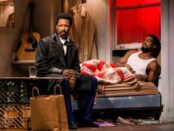
"Ain't nothin' sentimental about a dead revolution." Wearing a too-short, too-tight dress, shiny thigh-high boots, and a long fuchsia wig, the twentysomething Nina (Moses Ingram) attempts to plunge these words like a dagger straight into her estranged father's idealistic heart, which has survived a long prison stretch for an armored truck robbery committed decades ago to aid the Black liberation movement. Coming early in Signature Theatre's revival of Dominique Morisseau's "Sunset Baby," it's obvious Nina's flinty declaration will never be genuinely up for debate--at least not for Nina--nor should the audience get even passingly optimistic about a dewy-eyed mending of the broken familial bond between Nina and the recently freed Kenyatta (Russell Hornsby). It's a lot to so quickly take off the dramatic table, but the unrelenting Morisseau does it forthrightly and thoroughly to serve the play's one overriding objective: being true to Nina.
[more]
Like her masterful Sinatra solo for Mikhail Baryshnikov, “Brel” takes Cornejo from a strolling meditating figure (“Quand On N’A Que l’Amour”) to an anguished lover (“Ne Me Quitte Pas”). Cornejo twists and thrashes until the song “Amsterdam” had him gliding all over the stage. The mood rises through “Les Marquises” and “Marieke,” matching Brel’s penchant for crescendo, leading Cornejo into jags of runs, leaps, turns and wilder gestures. Although not as immediate a success as her other ballets to songs, “Brel” will soon be a favorite of solo danseurs all over the ballet world.
[more]
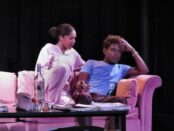
The balance is off between the two storylines. If the most crucial dramatic element of the story is the legal issue surrounding consent, the dynamics of the sisters’ current and historical relationship do not satisfactorily clarify that issue. If the story’s primary focus is the nature of the relationship between the sisters, the legal issue overshadows the intricacies and nuances of their relationship. The two main storylines of the play contain strong dramatic elements that would stand well by themselves—the final two scenes attempt to bring closure to the dramatic arcs but miss the mark. They seem to operate as endings to the two stories. While the show is a solid attempt at dramatizing the issue of consent when it comes to sexual relationships, it doesn’t quite squarely hit the mark.
[more]
It is a rare author indeed that can take uncomfortable material, and by uncomfortable that is, to hear, digest, and process a subject no one likes as a subject of conversation, and then give an audience the opportunity to take away from the experience a profound enlightenment. But when that author is Dael Orlandersmith we have come to expect nothing else. The playwright’s new work, "Spiritus/Virgil’s Dance," is a contemplative meditation on mortality as much as it is an examination of how we choose to pass and live out our days until our own “conclusion.”
[more]

At the performance under review, part of the audience found the show hilariously funny, while others proverbially sat on their hands. The show makes use of history, parody, satire, burlesque, musical comedy and tragicomedy, never being consistent to any one genre. At two and a half hours this kind of parody seems a bit too long. "Between Two Knees" is a noble effort to tell the story of one hundred years of Native American suffering through the Lakota tribe, but it seems to want to cover too much in too parodistic a style.
[more]

Inspired by 20th century film and video games based on the classic Chinese novel of the 15th century, 'Romance of the Three Kingdoms," Damon Chua’s delightful and engrossing "Warrior Sisters of Wu" takes two minor female characters and puts them center stage. Using the framework of Jane Austin’s "Pride and Prejudice" with the two best characters, male and female, taking an instant dislike to each other but eventually coming to see each other’s good traits, Warrior Sisters of Wu takes place at the end of the Chinese Han Dynasty in 200 A.D. when war is certain and society is changing. Stylishly directed by Jeff Liu for the Pan-Asian Repertory Theatre with top-notch fight choreography by Michael g. Chin, the play is both exciting and romantic including both vigorous swordfights and tender love scenes. Like Mr. Bennett in Austin’s novel, Lord Qiao has a problem: having only daughters, his estate is entailed to his next male heir, the indolent Cousin Xie who comes to visit in order to see about marrying either sister Wan or Qing, who are accomplished swordswomen. However, like Mr. Collins in Pride and Prejudice, Xie is an obnoxious social climber and does not interest either sister, Wan who is engaged to General Zhou Yu in a love match, nor Qing who has not found anyone who is her equal.
[more]

The host company, WHITE WAVE Young Soon Kim Dance Company ended the short, well-run program with the longest work, the three-part “Eternal NOW.” It also had the most complex costumes, geometrically shaped and brightly-colored two-part outfits designed by Sarah Cubbage. Putting her seven dancers through their modern dance paces, Kim displayed skill at handling the cast, pitting soloist against groups and each other as they moved to an alternately slow and fast score by Marco Cappelli. She is someone the other other dancemakers on this lineup could look up to.
[more]
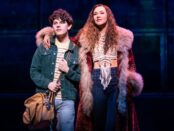
Unfortunately, at 70 minutes the play seems skimpy. Structured in a great many short scenes, only one thing happens in each, so that there is a sameness to it all. Basically a two character play with two lab assistants Zora (April Matthis) and Pilar (Carmen M. Herlihy) attempting to come up with new solutions to the problem and spoken in the level-headed tone of scientific investigation, the play does not offer climaxes or high points but moves on the same plane. The four actors playing seven characters remain on the same level without developing or changing. Kate Whoriskey’s direction appears to have eschewed raising tension to make the play more interesting or more dramatic, something it sorely needs.
[more]

«
1
…
15
16
17
18
19
…
114
»
Copyright Jack Quinn, 2001-2023