Archive
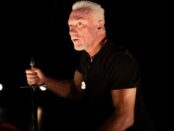
The subtitle of Patrick Page’s absorbing and informative one-man show "All the Devils Are Here: How Shakespeare Invented the Villain” is an actuate description of the content of his presentation. In a kind of lecture-performance it is Page’s credible contention that Shakespeare took the Vice character (the villain from the Middle Ages' Morality plays through Christopher Marlowe) and added psychological realism. Eventually in his last play, "The Tempest," Shakespeare was dealing with a character with a very worthy justification for revenge who finds compassion and empathy instead. [more]
Gutenberg! The Musical!
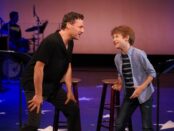
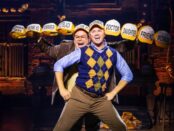
How much you enjoy 'Gutenberg! The Musical!" likely depends on a combination of factors entirely unrelated to that German fellow: familiarity with the tropes it's skewering; your own level of disdain for such hackney execution; and your tolerance for Rannells and Gad's incessant mugging. In their first Broadway pairing since "The Book of Mormon" over a decade ago, Rannells and Gad are less a comic team than a comic rivalry, with neither willing to be the Abbott to the other's Costello. Fortunately, their ping-ponging, look-at-me dynamic only occasionally grows tiresome, usually when either of them is trying to gin up laughs that aren't there or shouldn't rise above a tee-hee. [more]
HopeBoykinDance: States of Hope
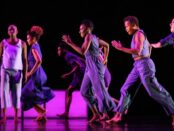
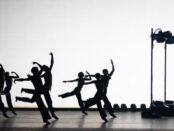
The spine of the work wasn’t the choreography or dancing, but the lines spoken by the dancers as they walked about the stage; however, since the lighting by Crawford was shadowy and the dancers wore head microphones—their voices projected via speakers—it was often difficult to see who was speaking. Add to this the fact that the performers weren’t the best actors and this all important text became just as shadowy as the lighting (which, to be fair, had a moment or two of brightness and color). [more]
Chasing Happy
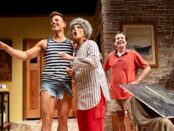
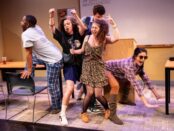
"Chasing Happy," written by Michel Wallerstein and directed by Alexa Kelly, is a five-character comedy about a gay love triangle. It unravels like a pilot for a television sitcom that borrows characterizations from other sitcoms. Despite the efforts of a skillful, hard-working ensemble, the show never rises to the challenge of solid character development within a believable story. It was not a well-spent two hours for this reviewer. [more]
Salesman 之死
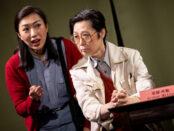
Not only is Jeremy Tiang’s "Salesman 之死I" an important document of a classic American play, it is also an illustrative reminder of the cultural differences between China and the United States. Under the direction of Michael Leibenluft, the cast of six is always engaging and always convincing playing both men and women alternately. The design puts the audience directly into the rehearsal room from March to May 1983. The play also allows us to watch major American playwright Arthur Miller as he explores and rethinks a play he had written over three decades before. The fact that the Chinese actors eventually did so well with this typically American text demonstrates the universality of Miller’s greatest play. [more]
Scrambled Eggs
Sometimes good intentions do not have the best results—at least in theater. Such is the case with "Scrambled Eggs" at the Gene Frankel Theatre. Presented to bring immediacy to the issue of domestic violence, the play written by and starring Reginald L. Wilson, MFA, is a vivid domestic melodrama, an R-rated afternoon special, which hammers the audience over the head. Perhaps, audiences need to be smacked to comprehend the direness of the subject matter and, perhaps, this is the means to that end. [more]
The Refuge Plays
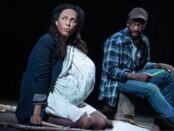
Nathan Alan Davis’ "The Refuge Plays," if one pays attention, is exactly about refuge: growing up with it (because someone else has lovingly created it for you), seeking it (if you feel you must create your own), and coming back to the refuge you have always known (once you come to terms with the realization you’ve had no success trying to create it somewhere else). Davis, for the most part, has given us characters that we can easily fall in love with, each with their own path to refuge. [more]
Down the Road
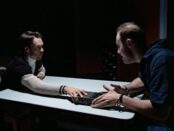
Lee Blessing's "Down The Road" is a tale that explores what can happen when "normal" people are confronted with the psychopathy of evil in the form of a charming, ego-centric serial killer. Skillfully directed by Chris Ryan, the story introduces a husband and wife writing team that their editor has assigned to do a book about a notorious killer responsible for the deaths of at least 19 women. It is not a play about the motivations behind a killer's acts. It is about what happens to rational, focused people when dealing with psychopathic evil. It is that examination that this production gets right from the slow unraveling of the couple's relationship with each other to the emotional and intellectual seduction of the killer. It is an engaging, chilling look into a heart of darkness. [more]
Helen.
"Helen." is a new play by Caitlin George based on Greek myths that is being given a terrific production at La MaMa by SuperGeographics in association with La MaMa and the storied company En Garde Arts. The acting is top-notch, the direction excellent, and the lighting (by Jackie Fox and Connor Sale) is atmospheric and evocative. [more]
Big Trip: Part 2 – Three Love Stories Near a Railroad
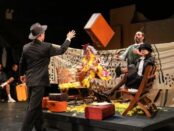
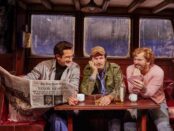
To say that Krymov works like no other director is an understatement not to be taken lightly. He is known for his inventive Russian adaptations, but he has also been earning a reputation for tackling American literature with the same whimsical and sometimes fourth wall-smashing approach that emphasizes the pure act of theater making. It is at first quite disarming in its playfulness, yet never loses sight of sincere treatment of works of literature. Here we find two Ernest Hemingway short stories, "Hills Like White Elephants" and "A Canary for One," both written in the late 1920’s, matched with two scenes that serve as dense character portraits from Eugene O’Neill’s "Desire Under the Elms," circa 1924. They are not your normal fare when you consider the expectations of the term “love story.” [more]
Melissa Etheridge: My Window
Melissa Etheridge is a bona-fide superstar. So, why is this artist, used to appearing in huge venues, “slumming” in a Broadway theater with a capacity of less than 800? Let’s not look this gift horse in the mouth. This is a gem of an opportunity to see Etheridge up close and personal in her My Window autobiographical show at the Circle in the Square. This is a memoir in song, songs that sprang from her adventurous life that went from entertaining in saloons to becoming a lesbian icon and a major rock concert star. [more]
DruidO’Casey: Sean O’Casey’s Dublin Trilogy
Director Garry Hynes (a co-founder of the Druid) heightens the portent of this bellicose rhetoric, as well as O'Casey's mockery of it, by having a fractious collection of barroom denizens stop their arguing to silently imbibe the outside speechifying with upturned faces (hauntingly lit by James F. Ingalls). As for a verbal rebuke, a biting one comes courtesy of Rosie Redmond (Anna Healy), a prostitute, who pragmatically declares she won't "fight for freedom that wouldn't be worth winnin' in a raffle!" With O'Casey, female wisdom, unfortunately, is never heeded, which inevitably has dire consequences for female sanity and female safety. [more]
The Lights Are On
"The Lights Are On," written by Owen Panettieri and directed by Sarah Norris, is a psychodrama that plays with two ideas: are we really who we think we are, and what are the reasons we do what we do? It explores the light and dark of personal psychology, our perceptions of those around us, the events that shaped those people, and ultimately, ourselves. Panettieri’s script and Norris' actualization result in a solid theater piece. It is a well-conceived and solidly acted play whose every minute is worth experiencing. [more]
(pray)
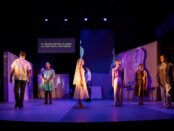
nicHi douglas’ vision is one of evocative beauty, one that gives us stage pictures to treasure for some time. The seated women fanning themselves with beautiful white fans as they watch one of their own reading a passage or singing is a natural touch. Even the graphic for the show gives us pause – the word “pray” surrounded by two hands creating the parentheses denotes how personal the power of an individual’s prayer is. douglas’ church is almost utopian in its design in that it welcomes all with no judgment…even the “mixed company” of whites present at the service who might be startled by how genuinely euphoric the service is. Her choreography, like her direction, is empowered by a true spirit of celebration, reminiscent of the great Alvin Ailey masterwork, "Revelations." [more]
The Great Divide
Does it matter how autobiographical Amy Crossman’s "The Great Divide" at the HERE Arts Center is? A production of the Boomerang Theatre Company, "Divide" is Crossman’s one-person play about a relationship that proved to be as beautiful as it was problematical. The situation is clichéd, but the presentation is first rate. [more]
The Picher Project
"The Picher Project" is a bluegrass and folk-infused musical conceived and directed by Quentin Madia, with music, book, and lyrics by Madia and Lauren Pelaia. This show is based on real-life events that are not only a part of Oklahoma's history but also of the social and industrial history of the United States. Through words and songs, the story is told of how this gentle, quiet, rural area became the center of lead and zinc mining in North America, only to end up dead as the number one most polluted place in the United States. [more]
Fall for Dance 2023: Program 5
The immediate impression of "Gira" was of the semi-circle of lights designed by Gabriel Pederneiras and Paulo Pederneiras (the Grupo Corpo artistic director) and their somber illumination of the twenty dancers—an impressively large cast—that heightened the ceremonial tone of the very repetitious choreography. The music by Metá Metá varied from ominous rumbles to full-out thumping Latin rhythms. The dancers filled the stage with stomps, twisting torsos, wildly abandoned runs and quickly morphing groupings. They formed circles around soloists and spread across the stage in their recurring movement patterns, quite effective dramatically in a sweaty, sensual way. The audience was bowled over by "Gira" as they were, for different reasons, by the other works on this very varied program. [more]
Bite Me
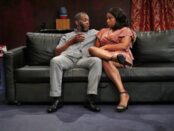
Both Garelik and Samuel’s performances as teens are fully formed and not stereotyped; their portrayals as young adults at their ten-year high school reunion are just as authentic. Direction by Rebecca Martínez is terrific, guiding both actors organically through their curiously intimate and emotionally climactic moments, at both stages of their characters’ young lives. Pipes has written an excellent play; she draws the disparate socio-economic and racial lines between Nathan and Melody with a fine pen. The arc and landscape of their friendship and its ultimate struggle is carefully wrought and effective. [more]
Jaja’s African Hair Braiding
"Jaja" is quite different from Bioh's other plays in that it is also very revealing about life in NYC for African immigrants. Directed by Whitney White who has piloted several major new Black plays in recent years, the play is funny, poignant and illustrative. The excellent and compelling cast of 11 includes six fine actors making their Broadway debuts. David Zinn’s detailed hair salon puts every inch of Jada’s Harlem African Hair Braiding parlor on stage down to the last braid and bobby pin. [more]
The Making of a Great Moment
"The Making of a Great Moment" by Peter Sinn Nachtrieb and directed by James Barry is a play about a pair of actors who are the principal players and only members of a bicycle theatrical touring company. It is a delightfully light-hearted story that takes us with them as they travel across New Hampshire with a show exploring the idea that "Great Moments" can happen unexpectedly. It is a show worth spending time with, although there are occasional bumps, flat tires, and rain storms in the journey. [more]
Bloodshot
Elinor T Vanderburg’s "Bloodspot" is a fascinating attempt to create a film noir play for the stage. The visuals do not live up to the script’s promise, but it remains entertaining and engrossing. The schizophrenic characterizations, half realistic and half outrageous, are distracting in their inconsistency; however, it does not take away from the final effect. While the production by SheNYC Arts, “a femme-led nonprofit organization fighting for gender equality in the arts and entertainment industry across the United States,” is deficient in several ways, the play augurs an impressive future career for talented playwright Elinor T Vanderburg. [more]
Fall for Dance: Program 3
The Houston Ballet, Julie Kent and Stanton Welch, directors, opened the program with Welch’s genteel "Clear" to music by J.S. Bach. Originally staged on American Ballet Theatre, the Houston dancers, seven men and one lonely lady, couldn’t have been better: smooth, exuberant, beautifully trained and rehearsed and musical to a fault. Bare-chested, wearing tight pants that flared at the bottom, the men performed Welch’s classical ballet-based choreography which ranged from simple classroom steps to bravura leaps and partnering. Yuriko Kajiya, the mostly ignored female, appeared to exist to be ignored by the men who barely interacted with her and then only in the slower movements. What distinguished the steps in "Clear" were the unusual arm movements that sometimes seemed to have emotional overtones, but mostly made lovely shapes as the dancers showed off their soft-edged virtuosity, particularly Connor Walsh who whirled madly about in a series of fouettés, usually the preserve of female dancers. [more]
Communion
LaBanca’s performance in his own play defies superlatives. Including us in his choir at the beginning of the show says it all. We are relieved that he still finds joy in teaching. As he puts it, “I packed up my classroom and as God would have it, I was invited to move everything to a public school. Also in my neighborhood.” He takes comfort in an accidental meeting with a priest who was asked to step down and move to another parish. “It’s ok. Matthew, just remember. The church isn’t God.” [more]
Saw The Musical: The Unauthorized Parody of Saw
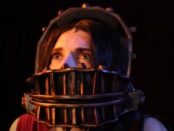
"Saw The Musical: The Unauthorized Parody of Saw" begins with a picture perfect recreation of the disgusting bathroom from the first movie in the iconic horror franchise. Then the puppet (Billy) shows up, wishing us a hearty "Wilkommen, bienvenue, welcome." (Note: this review has spoilers for "Saw" the movie as well as "Saw The Musical.") The show is impressively done with a cast of three (with the exception of Detective Tapp, played via voiceover by Donnel Johnson). Danny Durr plays Gordon and Zepp, Adam Parbhoo plays Adam and Gordon's daughter Diana, and on opening night Gabrielle Goodman played Amanda, Ali and Jigsaw. Goodman in particular stands out with a lovely voice and excellent dance skills, but all three turn in solid performances. (Durr's wig is so good it deserves its own program credit.) [more]
Twisted
It takes considerable skill for competent actors to play at being bad actors, and many of the cast members succeed. It is not a bad play, but the overarching problem with the show is that it is playing to a niche audience. If you do not know anything about the B-movies of the 50’s and 60’s, you will react as I did in thinking it is a terrible play. If you are familiar with the work of Roger Corman, William Castle, or any other B-film directors, or any of the films, such as "Galaxy of Terror," "The Little Shop of Horrors," "The Tingler," "The Curse of the Werewolf," or any of the dozen movies of that period, you may enjoy this production [more]
Purlie Victorious: A Non-Confederate Romp Through the Cotton Patch
In 1961, Ossie Davis channeled the hurt of growing up in segregated Georgia into "Purlie Victorious: A Non-Confederate Romp Through The Cotton Patch," humorously attacking the cause of his suffering rather than giving into it. A Broadway revival of the play, the first since those heady days of the modern Civil Rights Movement, is a current reminder that it's possible to smile through the pain. That it's a needed one is the tragedy. [more]
Golden Rainbow
The 1968 musical 'Golden Rainbow" (the show that gave us the song sensation “I’ve Gotta Be Me”) was so identified with its stars Steve Lawrence and Edie Gormé that it has not been seen in 55 years. When it was suggested to composer Walter Marks that he revisit the show, he found it had so much material created specifically for the Lawrences that it was no longer revivable. Instead he has written a new version of the original book by the late Ernest Kinoy (his collaborator on the Broadway musical "Bajour") as well as five new songs. The results are a small but appealing musical comedy with a terrific jazzy score as directed and choreographed by Stuart Ross. [more]
Big Trip: Pushkin “Eugene Onegin” In Our Own Words
Krymov’s production is a rapturous love letter to the making of theater. He unearths how we really tell our stories by our emotions, what we hide, as much as what we reveal. He uses his stagecraft to develop new work from what has existed for decades but now through what must be the most meticulous, yet fresh, improvisatory stage vocabulary. His new company’s forthcoming seasons will be must-see events of the highest order. [more]
Fall for Dance Festival 2023: Program 1
Ballet BC, the Canadian-based modern ballet company, began the program with 'The Statement," Crystal Pite’s witty take on a boardroom meeting, a corporate boardroom meeting full of intrigue and tension. Jay Gower Taylor’s slick set made the ballet with its chic, but spare conference table over which hung an ominous large, chimney-like structure, all lit with sharpness by Tom Visser. There wasn’t much of a musical score, just some rumblings by Owen Belton, over which a mini-play by Jonathon Young, pitting two couples against each other—one in business casual and the other more formally attired (costumes by Pite and Joke Visser)—became the sound score to which the dancers moved. The actors speaking the lines were Meg Roe, Colleen Wheeler, Andrew Wheeler and Jonathon Young, himself. The stylish, nimble dancers were Patrick Kilbane, Sarah Pippin, Vivian Ruiz and Rae Srivastava. [more]
“Dear Mr. Bottrell, I Cannot Possibly Accept This”
David Dean Bottrell is both a craftsman and an artist, as evidenced in his delightful and exquisitely entertaining show "Dear Mr. Bottrell, I Cannot Possibly Accept This." From his Prologue about the shape and size of a certain object to his adventures in New York and Los Angeles, and with his family in Kentucky, he takes us on a journey through the twist and turns of his life, and what a life it has been. [more]
Bettinger’s Luggage
An alternate title for Albert M. Tapper’s Clifford Odets-esque "Bettinger’s Luggage" might be "The Flood." In Tapper’s period piece, a flood destroyed the eponymous shop, an event around which Tapper’s tale of a family-owned business on Delancey Street in the Lower East Side of 1974 revolves. Solidly directed by Steven Ditmyer, "Luggage" is a classic story of one generation disappointing another with unreasonable expectations, with a touch of Jaime Sánchez’s character in the "The Pawnbroker"’s self-sacrifice tossed in for emotional heft. [more]
The Jester’s Wife
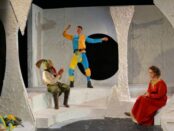
"The Jester’s Wife," written and directed by T.J. Elliott, is a fanciful attempt at reconstructing the source of the myth of Dymphna, a legendary medieval Irish saint who is considered the patron saint of mental illness. In telling the tale's origins, two characters create the framework what is to become the myth, and the third offers editorial commentary on their effort. While it is an intriguing idea to show how legendary myths were often created, this show does not measure up. The primary issue is the lack of a compelling interaction between the Jester and his Wife, leading to the creation of the story of Saint Dymphna. [more]
20 Seconds: A Play with Music
Sweitzer inhabits over a dozen characters in this play entitled "20 Seconds: A Play with Music," albeit two of them are him when young and him telling us the story now…two people he knows intimately. He is never so broad as to suggest caricature. His female characters are vibrant and flesh-and-blood enough for you to suspend disbelief that you aren’t actually seeing his mom Kathy, and Erdean, and Ms. Ruth, the fleabag hotel manager, and Denise, the girl next door, and finally his creation, Vivian Delgrosso, a drag homage to the Italian women his mom’s age. He brings the same depth to his male characters, with the masterpiece being his sadistic, yet eventually repentant father Tom. [more]
Dracula, A Comedy of Terrors
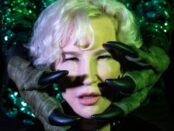
Each generation gets its own version of Bram Stoker’s Dracula, the classic vampire horror story, that possibly reflects its needs of it own time. The latest version now called "Dracula: A Comedy of Terrors" by Gordon Greenberg and Steve Rosen is a hoot, both a parody and a comedy, a cross-dressing hilarity in the style of both Charles Ludlam’s Ridiculous Theatrical Company and Monty Python. A fabulously talented cast of five led by buff, sexy young James Daly in the title role get a workout with the other four playing many roles in quick costume changes. Greenberg’s production with its witty script and design makes this a must-see entertainment. After the pandemic and other recent horrors, this is just what the doctor ordered. [more]
Swing State
Gilman's triteness and predictability combine to poorly serve a talented acting quartet, all of whom originated their roles in a 2022 production of "Swing State" at the Goodman Theatre under the usually steady hand of that institution's former Artistic Director Robert Falls, a Chicago legend. For whatever reason, Falls has kept his directing duties for the Off-Broadway run, too (a nice dinner at Minetta Tavern perhaps?). But it was a wasted trip for everyone, likely motivated by tragic topicality, the reputation of a world-class theater company, and a local sense of obligation to peek outside the New York bubble. [more]
Mary Gets Hers
From the playing style, as directed by Josiah Davis, the play seems to be a spoof. Unfortunately, it is not funny though the actors cheerfully mug their way through Horwitz’s text as though they find it hilarious. Its Middle Ages protagonist Mary played by Haley Wong is so naïve and unsophisticated that it is difficult to believe her portrayal. Much of the dialogue is very repetitious and becomes tedious while the plot is so emaciated that it is a wonder that it takes 80 minutes of playing time. [more]
Zoetrope
Clearly, "Zoetrope" often becomes difficult to follow for non-Spanish speakers. The dearth of realistic sets makes knowing which location is which confusing, despite the occasional descriptive titles. Then, the fact that most of the actors—all of whom are terrific—play several parts in a rapidly time-shifting plot makes figuring out who’s who and who is in a relationship with whom difficult to ascertain. Why is Puerto Rican independence glossed over? How does Claudio become a filmmaker? It’s the debut of his movie that ends "Zoetrope." [more]
Prometheus Firebringer
Somewhere there are rules for what theatre is supposed to do: it should entertain, it should instruct, it should provoke. To say that Annie Dorsen’s "Prometheus Firebringer" checks all the boxes is an understatement of what she has done here. It is a brilliant reactionary, and yes, even cautionary, piece that takes a 2,500-year- old play that doesn’t really exist anymore (what is left of it is the title and a fragment or two – the rest has been lost over time) and thrusts it into an exercise for the unwitting specter of Artificial Intelligence. The results are fascinating, yet unremarkable; provocative, yet giddy. [more]
Infinite Life
Ever since Pulitzer Prize-winning playwright Annie Baker adapted 'Uncle Vanya" for a 2012 production at the Soho Rep, her plays like "The Flick," "John" and "The Antipodes" have becomes more Chekhovian: not a great deal happens but characters live out their daily lives. In her new play "Infinite Life," she has gone even further with the silences and the pauses that she has become famous for. Under James Macdonald’s superb direction, we watch five women and one man read, sleep, talk and sip water or juice on the patio of a wellness clinic in Northern California trying to deal with their chronic pain. Not much happens but, on the other hand, these people reveal their whole lives before they complete their treatments and go back to their previous existences. [more]
Job
Max Wolf Friedlich’s "Job" is as tense as a thriller, as compelling as a psychological drama and as up-to-date as tomorrow’s headlines. As directed by Michael Herwitz, Peter Friedman and Sydney Lemmon are living their roles, rather than just acting them. While the play will grab you by the throat while you are in the theater, it will give you a great deal to think about after you leave. In that it resembles other two-character plays by such authors as David Mamet and Harold Pinter. It is to be hoped that the play will be extended or better yet moved to a larger theater so that more people will be able to see it. [more]
9 Kinds of Silence
This play demands attention to the smallest details and a thoughtful encounter with what truth is being hidden and revealed in both the spoken text and the silent actions. It leaves one with a need to make sense of the experience and the feelings that it engenders. It is drama to be experienced and savored. See the show if you like intense, thoughtful, well-acted drama. [more]
Tripping on Life
Shaye tells of a pot and drug-addicted couple who are totally disgusting parents to a two year old. That’s just not acceptable even though it is told as a funny hippy-dippy anecdote. Even so, Shaye is a great storyteller, her narration a perfect substitute for the absent camera. However, she is a poor developer of characters. Her insights end with naming the drugs each character takes. None of the characters seem to have any means of support, however colorful they are. [more]
Doris Day: My Secret Love
Borelli as Doris Day is charming and appealing; her voice is not quite as strong as Day’s, but it is pretty and expressive, especially in quieter, more intimate moments. At the peak of some songs, where she’s expected to sing out fully and with passion, her voice doesn’t quite have the strength. [more]
alt-Hamlet
"alt-Hamlet," written and directed by Suzanne Willett, loosely uses "Hamlet' 's plotting and character types in a carnivalesque/grotesque black comedy. Inspired by the US Supreme Court's 2022 decision on abortion rights, Willett penned an indictment of the court’s imposition of legally sanctioned restrictions on women’s control over their bodies. She uses Hamlet as the vehicle for the story since it was a play centered on the Elizabethan view of inheritance as a right. Her play centers on a woman’s right to control her body. She also uses pregnancy and "morning-after" and "abortion" pills as elements in the story. While the topics dealt with are important, this production does not effectively deliver on those topics, not for want of trying, but because of the venue and some directorial choices. It reads better than it plays. [more]
Anne Being Frank
Elisha has written a refreshing new take on Anne Frank’s life. Called "Anne Being Frank" (a title that should, perhaps, be reconsidered), the one-person, multi-character show posits a surreal possibility, that Frank managed to survive the War and decided to rewrite her oft-expurgated famous Diary [more]
No Good Things Dwell in the Flesh
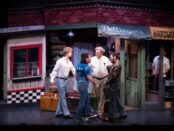
Everyone loves a good immigrant story, from The Godfather on down. 'No Good Things Dwell in the Flesh" doesn't reach that high, but it succeeds in what it tries to do, which is to be an accurate portrayal of a specific experience. Agata (played by reliable veteran Kellie Overbey) is an aging Russian tailor with a shop in Queens who wants to retire. She's 64 years old and hasn't had a vacation in 12 years. She'd like to give the shop to her young assistant Janice (Carmen Zilles). Janice is interested but also boy crazy and generally doesn't have good judgment. [more]
The Creeps
Catherine Waller’s one person show, "The Creeps", has all the elements of a successful horror show: a macabre setting, dark lighting, off-beat characters, and strange unexplained going-ons. Unfortunately, several things get in the way of its registering. Created and starring Waller dressed entirely in form fitting black, the production has eschewed a director who is very much needed as there is too much dead time in this slightly less than one hour show. At this length it still seems long with too many undramatic pauses. Presented in the renovated four-sided Playhouse 46 at St. Luke’s, the audience is also aware of each other throughout which makes the evening a great deal less scary than it ought to be. Scott Monnin’s lighting is never dark enough to make us feel that we are in some place other than the theater with other people. [more]
Relapse: A New Musical
In "Relapse" ’s most original conceit, a quartet called The Intrusive (Vinny Celerio, Audree Hedequist, Nicole Lamb and Zummy Mohammed) becomes a Greek Chorus, insinuating themselves into the minds of the four unhappy patients while commenting on the inner workings of their care. The four are nimble, vivid and sing well, choreographed by Freyani Patrice whose movements ooze, flit and crawl about the stage as these four surround each character. [more]
2023 Fini Dance Festival and Italian International Dance Awards
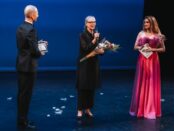
Antonio Fini in Ted Shawn’s “The Cosmic Dance of Siva,” performed as part of 2023 Fini Dance [more]
Click
"Click" by Drew Pisarra and directed by James Dean Palmer is a play inspired by the film "Breathless," written and directed by Jean Luc Godard and considered a seminal work in establishing French film noir. Pisarra is paying homage to Godard in creating a play that attempts to present the bleak, dark characters and settings of a noir film such as "Breathless" on stage. He is only partially successful in the task, and ultimately, the play fails to be an entertaining evening of theater. [more]
A Will to Live
Director Rick Hamilton effectively steers the sad tale away from an endless maudlin saga. After all, the “spoiler” is in the program. Helena Weinrauch is alive and well and in her late 90’s, living in New York City. She attended the opening night of this production. We are carried by Helena’s travails – some are ultimately uplifting, like her about-face on her relationship with Wladek, a Jewish guard. She takes him to task for his participation in the black market, but he steps in to save her from death more than once. Earlier, she leaves the safe haven of living with a German couple who think Helena is married to a German officer on the front so not to put them in harm’s way when she knows she will ultimately be found out to be a Jew masquerading as a young German bride. Hamilton is conscious of needing every scene to be driven by intense depictions of rapid change in what was once a beautiful place to live. [more]
The Tempest (Public Works)
Visually, the show is not as effective as it might have been considering the play usually includes a great deal of magic. Here there is very little in the way of scenic illusions or legerdemain. Alexis Distler’s setting which makes use of some elements of the design for Hamlet, the previous staging on the Delacorte stage, a falling down mansion seemingly off its foundation, adds little to the production’s visuals. Except for the stunning harpy costume for Ariel by Wilberth Gonzalez, the rest of the designs are more than bland. The all-black leather creations for the Europeans give the production a contemporary look that feels out of place. The dozens of community partners dressed in matching blue and yellow outfits have been given little to do besides stand around as witnesses or hum to the large-scale musical numbers. [more]
How to Steal an Election: A Dirty Politics Musical
While the misnamed "How to Steal an Election: A Dirty Politics Musical" is no lost masterpiece and at times seems long, it is a diverting political revue which offers an interesting take on the politics of the last 180 years. With the charming Jason Graae at the helm, the rest of the talented cast keeps the show rolling merrily along. New faces Emma Degerstedt, Alex Joseph Grayson, Courtney Arango, Kelly Berman and Drew Tanabe demonstrate that they should have very successful and acclaimed careers before them from their work here. [more]
Pay the Writer
Directed by Karen Carpenter, "Pay the Writer" by best-selling novelist Tawni O’Dell is slick and superficial but entertaining and engrossing. The play about the 45 year friendship between an ultimately successful gay literary agent and an unknown African American novelist who becomes celebrated and wealthy plays like a novel or mini-series with its 13 scenes and many two-character encounters but is ultimately satisfying by the time it reaches its denouement. The high powered cast plays it to the hilt, belying the fact that the characters are superficial and stereotyped, which, of course, doesn’t make it untrue. Some of the play is extremely funny with one-liners worth repeating. [more]
A Séance with Mom
Redman’s "A Séance with Mom" at the Chain Studio Theatre veers dizzyingly from one character to another, characters that include middle-aged Nadine who searches for her Mom; her mom, Gussie; an old Reformed Jewish Rabbi; several other Gussies; and, oh yes, Jesus and Gary Cooper, not to mention Shakespeare. It has to be mentioned that Nadine is the only character who isn’t dead. [more]

What Else Is True?
Another problem with the play is that although the subject is “Improv” we never actually witness any, just theater games to prepare for group improvs. Games like Mind Meld, Mating Call, 99 Problems, Zip Zap Zop and the Pattern Game are practiced but as the rules are not made clear, many in the audience be confused by what is happening. Throughout the play we are told that Miles is the most brilliant of them all, based on his auditions and performances, but except for a brief moment in the next to last scene in which he performs two characters in an improv alone, we are never shown any evidence of this. [more]

Baby Foot
"Baby Foot," written and directed by Tim Venable, follows the interactions between three addicts in the very early morning in the lounge room of a rehab facility. The two central characters are Alexis, who is leaving the program facility, and Blackie, who is on his first day. There is a third, pivotable character, Fred, the janitor, a recovering addict who has worked at the rehab facility for thirty years. "Baby Foot" effectively deals with psychologically and emotionally heavy topics in a thought-provoking way without being overly dark. It has moments of humor within the serious drama but ultimately provides a sense of hope and fulfillment. It is a show worth experiencing for skillful performances and a view of the world of a recovering addict. [more]
ON THE TOWN WITH CHIP DEFFAA: ON “FUNNY GIRL,” ETHNIC CASTING, AND FANNY BRICE…
Brice—as a pioneering Jewish female Broadway star who took charge of her own fabulous career in an era when few women did—became a source of inspiration for many aspiring young Jewish performers. At her peak, Brice was the highest-paid American singing comedienne. [more]
The Shark Is Broken
As for what's in a name, yes, Ian Shaw is Robert's son, returning the life-giving favor not just through his words but also bodily, portraying his father in "The Shark Is Broken" with a candid empathy (and astonishing physical resemblance) that highlights the elder Shaw's strengths while giving context to his weaknesses, too. Because of ongoing technical difficulties with Spielberg's monstrous mechanical fish, known as Bruce, there was protracted downtime during the filming of "Jaws," which the play fills with imagined conversations between Robert and his co-stars Richard Dreyfuss (Alex Brightman) and Roy Scheider (Colin Donnell). Despite set designer Duncan Henderson's remarkable recreation of the Orca, the movie's barely seaworthy boat, hardcore Jaws fans might feel as if they've been bait-and-switched, since, in the final tally, they only get one early image of a not-so-ominous shark fin to satiate their thrill-and-chill-seeking expectations. In keeping with what's on the marquee, it quickly malfunctions, sinking into video designer Nina Dunn (for PixelLux)'s vast ocean backdrop, never to be seen again. [more]
Back to the Future: The Musical
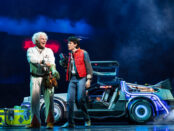
"Back to the Future: The Musical," the time travel adventure, joins a long line of problematic screen to stage musicalizations which do not improve on the originals in any way. Joining the list that includes in recent memory "Pretty Woman," "King Kong," "Tootsie," "Mrs. Doubtfire" and "Almost Famous," Back to the Future, using one of the original movie’s co-writers (Bob Gale without Robert Zemeckis), attempts to transplant the film in toto to the stage of the Winter Garden Theatre without adding anything new to the mix other than having the characters sing and dance. If theater is meant to surprise us, then like the stage version of "Almost Famous," "Back to the Future" slavishly follows its source material so that we feel like we have seen it all before – and better. [more]