News Ticker
- April 8, 2026 in Off-Broadway // Desi SNL
- April 7, 2026 in Musicals // No Singing in the Navy
- April 7, 2026 in Off-Broadway // Uncle Vanya, scenes from country life
- April 7, 2026 in Off-Broadway // The Last Audition
- April 2, 2026 in Columns // THE EXPLOSIVE GROWTH OF FILM AND TV PRODUCTION FACILITIES IN THE NEW YORK / NEW JERSEY AREA
- April 1, 2026 in Musicals // Gotta Dance!
- March 31, 2026 in Off-Broadway // Jesa
- March 30, 2026 in Musicals // Monte Cristo
- March 30, 2026 in Off-Broadway // The Unknown
- March 30, 2026 in Off-Broadway // Antigone (This Play I Read in High School)
- March 30, 2026 in Off-Broadway // Antigone in Analysis
- March 29, 2026 in Off-Broadway // Bughouse
- March 28, 2026 in Musicals // The Paparazzi
- March 27, 2026 in Broadway // Giant
- March 26, 2026 in Off-Broadway // Ivanov
- March 25, 2026 in Musicals // Blood/Love
- March 24, 2026 in Off-Broadway // Touch
- March 24, 2026 in Music // The Silent Serenade
- March 23, 2026 in Musicals // The Wild Party (New York City Center Encores!)
- March 22, 2026 in Broadway // Every Brilliant Thing
- March 22, 2026 in Multimedia // Burnout Paradise
- March 20, 2026 in Musicals // Chasing Grace
- March 20, 2026 in Off-Broadway // Entangled: 12 Scenes in a Circle K off the I-40 in New Mexico
- March 19, 2026 in Off-Broadway // Trash
- March 17, 2026 in Concerts // The New York Pops: “United in Sound: America at 250”
- March 17, 2026 in Musicals // Bigfoot! A New Musical
- March 14, 2026 in Off-Broadway // Spare Parts
- March 14, 2026 in Off-Broadway // Zack
- March 13, 2026 in Off-Broadway // Dear John
- March 10, 2026 in Off-Broadway // Our House
- March 10, 2026 in Off-Broadway // Body Count
- March 8, 2026 in Off-Broadway // Chinese Republicans
- March 7, 2026 in Off-Broadway // The Mall The Mall The Mall
- March 7, 2026 in Off-Broadway // The Reservoir
Archive
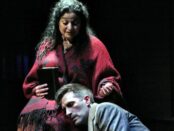
Tyson’s portrayal of Raskolnikov is riveting as he moves through the elements leading inexorably to his mental collapse. The exchanges with Porfiry are woven together with encounters with the people in his life that had an impact on his present mental state. Each of these ancillary scenes are used to fill gaps in the storyline needed to clarify Raskolnikov’s mental state and the exchanges that take place with the inspector. Lenartz gives a first-rate performance not only of Porfiry, but of all the characters he inhabits. He transforms into each of these characters with small changes in costume and with his movement and speech. He makes each of the ancillary characters distinct. This same skill is evident in Stone’s portrayal of all the women in the story, with small changes in costume and physicality she becomes a new character. The only quibble I have is with her portrayal of the character Sonia. The age of the character is important in the story, and although Stone does not fit the part, it does not diminish the impact of the performance.
[more]
Ronald K. Brown/EVIDENCE, the Brooklyn-based dance company founded in 1985 is back at the Joyce Theater presenting two works by Brown showing off the exuberance, sensuality and technical brilliance of its eight dancers plus one guest artist. “Walking Out the Dark” (2001) was the more substantial work. Using only four dancers—until the very end when company associate artistic director Arcell Cabuag performed a peculiarly out-of-place solo—Brown began in a quietly intense mood, gradually lightening up by the end of this uneven, but well-meaning 50-minute work.
[more]
Hendley is solid in his performance as the narrator of his and his grandmother’s story. His presentation commands attention without demand, smoothly and effortlessly focusing on the words being spoken. He has created a show with a strong storyline but needs a rework of the structure. Although his narrational guidance is well-written and beautifully presented, it adds too much exposition when perhaps the information could be dramatized.
[more]
Harmon meticulously fuses the domestic ups and downs of this bright, well-educated extended family with the overwhelming and unavoidable social upheavals that surround them whether it’s the Nazi persecutions or the rise in anti-Jewish violence and rhetoric in contemporary France. Their story is epic, but intimate. David Cromer, the director, isn’t afraid to keep "Prayer" flowing in a deliberate, unhurried pace, or pausing at times letting the play breathe. He makes the epic quite human scale. "Prayer for the French Republic" is monumental, yet human scaled, addressing a resurgent scourge with intelligence and warmth.
[more]
The show is well presented but lacks a clear narrative, leaving viewers with more questions than answers. Is it about a man's journey to self-discovery or an exploration into a confusing haze of fantasy and hallucination brought on by a mental breakdown? The added storylines used to illustrate narrative points do not clarify the overall thematic structure of the production but add layers to the mystery of Ernie’s mental state. If you like theater, even with the limitations in exposition, it is worth the effort to experience a production outside of what people typically consider dramatic staging.
[more]
Not only is Branden Jacobs-Jenkins’ "Appropriate" a classic American family drama with a new wrinkle, it is also a trenchant and scorching look at American racism which is just under the surface. So fine a playwright has Jacob-Jenkins become that every line of dialogue develops character and plot. What is most shocking about the play is how little the younger generation depicted knows about its American history, things we all should be aware of. Lila Neugebauer’s production for Second Stage mines all of the play’s nuances and her staging is smooth and effortless. The cast led by stage, screen and television stars Sarah Paulson, Corey Stoll and Elle Fanning (in her Broadway debut) make the most of their many opportunities. "Appropriate" is the most satisfying new American play on Broadway at this time and should not be missed. The running time may seem long but the rising tension and periodic revelations make the play feel like it could even be longer.
[more]
Aside from the title not being explained, the Jean Graham-Jones translation seems to end very abruptly. Nothing is settled at the end of its short running time and it certainly feels like more is to come, unlike Williams’ play. There are also too many unanswered questions like what does Ursula do that supports the family of three, why has Lorenzo chosen Spain to move to, what event caused Antonia to stop going out, what is the relationship between Lorenzo and Maximiliano, etc. While Ursula is proud of her Hungarian and Mexican heritage we don’t learn much about it. The Whole of Time plays like a sketch of a play that hasn’t been written or that need a second act to deal with all the loose ends.
[more]
Many people probably wonder, though, just what are the main differences between the film and theater industries? Aspiring actors are probably curious to know just what all is involved in each option. And if you’re interested in learning more about the art itself, you might consider taking an entry-level job and trying your hand directly.
[more]
How the ten dancers of Momix create so many beautiful and mysterious images is a credit to artistic director Moses Pendleton and his associate Cynthia Quinn who, along with the dancers, create superb eye candy illusions. In fact, the performers of Momix are billed as dancer-illusionists. This season at the company’s New York headquarters, the Joyce Theater, sadly, there was only one new work, “Floating.” Instead, the program, entitled “Viva Momix,” consisted of sixteen oldies-but-goodies all staged with Momix’s signature expertise.
[more]
There are few issues that raise the ire of the religious as a member changing religions. Apostate is the mildest term used for such a person. Mikhl Yashinsky’s "The Gospel According to Chaim" at Theater for the New City tells of such a person, the eponymous Chaim Einspruch, played with beatific authority by the author, himself. This is a true story and a rarity: a contemporary play written in Yiddish. (Supertitle translation is provided.) Chaim Einspruch wrote the first Yiddish translation of the New Testament, a shanda of the highest order since this acknowledges the existence of Jesus as “the Savior.”
[more]
Joy filled Carnegie Hall with The New York Pops’ annual two-night Christmas concert entitled "The Best Christmas of All" led by genial host, music director and conductor Steven Reineke. This year’s guest artist was Broadway baritone Norm Lewis who was joined by several announced and several surprise guests: soprano Vanessa Williams (Friday night only), Pastor Bobby Lewis (actually a cousin of Norm Lewis), 14-year-old percussionist Jonathan Logan making his third Carnegie Hall appearance, guest conductor Ruthanne Ruzika and the annual visit of Santa Claus with elf Pecan Pie. The program was mainly made up of old favorites and one or two unfamiliar compositions which were greeted with ovation after ovation from the sell-out crowd.
[more]
The latest Tennessee Williams revival is the first major New York staging of "The Night of the Iguana" since Roundabout Theatre’s 1996 production. Emily Mann’s version with a great many well-known stage actors (Tim Daly, Daphne Rubin-Vega, Lea DeLaria, Austin Pendleton and Jean Lichty) is a solid reading of the play though there is little chemistry between the main characters. Also at almost three hours, the production seems long though it does not drag. Visually the production with Jeff Croiter’s impressionistic lighting is stunning though the set by Beowulf Boritt may be a bit too large for what is basically an intimate play. Nevertheless, the revival is a good introduction to a Williams play not seen too often and best known from the somewhat different 1964 film version by John Huston which gave Richard Burton one of his best screen roles.
[more]

Ranchera is a style of traditional Mexican folk music with origins in the ranchos of rural Mexico. The songs are about love, patriotism, or nature and are usually sung by men. The vocals have a rough, raw quality in contrast to the more refined vocalizations of the urban singers. In Mexico City, Chavela defied the norms and sang rancheras with her style and interpretations while staying true to the rawness of delivery and the ideas expressed by the lyrics. Trudeau transforms herself into Chavela with an on-stage costume change and then provides solid interpretations of some of Vargas’ classic rancheras as she takes the audience on an exploration of Vargas' life in Mexico City, a brief time in Cuba and to the mid-1970’s when she stopped performing as a result of all the tequila she had consumed over the years. Although Trudeau's voice is more refined, she still delivers the songs with all the passion and fire needed in some and the introspection and sadness in others. Her embodiment of Vargas is complete.
[more]
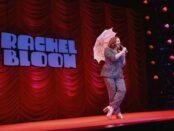
Dressed in a glittery, silver suit—costumes by Kristin Isola—Bloom immediately takes control of an audience who already admire her from her standup comedy and her bitterly funny TV show, "Crazy Ex-Girlfriend" plus her solo tour of "What Am I Going to Do with My Life Life?" and, perhaps, from the recent iteration of this amusing musing of life and death and birth and Covid. Bloom ponders her pre-pandemic self and the trauma of the birth of her daughter who had a life-threatening condition. Covid limited her visits to her baby in the NICU and caused the death of her close friend and writing partner Adam Schlesinger who, ironically, shared the NICU when it was partly converted to a Covid ward.
[more]
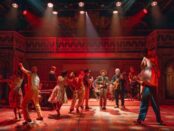
While the exciting new stage musical Buena Vista Social Club shares the same name with the acclaimed 1999 documentary by Wim Wenders, playwright Marco Ramirez’s book for the new show takes a different approach to the true story now under the direction and development of go-to director Saheem Ali (Fat Ham) for new work by people of color. While the film took us to the recording studio and then interviewed or followed the daily lives of the major singers and musicians involved ultimately taking us to their July 1, 1998 Carnegie Hall concert, the stage show instead tells the 1956 backstory of several of the main characters after we meet them at the 1996 recording session. Although the film made the male singers Ibrahim Ferrer and Compay Segundo the main characters, the musical puts the focus on recording star Omara Portuondo. Both approaches contain the original songs sung by the Cuban music group of old timers that came together in 1996 to record an album of almost forgotten Cuban songs making both versions documents of the highest authenticity.
[more]
Jes succeeds where some other bio-storytellers fail. Jes’ secret is being comfortable in their own skin to relate intensely personal experiences yet create a sense of universality, or community, that envelops the entire audience. You may not always agree, but chances are good you will be laughing with Jes, and not at Jes. As Jes puts it, “Most of my material takes at least two semesters of gender studies to truly understand.” As with most other autobiographical journeys, we get a heavy dose of self-deprecating humor, “I like when people call me 'they,' it makes me feel less lonely. Like someone can be like, 'That’s Jes, they’re gonna go smoke a spliff' and it sounds like I had a friend.” Reflecting on early career choices, “I was doing non-binary comedy in straight bars and clubs that were ten straight guys and one woman, and the woman was me. And I was like 'I’m not sure I’m the guy for the job but I’ll do my best for the culture. ' ”
[more]
Mary Kathryn Nagle’s "Manahatta" now at The Public Theater, just blocks from where most of the story takes place, is a fascinating combination of American history and recent events. Nagle who is a Native American has written a play that combines the Dutch purchase of the island of Manhattan in 1626 from the Delaware Lenapes with the Wall Street home-mortgage crisis of 2008 where many disenfranchised people lost their homes. She also includes the contemporary Lenape community living today in Anadarko, Oklahoma, after they had been evicted from their Texas reservation. While the three time-frames of the play run concurrently, they all come together in a devastating ending that indicts the capitalist system as well as how Native Americans have been treated in this country.
[more]
Until now it has been believed that the 1937 Joris Ivens-Ernest Hemingway documentary "The Spanish Earth" was paid for by a corporation called Contemporary Historians sponsored by some of the most famous liberal writers of the time: playwright Lillian Hellman, mystery writer Dashiell Hammett, poet, screenwriter and essayist Dorothy Parker and her husband Alan Campbell, poet Archibald MacLeish, novelists John Dos Passos and Hemingway. However, in "Spain," contemporary playwright Jen Silverman has another idea: what if this famously propaganda film was financed by the KGB and that filmmaker Ivens and his girlfriend/editor Helen van Dongen were agents for KGB operatives in New York?
[more]
Based on an identically titled 2015 HBO documentary by Alexandra Shiva, "How to Dance in Ohio," in its musical form, works best whenever that magnificent seven is completely together onstage and falters mightily if none of them are present. Their characters' bond comes courtesy of Dr. Emilio Amigo (Caesar Samayoa), a psychologist--in both real and theatrical life--who specializes in social therapy for autistic people. To assist them in the closing stage of their adolescent development, Dr. Amigo's creative approach is to hold a spring formal, a traditional rite of passage that, of course, generally produces a lot of anxiety even if you're not neurodivergent. Through the voice of Marideth (Madison Kopec), the newest and most studious member of the group, Rebekah Greer Melocik's high-minded book makes sure to point out this hoary event's gendered baggage, though simply as an annotation rather than as the basis for any intriguing character conflict.
[more]
Through a technologically astute production and fine acting, their intertwining stories unfold in a dramatic tapestry that reveals the sad business of mail-order brides. Using an intricate combination of pre-recorded videos, live video feeds and “ghost voices” (Joy Tamayo), the live actors emerge as engaging and moving women, their fates becoming ever more fascinating and heartbreaking.
[more]
"The Inheritance of a Long-Term Fault," written by Mêlisa Annis and directed by Vanessa Morosco, is an extraordinary play that explores how the societal structures across many cultures have shaped cultural interactions and defined what is viewed as societal norms to the present day. It is a provocative, thought-provoking look at how colonial patriarchal behaviors and attitudes about women's roles persist into the present day. It is a show worth seeing and, more importantly, exploring the ideas engendered by it.
[more]
Probably only David Rabe’s "Sticks and Bones" (part of his Vietnam trilogy that included "The Basic Training of Pavlo Hummel" and "Streamers") is as demonstrative as "Lone Star" in its depiction of a soldier’s inability to easily pick up from where he left off upon returning from a tour of duty. For this production, Ruth Stage, in an adaptation by director Joe Rosario and actor Matt de Rogatis, has been given the rights to append the character of Elizabeth to the original "Lone Star" cast. Her character is from a companion McLure play, "Laundry and Bourbon," which has a history of being performed in repertory with "Lone Star." Elizabeth is Roy’s wife, therefore Ray’s sister-in-law.
[more]
Playing women of a certain age, four women stars of stage and screen who became famous a while ago play friends of a certain age who meet for a birthday brunch in Sandra Tsing Loh’s "Madwomen of the West." The ensuing hilarity will be of most interest to baby boomers who still worship Gloria Steinem, Mary Tyler Moore and Hilary Clinton, but others will also find this an entertaining show as breezily directed by Thomas Caruso. The roles fit actresses Caroline Aaron, Brooke Adams, Marilu Henner and Melanie Mayron returning to the New York stage so well that one might think they were playing facets of themselves or of their screen personas.
[more]
Despite its fairy-tale plot, Axemas isn’t really suitable for children because of language and sexual situations, but everyone else will find something amusing in this rag-taggle production. An Axemas Story could use some tightening and more professional looking scenery, but it’s tongue-in-cheek fun, nevertheless. The score is beautifully played under the musical direction of Sara Linger and the keyboard expertise of Buck McDaniel.
[more]
"Killin’ Republicans," concept and libretto by Dick D. Zigun and music by Arturo Rodriquez, directed by vagabond, is billed as a rock opera about violence towards certain Republican Party leaders since the mid-nineteenth century. It deals with a series of assassinations and attempted assassinations of Republican leaders from the 1850s to President Reagan in 1981. It is supposed to be a discussion about the reasons for the attacks and not a call for violence against Republicans. The entire show is sung or performed in spoken form in various styles as more of a concept concert than an opera. The libretto covers a wide range of events attempting to give context to the multiple incidents but fails to clarify the point of the show. It is a mistake in its present form.
[more]
"The Jerusalem Syndrome" is a pleasant new musical comedy with some fine clever songs and good comic moments. However, Don Stephenson’s production does not take the farcical elements far enough nor does he allow the cast to really have fun with their wacky roles. Playing this material mainly straight undercuts the inherent fun in the premise and plot as the Jerusalem syndrome is ripe for satire.
[more]
"Mind Mangler: A Night of Tragic Illusion," starring the genial, but daffy, Henry Lewis, is part of the “gone wrong” franchise by Lewis, Jonathan Sayer and Henry Shields: "Peter Pan Goes Wrong" and "The Play that Goes Wrong," the latter of which is still playing in the same theater complex as "Mind Mangler." Like its sister shows, this is a goofy, but intelligent mix of silliness and sophistication.
[more]
Michael John LaChiusa’s "The Gardens of Anuncia" is an interesting attempt to tell choreographer Graciela Daniele’s adolescent story. Unfortunately, as of now the show does not make the case that her coming of age was that eventful or compelling. What we might like to know is about her famed career, but that sort of presentation has been done in "Fosse," "Jerome Robbins’ Broadway," and "Prince of Broadway," the Harold Prince story. "The Gardens of Anuncia" is pleasant enough but leaves one hungry for more. The magical realism elements might be more fleshed out and some of the unanswered questions that are coyly handled might be revealed.
[more]
The secrets revealed seem more contrived and clichéd and take away from the moving story of Mary’s battle with cancer. Nick behaves badly. Lucy has a drug habit and Jason questions his legitimacy in the family—all turn "‘Til Death" into a soap opera, a beautifully acted soap opera, yes, but still a soap. Kaye and Cuccioli provide the emotional heft, particularly in a tender scene when, for a few minutes, the rest of the family isn’t around. Both are expert actors and find all the rich opportunities to give life to Coplan’s words.
[more]
"Hell’s Kitchen" is both ambitious and noble in its intentions. However, as of now the show on the stage of The Newman at The Public Theater is not there yet. With very few characters developed and too many unanswered questions, the show’s book needs a simple rewrite. The Alicia Keys' score which too often sounds the same could use a reshaping to find some climactic moments other than the drama in the story. The plot lines need to come together more, rather than as disparate elements that take us in new directions all the time. Ultimately, Hell’s Kitchen has great potential when these problems are addressed.
[more]
"United Nations: The Other West," written and directed by Bossert, is an outstanding example of the hybrid theatrical system he has created. This production is an extension of his 2022 "United Nations: The Border and The Coast" with connections to stories streamed on Thirdwing’s internet platform. This form of theatrical production aims to bridge theater and film in a way that tells important stories that pierce the limitations of traditional theater and allow for a more expansive exploration of characters and themes. Bossert’s direction of an exceptional ensemble delivers an entertaining evening of theatre with humor and important ideas. This is not derivative of any other production; it stands alone as a play worth seeing.
[more]
There are frequent breaks in thought such as “I forgot to mention at the top that I will be injecting my jokes with a bit of humor tonight as a way to keep them both engaging and fun.” Thanks for clarifying the job description. This is just one of many exclamations to the obvious. Director Nemuna Ceesay keeps us guessing. Are we watching an actor portraying a comedian/lounge performer? Does the comedian/lounge performer think he’s funny? What if no one laughs? A bit later there’s a recitation that goes on longer than it needs to. We start waiting for a punchline that never comes. And then it does…As it was introduced as a voice-over, “That was the opening paragraph of Moby Dick by Herman Melville, sold wherever Moby Dick by Herman Melville is sold.
[more]
Director Matthew “Motl” Didner manages to make what might have been just a well-staged concert of moving songs into a dramatic whole with a deep feeling for the ebb and flow of emotions from happiness to hopelessness. "Amid Falling Walls"—an apt title, unfortunately, still consequential in 2023—does come during a spike in anti-Semitism. Though an entertainment, the show provides ample historical evidence of blind prejudice. If only the message could register.
[more]
Milo Cramer’s delightful solo musical "School Pictures," part of a festival of new one person shows running in repertory at Playwrights Horizons, is wildly inventive, hilarious funny, and extremely insightful about adolescence, class, over-privilege and the New York education system. Almost entirely sung throughout, School Pictures tells us in a series of 11 songs about Cramer’s experiences working as a private tutor in NYC after school with mostly rich, brilliant students who are damaged by their parents – and their own – expectations. All of them hope to get into one of the eight elite specialized high schools for which they will need the SHSAT (Specialized High School Admissions Test) or top colleges and the competition as both the parents and students know is fierce.
[more]
As Kenneth/Kate Marlowe, Wade McCollum not only becomes the character but inhabits it. Required to act as narrator as well as performer in both male and female attire, McCollum is totally convincing. His personal charm and rapport with the audience also makes this a pleasurable experience. Make Me Gorgeous! is an unusual biographical show as the details of Kenneth Marlowe’s story will likely be unfamiliar to most theatergoers who will also be entertained by the musical portions of the evening.
[more]
The pairing of Broadway legends Sutton Foster and Kelli O’Hara proved felicitous just like the previous pairing of Julie Andrews and Carol Burnett, with each lady using her special gifts: Foster was best in the comic moments and O’Hara was ravishing in the semi-operatic musical numbers, just as had been Burnett and Andrews in their three concerts. Backed by the glorious New York Pops orchestra led by Maestro Steven Reineke, Foster and O’Hara made the most of this unique concert staging directed by Dick Scanlan. The many uncredited costume changes put the singers in either stunning red, black or white outfits. Throughout the evening the singers were supported by their own music directors at the piano, Dan Lipton for Kelli O’Hara and Michael Rafter for Sutton Foster. "One Night Only: An Evening with Sutton Foster & Kelli O’Hara" proved to be a memorable evening and one that is hoped to be the first of many.
[more]
Ironically there is no rapport or chemistry between Shannon and Sparks playing friends who have been traveling together for 50 years. As Estragon, in need of sleep and with shoes that don’t fit, Shannon’s deadpan demeanor and poker face expression are unsuitable for a play in which all the actors have is their ability to communicate with each other as there is not much action, and less plot. As the more self-sufficient Vladimir, Sparks is better and more expressive but he can’t carry the play alone. Playing opposites, one pessimistic, one optimistic, it is important that we feel the tension and the link between them which here is latent. They are also somewhat younger than the roles are usually cast considering they mention having been together for five decades.
[more]
Still, whatever faint accommodations he grants it, for Idle, structure is the enemy of joy, which every aspect of "Spamalot" is relentlessly intent on delivering, not only from a few well-performed and well-known old Monty Python bits (the Knights Who Say "Ni!"; the French Taunter; the Black Knight) but also through amusing allusions to classic Broadway musicals that Aaron Sorkin was never given the chance to ruin. To be sure, it is fan service on a couple fronts, forming a Venn Diagram highlighting anyone who adores, for example, how Idle's brainy, irreverent silliness transforms Stephen Sondheim's song "Another Hundred People" from "Company" into a running plague count. It takes incredibly varied abilities to appealingly belt out Sondheim while landing that joke, which Ethan Slater, as the dejected Prince Herbert, does impressively and without remotely shortchanging either responsibility.
[more]
It takes an artist of the stature and extraordinary talent of Wiest to keep Caswell’s fragmented play from flying off in all directions as it veers from reality to fantasy and from flashback to the present. Or, is the entire plot, which takes an embittered 75-year-old widow from the depths of the Mid-west to the depths of Hollywood, just a figment of her yearning imagination? The tale of Meryl Kowalski (both names exuding meaning) is of the oft-told a-star-is-born genre: an unknown hopeful, through lucky breaks and gumption, manages to become a movie star. Sounds simple, right? Not here. Caswell ("Wet Brain' and "Man Cave") will not allow her story to be told in a linear fashion.
[more]
Tatarsky uses language in a fresh way, ultimately giving the sensation of having created her own. There are so many thoughts overlapping, and there are accompanying unintelligible sounds and gurgling (some of that happens during her coffee “breaks” and those coffee cups seem to be hidden absolutely everywhere), yet we follow her. When she references a new text, she will nonchalantly drop “I assume everyone here has read the book, yah? Great.” Of course, hasn’t everyone read "Die Ausbildung und Reisen von Wilhelm Meister"??? Her spontaneous body language may very well be choreographed but even there we have a very approachable and comforting whimsy throughout.
[more]
As a work of writing, "A Good Day to Me Not to You" is blisteringly funny and seems deceptively shapeless, almost like a meandering evening of stand-up comedy, until it comes together to a fine point--that of the story of a woman who’s lost so much of herself she doesn’t know where to begin to find what’s left. Will she even be able to do so? Will Meecie leave the women’s shelter within the suggested year’s time, or will she remain until the end of her days, hoarding forks and fading into the canary yellow walls, another lost soul whose “RIP” is posted on the community corkboard in the dining hall?
[more]
The musical "Harmony," the lovechild of pop music greats Barry Manilow (music) and Bruce Sussman (lyrics and book), has opened at a time when anti-Semitism has peaked once again and lessons to the contrary are in short supply. Harmony’s dive into Nazi era anti-Semitism, though, may fall on deaf ears, but Harmony is also very much an entertainment, not a message show. Certainly, Manilow and Sussman couldn’t have predicted the “perfect timing” of this staging, the last in a long line of productions, most recently at the Museum of Jewish Heritage in April, 2022. The current iteration is basically that production with most of the cast intact and a classier, mirrored set by Beowulf Boritt.
[more]
This being Bedlam famous for its experimental revivals, the second act is handled differently. The audience is asked to leave their seats in the amphitheater and when they return are given other seats now arranged on what had been the stage of the theater before. The second act then takes place mostly in the seats that were just vacated. Unfortunately, as both acts are supposed to take place in the same setting this is rather distracting. The opening of the second act is a speech given by Bernard which makes perfect sense in what now looks like a college lecture hall or an amphitheater but the rest of that act makes little sense in such a setting. In each act, a character enters and is made to walk through one of the rows of the audience, not only breaking the fourth wall of the theater so to speak but also inconveniencing everyone seated in that row.
[more]
Although playwright Qui Nguyen declared early in his earlier play "Vietgone" that “all characters appearing in this work are fictitious,” in his sequel "Poor Yella Rednecks" now at Manhattan Theatre, co-commissioned with South Coast Repertory, the playwright played by Jon Norman Schneider begins by interviewing his 70-year-old mother Tong Nguyen about how his parents built a life in America as Vietnamese refugees. Directed by May Adrales who also directed the earlier play in the same exuberant fashion, the resulting flashbacks are raucous, raunchy and poignant. In what was originally announced as a quintet of plays, "Poor Yella Rednecks" is now described as the middle play of a trilogy.
[more]
"Ode to the Wasp Woman," written and directed by Rider McDowell, is a play done in the style of film noir and true crime films of the 1950’s. The show focuses on the events leading up to the death of four actors from the B-movies of the 1950’s: Carl "Alfalfa" Switzer, Susan Cabot, George Reeves, and Barbara Payton. It is essentially four acts in style and dialogue that are uneven in terms of theatrical structure, but given the nature of B-movies, they fit within the two dominant styles of noir and true crime. Even though McDowell captures the feel of a B-movie, there are issues within the production that don't fit. It also takes some knowledge of B-movies in terms of genres and styles. If you do not know what the B-movies were like, you may not like the show, and even if you are a B-movie fan, you may not pick up on the resemblance to those movies.
[more]
Philip Roth’s 1995 Rabelaisian novel "Sabbath’s Theater" would seem a strange choice for stage adaptation both as it is considered Roth’s raunchiest – if not filthiest – book and it moves around a great deal to places in New England, New York, New Jersey and Venice, Italy. The stage adaptation by journalist Ariel Levy and actor-director John Turturro who also stars in The New Group’s production at the Pershing Square Signature Center is not really a play but a staged reading. Performed by Turturro and two actors, Elizabeth Marvel and Jason Kravits, taking all the other parts, this very doubling reinforces the feeling that this is not a fully realized play.
[more]
A repetitively thin outlook on grief, "I Need That" ostensibly concludes with an image of healing, but I'm not sure why, or if it actually does. It's possible the famously prolific Rebeck had another play to write and figured DeVito would leave the audience feeling better no matter what she put on the page. That wasn't a bad bet, I suppose, but not everyone has the privilege of casting DeVito to pull attention away from writing that ultimately falls prey to a cheaply metaphoric sunrise (no knock on lighting designer Yi Zhao who was just doing his job).
[more]
MasterVoices acquitted itself well in this deliciously comic concert staging of "The Frogs." Why this Stephen Sondheim score is not better known or revived more often remains a mystery after seeing the fine production that fit the Fredrick P. Rose Hall of the Rose Theater. Hopefully, this concert will lead to more fully staged productions now that MasterVoices demonstrated how many star turns are available in this comic masterpiece by Shevelove, Lane and Sondheim.
[more]
This fall, I saw two of the most rewarding tribute-type concerts I’ve seen in recent years—one a glittering (if overlong), star-filled salute to “the Voice of Broadway,” Betty Buckley; the other a sincere tribute to the late master song-stylist Tony Bennett by young students from the school that he founded (and told me he was so proud of). Both of these very different events gave me some moments I’ll never forget….
[more]
Not since Stephen Sondheim’s "Sunday in the Park with George" have “civilians” gotten so close to the creative individual’s “process” when attending a theater piece. David Adjmi’s "Stereophonic" is an intensely personal work that examines the creation of a rock album, a group’s follow-up to a late-blooming debut, in the very competitive music scene of the 1970’s. As the characters in the play have been compared to the celebrated Fleetwood Mac members in many articles appearing before the opening of this production, it’s safe to say this is an exquisite fantasia on the creation of the now-legendary rock masterpiece known as "Rumours," an album firmly in Rolling Stone Magazine’s Top 10 of “The 500 Greatest Albums of All Time.”
[more]
The production was conceived in the wake of the Russian invasion of Ukraine as a group of actors was performing "No Exit (Huis clos)." They decided to adapt the ideas of Sartre’s work into one that explores human nature amidst turmoil by looking at war, democracy, society, and social interaction using themes from Plato. The play uses physical and verbal improvisation, including, at times, engaging with the audience without breaking character. It is a complex undertaking in which thematic clarity is missing, especially when trying to incorporate the Platonic ideas of social morality and justice. It is for an audience that enjoys the challenge of theatrical experimentation and intellectual stimulation requiring focus and concentration.
[more]
What is remarkable about Mack's performance is that she is reliving the grieving process with every performance. It is not a fictional story with an actor taking on a role; this is a powerful emotional connection within her life. Using regular references to the audience's use of cell phones, she guides us to her discovery of what it means to talk with the dead. This show encourages using cell phones to take pictures, make recordings, and, most importantly, scan QR codes posted on the theater walls or that may appear on an upstage screen during the show. They contain information that will enhance understanding of the show or will guide to articles that will expand on some of the ideas being presented. These QR codes are designed to be a visceral engagement with grief as Mack experienced the loss of her ex-boyfriend and long-time friend Eric Anthamatten in 2011.
[more]
Far less mystical that he would have us believe, "Somnole" nevertheless is Charmatz’s honest exploration of his stated theme, although self-indulgence reared its ugly head too often. The work could easily have been just as effective if edited, but Charmatz’s charm and virility helped fill out the hour.
[more]
Mikel Murfi skillfully brings to life a handful of colorful characters in a rural town where Farnon is the cobbler. The transitions from one character to the next are done with shifts in posture and tone of voice that imbues each transition with the physical and verbal nuances that define the character. It is an interesting tale, rough in places and a bit too long in exposition, but well told by a seasoned actor whose performance is worth spending time on.
[more]
How does a Holocaust-themed play land with such emotional impact as Leslie Epstein’s "King of the Jews" at the HERE Theatre? Based on his novel of the same name, "King of the Jews" is a searing, eye-opening glimpse of a dark period in world history. Set in the formerly elegant Astoria Café in 1939 and 1941 Poland, "King of the Jews" turns the employees and customers into a microcosm of Jewish society, a community being crushed under the boots of the invading Nazis. These trapped Jews emerge as real people. As the eleven p.m. curfew, enforced by Gestapo goons, approaches, they each react in their own way.
[more]
If an audience can willingly get past the contrivance that the distant relative Stevie meets over coffee, a young white man whose family generations ago once owned (and fathered!) slaves in Stevie’s family, and who just so happens to be the live-in boyfriend of Stevie’s niece Meg, then the audience will have a good time. The four leads of Meg, her boyfriend Drew, her mom Beverly, and Beverly’s twin brother Stevie are written so well. We care so much about each of them that the revelation that they are intertwined by the horrific tale of a plantation owner that loved his slave but was not above slashing her tendons when she tried to run away sets a tone that should be devoid of all humor.
[more]
Olson might very well be the three-way love child of Thomas Dolby, Bill Irwin, and Max Headroom. He carries the show with an unbridled, infectious, childlike enthusiasm, sharing what he knows and loves--science and music--using songs he wrote in his car and lyrics that support his storytelling. He puts on this show like a life-long project that he couldn’t wait to find the barn for. Olson reels us all in as he fills our minds with profundities in the same ease and flair he might have if he were telling us an evening of dad jokes. He shares postulates about time, space, color, light, thought, consciousness, love, and existence, in easy-to-grasp terms using purposeful words and with exquisite imagery.
[more]
The three plays in the “Meet Miss Baker” Project, "The Price of Thomas Scott" in 2019, "Chains" in 2022 and now "Partnership" in 2023 are quite different. While Partnership is the only one you could call a conventional comedy, and a romantic one at that, it offers the least social commentary of the three. At first seeming to be a study of the Shavian “New Woman,” it ultimately makes little or no statement about women’s roles or rights at the time. Women theatergoers may appreciate a period play which puts the female roles front and center, but this play is ultimately too bland and inoffensive.
[more]
All eight stories are engagingly woven into a pattern that illustrates the things that help us understand what it is to encounter a fear of death or even a fear of living. David Dean Bottrell is a storyteller of great skill. He effortlessly gains the attention of his listeners and gently, lovingly carries them through 80 minutes of engaging and thoughtful moments in his adventurous life.
[more]
The dancers performed their dystopian tasks with great dedication and the occasional display of actual technique. They were all good-looking and clearly into what they believed was an iconoclastic work of social significance, but was actually a pretentious free-for-all that mimicked many clichéd tropes that were exhausted in the Sixties.
[more]
«
1
…
10
11
12
13
14
…
64
»
Copyright Jack Quinn, 2001-2026