News Ticker
- December 12, 2025 in Musicals // The Faggots and Their Friends Between Revolutions
- December 12, 2025 in Cabaret // Mary Foster Conklin — Mirrors Revisited (50th Anniversary)
- December 11, 2025 in Cabaret // Kathy Kaefer — Kiss Me Once: Stories from the Homefront
- December 11, 2025 in Off-Broadway // The American Soldier
- December 9, 2025 in Off-Broadway // This World of Tomorrow
- December 9, 2025 in Cabaret // A Noel Coward Celebration — Steve Ross & Friends
- December 7, 2025 in Off-Broadway // Diversion
- December 5, 2025 in Off-Broadway // Meet the Cartozians
- December 5, 2025 in Features // Tom Stoppard: An Appreciation
- December 4, 2025 in Off-Broadway // Practice
- December 4, 2025 in Cabaret // Eddie Bruce — The Magic & Music of Tony Bennett
- December 3, 2025 in Interviews // Interview with Ty Jones, Classical Theater of Harlem
- December 2, 2025 in Features // Gingold Theatrical Group’s 20th Anniversary Gala at The Players
- December 2, 2025 in Interviews // The American Soldier – An Interview with Douglas Taurel
- December 2, 2025 in Off-Broadway // A Bodega Princess Remembers La Fiesta de los Reyes Magos, 1998
Archive
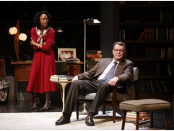
The trouble with British playwright David Rudkin's stage play, "The Love Song of Alfred J Hitchcock," is that it started life as a radio play and it hasn't escaped very far from the radio studio. Still a play for voices, Rudkin's script has a great many introspective monologues by the iconic director but not much action, a strange choice for a story of a director whose movies are loaded with incident. The play assumes a great in-depth knowledge of the director's work: such movies as "Marnie," "Vertigo," "Strangers on a Train," "Psycho," "The Birds" and "Frenzy" are referred to tangentially but remain unnamed. It would take a film historian to track down all the references but apparently the play is expected to stand on its own which will confuse many theatergoers.
[more]
The Pearl Theatre Company's revival of Richard Brinsley Sheridan's 1777 comedy of manners "The Rivals" is both laugh-out-loud funny and intellectually stimulating. Hal Brooks' exemplary direction scores immediately in the first scene. It's a typical pre-modern opening, pages of dense exposition where a couple of minor characters discuss the major characters and their situations. Brooks avoids tedium and confusion by having the characters appear upstage when named, doing a bit of dumb show when appropriate. It's a perfect solution, introducing the actors and plot without fuss, without anachronism, and without wasting time.
[more]
The Public Theatre’s LuEsther Hall has been reconfigured to resemble a nightclub where most of the audience stands to view the action which is performed all over the space on stages and platforms on all sides as well as platforms in the center that are moved by stage crew members. Young floor crew members in pink jump suits direct the audience to move around sometimes on stage and to encourage audience dancing and participation at appropriate times. There’s upper level seating away from the scene where one can sit and watch the events.
[more]
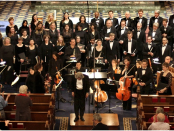
Mark Shapiro, music director and conductor of The Cecilia Chorus, explained in the program notes that the evening would present an exploratory voyage through the spiritual cosmos, searching out the individual's place in the universe.
[more]
David Byrne and his collaborators have created a unique musical theater extravaganza that dramatizes the life of this historical pop icon in all her victories and defeats.
[more]
Provocative playwright Branden Jacobs-Jenkins turns Boucicault’s 1859 classic inside out as he examines 2014 attitudes about race in U.S.
[more]
The latest edition of the long running satirical revue mercilessly skewers the contemporary Broadway scene with biting songs and sketches.
[more]
James Lapine's stage adaptation of Moss Hart's celebrated autobiography of his early years, Act One, is a bit unwieldy at under three hours in length as it does contain so many characters and incidents. However, like an absorbing mini-series you have lived with over a period of time, you will be sorry when it is over.
[more]
An evening of passionate and dramatic music, including a New York City Jennifer Higdon premiere, gorgeously presented and happily received.
[more]
Time has caught up with Jon Robin Baitz’s 1991 play and bankrupting one’s company over issues of integrity no longer seems quite admirable. Jon Robin Baitz writes literate, thoughtful plays like his 2012 Pulitzer Prize finalist, Other Desert Cities. However, like the revival last fall of his earliest play The Film Society showed, plays may date badly or their attitudes become artifacts of another generation.
[more]
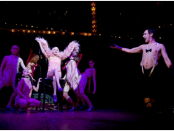
A huge, new production of a huge, ever now hit, Alan Cumming, Michelle Williams, Linda Emond and Danny Burstein shine.
[more]
An interesting and touching early musical from the composer of "Shrek," "Caroline, or Change," and "Fun Home." It may be in keeping with the notional scar, but sometimes "minimalist" fades into "generic." An inherent problem with the show, it's possible that even a small Broadway house like this one (740 seats) will always be too big.
The climactic sequence, following Violet's discouraging experience in Tulsa, takes place mostly in Violet's head and as such is almost unstagable, and in any case hard to understand. Last and most problematic is that these soldiers react relatively casually to Violet's allegedly repellent deformity.
[more]
The vibrant simple set by Timothy R. Mackabee, Amy Clark's lively 80's style costumes (shoulder pads galore), 80's big hair wigs and florid makeup by Leah J. Loukas, and Jason Lyons' expert lighting all make the show visually engaging. Music director Dominick Amendum and sound designer Johnny Massena keep everything aurally modulated without sacrificing bombast.
[more]
As always, the bright, clear acoustics of St. Jean Baptiste at Lexington Avenue and 76th Street served the music and the musicians well. The church's highly ornamented, shiny blue, white and gold American Baroque interior seemed at first at odds with Bach's Passion story. Throughout the sanctuary, however, major statues were shrouded head to toe in the purple cloths of Lent; it was as if unknown and unnamed witnesses mourned in the midst of glitter and jewels.
[more]
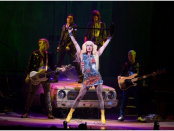
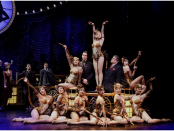
Complementing the stagecraft and performances is the actual dynamic band. Consisting of music director Justin Craig on guitar and keyboards, Matt Duncan on bass, Tim Mislock on guitar, and Peter Yanowitz on drums, they sound and look like the real thing. Adding another layer of authentic imagery are Arianne Phillips' witty costumes and Mike Potter's detailed wigs and make-up design.
[more]
The small-scale physical production is enhanced by the creative contributions of the technical staff. Mary Jo Dondlinger's lighting design skillfully moves the show through numerous time periods. Inventively filling the moderately sized stage are the props, furniture, slide projections and illustrative panels of production designer Justin West and scenic designer James Morgan. The sound design of Janie Bullard very effectively blends the music, singing, slide projections and voice-overs. The cast's often quick changes and visual appeal are greatly helped by Patricia McGourty's superb costumes.
[more]
The director deserves high marks for keeping the actors' delivery quick and light; anything else would have put the audience to sleep. His cast comes across as sincere but mostly inexperienced, with the fine exceptions of James and Blankenship.
[more]
The most famous songs (covered by many artists) continue to be "Ballad of Mack the Knife" and "Pirate Jennie." Although uncredited, the orchestrations appear to be Kurt Weill's own as they were in the 1954 Blitzstein/Theatre de Lys production. While the seven-piece orchestra under the direction of Fred Lassen is generally fine, occasionally the music seems too slow for Weill's jazzy rhythms. As to the musical numbers in the Blitzstein version, there has been some rearrangement. The "Barbara Song" originally sung by Lucy Brown has been reassigned to Polly Peachum. As a result, in order to give Lucy a song of her own, "Ballad of the Drowned Girl" from the Weill/Brecht Berlin Requiem (in an orchestration by music director Gary S. Fagin) has been interpolated into the score.
[more]
The Realistic Joneses introduces a new American playwright to Broadway, one with a unique voice all his own. Whether main stem audiences will understand Will Eno's cadences is another question. Toni Collette, Michael C. Hall, Tracy Letts and Marisa Tomei give the play a fine patina of urbanity. This, however, is not a play for all theatergoers. With its slightly mocking title (as these are anything but realistic Joneses), it is for those who want to be challenged and who want something new.
[more]
Beg. Borrow. Steal. In a breathtaking leap, famed Audra McDonald has vaulted past anything she's ever done to this pinnacle of performance art, her portrait of Billie Holiday, the mesmerizing, tragic figure who haunts us still with the beauty and wreckage of her life, and if you don't go to see her, you'll be poorer for it. Because this is not only Billie Holiday, this is Audra McDonald at her consummate best.
[more]
As the African American hand banished to the stable, Ron Cephas Jones alternates movingly between bitterness with his lot and his desperate loneliness. Jim Parrack brings a great sense of fairness and moral integrity to the role of Slim, the only member of this tight, little community to whom they all instinctively look up to. Receiving third billing, Leighton Meester (star of television's Gossip Girl) as Curley's wife, the only woman in the play in this man's world, is caught in the trap of playing either Madonna or whore, typical of 1930's Hollywood movies.
[more]
Clean, by playwright Sabrina Mahfouz, the other play on the double bill, is really not clean at all but director O'Loughlin isn't fazed a bit and whips her three, highly ornamental criminals through their paces with a stylish kind of nervy aplomb that sets off their rashers of charms while greatly adding to the fun – and by the way – wittily knocks off lots of bucks from production costs. No mean feat.
[more]
Jennifer Evans as French bombshell Denise Torel lights up the stage every time she appears. Her French accent is straight from Paris and she has a cunning way with a song. As the second bananas Madge and Larry, Molly Pope (of cabaret fame) and Thom Caska (aka associate producer for the StrawHat Auditions) turn their confrontations and shenanigans into stand-up comedy at which they are quite adept. Michael Mahany and Laurie Hymes as rising stars Michael and Geraldine bring a great deal of conviction to these leading roles, though Hymes' lisp disappears each time each she starts to sing.
[more]
I sure felt the spirit of the late Jonathan Larson strongly at the Trumbull (Connecticut) High School's production of his musical Rent. This was the school, you may recall, where the principal tried to cancel the students' production of Rent, and the students protested successfully for weeks until they won the right to do the show. Perhaps the fact that they had to fight so hard to do the show gave them an extra investment in it. But they pulled it off well.
[more]
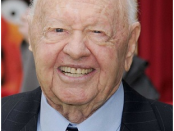
Mickey Rooney was always a treat, whether playing an Average Joe, a gangster, George M. Cohan, or Pinocchio.... I always loved seeing him, on screen or in person. And I liked talking with him. (One conversation we had, late in his life, was a little sad. He noted that for several years he had been MGM's biggest-money maker; in his heyday, his fans had packed movie theaters from coast to coast; no matter what films he was in. But now, his personal appearances tended to draw modest crowds. Where were his fans, he asked aloud, muttering that audiences were fickle. I didn't no how to respond. Audiences weren't necessarily fickle; he'd simply outlived most of his original fans.)
[more]
The play tells the story of the hard-working black Younger family living in a shabby two-room apartment on Chicago's South Side, sometime between World War II and 1960. The patriarch, Walter Lee, Sr. has died recently and the family is awaiting a $10,000 insurance check (about $88,000 today) which is due to arrive in a day or two. Each of them looks forward to using the money for a different purpose
[more]
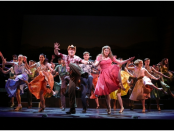
Author and director have put together a show which does not have a wink and a nod in it. Only the broadest of reactions will do. Which can sometimes be funny. If you know how to do it. Marin Mazzie does and is a knockout. Zach Braff does not and is not a knockout. And everybody else is somewhere in between. Except for one puzzlement: Karen Ziemba, a marvelous performer, one of the nine stars, what is she doing in this show? Her role makes no sense. Is that an inside joke? Nobody, but nobody gets it. Everybody is overdoing so much – and some of them are famous for overdoing – that it seems as if Susan Stroman's directing skills are playing very second fiddle to her choreographic skills.
[more]
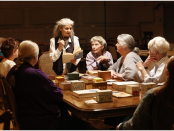
Director Jack Cummings III has not only chosen a new environment for this realistic play, he has also chosen to perform it with ten veteran actresses (who would be classified as senior citizens) playing all 23 parts, including teenage girls and boys, and all the male characters. When the audience enters the Gym at Judson the entire space has been turned into the playing area with seats in two rows around all four walls. Ten dining room sets with displays on each occupy the space, the size of a basketball court.
[more]
Every song was well chosen to demonstrate the versatility and range of R & H and the singers all met the challenge. Rebecca sang the often neglected "The Gentleman is a Dope" (Allegro) and turned it into a showstopper. The show closed with "Edelweiss" (Sound of Music) that Ted said people think is an old Austrian folk song but was written by these legendary collaborators. It was the perfect ending for a wonderful tribute to a never to be duplicated writing team whose shows and music will live forever.
[more]
Laura Benanti and Shuler Hensley in a scene from The Most Happy Fella (Photo credit:
[more]
Of course, it has to happen with the music and with dancing, with costumes, with sets – ye gods. Director Michael Greif has the great boon of set designer Mark Wendland's fresh way of presenting the entire premise instantly. He gives us the glittering ability of seeing what is going on two ways at once, with mirrors, very bright, very brainy. But we are not thus twice as much pulled into events so much as setting one view against another, a perfect visual metaphor fitting with the creators, but not with us, the audience. We are happily tasking outside, we don't come in until someone with heart pulls us in.
[more]
There has been renewed interest lately in the early, pre-How I Learned To Drive plays by Paul Vogel, the Pulitzer Prize-winning playwright. First there was The Baltimore Waltz (1992) at the Underground Theater last November. Now And Baby Makes Seven from 1984 is on view in a thoughtful, detailed production by the Purpleman Theater Company, directed by Marc Stuart Weitz, at the New Ohio Theatre in the West Village. Baby's tale of a same-sex couple having a child still resonates with particular clarity nowadays. Except for the fact that this lesbian couple, Ruth and Anna (the one who's bearing the child) couldn't be married back then, the play rings true as it explores all the anxieties, humor and fantasies straining the relationship of these two women with each other and with Peter, the biological father of the child.
[more]
All Photos by Stephen Sorokoff “Was I supposed to campaign?” Joked
[more]
«
1
…
110
111
112
113
114
»
Copyright Jack Quinn, 2001-2023