
The First Line of Dante’s Inferno
Kirk Lynn’s play asks why people enter the wilderness…To seek spiritual connection? To feel freedom? To find themselves? Or to lose themselves entirely…
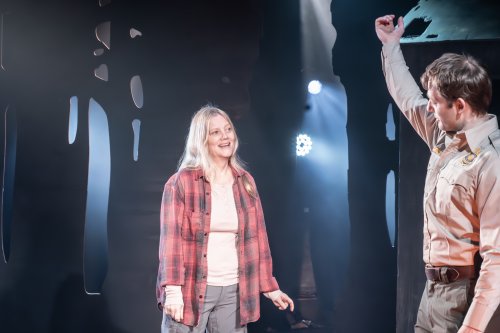
Kellie Overbey and Evan Sibley in a scene from Kirk Lynn’s “The First Line of Dante’s Inferno” at The Downstairs Theatre at La MaMa (Photo credit: Marina Levitskya)
The opening gesture of Dante Alighieri’s Inferno—that immortal confession of midlife disorientation in which a wanderer finds himself astray from the “straight road” and deposited in a “dark wood”—has rarely felt as theatrically apt as it does in The First Line of Dante’s Inferno, Kirk Lynn’s sly, searching, and disarmingly funny new experiment in staged storytelling. Lynn, a polymath of the American theater—playwright, novelist, screenwriter, educator, and guiding spirit of the Austin collective Rude Mechs—treats Dante’s premise less as a theological map than as a psychological condition. His forest is not an allegorical afterlife but a contemporary wilderness in which several souls, one quite literally at midlife, appear to have misplaced the coordinates of their former selves.
The production begins in near-darkness with a voice: Ann Espinoza speaking before she is seen, as if her body must catch up to her consciousness. Her narration sketches the contours of a national-park woodland and an illicit, ramshackle cabin that materializes onstage in Lauren Helpern’s silhouette-rich forest design—a set that seems carved from shadow and memory in equal measure. Zach Blane’s lighting filters in like cautious daylight through trees, and Bart Fasbender’s soundscape—alive with rustlings and distant murmurs—wraps the theater in the hush of the outdoors. From the outset, the play announces its peculiar grammar: direct speech mingles with third-person recollection, and the phrase “as I remember” recurs like a ritual incantation, suggesting that what we witness is as much reconstruction as event.
At once a memory play, a parable, and a species of spiritual itinerary, the piece resists the conventional musculature of dialogue-driven drama, unfolding instead in supple stretches of prose. Its very form poses a curious challenge to staging. The greater bulk of its text might be approached as an intricately detailed cartography of stage directions. A more conventional solution would be to assign the extended passages of third-person prose to a disembodied narrator, letting an over voice carry the descriptive weight and guide the audience through the play’s interior landscapes, smoothing the transitions between description and enactment.
But director Christian Parker opts for a braver, more permeable approach: he treats the entire text as playable, distributing its narrative burdens among the three characters so that each becomes, at times, both subject and storyteller. The result is theatrically paradoxical. Scenes occasionally risk a certain stillness, as if momentarily caught in the amber of exposition, yet that very density becomes expressive. The characters appear estranged not only from one another but from their own impulses, recounting themselves even as they live. Motivation remains partially veiled, as it so often is in life, and the audience is made to feel the distance between action and understanding. This strategy deepens the play’s emotional weather. Loneliness accrues in the gaps between what is lived and what is narrated. Even in moments of direct interaction, the figures seem to occupy adjacent but not fully overlapping stories, as though each were consulting a different map of the same forest. The effect is haunting: a drama in which connection is sought, skirted, and refracted through language, and where the act of telling becomes inseparable from the difficulty of truly being known.
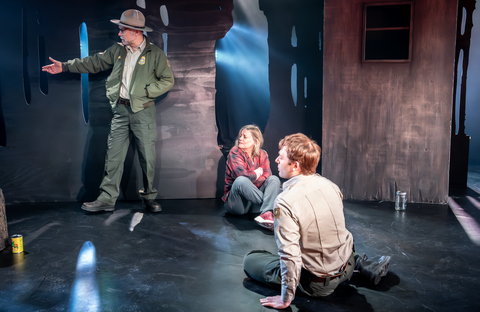
Greg Stuhr, Kellie Overbey and Evan Sibley in a scene from Kirk Lynn’s “The First Line of Dante’s Inferno” at The Downstairs Theatre at La MaMa (Photo credit: Marina Levitskya)
But director Christian Parker opts for a braver, more permeable approach: he treats the entire text as playable, distributing its narrative burdens among the three characters so that each becomes, at times, both subject and storyteller. The result is theatrically paradoxical. Scenes occasionally risk a certain stillness, as if momentarily caught in the amber of exposition, yet that very density becomes expressive. The characters appear estranged not only from one another but from their own impulses, recounting themselves even as they live. Motivation remains partially veiled, as it so often is in life, and the audience is made to feel the distance between action and understanding. This strategy deepens the play’s emotional weather. Loneliness accrues in the gaps between what is lived and what is narrated. Even in moments of direct interaction, the figures seem to occupy adjacent but not fully overlapping stories, as though each were consulting a different map of the same forest. The effect is haunting: a drama in which connection is sought, skirted, and refracted through language, and where the act of telling becomes inseparable from the difficulty of truly being known.
Ann, in her forties and raw with worry, has come in search of her sister Carol, who has vanished from domestic life without note or farewell, leaving behind children, obligations, and a silence large enough to be called a statement. The duration of her absence is left tantalizingly vague—measured less in days or months than in the emotional attrition of those who first sought her. The early urgency of the search has cooled; alarm has given way to a weary, unresolved ache. Into that vacuum steps Ann, gripped by a resolve that is equal parts devotion and quiet desperation, electing not merely to look for Carol but to retrace her very footsteps, as if the path itself might yield the meaning of the disappearance. In choosing to reenact Carol’s flight, Ann turns investigation into pilgrimage, and the forest into a living archive of her sister’s vanishing.
Finding the cabin, Ann breaks in, patches a broken window with a copy of Dante’s Inferno—a gesture both practical and symbolically overdetermined—and beds down inside, suspended between pilgrimage and trespass. By morning she encounters Craig, a young ranger whose initial commitment to enforcing park regulations proves far less durable than his susceptibility to human complexity. Their exchanges, written with Lynn’s signature deadpan wit, pirouette from bureaucratic sparring into flirtation, philosophy, and something like mutual recognition.
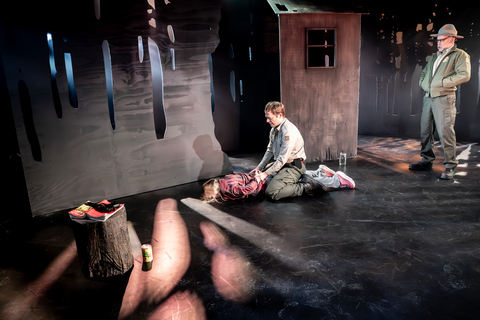
Kellie Overbey, Evan Sibley and Greg Stuhr a scene from Kirk Lynn’s “The First Line of Dante’s Inferno” at The Downstairs Theatre at La MaMa (Photo credit: Marina Levitskya)
The arrival of Bill, an older ranger with faltering eyesight and emphatic convictions, tilts the play into another register. His certainty that Carol came to the woods in search of death contrasts sharply with Ann’s hope and Craig’s wavering theories of renunciation. Bill’s half-seen discoveries—owing to his misplaced glasses—add a layer of comic irony, culminating in a grappling match between the men that carries a charge at once ridiculous and oddly sensual. The physical tussle, both comic and faintly feral, feels like the forest briefly expressing itself through human limbs.
Carol’s absence is the play’s gravitational center. Around it orbit questions that Lynn refuses to settle: Is disappearance an act of despair, of liberation, or of authorship over one’s own narrative? The woods, as the play patiently reveals, are not merely a refuge but a solvent. Time spent there erodes embarrassment, loosens identity, and dulls the performative reflexes of social life. Ann, gradually acclimating, begins to experience solitude not as deprivation but as a different medium of being. Danger exists—Craig’s aside that no creature wishes to be eaten lands with wry bluntness—but so does a fragile peace, and even the possibility of new relational arrangements ungoverned by ordinary scripts.
The performances are finely tuned to the play’s peculiar wavelength. Kellie Overbey’s Ann is at once flinty and sensuous, defensive yet searching; she gives the sense of a woman narrating herself into clarity. Evan Sibley renders Craig with a gawky sincerity that makes his authority as a ranger feel provisional and his openness endearing. Greg Stuhr’s Bill, blustering and eccentric, supplies a comic bass line that never quite obscures the character’s lonely certitudes. Together they form a trio that is less a triangle than a set of intersecting paths—each briefly illuminating the others’ journeys. Theresa Squire invests the costumes with a dry, knowing wit that quietly comments on the characters before they speak. Ann’s red plaid and jeans conjures an almost too-perfect amalgam of outdoorsy earnestness and retail fantasy, a cross between L.L. Bean and a trip to Bass Pro Shops. The rangers, meanwhile, wear their authority with telling inflections. Bill’s gear, neatly fitted beneath its official layers, hints at a man who takes a certain pride in the silhouette of command, even as the forest frays his certainties.
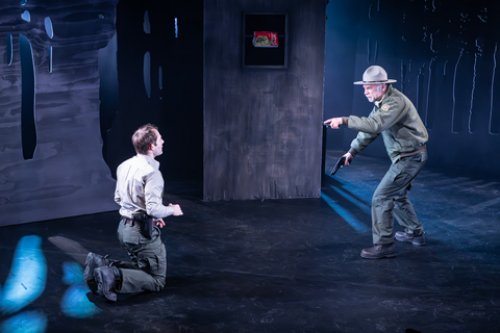
Evan Sibley and Greg Stuhr a scene from Kirk Lynn’s “The First Line of Dante’s Inferno” at The Downstairs Theatre at La MaMa (Photo credit: Marina Levitskya)
Craig’s uniform, similarly close-cut, carries a different charge: its crisp lines and faintly showy fit lend him the air of someone half-aware that a uniform can be both costume and invitation, bringing to mind a night out at Chippendale’s when/if they indulge uniform fetish. The suggestion of role-play lingers, lightly comic but revealing, as though the boundary between duty and display were more porous than anyone cares to admit.
As the play gradually discloses its secrets, it becomes apparent that Ann’s expedition is guided by motives more oblique than sisterly rescue. Carol is the catalyst, yes, but also the pretext: what Ann truly pursues is the experience of departure itself, the seductive grammar of walking away. Her journey begins to look less like a search party and more like a reenactment, an attempt to inhabit the same liminal space Carol once claimed between obligation and oblivion.
There are flickers of provisional warmth between Ann and Craig—moments that resemble happiness the way a campfire resembles sunrise—but the production resists any full thaw. A pensive melancholy hangs over the trio like mist in the trees. Each character guards a private interior, half-hidden even from themselves, and none quite discovers how to reconcile the domesticated self with the feral impulses that drew them to the woods in the first place. If the forest offers freedom, it also exacts the price of opacity.
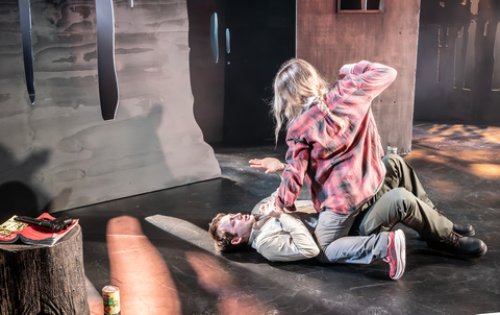
Evan Sibley and Kellie Overbey a scene from Kirk Lynn’s “The First Line of Dante’s Inferno” at The Downstairs Theatre at La MaMa (Photo credit: Marina Levitskya)
Ann, unlike her vanished sister, is not permitted to disappear entirely; the rangers function as both caretakers and custodians of the social world, gently but firmly steering her back toward the sanctioned path. Yet the play shrewdly withholds judgment on this return. Is it rescue or capture, restoration or diminishment? The final impression is deliberately unresolved, leaving the audience to wonder whether the “straight road” is a blessing, a compromise, or simply another kind of wilderness.
One leaves with the sense that the forest, like Dante’s dark wood, is less a place than a moment in a life when the old map fails. If there is a moral, it is delivered gently: at any point in one’s journey, the wild may be closer than expected, and following those who have strayed there might reveal not a fall, but a reorientation.
The First Line of Dante’s Inferno (through February 22, 2026)
The Downstairs Theatre at La MaMa, 66 East 4th Street, in Manhattan
For tickets, visit www.lamama.org
Running time: 90 minutes without an intermission


Leave a comment