
The Animals Speak
A story about Walt Disney and some of his company’s members on a diplomatic goodwill tour of South America in 1941.
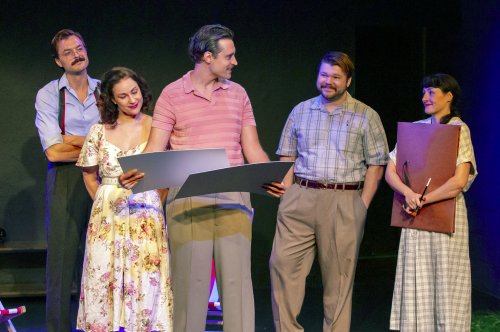
Adam Griffith as Frank Thomas, Ginger Kearns as Lillian Disney, Cameron Darwin Bossert as Walt Disney, Cian Genaro as Norm “Fergie” Ferguson and Krysten Wagner as Mary Blair in a scene from Bossert’s “The Animals Speak” at The Wild Project (Photo credit: Hunter Canning)
As Europe is being consumed by war, the fascist threat from Europe is ever-present in the United States, with diplomatic concerns for South America. In what today would be considered “soft diplomacy,” the government sent well-known sports and entertainment figures to different areas of the world to counter the fascist propaganda from Germany and Italy. One of those diplomatic missions involved Walt Disney and a number of his creative team traveling to South America to discourage support for fascism in specific South American governments.
The Animals Speak by Cameron Darwin Bossert is the final installment in a trilogy titled A Venomous Color. It recounts Walt Disney and some of his company’s members travels to several South American countries, with Brazil, Argentina and Chile being the primary focus. While some in the group view the trip as a vacation, for Disney, it is more than simply a vacation paid for by the government but a chance to come up with a movie to help the company recover from recent difficulties; the loss of European revenue because of the war, a strike by the company’s artists and technicians, and the death of his mother.
These details are revealed slowly through dialogue by various characters, but it is not always clear what the central dramatic arc of the play is. Is it really about Walt Disney and his emotional struggles, or are there other issues at play, such as the source of the creative ideas for the next movie, a shift in attitude in Disney towards his workforce, or the artistic vision of Disney artist Mary Blair (Krysten Wagner)?
The opening scene is set in Rio de Janeiro, where two Disney animators, Norm “Fergie” Ferguson (Cian Genaro) and Frank Thomas (Adam Griffith), discuss the trip as a vacation with work, and to keep Walt from going crazy. These two characters are light-hearted, offering a measure of comic relief to the story. Genaro and Thomas are solid in their comedic interplay, playing off each other as a balance to the more emotionally charged moments.
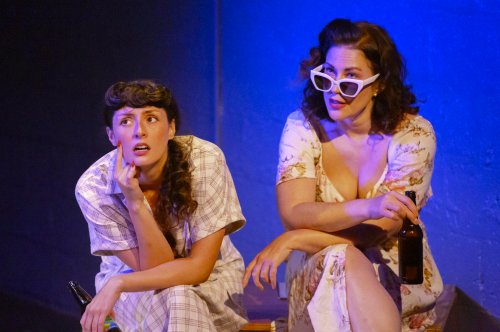
Krysten Wagner as animator Mary Blair and Ginger Kearns as Lillian Disney in a scene from Cameron Darwin Bossert’s “The Animals Speak” at The Wild Project (Photo credit: Hunter Canning)
After the short conversation, Lillian Disney (Ginger Kearns) appears. After greeting the two men, she comments on how much work they are getting done. The comment prompts Fergie to report on how others on the team are setting up a temporary working studio. Since they are animators, Frank and he have limited options without a story idea from the writers. This opening scene provides the bare bones of the story with hints into how it relates to Walt Disney.
As the conversation turns to the animator’s technique in bringing words to life as images, Walt (Cameron Darwin Bossert) appears, filming with a 16mm camera. Fergie and Frank immediately begin to vamp a silly scene until Walt puts the camera down after a few moments. All three men start to laugh, with Walt being more exuberant than the event warranted, as if he were hiding something.
At this point, Mary Blair enters with a drawing pad in hand. Mary joined the Disney Company in 1940, working on Dumbo and an early version of The Lady and the Tramp. She left in 1941 before the trip and the animators’ strike at Disney Studios. She rejoined the company for the trip to South America because her husband, Lee, was part of the team. She is a significant character in this play, as it highlights her impact on the visual style and atmosphere of the Disney films of the 1940s and 1950s. Her drawings were later instrumental in the design of the Disneyland ride “It’s A Small World.”
All of the principal characters are now in place, but a clear storyline is still not. The scenes in Brazil provide a sketch of what is to follow, with more depth added in the Argentine section. Of the three countries on the trip, Argentina is the closest to being accepting of the Nazis. It is the country that presents the most significant challenge to Disney’s goodwill trip. This part of the story exposes some of Walt’s emotional struggles. It is also a point where the relationship between Lillian and Mary becomes more defined.
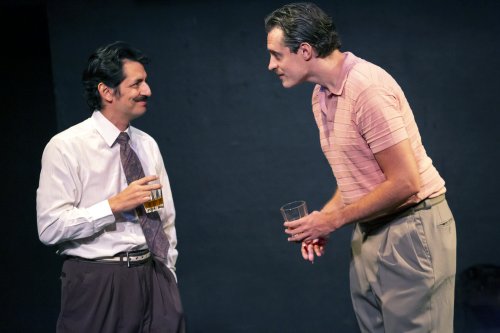
Felipe Arellano as Chilean filmmaker Jorge Delano and Cameron Darwin Bossert as Walt Disney in a scene from Bossert’s “The Animals Speak” at The Wild Project (Photo credit: Hunter Canning)
As the play progresses, it becomes apparent that Lillian is the glue that holds Walt together and keeps him somewhat focused. She is also the one with the most significant influence on Walt’s social dynamics. Kearns solidly portrays Lillian as a strong, focused, determined woman. She is the rock that will hold Walt together and help steer him through his emotional struggles.
As the action moves to Chile, Jorge Delano (Felipe Arellano), a Chilean filmmaker, enters the story. He is the host for the visiting Disney group, and his conversations with Walt reveal more of Disney’s character. The Chilian scenes bring all of the dramatic pieces in place and the depth of Walt’s struggles not only with the situation in Burbank with the strike and his brother Roy’s management of the company but also the raw feelings Walt has regarding the death of his mother two years before and the death of his father at this point in the trip. It is also the point where the potential impact of Blair’s art is revealed.
While the ensemble is solid in their portrayals of the characters, the play lacks a clear dramatic line regarding the main point of the story. Bossert’s portrayal of Disney and his emotional struggles appears to provide the scaffolding for a story that, in reality, is about Lillian Disney and her influence on the decisions that will ultimately be attributed to Walt. Her careful guidance of Walt’s presentation style ultimately enabled him to speak in public with greater confidence and engage more effectively with his audience. Her conversations and skillful guidance of Mary Blair’s view of herself as an artist, independent of her husband, led to Mary’s increased confidence in herself and ultimately to Walt’s recognition of her talent.
While no director is listed, there is a strong likelihood that Bossert is the guiding light. It is not always beneficial for a playwright to be the sole creative force behind a production. Although this play is worth experiencing, different creative voices might have helped address some of the production’s issues.
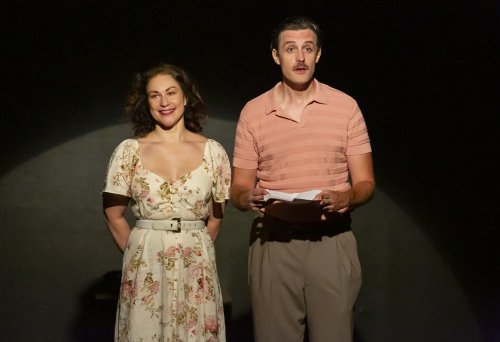
Ginger Kearns as Lillian Disney and Cameron Darwin Bossert as Walt Disney in a scene from Bossert’s “The Animals Speak” at The Wild Project (Photo credit: Hunter Canning)
The creative team does an excellent job of providing a sense of setting for the play. Yolanda Balana’s costume design is solid for 1941, even with the (uncredited) limited sets of the venue. Kia Rogers’ lighting design effectively sets the emotional temperature of the scenes and moves the action forward. Deeba Montazeri’s music adds to the overall emotional structure of the story and is true to the period.
Even with some of the issues discussed in this review, this play and the others of the Venomous Color trilogy are worth spending time with. Cameron Darwin Bossert’s Thirdwing Stage is an innovative theater company that presents thought-provoking and arresting works about American history and world politics. They reveal a distinct perspective on the factors that shape the political and social narratives of this complex world of human interaction. As important as it is to support theater companies like Thirdwing, it is equally important to support the theaters that give them a home. The Wild Project Theatre is a venue that promotes and showcases innovative and experimental theater companies, such as Thirdwing. It is vital to our community to support both of these organizations.
The Animals Speak (through August 17, 2025)
Thirdwing
The Wild Project, 195 East Third Street, in Manhattan.
For tickets, visit http://www.thirdwing.info
Running time: 90 minutes without an intermission


Leave a comment