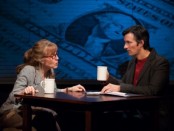
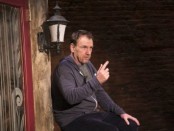
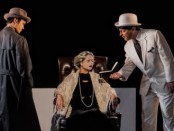
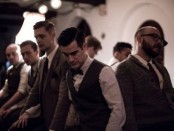
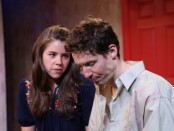
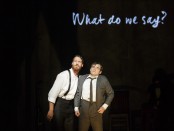
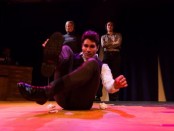
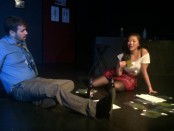
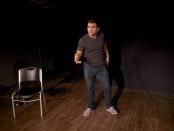
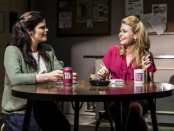
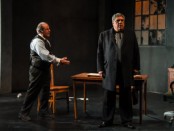
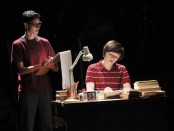
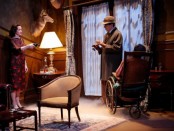
Cast as the curious playwright Rich, actor Jeffrey C. Wolf is the central focus of the evening. Wolf narrates the play by way of a series of monologues, which preface interviews with various members of the Tea Party or other pertinent political figures. Carrying the show on his back, Wolf is an agreeable narrator with an infectious curiosity. At times the play navigates deeply into American History, and when he dives into a fact or number heavy-preamble, his pace is cognizant of the fact that the audience is best assumed unfamiliar with it. Thanks to this, exposition regarding past political events is well-received and easily digestible. [more]
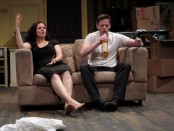
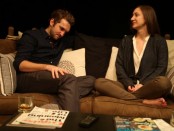
Joe Casey is a charming actor. He exudes a “playboy” vibe which goes hand-in-hand with the character of Michael whose vices range from women to booze and back again. Casey shows an understanding of a man who is largely misunderstood and actually well-intentioned. Steph Van Vlack plays the role of Donna. Nearing 50 and a divorcée with a child, Donna is conflicted in light of the fact that she—a woman of her age—is engaging in an apparent “one night stand.” Among other things, this is also a character deeply disturbed that she’s actually considering sleeping with the child she used to babysit for all those years ago. Van Vlack brings a necessary uncertainty to the character. Playing a woman of certain age, Van Vlack’s performance indicates that Donna still has deep insecurities and still has quite a bit to learn about relationships. [more]
Directed by Danya Taymor, 'In Quietness" excels in its exploration of intimacy. When dialogue is being spoken between two actors at a time, there are moments of silence that are loaded with implication. It is a credit to the director that more character development happens with nothing being said at all rather than when a character is speaking. Kristen Robinson’s set design is efficient enough—the whole stage is made to look like the inside of a chapel—though it is made much more effective by intelligent lighting design by Masha Tsimring and Caitlyn Rappaport. [more]
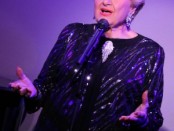
The crowd went wild when she sang some iconic favorites and became silent so as you could hear a pin drop when she crooned out others. Maye sure knows how to work a room. This snazzy, jazzy one-of-a-kind artist sang a lot of ballads, Broadway tunes and anything fabulous. Only the best would do for this phenomenal performer. Among the highlights were “Luck, Be a Lady Tonight, “Guess Who I Saw Today,” “Country Boy,” “That's Life” and “I'm Still Here” which was very apropos. [more]
Directed by Daisy Walker, "How Alfo Learned to Love" is chock full of Italian-American stereotypes. The characters are just heightened enough that the gimmick works, but there is also a lot of heart behind this story. Walker has brought to life a group of characters who are quirky and lovable, and in the end it really feels like a family affair. All of this is contingent on Thom’s performance as Alfo whose character arc is fleshed out and brimming with variety. This redemption story about learning to love is a rollicking good time. Backed by strong performances and direction, a slick and consistent pace, and an entertaining script which sticks to a winning formula, nary a soul is likely to leave this theater without a smile. [more]
Conceived by Daniel Fish and Jim Findlay, "Who Left This Fork Here"—inspired by the emotional themes found in Anton Chekhov’s "The Three Sisters"—is a stark and jarringly honest piece which examines morality and aging through the eyes of three different female performers. Separated by nearly seven decades, the three women (Tina Benko, Judith Roberts, and Auden Thornton) each represent a different phase of a woman’s life. [more]
Alas, the Tiny Tim of olden days exists no more. Thanks to medical advancement in the mid-1800’s, young Tim underwent a surgery which not only cured him of his ailment, but gave him a new heightened ability referred to as “a dancing leg.” This newly autonomous dancing leg is Timothy’s calling card and—whether he accepts it or not—the leg which was once a burden is now the precious asset upon which this grand adventure is based. "The Astonishing Times of Timothy Cratchit" is massively ambitious. As if imagining a sequel for one of Dicken’s most famous fictional characters wasn’t enough, Knee and Catrini scale things to an even higher level by tying in the fictional accounts of A Christmas Carol with the real-life autobiographical "Memoirs of Joseph Grimaldi," written first hand by the famous English clown and then later rewritten by Charles Dickens. It is a heroic effort which attempts to bridge the gap between two of Dickens' most famous works, even if there isn’t much correlation between the two to begin with. [more]
"That Physics Show!" is the brainchild of David Maiullo, a professional physics demonstrator who also happens to have a knack for comedy. Created and performed by Mr. Maiullo, this one man show—plus his assistant Kelsey Lane Dies—is a surprisingly educational production which, though it doesn’t have any narrative, is very engaging. From the moment the theater doors open, there is an infectious curiosity which permeates through the crowd: the stage is littered with test tubes, weights, racks, liquids, mysterious boxes containing curious looking objects and random items such as balloons, a fire extinguisher, and even a can of coke. Looking around, one can’t help but wonder how all the different objects will come to use. [more]
It wasn't until the sixth song, "Birth of the Blues" by DeSylva, Brown and Henderson, that she finally addressed the crowd which had filled the small venue. She commented that she has never considered herself a blues singer, although she has been identified as such for years, and went on to belt out a very heartfelt, bluesy rendition of the song. She then transitioned into one of her old-time favorites, a traditional English ballad from her Hair days, "The House of the Rising Sun." Interpreted with great feeling and emotion, this was one of her best performances maybe because of the memories it conjures up in her. [more]
Admittedly, many of the ideas in the play are hardly new or revolutionary: the first measures to limit the scope of the British monarchy’s power date back to the 1215 Magna Carta and subsequent arguments challenging the divine right of kings include the American Declaration of Independence, drafted in 1776. Rather, this production’s merit lies in the shocking immediacy it brings to the subject. Acutely aware of the fact that the nearly 90 year-old Queen will not live forever, Bartlett takes us into a not-too-distant future where the inevitable change of the empire’s figurehead sends the nation into a state of upheaval. His England is just melodramatic enough that to allow us to see it as fictional yet a shade too realistic to feel truly dystopian. [more]
The National Asian American Theater Company’s world premiere of Lloyd Suh’s "Charles Francis Chan, Jr.’s Exotic Oriental Murder Mystery" is best categorized as fiercely provocative satire. The play has two storylines. The first follows a 1960’s Frank who is developing and producing a murder mystery; the second being scenes from the aforementioned murder mystery, which is a stylized production featuring an Asian woman in white face as an elegant old debutant, and conversely an American Vietnam veteran in brown face as the Asian Detective Charles Chan, namesake to the production. [more]
Continuing the trend of producing challenging new works of theater in interactive environments, The Representatives are back with a riveting production of Stan Richardson’s "Veritas." Founded by Richardson along with Matt Steiner, the duo behind The Representatives chose to have their newest project performed at The Cave @ St. George’s, the ornately decorated basement chamber of the 300 year old St. George’s Church. [more]
Performed by two bonafide Boogie Woogie experts, Baldori and Migliazza are positioned on stage next to each other in front of their dueling grand pianos. With a lifetime of experience in the business, Baldori has played with Chuck Berry for the past 40 years in over 100 performances. This is evident in his stylings, technique, and from the hilarious and entertaining stories that are told in between songs. As his counterpart, Migliazza is a skilled and formidable musical opponent. Together the two take turns singing, playing the piano or keyboard, or cracking jokes to the audience to vary the pace. [more]
Director Sarah C. Carlsen does an excellent job of utilizing minimalism to tell the story. "Unseamly" is told in a non-linear format, and relies heavily on flashbacks. Instead of having set pieces rolling in and out to change scenes, the play is presented in a bright white room which has secret doors and set pieces that pop out of the walls to change the environment and accommodate the next flashback. The set and costumes are both designed by Brian Dudkiewicz, and there is definitely a consistent style throughout. Minimalist with flashes of bright color, the clothing is sexy and trendy, and contributes to the overall theme of the play: costumed liberally, the whole production is steeped in sexuality. [more]
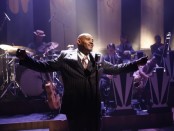
As always, Holbrook was dapper in his signature tux and brought real class and style to the stage. His rich, tenor voice was soothing to the ears and stirred the packed audience, mostly an older crowd, into reminiscing with him about the old days when these songs were written. Their enthusiasm was undeniable, underscored by their continuous applause. Holbrook's vocal instrument is not particularly robust but, what he lacks in volume, he makes up for in passion; a great interpreter, he really feels the music and sings with a lot of heart just like the title of his cabaret. This, along with his great stage presence, connects him with his audience and they find themselves being reeled in.
[more]
Before coming to the Westside Theatre, director David Saint helmed this production at the George Street Playhouse. No stranger to DiPietro’s style (he also premiered The Toxic Avenger at George Street), Saint does an excellent job of keeping the pace up when it matters most. The physical comedy is subtle and effective, but is over-the-top in just enough places to keep the laughter going continuously. Though one can hardly call the comedy of "Clever Little Lies" 'smart'—it is more vulgar than anything—Saint employs many different tactics to elicit laughs from his audience. [more]
Donna and Chris, the couple under the microscope in this play, are portrayed by two sets of actors: the first pair represents the lovers while they are still in college (where they first meet), and a second set of actors play the couple twenty years later—married and expecting their first child. The way these two stories intersect is through rotation, as alternating scenes flip between the two timelines until both stories come together at the climax. [more]
Aside from its notable staging, this production is also receiving a great deal off attention for facilitating the Broadway debut of Marlee Matlin, the only deaf Academy Award-winner to date. While her role as several of the town’s adult women is not a particularly weighty one, she imbues them with her characteristic fervor. Sandra Mae Frank and Katie Boeck work well together to share the character Wendla; Boeck’s voice fluidly pairs with Frank’s signing to separate the inner turmoil and outer façade of a character whose mother refuses to listen. Likewise notable is the always-wonderful Broadway and television veteran Krysta Rodriguez, whose portrayal (both sung and signed) of Ilse, a homeless bohemian clinging to her sanity, is uniquely dark and dangerous. [more]
"Reread Another" is a collection of Stein’s sometimes illuminating, sometimes moving, and sometimes completely ridiculous linguistic portraits arranged into a series of discrete scenes. Spoken by three actors taking on various roles from sailors to shrubs, the text is an angular, twisting mix of paradoxes, circular logic, and contradictions that achieve satisfying moments of coherence when we least expect them to. Although the performance lacks any sort of cohesive story, it amounts to a shockingly moving evening, providing its viewer the unique sense that something indescribably interesting, perhaps even important, has occurred. [more]
Performed at The Wild Project, a stylish downtown venue with a raked stage, the set (John Lavigne), lighting (Robert M. Stevenson) and sound design (Jorge I. Sanchez) all compliment the production and enhance the overall experience. Co-written by Wittrock, Donovan and Custer, and conceived and developed by the members of Improbable Stage, "Rough Draft" is a piece of theater which remains in its own category; a challenging, creative, and unique work presented by a group of talented artists with a message. [more]
Directed by Joseph Hayward, "Blue Surge" is specific and engaging, and moves at a brisk pace which deceives the nearly-two-hour run time. The lighting design (Jason Fok) is particularly impressive for such a small and aged theater space, and much of the intrigue derives from the varying lighting techniques and bold color scheme employed. Given the limited budget and resources with which Brooklyn Repertory Theatre’s latest production was mounted, commendable acting, direction, and design serve as a reminder that the actual theater space becomes irrelevant when in the midst of a talented cast and crew. [more]
"The Christians," Lucas Hnath’s examination of the intricacies of religion currently playing at Playwrights Horizons, comes to us at a unique cultural moment: every day, scientific advances further challenge the existence of God; ostensibly in an attempt to stay palatable to his mainstream constituents, The Pope has issued a series of proclamations regarding the acceptability of homosexuality, the truth of evolution, and other topics; "The Book of Mormon"—a patronizing, tongue-in-cheek assessment of the Church of the Latter Day Saints—is still playing to sold-out houses after five years on Broadway. Indeed, the fact that "The Christians"’ opening line, “Brothers and Sisters, let us pray,” was met with a hearty laugh is telling: today, New York audiences are largely secular and conditioned to sharpen their daggers at the very mention of Christ. To Hnath, however, the subject of religion is no joke. [more]
"The Black Book" follows the faculty of United University while they attempt to unravel the mystery
surrounding a difficult student named Collin Archer and a suicide on campus. Drama instructor Axel
Cooper works together with his co-workers Arthur Chase, Julie Edwards and Riley Andrews to decipher
the boy's disturbing set of clues. As the action rises, motives are questioned, allegiances are
challenged, and the lines between reality and delusion are blurred. Time and space spiral out of
control in a climax beyond (or maybe just shy of) the point of coherence. [more]
"Stoopdreamer," a new play by Pat Fenton, is an intimate commentary on the gentrification process in Brooklyn, specifically applying to the small neighborhood of Windsor Terrace. Located between Prospect Park and Greenwood Cemetery, Windsor Terrace is a nine-block wide residential neighborhood which for years was home to many immigrant families, a majority of which were Irish. Though the gentrification of Brooklyn continues today, for Windsor Terrace this has been an event 70 years in the making: in 1946, Robert Moses announced a brand new road building program that consequently destroyed an enormous amount of residences in the community, and as a result over 1,200 Windsor Terrace residents were left homeless. [more]
Life comes with detours, but more important than any of that is the personal response. Instead of allowing the past to dictate the future, Mahgoub’s path is one filled with determination and perseverance. Hard work is ultimately more important than “luck,” [more]
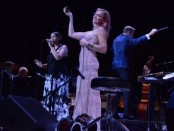
The song that made Pink Martini famous, “Sympathique,” was performed early on and welcomed much applause. Performed by China Forbes, one of Martini’s resident vocalists, “Sympathique” is a genre bending song which received critical acclaim internationally. Though Forbes was one of featured performers of the evening, all the vocalists associated with Pink Martini were top notch. As a whole this was as well-polished an evening of standards that one could ask for. Other highlights include Storm Large’s charismatic performance of “Quizáas, Quizás, Quizás.” [more]
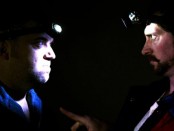
"Butcher Holler Here We Come" begins like any other theatrical: a quick pre-show announcement to silence all electronic devices, a note about the run-time of the production, and then a black out. The difference is that once those house lights go completely dark, they never turn back on until the final bow. With the exception of the small mining headlamps strapped to the foreheads of the five actors in the production, from beginning to end, this entire show is performed in darkness. In fact, it is nearly fifteen minutes in complete darkness before even one of the actors turns on a headlamp. [more]
Sally lays out her heart and soul onto the stage and her chemistry with the talented composer and pianist, Matthew Martin Ward, is unmistakable. At the end of the show, she turned to him and said, “What would I do without you?” to which he replied, “Back at you.” He then leapt up from the piano and they embraced in a kiss which led them into their encore, “Here's to Us.” [more]
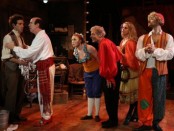
The premise of "Foolerie" centers on a clowning competition between the aptly named Clowne and a modern day Knave challenger. At the Earl’s behest, the two engage in a battle of fooling that bears extraordinarily high stakes: the winner is crowned Biggest Fool in the Land (purportedly an honor) and the loser is put to death. With the help of a supporting cast of Elizabethan actors, both competitors employ Shakespeare’s best-known characters to concoct a fictional story for the Earl’s amusement. [more]
Clearly a passion project, two of the three male actors of the cast are the previously named co-creators—Paul Louis and Nick Santa Maria. Both play their roles with comedic expertise, and as is evidenced by the quick-witted dialogue, these analogies and metaphors for male strife are derived from a very real place. Rounding out the cast is Stephen G. Anthony, who—thanks to a razor sharp sense of comedy—fits right in. [more]
Based on the book of the same name by EJ Stapleton, "The Calico Buffalo" gives a close look at a day in the life of a herd of wild buffalo. Not only are these walking and talking buffalo, but they are also animals which struggle with similar problems previously assumed exclusive to the human race—namely, this herd has a major problem with equality across all buffalo. When the Chief Buffalo’s first-born calf is one with a hide of bright orange and white--completely different than the dark brown and black of the rest of the herd, the Chief (Rhys Gilyeat) and his wife Willa-Mah (Rachel Rhodes-Devey) fear for the challenges their son might face living life as an outcast. [more]
Written almost ten years ago, ":Araberlin" is the story of the mysterious disappearance of Mokhtar (Gabriel Diaz DeSalas), a young man whom it would appear has left America to join an ISIS-like militant group. A bleak story with much in common with the present, the play glides between the past and present, flashing to scenes between Mokhtar with his family, or scenes solely featuring his loved ones following his disappearance. Focusing on the dysfunctional elements in Mokhtar’s life prior to the events of the play, Diaz DeSalas as Mokhtar is an angst-filled young man who hardly had a normal relationship in his life. [more]
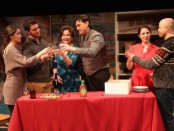
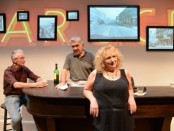
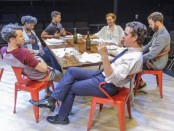
Loaded with a bevy of strong-minded characters, "At the Table" pits lifelong friends against each other in the wake of core differences or political beliefs. At any given point in the show, expect commentary on such issues as race, gender equality or identity, abortion, legal use of marijuana, classism, or remarks on a myriad of other topics which—almost as a prerequisite—spark debate. In fact, little actually happens in terms of a plot except for the falling out a few of the friends to make way for new characters in the second act. [more]
Norris is interested in examining issues so often argued in black and white terms by drawing out the—pun intended—shades of grey. However, while wryly entertaining and largely incisive, his new work suffers from some of the same missteps as does his aforementioned "Clybourne Park." Namely, he paints Chris—his ostensibly well-intentioned, under-informed, straight white male character—as so downright nasty that it is almost impossible to listen to any of his arguments, however logical some of them may be. While the action of the play operates under the guise of an engaging debate that includes various different perspectives, the scales are tipped and its presentation of arguments is uneven. [more]
As with all productions by the Children’s Acting Company & Academy, the cast is comprised entirely of children and teenagers—in this case between the ages of 12 and 16—and for all its innocence and simplicity, the charm in this production is its sheer authenticity. Children and teenagers are by nature unfiltered, and to have kids playing their own age on stage is the recipe for an afternoon of uninhibited fun. For the most part, this is an impressive outing for a group of young and aspiring artists, and many of the cast members have already worked professionally in TV, film, or on-stage. [more]
Though "The Pavilion" is a play which addresses time as if it were a simultaneous occasion—past, present, and future all occurring at once—the story takes place in the present, at The Class of 1985’s 20 year reunion. Of particular interest, the story focuses on Peter (Dusty Brown) and Kari (Julie Voshell), high school sweethearts who had a storied romance which withered and deteriorated long before the events of the play. Funny at times and touching at others, Brown and Voshell have created a great on-stage relationship which is buoyed by excellent chemistry, and the different dynamics of the two actors gives way to some moments which are very sweet and others which are heartbreaking. [more]
As if a talking parrot weren’t magical enough, the production and costumes are truly inspired. Conceptualized by Alisa Simonel-Keegan & Jim Keegan, the set design for this production is imaginative and destroys the perceived idea of value for a show presented in a black box theater. The lighting design (Jessica M. Kasprisin) is particularly beautiful, and is so unique in that it breathes a singular life into each separate exotic location. The finishing touch in the quest for an unmistakable mysticism and adventurous spirit can be traced to the costume design (Adrienne Carlile) which sees every single pirate, sailor, parrot or person uniquely dressed. [more]
A simple message is at the center of Sheldon Bull’s new play" Mallorca." As timeless as the theme may be, this doesn’t necessarily mean it is self-evident. Surrounding the dysfunctional friendship of four men, in some way every character in this play has left an important aspect of his life unattended. [more]
Directed by Anna Bamberger, "Devoted Dreams" is a mind-boggling production. It would seem as if the objective was almost to minimize this production as much as possible, as a challenge to play against the mythical and high-concept subject matter. Despite the short-sighted production values, there are also structural problems in the script which were not concealed in the slightest by the casting decisions and certainly didn’t help the actors. Though it is true in some cases that less is more, in this particular situation the concept might as well be thrown out the window. [more]
Set in Boston in 1984, "Nice Girl" is the story of Josephine “Jo” Rosen (Diane Davis), a 37-year-old secretary who lives with her mother. Davis’ Jo is the epitome of a “nice girl.” She keeps to herself, puts others first, and is afraid to say how she really feels in spite of clear emotional stress. Davis is an actress with immense emotional depth, and provides a varied and complex look at a protagonist whose self-inflicted pain, from an outsider’s perspective, is frustrating and also subtle enough that it feels totally conceivable. [more]
Founded by Albert Bergeret in 1974, he continues to this day as artistic director for the NYGASP, and on this occasion served as director and conductor, with an assist by choreographer David Auxier on the direction. A daunting and impressive achievement, this production also marked the conclusion of the first season in which the NYGASP performed in their new residence: NYU Skirball Center for the Performing Arts. A beautiful and state of the art theater, this is a space that can handle the grandeur and scale of a G&S piece. The theater provides remarkable production value, including a massive pit to house the almost thirty person orchestra. Thanks to the latest in acoustic engineering and innovation, the music of "The Gondoliers" was robust and invigorating. Led by Bergeret, the score filled every inch of the theater and truly transported the audience to another time and place. [more]
Perhaps the most unique aspect of this devised piece is the venue itself. Boarding the Lehigh Valley Barge off the docks of Red Hook, Brooklyn, is like taking a literal step off the land and a figurative step back in time. During normal business hours, the old barge is a museum dedicated to New York City’s rich maritime history. During the run of this production, however, the rickety, wooden fixture serves as the galley of a ghost ship. At the performance under review, thunder crackled in the distance and the makeshift stage bobbed in the Upper Bay’s stormy waters while the players carry on in costume designer Emily Blumenauer’s grungy, Victorian seafarer wear; if nothing else, "Blood Red Roses' is a chillingly atmospheric evening of theater. [more]
Clayton and Dylan are played by Peter Oyloe and Jared Weiss, respectively, and the two have great onstage chemistry. Oyloe’s Clayton is a still, thoughtful, creative man; a man who felt misunderstood and spun out of control. Slowly, Oyloe turns the once motivated artist to a man with deep resentment, shame, and fear. This is in stark contrast to Weiss’ Dylan, a sinewy and charming portrayal of the famed singer. Oyloe and Weiss banter on stage like old friends, but the real connective tissue here is the music. Both actors are excellent musicians, who play classic folk and blues songs with skillful and soulful execution. [more]
If the casting of four powerhouse actors hadn’t been the case—including Proval’s "The Soprano"’s co-star Vincent Pastore--this play would not falter. Michael Ricigliano, Jr.’s writing is consistent and engaging, and the dialogue between the characters is so fluid and effortless that it feels like two real people having a conversation. Full of powerful social commentary, this is a dark, exciting, and at times violent story with a little bit of something for everybody. [more]
On the evening of this performance under review, the audience was treated to a rare surprise: Victoria Bond, writer of the music, was not only present but was also the conductor for the evening. Gramercy Trio, under Bond’s musical direction, skillfully maneuvered through the score. Filled with atonal and complex orchestrations, Bond’s music strikes a fine balance between some very vibrant and cheery melodies followed by quite a few haunting and more chaotic progressions which coincide with the show’s climax. [more]
Inside this less-than-"Fun Home" of deception and repression is an exceedingly endearing and relatable cast of characters. Sydney Lucas, Emily Skeggs, and Beth Malone star as Small, Middle, and Adult Alisons, respectively; while their individual mannerisms and inflections may not depict a consistent character, their passionate performances work well enough together to amount to a moving “portrait of the cartoonist as a young woman” (or what have you). Stage and screen veteran Judy Kuhn likewise shines—or, more appropriately, fades—as the Alisons’ defeated mother Helen. As her former Disney princess voice glides across a broken ballad, Kuhn shows the anguish of a wife with nothing left to sing about. Perhaps most notably, Michael Cerveris’ heartbreaking portrait of Bruce is both authoritative and impotent, loveable and despicable. [more]
Set in South Wales in the 1950’s, "The Unexpected Guest" (first produced in London in 1958) is a mystery surrounding the events that led up to the death of Richard Warwick, patriarch to the Warwick fortune. In the opening minutes of the play, his lifeless corpse is discovered by Michael Starkwedder (Nicholas Viselli), a seemingly random stranger who—upon driving his car into a ditch—stumbled up to the Warwick Estate in search of assistance. Upon discovering the body, Michael is confronted by Laura Warwick (Pamela Sabaugh), now widow to Richard. [more]
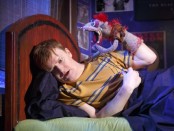
Though operating under the guise of a rather nonsensical comedy, Askins’ play is actually a sophisticated examination of how we handle grief. The text depicts two competing sides of a boy newly without a father and in the throes of puberty: while Jason appears too innocent to ever do anything wrong, the sock on his hand offers a convenient outlet for his bad behavior. Laced in this dichotomy are hints of schizophrenia, allusions to autoerotic stimulation, and a critique of the Christian notion that “unholy” behavior exists outside of the pure self and thus can be forgiven and eliminated. The question literally “at hand” is as follows: is the puppet actually possessed or is Jason mentally ill? If the latter, to what extent should the otherwise sweet boy be held responsible for the evil puppet’s actions? [more]
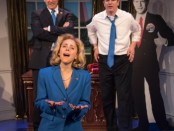
After a brief stint in the future, the show jumps back in time to the 1992 evening of Bill Clinton’s election. As the First Lady, Broadway veteran Kerry Butler is bold with her characterization, using vocal variation and employing highly stylized physical choices to bring Hillary to life. Still grandiose at best, Butler brings just enough warmth and heart to the character to ground the few fleeting dramatic moments. Early on the music is quite simply that of a musical comedy, but the writers manage to incorporate signature moments to showcase Butler’s true vocal abilities, in none more so than “Both Ways,” a power ballad performed by Butler with familiar command and ease. [more]
Through a series of five two-character scenes, Atik’s play charts the evolution (or lack thereof) of sex in humanity. While one segment depicts Adam and Eve fumbling through their first discovery of intercourse, another shows a pair of apocalypse survivors struggling to repopulate earth. In between, Atik includes a medieval couple’s epistolary romance, another couple’s post-breakup fling from “last week,” and a third’s inept attempt at exploring fetishes “next week.” Each with their own unique angle, Atik’s five self-contained shorts add up to a heartfelt, whimsical look at the reasons we pursue sex and the means we employ in order to have it. [more]
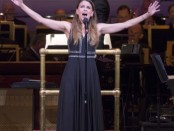
The concert’s triumph was due largely to its headliner, the incomparable Sutton Foster. Since her Tony Award-winning portrayal of the title character in the 2002 Broadway production of Thoroughly Modern Millie, she has proven herself to be one of the most versatile leading ladies to grace the Great White Way. Her brassy, yet lithe voice soared over the melodies of Cole Porter classics; her feet glided precisely across choreographer Michelle Elkin’s tap number (yes, a tap number at a New York Pops concert!); and her storytelling chops shone during heartrending takes on a couple of choice Sondheim ballads. She is a true triple threat in a way that most, if not all, of her Broadway diva contemporaries simply are not. [more]
The famous late-19th century author Oscar Wilde is a rather paradoxical historical figure. On the one hand, he was a proud Irishman quick to correct anyone who suggested otherwise; on the other, he spoke with the finest English accent. He was too pedantic to relate to the masses, and yet his work was widely revered by all social strata. Many people loved to hate him and others hated that they loved him. In "Diversions & Delights," the 1979 play that recently returned to Manhattan for a one-weekend run presented by The Ensemble Theatre Company of New York, writer John Gay distills these many facets of a complicated man into a solo performance piece that is appropriately pretentious and accessible. [more]
In 2015, it’s a bold move to revive a century and a half-old play that bears a racially insensitive title, and it’s an even bolder move to refrain from apologizing for such source material. Nevertheless, playwright Branden JacobsJenkins does just that in" An Octoroon," his adaptation of Irish playwright Dion Boucicault’s 1859 melodrama "The Octoroon." Back by popular demand from its previous Soho Rep mounting and recently extended at the Theatre for a New Audience through March 29, the production makes the risky decision to embrace an uncomfortable facet of our history and transform it into a contemporary piece. Thankfully, it paid off big time: the result is an entertaining, touching and illuminating theatrical experience that speaks to today’s audience. [more]
Playwright Ross Howard’s new work illustrates the characteristically 21st Century sentiments of unbridled selfishness, feigned apathy, and perennial discontent. His pointed, political indictment of our skewed American values is simultaneously too hard to watch and too illuminating to ignore. "No One Loves Us Here" is an entertaining, engaging bloodbath that leaves its audience thinking lots and feeling little. Perhaps this is as it should be. [more]
Asking us to stoop down to the level of three women willing to do many ethically reprehensible acts in the pursuit of wealth, Cahn challenges the notions of playing fair and working hard. Who would you throw under the proverbial bus in order to protect your livelihood? Is it ever justifiable to fight crime with more crime? Villainous Company raises these questions and more in the form of a short, fun play that is worth a watch but ultimately not worth too much thought. [more]
This holiday season the 59E59 Theaters is hosting a special cabaret, Cafe Society Swing, in tribute to a historic cafe which thrived back in the1940’s, one that defied conventional wisdom at a time when vanilla and chocolate didn't mix and red was a very scary color. Known as the Cafe Society Downtown, it was the first club of its kind in New York City and possibly in the country to feature white and black artists performing on stage together before an integrated audience. Not only that, mixed couples were seen dancing and even leaving together. Shocking as this was back then, Cafe Society appealed to the elite and became the big hot spot in town. Even Eleanor Roosevelt, Paul Robeson and Errol Flynn were known to stop in. Proprietor Barney Josephson referred to it in his memoir as "the wrong place for the Right people" and it is this work that inspired the making of Cafe Society Swing which is as much about the club's owner and his family as it is about the talent he brought to its doors. The Downtown club was an extraordinary place. Legendary for its jazz and blues, it produced a lot of stars: Lena Horne, Billie Holiday, Sarah Vaughan, Zero Mostel, Big Joe Turner, Count Basie, Carol Channing and Sid Caesar among them. [more]
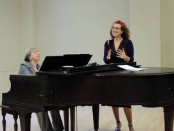
The crowd at The Pangea was in for a real treat when a unique mother/daughter act from the neighborhood performed a number of musical selections complete with stories that were nostalgic to this quaint, historic community on the Lower East Side. Mimi Stern-Wolfe began the 90-minute cabaret by recounting the tale of a Russian immigrant from the old days who used to come in from the Bronx to frequent the nearby Yiddish Theater. He went by the name of Bronstein. After a time, he left to go back to Russia to, as he put it, overthrow Kerensky. He turned out to be none other than Leon Trotsky. The theater later became the Children's Musical Theater where a little girl named Laura Wolfe took to the stage and a star was born. [more]