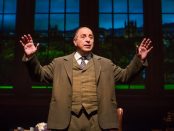
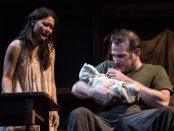
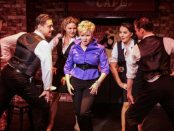
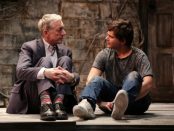
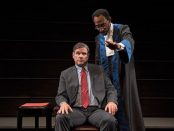
Theatre Row is the name for a section of 42nd Street in New York City which is the location for a number of small theatres; it is also the name of a large theatre complex built in 2000 to house six theatres.
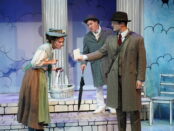
In their latest, Shaw’s ever-popular "Pygmalion," Staller has staged Shaw’s never-used prologue created for the 1938 film version which has the gods and goddesses on Mt. Olympus recount to the modern audience the myth of Pygmalion and Galatea which inspired Shaw’s Edwardian comedy. The set by Lindsay G. Fuori creates an Al Hirschfeld-inspired Greek temple used for all of the play’s five scenes. Four of the actors dressed in white Grecian robes (courtesy of designer Tracy Christensen) greet us and tell us the myth that we will see in Shaw’s updated 20th century comedy in which the sculptor becomes a professor of language and linguistics and the statue becomes a flower girl who wants to improve her speech well enough to get a job in a flower shop. However, Staller does not stop there but has created narrative introductions for each act which is rather intrusive though it may help some first-time viewers to understand the play. (Is there any theatergoer who has not seen the play’s musical version My Fair Lady on stage or screen?) [more]
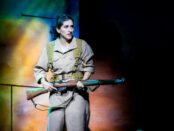
At the center of it all stands Apple, whose performance is nothing short of revelatory. As Catherine, she is brittle yet unbowed; as Hannah, she radiates vitality and purpose. Her voice—both spoken and sung—cuts through the air with the precision of belief. A stirring portrait of resistance, resilience, and unyielding hope, Apple’s one-woman tour de force unfolds with the emotional breadth and intensity of a full ensemble. Apple commands the stage with a virtuosity that transcends mere performance; she channels something elemental and deeply human, crafting an experience that lingers long after the lights fade. It is as inspiring as it is unforgettable—a testament not only to the power of storytelling, but to the indomitable spirit it so eloquently celebrates. Around her, Simon Feil lends quiet gravity as the spectral voices of Hannah’s brother and her Nazi captor. [more]
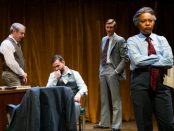
Ted Lange’s "Lady Patriot" reunites the author/director with his cast mates from The Love Boat series, Jill Whelan and Fred Grandy. Leaving that aside as it has little to do with his new historical play, the third in Lange’s American history trilogy, "Lady Patriot" is based on true events that took place in the Jefferson Davis White House and the neighboring house, the Elizabeth Van Lew Mansion, in Richmond, Virginia, during the Civil War, 1861 – 1865. While the play purports to tell the story of the leak in the Davis cabinet and the successful Union spying ring in the Confederacy in Richmond, it lacks urgency and tension even at the end when the Confederacy is about to come to an end. Told in 18 short scenes, the play could use a good deal of pruning of its two and a half hour running time. [more]
At an hour and 40 minutes, "Cracked Open" is an earnest but often exhausting theatrical experience. Its heart is unquestionably in the right place—tackling the vital and still-stigmatized subject of mental illness with sincerity—but the journey can feel more dutiful than illuminating. Despite these shortcomings, the cast’s unwavering commitment and playwright Kriegel’s courage in confronting such difficult terrain deserve commendation. [more]
"Night Sings Its Songs" by Norwegian author Jon Fosse (pronounced FAH-suh), the 2023 Nobel Prize-winning playwright, explores alienation and emotional disconnection by a couple in a dysfunctional marital relationship. Fosse's works are often compared to those of Henrik Ibsen and Harold Pinter. His minimalist style fits into the Norwegian existential and psychological drama tradition. Fosse is one of the most performed contemporary playwrights globally, but he is not well-known in the United States. The play, directed by Jerry Heymann from a translation by Sarah Cameron Sunde, never engages the audience in caring about the characters' emotional struggles. There is a feeling of "so what” or “why should I care” rather than one of concern or empathic understanding. [more]
The play is not very consistent with life in 1949. It is unlikely that middle class married women cursed, smoked marijuana, quoted Simone de Beauvoir or engaged in affairs with other women. While the program notes by the playwright describe "Mrs. Loman" as a “feminist critique” of the Arthur Miller play and reveals that the author feels that the original “does not provide for a full female character,” Linda’s studying philosophy at Brooklyn College does not make for a feminist statement. In fact, Beauvoir’s "The Second Sex" which Linda quotes from was not published in English until 1953 which means Linda could not have been studying it in an American class in 1949. [more]
Ako's portrayal of Izumo no Okuni combines traditional Japanese dance movements with Western-style acting. The nature of the script limits the impact of her performance. The dialogue is simplistic, verging on a museum presentation. The story being told is too small for someone who is such a large character in the folklore of Japan. It is a story that calls for a larger cast to show the impact her dance and performance style could have on audiences. Okuni certainly did not dance alone, so what needs to be added is the pageantry and bravado of a fully engaged dance ensemble. Ako also portrays Lady Yodo, the mistress of the late Toyotomi Hideyoshi, credited with the unification of Japan that led to the establishment of the Tokugawa shogunate. [more]
While "Sump’n Like Wings" is a lovely little play about a feisty 16-year-old girl who wants her independence in the 1913-16 period just after Oklahoma became a state, unfortunately Raelle Myrick-Hodges’ production is limp and undramatic, not making a good case for restoring this play to the American repertory. Ironically, while the fact that Riggs was gay and a Native American is being publicized by this production, neither of these themes appear in this play. The use of Junghyun Georgia Lee’s unit set for all five scenes makes the play seem thinner than it is and the beautiful poetry and high flown language of "Green Grow the Lilacs" (made available in the collection "The Cherokee Night and Other Plays" from University of Oklahoma Press) is nowhere in evidence in this play. Most of the important events take place offstage, unlike some of Riggs' other plays. [more]
"Hurricane Season" is the sort of vanity production in which one assumes that the author thinks he or she has invented the next step in the avant-garde. Unfortunately, Estes’ production will give most theatergoers a headache attempting to follow his play as well as the unnecessary flashing video. Whatever the play wants to say about “erotic desire and national anxiety,” it is lost in the proceedings on stage. Incidentally in the cause of transparency, Hurricane Season is not the least bit erotic though there is a certain amount of simulated sex. [more]
Director Nicholas Viselli has done well with the characterizations but is unable to resolve the thinness of the backstories which are not fleshed out by the script. The shallow set which has most of its furniture and appliances lined up across the stage makes some of the blocking awkward and repetitious. Making her Off Broadway debut as Libby in the role that won Dinah Manhoff the Tony Award, Makenzie Morgan Gomez is spunky and quick with the retort. She has a breezy, wise stage presence. Her use of a wheelchair and a cane is no problem to the character but when she says that she has hiked and hitched her way across half of America one wonders if this is realistic. And today in 2024 do 19-year-old women risk hitching alone that distance? [more]
Aside from its attempt to cover too much at one time (drug addiction, pregnancy, incarceration, high school dropouts, gun violence, lack of health care, underfunded ghetto schools), "Fish" does not tell us anything we don’t already know. It will come as no surprise that public schools teach to the test, truancy is a big problem and students fall asleep in class after working jobs at night to help pay the rent, or that charter schools are better funded than public schools. Nor does it have any answers other than that teachers should be more understanding of students’ home situations and help to do something about inadequate facilities and supplies – other than pay for missing supplies themselves. [more]
"The Inheritance of a Long-Term Fault," written by Mêlisa Annis and directed by Vanessa Morosco, is an extraordinary play that explores how the societal structures across many cultures have shaped cultural interactions and defined what is viewed as societal norms to the present day. It is a provocative, thought-provoking look at how colonial patriarchal behaviors and attitudes about women's roles persist into the present day. It is a show worth seeing and, more importantly, exploring the ideas engendered by it. [more]
Probably only David Rabe’s "Sticks and Bones" (part of his Vietnam trilogy that included "The Basic Training of Pavlo Hummel" and "Streamers") is as demonstrative as "Lone Star" in its depiction of a soldier’s inability to easily pick up from where he left off upon returning from a tour of duty. For this production, Ruth Stage, in an adaptation by director Joe Rosario and actor Matt de Rogatis, has been given the rights to append the character of Elizabeth to the original "Lone Star" cast. Her character is from a companion McLure play, "Laundry and Bourbon," which has a history of being performed in repertory with "Lone Star." Elizabeth is Roy’s wife, therefore Ray’s sister-in-law. [more]
The secrets revealed seem more contrived and clichéd and take away from the moving story of Mary’s battle with cancer. Nick behaves badly. Lucy has a drug habit and Jason questions his legitimacy in the family—all turn "‘Til Death" into a soap opera, a beautifully acted soap opera, yes, but still a soap. Kaye and Cuccioli provide the emotional heft, particularly in a tender scene when, for a few minutes, the rest of the family isn’t around. Both are expert actors and find all the rich opportunities to give life to Coplan’s words. [more]
The three plays in the “Meet Miss Baker” Project, "The Price of Thomas Scott" in 2019, "Chains" in 2022 and now "Partnership" in 2023 are quite different. While Partnership is the only one you could call a conventional comedy, and a romantic one at that, it offers the least social commentary of the three. At first seeming to be a study of the Shavian “New Woman,” it ultimately makes little or no statement about women’s roles or rights at the time. Women theatergoers may appreciate a period play which puts the female roles front and center, but this play is ultimately too bland and inoffensive. [more]
Shaye tells of a pot and drug-addicted couple who are totally disgusting parents to a two year old. That’s just not acceptable even though it is told as a funny hippy-dippy anecdote. Even so, Shaye is a great storyteller, her narration a perfect substitute for the absent camera. However, she is a poor developer of characters. Her insights end with naming the drugs each character takes. None of the characters seem to have any means of support, however colorful they are. [more]
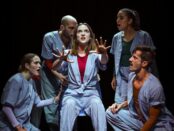
In "Relapse" ’s most original conceit, a quartet called The Intrusive (Vinny Celerio, Audree Hedequist, Nicole Lamb and Zummy Mohammed) becomes a Greek Chorus, insinuating themselves into the minds of the four unhappy patients while commenting on the inner workings of their care. The four are nimble, vivid and sing well, choreographed by Freyani Patrice whose movements ooze, flit and crawl about the stage as these four surround each character. [more]
Press materials promise a work that is inspired by Kafka's "The Castle" and Melville's "Bartleby, the Scrivener." Both are name checked – the lead character is called K, played by a clear-voiced Zoe Siegel, and there is even a Bartleby (Austin Owens Kelly, doing triple duty on synthesizer and later acoustic guitar) who says "I prefer not to" very often – but "In Corpo" also owes something to Vaclav Havel's "The Memorandum" with its depiction of bureaucracy gone mad. Of course, not even Havel could have envisioned the tyranny of the complex password, something "In Corpo" uses to excellent comic effect. The show is at its best when it satirizes things that everyone has to deal with, such as passwords and inane tasks. [more]
Scheduled to run only until July 1, "Lizard Boy" deserves a longer life as one of the most satisfying musical theater offerings to be seen currently in New York. While the message of tolerance and diversity is not heavy, the theme is dramatized so that no one can mistake its intent. The three-person cast is superb in the acting, singing and musical departments. Brandon Ivie’s staging is clever and imaginative, while the book, music and lyrics by Justin Huertas make audience goers look forward to his next project with eager anticipation. [more]
The Mint Theater Company continues its three play mini-festival of the forgotten plays of Elizabeth Baker with "Chains." Given a polished – maybe too polished – production like the earlier "The Price of Thomas Scott," this play is also problematic, but in another way. Unlike her contemporaries John Galsworthy, George Bernard Shaw and Harley Granville-Barker, Baker’s "Chains" has a very narrow focus: the discontents of the lower middle-class white collar folk. All of the characters in the play’s first half (the script’s Act I and II) do nothing but either complain about the grind of their daily six-days-a-week jobs (half-holiday on Saturday) or laugh at those who would give up a steady employment. You would think that back in 1909 when the play was written there wasn’t anything else to talk about. Jenn Thompson’s direction is conventional and sedate where something more animated might have been more to the point. [more]
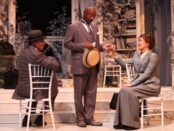
"Mr. Parker," the latest play by Michael McKeever whose "Daniel’s Husband" has been produced twice Off Broadway, has been given a stylish production by director Joe Brancato who also directed the earlier play. David Goldstein’s one-room studio set situated in the East Village is elegant and cozy. The costumes by Myra Oney are chic. The acting by its trio of actors is polished and urbane. Even its premise of a gay man dealing with the sudden death of a long-time partner and husband is up-to-date and timely However, as written the play seems superficial and slight. Dramatically it avoids all the big scenes that might have been included. It remains entertaining but without the payoff one wants in such a drama. [more]
Can a 27-year-old Black gay professional journalist and a 21-year-old Blatino bicycle messenger with an out of wedlock son find love and happiness together in Brooklyn? That is the crux of author James Earl Hardy’s compelling class-conscious drama "B-Boy Blues The Play," where all of its characters are confident of their varied sexuality. Mr. Hardy, an accomplished entertainment reporter, published his novel, "B-Boy Blues: A Seriously Sexy, Fiercely Funny, Black-on-Black Love Story," in 1994. It led to five sequels, a short story and an upcoming film version. Hardy’s stage adaptation premiered at New York City’s 2013 Downtown Urban Arts Festival (DUAF), which is also presenting this production. [more]
The world premiere of Peter Gil-Sheridan’s "This Space Between Us" gives itself away in its title: it is about a dysfunctional family that does nothing but argue when they get together. Jonathan Silverstein’s production for Keen Company bills itself as a comedy but unfortunately there are few if any laughs. While the author has an ear for realistic dialogue, he demonstrates little talent for plot, with the play as linear and predictable as could be. The only wrinkle in this timeworn theme is that the protagonist’s father is Cuban-born while his mother is American, and his Aunt Pat is a nun. One gets the feeling (possibly misplaced) that there is a semi-autobiographical element and the author is too close to his material. [more]
It appears that the later play was modeled on the earlier one though it may not have been noticed back in 1997 when "Sympathetic Magic" had its New York premiere. Both plays deal with discoveries by scientists: archeologists in "The Mound Builders" looking in the earth and astronomers in "Sympathetic Magic" examining the sky. The themes of both are about ethics in science, in "The Mound Builders" science versus commerce, and in "Sympathetic Magic" science versus fame. Both include a pair of brothers and sisters, and one parent of each is of vital importance, though not seen in both plays. A woman artist appears in each: a famous blocked novelist in "The Mound Builders" and a quickly rising sculptress in "Sympathetic Magic." Each drama has a newly announced pregnancy that is paralleled with the new scientific discovery. Both are ensemble plays dealing with a tightly knit group of people affiliated with a university department. In each a project ends disastrously, as well as a relationship breaks up for differing reasons. The academic world intrudes on both plots as the scientists are professors at their respective institutions. [more]
George Bernard Shaw’s once-banned problem comedy due to its controversial subject matter concerning prostitution, "Mrs. Warren’s Profession" has been given a stylish and elegant revival by the Gingold Theatrical Group which specializes in the plays of this master. As staged by artistic director David Staller and with a cast led by Karen Ziemba and Robert Cuccioli, the play is an entertaining story investigating hypocrisy in society, mother-daughter relationship, and the rights of women. While most of the shock value has worn off since the play was first written in 1893, the play’s message is still timely and relevant. Banned from the stage for 32 years in England after it was written, the play now seems to have come into its own with previous New York revivals that have starred such legendary actresses as Ruth Gordon, Lynn Redgrave, Uta Hagen and Dana Ivey. [more]
Following its opening production of Cy Coleman’s equally rarely seen "Seesaw," J2 Spotlight Musical Theater Company is presenting a fully staged version of "No Strings" as the second production of its inaugural season. While No Strings, set in the Paris world of high fashion and the French watering holes of the very rich, would need a much more lavish staging to do it justice, Deidre Goodwin’s production does have its charms though the show’s book by playwright Samuel Taylor seems particularly thin by today's standards. The songs are melodic and hummable though there is no breakout winner among the 14 musical numbers. [more]
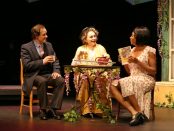
Pearl Cleage’s "Blues for an Alabama Sky" gets a belated New York premiere courtesy of Keen Company in its 20th season. Although seen in many regional theaters since its 1995 premiere at the Alliance Theatre Company in Atlanta with Phyllicia Rashad in the leading role, it has long been overdue in New York even though Cleage is also a successful and acclaimed novelist. Framed as a domestic drama, the play manages to take in the topics of racism, sexism, homophobia, birth control and abortion, poverty, alcoholism, and extreme religious points of view among the bohemians of Harlem, circa 1930. [more]
The Mint Theater Company has rediscovered and championed British actor/playwright Miles Malleson with Conflict and Yours Unfaithfully. Now they have combined two of his one acts adapted from great short story writers in an evening called "Chekhov/Tolstoy: Love Stories" in their premiere pairing. While the production directed by Jonathan Bank and Jane Shaw (each directing one play) is able to be performed on basically the same set, the two plays have little to do with each other and represent love in two different ways. Anton Chekhov and Leo Tolstoy are major writers, but the adaptations appear to be minor and do not show off their authors at their best. Although the Chekhov story is basically an anecdote, the Tolstoy tale is a fable with a message. [more]
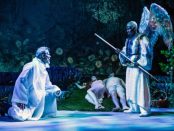
When a playwright adapts a famous, well-known story for the stage the problem becomes how to tell it in a new way that makes it seem unfamiliar and fresh. Otherwise, why bother retelling it once again? Unfortunately, Tom Dulack’s "Paradise Lost," “inspired by the poem by John Milton,” retells the story of Lucifer’s fall from Heaven into Hell, and the eventual banishment of Adam and Eve from the Garden of Eden without any surprises. Using only contemporary language, Dulack’s play lifts the skeletal plot of Milton but lacks the poetry, as well as those elements which made this epic controversial in the 17th century (rejection of the divine right of kings, embracing divorce and marriage equality, etc.) It resembles a Sunday Bible sermon or dramatization meant for youth. [more]
"The Giant Hoax" is a charming morality tale about telling the truth and growing up. The expert hands of director Christopher Michaels and choreographer Molly Model are clearly at work in all aspects of this production, bringing a touching story with affable songs and clever lyrics to life with a cast of first rate actors, a fine ensemble, and inventive and humorous choreography. This show will never get any bigger than it is, but it’s big enough to fill the hearts of its audience to bursting, as long as actors of this production’s caliber are playing it. [more]
His more abstract ballets for The Chase Brock Experience, such as its current presentation at Theatre Row, "The Four Seasons" to the Vivaldi score (a revival from 2006), did not fare quite as well. Despite the fact that "The Four Seasons" had some spoken text (by David Zellnick) and an environmental subtext, the majority of the work was a pretty, but slightly anemic balletic expression of the famous (over-used?) score. [more]
Political plots can be dry as toast. Hatem attempts to spice things up by crossing the genders of the actors playing Carter and young Cynthia; the convention is an interesting choice although it really doesn’t add any new light to the characters or story and is sometimes distracting. Not to worry, though, the script is smart, imaginative, humorous at the right times and keeps its audience interested. [more]
The enduring resonance of its source material is evident in "An Enchanted April" during this uneven stage musical adaptation. Lasting two hours and 45 minutes with an intermission, its initial frothiness gradually fizzles. The bright score is excessive, the solid book rambles, and the production is more dutiful than inspired. However, the performances are engaging, and the piece’s emotional power is palpable. The show was originally presented by the Utah Lyric Opera and this New York City premiere demonstrates its potential. [more]
As is Mr. Friel’s The Faith Healer, Molly Sweeney is a monologue play. Here, instead of being separated in individual acts, the three characters appear on stage together without interacting, and speak alternately. It’s certainly a viable format and Mr. Friel gives us a gorgeous cascade of memories, biographical details, differing points of view and suspense. However, as beautiful as these reveries may be, there’s too much of them and the play’s impact is diluted. Lasting two and a half hours and comprised of two acts with an intermission, the slender plot is embellished with the leisure of a literary work rather than a taut stage play. Still, by its end, one is caught up by the characters and their fates. The arguable structural deficiencies are compensated for by the faultless presentation. [more]
When the Gingold Theatrical Group’s revival of Bernard Shaw’s epic "Caesar and Cleopatra" begins, the characters are wearing white contemporary clothes and sitting on what looks like an excavation site which might give one pause. Like David Staller’s revival of "Heartbreak House" last year, his Caesar and Cleopatra tries to give this 1898 play a more contemporary relevance, but unlike Heartbreak House which pointlessly updated that play to W.W. II rather than the usual W.W. I setting, this modern approach works extremely well and proves to be quite charming. [more]
The score with Ms. Hagedorn’s sharp lyrics and composer Fabian Obispo’s pointed melodies in the manner of Stephen Sondheim and John Kander is quite accomplished with its rousing group numbers and rich solos. Highlights include an eerie sequence with one sick person after another seeking rejuvenation, a Billy Flynn "Chicago"-style bit documenting Felix’s past popularity and an acidic anthem by a mercenary San Francisco female florist who deals in black market identity papers for illegal immigrants. [more]
Lenore Skomal’s "The Exes" wants to revive the Broadway-style sex comedies of the 1950’s and 60’s, earlier called boulevard comedy. Unfortunately, not only is the formula passé but television sit-com now does it better. The play is also too heavily plotted with two main characters with the same name and a great many petulant, entitled people. Worse still, the play fails to deliver any witty or clever lines, instead giving us quotes and references from much better works without much point. Directed by Magda S. Nyiri, "The Exes" has at least two false endings before it comes to an unearned conclusion. [more]
A mash-up of Eugene O’Neill’s "Anna Christie" (set in Manhattan and off the coasts of Provincetown and Boston) and "Desire under the Elms "(with a rural New England setting), the play is set on a farm in the West of Ireland. With its fallen woman theme, this play could have been written any time since 1880. First time director Aidan Redmond has staged the play by the numbers and has given his actors little help. Some of the character interpretations undercut the play. However, the play does have a melodramatic but smashing and startling ending. [more]
Cohen is clearly an intelligent, well-read man, familiar with the twists and turns of different periods and styles. "Midnight Street" is chock full of ideas, poetic meanderings and some worthwhile melodies but just doesn’t add up. His direction can’t overcome the pretentious language and heavy-handed symbolism. Only a Lotte Lenya or, perhaps, a Patti LuPone might have given Mr. Cohen’s songs the right gravity, not to mention finding sense where none exists. [more]
Employing his rumbling deep voice, his thinning hair slicked back and veering from snarling cheeriness to reflective introspection, Jeremiah Kissel swaggering in a power suit gleefully gives us the ballsy Madoff we desire. Tossing off expertly pronounced Yiddishisms in his rants, Mr. Kissel fully embodies the archetypal striving lusty Jewish kid from Queens who worked the angles and became a macher. Kissel attacks the role with outsize relish as if it were Roy Cohn in "Angels in America." [more]
William Nicholson’s "Shadowlands" is one of those subtle plays that grows on you as it evolves and weaves its own spell. Based on a true story of one the most improbable love stories of the 20th century, it covers a range of human emotions that should catch you in its web. Under Christa Scott-Reed’s assured and astute direction, Daniel Gerroll gives a memorable performance as theologian and writer C.S. Lewis. A play of ideas on the meaning and varieties of faith, it is challenging as one has to follow its intellectual and spiritual arguments. However, for discriminating theatergoers, this is an added fillip for more than simple entertainment. [more]
The problem is that under Albert Bonilla’s stolid and matter-of-fact direction, Elizabeth Ingham and Zack Calhoon's characters never come alive. Just trading quips is not a sophisticated style and as all of their lines are said the same way without variety, it becomes tiresome quite soon. While Donze continually surprises us as Beth, Melissa and Dave remain the same throughout. And the production design doesn’t help much. While the couple discusses what good taste Melissa has in buying Dave’s shirt, Viviane Galloway’s costumes are extremely conservative and colorless, no proof of any special taste whatever. [more]
hough it’s a one-woman show, Alison Fraser plays a number of characters by speaking in different voices with a certain technical prowess. The principal one is an upper West Side psychotherapist, Sharon, who is ostensibly talking to her own therapist (a “shrink’s shrink,” we’re told) at his apartment late one night. She’s relating the story of her going to her hometown of Lubbock, Texas, for her beloved nephew’s funeral, after he’s committed suicide. But has Eddie really killed himself, like Sharon’s mother did decades ago when Eddie was only three? For that matter, did Sharon’s mother really commit suicide, we’re made to wonder by the end? [more]
Exquisitely produced by the Mint Theater, Jonathan Bank’s direction is leisurely and slow, which undercuts the theatricality of all but the last and the most satisfying one, 'The King of Spain’s Daughter," originally given four separate stage productions at the Abbey from 1935-1939 and two in London in 1939. Using a company of seven, the actors appear in varying combinations while all appear in the third play, "Holiday House. " Two of the plays end too abruptly calling out for a more substantial length, while one of the plays seems to go on too long. [more]
Lazarus’ score is an entertaining blend of rock, pop and show tunes. None of Elvis Presley’s actual songs are heard, but there are a number of clever takeoffs such as “Viva Milwaukee!” and “Spread the Word of Hound Dog.” His good-natured book is a shambles. The serious, campy and satirical elements don’t connect. The plot is crammed and wayward. It recalls the 1960’s "Batman" television show as well as counterculture fantasies such as the 1968 film "Wild in The Streets" and Brian De Palma’s movie, "The Phantom of The Paradise." [more]
Ludlam also starred in "Artificial Jungle," his last of 29 plays, which he also directed. It took its inspiration from Emile Zola’s "Therese Raquin," which had already inspired James M. Cain to write "The Postman Always Rings Twice" and "Double Indemnity," each of which became a hit film. Ludlam also set out, with Jungle, to write a crowd-pleaser, and he succeeded with critics and theatergoers alike. [more]
As he impersonates the British writer C.S. Lewis, Max McLean relies on little more than a pipe, a brown suit and tie, and a rather mellifluous voice to become the Anglican philosopher and noted atheist, who famously converted to Christianity in the mid-Twentieth Century. The script was cobbled together by McLean from Lewis’ memoir, letters and books, including other biographies of Lewis, a man who was “intoxicated” by words, which is primarily what this play is about--the mesmerizing effect that words can have, when uttered in an effective sequence. [more]
Speaking in an engaging Texas twang, the blonde Reeder recounts Ginnifer’s somber story with emotional straightforwardness and humor. Employing her expressive facial features, striking eyes and serene physicality, she delivers a performance of tremendous focus that hauntingly holds attention. [more]
Playwright Jeff Talbott offers an overall well-written and plotted social drama that detours into a strident political battle over capitalism. The sympathetic characters are trapped by their circumstances, as well as by Mr. Talbott’s rudimentary scenario. [more]
Based on a story by lyricist/bookwriter/producer B.G. DeSylva (“Good News,” “The Best Things in Life Are Free,” “The Varsity Drag”), this musical satire sends unworldly, teetotaler Oliver P. Loganberry, “the Watchdog of the Senate,” to New Orleans to investigate the corrupt dealings of the Louisiana Purchasing Company run by Jimmy Taylor, Colonel Davis, Junior Davis, Dean Manning of the university, and Captain Whitfield of the city government. Jimmy, the president of the company, who was out of town when the others used his powers of attorney for their illegal scheme, is left to sort out the mess. [more]
While the play is at times Pinteresque, it is talky in a way Pinter never is, explaining everything over and over, covering the same ground again and again. Nothing much happens other than that the men become more confiding and reveal more of their personal pasts. The play implies that Jonah is menacing, but under Hughes’ direction, he never seems much of a threat. The pace is slow and methodical, too slow for its own good. Sean Gormley’s Otto and Rupert Simonian’s Jonah are well-rounded characters but the acting style is too refined, too genteel to make much impression. [more]
Behind the theme of war," Incident at Hidden Temple" is a thriller of sorts. Sisters Ava (Ying Ying Li) and Lucy (Briana Sakamoto), first seen in China travelling on a train littered with American soldiers, are separated when a disturbing road block forces their train to a halt. With some time to kill, the sisters exit the train and are introduced to a mysterious stranger--Dinh James Doan as a blind man with a penchant for speaking in riddles--who tells them about a Hidden Temple located just a short ways away. The temple, the blind man cryptically tells them, is filled with lost treasures but will only be revealed to those of pure heart. [more]
While Harms has a fine ear for dialogue, the play moves by revelation and incident. Consequently, it plays like a sophisticated soap opera as every scene brings a new wrinkle not previously suggested. Drew Foster’s direction is smooth and polished but he can’t prevent the play’s plot from having too many incidents that aren’t foreshadowed. Steven Hauck, Elizabeth Rich and Amy Bodnar are charming in a worldly, cultivated way. However, we learn so little about each of them other than how events affect them that they seem one-dimensional. Important facts are left out: what is the rooming situation, are Julian and Agnes married, etc.? The sexual tension is clearly defined: dancing seems to be foreplay to sex. But one can’t live on love alone. [more]
“He” and “She” are a 40ish upper middle class couple who divorced ten years earlier following the traumatic death of their young son who was hit by a car. Due to toxic waste from a nearby gas factory, 200 graves, including their son’s will have to be dug up and the remains reinterred elsewhere. This unpleasant circumstance instigates this reunion after a long estrangement at a cemetery in Holland. [more]
"Hoi Polloi" was Coward’s tribute to the London working class that was trying to get back on its feet after the devastation of World War II. Partly out of his element and partly as Coward never saw the show in production, both the book and the score seem like part of a first draft which needs to be fleshed out. Mindy Cooper’s tame production with a hard-working cast of ten seems at best second-rate Coward rather than any unjustly lost rediscovery. The Master may have realized that he had not solved his story’s problems. [more]
Out of this frustration, Larson in 1991 began performing a rock monologue about his life and stalled career called 30/90, as it was set in 1990 as he turned thirty. Later it was retitled "Boho Days" and then "tick, tick... BOOM!," as a chief device is the ticking of a clock. The show was performed for short engagements at several New York City venues and ignited Larson’s career, leading to the creation and presentation of Rent Off-Broadway in 1996. [more]
The scenic design by Brett Banakis is a functional, minimalist configuration of a slightly raised wooden performance platform surrounded by a wooden frame dotted with small antlers suggesting the pub. There’s an assemblage of vintage furniture, potted plants, screens and vines that are shifted about to designate the various locations. This all contributes to a deficit of visual grandeur that the production is understandably striving for on a limited budget but doesn’t achieve. These design flaws could be superseded by an abundance of bravura performances, but there aren’t. [more]
Trial is stacked against Bush from the get-go. The torrent of facts alone convicts him. The director, Stephen Eich, the author and probably the actor, Mr. Carlin, seem to have decided to make Bush weak-voiced, full of twitches, nervous eye movements and religious fervor. Had Bush been portrayed as a stronger man who truly believed in what he did, the play might have had a dramatic spine. The very fact that after being convicted by a jury of audience members Bush’s last word is a tearful outcry (“Laura”) serves to induce not empathy, but pity. [more]