News Ticker

Moshe Yassur

Night Stories

December 26, 2025

"Night Stories" is, first and foremost, about Jewish life. The show’s characters are mainly Holocaust survivors, yet they are never reduced to simply being symbols of suffering. They go on tangents, they make jokes, they express unimaginable pathos before quickly moving on, and they navigate life as best they can. There are so many moments in this play that are deeply human, and deeply Jewish. The production imbues Sutzkever’s poetry with a magnificent resonance. His words are as strikingly beautiful as when he first wrote them, and this modern production is a heartrendingly beautiful affirmation of life. [more]

Bashevis’s Demons: 3 Tales by Isaac Bashevis Singer

December 25, 2024

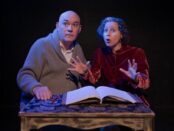
Typical of Singer stories about 19th century Polish Jewry, these three dramatizations combine Jewish mysticism and demonology with Baker as the narrator of two of the stories while also playing the demons in both (“The Mirror” and “The Last Demon.”) The third story published in English as “Cockadoodledoo” but here renamed “Thus Spake the Rooster” is performed by Seigel in two parts as the title character who seems to have supernatural powers. The evening is both directed and designed by Moshe Yassur and Beate Hein Bennett, both of whom worked on the Yiddish versions of Waiting for Godot and Death of a Salesman seen in New York under the auspices of The New Yiddish Rep. [more]

Death of a Salesman in Yiddish

October 19, 2015

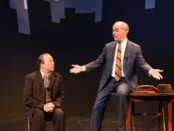
Although Arthur Miller grew up in a Jewish family, none of his characters with the exception of the antique dealer in The Price are explicitly Jewish. Yiddish stage star Joseph Buloff sought to correct that when he adapted "Death of a Salesman" as "Toyt fun a Seylsman" and presented the play in Argentina in 1949. In 1951, Miller permitted Buloff to bring the translation to Brooklyn’s Parkway Theatre where it was deemed a great success. Not seen again in New York until now, New Yiddish Rep is giving the Yiddish adaptation its Manhattan premiere in a slightly revised version in which the non-Jewish characters speak in English and the text is projected with English supertitles for a contemporary audience that does not know Yiddish. [more]