
The Least Problematic Woman in the World
Dylan Mulvaney's path, realizing in Catholic school that she’s in the wrong body, to be a TikTok trans icon, hit a bump when a beer ad sparked brewsky chaos.
Dylan Mulvaney in a scene from her one- woman show “The Least Problematic Woman in the World” at the Lucille Lortel Theatre (Photo credit: retouched by Andy Henderson)
There are solo shows, and then there are spectacles—the kind that wink at the audience while cutting deep into cultural truths, brandishing glitter like a weapon and tears like punctuation. Such is the kaleidoscopic, high-camp confessional that is The Least Problematic Woman in the World, Dylan Mulvaney’s fearless, ferocious, and frequently fabulous odyssey, now sashaying across the stage of the Lucille Lortel Theatre.
For those unacquainted with the name (Really? Where have you been—under a rock, or worse, off TikTok?), Dylan Mulvaney is a figure as polarizing as she is poised: Broadway belter turned viral sensation turned trans lightning rod in the culture war’s digital coliseum. At 28, she has lived more lives than shelter cats—and here, she tells all, with an effervescent wink and a dagger under her tulle skirt.
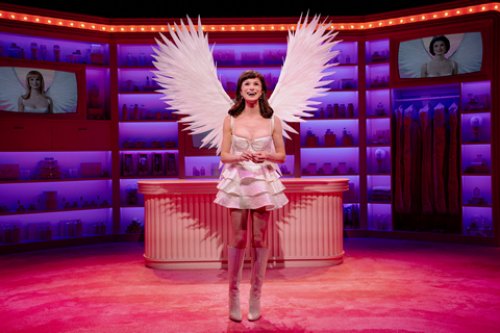
The evening begins not with a whisper, but with a celestial proclamation. Mulvaney descends—figuratively, then quite literally—from the heavens, clad in Enver Chakartash’s delightfully gaudy angel wings, to receive her next “assignment.” Past incarnations? Anne Boleyn (headless), Hitler’s mother (hopeless), Jon Benet Ramsey (you get the picture). This time, surely, will be different. Spoiler: it isn’t…the angel immediately before her got to be Zendaya. Dylan’s mortal coil is riddled with complications, contradictions, and commentary galore.
At the tender age of four, Dylan informs her mother that she is, in fact, a girl. What follows is an absurdist flurry of misdiagnosis and misdirection: a doctor prescribes her “twinkification” pills, essentially steering her toward that impish gay archetype of theater lore. It’s a clever bit—with Dylan as the onscreen doctor, funny, yes, but also chillingly astute in its critique of how queerness is often flattened to fit more “marketable” molds. Such is the tightrope Mulvaney walks all evening: between laughter and lamentation, self-deprecation and searing social indictment.
Dylan Mulvaney in a scene from her one- woman show “The Least Problematic Woman in the World” at the Lucille Lortel Theatre (Photo credit: retouched by Andy Henderson)
It comes as no surprise that Mulvaney approaches her storytelling with the deliberate intent of illumination rather than provocation. Her principal aim, it would seem, is not to chastise or alienate, but to foster understanding—to gently, and often hilariously, expand the audience’s perception of gender beyond the binaries that have long constrained public discourse. This is not a polemic masquerading as performance, nor is it a didactic exercise dressed up in sequins and stagecraft. What unfolds onstage is anything but a lecture. Instead, Mulvaney offers a deeply human—and deeply theatrical—invitation into her lived experience. She engages not with the cold remove of pedagogy, but with the warmth, wit, and vulnerability of a consummate performer who knows that the most profound education often arrives not through instruction, but through empathy. And in this regard, she excels: blending humor, personal narrative, and cultural critique into a piece that enlightens not by force, but by sheer force of charm.
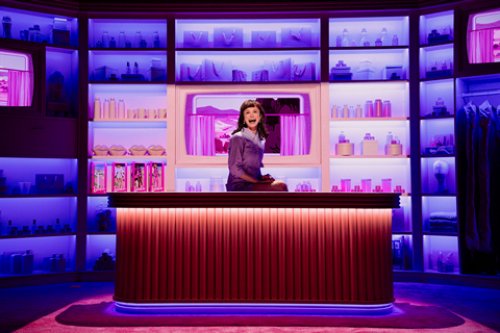
The first half of the show is a fizzy, theatrical confection. Directed with a devil-may-care glee by Tim Jackson, these early scenes are stuffed with rapid-fire gags, slapstick choreography, and sly cultural callbacks. One standout moment: Mulvaney’s “birth,” executed by diving Swan Lake-style across a table in Tom Rogers’s unapologetically pink set, a Barbie dreamscape on acid. It’s camp with a capital “C”—joyous, exaggerated, and utterly knowing.
Yet beneath the rhinestones and punchlines is an aching, deeply human story. Mulvaney’s rapport with the audience is electric. Before the show even begins, she mingles among the crowd, winged and radiant, taking selfies and radiating that rare mix of theatrical charisma and genuine warmth, “Where are you sitting? Oh,wow, that’s a great seat.” She is at once a diva and your best friend, sashaying through Abigail Barlow, Toby Marlow and Lucy Moss, Ingrid Michaelson, and Mark Sonnenblick’s delightfully earwormy songbook.
But as glitter gives way to grit, the second half of the show lands with a heavier thud—less polished, more pained. We glide swiftly past major beats: her Broadway chapter (barely a name-drop for The Book of Mormon), the viral origins of “Days of Girlhood,” and her meteoric rise to influencer stardom. The narrative whips through brand deals and backlash with a pace that leaves little room to breathe—or unpack. A talking opossum delivering fan and hate mail alike (a surreal touch that aims for Brechtian absurdity but landing somewhere near “furry fever dream”) may make us wonder just because Shari Lewis died, did Lamb Chop really need to stop speaking?
Dylan Mulvaney in a scene from her one- woman show “The Least Problematic Woman in the World” at the Lucille Lortel Theatre (Photo credit: Andy Henderson)
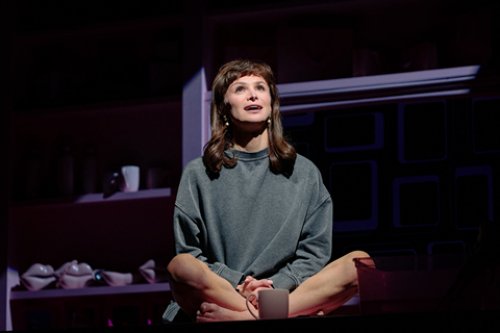
Still, it’s in this messier, murkier middle that Mulvaney’s rawness truly resonates. Her recounting of the vitriol she faced following a seemingly innocuous beer endorsement is devastating. (Country singer-owned bars in Nashville inspired ugly faceoffs between beloved Dylan-supporting Garth Brooks and every single Bible thumping loser for months.) The death threats, the slurs, the accusations of predation—it’s not just internet toxicity; it’s state-sanctioned dehumanization. That she manages to remain poised, humorous, even gracious in the face of such hatred is a marvel—and a masterclass in resilience.
The metaphor of the “twink medication” returns here with brutal clarity: the lifelong cost of trying to fit into palatable molds, of softening one’s truth for broader consumption. Mulvaney isn’t just telling her story—she’s indicting a culture that demands trans people be exceptionally non-threatening just to survive.
Mulvaney proves herself to be nothing short of a theatrical polymath—a performer who sings with clarity and character, dances with buoyant precision, writes with piercing wit and emotional nuance, and acts with a natural magnetism that suggests not merely training, but destiny. She doesn’t just occupy the stage; she owns it, moving through the space with the confident ease of someone for whom the spotlight is not a burden, but a birthright.
What’s most remarkable, however, is not merely the breadth of her talents, but the emotional intelligence with which she wields them. Her humor is not a shield but a scalpel—used not to deflect pain, but to dissect it, revealing its absurdities and its ache in equal measure. Her joy, meanwhile, is disarming in the truest sense; it strips the audience of their cynicism, not with sentimentality, but with authenticity so vibrant it becomes undeniable. And in those moments when she speaks plainly, with unvarnished honesty, it’s impossible not to root for her—not as a performer playing a part, but as a person telling her truth with a bravery that is both ordinary and extraordinary. The final moments are redemptive, and not in a saccharine way. It is, in many ways, a classic coming-of-age tale. But when told by Mulvaney—with all her sparkle and scars—it feels utterly new, satisfying, earned.
Dylan Mulvaney in a scene from her one- woman show “The Least Problematic Woman in the World” at the Lucille Lortel Theatre (Photo credit: Andy Henderson)
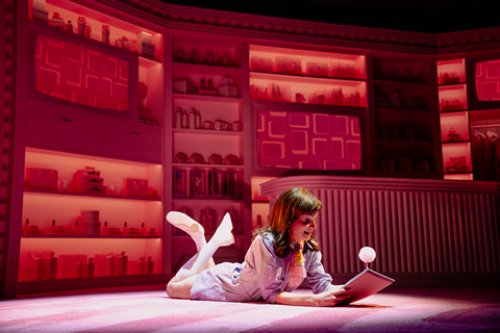
Visually, the production is a riotous feast: Rogers’ set is a millennial’s dreamscape, crammed with dolls, costumes, and coded clues to girlhood. Chakartash’s hot pink lamé choir robe will make everyone want to have one. Cha See’s lighting design adds a celebratory fizz, and Caite Hevner’s video projections hit the comedic sweet spot more often than not.
Under the weight of the show’s ambition, Dylan Mulvaney is a star. Not in the manufactured influencer sense, but in the time-honored theatrical tradition of the charismatic truth-teller who can command a stage with little more than timing, talent, and tenacity. She invites us to laugh with her, cry with her, rage with her—and then, perhaps, go out into the world a little more willing to see the humanity in people who are simply just trying to “be.” The Least Problematic Woman in the World is not without flaws—but like its creator, it dares to be seen in all its contradictions. And that is the most radical act of all.
The Least Problematic Woman in the World (through October 19, 2025)
Lucille Lortel Theatre, 121 Christopher Street, in Manhattan
For tickets, visit http://www.leastproblematicwoman.com
Running time: 85 minutes including one intermission


Leave a comment