
Oratorio for Living Things
Christian’s rapturous sonic tapestry in which music itself becomes the dramaturgy, conjures meaning beyond text through sheer harmonic revelation.
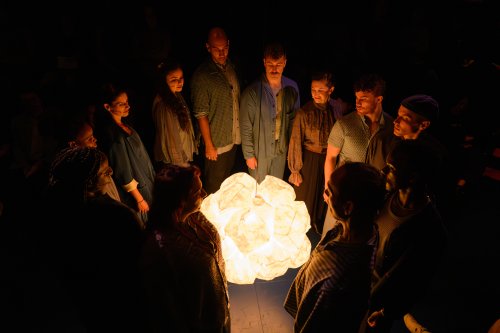
The company of Heather Christian’s “Oratorio for Living Things” at the Pershing Square Signature Center (Photo credit: Ben Arons)
The last time Heather Christian’s Oratorio for Living Things graced a New York stage, like incense trailing through an old cathedral, was the spring of 2022, that liminal season when gathering indoors, shoulder to shoulder with strangers, still carried the faint thrill of risk, the echo of courage. The city was still exhaling after the long, airless pause of the pandemic, and into that breathless hush returned Christian’s fervent, incandescent offering—an “oratorio” not just in form but in spirit, sung-through and half-chanted in Latin, straining toward the divine, or at least the eternal.
The production had been long-awaited, whispered about in the wings of downtown theater for years. Ars Nova first attempted to birth this work in 2020, intending to stage it at Greenwich House—but the world, as we know, had other plans. The shutters came down, the lights went out, and Christian’s choral mass for twelve voices remained, like so many things of that time, suspended in amber.
When it finally arrived—two long years later—it came not diminished but distilled. The time away seemed to have only intensified the piece, honing it to a glittering point of emotional precision. And how audaciously it returned! In a city still flinching from the nearness of breath, Oratorio embraced intimacy as a kind of radical act. Audiences were not merely close to the performers; they were enveloped, encircled, drawn into the ritual itself. Seated on tight risers arranged in an oval onstage, spectators became part of the sacred geometry, as the twelve blue-clad vocalists surged around them—above, beside, behind—enfolding the human chorus in another, holier one.
It was, without exaggeration, transcendent. It was a rare bird in the theatrical menagerie: quasi-religious, fiercely abstract, defiantly structureless—yet moving, urgent, electric. And just as it threatened to become something of a mythic event in its own right, fate, ever the cruel understudy, intervened. Covid, once again, crept into the wings, infecting several members of the company and silencing the show just before its final week of performances. Thus, Oratorio vanished again—not with the triumphant curtain call it deserved, but mid-run, mid-note, mid-breath. A fleeting miracle, again interrupted. And for those of us who witnessed it, the memory still vibrates, like a tuning fork struck deep in the soul.
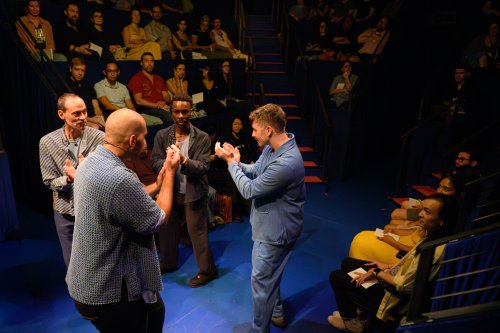
Dito van Reigerserg, Jonathan Christopher, Johnny-James Kajoba and Ben Moss in a sceneg from Heather Christian’s “Oratorio for Living Things” at the Pershing Square Signature Center (Photo credit: Ben Arons)
One of the surest measures by which we may recognize a true masterpiece is its inexhaustibility—its ability to reveal fresh contours, deeper mysteries, and emotional resonances upon each return. Such is the case with Oratorio for Living Things, a choral supernova—sacred, strange, and shimmeringly alive. That premiere felt revelatory; to witness it then was to encounter a work of such original fervor and ecstatic ambition that it left the senses dazed. Now, in its long-anticipated revival—staged under the banner of Christian’s residency at Signature Theatre, newly crowned as a MacArthur “genius”—it remains no less dazzling. But what’s more, it deepens. What once overwhelmed now invites contemplation. It is not only intact but enriched, aged into itself like a sacred text, or a wine of peculiar vintage.
To describe Oratorio is to flirt with the inadequacy of language. It is a musical work—a sung-through piece in the formal lineage of the oratorio, that 17th-century form that eschews staging and dialogue in favor of spiritual rumination through voice. Think Handel’s Messiah, and then think again—Oratorio for Living Things shares the same bones, but not the flesh. Christian, ever the aural alchemist, reclaims and “rewilds” the form, unbinding it from its ecclesiastical constraints and infusing it with a heady blend of the sacred, the scientific, and the speculative.
Unlike Christian’s previous works—Animal Wisdom, with its haunted requiem for the dead seen at Bushwick Starr in 2017 and which will be revived this season as part of her Signature residency, or Terce: A Practical Breviary presented in January 2025 at The Space at Irondale as part of the Prototype 2025 Festival, which nodded to Catholic liturgy—Oratorio does not merely meditate on death or prayer. It seeks nothing less than to render, in music, the invisible architecture of time itself: from the cellular to the celestial, from the microbe to the Milky Way. Christian’s program note describes it as a “rumination on a subject or theme the composer has decided is ‘holy.’ Tonight, this holy thing is Time.,” and while such grandiosity might wilt in less capable hands, here it finds form through sonic complexity and emotional clarity.
The score is a marvel—dense, shifting, kaleidoscopic. It traverses genres like a pilgrim crossing sacred ground: one moment a threnody, the next a jubilant gospel invocation. Chamber instruments hum and whisper beneath the surface (six musicians, twelve orchestrators, including Christian herself and the indefatigable Ben Moss, who also serves as co-conductor and cast member), giving rise to moments of crystalline beauty and others of jagged, apocalyptic dissonance. Vocal lines shatter and recombine, slipping from harmonious unison into spectral polyphony—sometimes song, sometimes chant, sometimes wail.
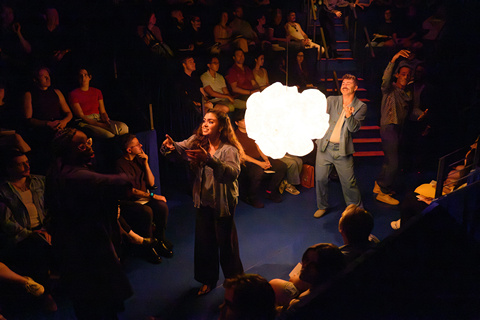
Ashley Pérez-Flanagan and Ben Moss in a scene from Heather Christian’s “Oratorio for Living Things” at the Pershing Square Signature Center (Photo credit: Ben Arons)
Formally, the work unfolds in three movements, each turning its gaze to a different scale of time. The first is microscopic, dramatizing biological processes—photosynthesis, DNA replication—with a poetic grandeur that lifts them into myth. The second considers time at the human level, setting real voicemails to music in a kind of polyphonic memory collage. And the third—profound, sobering, astonishing—gazes outward to the cosmos. Here, the music recedes; the performers speak, or fall silent. The audience is asked to rise, to stand in stillness, as if in mourning or awe. The effect is not theatrical flourish but sacred rite.
And yet, for all its heady abstraction, Oratorio never loses the thread of the human. Director Lee Sunday Evans shepherds the piece with a sure, intuitive hand, guiding us through the sonic maze with clarity and grace. One need not follow every Latin lyric (translations, available via QR code after the performance, reveal a trove of textual beauty) to feel the pulse of the piece. Emotion, after all, does not require translation.
Visually, the production is a wonder of restraint and resonance. Krit Robinson’s in-the-round scenic design creates a cocoon of intimacy; a cloudlike orb rises slowly throughout the performance, a metaphysical metronome. Jeanette Oi-Suk Yew’s lighting design, primarily composed of subtle, shifting blues, finds transcendent expression in the third act, rendering the ensemble in ghostly monochrome, as if they’ve already stepped beyond the veil. Costume designer Márion Talán de la Rosa wisely grounds the metaphysical with garments that suggest dignity, simplicity, and a kind of modern ritual.
And what of the twelve performers? To name them individually would, frankly, miss the point, but they would probably appreciate the mention: Kirstyn Cae Ballard, Jonathan Christopher, Carla Duren, Ashley Pérez Flanagan, Brian Flores, Jonny-James Kajoba, Ángel Lozada, Divya Maus, Barrie Lobo McLain, Onyie Nwachukwu, Dito van Reigersberg, and the previously mentioned Ben Moss. Oratorio is not a showcase for solos but a communion—a collective act of radical presence. The performers sing not at us but through us, inviting us into the current of their voices. Each finds their own emotional tether to the material, and the result is a breathtaking tapestry of sound and spirit, held together by Nick Kourtides’ impeccable sound design, which ensures that even in the densest moments of vocal overlap, fragments of meaning glint through like stars in an overcast sky.
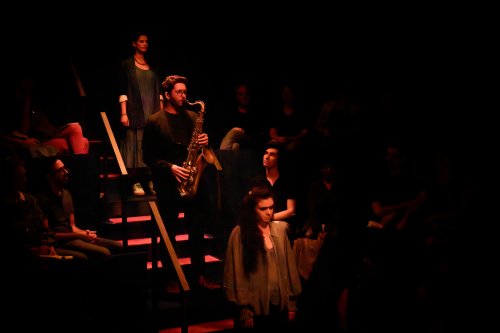
Divya Maus, Fraser Churchill (with saxophone) and Ashley Pérez Flanagan in a scene from Heather Christian’s “Oratorio for Living Things” at the Pershing Square Signature Center (Photo credit: Ben Arons)
In the end, Oratorio for Living Things is not merely a musical-theater piece. It is a meditation, a ritual, a dare. It asks not to be watched, but to be experienced—preferably more than once. With time, it seems to say, comes understanding. And in that understanding, maybe, something like grace. It remains, unquestionably, one of the most beautiful, ambitious, and soul-stirring works to emerge in the American theater in recent years.
Oratorio for Living Things (extended through November 23, 2025)
Signature Theatre
Originally premiered by Ars Nova
The Romulus Linney Courtyard Theatre at the Pershing Square Signature Center, 480 West 42nd Street, in Manhattan
For tickets, visit http://www.signaturetheatre.org
Running time: 90 minutes without an intermission


Leave a comment