
Night Stories
Both a beautiful homage to the Yiddish language and a thorough exploration of what it means to live after surviving.
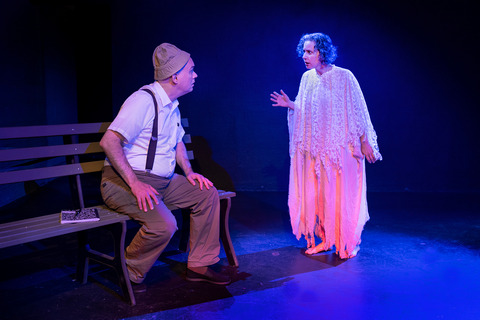
Shane Baker and Miryem Khaye-Seigel in a scene from “Night Stories” at the Wild Project (Photo credit: Jeffrey Wertz)
Night Stories: 4 Tales of Reanimation by Avrom Sutzkever, is an enrapturing piece of theater. The show consists of four short narratives by Sutzkever, all performed in the original Yiddish (with English supertitles). Sutzkever, born in 1913, was a Lithuanian Jewish (in Yiddish: Litvak) author who became a partisan fighter during the Second World War. He survived the war, even testifying as a witness at the Nuremberg trials in 1946, and continued writing works of Yiddish literature for decades afterwards. The show is both a beautiful homage to the Yiddish language and a thorough exploration of what it means to live after surviving.
Director Moshe Yassur (Bashevis’s Demons, Death of a Salesman in Yiddish) with an assist by Beate Hein Bennett (Bashevis’s Demons, Waiting for Godot in Yiddish) is consistently masterful across each story. The first piece, titled “A Child’s Hands,” is presented in stark fashion. Against the eerie score of composer Uri Schreter and the projected illustrations of Alona Bach, the show’s two performers stand motionless under harsh spotlights that turn on and off depending on which one is narrating the story. Actors Shane Baker (Bashevis’s Demons, Tevye Served Raw) and Miryem-Khaye Seigel (Toyznt tame = A thousand flavors, Women on the Yiddish Stage) deliberately contort their voices, forcing out Sutzkever’s beautifully somber poetry to haunting effect. “A Child’s Hands,” is quite short, but the duo’s performance brings the short narration of a child’s handprint on a window pane to life. Both appear gaunt and small under the focused glare of the spotlights (from lighting designer and stage manager Cameron Darwin Bossert), establishing a somber tone that perfectly carries into the second story.
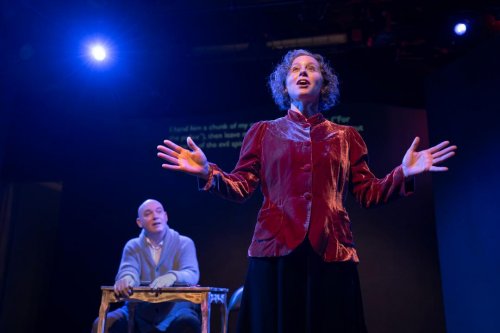
Shane Baker and Miryem Khaye-Seigel in a scene from “Night Stories” at the Wild Project (Photo credit: Jeffrey Wertz)
“Lupus,” the second story, features only Baker, who gives an incredible performance. He portrays both a nameless writer and the apparition of a man named Lupus, an old ghetto cyanide dealer, who manifests in the writer’s mirror one night. Having Baker portray both characters at once is an inspired choice from the show’s directors, allowing the production to challenge the antagonism between the two characters. The entire show is wonderful, but Baker’s performance of “Lupus” is the production’s highlight.
“Where the Stars Spend the Night” sees Baker and Seigel play opposite each other as a writer and his lover, and the two have a wonderfully uneasy chemistry that is both funny and emotionally engaging. “Portrait in Blue Sweater” is the final and longest story, and the closest to Sutzkever’s life. The story follows the protagonist’s journey to track down a painted portrait of himself in a blue sweater his mother made for him. The show ends with a photo of the real portrait, an excellent touch that ends the show on the right note.
Yoffe Sheinberg, who translated the show (Night Stories is performed in Yiddish, but intertitles of Sheinberg’s English translation are projected onto the back of the stage), excellently preserves the original author’s unique voice. Sutzkever’s literary style – with its unique turns of phrase and beautiful-yet-stark poetic descriptions – are excellently showcased. Sheinberg even adapted the jokes quite well.
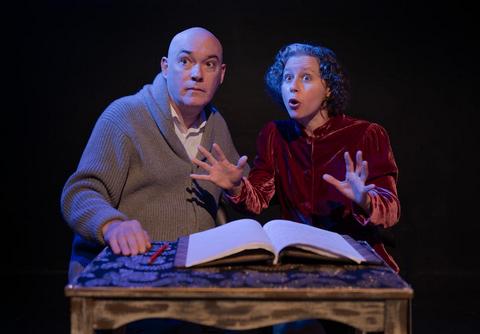
Shane Baker and Miryem Khaye-Seigel in a scene from “Night Stories” at the Wild Project (Photo credit: Jeffrey Wertz)
The show excels in capturing the mundane details of postwar life for those few Jews who survived. “Lupus” opens with a long monologue about electric lamps, wryly delivered by Baker, whose character casually mentions that he refuses to touch anything electric because it reminds him of the smell of burning human flesh. The character quickly moves on from the thought, but it’s a moment that lingers in the audience’s mind, a small glimpse of a pain so great as to be inexpressible.
Night Stories is, first and foremost, about Jewish life. The show’s characters are mainly Holocaust survivors, yet they are never reduced to simply being symbols of suffering. They go on tangents, they make jokes, they express unimaginable pathos before quickly moving on, and they navigate life as best they can. There are so many moments in this play that are deeply human, and deeply Jewish. The production imbues Sutzkever’s poetry with a magnificent resonance. His words are as strikingly beautiful as when he first wrote them, and this modern production is a heartrendingly beautiful affirmation of life.
Night Stories (through January 11, 2026)
Congress for Jewish Culture
Wild Project, 195 E. 3rd Street, in Manhattan
For tickets, visit http://www.thewildproject.org/performances/night-stories/
Running time: 80 minutes without an intermission


Leave a comment